
Mary Did You Know? – Questions About Jesus’ Childhood

ask blackboard chalk board chalkboard

A few weeks ago I created a page where you can submit questions or suggest topics. A reader sent in this question:

In John 2:3-5, Mary asks Jesus to do a miracle in order to save a wedding feast where they have run out of wine.

How did Mary know to ask Jesus for help? Was she even asking for help?

Did she know who he was and what he was here to do?

Why are there no stories of Jesus’ childhood, except in the gnostic gospels?

I recently taught this section at White Fields, during our Advent series. In the sermon I talk about how this first of Jesus’ miracles points to the eschatological hope of the gospel. You can listen to that message here: From Shame to Joy

Let me answer each of your questions in order.

Was Mary Asking Jesus for Help?

Yes, I think that is clear from two things we see in the narrative:

  1. Jesus’ apparent frustration with the request.
  2. Mary’s instructions to the servants to do whatever Jesus tells them to do.

How Did Mary Know to Ask Jesus for Help? Did She Know Who He Was and What He Was Here to Do?

Yes, Mary absolutely did know that Jesus was the Messiah! This is the woman who got pregnant without having sex. I think that’s something that would be hard to forget.

This is the woman who had the angel Gabriel appear to her to announce that she was pregnant with the Messiah (Luke 1:26-38). This is the woman who sang the “Magnificat” (Luke 1:46-56). This is the woman whose cousin Elizabeth and her husband Zechariah also had a visitation from the Lord. Joseph also had a visitation to tell him the identity of the child (Matthew 1)

Lest we forget, this is the woman who also experienced:

  1. The visit of the shepherds who had heard the divine proclamation (Luke 2)
  2. The visit of the magi who came from the East following the star which proclaimed the birth of a new king (Matthew 2)
  3. Interactions with Simeon and Anna in the temple (Luke 2)

Furthermore, this is the woman who had to flee with her baby in the night to Egypt, where they stayed for several years as refugees until Herod the Great died, because he was committed to killing this one who was the rightful heir to the throne of David, i.e. the promised Messiah.

Mary and Joseph had an acute awareness of who Jesus was, and I would expect that they also talked about this with Jesus. One question that theologians debate is whether Jesus innately knew that he was the Messiah, or if it was revealed to him by the Spirit. I expect that his mother and father would have talked to him about it as well, recounting to him as a young child why they had to live as refugees in Egypt, and telling him stories of the angels’ visitations and all the crazy stuff that happened at his birth.

The word Messiah means anointed one. There were three people in ancient Israel who were anointed with oil as a symbol of the Spirit of God upon them to empower them for their ministry: Prophets, Priests and Kings. The eschatological Messiah was known to be one who would be the perfect fulfillment of all three of these offices: he would be the ultimate priest, the true prophet (remember Moses’ prophecy in Deuteronomy 18:15 of the prophet whom God would raise up… the Jews understood this to be a Messianic prophecy – see John 1:21), and the true king (for more on this, read: If Jesus is God, Why is He Called the Son of God and the Firstborn of All Creation?)

Being that Jesus is the true and greatest prophet, it would be expected that he would perform miracles, like the “wonder-working prophets” Elijah and Elisha. This is why one of the expectations of the Jews from Jesus was that he validate his ministry through performing miracles. Jesus pushed back at this, knowing their hearts – but the fact is that he did perform many miracles.

Why are there no stories of Jesus’ childhood, except in the gnostic gospels?

It says clearly in John 2:11 that this was the first of Jesus’ miracles, or rather “signs”, by which he manifested his glory. This, by the way, goes to show the dubious nature of the childhood narrative of the gnostic Gospel of Thomas, which purports Jesus doing miracles to heal birds.

My guess is that the reason there isn’t more written about Jesus’ childhood is because there wasn’t much to talk about. He spent his first several years in Egypt, then at age 12, his parents noticed that he had a keen desire to know the Father and study the Scriptures. Beyond that, Jesus and his parents would have always known that he was the Messiah, but he didn’t do anything in that role until his baptism at age 30.

Thanks for these great questions! Keep studying the Word, and feel free to send more questions to me by filling out this form.

Chinese Conviction & American Apathy

Image result for chinese christianity

In 2018, the Chinese government acted to crack down on unregistered Christian churches. These churches are sometimes called “house churches,” which is a misleading term, since many of these churches have hundreds, even thousands of members and own their own buildings.

Chinese law requires Christians to worship only in congregations registered with the Three-Self Patriotic Movement, a government-sanctioned organization which manages churches. Millions of Chinese Christians meet in unregistered churches which defy these government regulations, seeing them as compromising the church, especially considering the Communist government’s atheistic agenda.

Over the past few months, the Chinese government has stepped up their persecution of Christians by destroying crosses, burning Bibles, confiscating religious materials and closing churches, even demolishing their buildings, as can be seen in this video:

In December 2018, more than 100 Christians who attend a Reformed church in Chengdu were arrested and charged with “inciting subversion of state power.”

Chinese Conviction

The pastor of that church, Wang Yi, a former human-rights lawyer and law professor, who has been an influential intellectual in China, issued a statement along with other Chinese Christian leaders titled: “My Declaration of Faithful Disobedience,” in which they stated that they would not cease gathering together for worship and studying the Bible.

Additionally, around 500 Chinese Christian leaders have signed a document called “A Declaration for the Sake of the Christian Faith,” in which they stated that they were prepared to bear all losses, even the loss of their freedom and their lives, for the sake of the gospel.

For Chinese Christians, gathering together for worship and Bible study is an act of resistance and social disobedience. It brings with it the possibility of arrest, punishment and persecution. And yet – believers are resolute: they will not stop gathering for public worship services, no matter what the cost.

American Apathy

At the same time, on the other side of the world, the American church is seeing a rising wave of apathy.

Some of the reports of the decline of Christianity in the United States are misleading, as I’ve written about here: Is Christianity in Decline? Yes and No. – Part 1 & Part 2.

However, other reports show that while reports of the decline of Christianity in the US may be overstated, there is a growing sense of apathy in regard to church attendance.

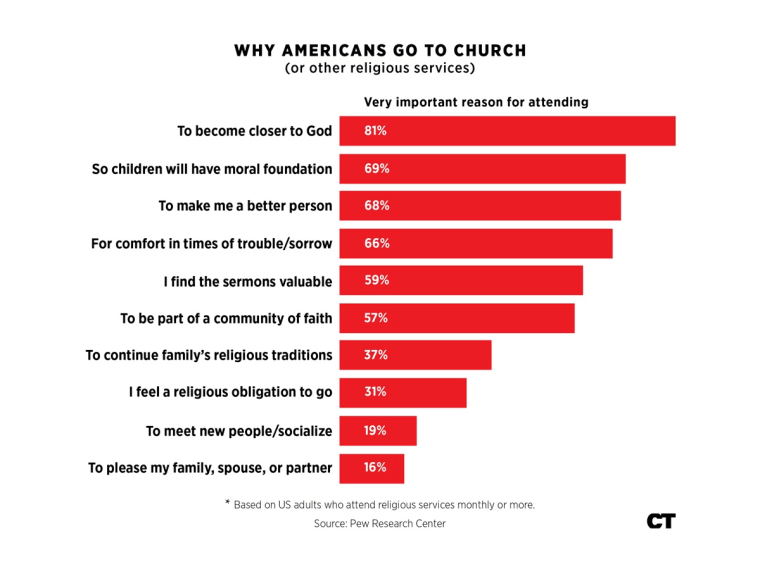
Christianity Today recently published these infographics based on data from Pew Research Center:

image.pngimage.png

Read the full report here: Pew: Why Americans Go to Church or Stay Home

Two significant things that these infographics reveal: 1) Americans view Christianity as being important for the purpose of moral formation, 2) Americans tend to think that church is superfluous when it comes to Christian faith.

The Irony

Comparing the Chinese situation with the American one, what we see is that the people who stand to lose the most from going to church (the Chinese) are the most resolute in doing so, even though doing so will likely hurt them financially, socially, and even physically. Conversely, those who have the most freedom and stand to lose nothing are the most apathetic about public worship.

Whereas many Chinese Christians see gathered worship as central to their faith, something they absolutely cannot give up or do without, and an act of resistance – many American Christians see it as extraneous.

Who is Right?

I believe that we in the West can afford to learn something from our brothers and sisters in the East.

Christianity was formed and grew in the crucible of persecution, and perhaps the worst thing for Christians is to experience such ease and comfort that we lose the understanding that following Jesus is a radical and subversive thing in this world.

Perhaps the greatest danger our faith can face is not direct persecution, but patronizing “pats on the head” and people thinking that Christianity is “nice”.

Sinclair Ferguson has put it this way:

“We are not saved individually and then choose to join the church as if it were some club or support group. Christ died for his people, and we are saved when by faith we become part of the people for whom Christ died.”

Recently I read an article by Simon Chan from the theological journal Pneuma, in which he very astutely wrote this:

[Western Christians] have a very weak sociological concept of the church. This has two negative consequences. First, the church tends to be seen as essentially a service provider catering to the needs of individual Christians. Rarely are individuals thought of as existing for the church. When the church is seen as existing for the individual, then the focus of ministry is on individuals: how individual needs can be met by the church. But when individuals are seen as existing for the church, the focus shifts from the individual needs to our common life in Christ: how we as the one people of God fulfill God’s ultimate purpose for the universe, namely, to glorify and enjoy God forever.

Chan is challenging us to ask the question: Contrary to our consumeristic mentality, isn’t it actually true that the church does not exist for us as much as we exist for the church, and the church exists for God?

I believe that we in the West can afford to look to the East and learn from our Christian brothers and sisters in China about the importance of gathered worship.

What Does It Mean to Live “Coram Deo”?

Image result for coram deo

What does it mean to be “in the presence of God”?

This past Sunday at White Fields we studied Isaiah 6 as part of our series, Remember the Prophets

You can listen to the audio of the message here: A Vision of God

In Isaiah chapter 6, Isaiah gives an account of his call to ministry, which took place through a vision he had of God. In our community groups, one of the discussion questions had to do with what it means to be in the “presence” of God.

Coram Deo

Coram Deo is a Latin phrase which literally means “before God”. For Christians, throughout history, the phrase has been used to describe a life that is lived before God, i.e. in constant awareness of His presence, and seeking to experience communion with Him – not just at church or in dedicated times of prayer (although those are not to be neglected!), but as you go throughout your day.

An Uber Driver and a Stay-at-Home Mom

This past week I had two conversations which illustrated the importance of this:

The first was with a lady in community group who drives Uber several hours a day. She described how, sitting in her car, she is able to commune with God; she listens to sermons and even as she’s driving, she converses with God in her soul.

The second was a stay-at-home mom who called in to Calvary Live, the weekly call-in radio show I host on Mondays on GraceFM. She described how she struggles to find time to pray because she is so busy with her toddler, so she has developed a system where she will set timers throughout the day, and when they go off she will pray for 3 minutes uninterrupted. I suggested that perhaps it would be helpful for her to learn instead the practice of “Coram Deo”: living your whole life before the face of God, and conversing with Him throughout the day, not only in dedicated stints.

Pray Without Ceasing & The Practice of the Presence of God

Paul the Apostle wrote to the Thessalonians that they ought to pray without ceasing (1 Thessalonians 5:17). It was in heeding this call that some throughout history were drawn to monastic movements: they became monks and nuns, went away to Bible colleges and the like, so they could truly pray without ceasing. But how can you do that if you have a job or a toddler? For most of the population, retreating from the duties and responsibilities of life in order to pray without ceasing is not feasible, and we must ask the question: even if it were feasible, would it actually be the right thing to do? I would say, No! God has given us a mission in this world, and in order to fulfill that mission, we are not called to retreat from the world, otherwise we cannot be salt and light; a city on a hill is not meant to be hidden (cf. Matthew 5:13-16)

A famous book written in the 17th Century by a monk who called himself Brother Lawrence, is: The Practice of the Presence of God. In it, Brother Lawrence describes his practice of ongoing conversation with God as he went about the duties of his day, which included dishwashing and other chores. Throughout his day, he was living Coram Deo: before the face of God.

An Integrated, Rather than Compartmentalized Life

The principle of Coram Deo is important, because it reminds us that our lives as the people of God are to be integrated, not compartmentalized. In other words: it isn’t that our lives are compartmentalized into different areas: work, family, faith, etc… – but that our faith is integrated into every aspect of our lives: we do our work before the face of God, and unto God’s glory! Our family life is lived before the face of God, and unto His glory!

In other words, to live Coram Deo means to seek to be constantly aware of God’s presence (which is there whether you realize it or not), seeking to live in constant communion with God, and integrating your relationship with God into every aspect of your life.

This means that you don’t have to be a monk or a nun in order to pray without ceasing. It means that you don’t have to be in vocational ministry (working for a church or Christian organization) in order to serve God through your work!

For more on this, read: Vocation and Calling According to the Reformers

I invite you to join me in seeking to live Coram Deo today and everyday moving forward!

For more on Isaiah’s vision of God, check out this video discussion I had with Worship Pastor Mike Payne:

Martin Luther King Jr. On Christianity and the Gospel

31 Powerful Quotes by Dr. Martin Luther King, Jr.

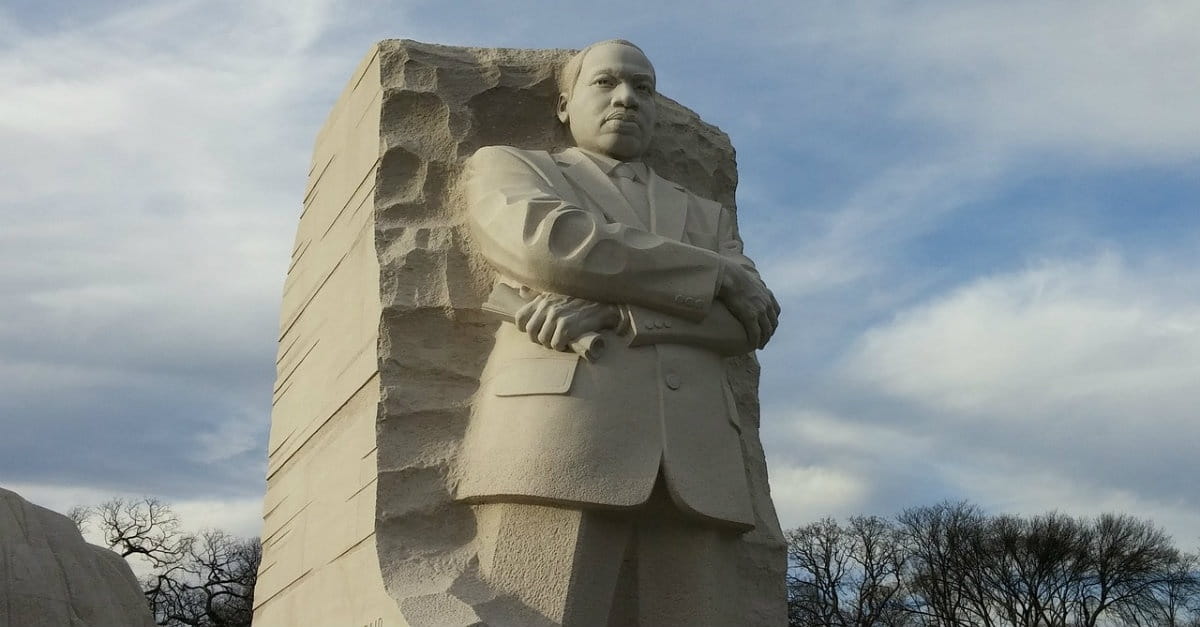
Today is Martin Luther King Jr. Day in the United States, the day when we commemorate the civil rights leader, who was also an ordained Baptist pastor.

I’ve written before about MLK Jr.’s letter to fellow pastors from his jail cell in Birmingham, and about his most famous speech.

Here are a few things he said about Christianity and the gospel:

1. “The end of life is not to be happy, nor to achieve pleasure and avoid pain, but to do the will of God, come what may.”

2. “There is so much frustration in the world because we have relied on gods rather than God. We have worshiped the god of pleasure only to discover that thrills play out and sensations are short-lived.”

3. “The early Christians rejoiced when they were deemed worthy to suffer for what they believed. In those days the Church was not merely a thermometer that recorded the ideas and principles of popular opinion; it was a thermostat that transformed the mores of society.”

4. “If any earthly institution or custom conflicts with God’s will, it is your Christian duty to oppose it.”

5. “We need to recapture the gospel glow of the early Christians who were nonconformists in the truest sense of the word . . . Their powerful gospel put an end to such barbaric evils as infanticide and bloody gladiatorial contests.”

6. “Faith is taking the first step even when you don’t see the whole staircase.”


Jordan Peterson and the Bible

Image result for jordan peterson

Jordan Peterson is an interesting character. A Canadian clinical psychologist and professor of psychology at the University of Toronto, he has had a meteoric rise in popularity in the media as of late.

One reason for Jordan Peterson’s recent popularity is that he has been able to put words and justification to what many people consider “common sense”, not least of all when it comes to the idea that gender is not a social construct, but is rooted in biology. He then, as a psychologist, gets into the psychology behind this very relevant social issue.

I recently finished reading his book, 12 Rules for Life: An Antidote to Chaosin which he brings some of his training and experience and makes it very practical, from everything to posture, raising children, and conversation.

Jordan Peterson and the Bible

Jordan Peterson states emphatically that he is not an atheist (nor does he believe that anyone is actually truly an atheist). He is also not a Christian, at least not in the traditional sense. He mentions in the book that he received a Christian upbringing, but departed from Christianity once he got out on his own.

Nevertheless, Peterson champions many things which are considered biblical or Judeo-Christian values. He argues convincingly for the doctrine of human depravity, and often uses the word “sin” – a word which even many Christian churches today try to avoid, as they feel it is off-putting and rubs people the wrong way. Jordan Peterson does not shy away from talking about human depravity and the need to take personal responsibility for your actions and decisions.

Peterson quotes generously from the Bible in his book; in fact, I mentioned to someone the other day that Peterson talks about and quotes the Bible more than the authors of many explicitly Christian books I have read!

However, Jordan doesn’t only quote from the Bible, he also attempts to exegete and interpret the Bible, particularly the opening chapters of the Book of Genesis, and it is here where I, as a theologian, take issue with what he says.

Presuppositions Influence Interpretation

Anyone who attempts to interpret the Bible will inevitably be influenced in their interpretation by their presuppositions, their commitments to already-held beliefs. None of us are truly objective. We all look at things through various lenses, and those lenses invariably and inevitably affect the conclusions we reach.

As a humanist who buys into the idea that all religions developed as the result of the shared consciousness of particular cultures, Jordan Peterson views the Bible as being a didactic mythology which served to help certain groups of people at certain times. He does not believe that it is objectively true, or even more true than the sacred writings of other religions, rather that it reflects the collective consciousness of a particular group of people at a particular time.

Thus, rather than taking what the Bible says at face value, he tries to fit it into his own framework of thinking. The reason this is sometimes confusing, is that it is unclear where exactly Jordan Peterson’s worldview comes from. It seems to be influenced by the Bible in large degree, and yet Peterson clearly has other influences, particularly Enlightenment thinkers, who championed the above stated views on the Bible in particular and epistemology in general.

The Irony…

Here’s the irony: while Jordan Peterson (rightly) argues against relativistic approaches to things like understanding gender and hierarchy, he himself has a relativistic approach to epistemology, truth and worldview! He has basically created it for himself, based on what he subjectively decides to borrow from various religions and philosophies.

Back to Issues of Epistemology and Worldview

For example, Jordan Peterson states (as fact) Wellhausen’s “Documentary Hypothesis” about the construction of the Old Testament having had 4 main sources and several redactions. Wellhausen’s theory is now considered deeply flawed and is not held by many contemporary Bible scholars. It is irresponsible and misleading, in my opinion, for Peterson to state this as if it is accepted fact, without even giving the caveat that this is a theory from the 1800’s which a great number of Bible scholars today (who have studied this subject in much greater depth than he has) no longer accept.

Irresponsible and Uninformed Exegesis and Hermeneutics

Furthermore, I would say that Jordan Peterson practices irresponsible and uninformed biblical exegesis and hermeneutics repeatedly throughout his book, particularly in regard to the significance of the opening chapters of Genesis. For example, in Rule 7: Pursue What is Meaningful (Not What is Expedient), he states that the Bible says that work is part of the curse of sin and death in Genesis 3. This is simply not the case! Genesis 1 & 2 show that work was part of the idyllic world which existed before sin came into the world, and it portrays God working. The difference after the curse, was not that people would have to work (they worked before the curse), but that their work would be characterized by frustration because of the introduction of sin and imperfection into the world.

Another example can be found in his further attempts to exegete and interpret Genesis 3:22-24, where it says that God drove the man and woman out of the garden after they fell into sin, lest they eat of the Tree of Life and live forever. Peterson expresses that this action of God seems mean and inexplicable. There is a very good and widely held view on why God did this, based on a clear reading of the text: God – in His mercy! – did not want the man and woman to be cursed to an eternal existence in their fallen state. Rather, he would allow them to die, so that he could then resurrect them once he had accomplished his plan of setting right all that they had done wrong. We call that: the gospel!

Nothing New Under the Sun

In summary, Jordan Peterson speaks with such confidence and bravado that he comes across as an authority, when in actuality he is merely recycling old Enlightenment approaches to the Bible popularized in the 1800’s, which are not considered to be consensus today.

All Injunctions, No Justification

My final critique of Jordan Peterson’s book would be this: he concludes the book by telling people that they must be strong in the face of adversity. He says that life is pain and hardship, but we must be strong in the face of it and persevere. But here’s the problem: he never gives a reason WHY we must persevere! Why push on? Why try to be strong and suffer well?

In other words: If we have no destination, and the journey is painful, then why bother continuing the journey?

Having rejected the hope of the gospel, Jordan Peterson has sawed off the very branch he is standing on, and at the end of his book, his message to be strong and persevere falls flat because he has not shown us that life has an actual telos: a destination, meaning and purpose.

As Christians, we absolutely do have a hope which goes beyond this life, and it is this hope which makes our lives meaningful and worth living, even in the face of hardship. We have a destination, and that destination gives us a mission in this life. Our goal is not only our own happiness, but to use our lives for God’s purposes until we do come into the great eschatological hope of eternal life because of what God has done for us in Jesus.

Resources for Studying the Prophets

This past Sunday we began a new series at White Fields called “Remember the Prophets“.

The idea for the series comes from James 5:10, where James tells us to “remember the prophets who spoke in the name of the Lord. Take them as examples of patient endurance under suffering.”  In this series, we will be looking at a different Old Testament prophet each week, considering their lives and their messages and what we can learn from them.

remember the prophets main title 16x9

We are moving through them chronologically, and so began with Amos, an interesting person with an important message. Click here to listen to that message: Amos: Faith that Works

This Sunday we will continue the series by looking at Hosea, a gripping story of adultery and faithfulness which gives us insight into God’s heart.

Resources for Studying the Prophets

Generally speaking, the prophetic books are not well known by many people who even regularly read the Bible. Part of the reason for that is because of the negative tone of some of the books, as well as the feeling that without understanding the context of the books, they don’t make sense.

People have asked me at times what books or materials are good to use if they want to get to know the prophetic books better. Here are my top two recommendations:

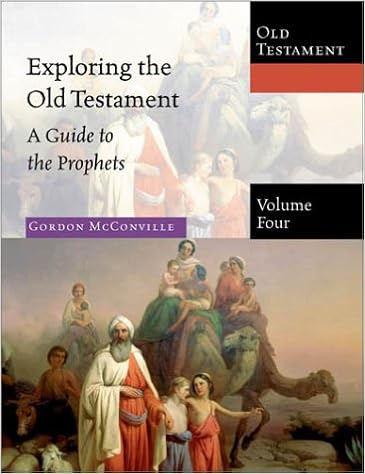
Exploring the Old Testament: A Guide to the Prophets, J. Gordon McConville

Image result for exploring the old testament a guide to the prophetsI had the pleasure of studying under Gordon McConville at the University of Gloucestershire in England, where he is professor of Old Testament theology. This was one of my text books, but is part of a great series from Inter-Varsity Press and is very accessible to the average reader and also scholarly at the same time.
On the scholarly side, this book tends to get a little bit into the weeds about theological discussions and debates, but the introductions and outlines of the books, their themes and their structures are very good. In other words, you can use it to go as deep as you’re ready to go.

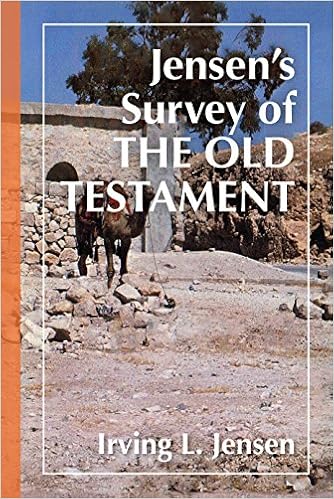
Jensen’s Survey of the Old Testament, Irving L. Jensen

When I first became a pastor, one of my mentors told me, “You’re going to need some books.” He then walked me into the book store at the church we were at and pulled Jensen’s surveys of the Old Testament and New Testament off the shelf and handed them to me.

The benefit to these books published by Moody Press is that rather than being a commentary that tells you information, they instead instruct you about how to ask the right questions. Thus, you are the one doing the exegetical work, or the inductive Bible study, rather than just passively receiving information. They do, however, give you important background information in order to get the context you need, but they also tell you where to go to get that context if it is found in other places in the Bible.

I hope these resources are helpful for you, as they have been for me!

How Can You “Count it All Joy” When Hardships Come Your Way?

In the month of December, we did a month-long series at White Fields on the topic of joy, and how Christianity gives a unique perspective on joy because it finds the source of joy in a unique place.

This past week, Mike and I sat down to discuss Christian joy and what it means when the Bible tells us to “count it all joy when you fall into various trials”, and what this means especially at the outset of the new year.

Here is a link to the Joy to the World series, where you can listen to those messages, and here is the video of our discussion:

(if you watch closely, I get a phone call in the 6th minute of the video!)

Making Resolutions is Not a Lack of Faith, It Can Be an Act of Faith

You know the drill: the parking lot at the gym is full on New Year’s Day, but by March it’s empty again. “Why bother making New Year’s resolutions,” some ask, “if I’m just going to break them anyway?”

Others, I have noticed, state that they do not make New Year’s resolutions because they choose instead to “trust in God” rather than “rely on themselves,” assuming that to make plans and set goals is antithetical to faith, trust and reliance on God.

But is it?

I might argue that not setting goals and making plans is what reflects a lack of faith.

Real Faith Manifests Itself in Actions

The theme for our ministry year at White Fields for 2019 is: “Faith in Motion”, and during this year, we will be studying the Epistle of James, as well as looking at the lives of some of the Old Testament Prophets, because James tells us to “remember the prophets who spoke in the name of the Lord. Take them as examples of patient endurance under suffering.” (James 5:10)

49124887_529821080863590_6906526974991138816_n

We will begin that series this Sunday by looking at Amos: a man who – in a time of “professional prophets” was a mere shepherd and fig-picker, but was given a calling and message from God, and he responded faithfully. In other words: his faith in God was reflected in his actions of obedience.

James famously tells us: “I will show you my faith by my works.” (James 2:18). The point is clear: real faith manifests itself in actions. If you really believe something is true, you will live – and plan – accordingly.

However, James also warns us against presumption in this. He says: ‘Come now, you who say, “Today or tomorrow we will go into such and such a town and spend a year there and trade and make a profit”— yet you do not know what tomorrow will bring. What is your life? For you are a mist that appears for a little time and then vanishes. Instead you ought to say, “If the Lord wills, we will live and do this or that.” (James 4:13-15)

The solution, James tells us, is NOT to not make any plans, but rather to still make plans, but submit those plans to God, and be flexible if God decides to take you in a different direction.

In other words: making resolutions (whether at the New Year or any other time of the year) can actually be an outworking of genuine faith. If you set goals which are in line with biblical and godly values, and make plans for how you are going to do those things, that is an act of stewardship.

A Matter of Stewardship

God has a LOT to say about stewardship in the Bible – starting with: Moreover, it is required of stewards that they be found faithful. (1 Corinthians 4:2). The point of stewardship is that you have been entrusted with certain things, and given a responsibility to use them according to the master’s wishes and purposes.

Jesus told his disciples: “I am the vine, you are the branches. Apart from me, you can do nothing.” (John 15:5) But to conclude that this means that we should then never attempt to do anything would be foolish and not at all what Jesus intended. It is not apart from Him that we attempt to accomplish anything, but with Him and by His power.

Paul the Apostle wrote this: “But by the grace of God I am what I am, and his grace toward me was not in vain. On the contrary, I worked harder than any of them (the other apostles), though it was not I, but the grace of God that is with me.” (1 Corinthians 15:10)

It is wrong to think that planning, effort and thoughtfulness are somehow opposed to spirituality. Rather these are faith in motion: the outworking of values which come as a result of seeking God and seeking to follow God – similar to Daniel, who “resolved in his heart not do defile himself” while in Babylon. (Daniel 1:8) That was a resolution based on a conviction, and an act of faith, not of self-reliance.

Challenging Goals Actually Make You More Dependent on God

One of the greatest benefits of setting attainable, yet challenging goals is that it also fuels my prayer life. If I set goals that I cannot achieve on my own, apart from the work of God, then I am in a position of being even more dependent on Him.

My Resolutions Annual Goals

I don’t set “New Years resolutions” per se, but what I do every year is set attainable, yet challenging goals for the year which serve as guides for me later on, when I’m not feeling motivated or when I lose steam or need to be reminded of what I should be working on or towards.

I’ve found that having goals keeps me focused and motivated over longer periods of time. I can look back at them and be reminded of the things which I believed at one time were important guides to keep me on track.

Some of my goals are family-related. Some are related to my work as a pastor. Many others are personal. I set goals for how many books I will read, and in which languages. I set goals for how many kilometers or miles I will run, and I set goals to accomplish certain projects.

I have been doing this for the last several years, to good effect. I haven’t always met all of my goals, but at least having the goals kept me moving in the right direction on the days when I am tired or begin to miss the forest for the trees – and lose sight of the big picture.

My Advice on Setting Goals: Make them Specific and Measurable

I encourage you to consider setting some goals here at the outset of the year. If you are a Christian, let biblical and godly values drive your goal setting. But don’t only set goals, also map out plans for actually attaining them. If you plan to run 500 miles, calculate how many miles you will need to run each week. If you plan to read through the Bible this year from cover to cover, figure out how much you need to read each day in order to do that.

Don’t make goals that are not specific; rather than saying “I want to get in shape” or “I want to be kinder”, set concrete, specific and measurable goals, so that you will be able to measure whether you succeeded in reaching those goals or not.

I wish you all the best in this new year! May it be a year in which you walk with God like never before!

Falling Through the Cracks, or Straying Sheep?

white and black animal standing on green grass

“It’s an all-too-common phenomenon in churches. A church member stops showing up on Sunday mornings. A few weeks pass, and then a few months, before someone notices.”

This past November, on our annual elders retreat, the elders of White Fields Community Church read Jeremie Rinne’s book Church Elders, which is part of the 9 Marks series. Jeremy brings up an interesting point:

‘People in my congregation refer to this phenomenon as “falling through the cracks.” They say things like: “Have you seen Sally around church lately? I hope she didn’t fall through the cracks.”

What if, instead of “falling through the cracks,” we use a different image: “straying from the flock.” That picture seems more fitting for at least two reasons. First, “straying” implies that a disconnected church member bears a personal responsibility to stay involved with the congregation. Sheep don’t ordinarily leave a flock by inadvertently plummeting into a void. They wander away over time through a series of choices.

Second, the image of straying sheep also suggests that someone should keep watch over the flock and take action when a sheep begins to meander away. Yes, each member has a personal responsibility not to roam, but all church members have a duty to watch out for one another. However, one group in particular has an obligation to be on the lookout for straying sheep: the elders.

Elders watch to make sure that no “wolves” infiltrate their congregations with false teaching. But elders also keep watch for unwanted movement in the other direction: members straying away from the flock and from the Lord. This is part of basic shepherding work. Shepherds feed the sheep, guard them from predators, and keep track of them.’

He goes on to point out something interesting from Ezekiel:

‘Ezekiel prophesied against Israel’s leaders by accusing them of negligent shepherding: “Woe to the shepherds of Israel, who have been feeding themselves! Shouldn’t the shepherds feed their flock?” (Ezek. 34:2). And what was one of the ways they failed to shepherd? “You have not . . . brought back the strays, or sought the lost” (v. 4). As a result, “My flock went astray on all the mountains and every high hill. They were scattered over the whole face of the earth, and there was no one searching or seeking for them” (v. 6).’

Jesus, in contrast, is the “good shepherd” who leaves the 99 to pursue the one wayward sheep, something which is indeed “reckless” from a business perspective (and this is exactly what the lyrics of Cory Ashbury’s song “Reckless Love” come from).

The difficult balance from a church leader’s perspective is how to be a good shepherd under Jesus, and being overbearing. May God give us wisdom and grace as we seek to do His work!

“They worshiped Him, but some doubted.”

adult art backlit boy

One of the most intriguing phrases to me in the Gospel of Matthew is found in Matthew 28:16. It says that after Jesus’ resurrection, the 11 disciples (Judas was gone now) went to Galilee, to the mountain where Jesus had directed them. And when they say him they worshiped, but some doubted.

“When they saw him they worshiped him, but some doubted.” (Matthew 28:16)

It would seem that it is possible to worship and have doubts – at the same time!

Doubt is Part of Having Faith

In fact, there is a sense in which doubt is an inherent part of faith.

Jude tells us to “have mercy on those who doubt” (Jude 1:22)

For more on doubt and faith, check out: The Role of Doubt in Faith

It has been said that “A faith without some doubts is like a human body without any antibodies in it.” 1

It is important that we ask the hard questions and wrestle through our doubts in order to make sure that what we believe is really true! Anselm of Canterbury famously defined the study of theology as, “Faith seeking understanding”.

So it would seem that is it possible to worship and have doubts – at the same time.

Why Did Matthew Include This Detail?

What is interesting is to consider why Matthew included this phrase in his gospel account. I believe it is because Matthew, with a heart of empathy and pastoral sensitivity, recorded this detail about doubt so that readers would be encouraged in their own struggles between worship and doubt.

This detail shows us that the disciples were not spiritual giants; Jesus gave the “great commission” to go out into all the world and carry on his work by making disciples of him – to an ordinary group of people like you and me.

What Should We Do With Our Doubts?

I was really encouraged this year by a podcast episode I heard this year about the importance of directly addressing the doubts that people have in regard to Christianity: not only for the sake of those who aren’t Christians, but also for the sake of those who are sitting in our churches, who are worshiping, yet they are struggling with doubts. By addressing some of the opposition to Christianity, you are speaking both to critics of Christianity, but also to those who want to believe, but are struggling to do some in some areas.

We did a series earlier this year, which has borne a lot of fruit – even residually. It was called: The Trouble Is… (link to sermon audio – and – link to YouTube follow-up videos). In this series we addressed some of the reasons why people commonly reject or doubt Christianity, including: Science, Hypocrisy, Hell, Suffering, and others.

We put that series onto pen-drives and have handed them out at community events here in Longmont, as well as made them available for free for people who come on Sunday mornings for church, and we have not been able to keep up with demand. We have handed out several hundred of these so far, as people take them to give to friends and co-workers. In fact, I had someone tell me the other day that they have been using the series to lead a group discussion at their workplace; every week they listen to one message and then watch the YouTube follow-up video, and then discuss it. Attending this group are people from all kinds of backgrounds, including agnostics, Buddhists, and lapsed Christians. Very cool to see God using it in this way!

What should we do with our doubts? We should press into them, and seek out answers, because if what the Bible says is true, then it will hold up under scrutiny, and our seeking will lead to finding, which will lead to the dispelling of doubts and the strengthening of faith. This is exactly what happened with the disciples themselves, who – though they doubted here in Matthew 28 – they were able to dispel their doubts and became so convinced of the reality of it, that all of them suffered for it, and all but one (John) gave their lives for it!

I Could Never Believe in a God Who…

As we look forward to the new year and plan our teaching schedule, we will be doing another series along these lines. Likely, this will become an annual thing for us.

This one will be called “I Could Never Believe in a God Who…” We will spend 6-7 weeks directly addressing the questions that people struggle with, such as: sexual orientation, genocide in the Old Testament, the historicity of the Bible, why “bad things happen to good people”, etc.

As I did previously, I will be posting a poll online to gather information and would love your feedback, so please keep an eye out for that.

In the mean time, don’t let your doubts stop you from worshiping! But don’t let your doubts derail you either. Press in, seek God, and seek the answers to the questions you have. You will be strengthened in the process, and you will also be equipped to help others.