How Did We Get the Bible? Exploring the Formation of the Biblical Canon – with Shane Angland

In this episode of the Theology for the People Podcast, I speak with Shane Angland about the question of how we got the Bible in its current form.

Shane has been a recurring guest on the podcast, and he has a keen mind and knowledge of historical theology. Shane lives in Ennis, Ireland where he serves at Ennis Evangelical Church. He holds a Masters of Divinity from Dallas Theological Seminary, and has served as a missionary in Ukraine.

From the formation of the Old and New Testaments to the question of the Apocrypha, to the impact of the Council of Trent, this conversation offers clarity on why the Bible is trusted as God’s inspired Word.

Key Topics Discussed

  • What is the Canon?
    • Definition: The canon is the list of inspired, authoritative Scriptures distinguished from other valuable writings.
    • Theological foundation: Scripture is “breathed forth” by God, carrying unique authority for the church (2 Timothy 3:16).
  • Old Testament Canon Formation
    • Begins with God’s redemptive acts, particularly after the Exodus and Sinai covenant (Exodus 24, Deuteronomy 31).
    • Jewish recognition of inspired texts from Moses to Malachi, with a prophetic silence post-Persian era.
    • Josephus and first-century Jewish consensus on 22 books (equivalent to the 39 books in modern Old Testaments).
    • No explicit criteria articulated, but guided by the Holy Spirit and covenantal context.
  • The Apocrypha and Deuterocanonical Books
    • Includes books like Tobit, Judith, Wisdom, Sirach, 1 & 2 Maccabees, Baruch, and additions to Esther and Daniel.
    • Historical debate: Some early Christians (e.g., Augustine) accepted these books, while others (e.g., Jerome) did not, aligning with Jewish tradition.
    • Council of Trent (1546): Roman Catholic Church dogmatically defined these books as canonical, partly in response to Reformation emphasis on scriptural authority (e.g., for doctrines like purgatory).
    • Eastern Orthodox churches maintain an open canon, avoiding infallible rulings.
  • New Testament Canon Formation
    • Tied to the new covenant and apostolic authority, with writings by or connected to apostles (e.g., Mark linked to Peter, Luke to Paul).
    • Criteria: Apostolic origin, Christ-centered message, and widespread church use in worship.
    • Early recognition: By the late first century, apostolic writings were distinguished (e.g., Clement’s letters vs. Paul’s epistles).
    • By the second century, 22–23 of the 27 books were widely accepted, with minor debates on smaller texts (e.g., 2 Peter, 3 John).
  • Misconceptions Addressed
    • Myth: The Council of Nicaea (325 CE) decided the canon. Reality: Nicaea focused on church governance, not canon selection.
    • Myth: Early Christians chose from hundreds of gospels. Reality: The four canonical gospels were the earliest, apostolic, and widely used.
    • Gnostic “gospels” (e.g., Gospel of Judas) lack historical or apostolic credibility and were not serious contenders.
  • Why the Delay in Formal Canon Lists of the New Testament?
    • The early church was decentralized, persecuted, and lacked centralized authority to compile lists.
    • Canonical texts were illegal, and possession could lead to martyrdom (e.g., 180 CE Carthage trial).
    • Earliest clear list: Athanasius’ Easter Letter (367 CE), reflecting existing church consensus.
  • Confidence in Scripture
    • The Bible’s unity across 66 books, three languages, and 1,500 years testifies to its divine inspiration.
    • The early church’s careful discernment reflects wisdom, not uncertainty.
    • Romans 3:2 affirms the Jewish role in preserving the Old Testament oracles, reinforcing trust in the canon’s reliability.

Resources Mentioned

  • Michael Kruger’s work on the canon (e.g., Canon Revisited).
  • Josephus’ Against Apion for first-century Jewish canon insights.
  • Augustine’s On Christian Doctrine.

Quotable Moments

  • “The canon begins with God’s work of redemption, not human decisions.” – Shane
  • “The church doesn’t establish the canon; it recognizes it through the Holy Spirit.” – Shane
  • “The Bible’s coherent message across 1,500 years is a miracle of God’s inspiration.” – Shane

Click here to listen to the episode, or listen in the embedded player below.

How Did We Get the Bible? Exploring the Formation of the Biblical Canon – with Shane Angland Th.M Theology for the People

In this episode, Nick Cady and Shane Angland tackle the critical question: How did the Bible come to be? They explore the formation of the biblical canon, addressing misconceptions, historical processes, and the theological significance of Scripture. From the Old Testament’s roots in God’s redemptive work to the New Testament’s apostolic authority, this conversation offers clarity on why the Bible is trusted as God’s inspired Word. They also discuss the Apocrypha, the Council of Trent’s impact, and how early Jewish and Christian communities recognized canonical texts.Connect with Theology for the PeopleWebsite: theologyforthepeople.comFollow on X: @nickcady
The First Council of Nicaea: What Actually Happened & Why Does It Matter?

When we talk about “the Early Church” many people’s minds immediately go to the first generation of Christianity, recorded in the Book of Acts and addressed in the New Testament. But what happened after that, and why does it matter for Christians living today?

Matt Pursley is the Executive Pastor at Park Hill Church in San Diego, California. He has a Masters in Christian History, and in this episode, Matt and I discuss the First Council of Nicaea: what led to it and what it produced.

We address many of the common misconceptions about Nicaea, and we discuss the early heresies of Marcionism, Gnosticism, and Arianism, and why it’s important for Christians today to understand those heresies, and why they were rejected.

Along the way we also talk about Jordan Peterson, who Matt says is a modern Marcionite, and how the errors of both liberalism and fundamentalism have a similar origin.

Click here to listen to the episode, or listen in the embedded player below.

The First Council of Nicaea: What Actually Happened & Why Does It Matter for Us Today? Theology for the People

When we talk about “the Early Church” many people’s minds immediately go to the first generation of Christianity, recorded in the Book of Acts and addressed in the New Testament. But what happened after that, and why does it matter for Christians living today? Matt Pursley is the Executive Pastor at Park Hill Church in San Diego, California. He has a Masters in Christian History, and in this episode, Matt and I discuss the First Council of Nicaea: what led to it and what it produced. We address many of the common misconceptions about Nicaea, and we discuss the early heresies of Marcionism, Gnosticism, and Arianism, and why it’s important for Christians today to understand those heresies, and why they were rejected. Along the way we also talk about Jordan Peterson, who Matt says is a modern Marcionite, and how the errors of both liberalism and fundamentalism have a similar origin. Visit the Theology for the People website at nickcady.org

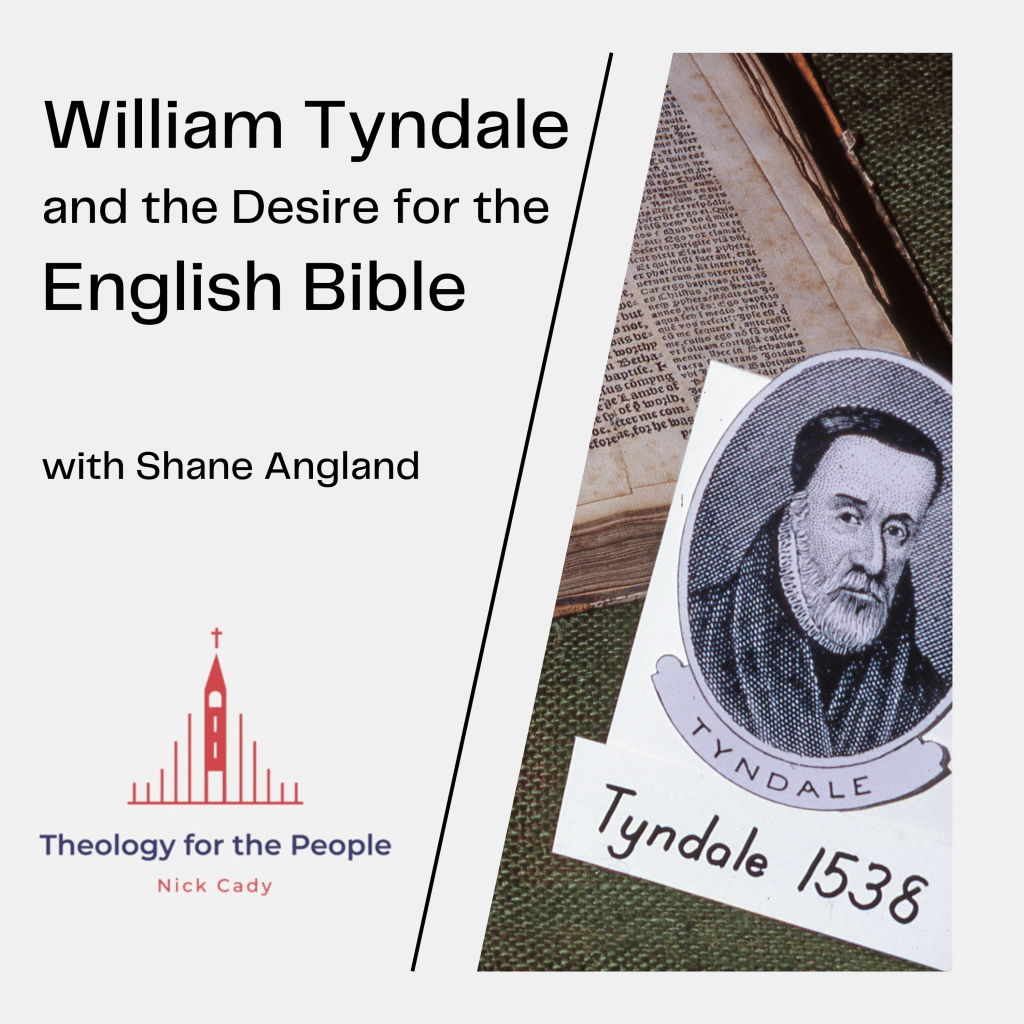
William Tyndale and the Desire for the English Bible – with Shane Angland

If you read the Bible in English, you may not realize all of the drama and sacrifices that went into getting the Bible translated into the English language. 

In this episode of the Theology for the People Podcast, I speak with Shane Angland of Ennis Evangelical Church in County Clare, Ireland. Shane holds a Master of Divinity degree from Dallas Theological Seminary, and specializes in historical theology.

Shane and I speak about William Tyndale: an English biblical scholar and linguist who became a leading figure in the Protestant Reformation, until he was executed for his beliefs. Tyndale created the first English translation of the New Testament from the original Greek text and was working on translating the Old Testament from Hebrew. Much of his work can still be seen in the way the Bible is translated into English to this day. 

Click here to listen to the episode, or listen in the embedded player below.

William Tyndale and the Desire for the English Bible – with Shane Angland Theology for the People

If you read the Bible in English, you may not realize all of the drama and sacrifices that went into getting the Bible translated into the English language.  William Tyndale was an English biblical scholar and linguist who became a leading figure in the Protestant Reformation, until he was executed for his beliefs. Tyndale created the first English translation of the New Testament from the original Greek text and was working on translating the Old Testament from Hebrew. Much of his work can still be seen in the way the Bible is translated into English to this day.  In this episode, my guest is Shane Angland of Ennis Evangelical Church in County Clare, Ireland. Shane holds a Masters of Divinity from Dallas Theological Seminary, and specializes in historical theology.

Is Christmas Pagan?

Some time ago, I addressed some common, but incorrect claims that the origins of Easter are pagan: “Does Easter Come from Ishtar?”

But what about Christmas? Does Christmas have pagan origins?

Saturnalia and the Winter Solstice

Did Christians simply take over the Roman pagan festival of Saturnalia and repurpose it as a celebration of Jesus’ birth Is that why we celebrate Christmas around the same time as the winter solstice?

I used to believe this one myself. However, upon further investigation, it would seem this is not how the celebration of Christmas on December 25 came about. Here’s why:

We don’t actually know what time of year Jesus was born. The one thing we know is that it was almost certainly not in late December. The reason for this is because Luke’s Gospel tells us that the shepherds were watching their flocks by night, sleeping in the fields. In Israel it gets too cold in the winter for that; shepherds sleep outside from about March-September. Clement of Alexandria wrote that some believed May 20 was Jesus’ birthday, others believed it was April 19 or 20, still others believed it was in late March. [1]

Early Christians, along with the majority of ancient cultures, did not celebrate birthdays in the same way we do today. Only two of the four Gospels talk about Jesus’ birth. The early Christian writer Origen dismissed birthdays as something only celebrated by tyrants, such as Pharaoh and Herod in the Bible. [2]

Things changed in the early 300’s AD with the beginning of the celebration of Epiphany, which commemorated the revealing of the Messiah to the Gentiles at the coming of the Magi to see Jesus after his birth. This was celebrated in early January in the Eastern church, not because they believed this to be the birthday of Jesus, but because of how it fit into the liturgical calendar which gave a plan for teaching through key events in the Gospels every year.

The Western (Latin speaking) part of the church wanted to have a festival similar to Epiphany, and decided that since they did not know when exactly Jesus was born, they would have their festival of the celebration of the incarnation and the birth of Jesus in late December, before Epiphany – since the Magi would have arrived after the birth of Jesus.

Again, the decision of this date was based on liturgical calendars, not on the taking over of pagan festivals. It was considered significant, however, that the coming of “the light of the world” should be celebrated at the time of the year which is darkest in the Northern Hemisphere. After this date, the days get longer and the darkness wanes. This symbolism was not lost on early Christians, but rather considered to be a great symbol of the effect of Jesus’ entrance into the world.

Here’s what’s so interesting: there is a document from about 350 AD which tells us that Romans celebrated the festival of Sol Invictus Natali (the birth of the unconquered sun) on December 25, and that same document also tells us that Christians celebrated the birth of Jesus on this same day. There is no earlier evidence or report of a Roman pagan festival on December 25. In other words, it is just as likely that the pagan Romans chose this day for their pagan festivals because Christians were already celebrating the birth of Jesus on this day, and wanted to have their own counter-festival, than that Christians chose this day because of an existing pagan festival.

Furthermore, there is nothing particularly pagan about celebrating anything at the darkest part of year, right before the days start getting brighter. Judaism, for example, celebrates Chanukah – the Festival of Lights, in which they light candles in the darkness to celebrate God’s faithfulness at this same time of year. Pagans don’t own the symbolism inherent to the orbit of the Earth.

Are Christmas Trees Pagan?

There is some evidence that Roman pagans liked to decorate their homes with greenery during winter festivals, and that early Christians decorated their houses with greenery during Epiphany as well.

It should be remembered that in the ancient world, decorating with greenery in the winter was also common because it was bleak outside and they didn’t have Wayfair.com to depend on for affordable home decor.

Some people claim that these verses in Jeremiah are speaking about the practice of Christmas trees:

“Learn not the way of the nations…for the customs of the peoples are vanity.
A tree from the forest is cut down and worked with an axe by the hands of a craftsman.
They decorate it with silver and gold; they fasten it with hammer and nails so that it cannot move.

Jeremiah 10:1-5

Sounds like a Christmas tree, right? Except that’s not what it’s describing. What Jeremiah is describing is the creation of a household idol out of wood. Isaiah talks about a similar practice in which people would fashion an idol out of wood, stone, or metal, and then worship the very object they had just created.

The history of the Christmas tree dates back to medieval Europe, in the 14th and 15th centuries, during which December 24 was celebrated as “Adam and Eve Day” which was celebrated with the decorating of “paradise trees” by attaching apples to them (think how much bulbs look like apples) – a rarity during the winter, so they were considered treats. Because it was winter, and especially in Northern Europe, evergreen trees were popular to use for this. [3]

Modern Pagan Christmas?

Perhaps of bigger concern is the way in which our modern consumeristic Christmas traditions can detract from the celebration of Jesus and the incarnation which Christmas is meant to celebrate.

May we, even in the joys and the fun of our modern celebrations, not lose sight of what it is that we are celebrating this season: that to people like us who live in deep darkness, a light has shone; the promised Messiah has come to save us from our sins and give us the light of life forever! That is certainly something worth celebrating.

What Has Athens to Do with Jerusalem?: How Should Christians Relate to Ideas and Practices Which Originate Outside of Christianity?

In this episode of the Theology for the People Podcast, Michael and I discuss the topic about which I wrote my BA dissertation: How should Christians relate to ideas and practices in our culture and society which have their origin outside of Christianity?

Some good examples would be:

  • Can Christians practice yoga? (Origins in Hinduism)
  • How about martial arts?
  • What about Christmas? (December 25 was originally a pagan solstice festival which Christians “took over,” detached it from its pagan origins, and infused it with new meaning and made it all about Jesus)
  • What about psychology?
  • How about certain instruments, like drums?
  • What about rock music and electric guitars?

This discussion of how Christians should relate to ideas and practices which originate outside of Christianity can be traced all the way back to a historical argument between Tertullian and Justin Martyr, early Christian apologists and theologians, and can be summarized by Tertullian’s classic question: “What Has Athens to Do with Jerusalem?”

In this episode, Michael and I discuss the relevant principles from the Bible we should follow as guides in navigating these matters.

How does the redemptive narrative arc of Scripture affect how we relate to these practices? How about what Paul says about meat sacrificed to idols in 1 Corinthians 8-10 and Romans 14?

Check out our discussion in the embedded player below, or by clicking here: What Has Athens to Do with Jerusalem?: How Should Christians Relate to Ideas and Practices Which Originate Outside of Christianity?

What Has Athens to Do with Jerusalem?: How Should Christians Relate to Ideas and Practices Which Originate Outside of Christianity? Theology for the People

In this episode Nick Cady and Michael Payne speak about how Christians should relate to things which originate outside of Christianity, such as yoga, psychology, Christmas, drums, or rock music.  This discussion can be traced all the way back to a historical argument between Tertullian and Justin Martyr which can be summarized by Tertullian's classic question: "What Has Athens to Do with Jerusalem?" Visit the Theology for the People blog site at nickcady.org – where you can ask questions or submit suggestions for future episodes.

Reformation Day: Martin Luther, the Bible, & the Gospel

If you own a Bible in your own language, it is a direct result of the Protestant Reformation, and the key figure God used to ignite that worldwide movement of returning to the Bible was Martin Luther: a German monk and professor of theology at the University of Wittenberg.

I grew up attending a Lutheran school until eighth grade. During my time there, I learned a lot about Luther, including studying his catechism. Years later, when I put my faith in Jesus and was born again, I started attending a Calvary Chapel church; and over the years, I have grown in appreciation for Martin Luther and the pivotal role he played in God’s work in the world.

The last day of October is celebrated around the world as Reformation Day, because it was on October 31, 1517, that Martin Luther set into motion the movement now known as the Reformation, by mailing a letter. Yes, you read that right: on the eve of All Saints Day (Halloween = “All Hallows Eve”), Luther mailed, not nailed, a letter.1 2

The letter was addressed to the Archbishop of Mainz,3 and Luther sent it because he wanted to alert the archbishop that plenary indulgences were being sold in the archbishop’s name by a man named John Tetzel. Tetzel had been sent from Rome the year before to sell these certificates promising the release of a soul from purgatory in exchange for their purchase, as a fundraising campaign for the building of St. Peter’s Basilica. Luther assumed the archbishop was unaware that this was going on, and that upon receiving his letter, the archbishop would tell Tetzel to cease and desist. That, however, is not what happened.

As a result of the archbishop’s inaction, Luther, as a professor, decided to organize a scholarly debate on the topic of indulgences: whether they were actually effective in procuring the release of a soul from purgatory. To this end, he wrote up what are now known as the 95 Theses, which he titled: A Disputation on the Power and Efficacy of Indulgences. This paper, which was posted on the door of the All Saints Church in Wittenberg, was an invitation to a scholarly debate, but in it Luther challenged both the selling of indulgences and the doctrine of purgatory as unscriptural. By doing this, Luther was challenging the Roman Catholic Church’s teaching and authority, and insisting that the Bible, not the church, should be the ultimate arbiter of what constitutes correct doctrine.

The posting of the 95 Theses is considered the spark which ignited the Protestant Reformation: a movement which sought to reform the church by shedding man-made traditions and returning to the faith which had been handed to us by God in the Holy Scriptures. 

Today, there are nearly 1 billion Protestant Christians in the world.4 In the “majority world,” including Africa, Asia, Latin America, and the Muslim world5, Protestant Christianity is growing faster than any other religious movement by conversion.6

Before Luther, there were others who sought to reform the church and bring the Bible to the people. John Wycliffe (1331-1384) published the first English translation of the Bible. Jan Hus (1369-1415) taught the Bible to the common people in Prague. Peter Waldo (1140-1218) commissioned a translation of the New Testament into the local vernacular of southern France. Each of these people were persecuted for trying to put the Scriptures into the hands of the common people.

Over a century before Luther, Hus had protested the sale of plenary indulgences, pointing out that the idea that God’s favor or blessings could be earned in any way, runs contrary to the message of the gospel and the testimony of the Scriptures, and the concept of purgatory is in conflict with the biblical teaching of the sufficiency of Christ’s atonement on the cross.

Martin Luther had long struggled with feelings of condemnation and inadequacy, until his own reading of the Scriptures led him to an epiphany when he read Habakkuk 2:4: “Behold, as for the proud one, His soul is not right within him; But the righteous will live by his faith.” This led Luther to the other places in the Bible where this phrase is repeated: Romans 1:17Galatians 3:11, and Hebrews 10:38 – where the message is clear: It is not by our own works that we are justified before God, but it is God who justifies us sinners as a gift of His grace, and we receive that justification by faith. After all, the Bible explains, this is how Abraham, the father of our faith, became righteous: he believed God and it was credited to him as righteousness (Genesis 15:6Romans 4:322). We receive God’s righteousness, which he has provided for us in Christ, in the same way.

Luther became convinced that everyone needed to be able to read the Scriptures for themselves, and he took it upon himself to translate the Bible into German, a translation that is still in use to this day. Soon the Bible was translated into other languages, including English, as the Reformation spread.

Martin Luther called people back to a belief that the Scriptures are perspicuous (clear), and can be understood by those who read them. He called us back to a belief in the inspiration and sufficiency of Scripture: that it is the ultimate rule of faith, by which we are to measure both doctrine and our lives.

In April 1521, Luther was brought before Holy Roman Emperor Charles V at the Diet of Worms, at which Luther was commanded to recant his teachings. Luther refused to do so, famously stating:

“Unless I am convinced by the testimony of the Holy Scriptures or by evident reason – for I can believe neither pope nor councils alone, as it is clear that they have erred repeatedly and contradicted themselves – I consider myself convicted by the testimony of Holy Scripture, which is my basis; my conscience is captive to the Word of God. Thus I cannot and will not recant.”7

This October, as we celebrate Reformation Day, may we take the opportunity to open the Bible and read it for ourselves, and may we embrace and celebrate the message of the gospel: that Jesus Christ came to save sinners, and that we are justified freely by his grace as we trust in him by faith.

NOTES

1 Marshall, Peter. 1517: Martin Luther and the Invention of the Reformation. OUP Oxford. 2017.

2 Little, Becky. “Martin Luther Might Not Have Nailed His 95 Theses to the Church Door.” History.com. A&E Television Networks, October 31, 2017. 

3 “Luther’s Letter to the Archbishop of Mainz (1517).” Historyguide.org, 2002. 

4 “Global Christianity: A Report on the Size and Distribution of the World’s Christian Population.” PewResearchCenter. Accessed December 2011. 

5 Miller, Duane A., and Patrick Johnstone. Believers in Christ from a Muslim Background: A Global Census II (2015): 2–19. academia.edu

Melton, J. Gordon (22 October 2005). Encyclopedia of Protestantism. Infobase Publishing. ISBN 9780816069835 – via Google Books.

7 “Here I Stand: Martin Luther’s Reformation at 500.” Abilene Christian University Special Collections, March 11, 2019.

Bible Translations: Translation Philosophy, Textual Criticism, & Source Documents

Shane Angland (MA Theology, Dallas Theological Seminary), joins the podcast this week to talk about Bible translations and what makes some translations better than others.

Shane is the lead preaching elder at Ennis Evangelical Church in Ennis, Ireland. A native of the west coast of Ireland, Shane served as a missionary in Ukraine with the International Fellowship of Evangelical Students, and later earned a Masters Degree from Dallas Theological Seminary, where the focus of his studies was on Textual Criticism.

In this episode, Shane explains what Textual Criticism is (and is not), and explains the important elements involved in Bible translation, such as translation philosophy and source documents. He also dispels some common misconceptions about Bible translations, such as that newer translations remove content from the Bible, or that they are less accurate than older translations.

Shane and I have some common friends in Ireland and Ukraine, and it was great getting to know him and listening to him share his knowledge on this subject.

See also the series of articles on Bible translation I posted here years ago:

  1. Making Sense of Different Bible Translations – Part 1
  2. Making Sense of Different Bible Translations – Part 2: the King James Bible
  3. Making Sense of Different Bible Translations – Part 3: Gender-Inclusive Language and the NIV

You can listen to this week’s episode by clicking this link, or by listening in the embedded player below: Making Sense of Bible Translations – with Shane Angland

Making Sense of Bible Translations – with Shane Angland Theology for the People

Shane Angland (MA Theology, Dallas Theological Seminary), joins the podcast to talk about Bible translations and what makes some translations better than others. Shane is the lead preaching elder at Ennis Evangelical Church in Ennis, Ireland. A native of the west coast of Ireland, Shane served as a missionary in Ukraine with the International Fellowship of Evangelical Students, and later earned a Masters Degree from Dallas Theological Seminary, where the focus of his studies was on Textual Criticism. In this episode, Shane explains what Textual Criticism is (and is not), and explains the important elements involved in Bible translation, such as translation philosophy and source documents. He also dispels some common misconceptions about Bible translations, such as that newer translations remove content from the Bible, or that they are less accurate than older translations. If you’ve benefited from this episode, please share it online, and leave a rating and review for this podcast in the Apple Podcast store. Also, visit the Theology for the People Blog at nickcady.org.

Bible Stories Gone Wrong in the Louvre

After our recent trip to London for my masters graduation, we took the train to Paris, and during our time in Paris we spent a day at the Louvre museum, which (along with the British Museum in London) is full of items of biblical relevance.

However, in the extensive Italian painters section, I came across several famous paintings which depict biblical scenes, albeit incorrectly.

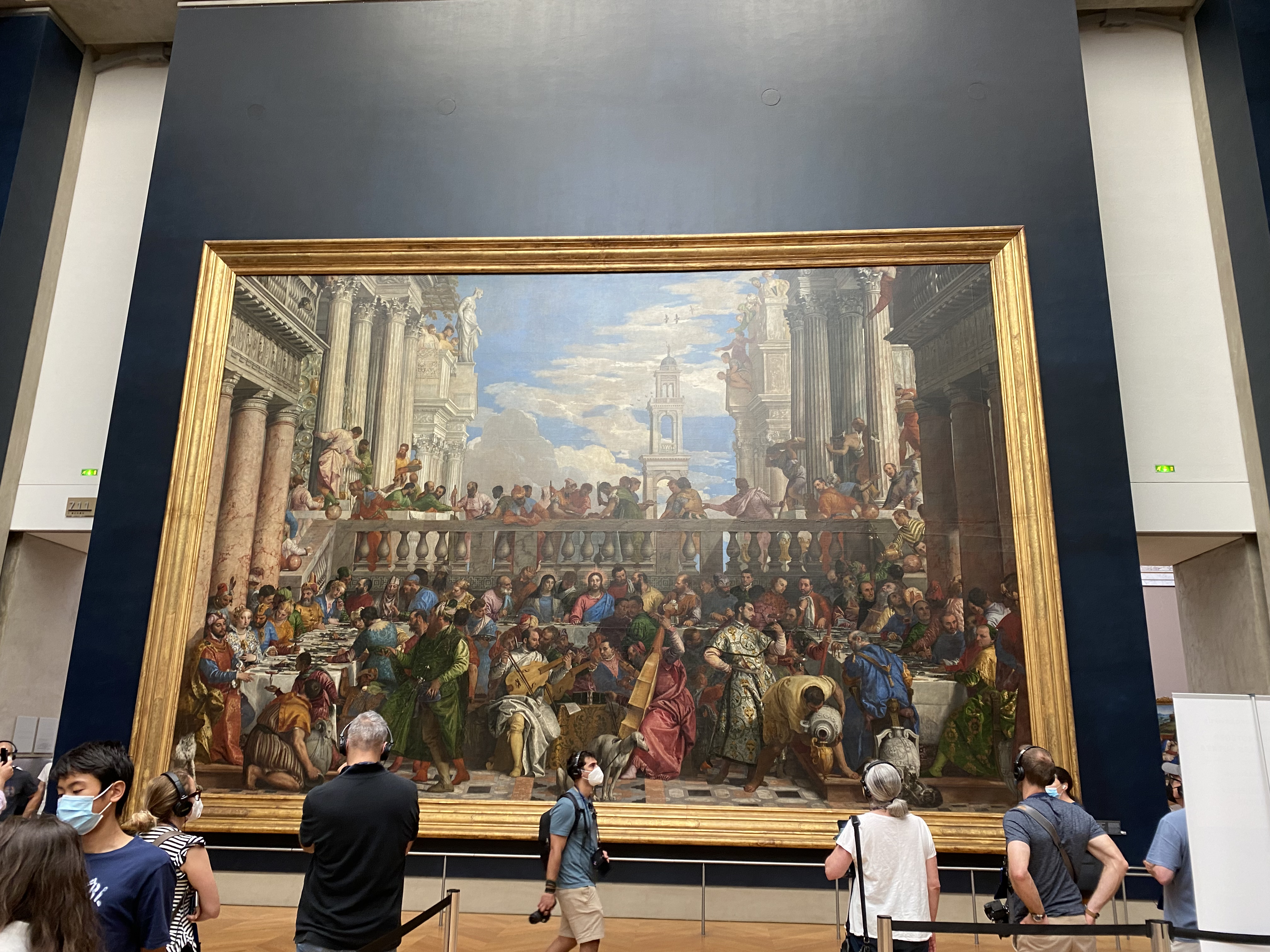
The Wedding at Cana

This famous painting by Paolo Veronese is one of the highlights of the Louvre, and is held in the same room as the Mona Lisa. It depicts the famous scene from John 2 in which Jesus performed his first miracle at a wedding in the town of Cana.

The only problem with this painting is that it is set not in a small Jewish village in Galilee, but in a large Greco-Roman city reminiscent of Athens. Cana was a small town, a village even, right north of the border between Samaria and the region of Galilee.

I like this painting though, especially how there’s a ton of interesting stuff going on in it, and Jesus is just chillin’ in the midst of it.

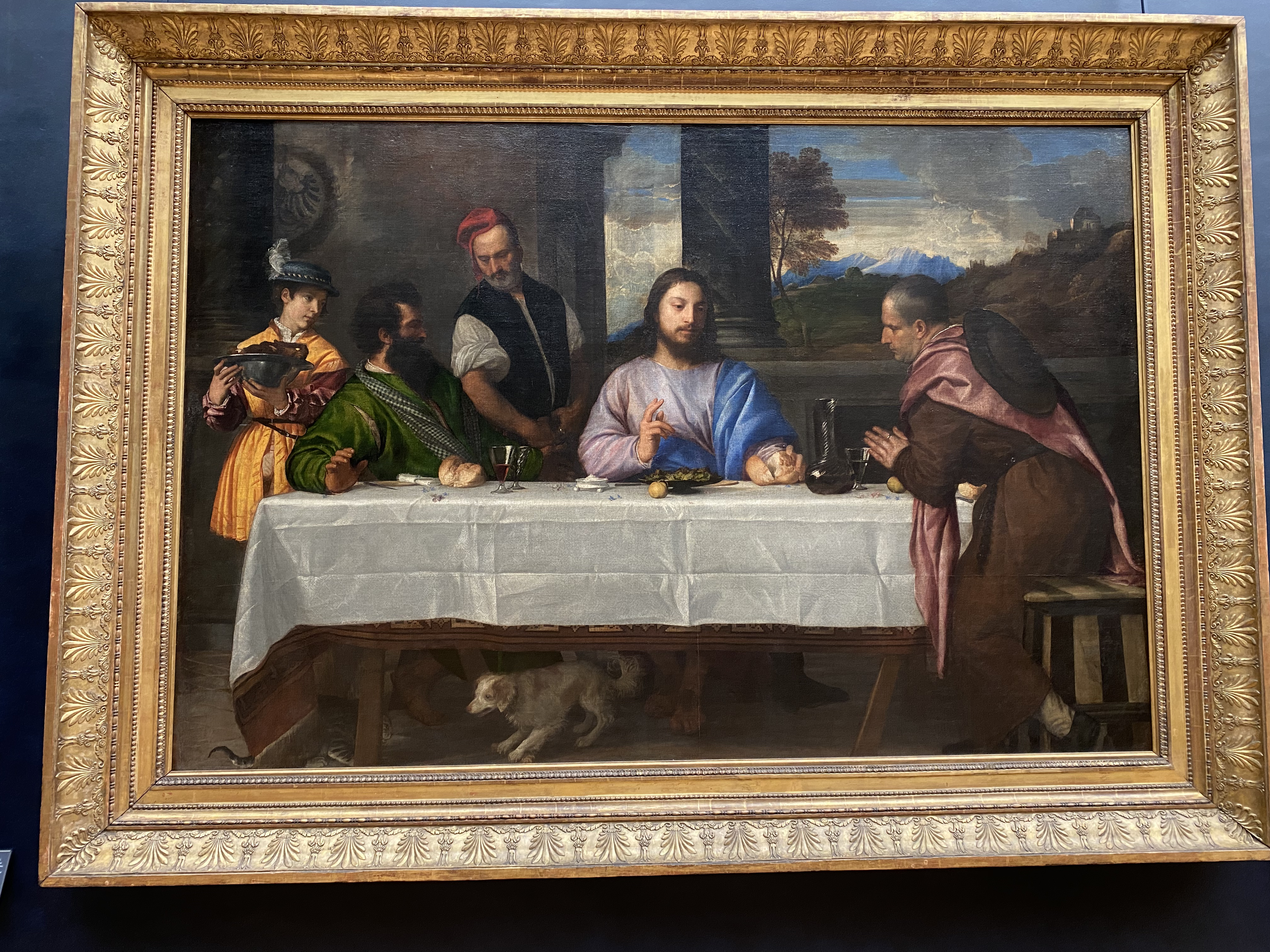
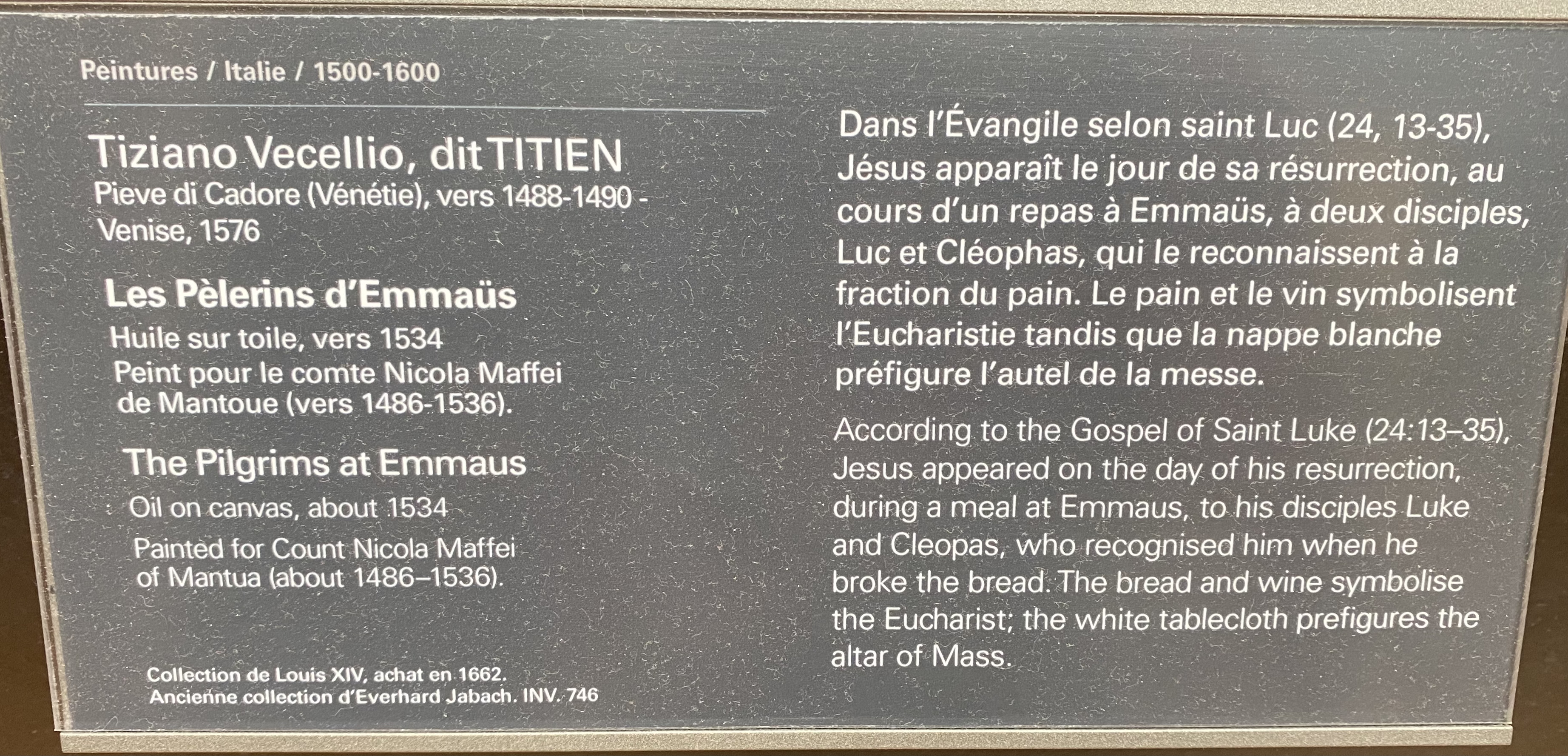
The Pilgrims at Emmaus

This is one of my favorite stories in the Gospels, and a key passage in understanding Christ-Centered hermeneutics, as Jesus opened the minds of his disciples to understand the Scriptures, showing them how all of the things written in the Books of Moses, the Psalms, and the Prophets (i.e. the entire Old Testament) was about him (see Luke 24:13-49)

However, you might notice the beautiful Alps in the background of this painting – which would make sense if Jesus had been in northern Italy rather than in Jerusalem. Apparently, although Titian was a great painter, he had never been to Israel, because then he would have known that there are no snow-capped mountains visible from the Judean desert near Jerusalem.

This is of course not to mention the anachronism of the servant’s clothes, which were not in style until at least 1000 years after the events recorded in Luke 24.

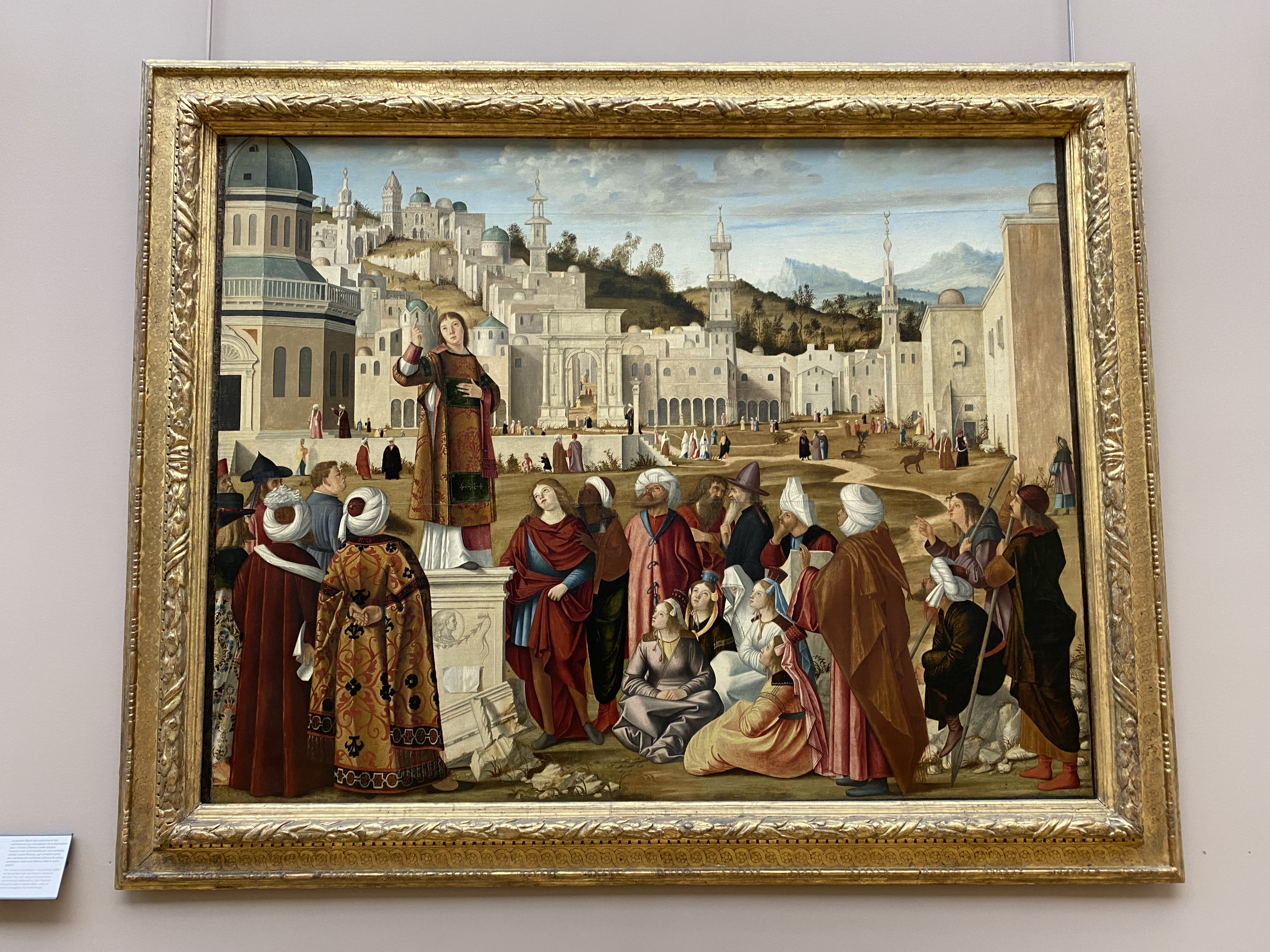
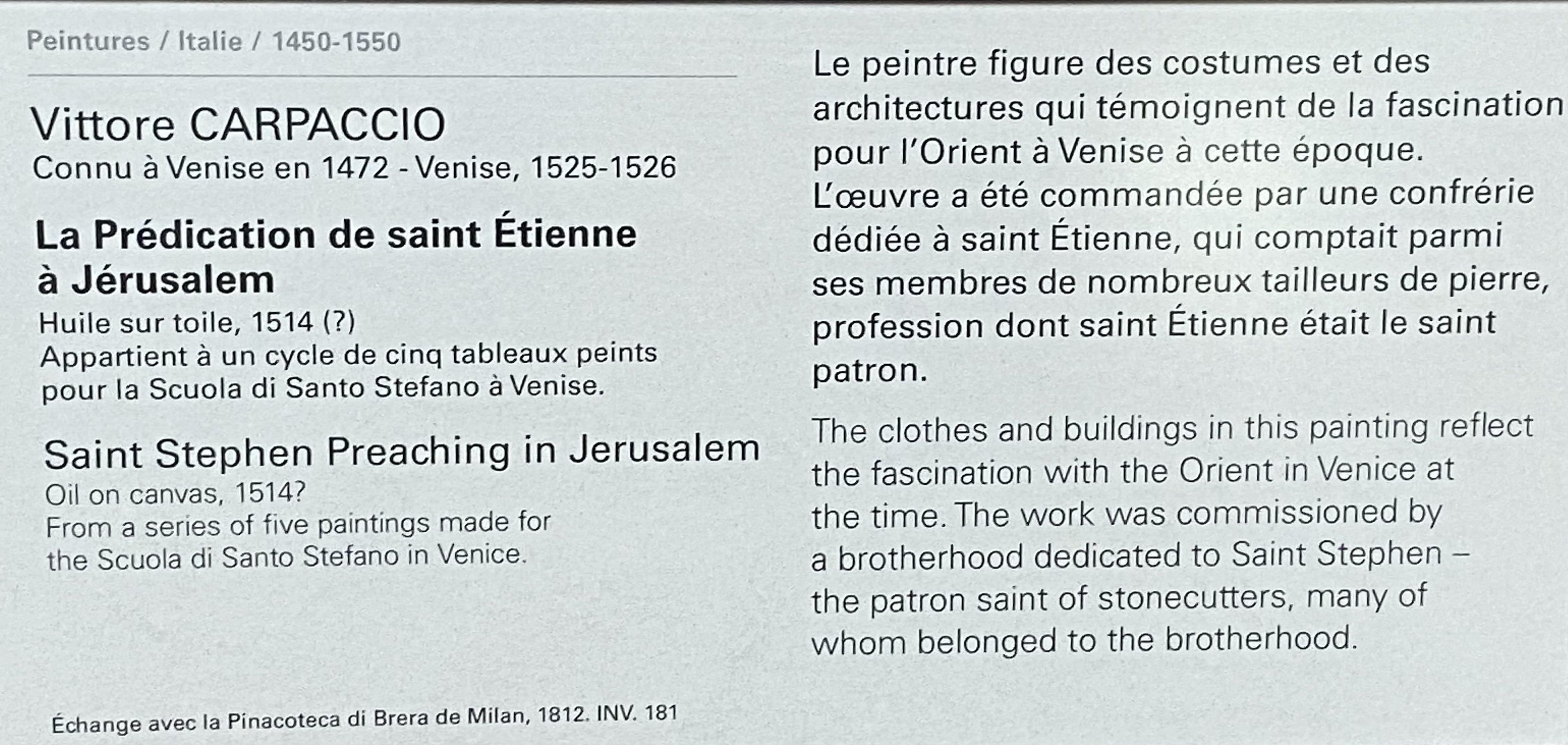
Saint Stephen Preaching in Jerusalem

This painting by the Italian master Carpaccio, is one of my favorites, because it shows that it’s possible to be good at painting, but bad at history.

It depicts the story found in Acts 7, in which Stephen, a deacon in the early church, preached to a crowd in Jerusalem right before they stoned him to death for his faith in Jesus, making him the first martyr of the Christian faith.

However, you might notice that Carpaccio’s depiction of Jerusalem has it filled with minarets: towers attached to mosques from which the Muslim call to prayer is heralded. Furthermore, notice the many people in turbans, the traditional dress of Muslim men in the Middle East.

At the time of Carpaccio, Jerusalem was indeed full of mosques and muslims. However, Islam wasn’t invented until over 600 years after the events which took place in Acts 7! In the 1st Century A.D. there were no muslims and no mosques in Jerusalem!

Sometimes people criticize Christian pop music and movies as being subpar, but these paintings show us that it is possible to make great art that is quite inaccurate from a biblical perspective.

The Offense of the Cross: Cicero, the Early Christians, and Us

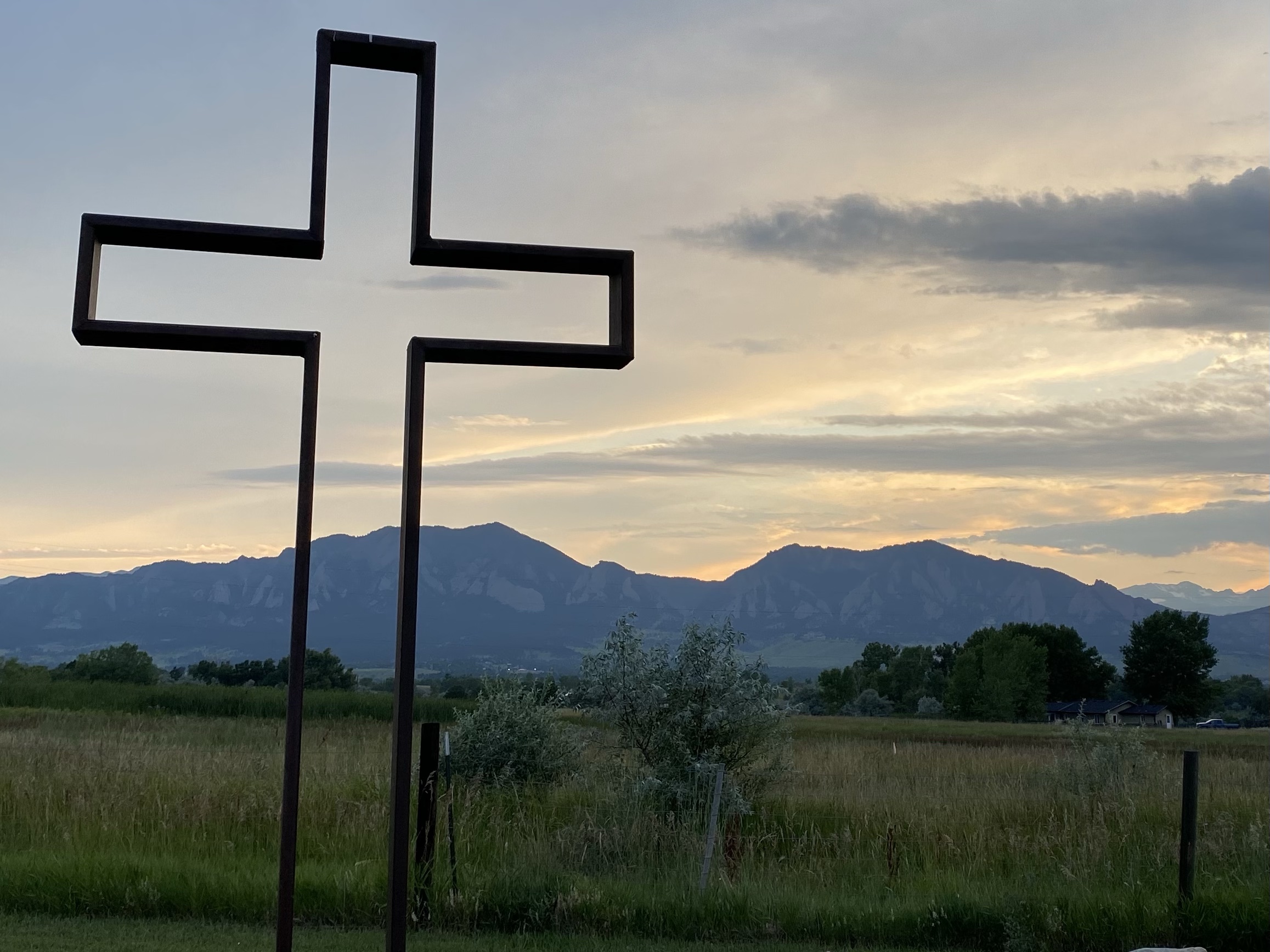
Boulder County & the Flatirons

The symbol of the cross is universally recognized today as the symbol of Christianity; for many in the Western world it is familiar and welcome. However, in the ancient world, in the first century AD, when this symbol was first used by early Christians, it was downright scandalous.

Paul the Apostle refers to the message of the cross as foolishness to the Greeks, a stumbling block to the Jews, and an offense to all. (1 Corinthians 1:22-23, Galatians 5:11)

The reason is because, for people in the ancient world, the cross was a terrible instrument of torture and execution. 

The thing that made crucifixion so terrible is that it didn’t kill you right away; it was designed to make a person suffer as much as possible, for as long as possible. And for this reason, crucifixion was reserved for only the very worst kinds of criminals.

Because of how terrible crucifixion was, the Romans did not allow their own citizens to be killed by crucifixion, no matter how dastardly their crimes; only slaves and those without rights were allowed to be crucified, since it was exceedingly inhumane. 

Cicero, the Roman statesman and philosopher said that crucifixion was so horrible, that the word “cross” should never be mentioned in polite society.

Let the very word ‘cross,’ be far removed from not only the bodies of Roman citizens, but even from their thoughts, their eyes, and their ears.

Cicero, 106-43BC, Pro Rabirio Postump 16

For the Jewish people in particular — to be crucified on a cross was considered a fate worse than death, because according to the Jewish Scriptures, anyone who was killed by being hanged upon a tree was considered “accursed”. (Deuteronomy 21:22-23)

And so, just imagine if you told someone back then that you were a follower of Jesus — a man who had been crucified… That person would have thought: “Whoa… Even if he was innocent, that’s probably something you should keep to yourself! That’s not something you want to go around advertising, because: that’s humiliating!”

But: here’s what’s interesting: for the early Christians, the fact that Jesus had been killed upon a cross was not something they tried to hide. Instead, the symbol of the cross became the main symbol they used to identify themselves – which is surprising, because the cross was generally consider to be the ultimate symbol of humiliation and defeat.

Furthermore, the message that the early Christians embraced and wanted to share with the world was what they called, “the message of the cross,” and “the good news of Christ, and him crucified.”

Paul the Apostle knew that the message of the cross was difficult for many people to accept. For the Jews, the idea of a crucified Messiah was a stumbling block. For Greeks, the idea that you could be saved through the death of an executed Jew seemed ridiculous. The idea that God would come to Earth and allow himself to be beaten, mocked, rejected and crucified, seemed completely unreasonable. They couldn’t wrap their heads around it. The Greek gods made humans serve them; they didn’t serve people – and they would never sacrifice themselves to save guilty people. 

Just as the message of the cross ran contrary to popular thinking back then, the message of the cross also runs contrary to popular thinking today.

The message of the Cross requires you to admit that you have sinned and fallen short of the glory of God and that you are powerless to save yourself. This is why Paul talks about “the offense of the cross” (Galatians 5:11)

The message of the cross offends our sensibilities and our pride by telling us that we are sinners who need a Savior, and that we cannot save ourselves. In order to receive this salvation, you have to humble yourself before God.

Another part of the offense of the Cross is that the message of the gospel is exceedingly simple. Many people in Corinth seemed to believe that in order to “find God,” you had to be really smart, or exceedingly “good.” And yet, God chose to bring salvation to the world in a way that was so simple that even  even a child could understand it, and in a way that it was available to people who had lived immoral lives. 

Another part of the “offense of the cross” is that God says that His reason for saving you was not because you are better than other people. Salvation is simply an act of God’s grace: completely undeserved and totally unearned. You can’t take credit for it. The message of the cross leaves no room for pride or arrogance.

And when you really embrace the message of the cross, on the one hand it forces you to be incredibly humble, but on the other hand it fills you with an incredible sense of confidence – because the message of the Cross is that God loves you, and He has acted to redeem you, and if you have put your faith in what Jesus did for you, then God has sealed you and made you His own: He has adopted you as His Child, and placed His Spirit inside of you — and therefore you can be incredibly confident, knowing that you have nothing to fear in life or in death because God has promised that He will cause all things to work together for your ultimate good and for His ultimate glory.

For more on the message of the cross, see this sermon titled, “The Message of the Cross & the Power of God”

What Has Happened to Me Has Really Served to Advance the Gospel

I saw a Christmas ornament advertised online today: a dumpster fire with 2020 written on it. 2020 has been a year filled with difficulty, frustration, tension, and sorrow, to the point where people are apt to say that they are “over it.”

In his letter to the Philippians, Paul said something incredible, especially when you consider the circumstances in which he wrote it:

I want you to know, brothers, that what has happened to me has really served to advance the gospel

Philippians 1:12

This statement is particularly surprising when you consider what things Paul is referring to here that had happened to him:

What Had Happened to Paul?

When Paul wrote this letter to the Philippians, he was being held as a prisoner in Rome.

Prior to his arrest, Paul had spent years traveling around the Roman Empire as missionary: preaching the gospel and starting churches, and training others to do the same. But then, some people who wanted to hinder Paul’s work and hinder the spread of the gospel, started spreading fake news that Paul was an anti-government revolutionary. As a result, Paul was arrested.

While under arrest, Paul was no longer able to travel the world to advance the gospel. Because of corruption in the judicial system, Paul was left in prison for several years, until he appealed his case to the Roman supreme court, which is how he came to be in Rome at the time when he wrote to the Philippians. Paul was under house arrest, awaiting trial, and chained to Roman soldiers 24 hours a day.

With those details in mind, consider again what Paul wrote to the Philippians:

I want you to know, brothers, that what has happened to me has really served to advance the gospel

Philippians 1:12

The things which had happened to Paul were:

  • The loss of his freedom
  • False accusations
  • Suffering at the hands of corrupt officials.

It would be easy to look at those circumstances and conclude that these things which had happened to Paul were preventing him from advancing the gospel, but Paul says, “No. Everything that has happened to me has actually served to advance the gospel.”

Being under house arrest had obvious limitations, but it also afforded Paul some unique opportunities.

One of those opportunities was: down time, and Paul used that time to pen four letters under the inspiration of the Holy Spirit which are now part of our New Testament canon, and for the past two millennia have been used by God to bring encouragement and instruction to those who read them.

Another unique opportunity this situation gave him, was that Paul was chained to members of Caesar Nero’s Imperial Guard for 24 hours a day, the soldiers being changed out on shifts. Rather than seeing himself as restrained, however, Paul viewed this as an evangelist’s dream! It wasn’t that he was chained to soldiers, Paul thought, but those soldiers were chained to him! For hours at a time, he had a soldier’s undivided attention, and when their time was up, a new soldier would be brought in and chained to him. Paul viewed himself as a missionary to those people in that place. I imagine Paul’s biggest struggle must have been finding time to sleep because he was so excited to make new friends and tell them about Jesus.

Some of these guards, Paul tells us, were becoming Christians. If Paul had not been in custody, but had rather knocked on the door of Caesar’s Palace and said, “Hi, I’m Paul, I’d like to talk to you about your sins and convert you to Christianity,” they would have slammed the door in his face, but because of what happened to him: the injustice, the slander, and the corruption, Paul now had unique opportunity for the furtherance of the gospel which he could not have had otherwise.

Paul was able to see the opportunities in the midst of the calamity, and he wanted his readers to develop that mindset as well.

Paul’s Mindset In Our Situation

The events of this past year have been difficult and uncomfortable for all of us, from the pandemic, to the racial and political tensions, the economic hardships, the isolation, and the online fatigue. But how would the Apostle Paul have looked at this situation, and how would he, under the inspiration of the Holy Spirit, have encouraged us to view these circumstances? Would it not be to view them through the eyes of faith, knowing that all of these difficulties have presented us with unique opportunities for the furtherance of the gospel, and that “what has happened has really served the furtherance of the gospel”?

God has placed us who are believers here for such a time as this. May we be faithful to steward this great gospel message in a world that needs it, and may we see the opportunities in the midst of the calamity for the furtherance of the gospel.