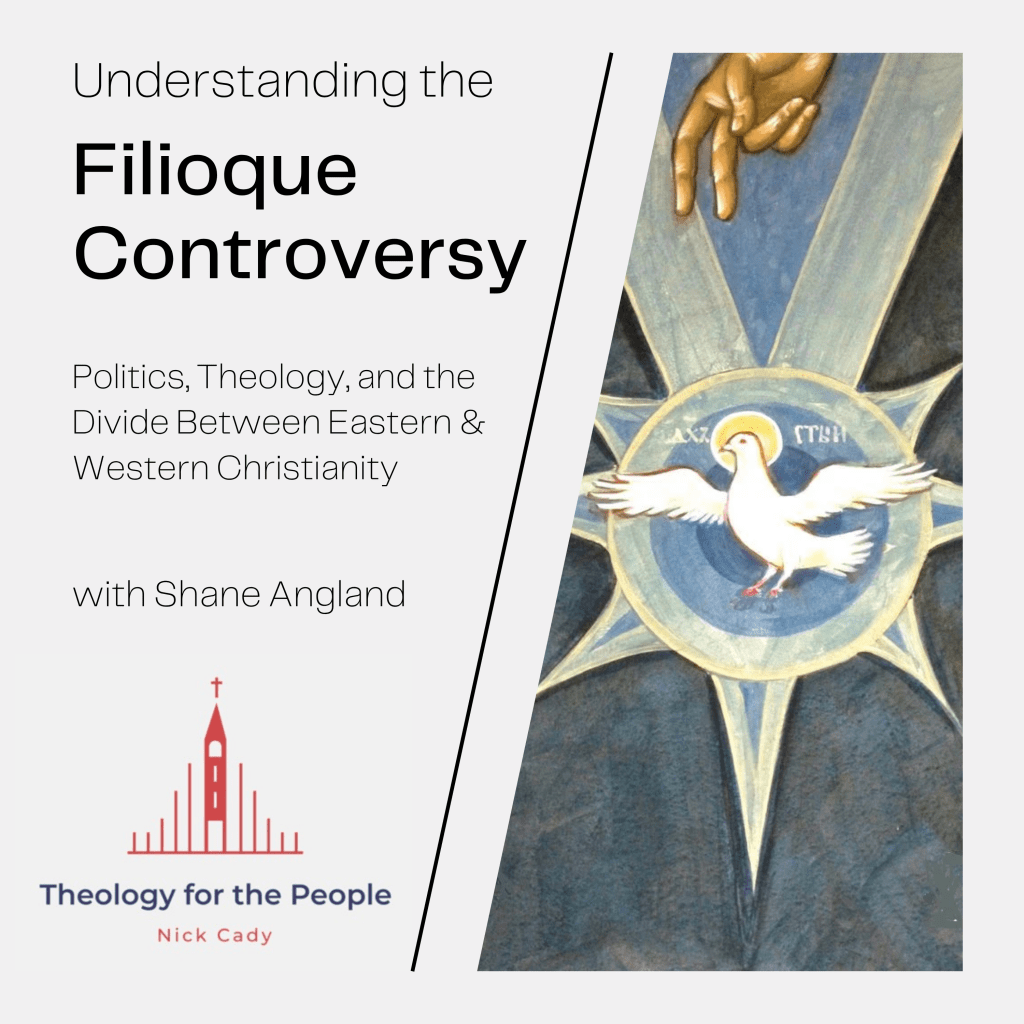
What does it mean that the Holy Spirit “proceeds from the Father” — and why did adding “and the Son” (Filioque), lead to one of the greatest divisions in church history?
I recently wrote two articles; one on the question of what it means that Jesus is the “begotten” Son of God, and the other on what it means that the Holy Spirit “proceeds” from the Father (and maybe the Son!). You can find those articles here:
These questions have to do what theologians call the “Eternal Generation” (of the Son) and the “Eternal Procession” (of the Holy Spirit). The question of the Holy Spirit gets into one of the fiercest theological debates in history; one which played a major role in the division between Eastern and Western Christianity (Orthodox vs. Roman Catholic).
In this episode of the Theology for the People Podcast, I speak with Shane Angland to unpack the history, theology, and ongoing significance of the Filioque controversy.
Together, we explore the origins of the Nicene Creed, the debates at the Council of Constantinople (381), and why the Western church added the Filioque clause.
We also discuss: • The difference between eternal procession and the mission of the Spirit • Why the East and West approach theology differently • The role of language (Greek vs. Latin) in shaping doctrine • How politics—not just theology—deepened the divide • Whether this issue still matters for Christians today
If you’ve ever wondered why theology can get so complex—or why it actually matters—this episode will help you see that these debates aren’t just academic, they’re about faithfully understanding who God is.
What does it mean that the Holy Spirit “proceeds from the Father” — and why did adding “and the Son” (Filioque), lead to one of the greatest divisions in church history?In this episode of Theology for the People, Nick Cady is joined by Shane Angland to unpack the history, theology, and ongoing significance of the Filioque controversy. Together, they explore the origins of the Nicene Creed, the debates at the Council of Constantinople (381), and why the Western church added the Filioque clause.They also discuss:The difference between eternal procession and the mission of the SpiritWhy the East and West approach theology differentlyThe role of language (Greek vs. Latin) in shaping doctrineHow politics—not just theology—deepened the divideWhether this issue still matters for Christians todayIf you’ve ever wondered why theology can get so complex—or why it actually matters—this episode will help you see that these debates aren’t just academic, they’re about faithfully understanding who God is.Visit the Theology for the People blog at nickcady.org
In that post, I mentioned that whereas the Bible says that Jesus is “from the Father” (the doctrine of “eternal generation”), the Bible says that the Holy Spirit “proceeds” from the Father — and, according to the Western Christian tradition, “from the Father and the Son.”
That raises some important questions:
Where does that language come from?
Is it biblical?
Why do Western Christians add that the Holy Spirit proceeds from the Father and the Son? What is the history of that?
In this article, I will walk you through the biblical foundation for the “procession” of the Holy Spirit, and the historical argument between Western and Eastern Christians about whether to add the clause “and the Son.”
The Biblical Language: “Proceeds from the Father”
The key verse behind this language comes from Jesus Himself:
“When the Helper comes, whom I will send to you from the Father, the Spirit of truth, who proceeds from the Father, he will bear witness about me.” (John 15:26)
This is the only place in the Bible where the word “proceeds” (Greek: ekporeuetai) is explicitly used to describe the Holy Spirit’s relationship to the Father.
Two important things are happening in this verse:
The Spirit proceeds from the Father – This speaks to the Spirit’s eternal origin.
The Son sends the Spirit – This speaks to the Spirit’s mission in time.
Christians have historically distinguished between these two ideas:
Eternal procession: Who the Spirit is in relation to the Father.
Temporal mission: What the Spirit does in being sent into the world.
This is similar to the distinction between the “ontological” and the “economic” Trinity. For more on that, read: The Trinity: Ontological & Economic
But this verse raises a question: If the Spirit proceeds from the Father, what is the Son’s role?
The Son’s Role in Sending the Spirit
Other passages fill in that picture:
John 16:7 — Jesus says of the Spirit, “I will send him to you.”
John 20:22 — Jesus breathes on the disciples after His resurrection and says, “Receive the Holy Spirit.”
Galatians 4:6 — “God has sent the Spirit of his Son into our hearts.”
These verses strongly connect the Spirit not only to the Father, but also to the Son.
So while John 15:26 emphasizes that the Spirit proceeds from the Father, the broader New Testament shows that the Spirit is also intimately related to the Son—to the point where He is even called “the Spirit of the Son.” In fact, in John 14, when telling His disciples at the Last Supper that He would not abandon them through this departure from this world, Jesus said that He would come to them, in the context of sending the Holy Spirit to them (see John 14:18). Furthermore, the New Testament authors tell us that the Holy Spirit indwells those who believe in Jesus, and then Paul tells us in Colossians that Christ dwells in us who believe (cf. Ephesians 1:13-14; Colossians 1:27)
Why “Proceeds”? What Does that Mean?
In addition to accurately reflecting the words of Scripture, “proceeds” (for the Spirit) and “begotten” (for the Son) describe the distinct ways each person of the Trinity relates to the Father. Since the Father, Son, and Holy Spirit are all fully God, these relationships distinguish them as unique persons.
The Father is unbegotten (He is the source). The Son is eternally begotten of the Father. The Spirit proceeds from the Father and is sent by the Son. The Son is not the Father because He is begotten, and the Spirit is not the Father or the Son because He proceeds. In God’s temporal mission, the Spirit is then sent by the Son and glorifies the Son, and the Son, in turn, glorifies the Father.
The Early Church and the Nicene Creed
As the early church wrestled with how to faithfully summarize biblical teaching, they gathered for the Council of Nicaea (325 AD). At that gathering, they produced the Nicene Creed, which affirmed that the Son is “begotten, not made.”
“We believe in the Holy Spirit… who proceeds from the Father…”
Notice: no mention of “and the Son” yet.
At this point, the church was primarily concerned with affirming:
The full divinity of the Spirit
His distinct personhood
His procession from from the Father (directly using the language of John 15:26)
The Addition of “and the Son” (Filioque)
The phrase “and the Son” (Latin: Filioque) was added later in the Western church.
It first appeared in regional councils in the West (notably in Spain in the 6th century) as a way to combat false teachings that undermined the divinity of the Son.
The reasoning went like this:
If the Spirit proceeds from the Father alone, some might conclude that the Son is less central or less divine.
But if the Spirit proceeds from both the Father and the Son, it reinforces the full equality and unity of the Father and the Son.
By the early Middle Ages, the Western church had adopted the phrase into the creed:
“who proceeds from the Father and the Son”
The Filioque Controversy
This addition led to one of the most significant theological disputes in church history between the Eastern (largely Greek speaking) and Western (largely Latin speaking) churches.
The Eastern church objected for two main reasons:
1. Theological Concern
Eastern theologians argued that the Father is the single source within the Trinity.
They believed:
The Son is begotten of the Father
The Spirit proceeds from the Father
Adding “and the Son,” they argued, blurred these distinctions.
2. Authority Concern
The East also objected that the Western church added to the creed unilaterally, without an ecumenical council.
For the Eastern church, this wasn’t just a doctrinal issue—it was also a question of church authority and unity. Tensions were already growing over the Western church’s claims about the primacy of the Bishop of Rome (the “Pope”) as the head of all Christians — a claim the Eastern church did not accept. From their perspective, the unilateral addition of the Filioque to the creed felt like another example of the West asserting authority in a way they believed was illegitimate and unwarranted.
The Great Schism: The East-West Split
Although it wasn’t the only factor, the disagreement over the Filioque clause contributed to the growing divide between Eastern and Western Christianity, culminating in the Great Schism of 1054.
To this day, the Eastern Orthodox Church rejects the Filioque clause and maintains “The Spirit proceeds from the Father,” whereas the Roman Catholic Church and most Protestant churches affirm “The Spirit proceeds from the Father and the Son.”
Is the Filioque Clause Biblical?
On the one hand, Eastern Christians point out that John 15:26 explicitly says the Spirit proceeds from the Father. On the other hand, Western Christians highlight the fact that the Spirit is deeply connected to the Son (John 16:7; Galatians 4:6), the Spirit is sent by the Son and bears witness to Him, and the unity of the Father and the Son is biblical and must be preserved.
Many theologians today suggest a both/and approach:
The Spirit proceeds from the Father
The Spirit proceeds through the Son in a way that reflects their unity
This preserves both the Father’s role as source and the Son’s participation and unity with the Father.
Conclusion
So, why do Christians say that the Holy Spirit “proceeds from the Father (and the Son)”?
It’s because Jesus explicitly stated that the Spirit proceeds from the Father (John 15:26), and because the New Testament shows the Spirit is also sent by and connected to the Son
Even though Christians have disagreed on how to best phrase it, both sides are trying to be faithful to Scripture and to preserve the mystery and beauty of the Trinity.
One definition of “begotten” is to create or produce, to bring into existence.
If God and Jesus are both eternal, and they have no beginning of existence and no end of existence, how is Jesus God’s begotten son?
The answer to this question lies in understanding the Greek word translated “begotten” and the attempt to explain something important that challenges the limits of human language.
“Begotten” Does Not Mean “Created”
When the early church clarified its beliefs about Jesus at the Council of Nicaea (325 AD), it used a very precise phrase:
γεννηθέντα, οὐ ποιηθέντα (gennēthenta, ou poiēthenta) = “Begotten, not made.”
That phrase is crucial.
“Made” means created—something that comes into existence
“Begotten” means sharing the same nature as the one who begets
gennaō (γεννάω) = “to beget” implies the same nature
poieō (ποιέω) = “to make” implies a different nature
So when Christians say Jesus is begotten, they are explicitly saying that He is not a created being.
This language was chosen in response to teachers like Arius, who argued that the Son (Jesus) was a created being. The church’s answer was clear: Jesus is not made—He is begotten.
Why Say that Jesus is “Begotten” at All?
We get this language from the Bible, and from Jesus’ own words. For this reason, it’s important that we not dismiss them, but receive them and try to understand them.
In passages like John 1:14, 1:18, and 3:16, Jesus is called the “only begotten Son.”
The Greek word behind this phrase is: μονογενής (monogenēs)
While it has traditionally been translated in English as “only begotten,” its meaning is slightly different. It most directly means: “one of a kind,” “unique,” or “only one of His kind”
So when John calls Jesus the monogenēs Son, he is emphasizing that:
Jesus is the unique Son of God
He is not one Son among many
He is the Son in a completely different category
This fits with what the creed later clarifies: Jesus is not just another “child of God” – He is the Son of God in a way that no one else is.
“Begotten” Speaks of Relationship, Not Beginning
Theologians have used the phrase “eternal generation” to describe this truth:
The Father is eternally Father
The Son is eternally Son
The Son is from the Father—but not after the Father
In other words: There was never a time when the Son did not exist. So “begotten” does not describe a moment in time, but rather aneternal relationship within the Godhead.
Why Not Just Say “Born”?
The Greek word gennaō can also be translated “born,” so this raises a question about why English translations of the Bible and creeds use the word “begotten” instead?
The reason is an attempt at theological precision.
“Born” tends to imply a moment in time
“Begotten” emphasizes shared nature, without implying that there was a “starting point” when it began.
So, begotten is carefully chosen to preserve the idea that the Son is unique and that He shares in the Father’s nature, but was not created.
The Unique Son: Jesus Is the Son by Nature; We Become Sons by Adoption
This brings us to an important distinction. The Bible says that we become sons or children of God through faith in Jesus (John 1:12, 1 John 3:1)
As sons of God, we share in the inheritance which is ours as sons, and Jesus is our brother. But there is a difference between the way that we are sons of God and the way that Jesus is the Son of God.
Jesus is the only begotten Son
Believers are adopted as sons (Romans 8:15; Galatians 4:4–7)
Jesus is:
Son by nature
Eternal
Shares the same divine essence as the Father
We (believers) are:
Sons and daughters by adoption
Not sons from eternity past, but:
Brought into God’s family by grace
John 1:12 says: “But to all who did receive him, who believed in his name, he gave the right to become children of God”
We become children of God. Jesus never became the Son, He has always been the unique Son of God – in a way that no one else is or ever will be.
Why This Matters
This isn’t just a technical theological point, it’s actually essential to the gospel.
If Jesus were made, then He would be a creature. But if Jesus is “begotten, not made,” then He is fully God.
And that matters because:
Only God can fully reveal God
Only God can truly save
The message of the gospel is that the eternal Son of God came to us, so that we, who are not sons by nature, might become sons by grace.
Going Deeper: “Eternal Generation” versus “Procession”
The doctrine of “Eternal Generation” is the way that theologians explain some of the passages in the Bible which describe the Son as being from the Father, while not being created by the Father. This is different from “procession,” which is the term traditionally used for the Holy Spirit.
But as for the Son coming from the Father, consider these examples:
“And the Word became flesh and dwelt among us, and we have seen his glory, glory as of the only Son from the Father, full of grace and truth.” (John 1:14)
“For as the Father has life in himself, so he has granted the Son also to have life in himself.” (John 5:26)
“He is the radiance of the glory of God and the exact imprint of his nature, and he upholds the universe by the word of his power.” (Hebrews 1:3a)
“In the beginning was the Word, and the Word was with God, and the Word was God.” (John 1:1)
The Bible describes the Son as being “from” the Father, but not as a created being or someone who came into existence at some point—rather, as the eternal Son who has always been in perfect relationship with the Father.
Here are four basic assertions about the Trinity that are universally accepted by Christians [1]:
There is one and only one true and living God.
This one God eternally exists in three Persons—God the Father, God the Son, and God the Holy Spirit.
These three Persons are completely equal in attributes, each sharing the same divine nature.
While each Person is fully and completely God, the Persons are not identical.
It is in an attempt to write down what the Bible, and Jesus Himself stated regarding the nature of God, that we use the terms “begotten” and explain it using the language of “eternal generation.”
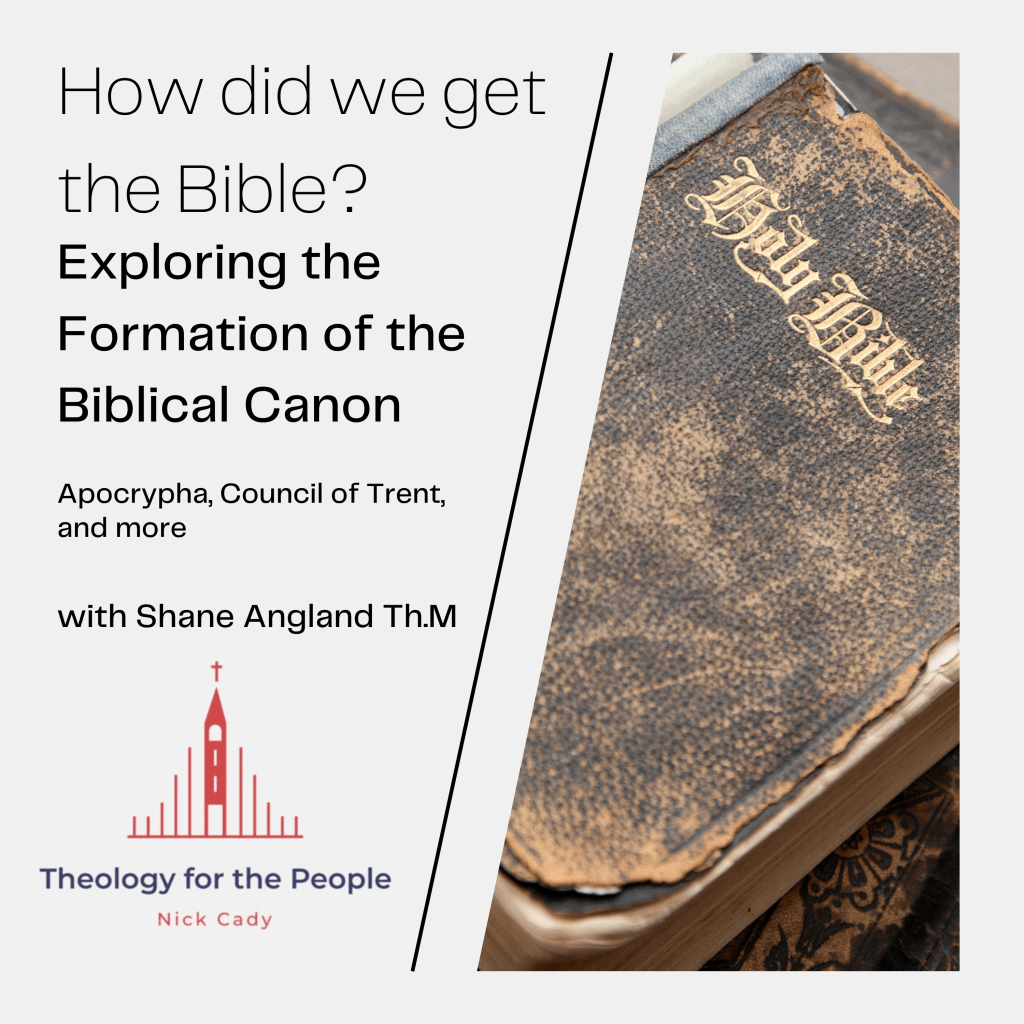
In this episode of the Theology for the People Podcast, I speak with Shane Angland about the question of how we got the Bible in its current form.
Shane has been a recurring guest on the podcast, and he has a keen mind and knowledge of historical theology. Shane lives in Ennis, Ireland where he serves at Ennis Evangelical Church. He holds a Masters of Divinity from Dallas Theological Seminary, and has served as a missionary in Ukraine.
From the formation of the Old and New Testaments to the question of the Apocrypha, to the impact of the Council of Trent, this conversation offers clarity on why the Bible is trusted as God’s inspired Word.
Key Topics Discussed
What is the Canon?
Definition: The canon is the list of inspired, authoritative Scriptures distinguished from other valuable writings.
Theological foundation: Scripture is “breathed forth” by God, carrying unique authority for the church (2 Timothy 3:16).
Old Testament Canon Formation
Begins with God’s redemptive acts, particularly after the Exodus and Sinai covenant (Exodus 24, Deuteronomy 31).
Jewish recognition of inspired texts from Moses to Malachi, with a prophetic silence post-Persian era.
Josephus and first-century Jewish consensus on 22 books (equivalent to the 39 books in modern Old Testaments).
No explicit criteria articulated, but guided by the Holy Spirit and covenantal context.
The Apocrypha and Deuterocanonical Books
Includes books like Tobit, Judith, Wisdom, Sirach, 1 & 2 Maccabees, Baruch, and additions to Esther and Daniel.
Historical debate: Some early Christians (e.g., Augustine) accepted these books, while others (e.g., Jerome) did not, aligning with Jewish tradition.
Council of Trent (1546): Roman Catholic Church dogmatically defined these books as canonical, partly in response to Reformation emphasis on scriptural authority (e.g., for doctrines like purgatory).
Eastern Orthodox churches maintain an open canon, avoiding infallible rulings.
New Testament Canon Formation
Tied to the new covenant and apostolic authority, with writings by or connected to apostles (e.g., Mark linked to Peter, Luke to Paul).
Criteria: Apostolic origin, Christ-centered message, and widespread church use in worship.
Early recognition: By the late first century, apostolic writings were distinguished (e.g., Clement’s letters vs. Paul’s epistles).
By the second century, 22–23 of the 27 books were widely accepted, with minor debates on smaller texts (e.g., 2 Peter, 3 John).
Misconceptions Addressed
Myth: The Council of Nicaea (325 CE) decided the canon. Reality: Nicaea focused on church governance, not canon selection.
Myth: Early Christians chose from hundreds of gospels. Reality: The four canonical gospels were the earliest, apostolic, and widely used.
Gnostic “gospels” (e.g., Gospel of Judas) lack historical or apostolic credibility and were not serious contenders.
Why the Delay in Formal Canon Lists of the New Testament?
The early church was decentralized, persecuted, and lacked centralized authority to compile lists.
Canonical texts were illegal, and possession could lead to martyrdom (e.g., 180 CE Carthage trial).
Earliest clear list: Athanasius’ Easter Letter (367 CE), reflecting existing church consensus.
Confidence in Scripture
The Bible’s unity across 66 books, three languages, and 1,500 years testifies to its divine inspiration.
The early church’s careful discernment reflects wisdom, not uncertainty.
Romans 3:2 affirms the Jewish role in preserving the Old Testament oracles, reinforcing trust in the canon’s reliability.
Resources Mentioned
Michael Kruger’s work on the canon (e.g., Canon Revisited).
Josephus’ Against Apion for first-century Jewish canon insights.
Augustine’s On Christian Doctrine.
Quotable Moments
“The canon begins with God’s work of redemption, not human decisions.” – Shane
“The church doesn’t establish the canon; it recognizes it through the Holy Spirit.” – Shane
“The Bible’s coherent message across 1,500 years is a miracle of God’s inspiration.” – Shane
How Did We Get the Bible? Exploring the Formation of the Biblical Canon – with Shane Angland Th.M –
Theology for the People
In this episode, Nick Cady and Shane Angland tackle the critical question: How did the Bible come to be? They explore the formation of the biblical canon, addressing misconceptions, historical processes, and the theological significance of Scripture. From the Old Testament’s roots in God’s redemptive work to the New Testament’s apostolic authority, this conversation offers clarity on why the Bible is trusted as God’s inspired Word. They also discuss the Apocrypha, the Council of Trent’s impact, and how early Jewish and Christian communities recognized canonical texts.Connect with Theology for the PeopleWebsite: theologyforthepeople.comFollow on X: @nickcady
When we talk about “the Early Church” many people’s minds immediately go to the first generation of Christianity, recorded in the Book of Acts and addressed in the New Testament. But what happened after that, and why does it matter for Christians living today?
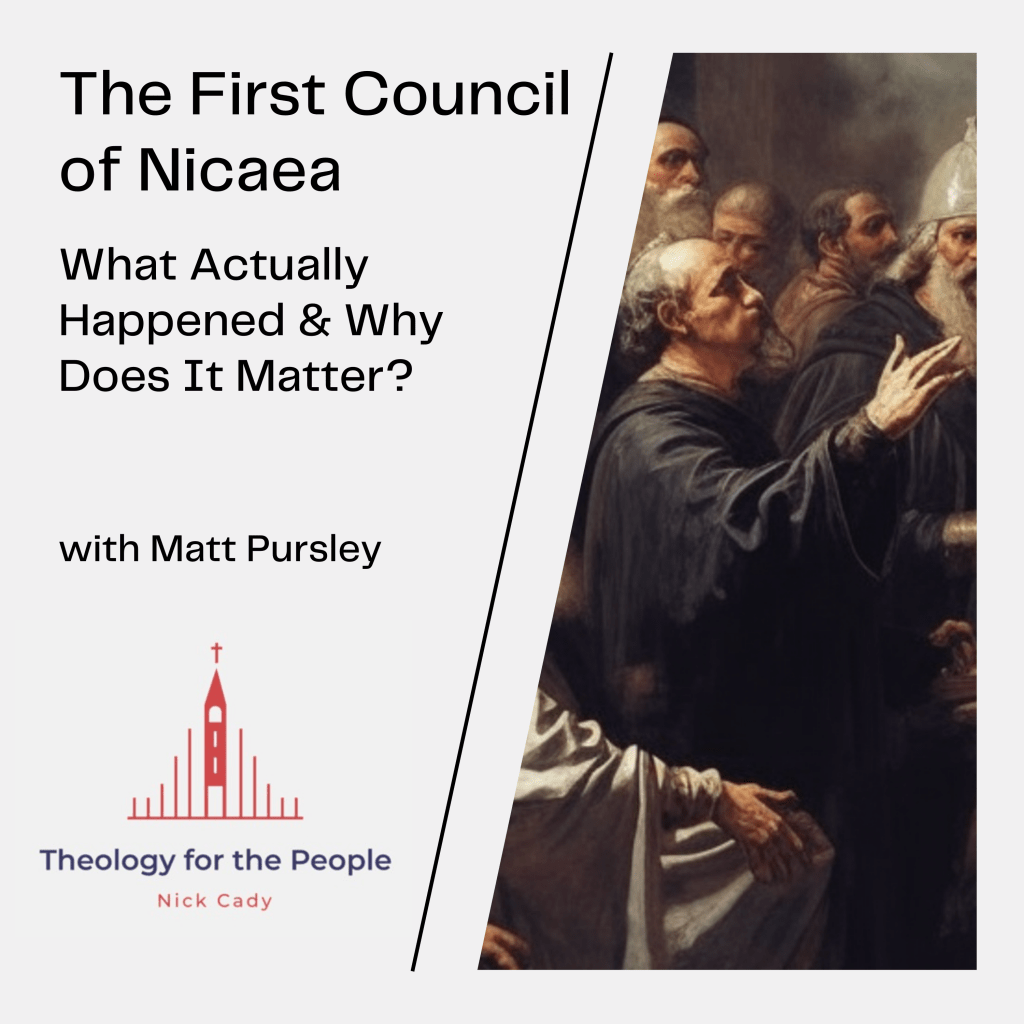
Matt Pursley is the Executive Pastor at Park Hill Church in San Diego, California. He has a Masters in Christian History, and in this episode, Matt and I discuss the First Council of Nicaea: what led to it and what it produced.
We address many of the common misconceptions about Nicaea, and we discuss the early heresies of Marcionism, Gnosticism, and Arianism, and why it’s important for Christians today to understand those heresies, and why they were rejected.
Along the way we also talk about Jordan Peterson, who Matt says is a modern Marcionite, and how the errors of both liberalism and fundamentalism have a similar origin.
The First Council of Nicaea: What Actually Happened & Why Does It Matter for Us Today? –
Theology for the People
When we talk about “the Early Church” many people’s minds immediately go to the first generation of Christianity, recorded in the Book of Acts and addressed in the New Testament. But what happened after that, and why does it matter for Christians living today?
Matt Pursley is the Executive Pastor at Park Hill Church in San Diego, California. He has a Masters in Christian History, and in this episode, Matt and I discuss the First Council of Nicaea: what led to it and what it produced.
We address many of the common misconceptions about Nicaea, and we discuss the early heresies of Marcionism, Gnosticism, and Arianism, and why it’s important for Christians today to understand those heresies, and why they were rejected.
Along the way we also talk about Jordan Peterson, who Matt says is a modern Marcionite, and how the errors of both liberalism and fundamentalism have a similar origin.
Visit the Theology for the People website at nickcady.org
December 6 is Saint Nicholas Day, or the Feast of Saint Nicholas.
Whereas Americans tend to say that Santa Claus comes on Christmas Eve to deliver presents, for Europeans Saint Nick brings chocolate and some gifts on December 6.
“The Real Santa is Dead”
One of my American friends once told me that they don’t do Santa Claus, because they like to keep fairy tales out of their faith. That’s a fair point. However, when it comes to Saint Nicholas, we would do well to not lose the legacy of the historical person as we throw out the proverbial bath water.
To that end, my wife and I have always taken the approach with our kids of telling them about the real Saint Nick: the pastor and theologian who loved and cared for the poor in his community.
We explain to them that the reason there are so many Santas in malls and at events is because Saint Nicholas was such a wonderful person that people want to keep his memory and legacy alive, and they do that by dressing up in that red costume with the beard.
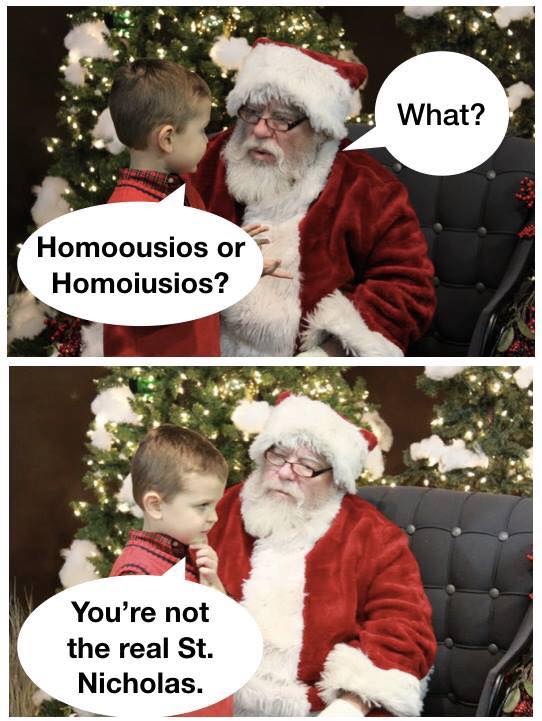
This led to a funny episode once, when we were waiting in line to have our picture taken with a mall Santa, and my son – 5 years old at the time – started talking to another kid in line and told him, “Did you know that the real Santa is dead?!” Needless to say, the kid was surprised and concerned to hear this news!
The Real Saint Nick
Saint Nicholas was born in the 3rd century in the village of Patara, in what is now southern Turkey, into a wealthy family. That’s right: no North Pole nor reindeer for the real Santa, but palm trees and white sand beaches.
His parents died when he was young, and he was taken in and raised by a local priest. Following Jesus’ call to the Rich Young Ruler (Mark 10:21) to “sell what you own and give the money to the poor,” Nicholas dedicated his entire inheritance to assisting the sick, needy and suffering.
He became a pastor, and was later made Bishop of Myra. He became famous for his generosity and love for children.
Nicholas suffered persecution and imprisonment for his Christian faith during the Great Persecution (303-311) under Roman emperor Diocletian.
As a bishop, he attended the Council of Nicaea (325), at which he affirmed the doctrine of the deity of Christ against the Arian heresy.
Homoousios or Homoiousios
The discussion at the Council of Nicaea was summarized by which word to use in describing Jesus’ nature: whether he was homoousios (of the “same substance” as God) or homoiousios (of a “similar substance” as God).
At the the Council of Nicaea, bishops from all over the world gathered to study the scriptures and address the Arian controversy which advocated for the term homoiousios, denying Jesus’ full deity. This view, which is also held today by the Jehovah’s Witnesses, was deemed heretical by the council of bishops based on examination of the Scriptures, which teach that Jesus is Immanuel (God with us), and is true God of true God.
The debate got very heated, and at one point Nicholas reportedly got so upset with he deemed to be blasphemy, that he slapped an Arian.
This is the real Saint Nick: Palm trees and white sand beaches, defender of the faith, and slapper of heretics.
Nicholas died in 343 in Myra. The anniversary of his death became a day of celebration, the Feast of St. Nicholas on December 6.
Where the Tradition of Gift Giving Comes From
Many stories are told about St. Nicholas’ life and deeds. Perhaps the most famous story is that of a poor man who had three daughters of marrying age. Because the man was poor, he was unable to provide a dowry for his daughters, which meant that they would not be able to find a descent husband and would either be married into further poverty or would have to become slaves.
After Nicholas found out about this family’s situation, he visited the family’s house at night, leaving them three anonymous gifts: bags of gold, which he tossed through an open window while the family was sleeping.
The story goes that they found the gold in their shoes when they awoke, which is the reason for the tradition in Europe that Saint Nicholas leaves chocolate in children’s shoes. Nicholas provided for these poor girls to help them break out of the cycle of poverty.
Rather than trying to make Christmas Santa-free, let’s take back the true story of Saint Nicholas and take hold of this opportunity to talk about a Christian man who loved Jesus, championed good theology, and exemplified Christ through compassion and generosity to the needy.
December 6 is the feast day of St. Nicholas. Particularly in Europe, it is celebrated as St. Nicholas Day, and the tradition is to put chocolate and gifts into the children’s shoes for them to find in the morning – a tradition that my wife keeps in our home.
I don’t know if you’ve met them or not, but there are some Christians who think that Santa Claus is evil and that he takes away from the true meaning of Christmas. Not to mention, some would point out, that Santa is nothing more than a misspelling of SATAN, which must be why he goes around in those obnoxious red clothes: because he is from HELL and wants to take you and your kids back there with him!
This of course, is based on a sad lack of knowledge regarding the origin of Santa Claus – the name (in English) being simply a direct derivative of “Saint Nicholas”.
For this reason, some Christians protest anything to do with Santa Claus, and tell their kids that Santa is not real, he is bad, and he takes away from the true meaning of Christmas, which of course is Jesus.
This Christmas season, as we do every year, we will tell our kids the story of the real Saint Nicholas – who was not a mythical fat man in red clothes who rode through the skies on a sleigh pulled by flying reindeer, but a devout Christian man, a pastor, who was persecuted for his faith, and gained fame because of his generosity to the poor and needy.
We don’t avoid Santa Claus – we don’t even want to. We see it as a great opportunity to teach our kids about a great Christian man who loved Jesus and was generous and kind because of the love of God which was in his heart. THAT is the “Christmas spirit”.
We tell our kids that there are many people in the world who want to follow the example of Saint Nicholas, and that is why they will meet a Santa at their school and at the mall – and some of them will have very fake beards, because none of them are the real Saint Nick. We also teach our kids that, as Christians, we want to be like Saint Nicholas too, and we are going to be generous to the poor and needy too because God loved us so much that he gave us his Son, Jesus, so that we could have eternal life and have a relationship with God.
The Story of the Real Saint Nicholas
The real Saint Nicholas was born in the 3rd century in the village of Patara, in what is now southern Turkey, into a wealthy family. That’s right – no North Pole and reindeer for the real Santa, but palm trees and white sand beaches. His parents died when he was young, and he was taken in and raised by a local priest. Following Jesus’ call to the Rich Young Ruler (Mark 10:21) to “sell what you own and give the money to the poor”, Nicholas dedicated to use his entire inheritance to assist the sick, needy and suffering.
He became a pastor, and was later made Bishop of Myra. He became famous for his generosity and love for children.
Nicholas suffered persecution and imprisonment for his Christian faith during the Great Persecution (303-311) under Roman emperor Diocletian.
As a bishop, he attended the Council of Nicaea (325), at which he affirmed the doctrine of the deity of Christ against the Arian heresy.
Nicholas died in 343 in Myra. The anniversary of his death became a day of celebration, the Feast of St. Nicholas, December 6th.
As Christians, we should take back the true story of St. Nicholas
Many stories are told about St. Nicholas’ life and deeds. Perhaps the most famous story is one of a poor man who had three daughters who were of marrying age. Because the man was poor, he was unable to provide a dowry for his daughters, which meant that they would not be able to find a descent husband, and would either be married into further poverty or would have to become slaves. After Nicholas found out about this family’s situation, he visited the family’s house, leaving them 3 anonymous gifts – each time a bag of gold, which was tossed through an open window while the family was sleeping. Legend has it that the gold fell into their shoes, the reason for the tradition in Europe that St. Nicholas leaves gifts in children’s shoes. Nicholas provided for these poor girls to help them break out of the cycle of poverty.
My favorite story about Nicholas is what he did at the the Council of Nicaea, where bishops from all over the world gathered to study the scriptures and address the major doctrinal controversies facing the church. Chief among these was Arianism, propagated by Arius, which denied the full deity of Jesus, saying instead that he was a created being – a view that is carried on today by the Jehovah’s Witnesses. The debate got very heated, and based on the study of the scriptures, Arianism was deemed heretical. Nicholas argued from the scriptures for the deity of Christian and against Arianism, and at one point got so upset with something that was said about Jesus from the other side, that he slapped an Arian. That’s my kind of Santa!
Rather than trying to make Christmas Santa-free, let’s take back the true story of Saint Nicholas and take hold of this opportunity to talk about a Christian man who loved Jesus, championed good theology and exemplified Christ through compassion and generosity to the needy.






 Theology for the People