Reader Questions: How Accurate are Bible Translations?

ancient antique architectural design architecture

I recently added a page on this site where readers can submit questions or suggest topics (click here for that page). Recently I received this question:

Hi Pastor Nick. I have heard you talk about your study of other languages and various Bible translations. Can you help me with a response to a Jewish man who is convinced the English translation is completely inaccurate and can’t be trusted?

Bible Translation Basics

I wrote a series on Bible Translation to explain some of the inherent difficulties in doing it, as well as some relevant issues related to some particular English translations:

  1. Making Sense of Different Bible Translations – Part 1
  2. Making Sense of Different Bible Translations – Part 2: the King James Bible
  3. Making Sense of Different Bible Translations – Part 3: Gender-Inclusive Language and the NIV

Response to the Question

I would start by asking which English translation he thinks cannot be trusted, and my next question would be why he believes they cannot be trusted.

There is not just one English Translation of the Bible, but hundreds of translations – many of which have been carried out by teams of scholars whose work was then reviewed, checked, proofread and scrutinized by other scholars in order to assure accurate translation.

Basically, his claim that a translation of the Bible into English (or presumably any language?) is not trustworthy is intellectually untenable.

These translations are made by groups of scholars who have devoted their lives to studying these ancient languages, cultures, and beliefs. Furthermore, there have been multiple groups over the past 2000 years who have translated the Scriptures into various languages, and these translations all say the same things. Where they differ is based on different possible translations of words or phrases in the original language, but there are a finite number of options, and the options are usually recorded in the footnotes or in textual commentaries. All that would be needed in order to refute a translation would be someone who could prove that they are in error. So a challenge to anyone who claims that a particular translation is not trustworthy or accurate would be to simply invite them to make their case publicly, and contribute their insights and knowledge to help make a better translation!

What is Inspired: the Original Text or the Translation?

It should be noted that we as Christians believe the original texts to have been inspired by God, not the copies or translations.

Article X of the 1978 Chicago Statement on Biblical Inerrancy explains it this way:

WE AFFIRM  that inspiration, strictly speaking, applies only to the autographic text of Scripture, which in the providence of God can be ascertained from available manuscripts with great accuracy. We further affirm that copies and translations of Scripture are the Word of God to the extent that they faithfully represent the original.

WE DENY  that any essential element of the Christian faith is affected by the absence of the autographs. We further deny that this absence renders the assertion of Biblical inerrancy invalid or irrelevant.

However, this does not mean we cannot or should not translate the Scriptures into languages other than the originals – to the best of our collective abilities – in order that people who do not speak ancient Hebrew and Greek (the vast majority of the world’s population) can understand God’s Word to them.

Bible Translation Has Precedent: the Septuagint and Jesus

Lastly, there is precedent in Scripture itself for the translation of the Bible into other languages. The Septuagint was the Greek translation of the Hebrew Bible, and it was widely used in antiquity. The New Testament writers often quote from the Septuagint and record Jesus as having quoted from the Septuagint. Being that Aramaic was widespread in Israel at the time of Jesus, we can be quite sure that Jesus would have spoken to crowds in Aramaic, meaning that when he referenced or quoted from the Hebrew Bible (AKA Old Testament), he would have translated those verses into Aramaic.

In conclusion, we can be quite confident in the translations that we have in English and other languages. While it may be helpful to acquaint yourself with the original languages, you can be sure that when you read your English translation of the Bible, you are getting the essence of the original text and its meaning, especially if you are supplementing your reading with textual commentaries.

Did Jesus Go to Hell?

night dark halloween horror

The Apostles’ Creed, one of the oldest Christian creeds – in continual existence since at least the 4th Century A.D. – contains a line which many people have found intriguing: it declares that Jesus “descended to the dead.”

Older translations of the original text into English sometimes translate this phrase as saying that Jesus “descended into Hell.”

Looking at the creed in ancient languages is interesting as the Greek text says: κατελθόντα εἰς τὰ κατώτατα, which means: “descended to the bottom” – and the Latin text says: descendit ad inferos, the word inferos being translated as “Hell.”

More recent translations into English have chosen to say “descended to the dead” rather than “descended into Hell” as “the dead” would be more accurate biblically and theologically than “Hell.” The reason for this is based on a particular understanding of “Sheol” in the Old Testament and the Jewish mind, which was the dwelling place of all souls, being divided (according to Luke 16:19-31) into two parts: Abraham’s Bosom and Hades, AKA: Hell.

Abraham’s Bosom, it is believed, was a place of comfort for those who died in faith, i.e. the “Old Testament saints,” such as those described in Hebrews 11, who died prior to the redemptive actions of Jesus. The theory, therefore, is that 1 Peter 3:19 and 4:6, Peter is describing how Jesus went to Sheol after his death on the cross but prior to his resurrection, and declared to the deceased souls held there what he had accomplished in his life and death. This message would have been a message of redemption and release from Sheol, to the immediate presence of God, to those who were kept in Abraham’s Bosom awaiting the redemptive work of the Messiah, and a message of condemnation for those held in the Hades/Hell portion of Sheol.

I have written more about this here: Did People Go to Heaven Before Jesus’ Death & Resurrection?

I also explain this in some detail in this past Sunday’s sermon from 1 Peter 3:18-4:11 – The Resurrected Life. The part that deals with this topic begins around 17:30.

However, there are several different, and possible, interpretations of these verses which Mike and I discussed and outlined in this week’s Sermon Extra video. It’s worth watching, as we discuss different views, such as that this speaks to Jesus preaching to demons related to the Nephilim in Genesis 6, Jesus preaching through Moses, etc.:


1 Peter: A Call to Missional Humility

photo of monument during daytime

We are currently studying through 1 Peter at White Fields. You can listen to the studies here: Pilgrim’s Progress: A Study Through 1&2 Peter

I’ve read the letter many times, but it’s my first time preaching through it. Doing so has caused me to see a few things in the letter which I hadn’t noticed before:

Peter Reflects Paul

Many scholars date this letter to 64 AD, the time when the great persecution of Rome began under Caesar Nero in the wake of the great fire of Rome. It was also during this time that Paul the Apostle was put to death.

One theory is that Peter wrote this letter in the wake of Paul’s death, to speak to the church in Asia Minor (see 1 Peter 1:1), the area where Paul did a great deal of his ministry and church planting, and to whom he wrote several letters (Ephesians, Galatians, Colossians). Peter was writing to warn them and prepare them for the flood of persecution that was radiating out from Rome to the rest of the empire, and to fill the gap to some degree since the Apostle Paul was now dead.

Throughout the letter, Peter can be seen reflecting on many of the same topics and themes which were found in Paul’s letters (especially Ephesians) and sometimes uses very similar language, although clearly Peter’s writing follows a different pattern than Paul’s. Interestingly, in 2 Peter, Peter mentions Paul’s writings, even calling them Scripture.

For related topics, check out: When Was the New Testament Recognized as Holy Scripture? & Did the New Testament Writers Know They Were Writing Scripture?

It seems that Peter was intimately familiar with Paul’s letters, and perhaps those letters influenced him in the writing of his own letter.

A Call to Missional Living

A major theme of 1 Peter is that as Christians we are sojourners and pilgrims, strangers in this world. As Christians, our citizenship is in Heaven, which is also where our ultimate hope lies; not on this Earth.

Considering that this letter was written to people who were suffering greatly, this message is not surprising. Indeed, the promise of the gospel is that one day those who are children of God will be brought home by their Father to be with Him in security and fullness of joy, free from the pain and suffering caused by sin.

However, if we see Peter’s letter as primarily being about the hope of escaping this cruel world and going to Heaven, we’ve missed the main thrust of his letter. The main thrust of the letter is actually about missional living.

The hope of Heaven makes us bold and courageous so that we can live this life on mission with God. Peter wants us to think of ourselves as sojourners on a mission.

There are several ways in which you can be a foreigner in a foreign land:

  1. A Tourist – Puts down no roots. They come to a place to take what they can and enjoy what they can, but they don’t invest deeply in that place or worry much about building relationships with the people there, because they are living out of a suitcase in a rented hotel room, as they await their flight out to go home.
  2. A Prisoner of War – Is in that foreign land against their will, and therefore they bide their time until they can get out.
  3. A Missionary – A missionary is intentional about their time and resources, knowing that they are in that place for a purpose; they are on assignment.

Peter, in this letter, focuses more on living in this world than escaping from this world, and encourages us to take the posture not of a tourist, nor of a prisoner of war, but rather that of a missionary.

Missional Humility

In this letter, Peter has a lot to say about humility. Throughout the gospels, it is apparent that Jesus’ disciples had an issue with being competitive. There are John’s comments about beating Peter in a footrace to Jesus’ grave on Easter Sunday, and the multiple times Jesus caught his disciples debating which of them was the greatest.

Peter himself, as a younger man, had pridefully told Jesus that even if everyone else fell away, he would remain faithful to the end. Jesus then informed Peter that before that very night was over, Peter would deny him three times.

Jesus graciously restored him, but Peter was unquestionably humbled by that experience. Furthermore, some 30 years had passed by this time since Jesus’ resurrection and ascension. Peter is older, and his word for younger people is: humble yourself, so that God doesn’t have to do it for you – because God resists the proud, but gives grace to the humble.

For Peter, humility is not only a way of relating to God, it’s also an important aspect of what it means to live missionally. Peter talks about living humbly in this world, and treating unbelievers with respect and gentleness (see 1 Peter 3:15). In order to engage in God’s mission effectively in this world, it’s not just what you say that matters, but how you say it, and how you live.

May we be those who hear the message of Peter:

  • May we love the Word of God, so that it sinks into us, and permeates our thoughts and speech.
  • May the promise of Heaven cause us to engage rather than disengage with the world around us in a missional way,
  • and may we take a posture of humility towards others and before God as we do so.

A Father, Not a Genie

selective focus photography of child hand

There are at least 11 instances recorded in the Gospels of Jesus stating that whatever we ask for in his name, will be given to us. And yet, if you are a praying person, it is likely that you have asked for things in prayer which you did not subsequently receive.

Furthermore, there are several stories recorded in the Bible in which people prayed and God did not grant their requests. In one of these cases, it was Jesus Himself whose request to the Father was denied! How then can these statements of Jesus be true, that whatever you ask for in His name, it will be given to you?

Many people ask: “If God makes these great promises and has all this power, then why am I not getting the things I ask for?”

A Father, Not a Genie

Timothy Keller explains that in order to understand petitionary prayer, you have to understand that it works on Father-Child terms. (see: Petition: Our Daily Bread)

We pray to “Our Father” not to “the Genie of the bottle”. The genie of the bottle gives you whatever you wish, even if what you wish for is not ultimately good for you. A father, on the other hand, gives you what is best for you; because He loves you, He gives you exactly what you would have asked for if you knew everything He knows.

A Safety Catch

When you have small children around, you have to baby-proof your home. The reason children are a danger to themselves is because they think they know what they are doing, even when they don’t. Children often ask for things they think will be great, even though they will be harmful to them.

The more powerful a machine is, the more important it is that the machine have safety features, to protect people (not only children) from hurting themselves with that machine.

Imagine what might happen if you gave Aladdin’s lamp to a toddler or a young child. They would likely make requests which were not the result of long-term thinking, sage wisdom, or perspective. Their requests might be too shallow or simple, on the one hand – or even dangerous, petty or spiteful on the other, depending on their mood.

Prayer without a safety catch is like giving Aladdin’s lamp to a child.

Many of us assume that we know what we need, or what would be best for us, but the truth is that we don’t have the wisdom or the full scope of knowledge necessary to make those determinations. The good news is that we have an all-knowing (omniscient), and loving God, who relates to us as a Father, not a genie.

The Magic Words?

“In my name” means “according to my will”. If I asked you to go to the pharmacy or the post office “in my name”, it would mean that you were acting on my behalf, according to my will and desires. To pray in Jesus’ name, and to say “Amen” are not the Christian versions of “Abracadabra” or other magic words; they are to submit your requests to God’s will, wisdom, and plans.

There have been times in my life when I have prayed for things which I now thank God He did not give me. I’m thankful that I have a Father, not a genie.

Psalm 84:11 says: “For the LORD God is a sun and shield; the LORD bestows favor and honor. No good thing does he withhold from those who walk uprightly.” Knowing that you have a father, not a genie, helps you to understand that when God doesn’t grant a request, it may be because either that thing is not good for you, perhaps not right now, or that He has something else good, perhaps even better than what you asked for.

Come to Him as a good Father, and trust Him with your needs and requests!

What is a Beatitude?

man jumping from a rock

The Beatitudes are the name given to the opening lines of Jesus’ “Sermon on the Mount”, found in the Gospel of Matthew 5:3-12. They consist of 9 statements which all begin with the words “Blessed are…”

So what exactly is a “beatitude”?

Not the Be-Attitudes

One common explanation is that the beatitudes are the “be-attitudes”, i.e. “the attitudes you should be.”

Not only is this atrocious grammatically, it’s also incorrect linguistically.

The Happy Sayings

The word beatitude comes from the Latin word beati, which means “happy”, because in the Latin Vulgate translation of the Bible, each of these sayings begins with the word, “Beati” or “Happy are…”

In the original Greek, each of these sayings begins with the word makarios, which also means “happy”.

The beatitudes, therefore, are not a laundry list of attitudes you need to muster up, rather they are a group of sayings, in which Jesus shows us the pathway to true happiness.

Blessed or Happy?

The English translators of the Bible chose to translate the word makarios as “blessed” instead of “happy”.

Other languages, however, retained the simple, straight-forward translation of makarios as “happy” – such as the other language I speak: Hungarian, which translates it as “boldog”, the regular word for “happy”, as opposed to the word “áldott” which means “blessed”. In Hungarian, the beatitudes are called “A Boldog Mondások”, literally “the happy sayings” – which is what beatitudes actually means.

Recently I was teaching at Ravencrest Bible College in Estes Park, and asked a student from Scandinavia how her Bible translated it, and sure enough, makarios was translated as a word meaning “happiness” rather than one referring to “blessedness”.

So, why did the English translators of the Bible translate makarios as “blessed” rather than as “happy”? Many people believe that it was because they felt that the word “happy” was too trite, and not religious enough. Some English translators have translated makarios as “happy” – such as the Good News Translation, but most have kept with the tradition of using “blessed” instead because it is so engrained in the English linguistic heritage.

However, I believe that translating makarios as “blessed”, something is lost in translation. The word “happy” has a different tone than the word “blessed”. After all, you can be blessed without being happy. Blessed doesn’t communicate elationit doesn’t evoke the image of a smile on your face and lightness in your heart!

When Jesus spoke these words, he was using a word that was common and relatable, and not a religious word: “happy”!

The Pathway to Happiness

The beatitudes would have been surprising to their original hearers! They would have caused people to do a double-take, and listen closely, perhaps wondering if maybe they had misunderstood Jesus in what he said!

Think about it:  “Oh how happy are the poor in spirit.”  “Oh how happy are you who weep.”

The first listeners would have said, Wait…what?! Poor people aren’t happy! People who weep are literally NOT happy!

It was a set-up, for Jesus to instruct them about his “upside-down kingdom”.

In the beatitudes, the “happy sayings”, Jesus is laying out the pathway to true and lasting happiness. Unlike what many people in the world popularly believe about how to attain happiness, Jesus shows us the true and better way:

Happiness begins, Jesus said, with recognizing and acknowledging your spiritual poverty, and then weeping over that spiritually poor condition. It continues by you humbling yourself before God and hungering and thirsting after righteousness: which if you do, God will give to you as a gift of his grace (His righteousness, not your own!).

For more on how the beatitudes, the “happy sayings”, show the pathway to happiness, check out this message I taught on this section called “How to Be Happy – Matthew 5:1-12”

May we be those who hear what Jesus has to say in these Happy Sayings, and may we follow him down the pathway to true, lasting happiness, which begins with humility and repentance!

Further Reading

Is Christianity About Denying Yourself or About Being Happy?

woman wearing grey long sleeved top photography

Jesus said that his desire was that we would have his joy in us, and that our joy would be complete (John 15:11). He also told his disciples that if anyone wants to come after him, that person must deny themselves, take up their cross and follow him (Matthew 16:24).

So, which is it? Is Christianity about being happy, or is Christianity about denying yourself and dying to yourself?

In my previous post, I talked about happiness and whether there is a difference between “joy” and “happiness”. Check that post out here: Does God Want You to Be Happy?

One question I received in response to that post was how self-denial and taking up your cross to follow Jesus fits into this idea of happiness.

A Means to an End

Is self-denial the goal of Christianity, or is it a means to another end?

This is a very important question, as it shapes the way we think about the purpose of following Jesus.

I believe the answer is quite obvious: self-denial is not the end goal of Christianity, it is a means to another end, which is: joy.

In order to experience greater and increasing joy, we must deny ourselves in some areas. After all, it was for the joy that was set before him that Jesus endured the cross. (Hebrews 12:2)

For Jesus, dying on the cross was a means to an end, not the end in itself. The end goal, the purpose of that act of literally dying to himself and taking up his cross, was the joy of redeeming his creation, and everything that would bring in the future.

Likewise, the purpose of denying ourselves – even to the point of taking up our “crosses” and following Jesus is: joy.

Liberating Constraints

This is true in all areas of life; if you indulge every desire you have, you will end up less-happy, not more-happy. Anyone who wants anything practices self-denial, because there are some things they want more than other things.

Real freedom comes from a strategically forfeiting some freedoms in order to gain others. Greater happiness always comes as a result of giving up some pleasures in order to greater pleasures.

Happiness is not the result of the absence of constraints but is found in choosing the right constraints and giving up the right pleasures and freedoms.

For example, if you want to have the freedom and pleasure which comes with having a good income, you will need to sacrifice many other freedoms and pleasures in order to get a good education, improve your skills, or build your business. If you don’t deny many of your impulses to go hang out with friends, spend money, travel, party, etc., you will not succeed in getting your degree, or building your business.

If you want to experience the elation that comes with being a top performer in sports or the arts, you will need to accept many constraints on your life. You may give up the freedom of where you live; you may have a coach who dictates what you will do with your time, what you will eat, etc.

Having children certainly restricts freedom. I have had to do some pretty gross things for my kids which I did not enjoy. More times than I can count, I have had to not do what I wanted to do in order to do things for them. But what has been the result of all this self-denial for my kids? Greater joy than I would have known without having them in my life.

Imagine a person who loves eating anything he wants, but also loves playing with his grandchildren. He goes in to the doctor, and the doctor tells him: “Unless you stop eating those foods you enjoy, you are going to die.” Obviously death would mean not being able to spend any more time with his grandchildren. So he is faced with a choice: which of the things that give him pleasure will he need to forfeit in order to enjoy the other? To deny himself the foods he enjoys will be driven by his desire for the greater joy of spending time with his grandchildren.

This principle can be found in almost every area of our lives: greater joy and happiness is always the result of denying ourselves something in order to gain something better.

Greater Joy

Why would Jesus tell us to deny ourselves? Because he wants us to experience greater joy. Because there is a difference between momentary pleasures and long-lasting elation.

God loves you, and he wants you to experience the true and lasting joy that your heart longs for, and because he loves you he guides and instructs you on how to experience that greater joy.

Trust him, and follow his lead into that greater joy!

Does God Want You to Be Happy?

silhouette photography of group of people jumping during golden time

Maybe you’ve heard someone say it before: “God doesn’t care about your happiness, he cares about your holiness.”

Is that true? I don’t believe so.

Recently at White Fields, I taught on the subject of holiness from 1 Peter 1:13-25. You can listen to the message here: 1 Peter 1:13-25, “The H Word”. As I talked about holiness, I made the claim that the reason why God wants us to be holy is because holiness leads to happiness, and God wants us to be happy.

Holiness vs Happiness?

I have sometimes heard people say things along these lines: The world offers happiness, but God doesn’t care about your happiness, He cares about your holiness!

I completely disagree. Not only does it send the absolute wrong message, it is not accurate biblically.

Sometimes people think that holiness is opposed to happiness. “The worse something makes me feel, the better,” this thinking goes, “because the more miserable I am, the more holy and godly I must be,”

Friends, that is not holiness, that is self-righteousness.

While there may sometimes be an aspect of self-denial involved in holiness, the purpose of that self-denial is because it will lead to more happiness, not less, in the end. I will elaborate on the relationship between self-denial and happiness in a future post.

For Christians to pit holiness and happiness against each other is a fundamental error, and a misrepresentation of the heart of God and the gospel.

Jesus: Holy and Happy

In Hebrews 1:9, we are told that Jesus was: 1) holy (he loved righteousness and hated wickedness), and 2) the happiest person who ever lived (anointed with the oil of gladness beyond all his companions).

Furthermore, this verse tells us that Jesus’ happiness was the direct result of his holiness (“therefore…”).

Holiness is not opposed to happiness, rather holiness is the pathway to happiness.

Therefore, when God says “be holy as I am holy” – he is inviting us to be happy as he is happy!

But Isn’t “Joy” Different than “Happiness”?

Sometimes people have tried to make a distinction between “joy” and “happiness.” They claim that whereas “happiness” is momentary and fleeting, “joy” is something which is unemotional and doesn’t depend on circumstances.

Furthermore, this line of thinking tends to say that “happiness” is what “the world” has, but “joy” is something that only Christians can have.

This is a false dichotomy. It is well-intentioned, but incorrect, both linguistically and biblically.

Joy and happiness are synonyms. Not only does Jesus use the word “happy”, but it is found throughout the Bible. Furthermore, the Bible talks about the “joy” of the wicked (see Job 20:5), and it talks about the Pharisees having “joy” when Judas betrayed Jesus.

Consider this quote from Joni Eareckson Tada:

“We are often taught to be careful of the difference between joy and happiness. Happiness, it is said, is an emotion which depends on what happens to you. Joy, by contrast is supposed to be enduring, stemming from deep within our soul, and which is not affected by circumstances surrounding us. I don’t think God had any such hairsplitting in mind. Scripture uses the terms interchangeably along with words such as “delight”, “gladness”, “blessing”. There is no scale of relative spiritual values applied to any of these. Happiness is not relegated to fleshly minded sinners nor joy to heaven-bound saints.”

Our Happy God

1 Timothy 1:11 says: “…in accordance with the gospel of the glory of the blessed God with which I have been entrusted.” (1 Timothy 1:11)

The word translated “blessed” is the Greek word markariou, which means: “happy”. In other words, a direct translation of the Greek text would be: “…our HAPPY God”

Furthermore, this word makarios (Greek for “happy”) is found in other places:

Happy are those whose sins are forgiven, whose wrongs are pardoned. Happy is the one whom the LORD does not accuse of doing wrong and who is free from all deceit. (Psalm 32:1-2 GNT)

Happy are those who reject the advice of evil people, who do not follow the example of sinners or join those who have no use for God. Instead, they find joy in obeying the Law of the LORDand they study it day and night. (Psalm 1:1-2 GNT)

Lost in Translation

As to why the English translators of the Bible in the Middle Ages chose to translate the word “makarios” as “blessed” rather than “happy” is because they considered the word “happy” to be too trite, and not religious-sounding enough. However, in the process, we have lost the sense of mirth that these words were originally intended to have!

In other languages, such as Hungarian, the word “markarios” is translated as “boldog” – which is the normal Hungarian word for “happy”, rather than the word “áldott” which means “blessed”. This more faithful and straight-forward translation conveys the heart and feeling of happiness which has been lost in translation for those of us who read in English.

Charles Spurgeon and Amy Carmichael on God and Happiness

Amy Carmichael was a missionary to India who worked with exploited girls in horrendous situations, and rescued over 1000 of them in the name of Jesus. She spent the final 20 years of her life mostly bedridden. Here’s what she said during that time:

“There is nothing dreary or doubtful about this Christian life. It is meant to be continually joyful. We are called to a settled happiness in the Lord, whose joy is our strength.”

Charles Spurgeon, “The Prince of Preachers” asserted:

“God made human beings to be happy.”

“My dear brothers, if anyone in the world ought to be happy, we are those people. How boundless our privileges, how brilliant our hopes!”

Redeeming the Word

The problem is not with the pursuit of happiness, it is with the pursuit of happiness in the wrong places and in the wrong ways. This is the essence of sin. But rather than throwing out the baby (happiness) with the bathwater (sin), we should redeem this wonderful word which is truly ours as the people of God, and pursue holiness and happiness – the former leading to the latter.

Resources

Randy Alcorn wrote a fabulous book on this subject, which I highly recommend: Happiness by Randy Alcorn

Check out this video in which Mike and I discuss happiness and God:

Here is the video of my sermon from 1 Peter 1:13-25: “The H Word”:


“Preaching” or “Sharing”?

architecture bible blur book

Dictionary.com defines the word “preachy” as: “tediously or pretentiously didactic.”

Apparently this is what the word “preaching” evokes in the minds of many people. Perhaps for this reason, some people I have encountered have suggested that churches abandon the word “preaching” in favor of the word “sharing.” Rather than someone “preaching a sermon,” they suggest we ought to have someone “share a message.”

Is this just splitting hairs? Does it even matter?

A Matter of Semantics…

Semantics: the branch of linguistics that deals with the meanings of words and sentences

Words do matter. Words not only convey meaning, but the reason we have synonyms, i.e. multiple words for a given thing, is because each of these words relates to a slightly different way of thinking about or portraying that thing, and different words convey different feelings.

At the same time, words are culturally shaped, and the meaning of a word can change over time – even if it refers to an objective reality which does not change. Western society, with its emphasis on equality, tends to be more inclined to a word like “sharing” as opposed to “preaching.”

A Biblical Matter

However, we must also recognize the fact that the Bible uses the word “preach” over 150 times (in the NKJV), and doesn’t use the word “share” at all in the sense of speaking with other people about God.

I remember talking to someone once who claimed that Jesus only “taught”, he didn’t “preach”. Her point was that Jesus wasn’t “preachy”; the only problem with her argument is the fact that there are dozens of verses which tell us that Jesus preached. In fact, not only does it say that Jesus preached, but Jesus himself said that the very reason He came was to preach, and then he trained and commissioned his disciples to preach.

“I must preach the kingdom of God…because for this purpose I have been sent.” (Jesus in Luke 4:43)

A Practical Matter

To preach means to proclaim. It means to announce and declare something.

Martyn Lloyd-Jones said that what makes preaching unique, is that the one who preaches “is there to ‘declare’ certain things; they are a person under commission and under authority… an ambassador [who] comes to the congregation as a sent messenger.” [1]

To preach, in the biblical sense, therefore, is not to speak on one’s own authority, or to share one’s own thoughts. Preaching, in the biblical sense, is to convey a message from God to people.

For this reason, I believe we should hold onto this biblical term. However, I believe it is important that our preaching should not be preachyi.e. “tediously or pretentiously didactic.” It should not be condescending, and it should come from a person who understands and conveys that they are the equal of their listeners – and yet, they come to them not with their own ideas and musings, but with a message from God which deserves their utmost attention.

Martyn Lloyd-Jones on the Role and Importance of Preaching

Here are some further quotes from Martyn Lloyd-Jones on preaching, from his classic Preaching and Preachers:

The most urgent need in the Christian Church today is true preaching; and as it is the greatest and the most urgent need in the Church, it is obviously the greatest need of the world also.

You cannot read the history of the Church, even in a cursory manner, without seeing that preaching has always occupied a central and a predominating position in the life of the Church.

At this point, Lloyd-Jones clarified that ministry to and care for the poor and marginalized is a ministry and a duty of the church, it must happen simultaneous to, not in place of, the proclamation of the Word of God. He points to Acts 6 to make this point, where the apostles appointed deacons, capable people full of the Holy Spirit, to ministry to the needs of the needy in their community, so that they could devote themselves to prayer and the ministry of the Word, deeming it improper for them to neglect those things.

Paul’s last word to Timothy was: ‘Preach the word; be ready in season and out of season; reprove, rebuke, exhort with all longsuffering and doctrine.’

What is it that always heralds the dawn of a Reformation or of a Revival? It is renewed preaching.

Preaching is logic on fire. It is theology coming through a person who is on fire.

The chief end of preaching is to give men and women a sense of God and His presence.

Preaching should make such a difference to those who are listening, that they are never the same again.

The preacher cares about the people they are preaching to; that is why they are preaching. The preacher is anxious about them; anxious to help them, anxious to tell them the truth of God. So they do it with energy, with zeal, and with obvious concern for people.

May God use us to preach, teach, and share His truth with others, so that hearts, minds, and lives will be changed for the better.

Gilgamesh, Richard Dawkins, & the Problem of Facts

Earlier this year I added a page on this site where readers can submit questions or suggest topics. Recently I’ve received some questions both on that page and on Calvary Live regarding the Epic of Gilgamesh, an ancient Near East text which contains a flood narrative.

Some people claim that this text proves that the biblical story of Noah and the flood is just borrowed, or stolen, from other ancient Near Eastern mythology, and is not to be taken literally. This is part of a larger conspiracy theory which claims that much of Christianity is actually borrowed, or stolen, from other ancient Near Eastern mythologies, e.g. that Jesus was just borrowed from the Egyptian story of Horus and Isis.

Over the course of the next several posts, I will address various aspects of this conspiracy, and show why no real scholars believe this is true. The reason? Because it is simply not factual. It requires building a narrative which only sounds plausible until its claims are checked, at which time it becomes clear that they are not based on actual facts, research, or history.

Richard Dawkins & the Folk Religion of the New Atheism

Richard Dawkins is what you might call an “evangelical atheist”, which means that he isn’t content with just being an atheist himself, he is on a mission to convert the world to his views.

In his recent book, which is aimed specifically at converting children and young people to his brand of atheism, he claims that the Old Testament story of Noah comes from a Babylonian myth, the legend of Utnapishtim, which in turn was taken from the Sumerian Epic of Gilgamesh.

This claim caught the attention of George Heath-Whyte, a researcher at Cambridge who specializes in Assyriology and Near East history. Heath-Whyte then took to Twitter and wrote a scathing thread of tweets exposing the slew of factual errors in Dawkins’ book.

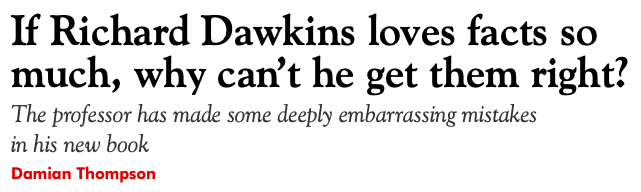
This was recently covered in an article on The Spectator titled, “If Richard Dawkins loves facts so much, why can’t he get them right?” The article summarizes the inaccuracies identified by Heath-Whyte in his chain of tweets.

Screen Shot 2019-09-28 at 2.27.43 PM.png

Here are a few highlights:

‘Well let’s start with “The Utnapishtim story … comes from the Sumerian Epic of Gilgamesh.” WHAT. The version of the Gilgamesh story that contains the flood narrative of Utnapishtim is NOT written in Sumerian, but Babylonian (Akkadian).

‘There are older Sumerian stories about the character Gilgamesh, none of which contain a flood story. There is even a Sumerian flood story too, but it’s not the flood story he’s talking about.

‘It seems he’s talking about a weird mix of one Babylonian flood story about a guy called Atrahasis and another Babylonian flood story about Utnapishtim (the latter being a part of the Babylonian epic of Gilgamesh)…

‘… but come on Dawkins, even Wikipedia could have told you that neither of these were written in Sumerian.’

That’s pretty embarrassing for a man who had just told Krishnan Guru-Murthy that he wants ‘to rid the world of all claims that are not evidence-based’. But Heath-Whyte was just getting into his stride.

‘Problem no. 2: “Arguably the world’s oldest work of literature, [Gilgamesh] was written two thousand years earlier than the Noah story.”

‘So he’s just stated that Genesis was written “during the Babylonian captivity” (sixth century BC), and now he’s stated that (what we assume he means to be) the epic of Atrahasis, or the Babylonian Epic of Gilgamesh, was written 2,000 years earlier – so roughly 2600-2500 BC.

‘Most likely Atrahasis was written less than 1,300 years before the Babylonian captivity, and the version of Gilgamesh that included a flood story was probably finished less than 1,000 years before the Babylonian captivity, and likely quite a few centuries less than a thousand.

From the above-linked article:

Other mistakes identified by Heath-Whyte: Dawkins mixes up the animals in the Gilgamash and Genesis flood stories, and claims that the Sumerian flood legend, like the story of Noah’s Ark, ends with a rainbow. 

‘There’s no rainbow mentioned in any Mesopotamian flood story. Anywhere. There just isn’t,’ says Heath-Whyte, adding that in any case the former Oxford professor for the Public Understanding of Science has misidentified a Sumerian god. 

I think we can take Heath-Whyte’s word for it. Not only can he read the cuneiform in which Gilgamesh is written, but he can also write it.

If These Claims Are Not Historically Accurate, Where Do They Come From?

Continuing from the above-mentioned article:

Just when Dawkins must be wishing that a non-existent God would send a flood to cover his embarrassment, he delivers the killer blow. As he says, even Wikipedia would have put the professor right on these matters. So what was his source? ‘A quick Google search suggests that Dawkins’ source for a lot of this stuff may be a cute little website called HistoryWiz.’

I checked, and he’s right: this is the version of the Gilgamesh as mangled by HistoryWiz, which invites you to ‘step into the past… Let the wizard take you to a different time’. 

Alas, it looks as if you really do have to step into the past in order to consult the wizard. The site is ‘copyright 1998-2008’, there are loads of broken links and the design, c. 2000, is quaintly rudimentary. 

It seems clear that Richard Dawkins and others who make these claims about Gilgamesh are so committed to the conclusion they already religiously believe, that they are not concerned with real scholarship when it comes to creating their narrative.

The “New Atheism,” we might say, is a kind of folk religion which has its own shared beliefs, stories, and mythos, which are not actually based on fact or history.

In my next article I will explain what the Epic of Gilgamesh and Utnapishtim character are, and how we should understand them in relation to the Bible.

Following that, I will discuss the “Jesus Myth” and the theory that what the New Testament says about Jesus is borrowed from ancient Egyptian and Near East mythology. What I hope to show in the end, is that these theories do not hold up to even the most basic fact-checking scrutiny, and are part of a mythos created by New Atheists and other who would try to discredit the Bible and erode faith in it.

A further question which follows from this is: Why are some people opposed to Christianity and the Bible? – a question which I plan to address as well.

Is There a Difference Between “Soul” and “Spirit”?

Every human being has a physical body, yet clearly who we are is not only defined by our bodies. As our bodies age or are damaged, there is something fundamental to who we are which is distinct from our bodies. The Bible tells us that in addition to our physical bodies, as human beings we possess an immaterial spirit and soul.

What can be confusing, however, is what exactly a person’s spirit is, and what their soul is, and how these two relate to each other.

Two Views: Trichotomy and Dichotomy

The Trichitomous view holds that the soul and the spirit are two distinct things, whereas the Dichotomous view holds that soul and spirit are two words which describe two distinct aspects of the same thing, namely the immaterial part of a human being.

Those who hold a Trichotomous view often claim that this three-part human nature is one of the ways in which we have been created in the “image of God” (Genesis 1:26-27). Just as God is a greater trinity of Father, Son, and Spirit, He has created us in his image as a lesser trinity of body, soul, and spirit, says the thrichotomist. This assertion is usually followed by an explanation of what the difference is between soul and spirit. A common explanation is that the soul refers to the mind, encompassing both cognitive and personality-related aspects, whereas the spirit is the part of a person which connects with God. This, it is commonly said by trichotomists, is what distinguishes human beings from animals, who are not created in God’s image; though they have bodies and cognitive abilities (including emotions and personalities), they do not have a spirit, which makes them capable of relationship with God.

There are several passages in the Bible which suggest that there is a separation between the soul and the spirit (Romans 8:16; 1 Thessalonians 5:23; Hebrews 4:12). However, there are also several Bible verses which use the terms soul and spirit interchangeably (Matthew 10:28; Luke 1:46–47; 1 Corinthians 5:3, 7:34).

Hebrews 4:12 says that “the word of God is living and active, sharper than any two-edged sword, piercing to the division of soul and of spirit, of joints and of marrow, and discerning the thoughts and intentions of the heart.” This would suggest that there is a dividing point between the soul and the spirit, but that they are so closely connected that the division of them is something which only God is capable of carrying out.

Advocates of the trichotomist position include James M. Boice, whereas J.I. Packer and John Calvin are some examples of those who hold a dichotomist view.

J.I. Packer’s argument for the dichotomous view

In his book “Concise Theology”, Packer explains the dichotomist view in this way:

Each human being in the world consists of a material body animated by an immaterial personal self. Scripture calls this self a “soul” or a “spirit.” “Soul emphasizes the distinctness of a person’s conscious selfhood; “spirit” carries the nuances of the self’s derivation from God, dependence on Him, and distinction from the body.
Biblical usage leads us to say that we have and are both souls and spirits, but it is a mistake to say that soul and spirit are two different things. (J.I. Packer, Concise Theology, pp. 74)

Packer goes on to explain that the trichotomous view tends to define soul as “an organ of this-worldly awareness,” whereas spirit is a distinct organ of communication with God.

This distinction, Packer argues, can lead to an unhealthy pitting of spirituality against intellectualism, in which intellectual engagement with God is considered “soulish”, i.e. unspiritual, while “spiritual perception” which is unrelated to the study of the Bible or rational thought. Furthermore, he adds that the trichotomous understanding of humanity may lead to a low view of the value of the material world, including our bodies, which would be inappropriate since we are embodied souls, and the hope of the gospel is not that we will escape this physical world, but that we will be resurrected to new and everlasting life in physical bodies.

My response to Packer’s view

I agree with Packer that it is wrong to devalue the physical world. As i have written about recently, this life matters! (See: Suicide, Christianity, & the Meaning of Life)

However, I do not believe that we should decide on theological positions based on fear of what they might lead some people to do. This is the kind of thinking that leads people to avoid teaching the scandalous truth about God’s amazing grace because they are afraid that some people might use it as a license to sin.

I do not believe that we should decide on theological positions based on fear of what they might lead some people to do.

Instead, we ought to develop our theological positions based on Scripture first, considering authorial intent as well as how these things were understood by the early Christians, subsequently applying reason (this is called “theological method”).

It seems dishonest, based on Scripture, to not acknowledge a distinction between soul and spirit. However, I am in agreement with Packer that we must not ever believe or teach that an intellectual pursuit of God is unspiritual, or that seeking God’s will in Scripture is less spiritual than seeking it through “spiritual perception”. Yet, the way the words are used in the Bible leads me to believe that soul and spirit are separate, yet intimately connected aspects of human personhood, the latter of which sets us apart from the animal world.

What are your thoughts on this topic? Do you lean more towards the trichotomous or dichotomous view, and why?

Check out this discussion that Mike Payne, worship pastor at White Fields Church and I recently had on this subject for our church’s YouTube channel: