Celebrating Saint Nicholas

December 6 is Saint Nicholas Day, or the Feast of Saint Nicholas.

Whereas Americans tend to say that Santa Claus comes on Christmas Eve to deliver presents, for Europeans Saint Nick brings chocolate and some gifts on December 6.

“The Real Santa is Dead”

One of my American friends once told me that they don’t do Santa Claus, because they like to keep fairy tales out of their faith. That’s a fair point. However, when it comes to Saint Nicholas, we would do well to not lose the legacy of the historical person as we throw out the proverbial bath water.

To that end, my wife and I have always taken the approach with our kids of telling them about the real Saint Nick: the pastor and theologian who loved and cared for the poor in his community.

We explain to them that the reason there are so many Santas in malls and at events is because Saint Nicholas was such a wonderful person that people want to keep his memory and legacy alive, and they do that by dressing up in that red costume with the beard.

This led to a funny episode once, when we were waiting in line to have our picture taken with a mall Santa, and my son – 5 years old at the time – started talking to another kid in line and told him, “Did you know that the real Santa is dead?!” Needless to say, the kid was surprised and concerned to hear this news!

The Real Saint Nick

Saint Nicholas was born in the 3rd century in the village of Patara, in what is now southern Turkey, into a wealthy family. That’s right: no North Pole nor reindeer for the real Santa, but palm trees and white sand beaches.

His parents died when he was young, and he was taken in and raised by a local priest. Following Jesus’ call to the Rich Young Ruler (Mark 10:21) to “sell what you own and give the money to the poor,” Nicholas dedicated his entire inheritance to assisting the sick, needy and suffering.

He became a pastor, and was later made Bishop of Myra. He became famous for his generosity and love for children.

Nicholas suffered persecution and imprisonment for his Christian faith during the Great Persecution (303-311) under Roman emperor Diocletian.

As a bishop, he attended the Council of Nicaea (325), at which he affirmed the doctrine of the deity of Christ against the Arian heresy.

Homoousios or Homoiousios

The discussion at the Council of Nicaea was summarized by which word to use in describing Jesus’ nature: whether he was homoousios (of the “same substance” as God) or homoiousios (of a “similar substance” as God).

At the the Council of Nicaea, bishops from all over the world gathered to study the scriptures and address the Arian controversy which advocated for the term homoiousios, denying Jesus’ full deity. This view, which is also held today by the Jehovah’s Witnesses, was deemed heretical by the council of bishops based on examination of the Scriptures, which teach that Jesus is Immanuel (God with us), and is true God of true God.

The debate got very heated, and at one point Nicholas reportedly got so upset with he deemed to be blasphemy, that he slapped an Arian.

This is the real Saint Nick: Palm trees and white sand beaches, defender of the faith, and slapper of heretics.

Nicholas died in 343 in Myra. The anniversary of his death became a day of celebration, the Feast of St. Nicholas on December 6.

Where the Tradition of Gift Giving Comes From

Many stories are told about St. Nicholas’ life and deeds. Perhaps the most famous story is that of a poor man who had three daughters of marrying age. Because the man was poor, he was unable to provide a dowry for his daughters, which meant that they would not be able to find a descent husband and would either be married into further poverty or would have to become slaves.

After Nicholas found out about this family’s situation, he visited the family’s house at night, leaving them three anonymous gifts: bags of gold, which he tossed through an open window while the family was sleeping.

The story goes that they found the gold in their shoes when they awoke, which is the reason for the tradition in Europe that Saint Nicholas leaves chocolate in children’s shoes. Nicholas provided for these poor girls to help them break out of the cycle of poverty.

Rather than trying to make Christmas Santa-free, let’s take back the true story of Saint Nicholas and take hold of this opportunity to talk about a Christian man who loved Jesus, championed good theology, and exemplified Christ through compassion and generosity to the needy.


If Satan Has Been Defeated, Why Is He Still “Prowling Around”?

lion painting

In 1 Peter 5:8, Peter the Apostle told us: Be sober-minded; be watchful. Your adversary the devil prowls around like a roaring lion, seeking someone to devour.

This is interesting because in Colossians 2:15, Paul the Apostle tells us that Jesus “disarmed the rulers and authorities and put them to open shame, by triumphing over them.”

If Jesus, through his life, death, and resurrection, defeated and disarmed Satan and the demonic powers, then how is it that the devil is still prowling around like a lion?

A Toothless Lion

Being that Satan has been disarmed, the real danger he poses is his “roar.”

A roar by itself can’t actually hurt you. Similarly, the devil can’t do anything to you without God’s permission (remember Job chapter 1). But whereas the devil needs God’s permission to harm you, you don’t need anyone’s permission to mess up your own life.

Jesus said this about the devil: “there is no truth in him. When he lies, he speaks his native language, for he is a liar and the father of lies.” (John 8:44) Ever since the Garden of Eden, one of the devil’s main strategies for our destruction has been deception. The serpent couldn’t hold Eve down and force her to take a bite of the forbidden fruit in order to destroy her. Instead, he had to talk her into destroying herself by falling into a trap.

For a look at some of the common traps the devil tries to lead us into, check out this message on 1 Peter 5:1-13 titled “Know Your Enemy”

Suffering According to the Will of God

Twice in 1 Peter, Peter speaks about people who suffer according to the will of God.

If Satan has been defeated, then why has God not yet destroyed him? We know that Satan’s fate is sealed: his final demise has been foretold in Revelation 20:10.

But why let him continue to exist and do destructive things, including testing / tempting people? The reason is because although God is not the author of evil, he is a redeemer, who uses bad and even terrible things to accomplish good purposes and carry out his plans.

One of my favorite examples of this is found in the genealogy of Jesus in the first chapter of the Gospel of Matthew, where we see multiple stories of how God redeemed people and situations in the family through which Jesus came. Check out: Redemption: The Knots in Jesus’ Family Tree

For more on this, check out this message on 1 Peter 4:12-19 titled “Suffering and the Will of God”

The Ultimate Humiliation

One of the biggest mistakes people make when it comes to thinking about the devil, is that the devil is God’s counterpart.

When Paul says in Colossians 2 that Jesus put Satan to “open shame” through the cross, he using a metaphor which his ancient readers would have been familiar with: it’s the picture of what a victorious army would do to the soldiers of the army they had defeated. They would not only bind them and lead them, humiliated, through the streets of every town on the road back to their capital, but they would often be sold as slaves.

The ultimate humiliation for a defeated soldier was something they might consider a fate worse than death: being forced to serve as a slave those by whom they had been defeated. This, Paul says, is what God now does with the devil: in his sovereignty and providence, what God allows the devil to do, He then uses to accomplish good and His purposes.

Mike and I discussed this in more depth in our Sermon Extra video this week. Check it out:

Is Abuse Grounds for Divorce According to the Bible?

art blur close up colors

In Matthew 19 we read about a time when some Pharisees came to Jesus to test him. They asked, “Is it lawful for a man to divorce his wife for any and every reason?” (Matthew 19:3)

The Pharisees, as usual, were attempting to trap Jesus with a no-win question, so that no matter what answer he gave, it would cause him to lose some of his followers. In the Law of Moses, Moses had allowed divorce for the reason of “uncleanness.” Human nature being what it is, people took advantage of the fact that the term “uncleanness” was open to interpretation, and they used it as a loophole, which afforded them the opportunity to “technically” keep the letter of the Law, while ignoring the heart of the Law. By the time of Jesus, people were in the practice of saying that basically anything could constitute “uncleanness,” for example: if a man saw a woman who was more beautiful than his wife, he could say that his wife was “unclean” in comparison to the other woman, and use that as grounds for divorce. If a man got angry at his wife, he could accuse her of being “unclean,” because her actions had caused him to sin by being angry.

The Big Two

Jesus combatted this flippant attitude towards marriage and divorce by taking people back to the design for marriage shown in creation, adding that divorce is permissible in cases of adultery.

Paul, in 1 Corinthians 7:15, gave another justification for divorce: abandonment.

Historically, Christians have recognized these two reasons as the two biblical grounds for divorce. The Westminster Confession of Faith, Chapter 24, Paragraph 6 states that “nothing but adultery, or such willful desertion as can no way be remedied by the church, or civil magistrate, is cause sufficient of dissolving the bond of marriage.”

What About Abuse?

Certainly God hates abuse. Throughout the Old Testament, God shows himself to be a God who is on the side of the abused and opposes abusers. In the prophetic books, such as Amos, when his own people become abusers, God makes it clear to them that because of what they are doing, He is opposed to them, and He calls them to repent and actively work for the welfare of the weak, the vulnerable, and the oppressed.

However, since abuse is not specifically mentioned in the Bible as a grounds for divorce, some Christians have wondered what the protocol should be for those in abusive marriages.

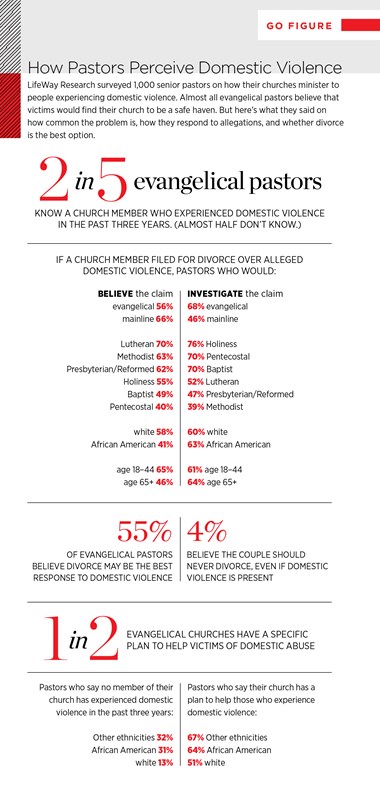
What’s important to note, is that even amongst those who do not believe that abuse is a biblical justification for divorce, almost no one would ever recommend a spouse to stay in an abusive relationship. According to a LifeWay Reseach survey, 96% of pastors recommend at minimum: separation, protection (such as restraining orders), and church discipline (for the abuser) in cases of abuse.

While it is quite alarming that 4% of the pastors polled said that a spouse should stay in an abusive relationship even when violence is present, it is important to note that even amongst those who do not believe that abuse is biblical grounds for divorce, the majority do advocate for separation. Assumedly, those who advocate for separation but not divorce are hopeful that repentance and restoration are possible and are committed to a high view of the authority of Scripture, believing that the Bible only gives the two justifications for divorce listed above.

Wayne Grudem and “in such cases”

Amongst those who have sought to identify a biblical justification for divorce in cases of abuse, most point to 1 Corinthians 7:15, which speaks about one spouse abandoning the marriage. The argument goes that abuse constitutes a form of abandonment. Many people, even those who hate abuse, find this line of thinking to be contrived and unconvincing.

Recently prominent theologian Wayne Grudem, Professor of Theology and Biblical Studies at Phoenix Seminary, announced at the annual meeting of the Evangelical Theological Society (ETS) that he had changed his position on divorce in cases of abuse based on his study of 1 Corinthians 7:15.

While he is still not persuaded by the “abuse is a kind of desertion” argument, he believes that another phrase in 1 Corinthians 7:15 presents a compelling argument for divorce in cases of abuse, namely the phrase, “in such cases” (ἐν τοῖς τοιούτοις).

But if the unbelieving partner separates, let it be so. In such cases the brother or sister is not bound. (1 Corinthians 7:15)

The question is, does this phrase refer to: 1) only cases of desertion by an unbeliever, or 2) cases in which a spouse has done something that has similarly destroyed a marriage?

Interestingly, this Greek phrase does not occur anywhere else in the New Testament or the Septuagint (the Greek translation of the Old Testament), but there are several uses of it in Ancient Greek literature, including 52 from the same time period as the New Testament. There are also several uses of the singular version of the word τοιοῦτος (“in this case”) in the New Testament.

Grudem’s analysis of the uses of these words in the Bible and in other Greek writings from the same time period has led him to the conclusion that “in such cases” refers to the cases in which a spouse has done something which, similar to abandonment, has destroyed a marriage, and that in such cases the latter part of 1 Corinthians 7:15 applies: the abused spouse is no longer bound, i.e. may divorce.

Grudem’s analysis has been met with very little criticism. You can read the outline of the presentation here, which includes a look at the different texts which use this phrase “in such cases” and what it means in those contexts, and why these led Grudem to change his position.

Looking for Loopholes or for the Heart of God

At worst, this could be used in the same way people used the idea of “uncleanness” in Jesus’ day: as carte blanche or a loophole big enough to drive a truck through. The same could be said though of the teachings of grace and forgiveness in the Bible, yet we must not reject nor downplay them just because they might be hijacked or misused – and I believe the same applies here.

Reader Questions: How Accurate are Bible Translations?

ancient antique architectural design architecture

I recently added a page on this site where readers can submit questions or suggest topics (click here for that page). Recently I received this question:

Hi Pastor Nick. I have heard you talk about your study of other languages and various Bible translations. Can you help me with a response to a Jewish man who is convinced the English translation is completely inaccurate and can’t be trusted?

Bible Translation Basics

I wrote a series on Bible Translation to explain some of the inherent difficulties in doing it, as well as some relevant issues related to some particular English translations:

  1. Making Sense of Different Bible Translations – Part 1
  2. Making Sense of Different Bible Translations – Part 2: the King James Bible
  3. Making Sense of Different Bible Translations – Part 3: Gender-Inclusive Language and the NIV

Response to the Question

I would start by asking which English translation he thinks cannot be trusted, and my next question would be why he believes they cannot be trusted.

There is not just one English Translation of the Bible, but hundreds of translations – many of which have been carried out by teams of scholars whose work was then reviewed, checked, proofread and scrutinized by other scholars in order to assure accurate translation.

Basically, his claim that a translation of the Bible into English (or presumably any language?) is not trustworthy is intellectually untenable.

These translations are made by groups of scholars who have devoted their lives to studying these ancient languages, cultures, and beliefs. Furthermore, there have been multiple groups over the past 2000 years who have translated the Scriptures into various languages, and these translations all say the same things. Where they differ is based on different possible translations of words or phrases in the original language, but there are a finite number of options, and the options are usually recorded in the footnotes or in textual commentaries. All that would be needed in order to refute a translation would be someone who could prove that they are in error. So a challenge to anyone who claims that a particular translation is not trustworthy or accurate would be to simply invite them to make their case publicly, and contribute their insights and knowledge to help make a better translation!

What is Inspired: the Original Text or the Translation?

It should be noted that we as Christians believe the original texts to have been inspired by God, not the copies or translations.

Article X of the 1978 Chicago Statement on Biblical Inerrancy explains it this way:

WE AFFIRM  that inspiration, strictly speaking, applies only to the autographic text of Scripture, which in the providence of God can be ascertained from available manuscripts with great accuracy. We further affirm that copies and translations of Scripture are the Word of God to the extent that they faithfully represent the original.

WE DENY  that any essential element of the Christian faith is affected by the absence of the autographs. We further deny that this absence renders the assertion of Biblical inerrancy invalid or irrelevant.

However, this does not mean we cannot or should not translate the Scriptures into languages other than the originals – to the best of our collective abilities – in order that people who do not speak ancient Hebrew and Greek (the vast majority of the world’s population) can understand God’s Word to them.

Bible Translation Has Precedent: the Septuagint and Jesus

Lastly, there is precedent in Scripture itself for the translation of the Bible into other languages. The Septuagint was the Greek translation of the Hebrew Bible, and it was widely used in antiquity. The New Testament writers often quote from the Septuagint and record Jesus as having quoted from the Septuagint. Being that Aramaic was widespread in Israel at the time of Jesus, we can be quite sure that Jesus would have spoken to crowds in Aramaic, meaning that when he referenced or quoted from the Hebrew Bible (AKA Old Testament), he would have translated those verses into Aramaic.

In conclusion, we can be quite confident in the translations that we have in English and other languages. While it may be helpful to acquaint yourself with the original languages, you can be sure that when you read your English translation of the Bible, you are getting the essence of the original text and its meaning, especially if you are supplementing your reading with textual commentaries.

What Does It Mean that “Judgment Begins at the Household of God”?

inside photography of church

In 1 Peter 4:17, Peter makes an interesting statement; he says: “For it is time for judgment to begin at the household of God; and if it begins with us, what will be the outcome for those who do not obey the gospel of God?”

Judgment might seem like an odd word to use in regard to the people of God… Hasn’t Jesus already taken our judgment upon himself on the cross? What is Peter referring to here, and how should we understand this statement?

The Waters That Buried Some, Lifted Others

In 1 Peter chapter 3, Peter referred to the judgment that took place in the time of Noah, and said that the waters of that flood were a type, or a picture, of baptism. The judgment of the flood, which was a judgment upon human wickedness, did effect, touch, and impact even those who were believers. However, because those believers were in the ark, the waters of the flood did not crush them, but rather lifted them up.

The ark, in this case, is a picture of Jesus. When we climb into Him by faith, and are hidden in Him, He takes the brunt of the storm of God’s judgment, which, apart from Him, we would not be able to survive on our own. As we are in Him, the waters which destroyed those outside the ark actually serve to lift us up and they have a cleansing and purifying effect.

The Fire That Destroys Some, Purifies Others

Along with water, Peter uses another word-picture in this letter: fire, which is used to purify precious metals, like gold.

Paul uses this same analogy in 1 Corinthians 3, where he talks about how our actions in this life will be tested by God as by fire; those things which were pure in motive will withstand the test, and those good things we might have done for the wrong reasons will be burned away like wood, hay and stubble.

Essentially, Peter is saying that the judgment of God will have the effect on believers, not of destroying them, but of purifying them, and clarifying who is really in the faith.

This makes sense, especially in light of the fact that earlier in the same chapter (1 Peter 4:1-4), Peter called his readers to holiness and to separate themselves from the sins which formerly enslaved them.

Malachi’s Prophecy

In his commentary on 1 Peter, Edmund Clowney says that in these verses (1 Peter 4:12-19), Peter is alluding to a prophecy of Malachi:

See, I will send my messenger, who will prepare the way before me. Then suddenly the Lord you are seeking will come to his temple; the messenger of the covenant, whom you desire, will come,’ says the Lord Almighty. But who can endure the day of his coming? Who can stand when he appears? For he will be like a refiner’s fire or a launderer’s soap. He will sit as a refiner and purifier of silver; he will purify the Levites and refine them like gold and silver. (Malachi 3:1-3)

God’s judgment has a double purpose: to purify his worshipers and to consume the wicked.

In Hebrews 12, the writer says that it is proof of God’s fatherly love for us that He disciplines us.

Rather than cleansing us in purgatory, God’s cleansing of his people is a process which takes place in this life through our trials. Our suffering in this life does not atone for our sins, Jesus’s suffering did that for us, but God uses our trials in order to form us into the image of Christ (cf. Romans 8:29), purify us like gold, and prepare for us a weight of glory to be revealed.

Further Discussion

https://twitter.com/DominicDone/status/1199788112060112896

This week Mike and I sat down to discuss this verse in more detail. One of the things we talked about was how persecution and hardship has the effect of purifying the church and “weeding out” those who have come to Jesus for the wrong reasons. One example we bring up is my experience with the Roma (Gypsy) population in Hungary and the false promises of the “prosperity gospel.” Check it out:

Did Jesus Go to Hell?

night dark halloween horror

The Apostles’ Creed, one of the oldest Christian creeds – in continual existence since at least the 4th Century A.D. – contains a line which many people have found intriguing: it declares that Jesus “descended to the dead.”

Older translations of the original text into English sometimes translate this phrase as saying that Jesus “descended into Hell.”

Looking at the creed in ancient languages is interesting as the Greek text says: κατελθόντα εἰς τὰ κατώτατα, which means: “descended to the bottom” – and the Latin text says: descendit ad inferos, the word inferos being translated as “Hell.”

More recent translations into English have chosen to say “descended to the dead” rather than “descended into Hell” as “the dead” would be more accurate biblically and theologically than “Hell.” The reason for this is based on a particular understanding of “Sheol” in the Old Testament and the Jewish mind, which was the dwelling place of all souls, being divided (according to Luke 16:19-31) into two parts: Abraham’s Bosom and Hades, AKA: Hell.

Abraham’s Bosom, it is believed, was a place of comfort for those who died in faith, i.e. the “Old Testament saints,” such as those described in Hebrews 11, who died prior to the redemptive actions of Jesus. The theory, therefore, is that 1 Peter 3:19 and 4:6, Peter is describing how Jesus went to Sheol after his death on the cross but prior to his resurrection, and declared to the deceased souls held there what he had accomplished in his life and death. This message would have been a message of redemption and release from Sheol, to the immediate presence of God, to those who were kept in Abraham’s Bosom awaiting the redemptive work of the Messiah, and a message of condemnation for those held in the Hades/Hell portion of Sheol.

I have written more about this here: Did People Go to Heaven Before Jesus’ Death & Resurrection?

I also explain this in some detail in this past Sunday’s sermon from 1 Peter 3:18-4:11 – The Resurrected Life. The part that deals with this topic begins around 17:30.

However, there are several different, and possible, interpretations of these verses which Mike and I discussed and outlined in this week’s Sermon Extra video. It’s worth watching, as we discuss different views, such as that this speaks to Jesus preaching to demons related to the Nephilim in Genesis 6, Jesus preaching through Moses, etc.:


Does God Want You to Be Happy?

silhouette photography of group of people jumping during golden time

Maybe you’ve heard someone say it before: “God doesn’t care about your happiness, he cares about your holiness.”

Is that true? I don’t believe so.

Recently at White Fields, I taught on the subject of holiness from 1 Peter 1:13-25. You can listen to the message here: 1 Peter 1:13-25, “The H Word”. As I talked about holiness, I made the claim that the reason why God wants us to be holy is because holiness leads to happiness, and God wants us to be happy.

Holiness vs Happiness?

I have sometimes heard people say things along these lines: The world offers happiness, but God doesn’t care about your happiness, He cares about your holiness!

I completely disagree. Not only does it send the absolute wrong message, it is not accurate biblically.

Sometimes people think that holiness is opposed to happiness. “The worse something makes me feel, the better,” this thinking goes, “because the more miserable I am, the more holy and godly I must be,”

Friends, that is not holiness, that is self-righteousness.

While there may sometimes be an aspect of self-denial involved in holiness, the purpose of that self-denial is because it will lead to more happiness, not less, in the end. I will elaborate on the relationship between self-denial and happiness in a future post.

For Christians to pit holiness and happiness against each other is a fundamental error, and a misrepresentation of the heart of God and the gospel.

Jesus: Holy and Happy

In Hebrews 1:9, we are told that Jesus was: 1) holy (he loved righteousness and hated wickedness), and 2) the happiest person who ever lived (anointed with the oil of gladness beyond all his companions).

Furthermore, this verse tells us that Jesus’ happiness was the direct result of his holiness (“therefore…”).

Holiness is not opposed to happiness, rather holiness is the pathway to happiness.

Therefore, when God says “be holy as I am holy” – he is inviting us to be happy as he is happy!

But Isn’t “Joy” Different than “Happiness”?

Sometimes people have tried to make a distinction between “joy” and “happiness.” They claim that whereas “happiness” is momentary and fleeting, “joy” is something which is unemotional and doesn’t depend on circumstances.

Furthermore, this line of thinking tends to say that “happiness” is what “the world” has, but “joy” is something that only Christians can have.

This is a false dichotomy. It is well-intentioned, but incorrect, both linguistically and biblically.

Joy and happiness are synonyms. Not only does Jesus use the word “happy”, but it is found throughout the Bible. Furthermore, the Bible talks about the “joy” of the wicked (see Job 20:5), and it talks about the Pharisees having “joy” when Judas betrayed Jesus.

Consider this quote from Joni Eareckson Tada:

“We are often taught to be careful of the difference between joy and happiness. Happiness, it is said, is an emotion which depends on what happens to you. Joy, by contrast is supposed to be enduring, stemming from deep within our soul, and which is not affected by circumstances surrounding us. I don’t think God had any such hairsplitting in mind. Scripture uses the terms interchangeably along with words such as “delight”, “gladness”, “blessing”. There is no scale of relative spiritual values applied to any of these. Happiness is not relegated to fleshly minded sinners nor joy to heaven-bound saints.”

Our Happy God

1 Timothy 1:11 says: “…in accordance with the gospel of the glory of the blessed God with which I have been entrusted.” (1 Timothy 1:11)

The word translated “blessed” is the Greek word markariou, which means: “happy”. In other words, a direct translation of the Greek text would be: “…our HAPPY God”

Furthermore, this word makarios (Greek for “happy”) is found in other places:

Happy are those whose sins are forgiven, whose wrongs are pardoned. Happy is the one whom the LORD does not accuse of doing wrong and who is free from all deceit. (Psalm 32:1-2 GNT)

Happy are those who reject the advice of evil people, who do not follow the example of sinners or join those who have no use for God. Instead, they find joy in obeying the Law of the LORDand they study it day and night. (Psalm 1:1-2 GNT)

Lost in Translation

As to why the English translators of the Bible in the Middle Ages chose to translate the word “makarios” as “blessed” rather than “happy” is because they considered the word “happy” to be too trite, and not religious-sounding enough. However, in the process, we have lost the sense of mirth that these words were originally intended to have!

In other languages, such as Hungarian, the word “markarios” is translated as “boldog” – which is the normal Hungarian word for “happy”, rather than the word “áldott” which means “blessed”. This more faithful and straight-forward translation conveys the heart and feeling of happiness which has been lost in translation for those of us who read in English.

Charles Spurgeon and Amy Carmichael on God and Happiness

Amy Carmichael was a missionary to India who worked with exploited girls in horrendous situations, and rescued over 1000 of them in the name of Jesus. She spent the final 20 years of her life mostly bedridden. Here’s what she said during that time:

“There is nothing dreary or doubtful about this Christian life. It is meant to be continually joyful. We are called to a settled happiness in the Lord, whose joy is our strength.”

Charles Spurgeon, “The Prince of Preachers” asserted:

“God made human beings to be happy.”

“My dear brothers, if anyone in the world ought to be happy, we are those people. How boundless our privileges, how brilliant our hopes!”

Redeeming the Word

The problem is not with the pursuit of happiness, it is with the pursuit of happiness in the wrong places and in the wrong ways. This is the essence of sin. But rather than throwing out the baby (happiness) with the bathwater (sin), we should redeem this wonderful word which is truly ours as the people of God, and pursue holiness and happiness – the former leading to the latter.

Resources

Randy Alcorn wrote a fabulous book on this subject, which I highly recommend: Happiness by Randy Alcorn

Check out this video in which Mike and I discuss happiness and God:

Here is the video of my sermon from 1 Peter 1:13-25: “The H Word”:


Is There a Difference Between “Soul” and “Spirit”?

Every human being has a physical body, yet clearly who we are is not only defined by our bodies. As our bodies age or are damaged, there is something fundamental to who we are which is distinct from our bodies. The Bible tells us that in addition to our physical bodies, as human beings we possess an immaterial spirit and soul.

What can be confusing, however, is what exactly a person’s spirit is, and what their soul is, and how these two relate to each other.

Two Views: Trichotomy and Dichotomy

The Trichitomous view holds that the soul and the spirit are two distinct things, whereas the Dichotomous view holds that soul and spirit are two words which describe two distinct aspects of the same thing, namely the immaterial part of a human being.

Those who hold a Trichotomous view often claim that this three-part human nature is one of the ways in which we have been created in the “image of God” (Genesis 1:26-27). Just as God is a greater trinity of Father, Son, and Spirit, He has created us in his image as a lesser trinity of body, soul, and spirit, says the thrichotomist. This assertion is usually followed by an explanation of what the difference is between soul and spirit. A common explanation is that the soul refers to the mind, encompassing both cognitive and personality-related aspects, whereas the spirit is the part of a person which connects with God. This, it is commonly said by trichotomists, is what distinguishes human beings from animals, who are not created in God’s image; though they have bodies and cognitive abilities (including emotions and personalities), they do not have a spirit, which makes them capable of relationship with God.

There are several passages in the Bible which suggest that there is a separation between the soul and the spirit (Romans 8:16; 1 Thessalonians 5:23; Hebrews 4:12). However, there are also several Bible verses which use the terms soul and spirit interchangeably (Matthew 10:28; Luke 1:46–47; 1 Corinthians 5:3, 7:34).

Hebrews 4:12 says that “the word of God is living and active, sharper than any two-edged sword, piercing to the division of soul and of spirit, of joints and of marrow, and discerning the thoughts and intentions of the heart.” This would suggest that there is a dividing point between the soul and the spirit, but that they are so closely connected that the division of them is something which only God is capable of carrying out.

Advocates of the trichotomist position include James M. Boice, whereas J.I. Packer and John Calvin are some examples of those who hold a dichotomist view.

J.I. Packer’s argument for the dichotomous view

In his book “Concise Theology”, Packer explains the dichotomist view in this way:

Each human being in the world consists of a material body animated by an immaterial personal self. Scripture calls this self a “soul” or a “spirit.” “Soul emphasizes the distinctness of a person’s conscious selfhood; “spirit” carries the nuances of the self’s derivation from God, dependence on Him, and distinction from the body.
Biblical usage leads us to say that we have and are both souls and spirits, but it is a mistake to say that soul and spirit are two different things. (J.I. Packer, Concise Theology, pp. 74)

Packer goes on to explain that the trichotomous view tends to define soul as “an organ of this-worldly awareness,” whereas spirit is a distinct organ of communication with God.

This distinction, Packer argues, can lead to an unhealthy pitting of spirituality against intellectualism, in which intellectual engagement with God is considered “soulish”, i.e. unspiritual, while “spiritual perception” which is unrelated to the study of the Bible or rational thought. Furthermore, he adds that the trichotomous understanding of humanity may lead to a low view of the value of the material world, including our bodies, which would be inappropriate since we are embodied souls, and the hope of the gospel is not that we will escape this physical world, but that we will be resurrected to new and everlasting life in physical bodies.

My response to Packer’s view

I agree with Packer that it is wrong to devalue the physical world. As i have written about recently, this life matters! (See: Suicide, Christianity, & the Meaning of Life)

However, I do not believe that we should decide on theological positions based on fear of what they might lead some people to do. This is the kind of thinking that leads people to avoid teaching the scandalous truth about God’s amazing grace because they are afraid that some people might use it as a license to sin.

I do not believe that we should decide on theological positions based on fear of what they might lead some people to do.

Instead, we ought to develop our theological positions based on Scripture first, considering authorial intent as well as how these things were understood by the early Christians, subsequently applying reason (this is called “theological method”).

It seems dishonest, based on Scripture, to not acknowledge a distinction between soul and spirit. However, I am in agreement with Packer that we must not ever believe or teach that an intellectual pursuit of God is unspiritual, or that seeking God’s will in Scripture is less spiritual than seeking it through “spiritual perception”. Yet, the way the words are used in the Bible leads me to believe that soul and spirit are separate, yet intimately connected aspects of human personhood, the latter of which sets us apart from the animal world.

What are your thoughts on this topic? Do you lean more towards the trichotomous or dichotomous view, and why?

Check out this discussion that Mike Payne, worship pastor at White Fields Church and I recently had on this subject for our church’s YouTube channel:

Suicide & Salvation

monochrome photo of woman sitting on floor

In response to my post, “Suicide, Christianity, & the Meaning of Life”, I received the following question from a reader:

I’m wondering about your thoughts on people who are mentally ill, followers of Christ, and decide to commit suicide. Do you think they go to heaven? In your post you said that suicide is equal to the sin of murder. This is something I’ve wrestled with for a long time now.

Mental Illness, Fallen Nature, and Spiritual Warfare

More people die from suicide than from homicide in America. Sadly, mental illness and suicide touch many lives, not only those who suffer from mental illness or struggle with suicidal thoughts, but also the lives of those who love them and are connected to them.  Mental illness often distorts the thinking and perception of those who struggle with it, leading them to feel alone and without hope, even when this is not the case.

Certainly, in addition to physiological disorders and imbalances in the brain, which themselves are the result of the fallen human condition, our minds are the chief battlefield upon which spiritual warfare is waged, with “the enemy of our souls,” the one who seeks to steal, kill, and destroy, attacking our thought life with lies and destructive suggestions.

The word “satan” comes from Hebrew, and means “adversary”. The word “devil” comes from Greek, and means “accuser” or “slanderer”. One of the ways the devil attacks us is by throwing our sins and shortcomings in our face. Whereas the devil is an “accuser”, Jesus is our advocate before the Father (1 John 2:1). Another way the devil attacks us is by telling us lies; Jesus said about the devil that “there is no truth in him. When he lies, he speaks his native language, for he is a liar and the father of lies.” (John 8:44)

It is significant therefore, that when Paul talks about taking up the “armor of God” to help us withstand “the schemes of the devil”, he includes the “helmet of salvation”, which protects the believer’s head (Ephesians 6:10-20). One of the best things we can do to combat the lies of the enemy is to become intimately familiar with God’s truth and who He says we are.

Sin and Salvation

Suicide, without a doubt, is a grave sin, equal to murder. However, does such a sin cause a person to lose their salvation? Since salvation is not something that can be earned in the first place by our good actions (or lack of bad actions), it is not something we can lose  by our bad actions.

The Bible teaches that those who have been redeemed by God have been forgiven of all of our sins: past, present, and future (Colossians 2:13-14). This means that I do believe it is possible that if a true Christian were to commit suicide in a moment of extreme weakness, they would be received into Heaven.

What About 1 Corinthians 3:16-17?

1 Corinthians 3:16-17 says, “Do you not know that you are God’s temple and that God’s Spirit dwells in you? If anyone destroys God’s temple, God will destroy him. For God’s temple is holy, and you are that temple.”

This verse has sometimes been used to say that those who commit suicide will be destroyed by God, i.e. receive eternal judgment and not salvation. The problem with using this verse in this way, is that this verse is not talking about suicide.

While 1 Corinthians 6:19-20 argues for individual holiness on the basis of the fact that, as believers in whom God’s Spirit dwells, we are the temple of the living God, in 1 Corinthians 3:16-17 Paul is talking about the church corporately as the temple of God. This is similar to what Peter says in 1 Peter 2:5, where he says, “you yourselves like living stones are being built up as a spiritual house, to be a holy priesthood, to offer spiritual sacrifices acceptable to God through Jesus Christ.” The picture Peter paints is that we are each individual stones who come together to form the temple of God; God, thus, makes his habitation in the midst of the congregation, not in special buildings built by human hands (cf. Acts 7:48, 17:24)

The problem we have in modern English is that we use the same word, “you”, for both the second person singular and the second person plural (y’all or you guys – depending on where you’re from), so a simple reading in our modern vernacular doesn’t tell us if a verse is directed towards us as individuals or to a collective group. 1 Corinthians 3:16-17 uses you in the second person plural, meaning that Paul is speaking of those who destroy God’s temple as those who destroy the Body of Christ, the Church. This is also clear from the context of 1 Corinthians 3, where Paul is talking about the importance of unity in the Body of Christ.

Thus, 1 Corinthians 3:16-17 is a warning about how seriously God takes attacks against the Church, not a warning aimed at those who are considering suicide.

A Word of Caution

My purpose in writing this post is only to bring clarity to a theological question and perhaps some hope to those who have had believing loved ones who suffered from mental illness and/or great spiritual attack, and in a moment of great weakness decided to do something awful and end their lives.

My fear is that in writing this I might give justification to someone who is considering committing suicide, but has been kept from doing so out of fear of Hell.

Let me be clear: what I have written here is my best attempt at faithfully exegeting and making sense of what the Scriptures say. I could be wrong.

I will say this: to entertain suicidal thoughts is sin. It is to entertain ideas of taking your life into your own hands, rather than honoring God as Lord and master of your life. He deserves that role both as a result of creation and salvation; you are not your own, you belong to Him (1 Corinthians 6:19-20).

Furthermore, the markers of person who has been regenerated by God’s Spirit is that their life is characterized by hope and by a mission. While there may be times when a person experiences extreme feelings of hopelessness for various reasons, there is hope, and God has a purpose with your life.

Help is available for those who are struggling. You can contact me directly here, or call the U.S. National Suicide Prevention Hotline if you need someone to talk to immediately: 1-800-273-8255

Suicide, Christianity, & the Meaning of Life

Image result for martyr

If – as the Bible teaches – when a believer dies, their soul goes to be with God, where there is no longer any suffering, pain or sickness, then why would we not want to speed up the process a little bit? After all, as Paul the Apostle wrote to the Philippians, “My desire is to depart and be with Christ, for that is far better” (Philippians 1:23). Why not take up smoking, stop using sunscreen, and give up wearing seatbelts? Or, to take it even further, why not just go all the way and end your life now, so you can leave this harsh world behind and go to Heaven?

If that sounds preposterous, keep in mind that this was something that actually happened in early Christian history: there was a time when committing suicide became fashionable among Christians, and the church had to respond and try to end this tragic fad.

When Christians Were Killing Themselves

Until the Edict of Milan, AKA the Edict of Tolleration was issued in 313 AD, Christianity’s status in the Roman Empire was that of religio illicita, an “illicit” or illegal religion (as opposed to Judaism, which held the status of religio licita)During this time, Christians throughout the Roman Empire experienced waves of persecution, usually dependent on the attitudes of local authorities, although there were times when persecution was the official policy of the entire empire – such as during the reigns of Nero and Diocletian. Christians also faced persecution outside the Roman Empire.

During this period, many Christians were martyred, and martyrs were highly regarded and respected as those who had been willing to pay the ultimate price for their faith. In fact, martyrdom was so highly regarded, that people began to seek it out and desire it, as a way of expressing their devotion to Jesus. Ignatius of Antioch, for example, wrote about his desire to die as a martyr.

But some people took it even further. Jerome writes about a young woman named Belsilla who flagellated herself so much that she died from her self-imposed injuries. Another woman, Agathonike, upon witnessing the execution of a bishop by burning, also threw herself onto the fire, declaring “this is the meal that has been prepared for me.” She died in the flames, even though she had not been arrested nor charged. There are other accounts of Christians volunteering to be martyred even though they were not even being sought by the authorities. [1]

The Donatists, who considered themselves particularly hard core and dedicated, greatly desired to show their devotion by being martyred, some even going to the point of simply killing themselves to show how spiritual they were, i.e. how much they were not attached to this life and how much they desired to depart this world and be with Christ.

The Response of the Church

Seeking martyrdom and committing suicide became such a big issue with the Donatists in particular that it threatened the credibility, and even the existence of the church in their area of North Africa.

Judaism had always considered suicide to be sinful, whereas in pagan Roman culture it was considered an acceptable way to exit this life, and was practiced mostly by the wealthy, in part because slaves were not allowed to commit suicide since their lives did not belong to them, but rather to their masters.

It was Augustine of Hippo, a native of North Africa himself, who took up the challenge of addressing this issue and clarifying Christian thinking on this subject. In his book ‘The City of God’, Augustine considered what the Bible has to say about suicide and weighed various arguments for and against suicide. His conclusion was that suicide is always wrong as it is a violation of the sixth commandment (“Thou shall not murder”), and is never justified even in extreme circumstances. This became the official position of the church. [2]

The Meaning of Life

This whole issue touches on something which is core to Christian belief, and which sets Christianity apart from other worldviews and religions.

Many world religions view the world negatively, as a place of chaos, pain, and suffering – where the goal is to escape. This is the goal of transcendence and Nirvana in Eastern philosophies and religions, for example.

Christianity on the other hand, views this world positively. Rather than seeing the origin of the world as having come about through conflict or chaos, it is described as the thoughtful and good creation of a loving God. It is described as a garden paradise, given to us as a gift by our loving creator.

Although this good creation has been corrupted by sin and world currently “lies under the power of the evil one” (1 John 5:19), the world still retains its fundamental goodness, and God has promised that one day He will redeem His creation.

The purpose of our lives, according to the Bible, is not to escape this world, but to steward this world (Genesis 1:28), as well as our lives and everything we’ve been given, to the glory of God and for the benefit and salvation of others. In other words: the people of God have been given a mission which can only be carried out in this life, and therefore this life matters greatly. Rather than escaping this world, His desire for us is to be about His business as long as we live.

It is an unbiblical an anemic theology of life and the world which leads to the attitude that the most spiritual thing to do is to bide your time as you wait to get out of this world to be with God. True spirituality is rather to value this life and the unique opportunities it affords to do the work of God, and be involved in his saving and redeeming work.

As Paul wrote to the Thessalonians: For God has not destined us for wrath, but to obtain salvation through our Lord Jesus Christ, who died for us so that whether we are awake or asleep we might live with him. (1 Thessalonians 5:19)

Between now and the end of our lives, there is a whole space that is significant. How you live it matters greatly to God. There are things he wants you to do with that time (cf. Ephesians 2:10). The Christian life, in other words, is not simply waiting to die so you can go to Heaven. God has given you this life for a purpose and He wants to use you to advance His Kingdom and to touch lives. He values our lives, and so should we!