What is a Beatitude?

man jumping from a rock

The Beatitudes are the name given to the opening lines of Jesus’ “Sermon on the Mount”, found in the Gospel of Matthew 5:3-12. They consist of 9 statements which all begin with the words “Blessed are…”

So what exactly is a “beatitude”?

Not the Be-Attitudes

One common explanation is that the beatitudes are the “be-attitudes”, i.e. “the attitudes you should be.”

Not only is this atrocious grammatically, it’s also incorrect linguistically.

The Happy Sayings

The word beatitude comes from the Latin word beati, which means “happy”, because in the Latin Vulgate translation of the Bible, each of these sayings begins with the word, “Beati” or “Happy are…”

In the original Greek, each of these sayings begins with the word makarios, which also means “happy”.

The beatitudes, therefore, are not a laundry list of attitudes you need to muster up, rather they are a group of sayings, in which Jesus shows us the pathway to true happiness.

Blessed or Happy?

The English translators of the Bible chose to translate the word makarios as “blessed” instead of “happy”.

Other languages, however, retained the simple, straight-forward translation of makarios as “happy” – such as the other language I speak: Hungarian, which translates it as “boldog”, the regular word for “happy”, as opposed to the word “áldott” which means “blessed”. In Hungarian, the beatitudes are called “A Boldog Mondások”, literally “the happy sayings” – which is what beatitudes actually means.

Recently I was teaching at Ravencrest Bible College in Estes Park, and asked a student from Scandinavia how her Bible translated it, and sure enough, makarios was translated as a word meaning “happiness” rather than one referring to “blessedness”.

So, why did the English translators of the Bible translate makarios as “blessed” rather than as “happy”? Many people believe that it was because they felt that the word “happy” was too trite, and not religious enough. Some English translators have translated makarios as “happy” – such as the Good News Translation, but most have kept with the tradition of using “blessed” instead because it is so engrained in the English linguistic heritage.

However, I believe that translating makarios as “blessed”, something is lost in translation. The word “happy” has a different tone than the word “blessed”. After all, you can be blessed without being happy. Blessed doesn’t communicate elationit doesn’t evoke the image of a smile on your face and lightness in your heart!

When Jesus spoke these words, he was using a word that was common and relatable, and not a religious word: “happy”!

The Pathway to Happiness

The beatitudes would have been surprising to their original hearers! They would have caused people to do a double-take, and listen closely, perhaps wondering if maybe they had misunderstood Jesus in what he said!

Think about it:  “Oh how happy are the poor in spirit.”  “Oh how happy are you who weep.”

The first listeners would have said, Wait…what?! Poor people aren’t happy! People who weep are literally NOT happy!

It was a set-up, for Jesus to instruct them about his “upside-down kingdom”.

In the beatitudes, the “happy sayings”, Jesus is laying out the pathway to true and lasting happiness. Unlike what many people in the world popularly believe about how to attain happiness, Jesus shows us the true and better way:

Happiness begins, Jesus said, with recognizing and acknowledging your spiritual poverty, and then weeping over that spiritually poor condition. It continues by you humbling yourself before God and hungering and thirsting after righteousness: which if you do, God will give to you as a gift of his grace (His righteousness, not your own!).

For more on how the beatitudes, the “happy sayings”, show the pathway to happiness, check out this message I taught on this section called “How to Be Happy – Matthew 5:1-12”

May we be those who hear what Jesus has to say in these Happy Sayings, and may we follow him down the pathway to true, lasting happiness, which begins with humility and repentance!


Further Reading

Is Christianity About Denying Yourself or About Being Happy?

woman wearing grey long sleeved top photography

Jesus said that his desire was that we would have his joy in us, and that our joy would be complete (John 15:11). He also told his disciples that if anyone wants to come after him, that person must deny themselves, take up their cross and follow him (Matthew 16:24).

So, which is it? Is Christianity about being happy, or is Christianity about denying yourself and dying to yourself?

In my previous post, I talked about happiness and whether there is a difference between “joy” and “happiness”. Check that post out here: Does God Want You to Be Happy?

One question I received in response to that post was how self-denial and taking up your cross to follow Jesus fits into this idea of happiness.

A Means to an End

Is self-denial the goal of Christianity, or is it a means to another end?

This is a very important question, as it shapes the way we think about the purpose of following Jesus.

I believe the answer is quite obvious: self-denial is not the end goal of Christianity, it is a means to another end, which is: joy.

In order to experience greater and increasing joy, we must deny ourselves in some areas. After all, it was for the joy that was set before him that Jesus endured the cross. (Hebrews 12:2)

For Jesus, dying on the cross was a means to an end, not the end in itself. The end goal, the purpose of that act of literally dying to himself and taking up his cross, was the joy of redeeming his creation, and everything that would bring in the future.

Likewise, the purpose of denying ourselves – even to the point of taking up our “crosses” and following Jesus is: joy.

Liberating Constraints

This is true in all areas of life; if you indulge every desire you have, you will end up less-happy, not more-happy. Anyone who wants anything practices self-denial, because there are some things they want more than other things.

Real freedom comes from a strategically forfeiting some freedoms in order to gain others. Greater happiness always comes as a result of giving up some pleasures in order to greater pleasures.

Happiness is not the result of the absence of constraints but is found in choosing the right constraints and giving up the right pleasures and freedoms.

For example, if you want to have the freedom and pleasure which comes with having a good income, you will need to sacrifice many other freedoms and pleasures in order to get a good education, improve your skills, or build your business. If you don’t deny many of your impulses to go hang out with friends, spend money, travel, party, etc., you will not succeed in getting your degree, or building your business.

If you want to experience the elation that comes with being a top performer in sports or the arts, you will need to accept many constraints on your life. You may give up the freedom of where you live; you may have a coach who dictates what you will do with your time, what you will eat, etc.

Having children certainly restricts freedom. I have had to do some pretty gross things for my kids which I did not enjoy. More times than I can count, I have had to not do what I wanted to do in order to do things for them. But what has been the result of all this self-denial for my kids? Greater joy than I would have known without having them in my life.

Imagine a person who loves eating anything he wants, but also loves playing with his grandchildren. He goes in to the doctor, and the doctor tells him: “Unless you stop eating those foods you enjoy, you are going to die.” Obviously death would mean not being able to spend any more time with his grandchildren. So he is faced with a choice: which of the things that give him pleasure will he need to forfeit in order to enjoy the other? To deny himself the foods he enjoys will be driven by his desire for the greater joy of spending time with his grandchildren.

This principle can be found in almost every area of our lives: greater joy and happiness is always the result of denying ourselves something in order to gain something better.

Greater Joy

Why would Jesus tell us to deny ourselves? Because he wants us to experience greater joy. Because there is a difference between momentary pleasures and long-lasting elation.

God loves you, and he wants you to experience the true and lasting joy that your heart longs for, and because he loves you he guides and instructs you on how to experience that greater joy.

Trust him, and follow his lead into that greater joy!

Does God Want You to Be Happy?

silhouette photography of group of people jumping during golden time

Maybe you’ve heard someone say it before: “God doesn’t care about your happiness, he cares about your holiness.”

Is that true? I don’t believe so.

Recently at White Fields, I taught on the subject of holiness from 1 Peter 1:13-25. You can listen to the message here: 1 Peter 1:13-25, “The H Word”. As I talked about holiness, I made the claim that the reason why God wants us to be holy is because holiness leads to happiness, and God wants us to be happy.

Holiness vs Happiness?

I have sometimes heard people say things along these lines: The world offers happiness, but God doesn’t care about your happiness, He cares about your holiness!

I completely disagree. Not only does it send the absolute wrong message, it is not accurate biblically.

Sometimes people think that holiness is opposed to happiness. “The worse something makes me feel, the better,” this thinking goes, “because the more miserable I am, the more holy and godly I must be,”

Friends, that is not holiness, that is self-righteousness.

While there may sometimes be an aspect of self-denial involved in holiness, the purpose of that self-denial is because it will lead to more happiness, not less, in the end. I will elaborate on the relationship between self-denial and happiness in a future post.

For Christians to pit holiness and happiness against each other is a fundamental error, and a misrepresentation of the heart of God and the gospel.

Jesus: Holy and Happy

In Hebrews 1:9, we are told that Jesus was: 1) holy (he loved righteousness and hated wickedness), and 2) the happiest person who ever lived (anointed with the oil of gladness beyond all his companions).

Furthermore, this verse tells us that Jesus’ happiness was the direct result of his holiness (“therefore…”).

Holiness is not opposed to happiness, rather holiness is the pathway to happiness.

Therefore, when God says “be holy as I am holy” – he is inviting us to be happy as he is happy!

But Isn’t “Joy” Different than “Happiness”?

Sometimes people have tried to make a distinction between “joy” and “happiness.” They claim that whereas “happiness” is momentary and fleeting, “joy” is something which is unemotional and doesn’t depend on circumstances.

Furthermore, this line of thinking tends to say that “happiness” is what “the world” has, but “joy” is something that only Christians can have.

This is a false dichotomy. It is well-intentioned, but incorrect, both linguistically and biblically.

Joy and happiness are synonyms. Not only does Jesus use the word “happy”, but it is found throughout the Bible. Furthermore, the Bible talks about the “joy” of the wicked (see Job 20:5), and it talks about the Pharisees having “joy” when Judas betrayed Jesus.

Consider this quote from Joni Eareckson Tada:

“We are often taught to be careful of the difference between joy and happiness. Happiness, it is said, is an emotion which depends on what happens to you. Joy, by contrast is supposed to be enduring, stemming from deep within our soul, and which is not affected by circumstances surrounding us. I don’t think God had any such hairsplitting in mind. Scripture uses the terms interchangeably along with words such as “delight”, “gladness”, “blessing”. There is no scale of relative spiritual values applied to any of these. Happiness is not relegated to fleshly minded sinners nor joy to heaven-bound saints.”

Our Happy God

1 Timothy 1:11 says: “…in accordance with the gospel of the glory of the blessed God with which I have been entrusted.” (1 Timothy 1:11)

The word translated “blessed” is the Greek word markariou, which means: “happy”. In other words, a direct translation of the Greek text would be: “…our HAPPY God”

Furthermore, this word makarios (Greek for “happy”) is found in other places:

Happy are those whose sins are forgiven, whose wrongs are pardoned. Happy is the one whom the LORD does not accuse of doing wrong and who is free from all deceit. (Psalm 32:1-2 GNT)

Happy are those who reject the advice of evil people, who do not follow the example of sinners or join those who have no use for God. Instead, they find joy in obeying the Law of the LORDand they study it day and night. (Psalm 1:1-2 GNT)

Lost in Translation

As to why the English translators of the Bible in the Middle Ages chose to translate the word “makarios” as “blessed” rather than “happy” is because they considered the word “happy” to be too trite, and not religious-sounding enough. However, in the process, we have lost the sense of mirth that these words were originally intended to have!

In other languages, such as Hungarian, the word “markarios” is translated as “boldog” – which is the normal Hungarian word for “happy”, rather than the word “áldott” which means “blessed”. This more faithful and straight-forward translation conveys the heart and feeling of happiness which has been lost in translation for those of us who read in English.

Charles Spurgeon and Amy Carmichael on God and Happiness

Amy Carmichael was a missionary to India who worked with exploited girls in horrendous situations, and rescued over 1000 of them in the name of Jesus. She spent the final 20 years of her life mostly bedridden. Here’s what she said during that time:

“There is nothing dreary or doubtful about this Christian life. It is meant to be continually joyful. We are called to a settled happiness in the Lord, whose joy is our strength.”

Charles Spurgeon, “The Prince of Preachers” asserted:

“God made human beings to be happy.”

“My dear brothers, if anyone in the world ought to be happy, we are those people. How boundless our privileges, how brilliant our hopes!”

Redeeming the Word

The problem is not with the pursuit of happiness, it is with the pursuit of happiness in the wrong places and in the wrong ways. This is the essence of sin. But rather than throwing out the baby (happiness) with the bathwater (sin), we should redeem this wonderful word which is truly ours as the people of God, and pursue holiness and happiness – the former leading to the latter.

Resources

Randy Alcorn wrote a fabulous book on this subject, which I highly recommend: Happiness by Randy Alcorn

Check out this video in which Mike and I discuss happiness and God:

Here is the video of my sermon from 1 Peter 1:13-25: “The H Word”:


“Preaching” or “Sharing”?

architecture bible blur book

Dictionary.com defines the word “preachy” as: “tediously or pretentiously didactic.”

Apparently this is what the word “preaching” evokes in the minds of many people. Perhaps for this reason, some people I have encountered have suggested that churches abandon the word “preaching” in favor of the word “sharing.” Rather than someone “preaching a sermon,” they suggest we ought to have someone “share a message.”

Is this just splitting hairs? Does it even matter?

A Matter of Semantics…

Semantics: the branch of linguistics that deals with the meanings of words and sentences

Words do matter. Words not only convey meaning, but the reason we have synonyms, i.e. multiple words for a given thing, is because each of these words relates to a slightly different way of thinking about or portraying that thing, and different words convey different feelings.

At the same time, words are culturally shaped, and the meaning of a word can change over time – even if it refers to an objective reality which does not change. Western society, with its emphasis on equality, tends to be more inclined to a word like “sharing” as opposed to “preaching.”

A Biblical Matter

However, we must also recognize the fact that the Bible uses the word “preach” over 150 times (in the NKJV), and doesn’t use the word “share” at all in the sense of speaking with other people about God.

I remember talking to someone once who claimed that Jesus only “taught”, he didn’t “preach”. Her point was that Jesus wasn’t “preachy”; the only problem with her argument is the fact that there are dozens of verses which tell us that Jesus preached. In fact, not only does it say that Jesus preached, but Jesus himself said that the very reason He came was to preach, and then he trained and commissioned his disciples to preach.

“I must preach the kingdom of God…because for this purpose I have been sent.” (Jesus in Luke 4:43)

A Practical Matter

To preach means to proclaim. It means to announce and declare something.

Martyn Lloyd-Jones said that what makes preaching unique, is that the one who preaches “is there to ‘declare’ certain things; they are a person under commission and under authority… an ambassador [who] comes to the congregation as a sent messenger.” [1]

To preach, in the biblical sense, therefore, is not to speak on one’s own authority, or to share one’s own thoughts. Preaching, in the biblical sense, is to convey a message from God to people.

For this reason, I believe we should hold onto this biblical term. However, I believe it is important that our preaching should not be preachyi.e. “tediously or pretentiously didactic.” It should not be condescending, and it should come from a person who understands and conveys that they are the equal of their listeners – and yet, they come to them not with their own ideas and musings, but with a message from God which deserves their utmost attention.

Martyn Lloyd-Jones on the Role and Importance of Preaching

Here are some further quotes from Martyn Lloyd-Jones on preaching, from his classic Preaching and Preachers:

The most urgent need in the Christian Church today is true preaching; and as it is the greatest and the most urgent need in the Church, it is obviously the greatest need of the world also.

You cannot read the history of the Church, even in a cursory manner, without seeing that preaching has always occupied a central and a predominating position in the life of the Church.

At this point, Lloyd-Jones clarified that ministry to and care for the poor and marginalized is a ministry and a duty of the church, it must happen simultaneous to, not in place of, the proclamation of the Word of God. He points to Acts 6 to make this point, where the apostles appointed deacons, capable people full of the Holy Spirit, to ministry to the needs of the needy in their community, so that they could devote themselves to prayer and the ministry of the Word, deeming it improper for them to neglect those things.

Paul’s last word to Timothy was: ‘Preach the word; be ready in season and out of season; reprove, rebuke, exhort with all longsuffering and doctrine.’

What is it that always heralds the dawn of a Reformation or of a Revival? It is renewed preaching.

Preaching is logic on fire. It is theology coming through a person who is on fire.

The chief end of preaching is to give men and women a sense of God and His presence.

Preaching should make such a difference to those who are listening, that they are never the same again.

The preacher cares about the people they are preaching to; that is why they are preaching. The preacher is anxious about them; anxious to help them, anxious to tell them the truth of God. So they do it with energy, with zeal, and with obvious concern for people.

May God use us to preach, teach, and share His truth with others, so that hearts, minds, and lives will be changed for the better.

Thoughts on Prayer: “God is Most Glorified in Our Dependence On Him”

Recently I sat down with Matthew Spencer of #LongmontPrays, a local initiative to encourage prayer in Longmont.

In this interview, I share some thoughts on prayer, such as that intimacy is created through shared experience, and we get to share experience with God through prayer, thus building intimacy.

We go on to talk about Jesus and how he was the embodiment of God’s glory, and that he showed us by example what it means to be dependent on the Father.

Check out the interview; I hope it encourages and blesses you!

Gilgamesh, Richard Dawkins, & the Problem of Facts

Earlier this year I added a page on this site where readers can submit questions or suggest topics. Recently I’ve received some questions both on that page and on Calvary Live regarding the Epic of Gilgamesh, an ancient Near East text which contains a flood narrative.

Some people claim that this text proves that the biblical story of Noah and the flood is just borrowed, or stolen, from other ancient Near Eastern mythology, and is not to be taken literally. This is part of a larger conspiracy theory which claims that much of Christianity is actually borrowed, or stolen, from other ancient Near Eastern mythologies, e.g. that Jesus was just borrowed from the Egyptian story of Horus and Isis.

Over the course of the next several posts, I will address various aspects of this conspiracy, and show why no real scholars believe this is true. The reason? Because it is simply not factual. It requires building a narrative which only sounds plausible until its claims are checked, at which time it becomes clear that they are not based on actual facts, research, or history.

Richard Dawkins & the Folk Religion of the New Atheism

Richard Dawkins is what you might call an “evangelical atheist”, which means that he isn’t content with just being an atheist himself, he is on a mission to convert the world to his views.

In his recent book, which is aimed specifically at converting children and young people to his brand of atheism, he claims that the Old Testament story of Noah comes from a Babylonian myth, the legend of Utnapishtim, which in turn was taken from the Sumerian Epic of Gilgamesh.

This claim caught the attention of George Heath-Whyte, a researcher at Cambridge who specializes in Assyriology and Near East history. Heath-Whyte then took to Twitter and wrote a scathing thread of tweets exposing the slew of factual errors in Dawkins’ book.

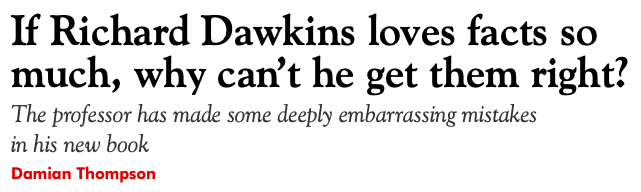
This was recently covered in an article on The Spectator titled, “If Richard Dawkins loves facts so much, why can’t he get them right?” The article summarizes the inaccuracies identified by Heath-Whyte in his chain of tweets.

Screen Shot 2019-09-28 at 2.27.43 PM.png

Here are a few highlights:

‘Well let’s start with “The Utnapishtim story … comes from the Sumerian Epic of Gilgamesh.” WHAT. The version of the Gilgamesh story that contains the flood narrative of Utnapishtim is NOT written in Sumerian, but Babylonian (Akkadian).

‘There are older Sumerian stories about the character Gilgamesh, none of which contain a flood story. There is even a Sumerian flood story too, but it’s not the flood story he’s talking about.

‘It seems he’s talking about a weird mix of one Babylonian flood story about a guy called Atrahasis and another Babylonian flood story about Utnapishtim (the latter being a part of the Babylonian epic of Gilgamesh)…

‘… but come on Dawkins, even Wikipedia could have told you that neither of these were written in Sumerian.’

That’s pretty embarrassing for a man who had just told Krishnan Guru-Murthy that he wants ‘to rid the world of all claims that are not evidence-based’. But Heath-Whyte was just getting into his stride.

‘Problem no. 2: “Arguably the world’s oldest work of literature, [Gilgamesh] was written two thousand years earlier than the Noah story.”

‘So he’s just stated that Genesis was written “during the Babylonian captivity” (sixth century BC), and now he’s stated that (what we assume he means to be) the epic of Atrahasis, or the Babylonian Epic of Gilgamesh, was written 2,000 years earlier – so roughly 2600-2500 BC.

‘Most likely Atrahasis was written less than 1,300 years before the Babylonian captivity, and the version of Gilgamesh that included a flood story was probably finished less than 1,000 years before the Babylonian captivity, and likely quite a few centuries less than a thousand.

From the above-linked article:

Other mistakes identified by Heath-Whyte: Dawkins mixes up the animals in the Gilgamash and Genesis flood stories, and claims that the Sumerian flood legend, like the story of Noah’s Ark, ends with a rainbow. 

‘There’s no rainbow mentioned in any Mesopotamian flood story. Anywhere. There just isn’t,’ says Heath-Whyte, adding that in any case the former Oxford professor for the Public Understanding of Science has misidentified a Sumerian god. 

I think we can take Heath-Whyte’s word for it. Not only can he read the cuneiform in which Gilgamesh is written, but he can also write it.

If These Claims Are Not Historically Accurate, Where Do They Come From?

Continuing from the above-mentioned article:

Just when Dawkins must be wishing that a non-existent God would send a flood to cover his embarrassment, he delivers the killer blow. As he says, even Wikipedia would have put the professor right on these matters. So what was his source? ‘A quick Google search suggests that Dawkins’ source for a lot of this stuff may be a cute little website called HistoryWiz.’

I checked, and he’s right: this is the version of the Gilgamesh as mangled by HistoryWiz, which invites you to ‘step into the past… Let the wizard take you to a different time’. 

Alas, it looks as if you really do have to step into the past in order to consult the wizard. The site is ‘copyright 1998-2008’, there are loads of broken links and the design, c. 2000, is quaintly rudimentary. 

It seems clear that Richard Dawkins and others who make these claims about Gilgamesh are so committed to the conclusion they already religiously believe, that they are not concerned with real scholarship when it comes to creating their narrative.

The “New Atheism,” we might say, is a kind of folk religion which has its own shared beliefs, stories, and mythos, which are not actually based on fact or history.

In my next article I will explain what the Epic of Gilgamesh and Utnapishtim character are, and how we should understand them in relation to the Bible.

Following that, I will discuss the “Jesus Myth” and the theory that what the New Testament says about Jesus is borrowed from ancient Egyptian and Near East mythology. What I hope to show in the end, is that these theories do not hold up to even the most basic fact-checking scrutiny, and are part of a mythos created by New Atheists and other who would try to discredit the Bible and erode faith in it.

A further question which follows from this is: Why are some people opposed to Christianity and the Bible? – a question which I plan to address as well.

Some Who Heard Him Were Not Impressed

I spent this past weekend in Howell, New Jersey, where we held an Expositors Collective training weekend at Cornerstone Calvary Chapel. My wife came with me, which was fun. It was only our second time taking a trip without our kids, and we got to spend time serving together, visiting friends, and going to the beach at the glorious Jersey shore!

Asbury Park, New Jersey. It was bright out!

During our time in Howell, we heard a great message on Mark 6:1-6 from our friend David Guzik, who is part of the Expositors Collective team.

If you haven’t heard of David before, check out his website: enduringword.com. Part of David’s life-work has been the creation of a great resource, a free online commentary of the whole Bible, which is now being translated into many languages. His ministry Enduring Word also provides audio messages, podcasts, videos, and books to help equip people with an understanding of God’s Word.

“Many who heard him were impressed”

In Mark 6, we read about how Jesus returned to his hometown of Nazareth, where his mother and (half)siblings still lived, and preached in the synagogue there. It says there in verse that “many who heard him were impressed”.

Think about that for a second… These people got to see Jesus himself open up the Scriptures and teach. His words were the very words of God! What an absolutely epic experience!

You would assume that EVERYONE who heard him teach would have been impressed, their lives irreversibly changed as a result. And yet, it says that ”MANY” were impressed; in other words, SOME people were not impressed! Some people heard Jesus teach, and were like, “Meh.” 🤷‍♂️

As a preacher, I find it strangely comforting to know that there were people who heard Jesus preach, who weren’t impressed. I shouldn’t be surprised; it is well within our human nature to be cynical and critical of even the most beautiful, true, and life-giving words.

May we who speak and teach God’s Word never do so out of an insecure, desperate need for human accolades and approval, but out of a love for God and love for people that leads us to lovingly present the truth of God’s words for them.

They thought they knew him, but they didn’t

Many were surprised because they thought they knew Jesus, and they were realizing that, in fact, they didn’t actually know him.

In verses 2-3, we are told that the people said: ‘What is the wisdom given to him? How are such mighty works done by his hands? Is not this the carpenter, the son of Mary and brother of James and Joses and Judas and Simon? And are not his sisters here with us?’ And they took offense at him.”

The people of Nazareth thought they knew who Jesus was. They saw him growing up. They knew him as the carpenter. But they were coming to realize that although they thought they knew who Jesus was, they did not in fact know him.

The reality is that there are many people, even today, who are in this same situation; they assume that they know who Jesus is and what he is all about, while in fact they do not really know him. I came to a similar realization as a young man: through the help of a friend, I came to realize that I did not actually know Jesus, though I thought I had it all pegged.

It is a good day in a person’s life when they come to realize that Jesus is much more than they ever thought him to be previously. If that hasn’t happened for you yet, I pray it will; that you will see him for who he fully is, and respond appropriately.

All of Christianity is Eschatological

Image result for crushing the head of the serpent

The word eschatology means “the study of the final things”. Often times we use the word eschatology to speak about those parts of the Bible which deal with “the end times” and constructing a “timeline” of end-times events based on various verses in the Bible.

But that’s not all that eschatology is. Eschatology is bigger than that.

In Greek, the word eschaton means “the final event”. And in this sense, all of the Bible is eschatological, because from the beginning of the book to the end, the Bible tells us that all of human history is moving towards a grand climax.

A Linear Versus a Circular View of Life

Whereas many Eastern philosophies tend to think about life and existence circularly (think: reincarnation), the Bible is different in that it it thinks about life and existence linearly. 

According to God’s Word, all of our lives and all of history are moving towards a particular, final, and unavoidable end. God has a plan that is going to culminate in something, and that something is the eschaton. 

Genesis, the first book of the Bible, begins by telling us about the origin of the world and its original design. This story of origin forms the introduction and foundation to the story which the rest of the Bible tells: the story of God’s redemption of his creation.

The eschaton is first alluded to as soon as sin enters into the world, corrupting the good creation. In Genesis 3:16, God speaks to the serpent and says, “I will put enmity between you and the woman, and between your offspring and her offspring; he shall crush your head, and you shall bruise his heel.” The seed of a woman (as opposed to the usual seed of a man) will be stricken by the serpent, but this one will defeat and destroy the serpent. This is a foreshadowing of how Jesus, born of a virgin, would wage the ultimate battle against evil, be mortally wounded, and yet in doing so would defeat sin, death, and the devil.

There are many aspects to this eschaton, including the return of Jesus, the resurrection of the dead, the final judgment, the Lake of Fire, and the New Heavens and the New Earth.

For more on these topics, check out:

Jesus came, therefore, as an eschatological Savior, and the hope that we have as Christians is an eschatological hope. All of the Bible and all of Christianity is oriented towards this eschatological hope.

Here is a video of a discussion Pastor Mike and I had about eschatology based on our recent study of 1 Thessalonians 4:13-18, which talks about the return of Jesus:

Do Christians and Muslims Worship the Same God?

concrete dome buildings during golden hour

Recently SBC pastor J.D. Greear received some criticism over claims that he said that Muslims and Christians worship the same God. 

In all fairness, that’s not exactly what J.D. said. In his book Breaking the Islam Code: Understanding the Soul Questions of Every MuslimJ.D. stated that while the Christian and Muslim conceptions of God are irreconcilably different, there are some shared assumptions about God which can be used in apologetic conversations with Muslims, e.g. monotheism, affirmation of the Old and New Testaments, recognition of Jesus as a prophet, etc.

You can hear, watch and read J.D. Greear speak on this subject in his own words here.

Allah and God

Earlier this year I had the opportunity to visit Israel, and during my time there I met several Israeli Christians, including some Arab-Israeli Christians. Arab-Israeli Christians refer to God by the Arabic word for God: Allah. Just as the English word God is of Germanic origin, and is not itself particularly tied to the God of the Bible, but is a “generic” name for deity, Allah is a similar word in Arabic. As monotheists, who believe there is only one God, we use this word to speak of the one supreme God rather than using a personal name for God to differentiate Him from other deities, since we do not believe any other so-called god is a rival to Him. There is precedent for this in the Bible, in which the ancient Hebrew word, with its Mesopotamian origins is used: אל (“El”), and in the New Testament, the Greek word Θεός (“Theos”).

Islam is different than Christianity in their belief that the Quran cannot be translated to any other language other than Arabic. Muslims are required to pray in Arabic, meaning that non-Arabic speakers are not allowed to pray to God in their mother tongue, but must memorize and recite Arabic prayers. Furthermore, when they read the Quran, they must read it in Arabic. There are “interpretations” of the Quran into other languages, but they are not considered scripture; only the Arabic-language Quran is considered valid and legitimate. It is for this reason, that muslims all over the world refer to their deity as Allah and not God in English, Gott in German, Бог in Russian, and so on.

So, the real issue is not: “What is the difference between Allah and God?”, but rather: “What is the difference between the God of Islam and the God of the Bible?” Even though they are both monotheistic supreme deities, they have different attributes, and therefore, even though they are both called “God”, they are not the same.

Why Islam is Like Mormonism

As the above tweet mentions, when Islam first came on the scene in the 7th Century, Christians did not consider it a different religion per se, they originally considered it a Christological heresy, and they considered Muhammed to be a false prophet.

In the Near East at that time, the majority of the population, particularly in urban areas, was Christian. In the Arabian peninsula, where Muhammed was located, polytheism was still practiced by the majority of the population, many of whom were nomadic. Muhammed led the Arabic people into monotheism, but a new and unique form of monotheism, which built on, but changed, the teachings of Judaism and Christianity.

The reason Islam was considered a Christological heresy was because Islam affirms both the Old Testament and the New Testament, considering them both holy scriptures, upon which Islam seeks to build. However, they claim that both the Old Testament and the New Testament have been severely altered and redacted, and therefore are not trustworthy. They argue that as a result, the Quran, which they claim is a new and trustworthy revelation given to Muhammed, the last and greatest in the long line of prophets, is the only trustworthy revelation available to us, and the Quran “sets the record straight” regarding things which have been altered and redacted in the Old and New Testaments.

For more information on why we can be sure that the Bible has not been altered (neither the Old nor the New Testament), check out this article in which I discuss historicity, attestation, and canonization.

Some of the things Islam claims were changed in the Bible: God’s choosing of Isaac instead of Ishmael (they claim Ishmael was the chosen son, since they trace their ancestry through him – and they claim the Jews changed the Bible to say that God chose Isaac). They also claim that what the New Testament says about Jesus was radically changed by Christians in order to claim that Jesus was God, when in fact (as they say), he was only a prophet. They do however, acknowledge that Jesus was sinless, unlike Muhammed.

Thus, Muslims deny Jesus’ deity, and along with that comes a denial of his identity as Savior. As a result, they teach salvation by works, whereas Christianity teaches salvation by grace, through faith, through the atoning work of Jesus on our behalf. The Christian gospel is that God imputes Christ’s righteousness to us, which is the basis for our standing before Him, as opposed to Islam, which claims that you must earn your way before God by trying hard enough to keep the 5 Pillars of Islam, so that hopefully your good works with outweigh your bad works, and then God will allow you into Heaven. These are two radically different soteriologies (doctrines of salvation, i.e. how one is saved).

In a way, Islam is quite similar to Mormonism. Consider the similarities:

  • Both claim to build upon the Old and New Testaments, but claim that both have been corrupted and are therefore not trustworthy in the present form in which we have them.
  • Both claim a “new revelation”: the Quran and the Book of Mormon
  • Both claim a new prophet: Muhammed and Joseph Smith
  • Both change the identity and story of Jesus
  • Both teach a works-based soteriology (doctrine of salvation)

Are there bridges of shared assumptions between Christians and Muslims which can be used for apologetic and/or evangelistic purposes?

I believe there are. My wife and I, before we were married, used to serve together in a refugee camp in Hungary which was populated mostly by Muslims from Asia. We provided humanitarian aid to them, and as we built relationships with them, we got the opportunity to share our faith with them as well. We found that they had an affinity for the New Testament and an openness and interest in reading it, so we provided them with copies of the New Testament in their own languages. Many of them, though they had been taught that the New Testament was one of their holy books, had never had the opportunity to read it, assumedly because of the teaching in Islam that the New Testament has been changed and is not trustworthy. However, as these people read the New Testament, many of them were captivated by Jesus, and decided to become Christians. The inbuilt affinity for the Old and New Testaments, for Jesus, and their monotheistic belief, are great starting points for sharing the gospel.

An example of this in the Bible can be seen in how the Apostle John, in the Gospel of John, begins in chapter 1 by identifying Jesus as the divine Λογος (Logos = “the Word”). The concept of the divine Logos was a Greek philosophical concept, which basically meant: “the grand idea” or “the grand force” of the universe. John identified the Logos (translated: the Word) as Jesus. By doing so, John was tapping into an existing belief for apologetic and evangelistic purposes, like Paul did in Acts 17 in Athens, where he appealed to the Athenians on the basis of their altar to “the unknown god.”

Like Paul and like John, may we be uncompromising in our biblical beliefs, and yet wise to use opportunities to share the gospel with people in ways they can grab ahold of, that they might find love, joy, hope, freedom, and salvation in Jesus.

Reader Questions: People Claiming to Be Christ at the End of the Age

accuracy analogue clock countdown

Earlier this year I added a page on this site where readers can submit questions or suggest topics (click here for that page). Recently I received this question:

“Dear Pastor Nick, I am an avid listener to Hope FM in Baltimore, MD, and love when you host the call in show. I have a question: How will we not be fooled by others that pretend they are the Christ in these days ahead. Maybe even trying to deceive us with signs or wonders. Thank you so much.”

The Text: The Olivet Discourse

The text you are referring to comes from what is called the “Olivet Discourse,” a teaching Jesus gave to his disciples on the Mount of Olives, a hill east of Jerusalem, during his “passion week,” the week Jesus spent in Jerusalem leading up to his crucifixion.

In Matthew 24, Mark 13, & Luke 21, Jesus warns his disciples that a time is coming when many will come claiming to be the Christ, but not to be deceived by them.

As he sat on the Mount of Olives, the disciples came to him privately, saying, “Tell us, when will these things be, and what will be the sign of your coming and of the end of the age?” And Jesus answered them, “See that no one leads you astray. For many will come in my name, saying, ‘I am the Christ,’ and they will lead many astray. And you will hear of wars and rumors of wars. See that you are not alarmed, for this must take place, but the end is not yet. (Matthew 24:3-6)

The disciples ask two questions: (1) when will these things be, and (2) what will be the sign of your coming and of the end of the age?

Jesus’ answer to these questions intertwines prophecy concerning the destruction of Jerusalem and his second coming. The nearer event (the destruction of Jerusalem) serves as a symbol and foreshadowing of the more distant event (the second coming).

Jesus warned his disciples from the outset that many people would be deceived as they awaited his return. There have been many times in history in which this has happened, in three main forms:

1. People claiming to be the Messiah

Tragically, those who rejected Jesus when He came to them as Messiah ended up falling after false messiahs who led them into nothing but death and destruction. For example, 100 years after Jesus, a man named Bar Kokhba was considered by many Jews to be the messiah. He led a revolution against the Romans and enjoyed early success, but was soon crushed.

2. People claiming that Jesus has returned, or that they are him

In the First Century, the Christians of Thessalonica had heard a rumor that Jesus had returned, and that they had missed it! Paul the Apostle wrote his Second Letter to the Thessalonians, in part, to dispel this rumor, and assure them that Jesus had not yet returned, and that when he did, they would surely know it.

The Jehovah’s Witnesses claimed that Jesus returned in 1914, invisibly, and began his reign over the Earth from within the Watchtower Bible and Tract Society (official name of the Jehovah’s Witness organization). The problem with this, of course, is that the Bible says that when Jesus returns, it will be visible, and will usher in a time of peace, which clearly the world has yet to see.

There is currently a man in Russia who claims to be Jesus returned: Siberian ‘Jesus’ Vissarion, Former Traffic Cop, Leads Patriarchal Russian Cult That Believes In Aliens

3. People wrongly predicting the date of Jesus’ return

William Miller produced publications which convinced hundreds of thousands in the United States that Jesus would return in 1846. When Jesus did not return, there was great disappointment, with some falling away, and some cultic groups spawned from the prophetic fervor.

Here is a fascinating list of false predictions of the return of Jesus: Predictions and claims for the Second Coming of Christ. You’ll notice that one of them just passed: June 8, 2019!

Trying to predict the date of Jesus’ return is a fool’s errand, since Jesus not only told us not to worry about it (Acts 1:7), and that no one knows the date or the hour, and that  it would happen at a time when we do not expect it. In other words, there is no secret code that anyone is going to crack and figure it out.

How will you recognize Jesus’ return?

When Jesus comes, it won’t be a secret coming. Everyone will know.

The Apostle John tells us in Revelation 1:7: Behold, he is coming with the clouds, and every eye will see him

John did not need a special vision to know that every eye will see Him. John heard Jesus this himself: So, if they say to you, ‘Look, he is in the wilderness,’ do not go out. If they say, ‘Look, he is in the inner rooms,’ do not believe it. For as the lightning comes from the east and shines as far as the west, so will be the coming of the Son of Man. (Matthew 24:26-27)

So, how can you be sure not to be deceived? Ignore alleged predictions or claims of Jesus’ return. Jesus’ second coming will not happen without you knowing it.

Sources: