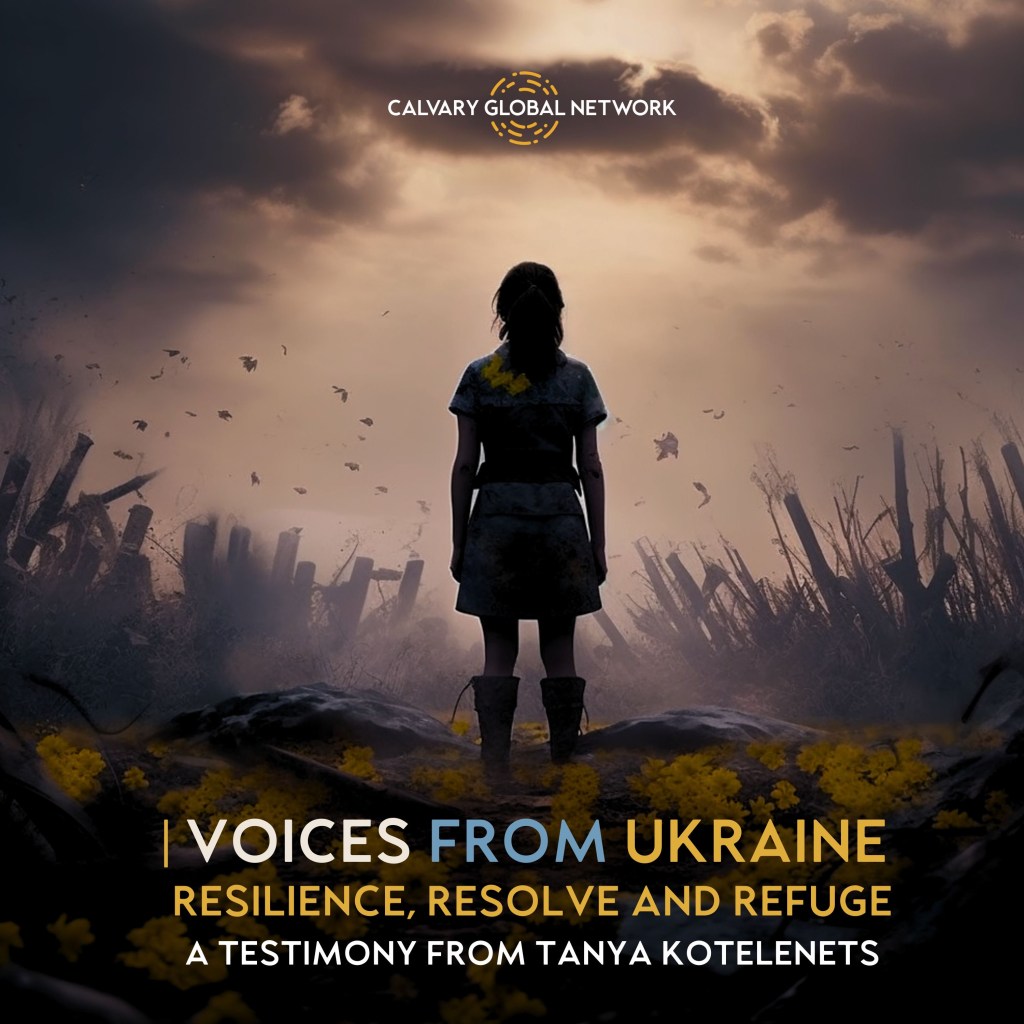
Earlier this year I traveled to Ukraine to help lead a conference for Christians who had been providing aid for people in their country since the full-scale Russian invasion began in February 2022.
While I was there, I heard stories from many people of tragedy and loss, but I also heard stories of heroism, faith, and spiritual revival.
I also had the opportunity to record a few interviews with members of different churches, in which they got to share their experiences in the early days of the war, how things look now, and how God has been working and using them to share his love to hurting people.
These interviews are being released on the CGN Voices Podcast. There will be four episodes in this mini-series, and they will be released every Friday for the next few weeks.
The first episode came out last week, and it is one which was particularly meaningful to me. You can listen to it here, or in the embedded player below.
Ukraine: Resilience, Resolve and Refuge – A Testimony from Tanya Kotelenets –
CGN Voices
Welcome to "Voices from Ukraine", a mini-series inside look at the resilience, faith, and service of Calvary Chapel believers in Ukraine during the difficult months since Russia's full-scale invasion began in February 2022.
In this special edition, we sit down with Tanya Kotelenets from a church in eastern Ukraine. Kotelenets shares her harrowing experiences from the first days of the war – the fear, uncertainty and eventual decision to flee the city with her church community. Despite difficult conditions, God's provision and grace sustained them.
Though she returned home months later, the impact of war remains. Kotelenets’s husband ministers at funerals almost daily, including that of a coworker who recently died in combat. Our listeners are reminded that all parts of the body of Christ feel the suffering of others.
Kotelenets asks for prayers for the children enduring so much change and loss, and for strength to continue living through this conflict with hope. If you'd like to support relief efforts in Ukraine, donations can be made through calvaryglobalnetwork.com/relief
Join us next time for another firsthand account of courage, sacrifice and faith continuing to burn bright within the Calvary Chapel family amidst the darkness of war.
According to Pew Research, Americans are more divided along ideological lines – and partisan antipathy is deeper and more extensive – than at any point in the last two decades. These trends manifest themselves in myriad ways, both in politics and in everyday life. [1]
Drs. Kim and Hoffman met at Gordon Conwell Theological Seminary. Dr. Hoffman is lead pastor of Evangelical Friends Church of Newport, Rhode Island, and Dr. Kim is Professor of Practical Theology and the Hubert H. and Gladys S. Raborn Chair of Pastoral Leadership at Truett Theological Seminary, Baylor University.
They are passionate about the Bible’s vision of the reconciliation of all things in Christ, and they care deeply about the Body of Christ and the Mission of God — and they share how this theology can play out practically in the way that we minister in a world which is plagued by division.
In this episode, we talk about when and how Christians should address hot topics in our societies, and some guiding principles for helping people navigate the cultural moments we find ourselves in.
Carrying Out the Mission of God in a Divided Nation – with Drs. Matthew Kim & Paul Hoffman –
Theology for the People
Drs. Matthew Kim and Paul Hoffman are the authors of Preaching to a Divided Nation: A Seven-Step Model for Promoting Reconciliation and Unity.
Drs. Kim and Hoffman met at Gordon Conwell Theological Seminary. Dr. Hoffman is lead pastor of Evangelical Friends Church of Newport, Rhode Island, and Dr. Kim is Professor of Practical Theology and the Hubert H. and Gladys S. Raborn Chair of Pastoral Leadership at Truett Theological Seminary, Baylor University.
They are passionate about the Bible’s vision of the reconciliation of all things in Christ, and they care deeply about the Body of Christ and the Mission of God — and they share how this theology can play out practically in the way that we minister in a world which is plagued by division.
In this episode, we talk about when and how Christians should address hot topics in our societies, and some guiding principles for helping people navigate the cultural moments we find ourselves in.
Mentioned in this episode is Dr. Kim's book, Preaching with Cultural Intelligence: Understanding the People Who Hear Our Sermons
Shane Angland is a teaching elder at Ennis Evangelical Church in County Clare, Ireland. He is a graduate of Dallas Theological Seminary (Th.M.) and holds a B.A. in History and Politics from the University of Limerick. Shane also served for several years as a missionary in Kharkiv, Ukraine.
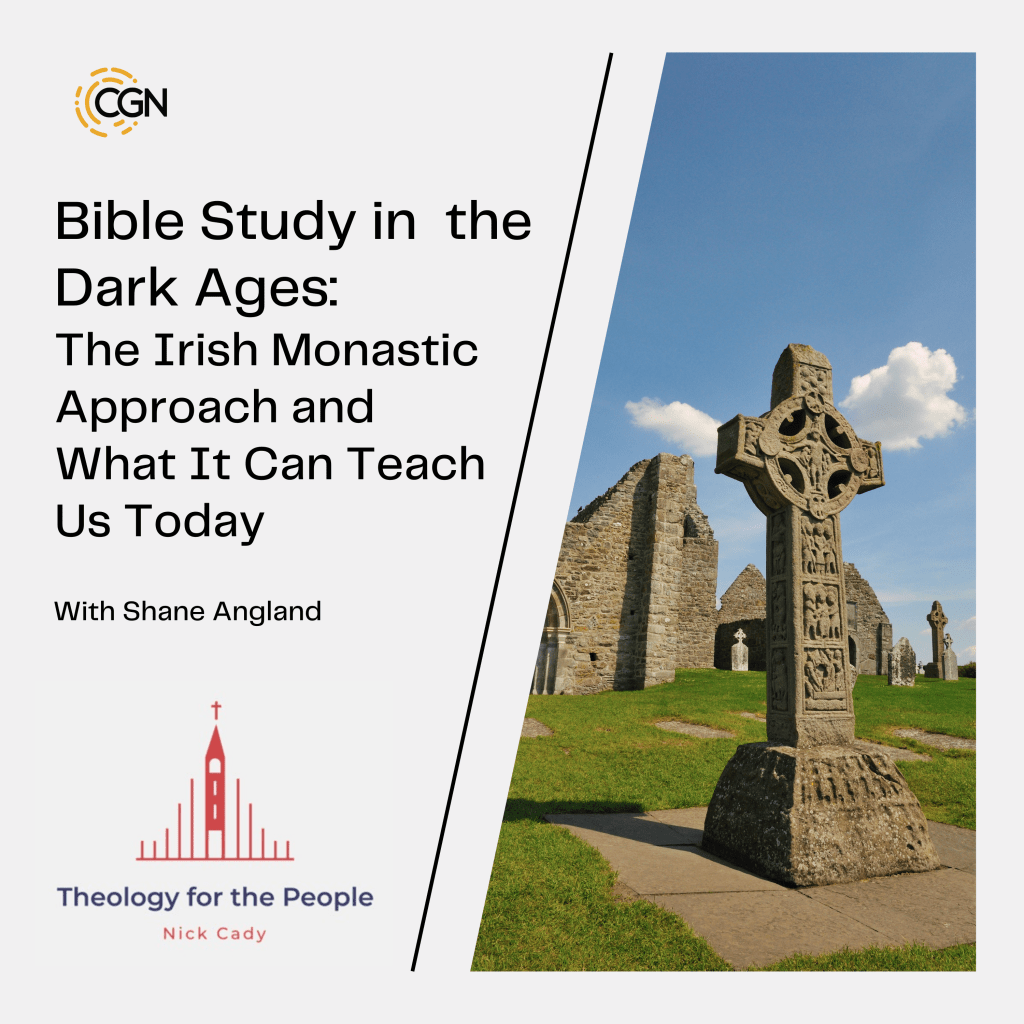
On this episode of the Theology for the People podcast, Shane shares some of his research about the Irish monastic approach to Bible study in the “Dark Ages” and what made it unique, as well as what we today can learn from their practices.
Bible Study in the Dark Ages: The Irish Monastic Approach and What It Can Teach Us Today – with Shane Angland –
Theology for the People
Shane Angland is a teaching elder at Ennis Evangelical Church in County Clare, Ireland. He is a graduate of Dallas Theological Seminary (Th.M.) and holds a BA in History and Politics from the University of Limerick. Shane also served for several years as a missionary in Kharkiv, Ukraine.
On this episode, Shane shares some of his research about the Irish monastic approach to Bible study in the "Dark Ages" and what made it unique, as well as what we today can learn from their practices.
Check out Shane's blog here: http://anglandicus.blogspot.com/
Visit the Theology for the People blog at nickcady.org, where you can read articles and suggest topics for future episodes.
This is something that I and my colleague, Curt Fuller, have been working on for many months, and it just went live today.
Additionally, Curt and I sat down recently to record a short podcast episode to talk about the other projects we have in the works, as well as to describe the process of writing and recording these books.
Curt Fuller is the Technical Director at White Fields Community Church. He was the editor of my first book, and he is the voice which reads the audiobook.
Prior to coming to work at White Fields, Curt was already in the audiobook publishing world and was involved doing voiceovers, so he was the right man for the job!
In addition to this audiobook, we have two other projects in the works: a group study guide for The God I Won’t Believe In, which is designed to be used in small groups, youth groups, or by families or individuals at home, and a new book tentatively titled, So That You May Believe, based on evidences for believing in Jesus found in the Gospel of John.
Curt Fuller is the Technical Director at White Fields Community Church in Longmont, Colorado.
Additionally, Curt is Nick's writing partner; he was the editor of Nick's first book: The God I Won't Believe In: Facing Nine Common Barriers to Embracing Christianity
The audiobook version of that book was published on February 1, 2023. In this episode, you can hear a preview of that book, and we discuss other projects currently in the works.
To read the Theology for the People blog, or to suggest a topic or ask a question, visit: nickcady.org
In this first episode of Season 3 of the Theology for the People podcast, I speak with Michael Payne about the biblical genre of lament and its role in the life of a believer today.
Michael Payne is the Worship Pastor at White Fields Community Church in Longmont, Colorado. Previously he served as a missionary and worship pastor in Hungary at Golgota Budapest. Prior to that, he served in the US Marine Corps.
How Long, O Lord? – The Biblical Genre of Lament and Its Role in Our Lives Today –
Theology for the People
Welcome to Season 3 of Theology for the People!
Michael Payne is the Worship Pastor at White Fields Community Church in Longmont, Colorado. Previously he served as a missionary and worship pastor in Hungary at Golgota Budapest. Prior to that, he served in the US Marine Corps.
Listen to Mike's original music on Spotify here, or see him in action on the White Fields Church YouTube page.
The books Mike recommends in this episode on the topic of the biblical genre of lament are:
Michael Card, A Sacred Sorrow: Reaching Out to God in the Lost Language of Lament
Mark Vroegop – Dark Clouds, Deep Mercy
Walter Brueggemann – The Message of the Psalms
For the Theology for the People blog, or to submit a question or suggest a topic, visit nickcady.org
Aaron Damiani is a pastor and the author of the book: Earth Filled with Heaven — Finding Life in Liturgy, Sacraments and other Ancient Practices of the Church.
In this episode, Aaron and I discuss some of the practices that Christians have traditionally done in their worship services, and how Christians today can benefit from incorporating some of those formative practices.
Additionally, we discussion some of the pitfalls or potential downsides of a liturgical approach to worship and discipleship, and some ways that High Church and Low Church Protestants can learn from each other in order to create an intentional order or service which helps develop healthy disciples of Jesus.
Aaron Damiani is a pastor and the author of the book: Earth Filled with Heaven — Finding Life in Liturgy, Sacraments and other Ancient Practices of the Church.
In this episode, Aaron and I discuss some of the practices that Christians have traditionally done in their worship services, and how Christians today can benefit from incorporating some of those formative practices.
Additionally, we discussion some of the pitfalls or potential downsides of a liturgical approach to worship and discipleship, and some ways that High Church and Low Church Protestants can learn from each other in order to create an intentional order or service which helps develop healthy disciples of Jesus.
If you benefited from this episode, please share it with others, and if you would like to help the podcast, the best way to do that is by leaving a rating or review on your podcast app.
Kellen Criswell is a pastor, ministry leader, and former missionary who holds and MA in Global Leadership from Western Seminary and is currently working on his doctorate. He is the Executive Director of Calvary Global Network and has a heart for the mission of God and the global church.
After a brief discussion about Kellen’s favorite music and the fact that he is from Utah (AKA “Colorado Jr.”), we dive into a discussion about Missional Ecclesiology, which is a way of understanding the identity, purpose, and function of the church within the Missio Dei (the love-motivated, self-sending, mission of God into the world to save, redeem, and restore).
One more thought about Utah: If you have to tell people (on your license plates) that you have “the best snow in the world,” you probably don’t. It’s kind of like using the world “Real” in a title. If you have to say that something is “real ______” – it probably isn’t. And also, what Margaret Thatcher said: “Being a leader is like being a lady: If you have to tell people you are one, you probably aren’t.” Same with the snow, Utah…
But I digress…
Ecclesiology is the discussion of what the Church is called to be and to do – including its nature, purpose, hopes, structures, and practices.
We discuss how this concept works out practically, including a discussion of “foreign missions” and how they fit into this understanding. Furthermore, we discuss what the past nearly two years of pandemic has revealed about ecclesiology, and why there is hope as we move forward.
Missional Ecclesiology: What is the role of the church in the mission of God? – with Kellen Criswell –
Theology for the People
Kellen Criswell is a pastor, ministry leader, and former missionary who holds and MA in Global Leadership from Western Seminary and is currently working on his doctorate. He is the Executive Director of Calvary Global Network and has a heart for the mission of God and the global church.
In this episode we discuss Missional Ecclesiology, which is a way of understanding the identity, purpose, and function of the church within the Missio Dei (mission of God). Ecclesiology is the discussion of what the Church is called to be and to do – including its nature, purpose, hopes, structures, and practices.
We discuss how this concept works out practically, including a discussion of "foreign missions" and how they fit into this understanding. Furthermore, we discuss what the past nearly two years of pandemic has revealed about ecclesiology, and why there is hope as we move forward.
Bibliography and recommended resources:
Hirsch, Alan. The Forgotten Ways: Reactivating Apostolic Movements.
Goheen, Michael. The Church and it’s Vocation: Leslie Newbigin’s Missionary Ecclesiology.
Stetzer, Ed. Planting Missional Churches: Your Guide to Starting Churches that Multiply.
Newbigin, Leslie. The Gospel in a Pluralist Society.
Van Engen, Charles. Transforming Mission Theology.
Wright, Christopher J.H.. The Mission of God: Unlocking the Bible’s Grand Narrative.
Bosch, David. Transforming Mission: Paradigm Shifts in Theology of Mission.
Hooker, Paul. "What is Missional Ecclesiology?"
Make sure to check out the Theology for the People blog at nickcady.org
Make sure to check out some of the books and papers listed below for more information and study on this topic.
Yesterday morning I had something happen that has never happened to me before in 16 years of preaching almost every Sunday: I woke up and I had lost my voice.
My sermon was ready, so I went to church hoping tea would fix it, but it didn’t. I took a Covid test, which came back negative, so I prepared to preach the first service, but during worship I realized I wasn’t going to be able to do it. So, I went up on stage and asked our worship pastor, Michael, to preach my sermon from my notes.
My notes are in a manuscript format; I like to write out every word I’m going to say. I don’t read my notes, but writing out every word helps me process my thoughts and plan my message.
There are other benefits to manuscripting, some of which I’ve written about more here: Speaking Tips: Manuscript, but Don’t Read. For example, I know that 4000 words in a Pages document equates to about 30 minutes, so manuscripting helps me keep my sermon the right length.
Another benefit of manuscripting is that lately I have been re-preaching some of my older sermons which had lost or damaged recordings. For the sake of our radio show, and so we can have complete series archives, I have been re-preaching these “lost” sermons, and having a manuscript makes it easy to pull up my notes and re-preach an old sermon without much preparation.
If I get asked to guest speak, having a manuscript of my past messages makes it easy to create a new sermon based on something I’ve shared before. Or when people request a text version of a particular teaching, it is easy to send them my manuscript.
Furthermore, I am currently beginning the process of turning some of my sermon series into books. Having manuscripts of my messages makes that process much easier.
Certainly there are downsides or detriments to manuscript preaching, like when someone reads their notes in the pulpit and fails to make eye contact and connect with their listeners, or when someone is so dependent on their notes that they leave no room for the Holy Spirit to inspire prophetic ad libs.
But yesterday I realized one more benefit of manuscripting my sermons: Mike, our worship pastor was able to preach my sermon without any preparation, and by the second and third services, he was ad libbing and making it his own.
In our current series at White Fields called Grace & Truth, we are studying through the book of 1 Corinthians.
This past Sunday, we studied the second half of chapter 1, in which Paul talks about “the message of the cross.” In doing so, Paul makes clear between 1:17 and 1:18 that the message of the cross is the gospel, and the gospel is the message of the cross. This message is “the power of God” for all who believe; precisely the same thing Paul says about the gospel in Romans 1:16. In other words, the gospel (the central message of Christianity) is the message of the cross.
Martin Luther wrote about the difference between a “theology of glory” and the “theology of the cross.” In this week’s Sermon Extra, I explain some of this historical context for Luther’s differentiation between the theology of glory and the theology of the cross, as well as how we can recognize theologies of glory in our modern times.
You can also listen to the podcast of this episode here:
In this week's sermon extra, Pastors Nick Cady and Michael Payne discuss Martin Luther's description of Theology of Glory vs the Theology of the Cross and how it works out in modern thinking, as well as the way to be happy.
You can watch the entire message from this past Sunday, “The Message of the Cross & the Power of God” (1 Corinthians 1:17-31), here:








 Theology for the People