
New Website and New Series

Website Update

We recently updated our website at White Fields Community Church. The bulk of the work was done by our Administrative Assistant: Ocean – and our friends over at CryBaby Design: a great company based here in Boulder County; check them out if you have any design needs.

Browse the site and let me know if you find any broken links or things that are out of order: whitefieldschurch.com

Screen Shot 2019-12-03 at 4.34.45 PM.png

Advent Series

Also, this Sunday we are starting a new series for Advent called God With Us.

God With Us Sermon graphic.jpg

In our first message, we will be looking at one of the most over-looked episodes in Christmas story: the killing of the innocent children by King Herod, and why this story illuminates important aspects of who Jesus was and why He came as the promised Savior to defeat evil and reconcile us to God.

If you’re in Longmont, or nearby on Colorado’s Front Range, we’d love to have you join us on a Sunday this Advent. More information here.

Giving Tuesday

adult birthday birthday gift box

For Giving Tuesday, if you would like to help support some great causes today, please consider these:

Thanks and God bless you!

Is Abuse Grounds for Divorce According to the Bible?

art blur close up colors

In Matthew 19 we read about a time when some Pharisees came to Jesus to test him. They asked, “Is it lawful for a man to divorce his wife for any and every reason?” (Matthew 19:3)

The Pharisees, as usual, were attempting to trap Jesus with a no-win question, so that no matter what answer he gave, it would cause him to lose some of his followers. In the Law of Moses, Moses had allowed divorce for the reason of “uncleanness.” Human nature being what it is, people took advantage of the fact that the term “uncleanness” was open to interpretation, and they used it as a loophole, which afforded them the opportunity to “technically” keep the letter of the Law, while ignoring the heart of the Law. By the time of Jesus, people were in the practice of saying that basically anything could constitute “uncleanness,” for example: if a man saw a woman who was more beautiful than his wife, he could say that his wife was “unclean” in comparison to the other woman, and use that as grounds for divorce. If a man got angry at his wife, he could accuse her of being “unclean,” because her actions had caused him to sin by being angry.

The Big Two

Jesus combatted this flippant attitude towards marriage and divorce by taking people back to the design for marriage shown in creation, adding that divorce is permissible in cases of adultery.

Paul, in 1 Corinthians 7:15, gave another justification for divorce: abandonment.

Historically, Christians have recognized these two reasons as the two biblical grounds for divorce. The Westminster Confession of Faith, Chapter 24, Paragraph 6 states that “nothing but adultery, or such willful desertion as can no way be remedied by the church, or civil magistrate, is cause sufficient of dissolving the bond of marriage.”

What About Abuse?

Certainly God hates abuse. Throughout the Old Testament, God shows himself to be a God who is on the side of the abused and opposes abusers. In the prophetic books, such as Amos, when his own people become abusers, God makes it clear to them that because of what they are doing, He is opposed to them, and He calls them to repent and actively work for the welfare of the weak, the vulnerable, and the oppressed.

However, since abuse is not specifically mentioned in the Bible as a grounds for divorce, some Christians have wondered what the protocol should be for those in abusive marriages.

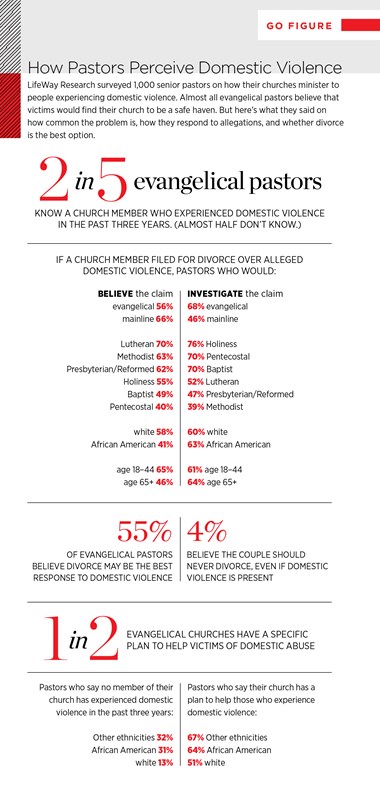
What’s important to note, is that even amongst those who do not believe that abuse is a biblical justification for divorce, almost no one would ever recommend a spouse to stay in an abusive relationship. According to a LifeWay Reseach survey, 96% of pastors recommend at minimum: separation, protection (such as restraining orders), and church discipline (for the abuser) in cases of abuse.

While it is quite alarming that 4% of the pastors polled said that a spouse should stay in an abusive relationship even when violence is present, it is important to note that even amongst those who do not believe that abuse is biblical grounds for divorce, the majority do advocate for separation. Assumedly, those who advocate for separation but not divorce are hopeful that repentance and restoration are possible and are committed to a high view of the authority of Scripture, believing that the Bible only gives the two justifications for divorce listed above.

Wayne Grudem and “in such cases”

Amongst those who have sought to identify a biblical justification for divorce in cases of abuse, most point to 1 Corinthians 7:15, which speaks about one spouse abandoning the marriage. The argument goes that abuse constitutes a form of abandonment. Many people, even those who hate abuse, find this line of thinking to be contrived and unconvincing.

Recently prominent theologian Wayne Grudem, Professor of Theology and Biblical Studies at Phoenix Seminary, announced at the annual meeting of the Evangelical Theological Society (ETS) that he had changed his position on divorce in cases of abuse based on his study of 1 Corinthians 7:15.

While he is still not persuaded by the “abuse is a kind of desertion” argument, he believes that another phrase in 1 Corinthians 7:15 presents a compelling argument for divorce in cases of abuse, namely the phrase, “in such cases” (ἐν τοῖς τοιούτοις).

But if the unbelieving partner separates, let it be so. In such cases the brother or sister is not bound. (1 Corinthians 7:15)

The question is, does this phrase refer to: 1) only cases of desertion by an unbeliever, or 2) cases in which a spouse has done something that has similarly destroyed a marriage?

Interestingly, this Greek phrase does not occur anywhere else in the New Testament or the Septuagint (the Greek translation of the Old Testament), but there are several uses of it in Ancient Greek literature, including 52 from the same time period as the New Testament. There are also several uses of the singular version of the word τοιοῦτος (“in this case”) in the New Testament.

Grudem’s analysis of the uses of these words in the Bible and in other Greek writings from the same time period has led him to the conclusion that “in such cases” refers to the cases in which a spouse has done something which, similar to abandonment, has destroyed a marriage, and that in such cases the latter part of 1 Corinthians 7:15 applies: the abused spouse is no longer bound, i.e. may divorce.

Grudem’s analysis has been met with very little criticism. You can read the outline of the presentation here, which includes a look at the different texts which use this phrase “in such cases” and what it means in those contexts, and why these led Grudem to change his position.

Looking for Loopholes or for the Heart of God

At worst, this could be used in the same way people used the idea of “uncleanness” in Jesus’ day: as carte blanche or a loophole big enough to drive a truck through. The same could be said though of the teachings of grace and forgiveness in the Bible, yet we must not reject nor downplay them just because they might be hijacked or misused – and I believe the same applies here.

Reader Questions: How Accurate are Bible Translations?

ancient antique architectural design architecture

I recently added a page on this site where readers can submit questions or suggest topics (click here for that page). Recently I received this question:

Hi Pastor Nick. I have heard you talk about your study of other languages and various Bible translations. Can you help me with a response to a Jewish man who is convinced the English translation is completely inaccurate and can’t be trusted?

Bible Translation Basics

I wrote a series on Bible Translation to explain some of the inherent difficulties in doing it, as well as some relevant issues related to some particular English translations:

  1. Making Sense of Different Bible Translations – Part 1
  2. Making Sense of Different Bible Translations – Part 2: the King James Bible
  3. Making Sense of Different Bible Translations – Part 3: Gender-Inclusive Language and the NIV

Response to the Question

I would start by asking which English translation he thinks cannot be trusted, and my next question would be why he believes they cannot be trusted.

There is not just one English Translation of the Bible, but hundreds of translations – many of which have been carried out by teams of scholars whose work was then reviewed, checked, proofread and scrutinized by other scholars in order to assure accurate translation.

Basically, his claim that a translation of the Bible into English (or presumably any language?) is not trustworthy is intellectually untenable.

These translations are made by groups of scholars who have devoted their lives to studying these ancient languages, cultures, and beliefs. Furthermore, there have been multiple groups over the past 2000 years who have translated the Scriptures into various languages, and these translations all say the same things. Where they differ is based on different possible translations of words or phrases in the original language, but there are a finite number of options, and the options are usually recorded in the footnotes or in textual commentaries. All that would be needed in order to refute a translation would be someone who could prove that they are in error. So a challenge to anyone who claims that a particular translation is not trustworthy or accurate would be to simply invite them to make their case publicly, and contribute their insights and knowledge to help make a better translation!

What is Inspired: the Original Text or the Translation?

It should be noted that we as Christians believe the original texts to have been inspired by God, not the copies or translations.

Article X of the 1978 Chicago Statement on Biblical Inerrancy explains it this way:

WE AFFIRM  that inspiration, strictly speaking, applies only to the autographic text of Scripture, which in the providence of God can be ascertained from available manuscripts with great accuracy. We further affirm that copies and translations of Scripture are the Word of God to the extent that they faithfully represent the original.

WE DENY  that any essential element of the Christian faith is affected by the absence of the autographs. We further deny that this absence renders the assertion of Biblical inerrancy invalid or irrelevant.

However, this does not mean we cannot or should not translate the Scriptures into languages other than the originals – to the best of our collective abilities – in order that people who do not speak ancient Hebrew and Greek (the vast majority of the world’s population) can understand God’s Word to them.

Bible Translation Has Precedent: the Septuagint and Jesus

Lastly, there is precedent in Scripture itself for the translation of the Bible into other languages. The Septuagint was the Greek translation of the Hebrew Bible, and it was widely used in antiquity. The New Testament writers often quote from the Septuagint and record Jesus as having quoted from the Septuagint. Being that Aramaic was widespread in Israel at the time of Jesus, we can be quite sure that Jesus would have spoken to crowds in Aramaic, meaning that when he referenced or quoted from the Hebrew Bible (AKA Old Testament), he would have translated those verses into Aramaic.

In conclusion, we can be quite confident in the translations that we have in English and other languages. While it may be helpful to acquaint yourself with the original languages, you can be sure that when you read your English translation of the Bible, you are getting the essence of the original text and its meaning, especially if you are supplementing your reading with textual commentaries.

What Does It Mean that “Judgment Begins at the Household of God”?

inside photography of church

In 1 Peter 4:17, Peter makes an interesting statement; he says: “For it is time for judgment to begin at the household of God; and if it begins with us, what will be the outcome for those who do not obey the gospel of God?”

Judgment might seem like an odd word to use in regard to the people of God… Hasn’t Jesus already taken our judgment upon himself on the cross? What is Peter referring to here, and how should we understand this statement?

The Waters That Buried Some, Lifted Others

In 1 Peter chapter 3, Peter referred to the judgment that took place in the time of Noah, and said that the waters of that flood were a type, or a picture, of baptism. The judgment of the flood, which was a judgment upon human wickedness, did effect, touch, and impact even those who were believers. However, because those believers were in the ark, the waters of the flood did not crush them, but rather lifted them up.

The ark, in this case, is a picture of Jesus. When we climb into Him by faith, and are hidden in Him, He takes the brunt of the storm of God’s judgment, which, apart from Him, we would not be able to survive on our own. As we are in Him, the waters which destroyed those outside the ark actually serve to lift us up and they have a cleansing and purifying effect.

The Fire That Destroys Some, Purifies Others

Along with water, Peter uses another word-picture in this letter: fire, which is used to purify precious metals, like gold.

Paul uses this same analogy in 1 Corinthians 3, where he talks about how our actions in this life will be tested by God as by fire; those things which were pure in motive will withstand the test, and those good things we might have done for the wrong reasons will be burned away like wood, hay and stubble.

Essentially, Peter is saying that the judgment of God will have the effect on believers, not of destroying them, but of purifying them, and clarifying who is really in the faith.

This makes sense, especially in light of the fact that earlier in the same chapter (1 Peter 4:1-4), Peter called his readers to holiness and to separate themselves from the sins which formerly enslaved them.

Malachi’s Prophecy

In his commentary on 1 Peter, Edmund Clowney says that in these verses (1 Peter 4:12-19), Peter is alluding to a prophecy of Malachi:

See, I will send my messenger, who will prepare the way before me. Then suddenly the Lord you are seeking will come to his temple; the messenger of the covenant, whom you desire, will come,’ says the Lord Almighty. But who can endure the day of his coming? Who can stand when he appears? For he will be like a refiner’s fire or a launderer’s soap. He will sit as a refiner and purifier of silver; he will purify the Levites and refine them like gold and silver. (Malachi 3:1-3)

God’s judgment has a double purpose: to purify his worshipers and to consume the wicked.

In Hebrews 12, the writer says that it is proof of God’s fatherly love for us that He disciplines us.

Rather than cleansing us in purgatory, God’s cleansing of his people is a process which takes place in this life through our trials. Our suffering in this life does not atone for our sins, Jesus’s suffering did that for us, but God uses our trials in order to form us into the image of Christ (cf. Romans 8:29), purify us like gold, and prepare for us a weight of glory to be revealed.

Further Discussion

https://twitter.com/DominicDone/status/1199788112060112896

This week Mike and I sat down to discuss this verse in more detail. One of the things we talked about was how persecution and hardship has the effect of purifying the church and “weeding out” those who have come to Jesus for the wrong reasons. One example we bring up is my experience with the Roma (Gypsy) population in Hungary and the false promises of the “prosperity gospel.” Check it out:

Did Jesus Go to Hell?

night dark halloween horror

The Apostles’ Creed, one of the oldest Christian creeds – in continual existence since at least the 4th Century A.D. – contains a line which many people have found intriguing: it declares that Jesus “descended to the dead.”

Older translations of the original text into English sometimes translate this phrase as saying that Jesus “descended into Hell.”

Looking at the creed in ancient languages is interesting as the Greek text says: κατελθόντα εἰς τὰ κατώτατα, which means: “descended to the bottom” – and the Latin text says: descendit ad inferos, the word inferos being translated as “Hell.”

More recent translations into English have chosen to say “descended to the dead” rather than “descended into Hell” as “the dead” would be more accurate biblically and theologically than “Hell.” The reason for this is based on a particular understanding of “Sheol” in the Old Testament and the Jewish mind, which was the dwelling place of all souls, being divided (according to Luke 16:19-31) into two parts: Abraham’s Bosom and Hades, AKA: Hell.

Abraham’s Bosom, it is believed, was a place of comfort for those who died in faith, i.e. the “Old Testament saints,” such as those described in Hebrews 11, who died prior to the redemptive actions of Jesus. The theory, therefore, is that 1 Peter 3:19 and 4:6, Peter is describing how Jesus went to Sheol after his death on the cross but prior to his resurrection, and declared to the deceased souls held there what he had accomplished in his life and death. This message would have been a message of redemption and release from Sheol, to the immediate presence of God, to those who were kept in Abraham’s Bosom awaiting the redemptive work of the Messiah, and a message of condemnation for those held in the Hades/Hell portion of Sheol.

I have written more about this here: Did People Go to Heaven Before Jesus’ Death & Resurrection?

I also explain this in some detail in this past Sunday’s sermon from 1 Peter 3:18-4:11 – The Resurrected Life. The part that deals with this topic begins around 17:30.

However, there are several different, and possible, interpretations of these verses which Mike and I discussed and outlined in this week’s Sermon Extra video. It’s worth watching, as we discuss different views, such as that this speaks to Jesus preaching to demons related to the Nephilim in Genesis 6, Jesus preaching through Moses, etc.:


1 Peter: A Call to Missional Humility

photo of monument during daytime

We are currently studying through 1 Peter at White Fields. You can listen to the studies here: Pilgrim’s Progress: A Study Through 1&2 Peter

I’ve read the letter many times, but it’s my first time preaching through it. Doing so has caused me to see a few things in the letter which I hadn’t noticed before:

Peter Reflects Paul

Many scholars date this letter to 64 AD, the time when the great persecution of Rome began under Caesar Nero in the wake of the great fire of Rome. It was also during this time that Paul the Apostle was put to death.

One theory is that Peter wrote this letter in the wake of Paul’s death, to speak to the church in Asia Minor (see 1 Peter 1:1), the area where Paul did a great deal of his ministry and church planting, and to whom he wrote several letters (Ephesians, Galatians, Colossians). Peter was writing to warn them and prepare them for the flood of persecution that was radiating out from Rome to the rest of the empire, and to fill the gap to some degree since the Apostle Paul was now dead.

Throughout the letter, Peter can be seen reflecting on many of the same topics and themes which were found in Paul’s letters (especially Ephesians) and sometimes uses very similar language, although clearly Peter’s writing follows a different pattern than Paul’s. Interestingly, in 2 Peter, Peter mentions Paul’s writings, even calling them Scripture.

For related topics, check out: When Was the New Testament Recognized as Holy Scripture? & Did the New Testament Writers Know They Were Writing Scripture?

It seems that Peter was intimately familiar with Paul’s letters, and perhaps those letters influenced him in the writing of his own letter.

A Call to Missional Living

A major theme of 1 Peter is that as Christians we are sojourners and pilgrims, strangers in this world. As Christians, our citizenship is in Heaven, which is also where our ultimate hope lies; not on this Earth.

Considering that this letter was written to people who were suffering greatly, this message is not surprising. Indeed, the promise of the gospel is that one day those who are children of God will be brought home by their Father to be with Him in security and fullness of joy, free from the pain and suffering caused by sin.

However, if we see Peter’s letter as primarily being about the hope of escaping this cruel world and going to Heaven, we’ve missed the main thrust of his letter. The main thrust of the letter is actually about missional living.

The hope of Heaven makes us bold and courageous so that we can live this life on mission with God. Peter wants us to think of ourselves as sojourners on a mission.

There are several ways in which you can be a foreigner in a foreign land:

  1. A Tourist – Puts down no roots. They come to a place to take what they can and enjoy what they can, but they don’t invest deeply in that place or worry much about building relationships with the people there, because they are living out of a suitcase in a rented hotel room, as they await their flight out to go home.
  2. A Prisoner of War – Is in that foreign land against their will, and therefore they bide their time until they can get out.
  3. A Missionary – A missionary is intentional about their time and resources, knowing that they are in that place for a purpose; they are on assignment.

Peter, in this letter, focuses more on living in this world than escaping from this world, and encourages us to take the posture not of a tourist, nor of a prisoner of war, but rather that of a missionary.

Missional Humility

In this letter, Peter has a lot to say about humility. Throughout the gospels, it is apparent that Jesus’ disciples had an issue with being competitive. There are John’s comments about beating Peter in a footrace to Jesus’ grave on Easter Sunday, and the multiple times Jesus caught his disciples debating which of them was the greatest.

Peter himself, as a younger man, had pridefully told Jesus that even if everyone else fell away, he would remain faithful to the end. Jesus then informed Peter that before that very night was over, Peter would deny him three times.

Jesus graciously restored him, but Peter was unquestionably humbled by that experience. Furthermore, some 30 years had passed by this time since Jesus’ resurrection and ascension. Peter is older, and his word for younger people is: humble yourself, so that God doesn’t have to do it for you – because God resists the proud, but gives grace to the humble.

For Peter, humility is not only a way of relating to God, it’s also an important aspect of what it means to live missionally. Peter talks about living humbly in this world, and treating unbelievers with respect and gentleness (see 1 Peter 3:15). In order to engage in God’s mission effectively in this world, it’s not just what you say that matters, but how you say it, and how you live.

May we be those who hear the message of Peter:

  • May we love the Word of God, so that it sinks into us, and permeates our thoughts and speech.
  • May the promise of Heaven cause us to engage rather than disengage with the world around us in a missional way,
  • and may we take a posture of humility towards others and before God as we do so.

Project Greatest Gift 2019

Project Greatest Gift is White Fields’ annual outreach to children in foster and kinship care in Northern Colorado.

Last year we were able to provide for 241 kids and their caretakers, and this year the Health and Human Services departments from the counties we partner with asked if we could do more, and of course we said ‘yes’! So this year we are aiming to cover 314; the most we’ve ever done.

Clearly Project Greatest Gift is meeting a real need which is not going away.

In this video, Christine Appel shares some information about the great needs that these families face and how we can help:

Project Greatest Gift runs throughout the month of November, which means that we are already two weeks in, and over half of the kids and caretakers still need sponsorship.

It’s not too late to sign up to sponsor a family this year to help make Christmas more joyful, and ultimately to introduce them to the hope that we have in Jesus Christ.

Did you know that children in the foster system are an at-risk people group within our communities?

In almost every case, the reason children end up in foster care is because of an unsuitable home environment, which often involves violence, neglect, drugs and crime. These environments not only result in trauma, but they are also associated with poverty. Many foster care situations are kinship care, which means the child is cared for by a relative, which can create a financial burden, especially in the case of grandparents living on pension.

Poverty has a profound impact on a child’s mental and physical well-being. In other words, the suffering that a child who is raised in this environment endures is not only limited to their childhood, but can adversely impact the rest of their life.

Our church, White Fields Community Church, has a history of ministering to children in the foster system. Through some of our leaders, we have developed a great relationship with the Health and Human Services departments in Weld and Adams Counties, and we are able to make an impact in the lives of needy families in our area. In recent years, we have had the special opportunity to get to meet and serve these families at a Christmas event we help put on for them in Greeley at which the gifts are distributed.

If you would like to be involved, visit us on a Sunday morning this November, leave a comment below, or contact the church here.

If you can’t participate but would like to support this endeavor financially, you can make a donation by clicking here, and choosing Project Greatest Gift from the drop-down menu. 100% of your donation will go straight to the kids and their families.

This Isn’t About Kanye

Kanye West Jesus is King

“I’m my favorite rapper.” What Kanye West lacks in subtlety, he makes up for in honesty.

Kanye’s conversion to Christianity and his release of an album which reflects that faith, titled “Jesus is King”, is big news right now.

But to look at this and only see Kanye, is to miss the bigger picture.

Christianity is Not Collapsing in America

There has been much talk recently about the decline of Christianity in the United States. However, reports of decline are overstated. I have explained why the numbers alone do not tell the whole story in these posts:

The New York Times published an article this past week about why claims about the “collapse” of Christianity in America are grossly overstated.

On his new album, Kanye is joined by Kenny G, who has also attended his Sunday Service events. Christian rapper NF was recently the best selling musician in the entire US.

Let’s put it this way: Christianity is much more widespread and influential than many would have you believe, and it is not going away any time soon.

Christianity is Thriving Amongst Minority Communities

Why are there fewer Christians were I live, near Boulder, Colorado, than there are in the American South? At least one reason is probably because of the relative homogeny of the  population in this area, compared with the number of people of color in the South.

The type of person most likely to be an atheist in America – and in the entire world – are white males. According to Pew Research Group, 78% of atheists in America are white, and 68% are men, even though white males only make up just over 30% of the US population.

According to one study, for example, at historically black universities 85.2% of students identified as Christian, and 11.2% identified as atheist, agnostic, or none. This is contrasted with a national average in all universities of 60.2% of students identifying as Christian, and 30.9% identifying as atheist, agnostic, or none.

As the major Western countries, including the United States, continue to become more ethnically diverse, it is predicted that we will see the number of atheists and agnostics decline, not increase – due to the fact that atheism and agnosticism are overrepresented by white males. For more on this topic, read: Projections for Belief & Secularization Around the World

If you look at Kanye’s Sunday Services, you will notice many people of color. Christianity is not, nor ever has been, a white, Western religion. African American communities have a rich heritage of Christianity, including Christian music, and it should come as no surprise to see African American people making music with gospel themes; it’s nothing new.

Speaking of the gospel and gospel music, I loved this episode of Carpool Karaoke with James Corden and Kanye West – both what Kanye said, and the music the choir sang:

Of course one of the big topics of discussion has been whether Kanye’s conversion is for real. I really appreciated Greg Laurie’s comments on this:

Furthermore, Kellen Criswell wrote a great article for Calvarychapel.com: Eight Things I Would Say to Kanye If I Could

For what it’s worth, here is my favorite song from “Jesus is King”:

To echo Greg Laurie’s words: I am glad for any person who makes a movement toward God, and I think it’s great that he is using his platform to get people talking about Jesus.

This isn’t about Kanye, but I’m glad Kanye is making it about Jesus.


A Father, Not a Genie

selective focus photography of child hand

There are at least 11 instances recorded in the Gospels of Jesus stating that whatever we ask for in his name, will be given to us. And yet, if you are a praying person, it is likely that you have asked for things in prayer which you did not subsequently receive.

Furthermore, there are several stories recorded in the Bible in which people prayed and God did not grant their requests. In one of these cases, it was Jesus Himself whose request to the Father was denied! How then can these statements of Jesus be true, that whatever you ask for in His name, it will be given to you?

Many people ask: “If God makes these great promises and has all this power, then why am I not getting the things I ask for?”

A Father, Not a Genie

Timothy Keller explains that in order to understand petitionary prayer, you have to understand that it works on Father-Child terms. (see: Petition: Our Daily Bread)

We pray to “Our Father” not to “the Genie of the bottle”. The genie of the bottle gives you whatever you wish, even if what you wish for is not ultimately good for you. A father, on the other hand, gives you what is best for you; because He loves you, He gives you exactly what you would have asked for if you knew everything He knows.

A Safety Catch

When you have small children around, you have to baby-proof your home. The reason children are a danger to themselves is because they think they know what they are doing, even when they don’t. Children often ask for things they think will be great, even though they will be harmful to them.

The more powerful a machine is, the more important it is that the machine have safety features, to protect people (not only children) from hurting themselves with that machine.

Imagine what might happen if you gave Aladdin’s lamp to a toddler or a young child. They would likely make requests which were not the result of long-term thinking, sage wisdom, or perspective. Their requests might be too shallow or simple, on the one hand – or even dangerous, petty or spiteful on the other, depending on their mood.

Prayer without a safety catch is like giving Aladdin’s lamp to a child.

Many of us assume that we know what we need, or what would be best for us, but the truth is that we don’t have the wisdom or the full scope of knowledge necessary to make those determinations. The good news is that we have an all-knowing (omniscient), and loving God, who relates to us as a Father, not a genie.

The Magic Words?

“In my name” means “according to my will”. If I asked you to go to the pharmacy or the post office “in my name”, it would mean that you were acting on my behalf, according to my will and desires. To pray in Jesus’ name, and to say “Amen” are not the Christian versions of “Abracadabra” or other magic words; they are to submit your requests to God’s will, wisdom, and plans.

There have been times in my life when I have prayed for things which I now thank God He did not give me. I’m thankful that I have a Father, not a genie.

Psalm 84:11 says: “For the LORD God is a sun and shield; the LORD bestows favor and honor. No good thing does he withhold from those who walk uprightly.” Knowing that you have a father, not a genie, helps you to understand that when God doesn’t grant a request, it may be because either that thing is not good for you, perhaps not right now, or that He has something else good, perhaps even better than what you asked for.

Come to Him as a good Father, and trust Him with your needs and requests!