Shane Angland (MA Theology, Dallas Theological Seminary), joins the podcast this week to talk about Bible translations and what makes some translations better than others.
Shane is the lead preaching elder at Ennis Evangelical Church in Ennis, Ireland. A native of the west coast of Ireland, Shane served as a missionary in Ukraine with the International Fellowship of Evangelical Students, and later earned a Masters Degree from Dallas Theological Seminary, where the focus of his studies was on Textual Criticism.
In this episode, Shane explains what Textual Criticism is (and is not), and explains the important elements involved in Bible translation, such as translation philosophy and source documents. He also dispels some common misconceptions about Bible translations, such as that newer translations remove content from the Bible, or that they are less accurate than older translations.
Shane and I have some common friends in Ireland and Ukraine, and it was great getting to know him and listening to him share his knowledge on this subject.
See also the series of articles on Bible translation I posted here years ago:
Shane Angland (MA Theology, Dallas Theological Seminary), joins the podcast to talk about Bible translations and what makes some translations better than others.
Shane is the lead preaching elder at Ennis Evangelical Church in Ennis, Ireland. A native of the west coast of Ireland, Shane served as a missionary in Ukraine with the International Fellowship of Evangelical Students, and later earned a Masters Degree from Dallas Theological Seminary, where the focus of his studies was on Textual Criticism.
In this episode, Shane explains what Textual Criticism is (and is not), and explains the important elements involved in Bible translation, such as translation philosophy and source documents. He also dispels some common misconceptions about Bible translations, such as that newer translations remove content from the Bible, or that they are less accurate than older translations.
If you’ve benefited from this episode, please share it online, and leave a rating and review for this podcast in the Apple Podcast store. Also, visit the Theology for the People Blog at nickcady.org.
Did you know that not everybody embraces Christ-centered hermeneutics with open arms?
Crazy, right? So, what exactly are their objections – and are any of them valid?
In this week’s episode of the Theology for the People Podcast, Mike Neglia joins me again for Part 2 of a 2-part series on Christ-centered hermeneutics. In Part 1, we discussed what a hermeneutics is, as well as the scriptural basis for Christ-centered hermeneutics.This week, in Part 2, we respond to some objections to Christ-centered hermeneutics.
These objections were given to me by a seminarian and author, who is involved in ministry, serving as a preacher in his church.
It all began when a friend of mine, seeing some of my presentations on Christ-centered hermeneutics, reached out and told me that a friend of his doesn’t agree with this position. I asked him to write out his objections for me, and he gave me a list of 8 reasons why he takes issue with Christ-centered hermeneutics.
Then, Mike and I went and read a journal article by Abner Chou, in which he used a lot more words to basically state some objections similar to those given by this friend of a friend.
Finally, Mike asked the Expositors Collective Facebook Group about whether they held or had heard of objections to Christ-centered hermeneutics, and the response we received also mirrored one of the points made by this friend of a friend in his list of 8 objections.
So, in this episode, we go through the 8 objections one-by-one, and respond to each of them.
The interpretive approach this friend-of-a-friend uses is what he calls the “grammatical-historical” hermeneutic. As you will hear in the episode, I think that a grammatical-historical hermeneutic dovetails perfectly with a Christ-centered hermeneutic, and the two are not at odds, as if we must choose one or the other. Certainly we can, and should choose both.
Christ-Centered Hermeneutics – Part 2: Responding to Objections to Christ-Centered Hermeneutics – with Mike Neglia –
Theology for the People
This week Nick Cady and Mike Neglia respond to some objections to Christ-centered hermeneutics.
Is Christ-centered hermeneutics actually ego-centric, in that it focuses on what Jesus has done for “me’? Does Christocentricity fail to honor the trinitarian nature of God by focusing primarily on the Son? Does it fail to teach what the text actually says in an attempt to make every message about Jesus?
Nick and Mike respond to these, and other questions in this episode, which is Part 2 of a 2-part series on Christ-Centered Hermeneutics. In Part 1, we laid the foundation for what Christ-Centered Hermeneutics is, and whether it is a true and faithful way to read the Bible.
Mike Neglia is the lead pastor of Calvary Cork in Ireland and he is the host of the Expositors Collective Podcast, which has an incredible line-up of guests, with interviews to help you grow in your private study and your public proclamation of God's Word.
Resources mentioned in this episode:
Fred Sanders, The Deep Things of God (Second Edition)
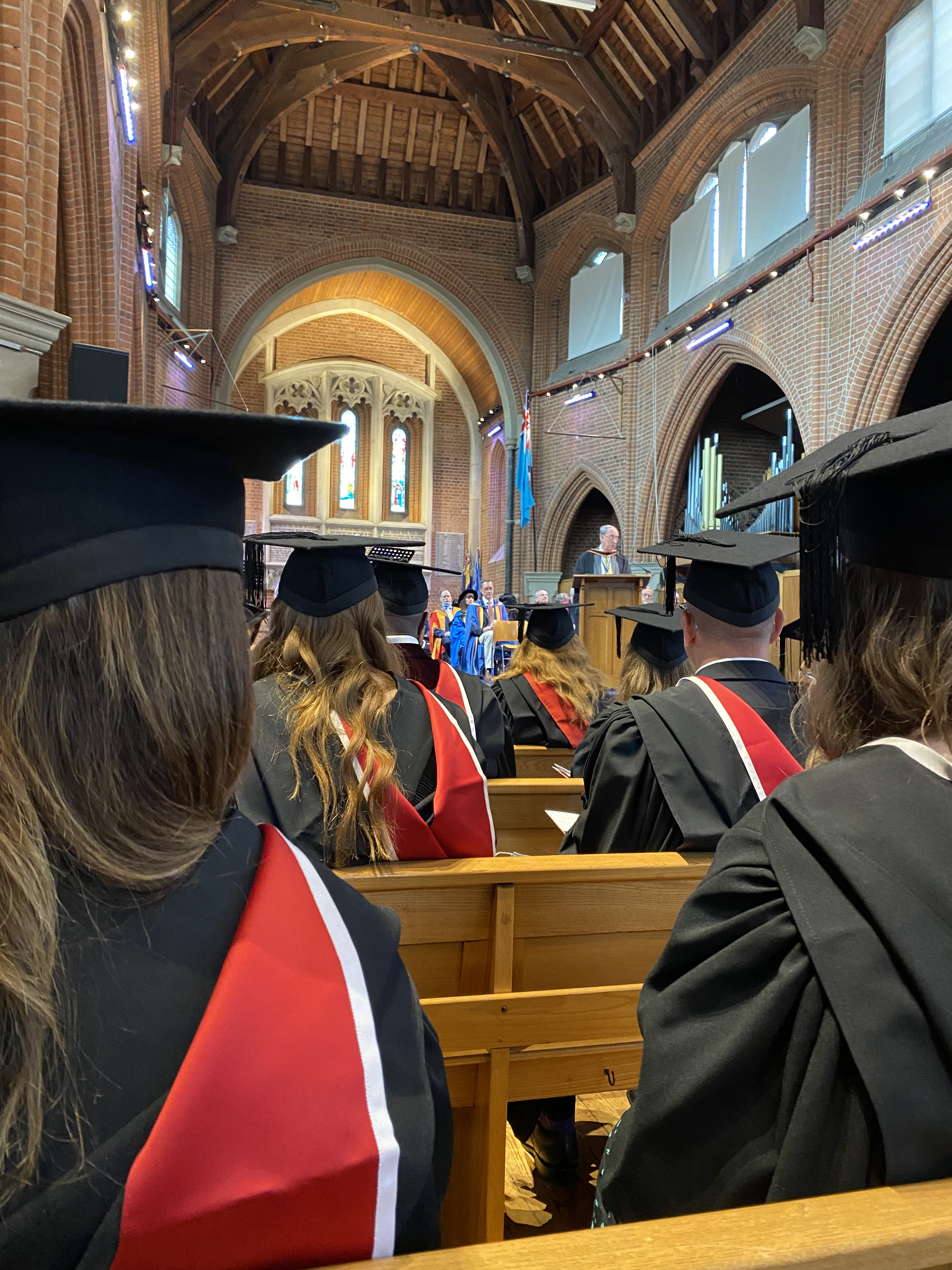
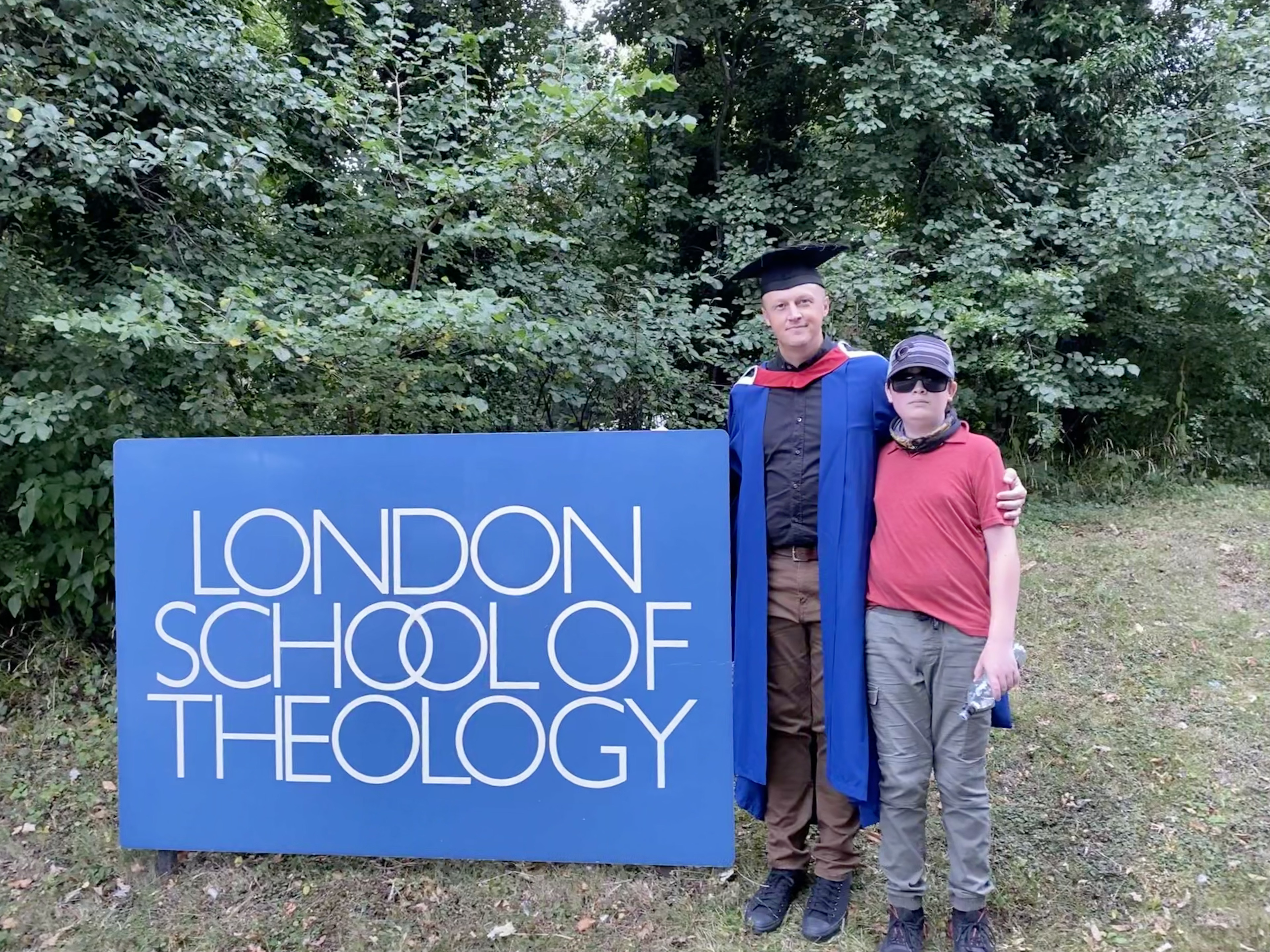
Earlier this month I traveled to London with my wife and 3 of our kids for my graduation ceremony from London School of Theology (University of Middlesex).
I had already graduated last November with a Master of Arts in Integrative Theology, but the ceremony was postponed until now because of the pandemic. As a result, it was a small ceremony, with most of the graduates not attending in person.
This is my second degree that I’ve done in the British system; I got my BA in Theology years ago from the University of Gloucestershire in the west of England.
London School of Theology (LST) is the largest non-denominational evangelical divinity school in Europe, and there were students from all over Europe and the world in my masters program, including several from the United States.
Sometimes people ask me why I chose to study in the UK rather than in the US. Part of the reason is because I began my theological studies while I was living in Hungary, and the UK was closer than the US. However, I chose to go back to school in the UK for my masters primarily because of cost, the ability to study fully online, and quality of education.
I currently have three American friends who are pursuing post-graduate degrees in the UK, one at LST, another in Oxford, and the other in Birmingham. I would recommend that more Americans consider studying theology in the United Kingdom for a few key reasons:
No Separation of Church & State = Lower Cost
Unlike the United States, the United Kingdom does not have “separation of church and state.” So whereas there might be more practicing Christians in the United States, on paper the US is a more secular state. The UK has a state church, with ties between the government and that church, e.g. the role of the monarch as the head of the church and the presence of Anglican bishops in the House of Lords. What this all amounts to is that the UK is, at least on paper, an officially Christian nation, whereas the United States is an officially secular nation.
One of the results of the separation of church and state in the United States is that public universities cannot have theological seminaries; at best they can have courses on subjects like “comparative religions.” For this reason, all theological seminaries in the United States are private schools, or part of private universities, which means no government funding, and higher cost for the student.
Since the United Kingdom does not having a separation of church and state, many public universities (e.g. Sheffield, Nottingham, Birmingham) have theological colleges (AKA departments), which amounts to a lower cost for the student. Many of these schools are highly respected, such as Nottingham, which has a great program in systematic theology, and LST which also has a great reputation around the world.
Furthermore, I was able to register for LST as a Hungarian citizen before the UK left the EU, which meant I qualified for subsidies as a “domestic student.” I’m not sure how or if things have changed for European students now as a result of Brexit.
British Education & British Evangelicalism
Perhaps I am biased, but I prefer the British higher education system. In undergraduate studies, they do not require “prerequisites” like American schools do, which means that the focus of your entire undergrad program is in your chosen field of study. In other words, if you study theology in England, you won’t have to take any math classes. Furthermore, the British system tends to have fewer homework assignments, and most of the assignments are essay writing. Undergrad students often write a dissertation research project to get their BA.
British evangelicalism has held onto the key facets of evangelical (meaning: gospel-focused) beliefs, such as the primacy and inerrancy of Scripture and the need for people to be born again by grace through faith, in a way that has avoided much of the politicalization of American evangelicalism. LST, for example, was founded by evangelical pastor John Stott, and is the alma mater of well-known Bible teacher Alister Begg.
If you are considering a theological education, I’d recommend looking into some options in the UK. I’m glad I did.
This week on the Theology for the People Podcast, I sat down with Dr. Roy Collins, a recently retired professor of theology at Colorado Christian University (CCU).
Roy attends White Fields, the church I pastor, and he leads an adult Sunday School class which is studying through the Gospel of Mark on Sunday mornings at 8:00 AM.
Prior to his retirement, Dr. Collins served as a pastor, consultant, and most recently as a professor at CCU, where he primarily taught Biblical Interpretation.
In this discussion, Roy gives some helpful book recommendations and a 5-step process for correctly handling a Biblical text in order to make accurate interpretation and correct application.
You can listened to the episode by clicking this link, or by listening in the embedded player below:
Biblical Interpretation with Dr. Roy Collins: Guidelines for Correctly Understanding & Faithfully Applying God's Word –
Theology for the People
Dr. Roy Collins (DMin) has served as a pastor, consultant, and professor of theology at Colorado Christian University, where he taught Biblical Interpretation. In this episode, Dr. Roy shares with us the key to unlocking the meaning of any given passage of the Bible, as well as a 5-step system of guidelines for how to exegete a given passage.
The books recommended in this episode by Dr. Collins are:
Grasping God's Word: A Hands-On Approach to Reading, Interpreting, and Applying the Bible, by Duvall & Hays
The Gospel and Kingdom, by Graeme Goldsworthy
Dr. Collins leads a Bible study through the Gospel of Mark on Sunday mornings at 8:00 AM (Mountain Time) at White Fields Community Church in Longmont, Colorado.
Check out the Theology for the People blog site, and please leave a review on your podcast app if you've benefited from this content.
Do you not know that you are God’s temple and that God’s Spirit dwells in you? If anyone destroys God’s temple, God will destroy him. For God’s temple is holy, and you are that temple.
This text has been used, particularly by the Roman Catholic Church to say that if a person commits suicide, they go directly to Hell – no passing Go, no collecting $200.
“Mortal Sins” and “Venial Sins”
Using these verses as justification, the Roman Catholic Church labels suicide a “mortal sin,” for which no atonement can be made, as opposed to “venial sins” which a person may be cleansed of through paying for them via suffering in purgatory.
First of all, the entire idea of mortal and venial sins goes contrary to the clear teaching of Scripture, which states that there is only one unforgivable sin, which is the blasphemy of the Holy Spirit (click here for an explanation of the blasphemy of the Holy Spirit). Furthermore, it is only Jesus who atones for our sins, we cannot atone for any of our sins, and to claim that we can “pay” for our own sins through our sufferings is to negate and minimize the work of Jesus on the cross, and say that Jesus suffered and died in vain.
In 1 Corinthians 3:16-17, Paul uses the plural form of “you” – in other words, he is saying: “All y’all (together) are the temple of God.”
What’s important to remember about this passage, is that Paul the Apostle is writing to the Corinthian church about their church. Some in the church were harming and tearing apart the church with their divisive attitudes and actions, and Paul is giving them a stern warning that if anyone destroys the temple of God (the Church which He loves), God will take that personally and not let is slide.
Later in 1 Corinthians, in chapter 6, Paul once again speaks of the Temple of God in relation to the indwelling of the Holy Spirit, but there he does so in regard to the individual believer. This passage in 1 Corinthians 3, however, is not written to or about the individual believer, but to the church about the church. So the point of the passage is not about suicide at all, but it is a warning to those who would harm and tear apart the church with their words and actions.
When Christians Were Killing Themselves
Until the Edict of Milan, AKA the Edict of Tolleration was issued in 313 AD, Christianity’s status in the Roman Empire was that of religio illicita, an “illicit” or illegal religion (as opposed to Judaism, which held the status of religio licita). During this time, Christians throughout the Roman Empire experienced waves of persecution, usually dependent on the attitudes of local authorities, although there were times when persecution was the official policy of the entire empire – such as during the reigns of Nero and Diocletian. Christians also faced persecution outside the Roman Empire.
During this period, many Christians were martyred, and martyrs were highly regarded and respected as those who had been willing to pay the ultimate price for their faith. In fact, martyrdom was so highly regarded, that people began to seek it out and desire it, as a way of expressing their devotion to Jesus. Ignatius of Antioch, for example, wrote about his desire to die as a martyr.
But some people took it even further. Jerome writes about a young woman named Belsilla who flagellated herself so much that she died from her self-imposed injuries. Another woman, Agathonike, upon witnessing the execution of a bishop by burning, also threw herself onto the fire, declaring “this is the meal that has been prepared for me.” She died in the flames, even though she had not been arrested nor charged. There are other accounts of Christians volunteering to be martyred even though they were not even being sought by the authorities. [1]
The Donatists, who considered themselves particularly hard core and dedicated (and looked down on those they considered less-committed, even to the point of questioning their salvation), greatly desired to show their devotion by being martyred. Some Donatists even went to the point of simply killing themselves to show how spiritual they were, i.e. how much they were not attached to this life and how much they desired to depart this world and be with Christ.
The Response of the Church
Seeking martyrdom and committing suicide became such a big issue with the Donatists in particular that it threatened the credibility, and even the existence of the church in their area of North Africa.
Judaism had always considered suicide to be sinful, whereas in pagan Roman culture it was considered an acceptable way to exit this life, and was practiced mostly by the wealthy, in part because slaves were not allowed to commit suicide since their lives did not belong to them, but rather to their masters.
It was Augustine of Hippo, a native of North Africa himself, who took up the challenge of addressing this issue and clarifying Christian thinking on this subject. In his book ‘The City of God’, Augustine considered what the Bible has to say about suicide and weighed various arguments for and against suicide. His conclusion was that suicide is always wrong as it is a violation of the sixth commandment (“Thou shall not murder”), and is never justified even in extreme circumstances. This became the official position of the church. [2]
And yet…
Just because 1 Corinthians 3:16-17 isn’t talking about suicide, it must be noted that suicide is clearly a sin and is never the answer.
Help is available for those who are struggling. You can contact me directly here, or call the U.S. National Suicide Prevention Hotline if you need someone to talk to immediately: 1-800-273-8255.
This week’s episode of the Theology for the People podcast is a discussion I had with pastors Benjamin Morrison and Craig Babcock on the topic of hermeneutics and Biblical interpretation.
Hermeneutics is the method by which we interpret communication, particularly texts. Legal hermeneutics, for example, is the study of how laws, or the constitution for example, are to be understood and put into practice.
Biblical hermeneutics is all about how to correctly interpret the Bible, so that we can be doers of the Word, not hearers only.
It must be said that not all hermeneutics are equally valid. Some hermeneutics are better than others. Sometimes we even intentionally use a hermeneutics in order to properly interpret something, as we do with “Christ-centered hermeneutics” – in which we intentionally read all of Scripture as pointing to Jesus, which we do because Jesus himself told us that this was the proper way to read and interpret the Old Testament Scriptures (see Luke 24:44-48).
Other examples of good hermeneutics would be “biblical hermeneutics,” in which read the Bible understanding all of the Bible to be the inspired Word of God, meaning that each individual part of the Bible should be understood in light of what the rest of the Bible says. We might intentionally choose to read the gospels through a Jewish lens, seeking to put ourselves sin their shoes in order to understand the things that happened or were said.
Oftentimes, however, our hermeneutics are not intentional, and we may not be aware of them, and they do impact how we interpret and understand what the Bible says. How then can we become aware of the hermeneutics we’re unintentionally using so that we can determine if they are good or not?
In this episode we discuss this and other questions surrounding the topic of hermeneutics. You can listen here or in the embedded player below.
Hermeneutics: How Do We Correctly Interpret What the Bible Says? – with Benjamin Morrison & Craig Babcock –
Theology for the People
In this episode Nick Cady and special co-host Craig Babcock speak with Benjamin Morrison, lead pastor of Calvary Chapel Svitlovodsk, Ukraine and coordinator for City to City Ukraine, about the topic of hermeneutics: the interpretation of texts, particularly the Bible. Hermeneutics and biblical interpretation is the focus of Ben's masters studies at London School of Theology, Nick's alma mater.
What is hermeneutics, and why is it important? Can't we just read the Bible without having to worry about interpretation?
As Ben shows us, everyone who reads the Bible has a hermeneutics and we are all interpreters, the question is: are you a good and faithful interpreter of the biblical text? If, as Ben points out, not all hermeneutics are equally good, then how can we determine which ones are better than others and how do we identify our own hermeneutics in order to examine whether they are good or not? We discuss these questions in this episode.
In our current series at White Fields called Grace & Truth, we are studying through the book of 1 Corinthians.
This past Sunday, we studied the second half of chapter 1, in which Paul talks about “the message of the cross.” In doing so, Paul makes clear between 1:17 and 1:18 that the message of the cross is the gospel, and the gospel is the message of the cross. This message is “the power of God” for all who believe; precisely the same thing Paul says about the gospel in Romans 1:16. In other words, the gospel (the central message of Christianity) is the message of the cross.
Martin Luther wrote about the difference between a “theology of glory” and the “theology of the cross.” In this week’s Sermon Extra, I explain some of this historical context for Luther’s differentiation between the theology of glory and the theology of the cross, as well as how we can recognize theologies of glory in our modern times.
You can also listen to the podcast of this episode here:
In this week's sermon extra, Pastors Nick Cady and Michael Payne discuss Martin Luther's description of Theology of Glory vs the Theology of the Cross and how it works out in modern thinking, as well as the way to be happy.
You can watch the entire message from this past Sunday, “The Message of the Cross & the Power of God” (1 Corinthians 1:17-31), here:
In the latest episode of the Theology for the People podcast, Mike and I discuss the topic of “theological method,” which was a big part of my Masters study in Integrative Theology.
Integrative theology weaves together historical, biblical, systematic, and other approaches to doing theology in order to take a holistic approach, and the result is an integrated theological method.
Here’s the thing: everyone uses a method for doing theology, whether they recognize it or not. Furthermore, the reason why different people and groups arrive at different conclusions is because they are using different theological methods.
In this episode, I explain the 5 commonly recognized “sources of theology,” and answer the question of how to examine your own theological method.
Theological Method: Sources of Theology and Why People Arrive at Different Conclusions About Matters of Faith and the Bible –
Theology for the People
In this episode, Nick and Mike discuss the topic of "theological method", which involves the study of how people arrive at theological conclusions based on how they use the "sources of theology" in relation to each other.
We discuss the 5 commonly recognized sources of theology, explain different theological methods that exist, and how they relate to interpreting the Bible in light of our ever-changing world.
Check out the Theology for the People blog site at nickcady.org
One of the questions that is sometimes asked about the Holy Spirit, is whether God will ever remove the Holy Spirit from a person because of disobedience or sinful actions.
Certainly there are verses which talk about God removing the Holy Spirit from people, such as Psalm 51:11, where King David prays, “Cast me not away from your presence, and take not your Holy Spirit from me.” David prayed this in the wake of his sin with Bathsheba (2 Samuel 11), so that brings up the question: Are there times when God removes the Holy Spirit from someone if they do something really bad?
Furthermore, in 1 Samuel 16, is says that the Spirit of the Lord departed from King Saul, and in the Book of Judges, it says that the Spirit of the Lord departed from Samson.
So, does this mean that God will REMOVE his Spirit from YOU, if you live in a bad way? If so, that would be a pretty big problem, because Romans 8:9 says “Anyone who does not have the Spirit of Christ does not belong to him.”
Understanding the Three Relationships the Holy Spirit has with different groups of people
In order to answer this question and understand what it meant for David, Saul, and Samson – and what it means for us today, we have to first understand the 3 different relationships that the Bible tells us the Holy Spirit has with different groups of people.
Relationship 1: “WITH” All People
In John 14:17, Jesus told his disciples that the Holy Spirit had been with them up until that point.
Jesus then he told them that the work of the Spirit in the world is that He brings about conviction in people’s hearts and minds about 3 things: Sin, Righteousness, and Judgment (John 16:8)
In other words, the Holy Spirit is at work in the world in every country, with all people, and he is whispering in their ears and speaking to their hearts about the fact that 1)They are sinners (they have fallen short of God’s perfect standard), and 2) God is righteous, so therefore 3) There is coming a day of judgment when they will have to stand before that righteous God and give account for their lives.
The purpose of this conviction is not to just make people feel bad about themselves; the purpose is to draw them to Jesus by bringing them to a realization of why they need a savior, so they will embrace Jesus and what He has done in order to save them.
Relationship 2: “IN” those who have been redeemed by Jesus
Jesus told his disciples in John 14:17: The Holy Spirit has been WITH YOU up until this point — but soon, the Holy Spirit will also be IN YOU.
This indwelling of the Holy Spirit is something that was prophesied by the Old Testament prophets Ezekiel and Jeremiah, that one day God was going to put His Spirit within His people (Ezekiel 36:27), in order to transform them from the inside out.
For people in the Old Testament, the indwelling of the Holy Spirit was always a future event, but after Jesus had died and resurrected, we read in John 20:22 that Jesus met with his disciples and he breathed on them and said to them, “Receive the Holy Spirit.” It was at this moment, that the disciples received the Holy Spirit within them, and it was at this moment that they were “born again.” (See also: “What does it mean to be “Born Again”?)
What it comes down to is this: Only those who have put their faith in Jesus have the Holy Spirit within them, and every person who has put their faith in Jesus has the Holy Spirit dwelling with them.
The Bible tells us that when you put your faith in Jesus, God puts his seal on you and gives you His Spirit in as a guarantee(2 Corinthians 1:23). Furthermore, the regenerating and indwelling Spirit is called “the Spirit of Adoption” (Romans 8:15) It’s His guarantee that you belong to Him, and you are His.
The indwelling Spirit sanctifies, leads, guides, strengthens, and transforms from within.
Relationship 3: “UPON” Some people at different times, to empower them to do what God has called them to do
Remember how in John 20 Jesus breathed on his disciples and said, “Receive the Holy Spirit”? Well, right after that, Jesus told his disciples to stay in Jerusalem and wait until the Holy Spirit came upon them. (Luke 24 & Acts 1:4)
But… if they just RECEIVED the Holy Spirit, then why did Jesus tell them to wait for the Holy Spirit?
Because: this is speaking about two different relationships with the Holy Spirit!
When Jesus breathed upon them, they received the Spirit IN them (and they were born again) — but then they were to wait in Jerusalem for the Holy Spirit to come UPON them: to EMPOWER THEM to carry out the mission Jesus had given them.
That’s why Jesus His disciples in Acts 1:8, “But you will receive power when the Holy Spirit has come UPON you, and you will be my witnesses in Jerusalem and in all Judea and Samaria, and to the end of the earth.”
Throughout the Old Testament, before people could have the Holy Spirit WITHIN them — we read that the Holy Spirit would come UPON people, to empower them to do things God had called them to do. For example, it says that the Spirit of the Lord came upon Gideon! (Judges 6:34 NKJV) We’re also told that the Holy Spirit came UPON Samson, and UPON David, and UPON Elisha, and others — to EMPOWER them to do what God had called them to do.
So, Jesus was promising his disciples (and us) — that the Holy Spirit will also come upon us, to empower us to carry out the callings He has placed upon our lives.
Un-Adopting? Un-Sealing?
Remember: in the Old Testament, the Spirit was WITH people (to bring conviction) and the Holy Spirit was UPON people (to empower them), but at that point that Spirit was not yet WITHIN people. So when we read in the Old Testament about God “removing” his Spirit, it’s not in the sense of a person who had the Holy Spirit dwelling within them, rather it’s in the sense of God removing the empowering work of the Holy Spirit from those people.
But for a person who has been sealed by the Holy Spirit indwelling them, we never read of God removing His Spirit from someone in that sense. The indwelling Holy Spirit is the Spirit of Adoption. God does not un-adopt us when we make mistakes and mess up, rather: he disciplines us like a loving Father (see Hebrews 12).
If He has SEALED you, as a guarantee of your salvation, that’s exactly what it is: He has placed his Spirit within you as a guarantee that He will see you through and bring to completion the good work that He has begun in you.
If you are His child, He won’t give up on you – and that’s really good news!
Further Study
For more on the 3 Relationships with the Holy Spirit, see this study: The Promised Helper
In this week’s episode of the Theology for the People Podcast, I sat down with Pastor Wayne Taylor from Calvary Fellowship in Seattle, Washington.
Wayne has a long history as a leader in the Calvary Chapel movement. He founded Calvary Fellowship in Seattle and served there as lead pastor for 42 years. Under Wayne’s leadership, 55 churches were planted, both in the Pacific Northwest and abroad.
Wayne recently spoke at White Fields Church. That message, in which he reads a limerick he wrote about me(!), can be found here: Ephesians 2:10 – God’s Poem’s at Work.
In this episode, Pastor Wayne and I discuss Charismatic Christianity: where the word “charismatic” comes from, what it means, arguments for and against charismatic practices, as well as John MacArthur, theological method, Calvary Chapel, and our own personal experiences and biases.
Pastor Wayne Taylor has a long history as a leader in the Calvary Chapel movement; he founded Calvary Fellowship in Seattle, Washington, where he served as lead pastor for 42 years. Under his leadership, 55 churches were planted out of Calvary Fellowship, both in the Pacific Northwest and abroad. Wayne now serves on the executive leadership team of Calvary Global Network.
In this week's episode, Wayne and I discuss what it means to be "charismatic." We discuss the origin of the word, arguments for and against charismatic practices, as well as John MacArthur, theological method, Calvary Chapel, and our own personal experiences and biases.
Follow Pastor Wayne on Facebook, and check out the Theology for the People blog.
The sermon series from White Fields Church on the Holy Spirit can be found here: The Spirit-Filled Life.














 Theology for the People