I arrived home last night after a whirlwind trip to Europe to help with the humanitarian crisis caused by Russia’s invasion of Ukraine.
Many people have been interested to hear about what we did over there, and what needs and opportunities there are for help in the future, so the night before I left to come back to the US, Pastor Michael and I sat down to film a video sharing with people some of what we accomplished, and what some of the ongoing needs are.
We filmed this at the kitchen table in Michael’s old apartment in Budapest, using a broom as our camera stand!
There are many needs. Just today we have been working on wiring money to people in another city in Ukraine to help buy another van to transport food and aid, and to evacuate people. If you would like to give, we will put that money directly into the hands of people who are serving on the ground. Donations can be made here: Ukraine Relief Fund
As I mentioned in a previous post, I was scheduled to be in Ukraine this week to visit ministry partners in Kyiv and Kharkiv, and speak at a conference in Irpin. Instead, many of the people we were going to work with are hiding in bomb shelters, basements, and metro stations because of the Russian attack. Others have left their homes for safer locations in western Ukraine or in neighboring countries.
I am so impressed with the courage and resolve of the Ukrainian people, as well as with the leadership of their president. I pray for justice to prevail, for an end to these attacks, and for peace in Ukraine.
Today I am flying to Hungary with 2 other pastors who served for many years in that region as missionaries. We are going to visit our missionaries who have fled there from Ukraine, take gifts and supplies for them and their kids, and explore potential opportunities for outreach to refugees, as well as ways to help those within Ukraine who are serving displaced people.
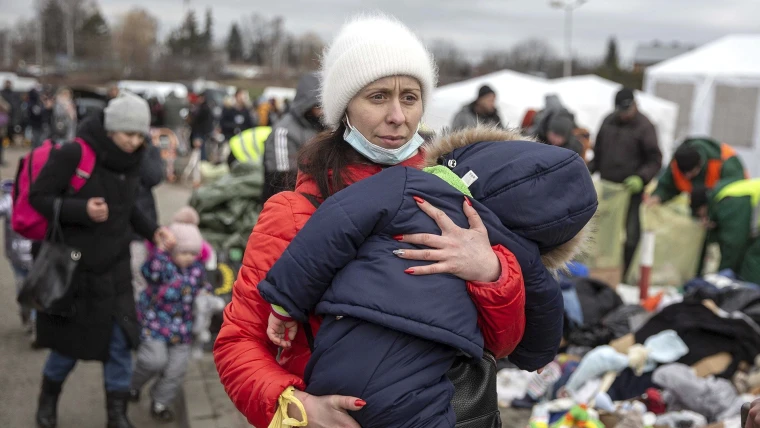
So far over 500,000 people have fled Ukraine, and that number is expected to reach up to 4,000,000 according to the UNHCR. This is a time for the church to shine, and for us to step up and be the hands and feet of Jesus to the world. Those I am in contact with in Ukraine and Hungary are doing just that, and it is noteworthy and beautiful. In addition to the immediate needs now, there will likely be many opportunities to help in the months and years to come.
How to Help
If you would like to give to our Ukraine Relief Fund, those funds will go to purchase needed supplies, fuel, medicines, and provide shelter for displaced people.
Kellen Criswell is a pastor, ministry leader, and former missionary who holds and MA in Global Leadership from Western Seminary and is currently working on his doctorate. He is the Executive Director of Calvary Global Network and has a heart for the mission of God and the global church.
After a brief discussion about Kellen’s favorite music and the fact that he is from Utah (AKA “Colorado Jr.”), we dive into a discussion about Missional Ecclesiology, which is a way of understanding the identity, purpose, and function of the church within the Missio Dei (the love-motivated, self-sending, mission of God into the world to save, redeem, and restore).
One more thought about Utah: If you have to tell people (on your license plates) that you have “the best snow in the world,” you probably don’t. It’s kind of like using the world “Real” in a title. If you have to say that something is “real ______” – it probably isn’t. And also, what Margaret Thatcher said: “Being a leader is like being a lady: If you have to tell people you are one, you probably aren’t.” Same with the snow, Utah…
But I digress…
Ecclesiology is the discussion of what the Church is called to be and to do – including its nature, purpose, hopes, structures, and practices.
We discuss how this concept works out practically, including a discussion of “foreign missions” and how they fit into this understanding. Furthermore, we discuss what the past nearly two years of pandemic has revealed about ecclesiology, and why there is hope as we move forward.
Missional Ecclesiology: What is the role of the church in the mission of God? – with Kellen Criswell –
Theology for the People
Kellen Criswell is a pastor, ministry leader, and former missionary who holds and MA in Global Leadership from Western Seminary and is currently working on his doctorate. He is the Executive Director of Calvary Global Network and has a heart for the mission of God and the global church.
In this episode we discuss Missional Ecclesiology, which is a way of understanding the identity, purpose, and function of the church within the Missio Dei (mission of God). Ecclesiology is the discussion of what the Church is called to be and to do – including its nature, purpose, hopes, structures, and practices.
We discuss how this concept works out practically, including a discussion of "foreign missions" and how they fit into this understanding. Furthermore, we discuss what the past nearly two years of pandemic has revealed about ecclesiology, and why there is hope as we move forward.
Bibliography and recommended resources:
Hirsch, Alan. The Forgotten Ways: Reactivating Apostolic Movements.
Goheen, Michael. The Church and it’s Vocation: Leslie Newbigin’s Missionary Ecclesiology.
Stetzer, Ed. Planting Missional Churches: Your Guide to Starting Churches that Multiply.
Newbigin, Leslie. The Gospel in a Pluralist Society.
Van Engen, Charles. Transforming Mission Theology.
Wright, Christopher J.H.. The Mission of God: Unlocking the Bible’s Grand Narrative.
Bosch, David. Transforming Mission: Paradigm Shifts in Theology of Mission.
Hooker, Paul. "What is Missional Ecclesiology?"
Make sure to check out the Theology for the People blog at nickcady.org
Make sure to check out some of the books and papers listed below for more information and study on this topic.
Jon Markey and Michael Payne are accomplished musicians, songwriters, and producers, and in the latest episode of the Theology for the People podcast, I sat down with them to talk about the theology of music.
Michael is the Worship Pastor at White Fields Community Church in Longmont, Colorado. Prior to coming to Longmont, he spent 21 years as a worship leader and missionary in Hungary, and prior to that he served in the US Marine Corps.
Jon is a pastor and missionary in Ternopil, Ukraine. He moved to Kiev, Ukraine with his family in the 1990’s, when he was 5 years old, and earned a masters degree from the Ukrainian National Tchaikovsky Academy of Music.
We recently had the pleasure of having Jon and his family visit Longmont and lead worship at our church, and while he was here, I got to sit down with him and Mike to discuss what the Bible has to say about music: its purpose, uses, and significance – including the “song of creation,” and how it serves to counteract pagan origin narratives, as well as Jubal: the first human musician, mentioned in Genesis 4, as well as other practical discussions which have modern application.
Michael Payne and Jon Markey are accomplished musicians, songwriters, and producers, and in this episode they talk with Nick about the theology of music. Listen in to this discussion of what the Bible has to say about music: its purpose, uses, and significance – including the "song of creation," Jubal, and practical discussions for today.
Check out Jon's ministry: Room for More music on YouTube and his church: Calvary Chapel Ternopil (Ukraine)
Check out Michael on Spotify: Michael Payne and you can watch him on the White Fields Community Church YouTube page.
The book mentioned in this episode is Scribbling in the Sand: Christ and Creativity by Michael Card
Visit the Theology for the People blog.
Recently we have had the pleasure of getting to spend some time with some of our missionary friends from Ukraine, who have visited our church here in Colorado.
This past Sunday I had the opportunity to sit down with pastor Benjamin Morrison from Svitlovodsk, Ukraine to talk about his life and ministry. Ben is the pastor of Calvary Chapel Svitlovodsk, Ukraine, as well as the coordinator for City to City Ukraine and is part of the leadership of City to City Europe.
This turned out to be a great conversation in which we talked about how Ben came to be a missionary in Ukraine, what it’s like doing ministry in a post-communist context, and what “contextualization” means and how it works out in practice. We finished the conversation by sharing some practical advice for those who are seeking God’s leading and direction for how they can get involved in God’s global mission.
Outside of proverbs, bribery is spoken against. Inside proverbs we see both direct opposition to it, but also some almost-approving of it. I won’t list verses which speak against it because they’re numerous and easy to find, but I’d like to hear your thoughts regarding verses like these:
A bribe is like a magic stone in the eyes of the one who gives it; wherever he turns he prospers. Proverbs 17:8 ESV
A gift in secret averts anger, and a concealed bribe, strong wrath. Proverbs 21:14 ESV
Corruption and bribery are major topics here in Ukraine and we’ve dealt with this question a few times.
That’s a great question. To answer it, I reached out to a friend who lives in Ukraine where he serves as a pastor and missionary: Benjamin Morrison.
We had a great discussion on this topic, which I think you will really enjoy and benefit from. In this video we discuss the nature of the Book of Proverbs, different scenarios in which bribes are asked for or offered – and how to respond in each, as well as some personal stories. Finally we end the conversation on a note of how the gospel helps and empowers us to face corruption and bribery and other things that are wrong in the world. Enjoy!
This past week I was honored to be interviewed by David Snead on his podcast. David is a missionary in Lviv, Ukraine – and he is one of the most organized people I know.
We had a great discussion about my background in ministry, ministering in the COVID-19 crisis and beyond, Calvary Chapel, and expository preaching. Check it out:
When I left on March 5 to Hungary and Ukraine, there was no recommendation not to travel to those areas – and even now there are very few cases of COVID-19. I am deeply concerned by the threat that this virus poses to the vulnerable and immune-compromised around the world, and am committed to doing my part to prevent the spreading of the virus.
That being said, here is an update on what Mike and I were up to in Hungary and Ukraine:
Expositors Collective Budapest
The Expositors Collective is a growing network of pastors and leaders who are committed to raising up the next generation of Christ-centered Bible teachers and preachers through interactive training seminars and a weekly podcast.
Just last week, the Expositors Collective celebrated two years since our first training weekend in Thousand Oaks, CA!
Since that first event, we have hosted 8 training seminars, the latest being the one in Budapest, which was a bit of a hybrid: as opposed to our usual 2-day format, we condensed it into a 1-day event, which required leaving out some aspects of our usual training.
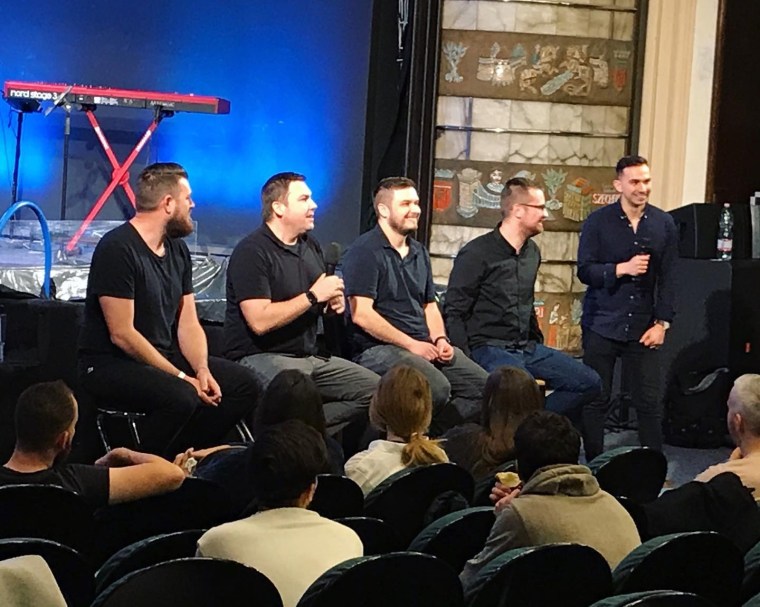
March 7 Expositors Collective training in Budapest
Budapest was also our first time working in a bilingual setting, as we had people in attendance not only from Hungary, but from surrounding countries, including Slovakia, Serbia, and Romania, as well as students from Calvary Chapel Bible College Europe.
The training went very well, and there is interest for Expositors Collective events in other European countries, as well as for the full 2-day version in Budapest at some point in the future.
Visiting Missionaries & Speaking at Churches
White Fields supports several missionaries around the world, mostly in Eastern Europe. (See: White Fields Missions) On this trip, I was able to visit all of our European missionaries except one, beginning with the Németh family in South Budapest. I had the opportunity to preach at their church, Golgota Dél-Pest. I loved getting to preach in Hungarian again. The video of that sermon is embedded below.
On Monday, March 9, Mike and I flew to Kyiv, Ukraine – where we were met by missionaries and friends: George Markey (senior pastor of Calvary Chapel Kyiv), and Nate Medlong, who serves in Kharkiv, Ukraine with Calvary Chapel Kharkiv and Fostering Hope ministry to children in foster care. Mike then took a train to Ternopil, in western Ukraine to visit missionaries there, and I went to Kharkiv with Nate to spend a few days with him, his family, and people from their church.
I taught the Thursday night service at the church in Kharkiv, after a quick trip up to Kyiv Thursday morning to speak at Ukrainian Evangelical Theological Seminary, where I taught two 80-minute classes on Spiritual Formation.
Teaching at UETS, a view of Kyiv from the train, teaching at the church in Kharkiv
This past Sunday I taught at Calvary Chapel Kyiv, their last service before the national quarantine began. Video of that message is embedded below as well.
Calvary Chapel Ukraine Leadership Conference
On Friday-Saturday we had 65 Calvary Chapel leaders from all over Ukraine gather in Irpin for the annual leadership conference. This was a time of teaching, training, and discussing leadership principles from God’s Word in order to help us lead our churches well. Click here for photos of the conference.
With the spread of COVID-19, these gatherings are no longer possible or wise, but in God’s providence we were able to hold them while it was still safe and wise to do so.
It was a fruitful time of ministry, and great times of fellowship with people who are doing important work in a place where it is very needed. Please keep the work of these leaders and churches in your prayers that God would bless and use their ministries for His glory and for the good of many people!
This past Sunday at White Fields Church, we began a new series called Upside Down, which may or may not be a reference to Stranger Things, but definitely comes from what was said about the Christians in Thessalonica, that “these people who have turned the world upside down have now come here also.” (Acts 17:6)
One of the interesting aspects about the church in Thessalonica is that Paul never actually intended to go there. His plan was to go somewhere else: to the province of Asia. When that didn’t work out, he tried to go to the region of Bithynia. In other words, going to Thessalonica, in the province of Macedonia, wasn’t even Plan B, it was Plan C! And yet, God did an amazing work there, so much so that Paul tells the Thessalonians that they are his glory and his joy. (1 Thessalonians 2:20)
Closed Doors that Changed History
David Livingstone, the great missionary who brought the Gospel to the interior of Africa,originally wanted to go to China as a missionary, but it didn’t work out. That’s how he ended up in Africa. The rest is history.
William Carey, who pioneered the modern missionary movement in India, originally planned to go to Polynesia.
Adoniram Judson, who brought the gospel to Burma, originally wanted to go to India, but the doos were closed.
Closed Doors and God’s Leading in My Life
I spent 10 years as a missionary in Hungary. They were wonderful, fruitful years. But I didn’t originally intend to go to Hungary.
Check out this video in which Mike and I discuss how God led each of us to Hungary. Spoiler alert: Mike didn’t intend to go to Hungary either. Watch the video to find out where we were each intending to go, and how God led us, and how we feel about our plans not working out.
We are also now podcasting not only our sermons, but these Sermon Extra discussions every week as well. You can find them on Apple Podcasts, Google Play, and Spotify.
Michael Payne, who serves as worship pastor at White Fields Community Church in Longmont, just released an original song called “My Times”. Check it out on YouTube here:
Here’s what Mike wrote about the song:
The story of this song starts back in 1996 when I arrived in Debrecen, Hungary with my backpack and guitar. It comes from Psalms 73 and 31 and encapsulated the start of my journey as a missionary. This song would become a mainstay for our Monday night English language Bible study with the medical students. But then I left the song behind in Debrecen as we moved to Budapest where I felt God call me to invest in Hungarian songwriters and song-writing. Since our move to the States 21 years later, this song has taken on new meaning as my family declares this same endless truth to God again – “My times are in Your hands”, stepping out into a new chapter in life.
Music is not only about the song itself, but who you play it with and it was a great joy to record this with great friends.
I hope the story and the words of this song resonate with you wherever you are in your walk with God.
Mike is going to be featured in the Longmont Times-Call’s 100 People of the St. Vrain Valley feature, in which they highlight notable people from the area.











 Theology for the People