Most Listened-To Sermons of 2019

silver iphone x with airpods

Our church’s website was recently updated, including a major overhaul of the sermon archive, which now allows you to browse by series and books we have taught through. Check it out here: White Fields Community Church Sermons

If you haven’t done so yet, you can subscribe to our podcast here, or just search White Fields Community Church in whatever podcast app you use. If you like what you hear, please rate and review us, as that helps boost us in their algorithm, and helps other people discover us.

I recently switched to the Overcast app for listening to podcasts. I like that it cuts out pauses and regulates audio to a consistent level, and allows me to make playlists. Overcast is only available for iOS, but the best app for Android, which has many of the same features is Podcast Addict. My wife’s biggest hesitation with switching to an iPhone recently was that she would lose Podcast Addict.

These sermons I preached in 2019 were listened to and downloaded the most:

10. Amos: Faith that Works

9. Daniel: How to Live a God-Honoring Life in a Hostile Environment

8. How to Be Right When You are Wronged – 1 Peter 3:8-22

7. What is Your Life? – James 4:13-5:6

6. Encouragement for the Fainthearted – 2 Thessalonians 1:1-12

5. Count It All Joy – 1 Peter 1:1-9

4. I Could Never Believe in a God Who: Condoned Genocide in the Old Testament

3. I Could Never Believe in a God Who: Hasn’t Proven His Existence

2. I Could Never Believe in a God Who: Does Not Affirm Some People’s Sexuality

1. I Could Never Believe in a God Who: Sends People to Hell

Analysis

A few things pop out at me from this list. First of all, the fact that some of our more recent sermons are in the top ten means that listenership to our podcast is increasing.

Secondly our biographical look at the prophets, called “Remember the Prophets” was a lot of fun. Those books and their authors are often overlooked for various reasons, but their messages are very important.

Finally, our apologetics series “I Could Never Believe in a God Who…” was our second consecutive year doing a series like this, and clearly it struck a chord with a lot of people. These kinds of series are helpful both for engaging with those who might be skeptical about Christianity, and for teaching Christians how to respond well to those who ask questions. Oftentimes many of us who are Christians struggle with questions even though we choose to trust God and believe. As the church we engage with those issues and equip others to do so as well.

What Didn’t Make the List?

Leave me a comment below and let me know which sermon from this year made the biggest impact on you!

If need to refresh your memory, a list of our past sermons from this year can be found here: White Fields Sermons

What Did John Calvin Mean By, “We must remember that Satan has his miracles too”?

image.png

In a recent post titled If Satan Has Been Defeated, Why Is He Still “Prowling Around”?, we looked at how Satan is not God’s counterpart, and certainly not his equal. How then can someone like John Calvin, who has a high view of God’s sovereignty and power, say that “Satan has his miracles too?

Calvin was referring to Matthew 24:24 – where, in his Olivet Discourse, Jesus states that during a time to come of great tribulation, “false messiahs and false prophets will arise and perform great signs and wonders, so as to lead astray, if possible, even the elect.”

The Context of Calvin’s Statement: A Response to Roman Catholic Criticisms About a Lack of Miracles in the Reformation

This statement is only part of a bigger statement by John Calvin. It is found in the “Prefatory Address to the King of France,” at the beginning of Institutes of the Christian Religion. In this section, Calvin is responding to Roman Catholic criticisms of the Reformation, one of which was that the Reformation lacked miracles, which they said proved that the Reformation was not a legitimate, apostolic, work of God.

In his response, Calvin said that the immediate purpose of a miracle like healing was to bring relief to the individual, but the ultimate purpose was to prove that the apostolic preaching was true. Calvin then argues that the Reformation is not a new revelation, but rather the reaffirmation of the original apostolic preaching, therefore it does not necessitate miracles to confirm its validity.

Calvin then takes it one step further by suggesting that many of the supposed miracles reported by the Roman Catholic Church may not be from God, but may instead be of the sort talked about by Jesus in Matthew 24:24, i.e. performed by false prophets by the power of Satan to lead people astray and deceive them.

Interestingly however, Calvin does not disavow miracles entirely, but suggests that there were actually miracles that accompanied the Reformation. He then makes the concluding point that the test of miracles should be what they cause you to worship and trust in. Any miracle which causes you to trust in false doctrines or turn away from the Word of God, he says, are suspect in their origin.

This final point is a good one; you might remember that in Exodus, Pharaoh’s sorcerers were able to do replicate some of the miracles which Moses performed. The effect of these miracles was to cause people not to listen to God and repent, but to trust in false gods. I have witnessed a similar phenomenon amongst people in some circles today who seek signs and wonders; sometimes the signs they seek cause them to trust in things other than God, His Word, and the gospel.

You can read a larger excerpt of what Calvin wrote here, but here are some highlights:

In demanding miracles from us, they act dishonestly; for we have not coined some new gospel, but retain the very one the truth of which is confirmed by all the miracles which Christ and the apostles ever wrought.

But the mark of sound doctrine given by our Savior himself is its tendency to promote the glory not of men, but of God (John 7:18; 8:50). Our Savior having declared this to be test of doctrine, we are in error if we regard as miraculous, works which are used for any other purpose than to magnify the name of God.

And it becomes us to remember that Satan has his miracles, which, although they are tricks rather than true wonders, are still such as to delude the ignorant and unwary. Magicians and enchanters have always been famous for miracles, and miracles of an astonishing description have given support to idolatry: these, however, do not make us converts to the superstitions either of magicians or idolaters.

But our opponents tell us that their miracles are wrought not by idols, not by sorcerers, not by false prophets, but by saints: as if we did not know it to be one of Satan’s wiles to transform himself “into an angel of light” (2 Cor. 11:14).

We, then, have no lack of miracles, sure miracles, that cannot be gainsaid; but those to which our opponents lay claim are mere delusions of Satan, inasmuch as they draw off the people from the true worship of God to vanity.

Source: John Calvin, Institutes of the Christian Religion, cited in: The Reformation’s Lack of Miracles: A Response by John Calvin

Is Abuse Grounds for Divorce According to the Bible?

art blur close up colors

In Matthew 19 we read about a time when some Pharisees came to Jesus to test him. They asked, “Is it lawful for a man to divorce his wife for any and every reason?” (Matthew 19:3)

The Pharisees, as usual, were attempting to trap Jesus with a no-win question, so that no matter what answer he gave, it would cause him to lose some of his followers. In the Law of Moses, Moses had allowed divorce for the reason of “uncleanness.” Human nature being what it is, people took advantage of the fact that the term “uncleanness” was open to interpretation, and they used it as a loophole, which afforded them the opportunity to “technically” keep the letter of the Law, while ignoring the heart of the Law. By the time of Jesus, people were in the practice of saying that basically anything could constitute “uncleanness,” for example: if a man saw a woman who was more beautiful than his wife, he could say that his wife was “unclean” in comparison to the other woman, and use that as grounds for divorce. If a man got angry at his wife, he could accuse her of being “unclean,” because her actions had caused him to sin by being angry.

The Big Two

Jesus combatted this flippant attitude towards marriage and divorce by taking people back to the design for marriage shown in creation, adding that divorce is permissible in cases of adultery.

Paul, in 1 Corinthians 7:15, gave another justification for divorce: abandonment.

Historically, Christians have recognized these two reasons as the two biblical grounds for divorce. The Westminster Confession of Faith, Chapter 24, Paragraph 6 states that “nothing but adultery, or such willful desertion as can no way be remedied by the church, or civil magistrate, is cause sufficient of dissolving the bond of marriage.”

What About Abuse?

Certainly God hates abuse. Throughout the Old Testament, God shows himself to be a God who is on the side of the abused and opposes abusers. In the prophetic books, such as Amos, when his own people become abusers, God makes it clear to them that because of what they are doing, He is opposed to them, and He calls them to repent and actively work for the welfare of the weak, the vulnerable, and the oppressed.

However, since abuse is not specifically mentioned in the Bible as a grounds for divorce, some Christians have wondered what the protocol should be for those in abusive marriages.

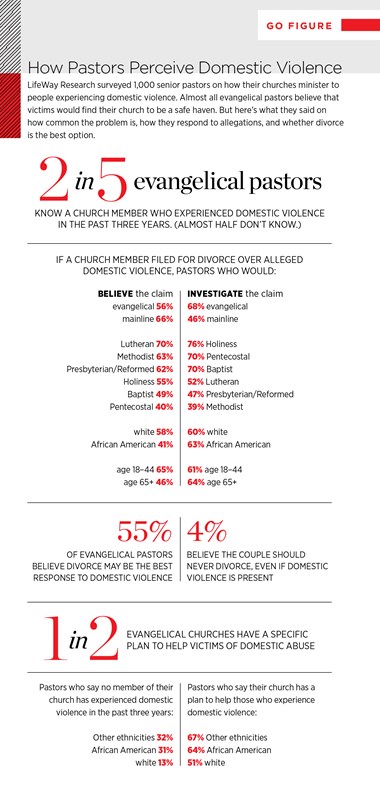
What’s important to note, is that even amongst those who do not believe that abuse is a biblical justification for divorce, almost no one would ever recommend a spouse to stay in an abusive relationship. According to a LifeWay Reseach survey, 96% of pastors recommend at minimum: separation, protection (such as restraining orders), and church discipline (for the abuser) in cases of abuse.

While it is quite alarming that 4% of the pastors polled said that a spouse should stay in an abusive relationship even when violence is present, it is important to note that even amongst those who do not believe that abuse is biblical grounds for divorce, the majority do advocate for separation. Assumedly, those who advocate for separation but not divorce are hopeful that repentance and restoration are possible and are committed to a high view of the authority of Scripture, believing that the Bible only gives the two justifications for divorce listed above.

Wayne Grudem and “in such cases”

Amongst those who have sought to identify a biblical justification for divorce in cases of abuse, most point to 1 Corinthians 7:15, which speaks about one spouse abandoning the marriage. The argument goes that abuse constitutes a form of abandonment. Many people, even those who hate abuse, find this line of thinking to be contrived and unconvincing.

Recently prominent theologian Wayne Grudem, Professor of Theology and Biblical Studies at Phoenix Seminary, announced at the annual meeting of the Evangelical Theological Society (ETS) that he had changed his position on divorce in cases of abuse based on his study of 1 Corinthians 7:15.

While he is still not persuaded by the “abuse is a kind of desertion” argument, he believes that another phrase in 1 Corinthians 7:15 presents a compelling argument for divorce in cases of abuse, namely the phrase, “in such cases” (ἐν τοῖς τοιούτοις).

But if the unbelieving partner separates, let it be so. In such cases the brother or sister is not bound. (1 Corinthians 7:15)

The question is, does this phrase refer to: 1) only cases of desertion by an unbeliever, or 2) cases in which a spouse has done something that has similarly destroyed a marriage?

Interestingly, this Greek phrase does not occur anywhere else in the New Testament or the Septuagint (the Greek translation of the Old Testament), but there are several uses of it in Ancient Greek literature, including 52 from the same time period as the New Testament. There are also several uses of the singular version of the word τοιοῦτος (“in this case”) in the New Testament.

Grudem’s analysis of the uses of these words in the Bible and in other Greek writings from the same time period has led him to the conclusion that “in such cases” refers to the cases in which a spouse has done something which, similar to abandonment, has destroyed a marriage, and that in such cases the latter part of 1 Corinthians 7:15 applies: the abused spouse is no longer bound, i.e. may divorce.

Grudem’s analysis has been met with very little criticism. You can read the outline of the presentation here, which includes a look at the different texts which use this phrase “in such cases” and what it means in those contexts, and why these led Grudem to change his position.

Looking for Loopholes or for the Heart of God

At worst, this could be used in the same way people used the idea of “uncleanness” in Jesus’ day: as carte blanche or a loophole big enough to drive a truck through. The same could be said though of the teachings of grace and forgiveness in the Bible, yet we must not reject nor downplay them just because they might be hijacked or misused – and I believe the same applies here.

Did Jesus Go to Hell?

night dark halloween horror

The Apostles’ Creed, one of the oldest Christian creeds – in continual existence since at least the 4th Century A.D. – contains a line which many people have found intriguing: it declares that Jesus “descended to the dead.”

Older translations of the original text into English sometimes translate this phrase as saying that Jesus “descended into Hell.”

Looking at the creed in ancient languages is interesting as the Greek text says: κατελθόντα εἰς τὰ κατώτατα, which means: “descended to the bottom” – and the Latin text says: descendit ad inferos, the word inferos being translated as “Hell.”

More recent translations into English have chosen to say “descended to the dead” rather than “descended into Hell” as “the dead” would be more accurate biblically and theologically than “Hell.” The reason for this is based on a particular understanding of “Sheol” in the Old Testament and the Jewish mind, which was the dwelling place of all souls, being divided (according to Luke 16:19-31) into two parts: Abraham’s Bosom and Hades, AKA: Hell.

Abraham’s Bosom, it is believed, was a place of comfort for those who died in faith, i.e. the “Old Testament saints,” such as those described in Hebrews 11, who died prior to the redemptive actions of Jesus. The theory, therefore, is that 1 Peter 3:19 and 4:6, Peter is describing how Jesus went to Sheol after his death on the cross but prior to his resurrection, and declared to the deceased souls held there what he had accomplished in his life and death. This message would have been a message of redemption and release from Sheol, to the immediate presence of God, to those who were kept in Abraham’s Bosom awaiting the redemptive work of the Messiah, and a message of condemnation for those held in the Hades/Hell portion of Sheol.

I have written more about this here: Did People Go to Heaven Before Jesus’ Death & Resurrection?

I also explain this in some detail in this past Sunday’s sermon from 1 Peter 3:18-4:11 – The Resurrected Life. The part that deals with this topic begins around 17:30.

However, there are several different, and possible, interpretations of these verses which Mike and I discussed and outlined in this week’s Sermon Extra video. It’s worth watching, as we discuss different views, such as that this speaks to Jesus preaching to demons related to the Nephilim in Genesis 6, Jesus preaching through Moses, etc.:


This Isn’t About Kanye

Kanye West Jesus is King

“I’m my favorite rapper.” What Kanye West lacks in subtlety, he makes up for in honesty.

Kanye’s conversion to Christianity and his release of an album which reflects that faith, titled “Jesus is King”, is big news right now.

But to look at this and only see Kanye, is to miss the bigger picture.

Christianity is Not Collapsing in America

There has been much talk recently about the decline of Christianity in the United States. However, reports of decline are overstated. I have explained why the numbers alone do not tell the whole story in these posts:

The New York Times published an article this past week about why claims about the “collapse” of Christianity in America are grossly overstated.

On his new album, Kanye is joined by Kenny G, who has also attended his Sunday Service events. Christian rapper NF was recently the best selling musician in the entire US.

Let’s put it this way: Christianity is much more widespread and influential than many would have you believe, and it is not going away any time soon.

Christianity is Thriving Amongst Minority Communities

Why are there fewer Christians were I live, near Boulder, Colorado, than there are in the American South? At least one reason is probably because of the relative homogeny of the  population in this area, compared with the number of people of color in the South.

The type of person most likely to be an atheist in America – and in the entire world – are white males. According to Pew Research Group, 78% of atheists in America are white, and 68% are men, even though white males only make up just over 30% of the US population.

According to one study, for example, at historically black universities 85.2% of students identified as Christian, and 11.2% identified as atheist, agnostic, or none. This is contrasted with a national average in all universities of 60.2% of students identifying as Christian, and 30.9% identifying as atheist, agnostic, or none.

As the major Western countries, including the United States, continue to become more ethnically diverse, it is predicted that we will see the number of atheists and agnostics decline, not increase – due to the fact that atheism and agnosticism are overrepresented by white males. For more on this topic, read: Projections for Belief & Secularization Around the World

If you look at Kanye’s Sunday Services, you will notice many people of color. Christianity is not, nor ever has been, a white, Western religion. African American communities have a rich heritage of Christianity, including Christian music, and it should come as no surprise to see African American people making music with gospel themes; it’s nothing new.

Speaking of the gospel and gospel music, I loved this episode of Carpool Karaoke with James Corden and Kanye West – both what Kanye said, and the music the choir sang:

Of course one of the big topics of discussion has been whether Kanye’s conversion is for real. I really appreciated Greg Laurie’s comments on this:

Furthermore, Kellen Criswell wrote a great article for Calvarychapel.com: Eight Things I Would Say to Kanye If I Could

For what it’s worth, here is my favorite song from “Jesus is King”:

To echo Greg Laurie’s words: I am glad for any person who makes a movement toward God, and I think it’s great that he is using his platform to get people talking about Jesus.

This isn’t about Kanye, but I’m glad Kanye is making it about Jesus.


Is Christianity About Denying Yourself or About Being Happy?

woman wearing grey long sleeved top photography

Jesus said that his desire was that we would have his joy in us, and that our joy would be complete (John 15:11). He also told his disciples that if anyone wants to come after him, that person must deny themselves, take up their cross and follow him (Matthew 16:24).

So, which is it? Is Christianity about being happy, or is Christianity about denying yourself and dying to yourself?

In my previous post, I talked about happiness and whether there is a difference between “joy” and “happiness”. Check that post out here: Does God Want You to Be Happy?

One question I received in response to that post was how self-denial and taking up your cross to follow Jesus fits into this idea of happiness.

A Means to an End

Is self-denial the goal of Christianity, or is it a means to another end?

This is a very important question, as it shapes the way we think about the purpose of following Jesus.

I believe the answer is quite obvious: self-denial is not the end goal of Christianity, it is a means to another end, which is: joy.

In order to experience greater and increasing joy, we must deny ourselves in some areas. After all, it was for the joy that was set before him that Jesus endured the cross. (Hebrews 12:2)

For Jesus, dying on the cross was a means to an end, not the end in itself. The end goal, the purpose of that act of literally dying to himself and taking up his cross, was the joy of redeeming his creation, and everything that would bring in the future.

Likewise, the purpose of denying ourselves – even to the point of taking up our “crosses” and following Jesus is: joy.

Liberating Constraints

This is true in all areas of life; if you indulge every desire you have, you will end up less-happy, not more-happy. Anyone who wants anything practices self-denial, because there are some things they want more than other things.

Real freedom comes from a strategically forfeiting some freedoms in order to gain others. Greater happiness always comes as a result of giving up some pleasures in order to greater pleasures.

Happiness is not the result of the absence of constraints but is found in choosing the right constraints and giving up the right pleasures and freedoms.

For example, if you want to have the freedom and pleasure which comes with having a good income, you will need to sacrifice many other freedoms and pleasures in order to get a good education, improve your skills, or build your business. If you don’t deny many of your impulses to go hang out with friends, spend money, travel, party, etc., you will not succeed in getting your degree, or building your business.

If you want to experience the elation that comes with being a top performer in sports or the arts, you will need to accept many constraints on your life. You may give up the freedom of where you live; you may have a coach who dictates what you will do with your time, what you will eat, etc.

Having children certainly restricts freedom. I have had to do some pretty gross things for my kids which I did not enjoy. More times than I can count, I have had to not do what I wanted to do in order to do things for them. But what has been the result of all this self-denial for my kids? Greater joy than I would have known without having them in my life.

Imagine a person who loves eating anything he wants, but also loves playing with his grandchildren. He goes in to the doctor, and the doctor tells him: “Unless you stop eating those foods you enjoy, you are going to die.” Obviously death would mean not being able to spend any more time with his grandchildren. So he is faced with a choice: which of the things that give him pleasure will he need to forfeit in order to enjoy the other? To deny himself the foods he enjoys will be driven by his desire for the greater joy of spending time with his grandchildren.

This principle can be found in almost every area of our lives: greater joy and happiness is always the result of denying ourselves something in order to gain something better.

Greater Joy

Why would Jesus tell us to deny ourselves? Because he wants us to experience greater joy. Because there is a difference between momentary pleasures and long-lasting elation.

God loves you, and he wants you to experience the true and lasting joy that your heart longs for, and because he loves you he guides and instructs you on how to experience that greater joy.

Trust him, and follow his lead into that greater joy!

Does God Want You to Be Happy?

silhouette photography of group of people jumping during golden time

Maybe you’ve heard someone say it before: “God doesn’t care about your happiness, he cares about your holiness.”

Is that true? I don’t believe so.

Recently at White Fields, I taught on the subject of holiness from 1 Peter 1:13-25. You can listen to the message here: 1 Peter 1:13-25, “The H Word”. As I talked about holiness, I made the claim that the reason why God wants us to be holy is because holiness leads to happiness, and God wants us to be happy.

Holiness vs Happiness?

I have sometimes heard people say things along these lines: The world offers happiness, but God doesn’t care about your happiness, He cares about your holiness!

I completely disagree. Not only does it send the absolute wrong message, it is not accurate biblically.

Sometimes people think that holiness is opposed to happiness. “The worse something makes me feel, the better,” this thinking goes, “because the more miserable I am, the more holy and godly I must be,”

Friends, that is not holiness, that is self-righteousness.

While there may sometimes be an aspect of self-denial involved in holiness, the purpose of that self-denial is because it will lead to more happiness, not less, in the end. I will elaborate on the relationship between self-denial and happiness in a future post.

For Christians to pit holiness and happiness against each other is a fundamental error, and a misrepresentation of the heart of God and the gospel.

Jesus: Holy and Happy

In Hebrews 1:9, we are told that Jesus was: 1) holy (he loved righteousness and hated wickedness), and 2) the happiest person who ever lived (anointed with the oil of gladness beyond all his companions).

Furthermore, this verse tells us that Jesus’ happiness was the direct result of his holiness (“therefore…”).

Holiness is not opposed to happiness, rather holiness is the pathway to happiness.

Therefore, when God says “be holy as I am holy” – he is inviting us to be happy as he is happy!

But Isn’t “Joy” Different than “Happiness”?

Sometimes people have tried to make a distinction between “joy” and “happiness.” They claim that whereas “happiness” is momentary and fleeting, “joy” is something which is unemotional and doesn’t depend on circumstances.

Furthermore, this line of thinking tends to say that “happiness” is what “the world” has, but “joy” is something that only Christians can have.

This is a false dichotomy. It is well-intentioned, but incorrect, both linguistically and biblically.

Joy and happiness are synonyms. Not only does Jesus use the word “happy”, but it is found throughout the Bible. Furthermore, the Bible talks about the “joy” of the wicked (see Job 20:5), and it talks about the Pharisees having “joy” when Judas betrayed Jesus.

Consider this quote from Joni Eareckson Tada:

“We are often taught to be careful of the difference between joy and happiness. Happiness, it is said, is an emotion which depends on what happens to you. Joy, by contrast is supposed to be enduring, stemming from deep within our soul, and which is not affected by circumstances surrounding us. I don’t think God had any such hairsplitting in mind. Scripture uses the terms interchangeably along with words such as “delight”, “gladness”, “blessing”. There is no scale of relative spiritual values applied to any of these. Happiness is not relegated to fleshly minded sinners nor joy to heaven-bound saints.”

Our Happy God

1 Timothy 1:11 says: “…in accordance with the gospel of the glory of the blessed God with which I have been entrusted.” (1 Timothy 1:11)

The word translated “blessed” is the Greek word markariou, which means: “happy”. In other words, a direct translation of the Greek text would be: “…our HAPPY God”

Furthermore, this word makarios (Greek for “happy”) is found in other places:

Happy are those whose sins are forgiven, whose wrongs are pardoned. Happy is the one whom the LORD does not accuse of doing wrong and who is free from all deceit. (Psalm 32:1-2 GNT)

Happy are those who reject the advice of evil people, who do not follow the example of sinners or join those who have no use for God. Instead, they find joy in obeying the Law of the LORDand they study it day and night. (Psalm 1:1-2 GNT)

Lost in Translation

As to why the English translators of the Bible in the Middle Ages chose to translate the word “makarios” as “blessed” rather than “happy” is because they considered the word “happy” to be too trite, and not religious-sounding enough. However, in the process, we have lost the sense of mirth that these words were originally intended to have!

In other languages, such as Hungarian, the word “markarios” is translated as “boldog” – which is the normal Hungarian word for “happy”, rather than the word “áldott” which means “blessed”. This more faithful and straight-forward translation conveys the heart and feeling of happiness which has been lost in translation for those of us who read in English.

Charles Spurgeon and Amy Carmichael on God and Happiness

Amy Carmichael was a missionary to India who worked with exploited girls in horrendous situations, and rescued over 1000 of them in the name of Jesus. She spent the final 20 years of her life mostly bedridden. Here’s what she said during that time:

“There is nothing dreary or doubtful about this Christian life. It is meant to be continually joyful. We are called to a settled happiness in the Lord, whose joy is our strength.”

Charles Spurgeon, “The Prince of Preachers” asserted:

“God made human beings to be happy.”

“My dear brothers, if anyone in the world ought to be happy, we are those people. How boundless our privileges, how brilliant our hopes!”

Redeeming the Word

The problem is not with the pursuit of happiness, it is with the pursuit of happiness in the wrong places and in the wrong ways. This is the essence of sin. But rather than throwing out the baby (happiness) with the bathwater (sin), we should redeem this wonderful word which is truly ours as the people of God, and pursue holiness and happiness – the former leading to the latter.

Resources

Randy Alcorn wrote a fabulous book on this subject, which I highly recommend: Happiness by Randy Alcorn

Check out this video in which Mike and I discuss happiness and God:

Here is the video of my sermon from 1 Peter 1:13-25: “The H Word”:


What to Make of the Christ Myth Hypothesis

man wearing brown jacket and using grey laptop

Come back in time with me, all the way back to the magical year of 2007.  I had a beautiful, thick head of hair… My wife was pregnant with our first child. I was living in Eger, Hungary, where we had planted a church which I was pastoring, and I had just gotten broadband internet hooked up in our flat. There was this new thing around at that time called YouTube, we weren’t sure if it was going to catch on or not… I mean, who wants to watch videos on their computer???

There on YouTube, I came across this video called Zeitgeist, which is basically a big conspiracy theory that says that everything you’ve ever been told about everything is a lie, conjured up by people who want to control you. Overall, I didn’t take the movie seriously, but… the beginning of the movie made some pretty serious claims about Jesus and the Bible that gave me pause when I first heard them…

The Claims

For example, the video claimed that 3000 years before Jesus, the Egyptians had a god named Horus who was:

  • Born on December 25
  • Born of a virgin
  • His birth was marked by a star in the East
  • He was adored by 3 kings
  • He was a teacher at age 12
  • He was baptized and began his ministry at age 30
  • He had 12 disciples

Sound like anyone else you’ve heard of before? They went on…

BHgUOqGCUAEyAst.png
Stills from video

The basic premise of their claims is that all the stuff the Bible says about Jesus was just ripped off and plagiarized from other ancient religions. For a moment, these claims surprised me and shook me, because I had never heard this before, and I realized that if these claims were true, then Christianity is just a myth and is not true…

The Reality: the “Christ Myth Hypothesis” is a misinformation campaign

I figured it was pretty important to find out whether the things this video claimed were true, so I immediately went and did some research.

Here’s what I found: these claims are nothing new, they have been around for hundreds of years AND they have been disproven and are not taken seriously by anyone who knows anything about history because their claims are false.

Several books and films have been produced by “evangelical atheists” such as Richard Dawkins, Bill Maher, and Tim Harper which promote these claims as the basis for why people should abandon belief in the Bible.

Not only are the claims of the “Christ Myth Hypothesis” not true, but they are intentionally misleading, which is even worse. This is no mere misunderstanding, this is a misinformation campaign aimed at swaying people’s opinions using underhanded and dishonest means.

The Reality: Historical Facts Disprove the Christ Myth Hypothesis

One of the big claims of those who promote the Christ myth is that Jesus never actually existed.

How Do We Know that Jesus Really Existed?

Edwin Yamauchi, Professor of History at the University of Miami says this: “Any argument that challenges the claim of a historical Jesus is so ridiculous in the scholarly community, it is relegated only to the world of footnotes.”

Why? There are at least 10 sources, other than the Bible, that talk about Jesus as a historical person. Here are 2 examples:

  • Tacitus (Roman official):   “Nero fastened the guilt . . . (for a great fire that happened in Rome) on a class hated for their abominations, called Christians by the populace.  Christus, from whom the name had its origin, suffered the extreme penalty during the reign of Tiberius at the hands of the procurator Pontius Pilatus.” (Tacitus, Annals, 15.44)
  • Josephus: “About this time there lived Jesus, a wise man, if indeed one ought to call him a man. For he . . . wrought surprising feats. . . . He was the Christ. When Pilate condemned him to be crucified, those who had come to love him did not give up their affection for him.    On the third day he appeared . . . restored to life . . . and the tribe of Christians . . . has not disappeared.” (Josephus, Antiquities, 18.63–64)

Bart Ehrman is not a Christian, and yet he explains, “There is more evidence for the existence of Jesus Christ than there is for nearly any other person from antiquity,” and “Mythicists as a group, and as individuals, are not taken seriously by scholars,” because “the idea that Jesus did not exist is a modern notion. It has no ancient precedents. It was made up in the eighteenth century. One might as well call it a modern myth, the myth of the mythical Jesus.”

Another reason we can be sure that Jesus really existed is because of the rise of the early Christian church.

The rise of early Christianity doesn’t make any sense if Jesus never actually existed. It was a movement of people who claimed to have known, lived with, and witnessed the life, death and resurrection of this man, and as a result they willingly suffered persecution and death, including the torture and murder of their wives and children. Not even the leaders reaped any personal benefit from these claims at all. The history of early Christianity makes no sense apart from the fact that these people actually saw their leader crucified and then rise again.

Examining the Claims of the Christ Myth Hypothesis

Problem #1: Lack of Primary Sources

Problem #2: Gets basic facts about the Bible wrong

Let’s look at some of the specific claims, starting with the most popular: Horus.

Born on December 25
I hope I’m not ruining your Christmas, but Jesus wasn’t born on December 25th. Nowhere in the Bible does it say when Jesus was born, in fact it is most likely it was not in winter, but in fall because it says in the Gospels that the shepherds were sleeping outside with their sheep – which they don’t do in Israel in December because it’s too cold.

It was around 400 AD, when Pope Julius I changed when the day when Christians celebrated the birth of Jesus, to December 25th — in order to subvert a pagan holiday which was celebrated on the Winter Solstice.

Christians have never actually believed that Jesus was born on Dec. 25th — that’s just the day we chose to celebrated it. If you want to celebrate it in August, go for it!  So, December 25 is not an actual parallel.

Born of a Virgin

Here’s how Horus was conceived: His mom was a goddess named Isis — his dad was a god named Osiris. Osiris got into a fight with another god and lost (it’s such a bummer when your god loses…) The other god cut Osiris up and chopped him into pieces, and then Horus’ mom came along and found Osiris’ severed phallus — and yada, yada, yada — she got pregnant, and that’s how Horus was conceived.

I’m pretty sure that doesn’t count as a virgin birth, and it’s certainly not a parallel to Jesus.

Star in the East — Attended by 3 Kings

Again, I don’t want to ruin your Christmas — but the Bible doesn’t say that 3 kings followed a star and arrived at the birth of Jesus. The only people who came at the birth of Jesus were the shepherds from the nearby fields.

In the Gospel of Matthew — it says that a group of magi came from the East, when Jesus was about 2 years old, but nowhere does it says they were kings… “Magi” were magicians, sorcerers, practitioners of Zoroastrianism (Persian traditional religion).

Furthermore, nowhere does it say that there were 3 of them. It says that they brought 3 gifts, gold, frankincense and myrrh —but there were probably more than 3 of them. There could have been 15 or 20 or 100. So, again: this isn’t a parallel.

Teacher at 12 and Baptized at 30 

There aren’t any references to any of these things in ancient writings regarding Horus.  

12 Disciples

The Hieroglyphics show that Horus actually had 4 disciples — and they were: a turtle, a bear, a lion and a tiger. Also not a parallel

Some people say that Horus was crucified and then resurrected on the 3rd day. However, crucifixion didn’t exist in Egypt — it was invented by the Romans thousands of years later. Furthermore, in most stories of Horus, he didn’t die. In one story, he was killed and cut up into pieces, then thrown into a swamp, in which the pieces turned into a crocodile – and THAT is claimed to be a resurrection which was supposedly copied by the Gospels!

Mithra: Born of a Virgin

Mithra, legend says, was actually born fully-formed, out of a rock. That’s not exactly a virgin birth.

Other “Parallels”

Another resurrection parallel that is sometimes claimed is the Greek god Attis, but if you look at his story, here’s how it goes: Attis gets killed by his father, then his father asks Zeus to resurrect him from the dead, and Zeus said: “No. But, here’s what I’ll do: I’ll make Attis’ pinky finger move eternally, and his hair will grow forever.”

Again that’s not resurrection, and there’s no parallel at all with Jesus.

Conclusion & Further Resources

It’s probably not a great idea to get historical information from YouTube videos and blatant propaganda materials, and yet many people do.

What makes Christianity unique is that it is not based on abstract ideas, feelings, or concepts, but it is based on historical events which either happened or they didn’t. The good news is that because of this, the claims of Christianity can be studied and researched from a historical perspective. Actual scholarly research and material refutes the claims of the Christ Myth Hypothesis and corroborates the claims of the gospel.

For further reading/listening, I recommend:


Some Who Heard Him Were Not Impressed

I spent this past weekend in Howell, New Jersey, where we held an Expositors Collective training weekend at Cornerstone Calvary Chapel. My wife came with me, which was fun. It was only our second time taking a trip without our kids, and we got to spend time serving together, visiting friends, and going to the beach at the glorious Jersey shore!

Asbury Park, New Jersey. It was bright out!

During our time in Howell, we heard a great message on Mark 6:1-6 from our friend David Guzik, who is part of the Expositors Collective team.

If you haven’t heard of David before, check out his website: enduringword.com. Part of David’s life-work has been the creation of a great resource, a free online commentary of the whole Bible, which is now being translated into many languages. His ministry Enduring Word also provides audio messages, podcasts, videos, and books to help equip people with an understanding of God’s Word.

“Many who heard him were impressed”

In Mark 6, we read about how Jesus returned to his hometown of Nazareth, where his mother and (half)siblings still lived, and preached in the synagogue there. It says there in verse that “many who heard him were impressed”.

Think about that for a second… These people got to see Jesus himself open up the Scriptures and teach. His words were the very words of God! What an absolutely epic experience!

You would assume that EVERYONE who heard him teach would have been impressed, their lives irreversibly changed as a result. And yet, it says that ”MANY” were impressed; in other words, SOME people were not impressed! Some people heard Jesus teach, and were like, “Meh.” 🤷‍♂️

As a preacher, I find it strangely comforting to know that there were people who heard Jesus preach, who weren’t impressed. I shouldn’t be surprised; it is well within our human nature to be cynical and critical of even the most beautiful, true, and life-giving words.

May we who speak and teach God’s Word never do so out of an insecure, desperate need for human accolades and approval, but out of a love for God and love for people that leads us to lovingly present the truth of God’s words for them.

They thought they knew him, but they didn’t

Many were surprised because they thought they knew Jesus, and they were realizing that, in fact, they didn’t actually know him.

In verses 2-3, we are told that the people said: ‘What is the wisdom given to him? How are such mighty works done by his hands? Is not this the carpenter, the son of Mary and brother of James and Joses and Judas and Simon? And are not his sisters here with us?’ And they took offense at him.”

The people of Nazareth thought they knew who Jesus was. They saw him growing up. They knew him as the carpenter. But they were coming to realize that although they thought they knew who Jesus was, they did not in fact know him.

The reality is that there are many people, even today, who are in this same situation; they assume that they know who Jesus is and what he is all about, while in fact they do not really know him. I came to a similar realization as a young man: through the help of a friend, I came to realize that I did not actually know Jesus, though I thought I had it all pegged.

It is a good day in a person’s life when they come to realize that Jesus is much more than they ever thought him to be previously. If that hasn’t happened for you yet, I pray it will; that you will see him for who he fully is, and respond appropriately.

Is There a Difference Between “Soul” and “Spirit”?

Every human being has a physical body, yet clearly who we are is not only defined by our bodies. As our bodies age or are damaged, there is something fundamental to who we are which is distinct from our bodies. The Bible tells us that in addition to our physical bodies, as human beings we possess an immaterial spirit and soul.

What can be confusing, however, is what exactly a person’s spirit is, and what their soul is, and how these two relate to each other.

Two Views: Trichotomy and Dichotomy

The Trichitomous view holds that the soul and the spirit are two distinct things, whereas the Dichotomous view holds that soul and spirit are two words which describe two distinct aspects of the same thing, namely the immaterial part of a human being.

Those who hold a Trichotomous view often claim that this three-part human nature is one of the ways in which we have been created in the “image of God” (Genesis 1:26-27). Just as God is a greater trinity of Father, Son, and Spirit, He has created us in his image as a lesser trinity of body, soul, and spirit, says the thrichotomist. This assertion is usually followed by an explanation of what the difference is between soul and spirit. A common explanation is that the soul refers to the mind, encompassing both cognitive and personality-related aspects, whereas the spirit is the part of a person which connects with God. This, it is commonly said by trichotomists, is what distinguishes human beings from animals, who are not created in God’s image; though they have bodies and cognitive abilities (including emotions and personalities), they do not have a spirit, which makes them capable of relationship with God.

There are several passages in the Bible which suggest that there is a separation between the soul and the spirit (Romans 8:16; 1 Thessalonians 5:23; Hebrews 4:12). However, there are also several Bible verses which use the terms soul and spirit interchangeably (Matthew 10:28; Luke 1:46–47; 1 Corinthians 5:3, 7:34).

Hebrews 4:12 says that “the word of God is living and active, sharper than any two-edged sword, piercing to the division of soul and of spirit, of joints and of marrow, and discerning the thoughts and intentions of the heart.” This would suggest that there is a dividing point between the soul and the spirit, but that they are so closely connected that the division of them is something which only God is capable of carrying out.

Advocates of the trichotomist position include James M. Boice, whereas J.I. Packer and John Calvin are some examples of those who hold a dichotomist view.

J.I. Packer’s argument for the dichotomous view

In his book “Concise Theology”, Packer explains the dichotomist view in this way:

Each human being in the world consists of a material body animated by an immaterial personal self. Scripture calls this self a “soul” or a “spirit.” “Soul emphasizes the distinctness of a person’s conscious selfhood; “spirit” carries the nuances of the self’s derivation from God, dependence on Him, and distinction from the body.
Biblical usage leads us to say that we have and are both souls and spirits, but it is a mistake to say that soul and spirit are two different things. (J.I. Packer, Concise Theology, pp. 74)

Packer goes on to explain that the trichotomous view tends to define soul as “an organ of this-worldly awareness,” whereas spirit is a distinct organ of communication with God.

This distinction, Packer argues, can lead to an unhealthy pitting of spirituality against intellectualism, in which intellectual engagement with God is considered “soulish”, i.e. unspiritual, while “spiritual perception” which is unrelated to the study of the Bible or rational thought. Furthermore, he adds that the trichotomous understanding of humanity may lead to a low view of the value of the material world, including our bodies, which would be inappropriate since we are embodied souls, and the hope of the gospel is not that we will escape this physical world, but that we will be resurrected to new and everlasting life in physical bodies.

My response to Packer’s view

I agree with Packer that it is wrong to devalue the physical world. As i have written about recently, this life matters! (See: Suicide, Christianity, & the Meaning of Life)

However, I do not believe that we should decide on theological positions based on fear of what they might lead some people to do. This is the kind of thinking that leads people to avoid teaching the scandalous truth about God’s amazing grace because they are afraid that some people might use it as a license to sin.

I do not believe that we should decide on theological positions based on fear of what they might lead some people to do.

Instead, we ought to develop our theological positions based on Scripture first, considering authorial intent as well as how these things were understood by the early Christians, subsequently applying reason (this is called “theological method”).

It seems dishonest, based on Scripture, to not acknowledge a distinction between soul and spirit. However, I am in agreement with Packer that we must not ever believe or teach that an intellectual pursuit of God is unspiritual, or that seeking God’s will in Scripture is less spiritual than seeking it through “spiritual perception”. Yet, the way the words are used in the Bible leads me to believe that soul and spirit are separate, yet intimately connected aspects of human personhood, the latter of which sets us apart from the animal world.

What are your thoughts on this topic? Do you lean more towards the trichotomous or dichotomous view, and why?

Check out this discussion that Mike Payne, worship pastor at White Fields Church and I recently had on this subject for our church’s YouTube channel: