Why is it that in the Bible, sometimes God punishes certain people severely for their sins, but other people receive no punishment for similar actions?
Why does God bring judgment upon some sinful people, yet others who do much worse things remain healthy, prosperous, and well? In some cases they even seem to be getting God’s approval or at least not His punishment for the same sins as those who receive judgment. Examples of this would be Michal (David’s wife) and Uzzah in 2 Samuel 6, and the story of the two prophets in 1 Kings 13.
This is a good question, and is related to a question that David asked in the Psalms about why God allows wicked people to prosper and righteous people to suffer. This question, from David, was not an abstract query, but one that was deeply person to his lived experience.
We can see this dynamic at work in the world today as well, where some people do evil things and seem to suffer no consequences, and in some cases succeed as a result, whereas many who endeavor to lead a godly life don’t succeed or even suffer.
I responded to this question with a podcast episode which is embedded and linked below. In this episode, I give three important considerations which help us to understand this dynamic.
In the latest episode of the Theology for the People podcast, Mike and I discuss the question of whether God hates religion.
Is religion opposed to relationship with Jesus? What is “religion” anyway – and is Christianity a religion or not?
In this episode we look at uses of the word “religion” in the Bible (there are 5 of them!), as well as passages like Isaiah 1 and Amos 5 where God talks about despising the religious practices of Israel; the very practices which He himself commanded them to do earlier in the Bible…
We also examine Jefferson Bethke’s spoken word YouTube video: “Why I Hate Religion but Love Jesus,” as well as a New York Times article about popular views on religion and biblical examples from Jesus, the apostles, and the New Testament church.
In this episode Nick and Mike discuss what the Bible has to say about religion and how God feels about it. Is religion opposed to relationship with Jesus? What is "religion" anyway – and is Christianity a religion or not?
We look at uses of the word "religion" in the Bible, as well as passages like Isaiah 1 and Amos 5. We also examine Jefferson Bethke's spoken word YouTube video: "Why I hate religion but love Jesus," as well as a New York Times article about popular views on religion – along with biblical examples from Jesus, the apostles, and the New Testament church.
Tom Stipe was my pastor and mentor. He was the pastor of Crossroads Church of Denver, and in 1999, at 16 years old, I walked through the doors of that church for the first time on a Wednesday night. Little did I know that would be one of the best decisions I ever made, and it would shape the course of my life.
I went to Crossroads at the recommendation of my friends from school – friends who were not Christians! This is a testimony to the fact that Tom and Crossroads had an incredible reputation in the community. He was well-known and respected, even by people who didn’t follow Jesus or go to church. My friends told me that Crossroads had good music and they just teach the Bible.
I started going to Crossroads whenever the doors were open and I grew under Tom’s Bible teaching. I made other friends there and mentors with whom I have had lifelong friendships.
In January 2002, Tom sent me out as a missionary to Hungary. He ordained me, and for years he supported, encouraged and visited me and my wife while I was there. He really liked my wife Rosemary, probably even a little more than he liked me 😄.
Upon returning to Colorado, Tom was a source of encouragement. I will miss hearing his stories of all the great things God did through the Jesus Movement and over the years through Crossroads, but with the hope of the resurrection, I look forward to seeing him again.
A celebration of life was held for Pastor Tom at Harvest Church in Irvine, California, and was led by Greg Laurie, a friend of Tom’s. Harvest did a great job creating a video of the event for those who couldn’t join in person. That video is embedded below, or can be found here.
I was honored to get to say a few words at the memorial as well: my eulogy starts at 51:54.
Tom will be sorely missed. The God of Tom Stipe and the Spirit which he trusted in and relied on is here with us still, to do great things in the next generation.
In regard to God’s treatment of Eli in 1 Samuel 2-4, I’ve always been disturbed that Eli was included in judgement because of his sons.
1. Aaron was not condemned to death because his sons offered “strange’ fire. 2. Eli raised Samuel to be an upright man of God; he must’ve done something right.
I know that perhaps Eli’s heart was not right with God as the text does not elaborate and it does not say that he asked for forgiveness or repented. His admonition of Hannah for being drunk may also reflect that he did not possess the compassion and empathy that reflects God’s character in his servants. Still, I was hoping you might point to other portions of the Bible that explains Eli’s punishment more effectively rather than trying to “read between the lines” and dangerously make up what’s not written.
Still, this has always made me ask if my heart is in the right place and whether or not my faith in Jesus’ redemption is truly “genuine enough”
For those who might need a refresher on the story, Eli was the high priest at the time recorded in the beginning of 1 Samuel. Eli’s sons, Hophni and Phinehas, served as priests in the temple, but they were corrupt, stealing, embezzling, and committing acts of sexual immorality by abusing their positions of power with women who came to the Tabernacle to worship. As a result of their actions, not only was the Tabernacle profaned, but people avoided coming to worship because of the presence of these wicked priests.
The reason for God’s judgment on Eli is outlined in 1 Samuel 2:27-29, in which a prophet tells Eli that he is going to be judged for the sins of his sons because he did not do enough to stop them from doing these acts. In 1 Samuel 2:29, God states that Eli honored his sons more than he honored God, and it is for this sin that Eli is being judged. Although Eli had scolded them, he did not do anything besides talking to them. Eli’s responsibility is two-fold, since he was both their father and their boss – as high priest. Eli should have fired his sons or carried out some sort of disciplinary action, and it is for this reason of allowing these things to take place and not doing anything about it, that Eli received God’s judgment.
I’ll never forget that one of my mentors fired his own son in law over an act of impropriety in the church. It must have made for a very awkward Thanksgiving, but at least he was not following in the sin of Eli.
The sin of Eli was covering up the abuse of his children
Allowing them to stay in power
when he knew they were taking advantage of ppl
Caused God to remove Eli
We must call out abuse
Even when it’s in our own families or party or churches
Two Important Thoughts About Judgment: Temporal Judgments and the Mercy of God
It is worth noting that the removal of both the priesthood from Eli and his life were temporal judgments, rather than eternal or spiritual judgments upon his soul. I think it is likely that Eli, recognizing his shortcomings and sins, and knowing the promise of God to send a savior to save his people from their sins (Matthew 1:21), he would have cast himself upon God’s mercy and received forgiveness. Temporal judgments, in other words, do not preclude eternal salvation.
Furthermore, it is worth noting that the very nature of justice is that it entails getting what is deserved. Mercy, on the other hand, is not getting the judgment that is deserved. So, for God to judge Eli for his failure to lead well as high priest, is fair. On the other hand, when God chooses to give mercy, such as in the case of Aaron, that is His prerogative. As Paul puts it in Romans 9:18: “God has mercy on whom he wants to have mercy.” Mercy is never deserved, nor can it be demanded or expected. God reserves this right, and does so for His purposes, which we may never fully know on this side of eternity.
Knowing this helps us understand both the reasons why sometimes God doesn’t save us from the consequences of our sins even when He forgives us of them, and it helps us marvel all the more at the undeserved grace and mercy of God towards us!
This is a devotional I wrote for It is Well, a great Instagram account that posts encouraging devotional messages. They’re worth following!
Hope for the Disfavored
The true measure of character is not how we treat the privileged, but how we treat the disfavored. There was no one more disfavored in the minds of the Jewish people than the Gentiles, i.e. non-Jews. After all, the Jewish people were God’s chosen people. What then of the Gentiles?
And yet, Romans 15:10-13 tells us something incredible: quoting from Deuteronomy, we read: “Rejoice, O Gentiles, with his people.” And again, “Praise the Lord, all you Gentiles, and let all the peoples extol him,” because “the root of Jesse will come, even he who arises to rule the Gentiles, and in him will the Gentiles hope.”
The good news of Christmas, is that God has come to the disfavored, to save them and welcome them into his family! That is good news for us, who have fallen out of favor with God because of our sins.
Great rulers and conquerors, from Alexander to Augustus, had established empires which provided people with stability and peace. But as the Roman philosopher Epictetus explained: “While the emperor can give peace from war on land or sea, he is unable to give peace from passion, grief, and envy. He cannot give peace of heart, which men long for more than outward peace.” And yet the promise of the gospel is Jesus has come to give us the peace which our hearts long for by making peace between us and God through the sacrifice of himself on our behalf.
The good news of Christmas is that God has treated disfavored people like us with kindness and grace. He came to us, in the person of Jesus, to do for us what we could not do for ourselves.
The way to receive this great gift, Romans 15:13 tells us, is by “believing,” which means “to trust in, to rely upon, and to cling to” Jesus. That is the way to be filled with joy and peace, and to abound in hope this Christmas season.
Through the prophet Habakkuk, God spoke to the people of Judah, telling them this:
“Look among the nations, and see; wonder and be astounded. For I am doing a work in your days that you would not believe if told.”
Habakkuk 1:5
But what exactly would this thing be that God was going to do, which was so incredible that people wouldn’t have believed it even if they were told? The very next verse reveals the answer:
For behold, I am raising up the Chaldeans, that bitter and hasty nation, who march through the breadth of the earth, to seize dwellings not their own.
Habakkuk 1:6
The Chaldeans are also known as the Babylonians. What God was telling the people through Habakkuk was that He was going to raise up the Babylonian Empire to bring judgment on both the Assyrians and… upon Jerusalem!
The result of the Babylonian attack on Jerusalem would be that the Temple would be destroyed and the people of Judah would be carried off into exile for an entire generation.
The idea that God would allow a wicked nation like Babylon to attack and destroy Jerusalem was inconceivable to the people of Judah; it was the kind of news that was so incredible that they wouldn’t have believed even if someone told them!
After all, they were the people of God! Didn’t God love them? Then why would he let this wicked nation to attack them, defeat them, destroy the Temple, and carry them off into exile, making them slaves and subjects who lived as minorities under pagan rulers?
The Unexpected Blessings of the Exile
But perhaps even more difficult to believe, would have been the fact that in many ways, though the exile was painful, it would end up being one of the best things that ever happened to the people of Israel.
The destruction of the Temple and exile in Babylon were their greatest fears, and what God was telling them was that their greatest fears were going to become reality. The people of Israel assumed that because they were God’s chosen people, God would never let anything like that happen to them, and yet He did.
It begs the question: if God loved them, why would He let this happen to them?
The answer is: God intended to use this to accomplish good things in their lives that wouldn’t happen any other way.
In Hebrews 12, God tells us that as a loving father, he disciplines His children. He does this not in spite of His love for us, but because of His love for us!
Here are some of the blessings that Israel experienced in exile:
The divided kingdoms of Israel and Judah were reunited (because Babylon conquered Assyria), and they would come out of the exile as a united nation once again.
Many of the people turned back to God and forsook the worship of idols, which had long plagued them as a people.
A new form of worship was born: because they were cut off from the Temple, the Jewish people began gathering together in Synagogues, where they would study the Scriptures and pray.
Synagogues developed during the exile, and the Jewish people brought them back home with them and continued them after the exile and after the rebuilding of the Temple. Prior to the exile, the people of Israel had a relatively weak relationship with the Scriptures. Consider the fact that when King Josiah found a copy of the Scriptures in the Temple during the renovation, it was the only known copy, and no one had seen it in many years!
Because of the exile, and fueled by the lack of a Temple, the people began regularly studying the Word of God in Babylon, and as they became familiar with it, their hearts were being prepared for the coming of Jesus in the years to come.
The exile was the people’s greatest fear, it was a form of chastisement from God, but ultimately it was one of the best things that ever happened to the people of Israel.
More Than Conquerors
The idea of being in exile was considered by the early Christians to be a good picture of what it means to be a Christian: we are a minority group living in a place that is not our home, and in this place we experience hardships.
As Paul wrote to the Philippians: to be a Christian is to live on Earth, but to have your primary citizenship and identity rooted in Heaven. And yet, as foreigners and sojourners in this world, we understand that God has us here for a purpose.
Just as the exile and the destruction of Jerusalem were the greatest fears of the people of Judah, we might have things in our lives that we consider to be our greatest fears: whether on a social or a personal level. Yet what we learn from Israel’s exile and the realization of their greatest fears, is that God uses even terrible and painful things to accomplish beautiful things in and through our lives.
This is what it means in Romans 8:37 when Paul says that in Christ we are “more than conquerors”: it means that because of what Jesus did for us to redeem us and make us children of God, the worst things that could ever happen to us in this life are also the best things that can ever happen to us! And if that’s the case, then you have absolutely nothing to fear!
Trials and difficulties will be used by God for your good and for His purposes. Hardships will draw you closer to Him. Death will literally bring you to Him. All the worst things that can possibly happen to you, in Christ, are also the best things that can ever happen to you – because of God’s love for you and commitment to you. In him, you are bulletproof! You are more than a conqueror through Him who loved you!
That is very good news that can fill us with confidence, that no matter what comes our way in this life, we can face it boldly and without fear, knowing that we are here in this place for a short time, with a mission from God to carry out with however much time we have left: to be representatives of His Kingdom and messengers of the good news of what Jesus has done to save souls from this present darkness unto eternal life.
This week I sat down with Christine Appel to discuss the history of Project Greatest Gift, a home-grown ministry that serves kids in kinship and foster care in northern Colorado at Christmastime.
Every year during the month of November, we partner with the Health and Human Services departments of Weld, Adams, and Boulder Counties to provide for children and families in the kinship and foster care systems.
In this interview, Christine tells the story of how Project Greatest Gift got started, the vision behind it, and how God has used it over the past few years.
Importantly, we also discuss what is different this year in 2020, as Project Greatest Gift expands to an online platform.
Years ago I was telling my dad about the moral failure of a high profile Christian leader which had disqualified him from ministry. I concluded the story by saying something to the effect of: “Well, I guess he showed his true colors.”
My dad’s response was: “What if that’s not who he is at the core, but a mistake that he made?”
There I was, judging this man based on one of his worst moments, and saying: “That is who he IS!” My dad was willing to say that while what this man did was wrong, he should be given the opportunity for redemption rather than being forever dismissed and defined by his worst moment.
This isn’t to say that people are not sinners or that sinful actions are justifiable, or can just be chalked up as an “oops” that doesn’t count against us. No.
And yet: What do we do with sinners? Do we write them off and condemn them, standing upon their fallen frames in order to make ourselves appear that much taller? Or do we believe that redemption is possible and desire to see it take place?
I don’t pay much attention to Sarah Silverman, but I stumbled upon this clip of her talking about cancel culture and how it labels people as irredeemable. She makes a great point: Don’t we want to see people change? If so, we should encourage and celebrate transformation rather than self-righteously writing off people forever who have made mistakes.
This is what made Jesus so incredible: he showed love to those whom his society considered irredeemable: prostitutes, tax collectors, sinners. Far from affirming their sins, he offered them redemption, a new identity, and a new destiny.
Sarah is not a Christian, but she is touching on something that is core to Christianity.
May we as the church be those who champion redemption, who provide a place where people are loved and are shown that they are not irredeemable because of Jesus!
In him, fallen people like us have had our sins dealt with before God, and therefore we can receive forgiveness, redemption, a new identity, and a new destiny. That’s good news.
In Genesis 31:22-32, who did Jacob wrestle with: the Angel of the Lord? Archangel Phanuel? Or ???
In Genesis 31, we read that Jacob was about to meet with his brother Esau and he was greatly afraid, assuming that Esau wanted to kill him. The night before their meeting, Jacob ventures off alone into the wilderness, and there encounters a man with whom he ends up wrestling until daybreak. The man touches Jacob’s hip, dislocating it, but Jacob refuses to release his grasp on the man unless the man agrees to bless him.
The man consents to blessing Jacob, and changes his name from Jacob (conniving) to Israel (wrestles with God).
Jacob then calls this place Peniel, which means ‘the face of God,’ and says: ‘For I have seen God face to face, and yet my life has been spared.’
So, let’s take stock: Jacob wrestled with a man, but then he claimed that the man he wrestled with was God, and that he had seen God face to face, yet he had not died.
Who did Jacob wrestle with? He wrestled with a man, who is also God… There is only one such man: the Divine Son, the second person of the Trinity: Jesus.
This story in Genesis 31 is one of many Christophanies in the Old Testament: appearances of Jesus before he was born as a baby in Bethlehem.
The first chapter of the Gospel of John tells us that Jesus has existed since eternity past, that he is God, and that he is distinct from the Father, who is also God. We are told that no one has ever seen God the Father, but the Divine Son has made him known. We are told in Colossians that Jesus is ‘the image of the invisible God.’
In other words: when we see God in human form, we are seeing an appearance of God the Son, i.e. Jesus before he came as a baby in Bethlehem.
As for the ‘Archangel Phanuel’: Phanuel is a form of transliteration of Peniel, which means ‘the face of God.’ The ‘Archangel Peniel’ is only mentioned in an apocryphal book called the Book of Enoch, which has never been considered Holy Scripture, neither by the Jews nor the Christians. We have no substantial reason to believe in the existence of any archangel by that name, as the inspired authority of the Book of Enoch is dubious and suspect. The reason Jacob called the place Peniel is because he understood that he had come face to face with God.
Bible Commentary Recommendations
Which Bible commentary is the closest to the word of God: Life Application Bible Commentary or the Bible Knowledge Commentary. Would you have a recommendation?
I’m not very familiar with the Life Application Bible Commentary, but I do know the Bible Knowledge Commentary, and I think it is quite good. My top recommendation for a commentary series would be the New International Commentary of the Old and New Testaments. The Word Biblical Commentary is also quite good.
Will We See the Trinity in Heaven?
When we get to haven will we see God the Father, God the Son, and God the Holy Spirit, with Jesus sitting at the right hand of the Father. Please explain.
I believe the answer to this question is: Yes, we will see the three persons of the Godhead as separate persons. For example, in Revelation, John sees Jesus as separate from the Father several times. What is not clear is if we will ‘see’ the Holy Spirit, since I can’t think of any instance in the Bible when the Holy Spirit is seen.
The best, most concise summary of what Christians believe about the Trinity, the triune God revealed to us in the Bible, is found in the Athanasian Creed:
This is the [universal Christian] faith:
That we worship one God in trinity and the trinity in unity, neither blending their persons nor dividing their essence. For the person of the Father is a distinct person, the person of the Son is another, and that of the Holy Spirit still another. But the divinity of the Father, Son, and Holy Spirit is one, their glory equal, their majesty coeternal.
What quality the Father has, the Son has, and the Holy Spirit has. The Father is uncreated, the Son is uncreated, the Holy Spirit is uncreated.
The Father is immeasurable, the Son is immeasurable, the Holy Spirit is immeasurable.
The Father is eternal, the Son is eternal, the Holy Spirit is eternal.
And yet there are not three eternal beings; there is but one eternal being. So too there are not three uncreated or immeasurable beings; there is but one uncreated and immeasurable being.
Similarly, the Father is almighty, the Son is almighty, the Holy Spirit is almighty. Yet there are not three almighty beings; there is but one almighty being.
Thus the Father is God, the Son is God, the Holy Spirit is God. Yet there are not three gods; there is but one God.
Thus the Father is Lord, the Son is Lord, the Holy Spirit is Lord. Yet there are not three lords; there is but one Lord.
The creed goes on and it worth reading, but the point is that the three persons of the Godhead are not only functionally distinct, but are ontologically distinct. This means that just as they have been distinct from eternity past, they will be distinct from eternity future, although they are persons of the one God.
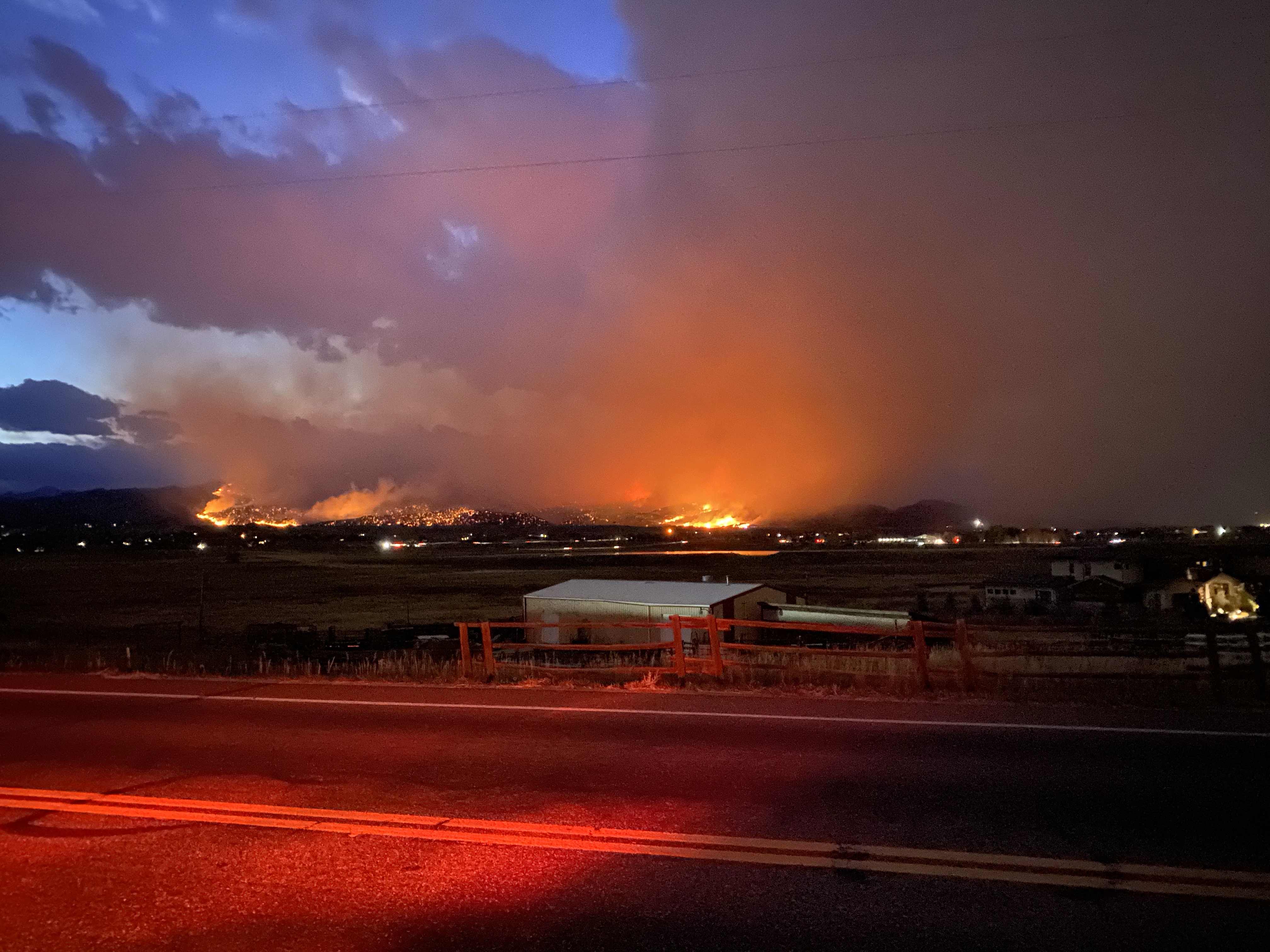
Taken Oct 17, 2020 from Longmont looking west at the Calwood fire burning along US 36.
2020 has been a wild ride! It feels like there’s a new surprise around every corner, and none of them are fun!
This year we’ve had the coronavirus pandemic, economic crisis, political and social crises, and environmental crises in the form of devastating fires in the western United States and hurricanes in the southern US.
Several people have asked me whether these fire are the judgment of God upon our society, or whether they are instead the work of the Devil.
God’s Judgment in the Bible Through Natural Means
This is an interesting question, because there are times in the Bible when we read about things which seem to be natural phenomena, but the Bible tells us they were acts of God for the purpose of judgment.
Examples of this would include: the great flood in the time of Noah, the earth opening up and swallowing the sons of Korah (sounds a lot like a sinkhole!) in Numbers 16, the judgment of Sodom and Gomorrah in Genesis 19 (the site of the Dead Sea, often thought to be the result of a meteor striking the Earth), or Gehazi being struck with leprosy in 2 Kings 5.
The Bible Gives Us Something We Don’t Have In Our Time
What we have in the Bible is not just a sterile account of historical events, but rather an authoritative theological interpretation of historical events. In other words: floods happen all the time, but this flood was the judgment of God. Not every sinkhole is the judgment of God, but this one was!
These theological interpretations were given by inspiration of the Holy Spirit to the writers of Scripture. The question is: how can we know whether current events are God’s judgment or not?
When an earthquake or a tsunami strikes, or when forest fires rage, it would be presumptuous for us to declare that they are the judgment of God, because we simply don’t have the same authoritative insight or theological interpretation that was given to the writers of Scripture.
Further Considerations: A Fallen World and a Natural Ecosystem
When sin came into the world, it not only affected us human beings, it affected all of creation. There are things about nature which are broken, harsh and cruel.
Here in Colorado, for example, fire is a natural part of our ecosystem. There are certain pine cones which only open in the heat of fire, and pine forests often need fire in order to clean up the undergrowth and fallen debris and replant themselves. It’s how the ecosystem works, and there have been fires here since long before humans inhabited this area in the way we do now.
In other words: we moved to an area where wildfires are part of the ecosystem… so it probably shouldn’t surprise us when there are fires!
We look forward to the New Heavens and the New Earth, where things will be the way they were meant to be, the way they are supposed to be: where there is no more destruction by fire and no more disease, pestilence, and the like.
What Jesus Said About This: The Tower of Siloam
In Luke 13:1-5, Jesus was talking to some people about some current events which included the suffering and death of people in their community. One instance included a tower, the Tower of Siloam, which stood in Jerusalem, but had collapsed and killed 18 people.
People were asking whether the collapse of this tower, killing these 18 people, had been the judgment of God upon them. Check out Jesus’ response:
Those eighteen on whom the tower in Siloam fell and killed them: do you think that they were worse offenders than all the others who lived in Jerusalem? No, I tell you; but unless you repent, you will all likewise perish.
Luke 13:4-5
Jesus told these people, “No, this wasn’t the judgment of God.” Apparently, in our imperfect, fallen world, sometimes towers are built poorly and materials collapse, or the ground shifts, and structures sometimes collapse. Sadly, sometimes people die in accidents, or of illnesses, or of other reasons.
But, although this was not the judgment of God, Jesus warned those people that they should take heed in light of this event, and let this be something which causes them to repent and turn to God in humble faith, lest they also perish.
Regarding the fires raging in the United States, COVID-19, and the other difficulties facing the world right now: Is this the judgment of God? Maybe. Or maybe not. We can’t be sure. But we can be sure of this: these events should certainly cause you to turn to the Lord in prayer and repentance, and if we don’t repent then we will perish in something much worse than wildfire or COVID-19: the judgment of our souls.
One thing is for sure: God wants to use these events to cause us to turn to him. May we do so without delay. If we do, the hope of the gospel is not only the salvation of our souls, but the redemption of our lives, and a relationship with God.






 Theology for the People