
Happy St. Patrick’s Day!
A while back I wrote an article about who Patrick of Ireland was, but for today I will just share this hilarious (and very informative) video about bad Trinity analogies:
Happy St. Patrick’s Day!
A while back I wrote an article about who Patrick of Ireland was, but for today I will just share this hilarious (and very informative) video about bad Trinity analogies:

This past weekend we were up in Estes Park with some couples from White Fields for a marriage retreat we organized together with a couple other churches.
For Rosemary and I, this was our first time team-teaching together, and it was a great experience. We taught a session on the importance of Christian community and the local church for a healthy marriage.
In preparing for the retreat, our thought was to get away from the things which we don’t like about marriage retreats, such as:
I have been to marriage events in the past where instead of strengthening and encouraging marriages, the retreat seemed to only fuel existing discord and frustrations, so that on the car ride home the wife was saying: “Were you listening to what the speaker said? Those are all the things that I’m always telling you that you need to change and do better!” – and the husband saying: “Did you hear the part about how important it is to have sex even if you don’t feel like it? That’s what I’ve been telling you for years!” And both wonder why they spent $200 to get in a fight, when they were doing alright before the “retreat.”
Instead, our vision was to host a true retreat – and focus on the experience rather than a particular speaker. Our theme was connecting with God, your spouse and Christian community and our goal was to encourage, give some tools, biblical guidance and challenges, and create a setting where couples could be refreshed and reconnect with each other and spend time with other couples.
The retreat turned out even better than I had expected. Some great admin work was put in by the staff of Calvary Belmar in Lakewood. Brian Boehm of Trail Ridge Counseling taught one of the sessions and presented some great material that Rosemary and I will be looking at for weeks to come. Brian and his wife Nicole did a ton of work to make the retreat special and they deserve much of the credit for it being a success; they designed and led several key parts of the weekend.
If retreats are done right, they can be awesome experiences. We look forward to doing more of these in the future.

I saw a quote today posted online that said this:
“Occasions make not a man fail, but they show what the man is.”
Thomas à Kempis
It reminded me of a conversation I had with my dad a few years ago. We were talking about a prominent pastor who had committed sin which resulted in him to losing his position and ministry along with the respect of his peers.
I commented to my dad, “I guess he showed his true colors.”
My dad wisely and graciously responded, “Maybe those aren’t his true colors. Maybe that was just something he did in a moment of great weakness and darkness.”
In other words: I was suggesting that the good things this man had done for years were really just a facade, and finally his true self was revealed. My dad on the other hand was suggesting that maybe the terrible things the man had done were more of an anomaly than the true essence of who he was.
Should we determine a person’s character based on their worst moments or on their best moments?
That’s not a very easy question to answer.
Surely no one would say that we should judge Adolf Hitler’s character based on his best moments. However, all of our greatest cultural and even faith heroes are people who had dark moments in which they did bad things. Martin Luther King Jr. committed infidelity. Moses was a neglectful father. Martin Luther had a racist rant. The list could go on.
Despite the fact that we like clean-cut distinctions, to label people either “good” or “bad” – the messy reality of life is that all of us do both good things and bad things. We commit sins which hurt others and grieve the heart of God, and we do wonderful things which benefit others.
So, which you is the real you?
David and Saul. Both were kings of Israel. Both were chosen by God for the people. Both began very well – and both committed grievous sins which had tragic effects for both their lives and the lives of many others because of their position as king.
And yet, one of them is called “the man after God’s own heart” whereas the other is remembered as an anti-hero with no concern for God.
It could even be argued that David’s sins were worse than Saul’s. Saul attempted murder, but David actually committed murder and adultery.
However, the great difference between the two men is that David, when confronted with his sins, was quick to repent and turn back to God. Saul, on the other hand, when confronted, stubbornly persisted and resisted God.
This response to God of humility and willingness to repent – this fundamental desire to live for God and please God, seems to be at the heart of what separates these two men.
There is a sense in which I agree with the above quote from Thomas à Kempis, and yet I am hesitant about what I perceive to be its inference.
I agree with the quote in as much as it is saying that ALL people are fallen and therefore the reason we sin is because we are sinners at heart; our very nature has been corrupted and opportunities to sin simply reveal this fact.
However, it seems that the inference of this quote is that in a given situation, some people fail and others do not – and this reveals their fundamental character. Furthermore, a person who does not fail in that given situation should feel a sense of pride that they are fundamentally better than those who did fail.
If this is indeed what is being inferred, this attitude, while commonly held, is contrary to the gospel.
The message of the gospel, that God took on human flesh in order to pay the price for your sin and redeem you, has 2 simultaneous effects on the person who really understands it:
1) it makes you incredibly humble – because it tells you that you are not fundamentally better than anyone else. You are made of the same stuff and you are in the same boat: a sinner who is hopeless without a savior,
2) it makes you incredibly confident – because it tells you that you are loved by God, and that He is wholly committed to you, forever.
The promise of the gospel is that if you will repent of your sins and turn to God – like David did – and put your faith in what Jesus did for you, then not only will God justify you, but He will also redeem you, and as part of that He will sanctify you, from the inside out by the power of His Spirit – and the end result will be that the “true you,” the version of you free of sin, which He created you to be, will ultimately be revealed.
Romans 8:19 says, For the creation waits with eager longing for the revealing of the sons of God.
1 John 3:2 says, We do not yet know what awaits us when He appears, except that we will be like Him.
The real you is the you that you are in relation to God – the you whom God declares you to be – and if your faith is in Jesus, then the you whom He is making you into by His Spirit: the version of you without the corrupting effects of sin which have marred the image of God that you bear.
The promise of the gospel is that it will be so for those who have embraced God’s offer of salvation in Jesus.

Over the past few weeks, I, like many of you, have been following the political developments in the U.S. In such a caustic and antagonistic climate, I would much rather be known for my stance on Jesus Christ and the message of the gospel than for my personal convictions about political matters. That is the drum that I will beat and the hill I will be willing to die on.
Why is it that the political climate is so caustic and people are so divided? According to many sociologists, philosophers and theologians, the issue is one of identity: namely, that one of the most common ways that people create identity is through “the exclusion of the Other.”
According to Zygmunt Bauman, “We can’t create ‘Us’ without also creating ‘Them.’ Social belonging happens only as some other contrasting group is labeled as the Different or the Other. We bolster our identity by seeing others in a negative light and by excluding them in some way.” (Modernity and Ambivalence, p. 8)
In other words: I can feel I am one of the good people because I know I am not one of the bad people. Therefore the “Other” must be degraded, excluded and/or vilified in order for me to have a sense of self-worth.
Croatian theologian and professor at Yale University, Miroslav Wolf, in his book Exclusion and Embrace, says that the reason we indulge in these attitudes and practices is that by denouncing and blaming the Other it gives us “the illusion of sinlessness and strength.”
One great example of this, Timothy Keller points out, is: “If I find my identity in working for liberal political and social causes, it is inevitable that I will scorn conservatives, and the same goes for conservatives regarding liberals. In fact, if the feelings of loathing toward the opposition are not there, it might be concluded that my political position is not very close to the core of who I am.” (Making Sense of God, p. 145)
In order to do this, Wolf says, we must “over-bind” and “over-separate”: To over-separate means to fail to recognize what we do have in common, and to over-bind means to refuse other people the right to be different from us.
This practice is common in many areas, not just in regard to politics.
Keller goes on to say: “If my identity rests to a great degree in being moral and religious, then I will disdain those people I think of as immoral. If my self-worth is bound up with being a hardworking person, I will look down on those whom I consider lazy. As the postmodernists rightly point out, this condescending attitude toward the Other is part of how identity works, how we feel good and significant.” (Ibid.)
Jesus himself gave an example of this:
He also told this parable to some who trusted in themselves that they were righteous, and treated others with contempt: “Two men went up into the temple to pray, one a Pharisee and the other a tax collector. The Pharisee, standing by himself, prayed thus: ‘God, I thank you that I am not like other men, extortioners, unjust, adulterers, or even like this tax collector. I fast twice a week; I give tithes of all that I get.’ But the tax collector, standing far off, would not even lift up his eyes to heaven, but beat his breast, saying, ‘God, be merciful to me, a sinner!’ I tell you, this man went down to his house justified, rather than the other. For everyone who exalts himself will be humbled, but the one who humbles himself will be exalted.”
Luke 18:9-14 ESV
Jesus is describing people who excluded, degraded and vilified others for the purpose of bolstering their own sense of self-worth, value and identity. However, much to their surprise, Jesus tells them that God does not play this game – in fact, he is very much opposed to it, because it is rooted in pride and self-justification rather than humility.
What then is the solution?
The solution is this: we must find our identity not in being better than others, but in who we are in God’s eyes, because of what Jesus has done for us. We need an identity which is centered on the Cross.
The fact that Jesus went to the cross to die for our salvation is both a profound statement of our sin and failure, and at the same time the greatest expression of love and of our value to God. In this sense, my identity and value is not based on me being better than other people – rather it does not allow me to see myself as better than others. I, like them, have sinned and fallen short. My value, according to the gospel, is that God loves me so much that he was willing to pay the greatest cost and hold nothing back; he is that devoted and committed to me.
May we be those who find our identity in Christ, rather than in our political or other affiliations, and may the way Christians express their political views not be a hindrance to the message of the gospel.
First of all, then, I urge that supplications, prayers, intercessions, and thanksgivings be made for all people, for kings and all who are in high positions, that we may lead a peaceful and quiet life, godly and dignified in every way. This is good, and it is pleasing in the sight of God our Savior, who desires all people to be saved and to come to the knowledge of the truth.
But seek the welfare of the city where I have sent you into exile, and pray to the Lord on its behalf, for in its welfare you will find your welfare.
Let every person be subject to the governing authorities. For there is no authority except from God, and those that exist have been instituted by God.
But our citizenship is in heaven, and from it we await a Savior, the Lord Jesus Christ.
Sing praises to God, sing praises! Sing praises to our King, sing praises!
For God is the King of all the earth; sing praises with a psalm!
God reigns over the nations; God sits on his holy throne.
The princes of the peoples gather as the people of the God of Abraham.
For the shields of the earth belong to God; he is highly exalted!
All that is gold does not glitter,
Not all those who wander are lost;
The old that is strong does not wither,
Deep roots are not reached by the frost.From the ashes a fire shall be woken,
A light from the shadows shall spring;
Renewed shall be blade that was broken,
The crownless again shall be king.J.R.R. Tolkien – The Fellowship of the Ring
I remember as a kid, discovering my parents’ record collection, and listening to their albums on the turntable in our basement. My favorite album was Led Zepplin IV: the one which had all the symbols for the title.
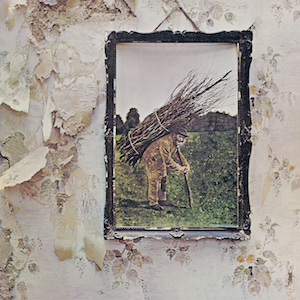 In that album there were several references to J.R.R. Tolkien’s books, The Hobbit and The Lord of the Rings, particularly in The Battle of Evermore and Misty Mountain Hop, and of course the opening lines of Stairway to Heaven: “There’s a lady who’s sure all that glitters is gold, and she’s buying the stairway to heaven.”
That is a reference to a poem from The Fellowship of the Ring, a riddle which is found in Gandalf’s letter to Frodo, which he left for him at Bree. Frodo only realizes later that the riddle is about a person: Strider, AKA Aragorn, the true king – who is the Christ figure in the story.
Yesterday was Tolkien’s 125th birthday. Born John Ronald Reuel Tolkien, the Oxford don never actually aimed to be a fantasy writer, but the fantasy literature he wrote led to a subsequent surge in fantasy writing. Tolkien did not consider The Lord of the Rings to be his greatest achievement. Tolkien’s main passion was linguistics, and he created multiple working languages over the course of his life.
As I have written about before (see: Addison’s Walk), Tolkien was very interested in the topic of what he called “fairy stories,” and why it is that they captivate people the way they do, especially in an age of science and reason. He believed that the reason is because the characteristic features of all the great stories reflect the deep human longings – and as such, they point to an underlying reality which is more real that reality as we experience it.
Upon further reflection Tolkien recognized that all these key elements are also present in the gospel story of Jesus. His conclusion was that the gospel is not just one more story which points to this underlying reality, but that the gospel isthe underlying reality to which all the stories point.
The movies that move you to tears. The stories which you can’t get enough of, even though they contain the same elements as all the other stories: heroic self-sacrifice, life out of death, love without parting, good overcoming evil, victory snatched from the jaws out death, etc… The reason we can’t get enough of these stories is because they point to THE STORY which is written on our hearts. Tolkien was the master story teller precisely because he understood this.
When Tolkien wrote “All that is gold does not glitter,” he was not only referring to Aragorn, but to a fundamental and biblical truth: that some of the most precious and truly valuable things in this world are not monetary or even material at all.
“Blessed be the God and Father of our Lord Jesus Christ! According to his great mercy, he has caused us to be born again to a living hope through the resurrection of Jesus Christ from the dead, to an inheritance that is imperishable, undefiled, and unfading, kept in heaven for you,”
“…your faith which is more precious than gold” (1 Peter 1:3-4, 7)

Happy New Year!
This past Sunday at White Fields we continued our series Be Set Free, in the Book of Exodus, seeing the people of Israel now on the other side of the Red Sea after having been set free by God.
Their situation there on the far shore of the Red Sea parallels what it means to be a Christian today: they had been set free from bondage, but that wasn’t the end of their journey, it was only the beginning! God was taking them to the Promised Land.
As the people of Israel stood on the bank of the Red Sea, they sang a song of thanksgiving and praise, which had 2 aspects:
This is a great model for us as we come into this new year.
I encourage you to look back and give thanks to God for His faithfulness and mercy that you experienced in 2016 — for the answered prayers, for the abundant grace and for salvation in Jesus. Be like the one former leper in Luke 17:11-19, who returned to Jesus to give thanks, rather than the nine who didn’t.
Once you’ve done that, I encourage you to look forward to this coming year and seek God about what He might want this next year of your life to be like — and then make plans and take steps accordingly, so that those good intentions actually become reality.
What does God want this next year to look like for you?
Start with what you already know is His will and His desire for you:
Determining to do things which are in line with God’s heart and His desires, then planning and working toward those things is an act of faith and obedience. So let this new year be filled with godly goals and pursuits.
I pray that this coming year would be one in which you experience His work in you and through you in a greater way than ever before!

I never thought I would be a New Year’s resolution type of person, but over the years I have learned a few things about myself and about New Year’s resolutions that have changed my mind.
Here are some quick statistics for you:
One study shows as few as 8% of people accomplish their resolutions.
However, that same study shows that people who make resolutions are as much as 10x more likely to achieve their goals than people who don’t.
People who make resolutions are as much as 10x more likely to achieve their goals than people who don’t
In a way, the New Year is a strange holiday. We aren’t celebrating a grand event in the past which changed the course of history, as we do at Easter or Independance Day. We are not celebrating the birth of a great figure as we do at Christmas or Martin Luther King Jr. Day. We are not celebrating a class of people as we do on Labor Day, Veterans Day or Mothers Day. All we are really celebrating is that the Earth went all the way around the sun again; which we could theorertically celebrate any day of the year. We have gotten to the end of our calendar, which begins on an arbitrary date.
However, I have come to greatly appreciate this holiday, because it gives us something to measure time by. And albeit slightly contrived, it does give us the sense of a new beginning, a fresh start.
On my desk in my office, I have a book stand, and on that stand is a notepad. For the past 2 years, I have been writing down several goals for the year, ranging from personal goals, to items related to my marriage and family to ministry and prayer topics, which I would like to see come to fruition in that coming year. Then for the rest of the year, I leave that notepad right there, always in constant view, so that I see it every day when I sit down and get to work.
The reason I started doing this was because I read somewhere that goals which get written down are much more likely to be accomplished. I think there’s more that goes into accomplishing goals, but that’s a good start.
Over the past 2 years that I have been doing this, I have been amazed how at the end of the year, almost all of the things which I wrote down have become reality. 2016’s list had about 20 items on it, and at the end of this year, only 2 of them remain unrealized. Those items will be rolled over into 2017’s list, but even those are not to be considered failure, as having them on the list for the past year led to them being topics of prayer that I brought before God almost daily and asked for His will to be done.
The heart of man plans his way, but the LORD establishes his steps. (Proverbs 16:9)
Setting goals which you cannot accomplish on your own keeps you on your knees and dependent on God, pushing forward and asking Him to do great things.
Without a strategy, your resolutions will likely only remain a good intention, and we know what those pave the road to… This Forbes article points out that the huge difference between “intentions” and “decisions”: stating that most people don’t follow through on intentions, but they do follow through once they’ve actually made a decision.
This year one of my goals is to run a half-marathon. Rather than just writing it down, I’ve also gone online, picked out the race I want to run, signed up and paid for it, and signed up for a training program. Whatever your goal is, don’t let it remain only a good intention, make a concrete plan for how it is going to become reality.
Time is kind of like money: you’ve only got so much of it, so you’ve got to budget it. Be strategic and schedule things that are important to you into your calendar. If you want to pray and read the Bible more, scedule it into your day. If you want to spend more time with your kids, schedule it into your day. If you want to read or write more, schedule it. You can still be flexible, but at least having it on the calendar will give structure to your days and keep your on track towards your goals.
These were the top 16 posts on this blog from 2016, based on views and shares:
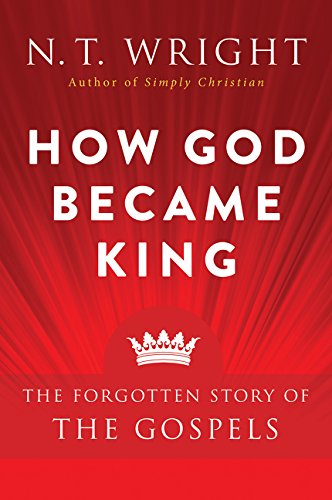 I just finished reading N.T. Wright’s How God Became King: The Forgotten Story of the Gospels. He is a great thinker and while I may not agree with him on everything, I do appreciate his writing. Here’s a quote from How God Became King which I found particularly insightful and encouraging regarding the “modern myth” of the failure of Christianity and the attempts to relegate it to the realm of private religion rather than the revolutionary message it truly is.
“The failure of Christianity is a modern myth, and we shouldn’t be ashamed of telling the proper story of church history, which of course has plenty of muddle and wickedness, but also far more than we normally imagine of love and creativity and beauty and justice and healing and education and hope. To imagine a world without the gospel of Jesus is to imagine a pretty bleak place.
Of course the reason the Enlightenment has taught us to trash our own history, to say that Christianity is part of the problem, is that it has had a rival eschatology to promote. It couldn’t allow Christianity to claim that world history turned its great corner when Jesus of Nazareth died and rose again, because it wanted to claim that world history turned its great corner in Europe in the 18th century. “All that went before,” it says, “is superstition and mumbo-jumbo. We have now seen the great light, and our modern science, technology, philosophy and politics have ushered in the new order of the ages.”
That was believed and expounded in America and France, and it has soaked into our popular culture and imagination. So, of course, Christianity is reduced from an eschatology (” this is where history was meant to be going, despite appearances!”) To a religion (“here is a way of being spiritual”), because world history can’t have two great turning points.
If the enlightenment is the great, dramatic, all-important corner of world history, Jesus can’t have been. He is still wanted on board, of course, as a figure through whom people can try to approach the incomprehensible mystery of the”divine” as a teacher of moral truths that might, if applied, actually strengthen the fabric of the brave new post-Enlightenment society. But when Christianity is made “just a religion,” it first muzzles and then silences altogether the message the Gospels were eager to get across.
When that happens, the Gospel message is substantially neutralized as a force in the world beyond the realm of private spirituality and an escapist heaven. That indeed, was the intention. And the churches have, by and large, going along for the ride.”
(N.T. Wright, How God Became King: The Forgotten Story of the Gospels, HarperOne: 2016, pp.163-164)

