
In this video I explain our church’s 3-stage plan to reopen and resume physical gatherings in light of COVID-19 and the end of stay-at-home orders:
Augustine on Ambition
Should Christians be “ambitious”? Is “ambition” the opposite of humility?
Augustine of Hippo, the African bishop from the 4th and 5th Century has a take on ambition which might surprise you.
The Opposite of Ambition is Not Humility
According to Augustine, “the opposite of ambition is not humility, it is sloth, passivity, timidity, and complacency.”
We sometimes like to comfort ourselves by imagining that the ambitious are prideful and arrogant so that those of us who never wish and never aspire, who never launch out into the deep, get to wear the moralizing mantle of humility, but this is just a thin cover for a lack of courage, even laziness.
James K.A. Smith, On the Road with Saint Augustine

Interestingly, Augustine’s view on ambition is that “playing it safe” and not taking risks is not actually an expression of humility like many may assume, but is often based in pride and a fear of other people thinking less of you if you were to fail.
In James K.A. Smith‘s recent book, On the Road with Saint Augustine, he tells the story of Augustine’s journey from provincial North Africa to Carthage, and from there to Rome and Milan, originally as a rhetoric teacher, not as a priest. It was Augustine’s ambition which originally led him from his birthplace to these places, but in Milan his friendship with Ambrose, bishop of Milan, changed his life and led him to pursue a relationship with God which led to him stepping into vocational ministry for the rest of his life.
See also: Book Review: On the Road with Saint Augustine
Smith argues that Augustine never stopped being ambition after giving his life to the Lord. What changed was his goal, the aim of his ambition.
The Ultimate Ambition
According to Smith, the Augustinian question when it comes to ambition is: “Whom and what do I love when I am being ambitious?”
The goal, he would argue, is not to be devoid of ambition, but rather to live a life which has “friendship with God” as its supreme ambition.
This is the only ambition, Smith points out, which comes with a guarantee of success and ultimate security! (“Draw near to God, and he will draw near to you.” James 4:8)
Solomon and the True End of Ambition
Augustine challenges us to ask, What if buried in your ambition to succeed in business, academics, sports, and other pursuits, is a desire for something else, something more – which is found in God himself?
Currently at White Fields we are studying through the life of Solomon in 1 Kings. Solomon was an ambitious person; he asked God for wisdom so that he could govern the nation well, and he succeeded both in making the nation wealthy and powerful, but also in becoming wealthy and powerful himself.
In the Book of Ecclesiastes, Solomon tells the story of his ambition; he acquired many lovers, much money, incredible power, extensive knowledge, as well as exotic animals, parties and entertainment. And yet, in the end, he found all of it to be empty and ultimately unfulfilling. None of it did for him what he had expected it would.
In the end, Solomon comes to the realization that buried in his ambition was ultimately the desire for God himself, and what could only God can give.
Solomon’s conclusion at the end of Ecclesiastes is a cliff-hanger, because Solomon says that the chief end of humanity is to keep God’s commandments (in order to be in relationship with Him). The only problem of course, is that Solomon failed to keep God’s commandments — and so have we! What is needed therefore, is one who can reconcile us to God by somehow bridging the gap created by our shortcomings and sins. The good news of the gospel is that this person has come, and his name is Jesus!
Because of Jesus, our ambition can find its ultimate desire, and can be redirected into areas which are secure and eternally meaningful: relationship with God, and participation in His mission to bring the truth of his love and grace to the world!
May God help us to avoid the false humility which is based in fear and pride, and be ambitious for Him!
Reader Questions: Book Recommendation on Marital Intimacy & Responding to Christian Perfectionism

There is a feature here on the site where you can Ask a Question or Suggest a Topic.
Here are some recent questions that came in:
Book Recommendation on Marital Intimacy
Is there a book or message series you can recommend to help rebuild sexual intimacy in marriage?
I’m sure there are other resources out there, but the one I am familiar with and can recommend is Sheet Music: Uncovering the Secrets of Sexual Intimacy in Marriage
Responding to Christian Perfectionism
I have a Christian forum at my place of employment. One employee regularly posts statements in line with a ‘sinless perfection’ doctrine and encourages others to listen to Jesse Peterson (which I know nothing about.)
Essentially, this employee constantly insists that if we are still sinning we are hypocrites and is adamant we shouldn’t listen to others or read the Bible but should just ‘know’ God, we should ‘just be’ (insert confused emoji here), and sin is hate, the only way to receive eternal life is to forgive. I dismiss his theology – he makes no sense – and despite support from the Word of God, he continues his posts – because he doesn’t value the word of God.
Do you have any thoughts on how I can redirect his skewed theology, while helping the other members of this group also dismiss this line of thinking?
One way to respond might be to point out how this kind of theology has been dismissed and rejected by Christians throughout history. John Wesley, for example, who taught a form of Christian perfectionism at one point (unsurprisingly, when he was younger), later changed his position on the topic.
My guess is that other people on the site probably see the wackiness of what he’s writing and aren’t swayed by it. A smart, simple response will be gladly received by most people in the group therefore, but don’t let the group get focused on responding to everything he says. Don’t let the squeaky wheel get all the grease, in other words. You’ve got bigger fish to fry. Sorry for piling on the idioms!
The most compelling Biblical arguments against Christian perfectionism I can think of are:
- Romans 7
- 1 John
- 1 Timothy 1:15
Martin Luther famously stated that the Christian is Justus et pecator (both righteous and a sinner). We have been declared righteous in Jesus; his righteousness has been accounted to us by grace through faith – and yet, we still sin.
When the Bible talks about salvation, it is important to note that it speaks of it in comprehensive terms: it says that we have been saved (past tense), we are being saved (present continuous tense), and we will be saved (future tense).
We have been saved (think: “It is finished”) from the penalty of sin by what Jesus did for us in the past. We are being saved (sanctification) from the power of sin as we “work out our salvation with fear and trembling,” and yet “it is God who works in you to will and to do His good pleasure” (Philippians 2:12-13). And we will be saved, in the future, from the very presence of sin, when Jesus comes and saves us from the very presence of sin.
Romans 7
In Romans 7 Paul speaks about his experience of struggling with sin. Some in the Christian perfectionist circles will claim that Paul is writing about his life before his conversion, but that argument doesn’t hold much water because Paul speaks about his sin in the present tense.
1 John
In 1 John, John says things like, If we say we have no sin, we deceive ourselves, and the truth is not in us. (1 John 1:8). 1 John is a favorite book, by the way, of Christian perfectionism advocates, because of its black-and-white language about righteousness, obedience, and sin. However, it is important to note that John is talking about a pattern of life, not about individual sins.
It’s about what you practice. Think about things you practice, and why you practice them: you practice the guitar, you practice your golf swing. Why? So you can do them better. A person who practices sin habitually and willfully truly needs to ask the question of if they are actually in the faith at all.
In Christ, we have become “new creations” (2 Corinthians 5:17). A sheep and a pig are two different creations. They both might fall in the mud on occasion, but the pig lives for the mud. The mud is what the pig dreams about, and the goal of its life is to get in that mud! A sheep, on the other hand, might fall in the mud, but that’s not where it wants to be. This is the essence of John’s point about sin and righteous living in 1 John.
I wrote something recently related to 1 John and the topic of Christian perfectionism. Check it out here.
1 Timothy 1:15
In 1 Timothy 1:15, Paul says: “The saying is trustworthy and deserving of full acceptance, that Christ Jesus came into the world to save sinners, of whom I am the foremost.”
If you read through Paul’s descriptions of himself as he progressed in life and in relationship with Jesus, you’ll notice this:
- In Philippians 3, he wrote that according to the law, he was blameless.
- Later on, in 1 Corinthians 15:9, he describes himself as “the least of all the Apostles”
- Even later on in life, in 1 Timothy 1:15, he describes himself as the chief of all sinners.
As Paul progressed through life, he did not become more and more enamored with himself, but he actually saw himself as more and more of a sinner – yet one who was loved by God and a recipient of His grace.
The reason for this is because, the closer you get to God, the more you become aware of your shortcomings, much like how: the more light there is in the bathroom, the more clearly you see your blemishes in the mirror – and like how, the older you get and the more you learn, the more you realize how much you don’t know.
The point is not that Christian maturity means thinking less and less of yourself, but that as you become more aware of your flaws, you are more thrilled by the grace and love of God as you realize more and more how much you need it!
The Danger of Christian Perfectionism
The great danger of Christian perfectionism theology is that it places an unbearable burden on a person, and it leads to either pride or despair.
If you tell someone that if they are really in the faith that they won’t sin anymore, then when they are doing well, and not falling into temptation, they will be puffed up with pride and look down on those whom they observe sinning. Conversely, when they (inevitably) do commit some sin, they will immediately be forced to question their own salvation, and if they are even saved at all.
The good news of the gospel is that our salvation is the work of God! It is based on what He did for you, not on the things that you do or don’t do. Even if you slip, the good news of the gospel is that He is holding onto your hand, and He won’t let you go!
Submit a Question or Topic
Thanks for these questions. If you have a question or topic, fill out this form: Ask a Question or Suggest a Topic
Hulk Hogan, Idols, and the Name of God
Recently Hulk Hogan posted this on Facebook, which garnered a lot of attention, and a reader asked me to comment on it.

In three short months, just like He did with the plagues of Egypt, God has taken away everything we worship. God said, “you want to worship athletes, I will shut down the stadiums. You want to worship musicians, I will shut down Civic Centers. You want to worship actors, I will shut down theaters. You want to worship money, I will shut down the economy and collapse the stock market. You don’t want to go to church and worship Me, I will make it where you can’t go to church”
“If my people who are called by my name will humble themselves and pray and seek my face and turn from their wicked ways, then I will hear from heaven and will forgive their sin and will heal their land.”
Maybe we don’t need a vaccine, Maybe we need to take this time of isolation from the distractions of the world and have a personal revival where we focus on the ONLY thing in the world that really matters. Jesus.
Matters of the Soul and the Body
I agree with Hulk’s statement that we should take this time of isolation from the distractions of the world and have a personal revival.
I agree with his call to repentance, prayer, and seeking the Lord from 2 Chronicles 7:14.
I don’t see why this repentance and revival would exclude the need for a vaccine however, but just as Jesus said: “What does it benefit a person if they gain the whole world but lose their soul?”, (Mark 8:36) that question could easily be applied to our current situation: “What does it benefit a person if they survive the COVID-19 crisis but lose their soul?”
Personally, I have seen a significantly greater openness to the gospel and to prayer in many people during this crisis, and I praise God for that. I believe that God is more concerned with the well-being of our souls than with our physical comfort. At the same time, it is also the call of the people of God to relieve suffering when possible (see Matthew 25:31-46), as we look forward to the end of sickness and death forever for those in Christ because of what He accomplished in his life, death, and resurrection.
The Human Heart is an Idol Factory
Hulk claims that “in three short months, just like He did with the plagues of Egypt, God has taken away everything we worship.”
The thing is, just taking away people’s money doesn’t make them stop worshiping money. Oftentimes it is not what we have that we worship, but what we want – that’s what it means to covet.
One of the things I learned working with refugees and the impoverished Roma population in Hungary, is that some of the people who worship money the most are those who don’t have any of it. They seek after it, believing that if they had it, they would be content and fulfilled. Some of the most materialistic people I have known are people who lacked materially. On the contrary, I have known many wealthy people who were incredibly generous – having learned firsthand that money and possessions will never fill the God-shaped void in one’s soul.
Martin Luther stated that “the human heart is an idol factory.” In other words, even if God did take away these idols, (which are all clearly still here, with the exception of sports) the underlying problem would still exist, and we would just make and find new idols to worship with our time, energy, resources, and attention.
What we need is something deeper: regeneration, new birth, a transformation from the inside out, which is the work of God in our lives.
The Name of God
I find it absurd that Hulk uses the name of God as his personal motto: “I am that I am.”
The name Yahweh derives from the Hebrew word for “to be” – which is why God told Moses to tell Pharaoh that “I am who I am” if Pharaoh asked the name of the God who had sent Moses.
To use this name as a personal motto is borderline, or perhaps blatant blasphemy, in my opinion.
In Conclusion
While it is a bit ironic that Hulk Hogan, a celebrity, is calling out the cultural idol of celebrity worship, and his point about God taking away our idols is dubious at best (if God shut down stadiums to stop our worship of athletes, how does he then reason that the shutting of churches is to be understood as punishment for people not going to church???), his core point is a good one: rather than just waiting for this to be over, we should take this time to refocus on our relationship with God and repent where necessary of giving other things the place in our hearts which rightly belongs to Him.
Online Events: Expositors Collective Webinar & Prayer Around the World
Expositors Collective Webinar: May 9, 2020
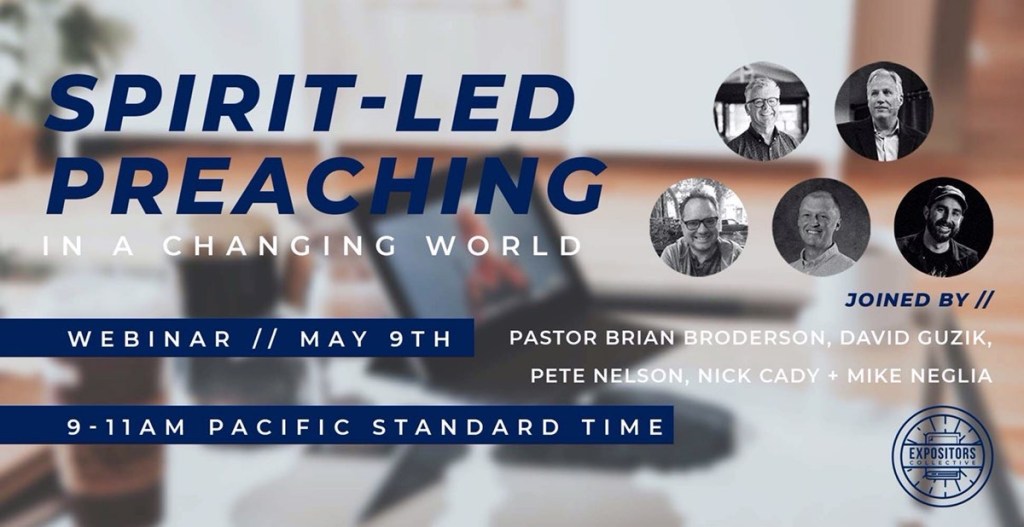
The world as we know it is always changing. We have all experienced that recently with the COVID-19 crisis. In order for us to preach and teach God’s Word faithfully in an ever-changing world, we need to be led and empowered by the Holy Spirit.
As part of our ongoing mission to help equip the next generation of expository Bible teachers, we are excited to announce our first-ever online event: an interactive webinar on May 9, 2020 from 9-11 AM Pacific Standard Time (10AM-12PM Mountain Time)
Similar to our training weekends, the webinar will include short messages from experienced Bible teachers, and interactive opportunities to ask questions and discuss topics.
Schedule
There will be two talks, interspersed with opportunities to ask questions and discuss topics.
- Brian Brodersen: “The Holy Spirit & Preaching”
- David Guzik: “Consistent Message, Changing Styles”
For more information and how to join, visit ExpositorsCollective.com
Prayer Around the World Extended for Another Week

For the past 3 weeks Calvary Global Network leaders around the world have been leading live prayer on the Calvary Chapel Facebook page.
I have been leading from 1:00-2:00 PM Mountain Time each day, and it has been encouraging to see God use it.
It would be great to have you join me for these times of prayer; it has certainly been good for me to spend an hour in prayer each day for all that’s going on. I’m sure God would use it in your life as well.
Ministry in the COVID-19 Crisis and Beyond
This past week I was honored to be interviewed by David Snead on his podcast. David is a missionary in Lviv, Ukraine – and he is one of the most organized people I know.
We had a great discussion about my background in ministry, ministering in the COVID-19 crisis and beyond, Calvary Chapel, and expository preaching. Check it out:
New Sermon Series: Desiring the Kingdom

For a long time I have wanted to study the books of 1 & 2 Kings with our church.
These are historical books which tell the history of the nation of Israel after the time of King David, beginning with the “Golden Age” of King Solomon, and following the downward spiral that began with his apostasy, followed by the division of the people into two rival kingdoms, and their subsequent apostasies and exiles in Assyria and Babylon.
This history is, on the one hand tragic, and on the other hand full of hope. One of the great “narrative plot lines” that runs throughout the Bible is that of the desire for a king and a kingdom.
While on the one hand these books show us how even the best people are merely people at best, we are constantly reminded of and pointed to the promised Eternal Kingdom and its coming King: the Messiah, Jesus Christ. He alone remains as the sole hero of the stories in these books!
Through the failed kings of Israel and Judah, we are reminded of our desire for a kingdom and a king, and the ever-increasing realization that what we desire will be fulfilled in Jesus and His Kingdom.
I invite you to join us on this journey through 1-2 Kings online on the White Fields YouTube channel and Facebook page, as well as on our website: whitefieldschurch.com
Book Review: Why Does God Care Who I Sleep With?

Sam Allbery is an Anglican pastor from Maidenhead, England, who also works with Ravi Zacharias International Ministry (RZIM), Cedarville University, and writes for The Gospel Coalition. He is the author of a number of books, including Is God Anti-Gay?, and 7 Myths about Singleness.
I was introduced to Sam last year when he spoke at the Calvary Global Network conference. See: Sam Allbery on Sexual Ethics and Moral Intuition
One thing that is worth knowing about Sam is that by his own admonition, he has only ever had romantic desires and sexual attraction to other men, yet he has chosen to live a celibate life of devotion to God.
When I saw that Sam’s latest book “Why Does God Care Who I Sleep With?,” was being released, I preordered a copy. Upon my return from my recent trip to Europe, I was happy to see that the book had arrived while I was away, and I used the first week of my quarantine to read it from cover to cover.
The Supreme Human Right?
Sam begins his book by answering the question in the title of the book:
Just fifteen years ago Christians like me, who follow the teaching of the Bible, would have been thought of as old-fashioned for holding to the traditional Christian understanding of sex being exclusively for marriage, but now, increasingly, we are thought of as being dangerous to society.
Who we sleep with is seen as a supreme human right. Anything that seems to constrain our choice in this area is somehow viewed as an existential threat.
God cares who we sleep with because he cares deeply about the people who are doing the sleeping. He cares because sex was his idea, not ours. He cares because misusing sex can profoundly hurt and damage. He cares because he regards us as worthy of his care.
Why Does God Care Who I Sleep With?, pp. 9-10
Honoring Sacred Space
One of Allberry’s key points of argument is to show that the Bible does not take a low view of sex, seeing it as something dirty and unholy, but just the opposite: it takes a much higher view of our physical bodies and what we do with them than the secular world does, describing them as “temples” (1 Corinthians 6:19) and therefore sacred space.
It is precisely because of this high view of the physical body that God cares so much about sex, insisting that this powerful thing be used in the right ways, lest it cause pain and destruction.
He points out that when Jesus says that for a man to look lustfully at a woman is to break the commandment against adultery, Jesus is declaring that the sexuality of the person being looked at is precious and valuable: an integrity that deserves to be honored, and must not be violated, even in the privacy of another person’s mind, and to do so is to wrong that person.
Jesus’ teaching reflects something we see throughout the whole Bible: how we treat one another sexually matters a great deal to God.
Any sexual assault is a violation of sacred space.
The pain of sexual assault is not the pain of a grazed knee but the trauma of holy space being desecrated. Maybe our bodies are less like playthings and more like temples.
pp. 19, 20, 30
The reason our bodies matter so much is because of the Imago Dei (the Image of God) with which we are endowed uniquely as human beings. It is for this reason that we believe that all human life, regardless of physical ability or disability, income or education level, is equal in value.
There is something sacred about human life.
We [all] know that human life matters in a unique way. When someone treats a pet life a human, we think it a bit odd. But when someone treats a human being like an animal, we know deep down that it is terribly wrong.
When we fawn over a baby, we’re not coldly observing a mere organism. We’re beholding one who bears divine finger prints. And because a human being is the sacred product of sex, the sexual process by which that person is made is also sacred.
p. 35
Holy Fire
Sam Allberry describes the power of sex with the metaphor of fire: where you do it matters. In the fireplace of a house it can create heat and light which brings warmth and life. Lighting one elsewhere can be dangerous, destructive, and life-threatening. The context matters.
Furthermore, he points out that the purpose of sex is unification and giving. To use it in a way which does not serve these purposes is to take it out of the life-giving context.
Not Just Physical
God cares who we sleep with because God cares about us as people. Sex deeply affects the whole person: physically, emotionally, and psychologically.
When someone is sexually assaulted or when someone is sexually betrayed, it is not just their body that is attacked; they as a person are violated.
p. 51
Redemption
One of Sam Allberry’s emphases in this book is that while he wants to explain the biblical and theological reasoning behind the Bible’s sexual ethics, he also wants to communicate the Bible’s message of redemption for those who have fallen short.
He points out that not only are all of us sinners, all of us are sexual sinners – and the promise of the gospel is forgiveness, redemption, and new life in Jesus Christ.
Conclusion
This book is short, informative, and engaging. It answers several very commonly asked questions, which are only going to be asked more and more in the years to come, including questions about LGBTQ and co-habitation. Everyone would do well to educate themselves on the answers to these questions, and this book by Sam Allberry is an excellent resource for doing so.
Global Prayer & Local Music Videos
Prayer Around the World Extended for another week

For the past 2 weeks Calvary Global Network leaders around the world have been leading live prayer on the Calvary Chapel Facebook page. The idea is that you can log on at any time and join in prayer as well as submit prayer requests.
I have been leading prayer from 1:00-2:00 PM Mountain Time each day, and it has been encouraging to see God use it. I have had people ask to pray to receive salvation, I’ve had several times when we prayed for something and then received a report within a few minutes that God had answered that prayer, and I had someone say that God has used these prayer times to change their life!
It would be great to have you join me for these times of prayer; it has certainly been good for me to spend an hour in prayer each day for all that’s going on. I’m sure God would use it in your life as well.
Music from Good Friday & Easter
One of the benefits of having our facility is that we are able to do more with music and video. We have a great worship ministry, and we look forward to having them lead us in worship together once the current crisis subsides.
Here are two songs they did: one for Good Friday and the other for Resurrection Sunday:
Preaching Funerals

In the latest episode of the Expositors Collective podcast, Mike Neglia and I discussed preaching funerals.
Click here to listen: Episode 100 – Preaching Funerals. Click here to listen on Apple Podcasts, or on Spotify.
As it so happens, this is the 100th episode of the podcast. As Mike shares in the intro to the episode, he had planned some fanfare and celebration for this milestone, but with the current COVID-19 crisis, it seems that an episode on preaching funerals is more apropos.
Mike and I recorded this episode in Austria back in January during the Calvary Chapel European Pastors Conference in Millstatt.
Whether you find yourself in the position of preaching or leading a funeral, or if you simply want to listen in to my process and insights, I encourage you to check out this episode.
 Theology for the People