Why Does it Matter What Bono Thinks About Jesus? A Few Reasons

I recently ran across this video of Bono talking about his Christian faith in an interview:

A lot has been made of Bono and his faith. I have heard some Christians declare that Bono is their pastor; I know several Christians who don’t listen to any “secular” music, but love U2 more than their first-born children – these ones typically own a guitar, on which they can play simple worship songs AND a few songs by U2, which they would say are “kinda like worship songs, you know, if you really think about it.”  In fact, I have known of churches where the worship leader has lead the congregation in a chorus of a U2 song during worship.

All that goes to say: There are quite a few Christians out there. Why should it matter what Bono in particular thinks of Jesus?

As I listen to Bono speak about his faith, I feel that he is almost hesitant to admit that he believes Jesus is the Messiah. The way he talks about church kind of rubs me the wrong way too. Jesus didn’t come to establish a private religion that people practice alone or in their home with just their family – Jesus came to start a worldwide movement which has corporate expression. The church is not a somewhat-necessary evil, it is intrinsic to why Jesus came.

Having said that – here are a few reasons why what Bono has to say about Jesus matters.

Why does it matter what Bono thinks about Jesus?  A few reasons:

1. He is not American

I think a lot of American’s don’t understand how the world outside of America views us. I remember the first time I travelled abroad, right after high school, I had this unarticulated view of people in other countries, that they were basically ‘the ones who hadn’t made it to America yet’. American culture tends to not have a clear understanding of how people outside of America really think about America. Often it is assumed that people either hate America or love America. In reality, it is much more nuanced than that.

One of the main views on America that I have heard abroad, is that we are a very religious country – which, statistically is absolutely true. Thus, people outside of the United States are used to American celebrities and politicians talking about their faith, oftentimes their evangelical Christian faith. However, when a European – an Irishman in Bono’s case – expresses evangelical Christian beliefs, the non-American world stops to listen a little more. And this is a great thing actually, because it helps the world to see that evangelical Christianity is not just an American phenomena – it is the natural outworking of taking the Bible seriously.

2. He is a celebrity who does a lot of good things

Bono has credibility in the eyes of the world because he has been so active in working for humanitarian causes. One of the criticisms evangelicalism has gotten (whether deserved or not), is that we are a relatively apathetic bunch when it comes to major social issues facing people around the world, such as AIDS, lack of clean drinking water, etc. Once again, the case can be made that this is certainly not the case – but there is a sense in which this is the reputation that evangelicals have gotten: that they are only concerned with getting “goose-bumps from Jesus” and getting the heck heaven out of here, that they are not concerned with the plights and suffering that people are facing. Bono, because of his well-publicized humanitarian efforts is generally considered a credible person. <— this is something to take note of for those of us who want to be heard.

3. He understands the outsider’s perspective

This is perhaps the greatest reason. Bono knows how to speak in a way that relates to those outside of the fold of Christianity and the church. I believe there are a great number of people who have some kind of latent faith in Jesus, but are not connected to any community of faith, because they are afraid that structured religion will kill their faith. Bono has a way of talking about Jesus which retains much of the mystery and awe for him, which is often lost by evangelicals. Yes, he comes across reluctant and non-conformist, but guess what: that’s how A LOT of people out there feel. Bono is good at speaking in a way that is relatable to the “outsider” because he is able to see things from their perspective – a very important skill we could all afford to grow in, by the way! I believe Jesus was a person who was able to relate to “outsiders” well too – and that was part of his magnetism.

I’d love to hear your thoughts on Bono and his faith below in the comments section!

 

Is Christian Evangelism Presumptuous?

Evangelism, proselytizing, seeking to convert people to our faith – these are things which are inherent to Christianity if one is to take the words of Jesus as true and relevant.

However, some – even some Christians – feel that this is presumptuous; that Christians should just do their thing and let other people be drawn to it if they will – but not actively attempt to convert others to their faith.

I found this quote to give a helpful perspective:

A major aspect of the Great Commission is the emphasis that Jesus places upon his authority. This is vitally important, because unless Jesus has such authority how can he give such a command? This is a kingly command which assumes that he is Lord over all peoples. If Jesus is not the King, his Commission is presumptuous and without foundation. If he is King, then the whole of life ought to be subject to his royal authority. The fact that God is King is the heart of the Gospel message.

The authority of the missionary lies therefore in the very person of Christ. If Jesus is the King of God’s Kingdom then the missionary has the right, even the duty, to go to all people. If he is not King, then the missionary has no right to seek to take his religious ideas to others. Is Jesus Lord? This is the vital question.

– D. Burnett, “God's Mission: Healing the Nations”


What Are We Fighting For?

Recently I have been reading the biography of Dietrich Bonhoeffer by Eric Metaxas: Bonhoeffer: Pastor, Martyr, Prophet, Spy.

I’ve been very impressed with the way that Bonhoeffer acted as a Christian during the Nazi period, in which EVERY Christian was faced with an intense ethical dilemma because of the evils acted out by the Nazi regime.

This Sunday at White Fields I taught 1 Samuel 11. In that chapter the town of Jabesh-Gilead is attacked by the Ammonites, and Saul, hearing the news, sends a message to all the men of Israel that they need to come to the defense of the people of Jabesh-Gilead, or else.
This was a time in Israel, when it would have been wrong to do nothing.

Surely, Bonhoeffer lived in such a time as well – when it would have been ethically wrong to do nothing in the face of the evils of the Nazi regime. If being a Christian is all about being conformed to the image of Christ (Romans 8:29), and as those who are part of the body of Christ, God would have us do His work, being his mouthpiece, his hands and his feet – there are great implications, as Bonhoeffer knew better any, for us as Christians and how we act and respond in the face of evil, injustice and other things which God is opposed to.

Bonhoeffer famously said:

“Silence in the face of evil is itself evil: God will not hold us guiltless. Not to speak is to speak. Not to act is to act.” ― Dietrich Bonhoeffer

In light of this, I can’t help but wonder what the great issues of our day, and our time and place are. What are the things that God would have us as Christians stand up for and fight against in this day?

It says there in 1 Samuel 11, that when Saul heard about how the people of Jabesh-Gilead were being mistreated, the Spirit of the Lord came upon him, and he became angry. That anger moved him to action.

I wonder what the issues are in our day that we should rightly be upset about, and that God would move us to righteous action for.

Yesterday, Eric Metaxas, the author of that biography about Bonhoeffer wrote this on Twitter:

Do you agree?  If so, what are the issues in our day that we should be pushing hard about?

To add a counterpoint, this is what Timothy Keller posted on Facebook today:

Jesus didn’t come to solve the economic, political, and social problems of the world. He came to forgive our sins. – Timothy Keller

It is true that Jesus did come to redeem the world, not by fixing the social problems of the day, or by driving out the Romans, but by dying on the cross for our sins.

What does this mean for us as Christians? Should our focus be other-worldly, i.e. saving people from this world unto the next life and the world which is to come, since this world will soon pass away — or, since eternal life starts now (John 17:3), should we be seeking to do the will of God here and now by coming against evil social structures and injustice, working to put an end to human suffering? Certainly this was a major theme of the Old Testament, but not something addressed much in the New Testament.

Are these two concepts at odds with each other, or can they be reconciled?

I don’t believe they are at odds – I think there is a healthy “both this and that” approach, but finding that balance of focus and knowing which hills God would have us fight on is something for which we must seek wisdom and guidance from God.

I’d love to hear your thoughts! Feel free to comment below.

Pray for Ukraine

Our family walking in downtown Kyiv in November 2010:

DSC_1378

I was in town for a pastors conference with Calvary Chapel and we found Kyiv to be a beautiful, cosmopolitan European capital.

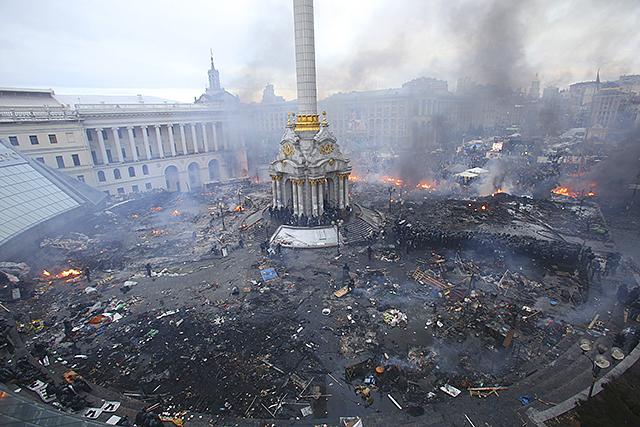
Here’s what Khreshchatyk street looks like today after months of anti-government protests, which recently turned violent:

 1959855_10203073030967423_1411475053_n

Here’s a photo I took of Independence Square, AKA Maidan, in 2010:

DSC_1376

Here’s the scene today:

IndependenceSquareKiev021914_640

You can follow the news of what is going on in Ukraine here: the BBC is running live updates as things unfold.

Please pray for the people of Ukraine. They have suffered greatly from corruption since the end of the Soviet Union. Ultimately, the greatest hope for these people, as for all people, is found in Jesus Christ, and in His Kingdom of righteousness.

“Blessed are those who hunger and thirst for righteousness, for they shall be satisfied.” (Matthew 5:6, ESV)

What Not to Say to Someone Who’s Suffering

It’s been said that if you minister to hurting people, you will never lack an audience.

But one of the things I believe we need to equip Christians with is how to love and care for hurting people. Christians are no different than most people, in that they feel uncomfortable around people who are suffering, and desperately want to make it all better. But as those who have been called to be salt and light in the world, I think we should be prepared and equipped to minister to those around us who are hurting – whether they be neighbors or people we are in community with at church.

In the video above, these pastors talk about what not to say to people who are suffering. A lot of people, because they feel that they should say something, and they want so bad to give a solution and fix the problem and alleviate the pain, say things which aren’t actually helpful. I have been on the receiving end of a few of these before: things like “I know what you’re going through” – “everything’s going to be fine” – and other things people say to try to quickly restore happiness.

But as the pastors mention towards the end of the video: the Gospel is big enough to handle our pain and to accept that tragedies happen and they are bad. The Gospel doesn’t shy away from the blood and guts of the reality of life in a fallen world. The Gospel is also big enough to give hope in the most dire circumstances by pointing to the ultimate happy ending that belongs to those who have been redeemed in Jesus.

Question: What is the most helpful thing someone has said to you or done for you during a difficult time in your life?

I want to hear your thoughts! Comment below!

Should I Tithe if I’m in Debt?

One of the questions I am frequently asked as a pastor is whether people who are in debt should tithe to their church, or if they should rather dedicate that money to paying off their debt.

UPDATE: Since this post was written, my wife and I have paid off our debt. More about that in this post: Debt Free!

First of all, I should say that the New Testamnet does not require that a person give a tithe (10% of their income donated to the congregation where they worship) per se. Although this requirement did exist in the Old Testament for the nation of Israel, the New Testament teaches that we are to give unto the Lord not out of obligation but from a cheerful heart, to contribute to the work of the Lord and the community of faith. Many, however, including myself, believe that the Old Testament standard of a tithe, although not required by the New Testament, is a good guideline for giving.

According to Business Insider, the average American household is $6,500 in debt – that’s consumer debt not related to their mortgage.

The average American household carries $6,500 of consumer debt

There is a good chance that MOST people in any given church in America are in thousands of dollars of debt. That means that there are multitudes of faithful Christians who desire to honor God with their money by giving to Him of their first fruits and investing in building His Kingdom and spreading the Gospel – who wonder if giving a few hundred dollars in tithe to their church every month should rather be directed towards paying off their debt.

The short answer? Yes, I think you should regularly give tithes and offerings, even if you are in debt.

I know that some people will not agree with that – but please understand that I do not say that lightly at all. I too am in debt, and yet I tithe. I don’t want to be in debt, in fact, I’m working very hard to get out of debt. Last year we had some unexpected expenses which we deemed worthy of going into debt for. So, I say this as one who is in the same boat – carrying debt and struggling with whether to give a tithe or offering to my church or use that money to help pay off our debt.

I too am in debt, and yet I tithe

Here is why I tithe even though I have debt:

The tithe is not God’s way of raising money, it’s God’s way of raising kids.

I tithe because it is a values issue, and it trains my heart. By making the first check I write every month my tithe check, I am making a clear statement of my priorities and values. And it sends a message to my heart, that for us, we would rather invest in the Kingdom of God and the furtherance of the Gospel than just buying more stuff.

‘But, wait’ – you might say: ‘You wouldn’t be using that money to buy more stuff, you would be using that money to pay off your debt for the stuff you already bought.’ That’s nice in theory, but in practice, most people, with a few hundred more dollars in their pocket, won’t regularly devote that money to aggressively paying off their debt, it will just be a cushion on their budget.

The key to getting out of debt for many people is changing your lifestyle, not having a little more money – and tithing helps you change your lifestyle.

People who have more money – guess what they do? They spend more money. I watched a documentary on Netflix the other day about how an astonishing number of professional athletes go broke within just a few years of retirement. They had a lot of money and they spent a lot of money. What we need is a lifestyle change, not just more money. I have found that letting go of some of my money and giving it to God as the first thing I do when I get paid releases me from the grip of money – and helps me to change my lifestyle.

I have found then when I tithe vs when I don’t tithe, I don’t really end up with more money in my pocket, or get ahead with getting out of debt.

A sacrifice is only a sacrifice if it hurts.

David said, I will not sacrifice to the Lord that which cost me nothing (2 Samuel 24:24)  The woman who gave 2 mites – it was a relatively insignificant amount to the rest of us, but for her IT HURT. And Jesus publicly commended her for giving in a sacrificial way, although she could have just as well used that money to buy milk or bread which she probably had need of. She gave sacrificially, and Jesus not only commended her for it – God made sure it was recorded for all time so that generation after generation could learn from her example.

Worship and sacrifice are very closely related. We all sacrifice for what we worship. If we don’t sacrifice as an act of worship, well just put some thought into what that says about who you worship…

God is looking for vessels He can pour into, who will then pour back out what He has given them in ways that He desires. If we show ourselves faithful stewards with little, he will entrust us with more. I believe that God honors those who step out in faith and give radically and generously – because He is a God who also gives radically and generously, and when we do that, it aligns us in a greater way with His heart.

Is this a hard, fast rule? No. It’s a principle. But yet, it is the one principle, which God challenges us to test him on (see Malachi 3:10).

God loves a joyful giver. He doesn’t want people to give out of a sense of coercion or obligation. But this is a principle of which God says: “If you want to live the full life that I have designed for you, if you want to experience joy, then walk in this way,” – ‘the way everlasting’.

Join us on Christmas Eve at White Fields!

Image

If you live near Longmont, then I’d like to invite you to join us on Christmas Eve for our Candlelight Christmas Celebration.

We will have a special band leading us in Christmas carols and worship, as well as a children’s choir and “glad tidings of great joy for all people”.

Hope you will join us!

Son of God: New movie about Jesus

The story the world can’t get enough of…

When we worked with refugees in Hungary, we used to show them the Jesus film, which follows the Gospel of Luke. I love the Gospel of Luke, but I have to say – that was one very boring depiction of it.

After watching this trailer, I have to say that this new movie looks hopeful, that it might be the best Jesus movie yet.
We’ll have to wait and see how biblical it is and if/where they decide to take liberties.

I saw Mel Gibson’s “The Passion of the Christ” – but there was something that irked me about it. Not sure what it was – although it might have been the part where Jesus is credited with inventing the chair…

I’m looking forward to this movie though. How about you?

Atheist Mega-churches: What they mean and what we can learn from them

Image
Sunday Assembly in Los Angeles

Recently a new movement has been getting a lot of publicity. Dubbed “atheist mega-churches” – the movement is being spearheaded by two British comedians. They call their meetings “sunday assemblies,” and they have all of the look and feel of a contemporary Christian church service, without one key factor: God.

Co-founders, Sanderson Jones and Pippa Evans have stated that their goal is to export the original concept, first started in London, around the world. They are currently on tour visiting 40 major cities; right now they are in the US, going from New York to Los Angeles, trying to establish Sunday Assemblies and propagating their message of humanist community gatherings.

At these Sunday assemblies, they do everything that your average Christian church does: they sing songs, they drink tea and coffee and chat in the lobby, they raise money for humanitarian causes – they take offerings, and they have a sermon each week! In an interview, Sanderson Jones answered the obvious question of what they preach on if they don’t have the Bible or another “sacred text”. His answer was astounding and something that should cause Christians everywhere some serious consideration. He said that ‘preaching without God isn’t hard at all – after all, most preaching in churches these days is basically tips and strategies about how to be a kinder, more balanced, well-rounded person; we embrace that whole heartedly, and we don’t believe we need God to do that.’

‘preaching without God isn’t hard at all – after all, most preaching in churches these days is basically tips and strategies about how to be a kinder, more balanced, well-rounded person; we embrace that whole heartedly, and we don’t believe we need God to do that.’

Here are my thoughts on these “atheist mega-churches”:

1. Mega-churches? Hardly.

Although they have been dubbed “mega-churches” by the media, if you look at the pictures, you will notice that if this were a Christian church, it would not be qualify as a “mega-church”. Furthermore, let’s not forget that the gatherings getting the most press are the ones in which Jones and Evans are present and leading the meetings – two British celebrities, who have been getting a lot of press attention lately for these Sunday Assemblies. This is a special event, not a church – not a committed community of people, and certainly not a mega-church. Even the original Sunday Assembly is not all that big. I understand that “mega-church” pops out on a page – but let’s make sure we’re not blowing this all out of proportion.

2. Novelty = Media Hype

“Atheist Mega-church” is a novelty of a phrase that grabs people’s attention. Perfect for the media. Is there much substance to it? Will we see this as a growing movement for years to come? I don’t think so. I don’t believe it is sustainable. In fact, if it hadn’t been started by two celebrities, I don’t think it would have ever gotten off the ground. I see this fizzling out in the weeks, months and years to come as media hype wears off and moves on to the next amusing story. The reason why “Christian music and movies” are never as good as the original is simply this: they are not original – they are trying to copy someone else’s idea and put a Christian twist on it. It is often second-rate as a result. This smacks of the same thing, only more so.

3. A Very Important Critique

The quote from Sanderson Jones above is a VERY important critique for Christians, and particularly church leaders. Because here’s the deal: ANYBODY can “do church”! And Sanderson is right – you don’t need God to just get together, drink some bad coffee, sing a few songs and hear an inspiring talk about 10 ways to have your best life now. YOU DON’T NEED GOD FOR THAT! He’s right!

ALL that we have as Christians is the Gospel of Jesus Christ. If we get away from that, then we have become nothing more than a community gathering – in which it doesn’t matter if God is there or not.

Recently I had someone come to our church, and they told me that they had been attending another church previously, but came to realize that the sermons that were being preached could have easily been speeches given at a high school graduation or by a politician. God’s name was mentioned, but if it hadn’t been, it wouldn’t have changed the substance of the message. In other words: it didn’t matter if God was there or not. They were giving tips and strategies for how to be a kinder, more-balanced, well-rounded person – and the fact is, that you don’t need God to do that.

The Gospel of Jesus Christ and the Word of God are what we have as Christians. They are what we should major on, and never neglect in an effort to give practical advice. The Gospel is life-changing and transforming, and we must crank it up rather than water it down. Only then will people really be transformed.

What do you think of these atheist mega-churches and my estimation of them?  Are they just a flash in the pan, or are they here to stay?  And what does this mean for Christianity and society in general?

A “Christian Nation” and the End of an Era

Have you ever heard the term “Christendom”? I have often heard it used to refer to the “invisible community of Christians everywhere” – kind of along the lines of the term “blogosphere”.

While that use of Christendom isn’t wrong – it isn’t the historical use of the word either. Historically, Christendom referred to the “Christian nations.” It was a way of dividing up the globe, into “Christendom” and “heathendom”.

One of my professors from seminary, Llyod Pietersen, recently wrote a book titled Reading the Bible After Christendom.

In the book he includes two lists: the first is a list characterizing Constantinian Christianity and culture, and the second characterizes the shift away from it. They are particularly interesting in regard to thinking of the United States or the United Kingdom (or any country for that matter) in our modern era as a “Christian nation.”  Whether or not our founders were God-fearing people, or whether we have a history of movements of God in our country – we need to assess the reality of the modern situation. Sweden, for example, like a number of other European countries, is still technically a Christian nation, whilst practically they shifted away from Christendom long ago.

The other thing you realize from these lists is that maybe Christendom wasn’t actually as great as people think it was. One of the great downfalls of a “Christian nation” is that you give people a false sense of security in their salvation – simply because they were born into a “Christian” culture or society. At least in a pluralistic society (which is what we are in – but was also the situation Paul the Apostle and the Christians in the Book of Acts were in!) people realize the immediate and pressing need for them to make a choice to follow Jesus, and the radical implications that come with it!

Rather than bemoaning the end of Christendom, I believe that Christians are faced with a great new opportunity in pluralistic society – the opportunity to bring to bear on all people the challenges of the Gospel and the call to follow Jesus Christ, because being a Christian is no longer a “given”.

Here are those lists:

Characteristics of the shift to Christendom:

  • The adoption of Christianity as the official religion of city, state, or empire.
  • Movement of the church from the margins to the center of society.
  • The creation and progressive development of a Christian culture or civilization.
  • The assumption that all citizens (except Jews) were Christian by birth.
  • The development of a “sacral society,” corpus Christianum, where there was no freedom of religion and political power was divinely authenticated.
  • The definition of “orthodoxy” as the belief all shared, determined by powerful church leaders with state support.
  • Imposition, by legislation and custom, of a supposedly Christian morality on the entire society (though normally Old Testament morality was applied).
  • Infant baptism as the symbol of obligatory incorporation into Christian society.
  • The defense of Christianity by legal sanctions to restrain heresy, immorality, and schism.
  • A hierarchical ecclesiastical system based on a diocesan and parish arrangement, analogous to the state hierarchy and buttressed by state support.
  • A generic distinction between clergy and laity, and relegation of laity to a largely passive role.
  • Two-tier ethics, with higher standards of discipleship (“evangelical counsels”) expected of clergy and those in religious orders.
  • Sunday as an official holiday and obligatory church attendance, with penalties for non-compliance.
  • The requirement of oaths of allegiance and oaths in law court to encourage truth telling.
  • The construction of massive and ornate church buildings and the formation of huge congregations.
  • Increased wealth of the church and obligatory tithes to fund the system.
  • Division of the globe in “Christendom” and “heathendom” and wars waged in the name of Christ and the church.
  • Use of political and military force to impose Christianity, regardless of personal conviction.
  • Reliance on the Old Testament, rather than the New, to justify these changes.

Characteristics of the shift into post-Christendom:

  • The Christian story and churches have moved from the center to the margins.
  • Christians are now a minority.
  • Christians therefore no longer feel at home in the dominant culture.
  • Christians no longer enjoy automatic privileges but find themselves as one community among many in a plural society.
  • The church no longer exercises control over society but instead Christians can exercise influence only through faithful witness to the Christian story and its implications.
  • The emphasis is now no longer on maintaining the status quo but on mission in an contested environment.
  • Churches can no longer operate mainly in institutional mode, but must learn to operate once again as part of a movement.


What do you think?  Are there any Christian nations these days?  Do we really want to be one?

Jesus didn’t live in a Christian nation, neither did Paul. And I don’t think they thought our goal as Christians was to establish them either.