Yesterday, I was deeply grieved to hear the news of the killing of Charlie Kirk and the shooting at Evergreen High School here in Colorado.
Charlie Kirk
Charlie Kirk rose in fame because of his advocacy for conservative social and economic issues. In recent years, he also became an outspoken Christian. Ever since the pandemic, his focus on faith in Jesus as the ultimate answer became even more pronounced. He was also a father and a husband.
One thing I always appreciated about Charlie was the way that he welcomed polite and calm dialogue with people who had opposing views. Even if someone disagrees with another person’s political positions or opinions on things like gender and identity, that does not warrant murdering them and leaving their children fatherless.
Evergreen High School
I grew up in Jefferson County, which means that I played baseball at Evergreen High School. A good friend and fellow pastor is on staff there, and his daughter is a student.
When I heard about the shooting at Evergreen High School (a JeffCo Public School), it reminded me of April 20, 1999 – a day I will never forget: I was a sophomore in high school, also in a JeffCo Public School, when the shooting at Columbine High School (another JeffCo Public School) took place. There were people I knew at the school that day, and it shaped my final two years of high school in a major way – as it did our country, and the world.
Thankfully my friend and his daughter were not harmed, but the sense of unease that one gets after experiencing something like this lasts well beyond the event.
Pray
Please pray for our country, and for the hurting and frustrated individuals who are considering hurting others.
Please pray for healing and peace in the hearts and minds of those who witnessed or were affected by these tragic events.
Join me in praying what Jesus taught us:
Our Father in heaven, hallowed be your name. Your kingdom come, your will be done, on earth as it is in heaven. Give us this day our daily bread, and forgive us our debts, as we also have forgiven our debtors. And lead us not into temptation, but deliver us from evil.
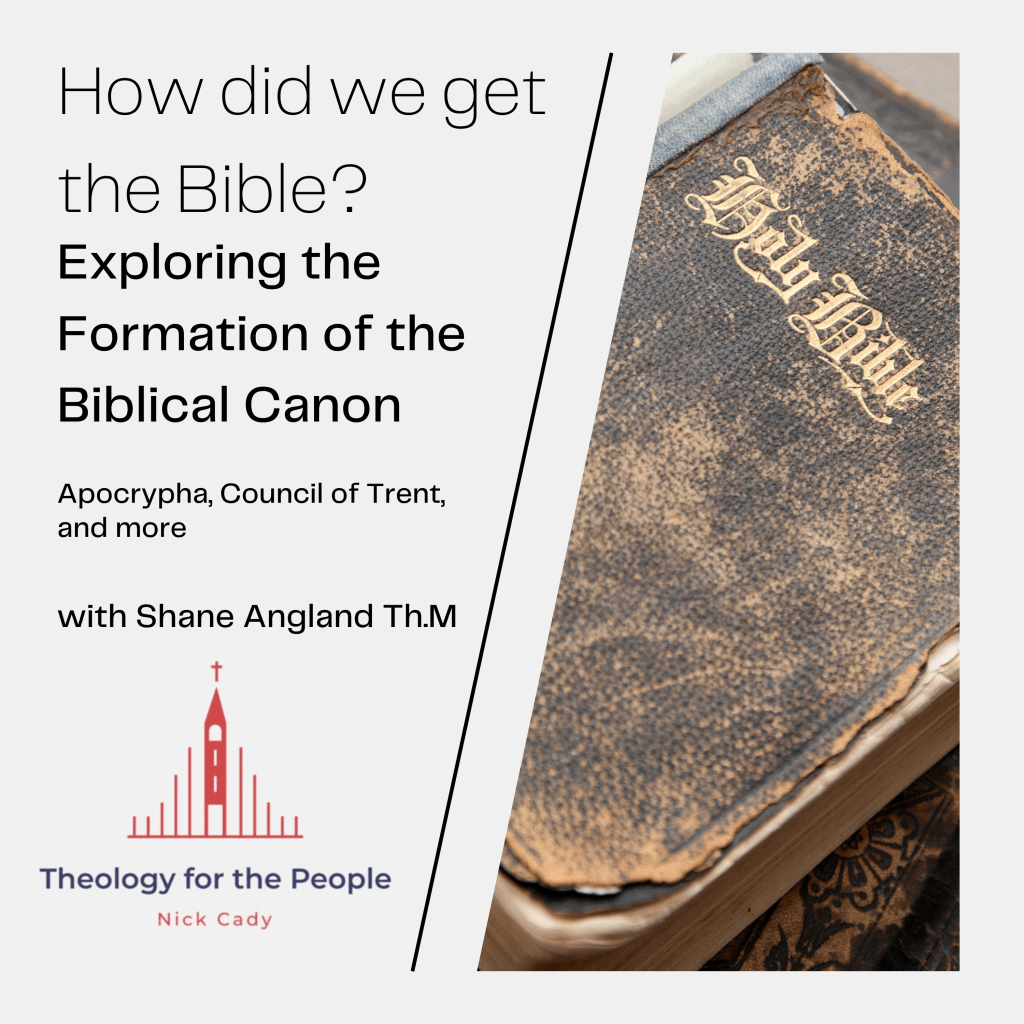
In this episode of the Theology for the People Podcast, I speak with Shane Angland about the question of how we got the Bible in its current form.
Shane has been a recurring guest on the podcast, and he has a keen mind and knowledge of historical theology. Shane lives in Ennis, Ireland where he serves at Ennis Evangelical Church. He holds a Masters of Divinity from Dallas Theological Seminary, and has served as a missionary in Ukraine.
From the formation of the Old and New Testaments to the question of the Apocrypha, to the impact of the Council of Trent, this conversation offers clarity on why the Bible is trusted as God’s inspired Word.
Key Topics Discussed
What is the Canon?
Definition: The canon is the list of inspired, authoritative Scriptures distinguished from other valuable writings.
Theological foundation: Scripture is “breathed forth” by God, carrying unique authority for the church (2 Timothy 3:16).
Old Testament Canon Formation
Begins with God’s redemptive acts, particularly after the Exodus and Sinai covenant (Exodus 24, Deuteronomy 31).
Jewish recognition of inspired texts from Moses to Malachi, with a prophetic silence post-Persian era.
Josephus and first-century Jewish consensus on 22 books (equivalent to the 39 books in modern Old Testaments).
No explicit criteria articulated, but guided by the Holy Spirit and covenantal context.
The Apocrypha and Deuterocanonical Books
Includes books like Tobit, Judith, Wisdom, Sirach, 1 & 2 Maccabees, Baruch, and additions to Esther and Daniel.
Historical debate: Some early Christians (e.g., Augustine) accepted these books, while others (e.g., Jerome) did not, aligning with Jewish tradition.
Council of Trent (1546): Roman Catholic Church dogmatically defined these books as canonical, partly in response to Reformation emphasis on scriptural authority (e.g., for doctrines like purgatory).
Eastern Orthodox churches maintain an open canon, avoiding infallible rulings.
New Testament Canon Formation
Tied to the new covenant and apostolic authority, with writings by or connected to apostles (e.g., Mark linked to Peter, Luke to Paul).
Criteria: Apostolic origin, Christ-centered message, and widespread church use in worship.
Early recognition: By the late first century, apostolic writings were distinguished (e.g., Clement’s letters vs. Paul’s epistles).
By the second century, 22–23 of the 27 books were widely accepted, with minor debates on smaller texts (e.g., 2 Peter, 3 John).
Misconceptions Addressed
Myth: The Council of Nicaea (325 CE) decided the canon. Reality: Nicaea focused on church governance, not canon selection.
Myth: Early Christians chose from hundreds of gospels. Reality: The four canonical gospels were the earliest, apostolic, and widely used.
Gnostic “gospels” (e.g., Gospel of Judas) lack historical or apostolic credibility and were not serious contenders.
Why the Delay in Formal Canon Lists of the New Testament?
The early church was decentralized, persecuted, and lacked centralized authority to compile lists.
Canonical texts were illegal, and possession could lead to martyrdom (e.g., 180 CE Carthage trial).
Earliest clear list: Athanasius’ Easter Letter (367 CE), reflecting existing church consensus.
Confidence in Scripture
The Bible’s unity across 66 books, three languages, and 1,500 years testifies to its divine inspiration.
The early church’s careful discernment reflects wisdom, not uncertainty.
Romans 3:2 affirms the Jewish role in preserving the Old Testament oracles, reinforcing trust in the canon’s reliability.
Resources Mentioned
Michael Kruger’s work on the canon (e.g., Canon Revisited).
Josephus’ Against Apion for first-century Jewish canon insights.
Augustine’s On Christian Doctrine.
Quotable Moments
“The canon begins with God’s work of redemption, not human decisions.” – Shane
“The church doesn’t establish the canon; it recognizes it through the Holy Spirit.” – Shane
“The Bible’s coherent message across 1,500 years is a miracle of God’s inspiration.” – Shane
How Did We Get the Bible? Exploring the Formation of the Biblical Canon – with Shane Angland Th.M –
Theology for the People
In this episode, Nick Cady and Shane Angland tackle the critical question: How did the Bible come to be? They explore the formation of the biblical canon, addressing misconceptions, historical processes, and the theological significance of Scripture. From the Old Testament’s roots in God’s redemptive work to the New Testament’s apostolic authority, this conversation offers clarity on why the Bible is trusted as God’s inspired Word. They also discuss the Apocrypha, the Council of Trent’s impact, and how early Jewish and Christian communities recognized canonical texts.Connect with Theology for the PeopleWebsite: theologyforthepeople.comFollow on X: @nickcady
In this episode of the Theology for the People Podcast, I speak with Dr. Alan Stoddard, who interviews me about the baptism of the Holy Spirit.
What is the baptism of the Holy Spirit? Does it happen simultaneously with salvation, or is it a subsequent experience? How should our understanding of the baptism with the Holy Spirit shape our practice in the church?
Alan is a pastor and church planter with over 25 years of ministry experience. Alan holds a Master’s Degree from Southwestern Seminary, and a Doctorate in preaching from Gordon Conwell. Both Nick and Alan serve as Adjunct Professors at Calvary Chapel Bible College. Alan also teaches at Rockbridge Seminary. Nick and Alan also serve on the Leadership Team of Expositors Collective. This year, on Easter Sunday, Alan launched a new church plant called Imagine Church in Cressen, Texas.
In this episode, Nick and Alan discuss the prepositional approach to understanding the Spirit’s work, and how it helps to address some common questions and even some misconceptions about the baptism of the Holy Spirit.
What is the baptism of the Holy Spirit? Does it happen simultaneously with salvation, or is it a subsequent experience? How should our understanding of the baptism with the Holy Spirit shape our practice in the church? In this episode, Pastor Nick Cady is interviewed by Dr. Alan Stoddard about this topic.Alan is a pastor and church planter with over 25 years of ministry experience. Alan holds a Master’s Degree from Southwestern Seminary, and a Doctorate in preaching from Gordon Conwell. Both Nick and Alan serve as Adjunct Professors at Calvary Chapel Bible College. Alan also teaches at Rockbridge Seminary. Nick and Alan also serve on the Leadership Team of Expositors Collective. This year, on Easter Sunday, Alan launched a new church plant called Imagine Church in Cressen, Texas.In this episode, Nick and Alan discuss the prepositional approach to understanding the Spirit’s work, and how it helps to address some common questions and even some misconceptions about the baptism of the Holy Spirit.Resources to check out: Perspectives on Spirit Baptism – book, recommended by AlanArticle by Nick: "Is the “Baptism in the Spirit” the Same as Being “Filled” With the Holy Spirit? Yes and No. Here’s Why"Subscribe to Theology for the People for more episodes.Visit the Theology for the People website and blog
When we talk about “the Early Church” many people’s minds immediately go to the first generation of Christianity, recorded in the Book of Acts and addressed in the New Testament. But what happened after that, and why does it matter for Christians living today?
Matt Pursley is the Executive Pastor at Park Hill Church in San Diego, California. He has a Masters in Christian History, and in this episode, Matt and I discuss the First Council of Nicaea: what led to it and what it produced.
We address many of the common misconceptions about Nicaea, and we discuss the early heresies of Marcionism, Gnosticism, and Arianism, and why it’s important for Christians today to understand those heresies, and why they were rejected.
Along the way we also talk about Jordan Peterson, who Matt says is a modern Marcionite, and how the errors of both liberalism and fundamentalism have a similar origin.
The First Council of Nicaea: What Actually Happened & Why Does It Matter for Us Today? –
Theology for the People
When we talk about “the Early Church” many people’s minds immediately go to the first generation of Christianity, recorded in the Book of Acts and addressed in the New Testament. But what happened after that, and why does it matter for Christians living today?
Matt Pursley is the Executive Pastor at Park Hill Church in San Diego, California. He has a Masters in Christian History, and in this episode, Matt and I discuss the First Council of Nicaea: what led to it and what it produced.
We address many of the common misconceptions about Nicaea, and we discuss the early heresies of Marcionism, Gnosticism, and Arianism, and why it’s important for Christians today to understand those heresies, and why they were rejected.
Along the way we also talk about Jordan Peterson, who Matt says is a modern Marcionite, and how the errors of both liberalism and fundamentalism have a similar origin.
Visit the Theology for the People website at nickcady.org
Who is the Holy Spirit, and how does an understanding of the person and work of the Holy Spirit contribute to our life and faith as believers in Jesus?
Fred has focused much of his theological work on the topic of the Trinity, so when it comes to talking about the person and work of the Holy Spirit, he has a unique and helpful perspective.
In this episode we talk about what the Bible says and doesn’t say about the Holy Spirit, whether it’s okay to pray to the Holy Spirit, and more.
Who is the Holy Spirit, and how does an understanding of the person and work of the Holy Spirit contribute to our life and faith as believers in Jesus?
Fred Sanders is professor of theology at the Torrey Honors College at Biola University. He is the author of a much sought-after series of theological comic books, as well as the recently published book, The Holy Spirit: an Introduction, which is part of the Short Studies in Systematic Theology series put out by Crossway Publishing.
Fred has focused much of his theological work on the topic of the Trinity, so when it comes to talking about the person and work of the Holy Spirit, he has a unique and helpful perspective.
In this episode we talk about what the Bible says and doesn’t say about the Holy Spirit, whether it’s okay to pray to the Holy Spirit, and more.
Make sure to visit the Theology for the People website at nickcady.org
As Christians, we confess that there is one God who eternally exists in three distinct persons: Father, Son, and Holy Spirit.
The three persons of the Trinity are equal in power and glory, are co-eternal, and are of the same essence (Ousia in Greek).
The Father is God, the Son is God, the Spirit is God, but the Father is not the Son, the Son is not the Father, nor is the Spirit the Father or the Son.
The three persons of the Trinity also have unique functions, and relate to each other in unique ways. As a result, we can speak about the Trinity in two ways: the “Ontological Trinity” and the “Economic Trinity.”
OntologicalTrinity
“Ontological” has to doing with “being.” So, to speak of the Ontological Trinity is to explain who God is, and who the three persons of the Godhead are.
The major ecumenical councils of the church, such as Nicaea and Chalcedon, focused on the ontological nature of the persons of the Trinity, and affirmed that Jesus, the Son, is very God of very God, and that the Holy Spirit is not an impersonal force, but is, indeed, God.
So, to speak about the Trinity ontologically, is to affirm both the divine nature and the unique personhood of the three persons of the Trinity.
Economic Trinity
“Economic” has to do with action, roles, and function: what God (and each person of the Godhead) does.
So, when we take an economic view of the Trinity, we are talking about the things which the Father does, or which the Spirit does, which are unique to that person of the Godhead.
For example, it is the role and function of the Holy Spirit to perform the sealing and sanctifying functions of God in the life of a believer.
Jesus, the divine Son, uniquely took on human flesh, came to Earth, lived a sinless life, and died on a cross for our redemption.
The Father sent the Son, the Son submitted to the Father and obeyed the Father, the Father and the Son sent the Spirit. The Spirit glorifies and points to the Son. The Son glorifies the Father. The Father exalts the Son. The Son ever lives to make intercession for us. The Spirit indwells believers, reminding them of what the Son said, and bringing about conviction of sin, righteousness, and judgment.
Application
One important application of these principles, is the understanding that economic actions, such as submission, leadership, and difference of roles, does not diminish or take away from a person’s ontological identity, value, dignity, or identity.
This is communicated explicitly in Philippians 2, where we are told that Jesus, although he was equal with the Father, as God (ontologically), did not regard equality with [the Father] (economically) something to be grasped, but emptied himself, taking the form of a servant, being born in the likeness of men, and humbled himself in obedience, even to the point of death on a cross.
The point here is that Jesus’ economic activity did not detract from his ontological nature.
A point of application is made in the New Testament, in the complementary roles of men and women in the church. Though men are called to teach and exercise authority in the “household of God” (1 Timothy 3:15), this does not diminish or take away from the ontological equality of men and women as human beings, and as children of God, but is rather a matter of economic function. If this is true of the Trinity (and clearly it is), then it should not surprise us that it is true in the “household of God,” acted out by those who reflect His image to the world.
For more on this, check out this discussion of 1 Timothy 2:8-15, which I had with my wife, Rosemary, for our church’s weekly Sermon Extra video:
In this week’s episode of the Theology for the People podcast, I sit down with Michael Payne and Curt Fuller to discuss my forthcoming book, The God I Won’t Believe In: Facing Nine Common Barriers to Embracing Christianity. The book is scheduled to be released on March 6, 2022, and will be available for purchase online, as well as in our church’s bookstore. We are currently working on distribution, and getting it into other bookstores and book distributers as well.
In this episode, Michael interviews me and Curt, who edited the book, as we discuss the backstory behind how it came about, as well as the content of the chapters, and who this book is for.
I hope this book will be a great resource to help both those who are wrestling through facing these barriers to embracing Christianity, as well as those who seek to be equipped to help their family and friends move from doubt to belief.
I’d love it if you’d consider buying a copy of the book, and if you’d help spread the word about it online!
Book Release Announcement & Preview – The God I Won't Believe In: Facing Nine Common Barriers to Embracing Christianity –
Theology for the People
Nick wrote a book! It's coming out March 6, 2022 and is available for pre-order on Amazon here.
The book is titled, The God I Won't Believe In: Facing Nine Common Barriers to Embracing Christianity.
In this episode, Nick sits down with Michael Payne and Curt Fuller, who edited the book, the discuss how the book came about, who it's for, and what it's about.
Make sure to visit the Theology for the People blog at nickcady.org for more articles and content.
Both God the Father and the Son have distinct and obvious eternal roles that we see played out in the Bible, with Jesus being more obvious, but as I was thinking through the role of the Holy Spirit in eternity, I couldn’t come up with anything concrete. Could you give a brief overview of the roles of the triune persons of God as it pertains to eternity? I’m mostly interested in the Holy Spirit, but would love a pastor’s perspective on the other two also.
The “Ontological Trinity” and the “Economic Trinity”
There are two fields of discussion when it comes to the Trinity. The “ontological” and the “economic.” “Ontological” refers to who God is, i.e. that which pertains to being, whereas “economic” refers to what God does.
Specifically applied to the Trinity, study of the “ontological Trinity” is focused on those parts of the Bible which communicate that the Father is God, the Son is God, and the Holy Spirit is God, and yet these three, while distinct persons, are one God. Study of the “economic Trinity” is focused on the passages in the Bible which tell us what each of these three persons does as their role in “the Godhead.”
So, ontologically, it is important to point out that eternality is part of God’s nature. God is eternal, and each person of the godhead is eternal. So, the role of God in eternity is merely a continuation of who God has been until now, and who God will forever be.
However, the question above is about the economics of the Triune God after this present age is over, and we have transitioned into what the Bible calls “the new heavens and new Earth.” What will the functions of the three persons of the Triune God be in “the age to come”?
The Role of the Son in the Age to Come
The Son, we are told, is currently seated at the right hand of the Father, and for eternity he will reign and rule as king over all of redeemed creation. (See Revelation 22:3)
Currently, Jesus is making intercession for believers, advocating for us, and is seated on a throne, but for eternity, all we really know is that he will be an eternal sovereign, ruling over a kingdom of righteousness and peace which will never end.
The Role of the Father in the Age to Come
Along with ruling over the redeemed creation from a heavenly throne, revelation tells us that God (not necessarily just the Father) will be a source of light, which will preclude the need for the sun to illuminate, since God himself will be our light.
The Role of the Holy Spirit in the Age to Come
The one thing that sticks out about the Holy Spirit’s role in eternity, is that, whereas the Father and the Son have a throne in the New Heavens and New Earth, the Holy Spirit does not (Revelation 22:3).
Beyond this, I can’t think of any verses which speak specifically about a role of the Holy Spirit in the age to come – but that is not surprising, and here’s why:
What we read regarding the economic Trinity mostly has to do with the work of God to redeem human beings. Remember, the Bible is a book about Jesus: who he is, and how he saves us.
Since the Bible is focused on the story of the salvation and redemption of humankind, it does not tell us very much about what God did before creating the world, nor does it tell us much about what God will do after the redemption of the world is complete.
“The Great Story Which No One on Earth has Read”
This reminds me of the final paragraph of C.S. Lewis’ The Final Battle, which is the final book in the Chronicles of Narnia series, which is full of allegories about biblical passages and teachings.
C.S. Lewis poetically describes “the age to come” in this way:
“…but the things that began to happen after that were so great and beautiful that I cannot write them. And for us this is the end of all the stories, and we can most truly say that they all lived happily ever after. But for them it was only the beginning of the real story. All their life in this world and all their adventures in Narnia had only been the cover and the title page: now at last they were beginning Chapter One of the Great Story which no one on earth has read: which goes on for ever: in which every chapter is better than the one before.”
C.S. Lewis, The Last Battle
The Bible doesn’t tell us much about what the three persons of the Trinity will do in eternity, because that is not the story which the Bible exists to tell.
God Will Do What God Did Before
Prior to the creation of the world, it is important to remember that God existed from eternity past. Without human beings to rescue, sanctify, and redeem, what did God do?
What we can be sure of, is that God was neither bored nor lonely.
From eternity past, the one God, who exists as Father, Son, and Holy Spirit existed as a mutually edifying and glorifying community unto himself. Creation, was God inviting us to join in the “perichoresis,” the eternal relationship which exists between Father, Son, and Holy Spirit, sometimes referred to as “the dance of God.”
In other words, in eternity, we can expect that God will do what God did before: delighting in himself, with each person fueling this mutually edifying and glorifying relationship.
Ask a Question or Suggest a Topic
If you have a question or would like to suggest a topic for me to address here on the blog, click here: Ask a Question or Suggest a Topic
Jon Markey and Michael Payne are accomplished musicians, songwriters, and producers, and in the latest episode of the Theology for the People podcast, I sat down with them to talk about the theology of music.
Michael is the Worship Pastor at White Fields Community Church in Longmont, Colorado. Prior to coming to Longmont, he spent 21 years as a worship leader and missionary in Hungary, and prior to that he served in the US Marine Corps.
Jon is a pastor and missionary in Ternopil, Ukraine. He moved to Kiev, Ukraine with his family in the 1990’s, when he was 5 years old, and earned a masters degree from the Ukrainian National Tchaikovsky Academy of Music.
We recently had the pleasure of having Jon and his family visit Longmont and lead worship at our church, and while he was here, I got to sit down with him and Mike to discuss what the Bible has to say about music: its purpose, uses, and significance – including the “song of creation,” and how it serves to counteract pagan origin narratives, as well as Jubal: the first human musician, mentioned in Genesis 4, as well as other practical discussions which have modern application.
Michael Payne and Jon Markey are accomplished musicians, songwriters, and producers, and in this episode they talk with Nick about the theology of music. Listen in to this discussion of what the Bible has to say about music: its purpose, uses, and significance – including the "song of creation," Jubal, and practical discussions for today.
Check out Jon's ministry: Room for More music on YouTube and his church: Calvary Chapel Ternopil (Ukraine)
Check out Michael on Spotify: Michael Payne and you can watch him on the White Fields Community Church YouTube page.
The book mentioned in this episode is Scribbling in the Sand: Christ and Creativity by Michael Card
Visit the Theology for the People blog.
Based on your knowledge of activity in Heaven what was going on in Heaven prior to the crucifixion and how did it change, if at all after Jesus resurrection? For example, was there joy in the presence of angels over sinners repenting before Jesus died and rose??
Interesting question! Here are my thoughts:
The Sons of God Shouted for Joy
In the Book of Job, when God speaks, God challenges Job by saying this:
“Where were you when I laid the foundation of the earth? …when the morning stars sang together and all the sons of God shouted for joy?”
The “sons of God” mentioned here is a reference to the angels. What this is telling us is that at the creation, the angels were “the audience” who watched and cheered as God created the universe.
The Heavenly Audience
This theme of the angels being an audience, watching the things which happen on Earth, is carried through the Bible.
At the beginning of the Book of Job, we read about Satan asking for permission from God to afflict someone. The picture we get from that scene is that those in Heaven are aware and attentive to the happenings of people on Earth.
Not only are those in Heaven aware and attentive to what is happening on Earth, they seem to be emotionally invested in what is happening on Earth. For example, in Revelation 5, we read that when no one was found who could open the seal, there was weeping in Heaven until it was revealed that the Lamb was worthy to do so.
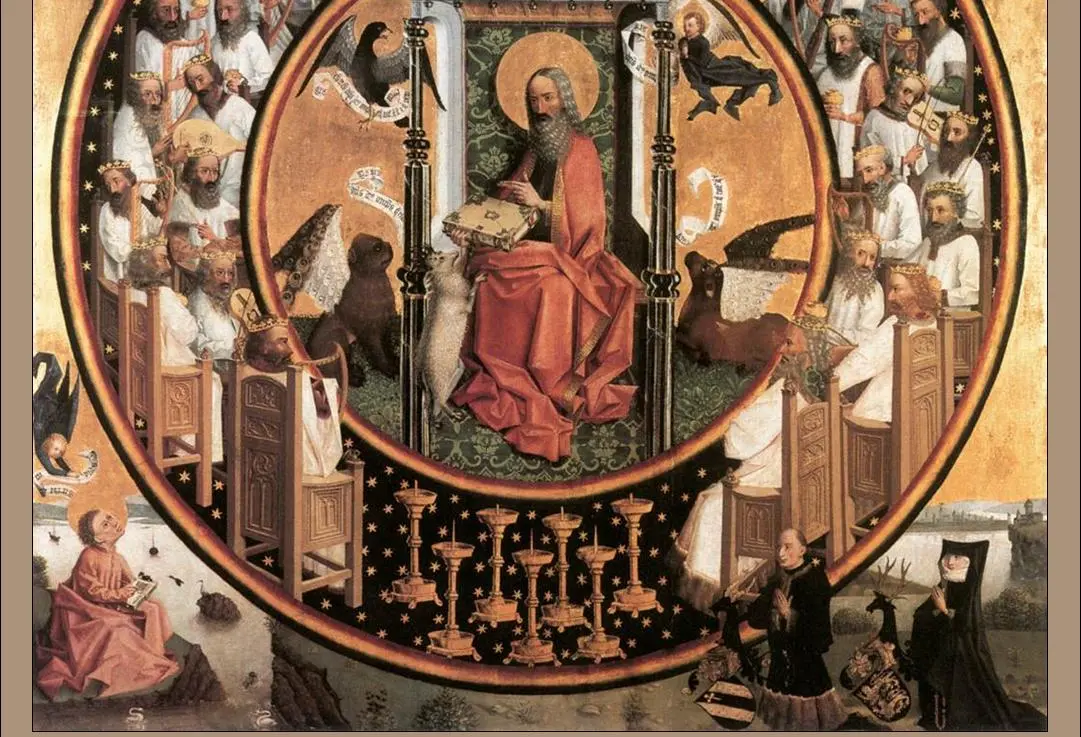
The whole picture of Revelation is that John the Apostle gets a preview of Heaven. Starting in chapter 4, John is caught up to Heaven, and what he describes is how, from that vantage point, he joins the angels in watching the happenings down below on Earth. The picture, therefore, is of Heaven being aware of and attentive to, as well as emotionally invested in, the happenings here on Earth.
The Stadium and Those in the Stands
In Hebrews 12:1 we read:
Therefore, since we are surrounded by so great a cloud of witnesses, let us also lay aside every weight, and sin which clings so closely, and let us run with endurance the race that is set before us,
The picture the writer is painting here is that of a stadium, and Greco-Roman competitions, such as the Olympics. He describes life as being a race, a theme which Paul also discusses, using similar language drawing from Greco-Roman athletic competitions.
But here the writer highlights a particularly interesting aspect of those competitions: as we run this race, we are surrounded by a cloud of witnesses. The “witnesses” are those who were mentioned in the previous chapter, Hebrews 11, where we are told about those who preceded us in the faith – the “Old Testament saints,” as they have been called.
The image the writer is invoking is that of a stadium, in which the stands all around us are full of those who have preceded us in the faith, and who are now “cheering us on” as we run the race that is set before us.
The Angels and the Saints
What we are left with, therefore, are two groups: the angels and the saints. Both groups are apparently aware and attentive to what is happening on Earth, and are rooting for us and eagerly awaiting the fulfillment of God’s promises.
What Changed in Heaven When Jesus Died and Resurrected?
The word angel literally means “messenger” in Greek, and this aligns with what the Bible tells us about angels; that they are “ministering spirits.” It would seem that the angels have been and still are aware, attentive to, and emotionally engaged in what is happening on Earth.
Thus, to answer your question, I do think there was joy in the presence of the angels over sinners repenting – prior to Jesus’ death and resurrection.
The one thing which changed when Jesus died and resurrected, is that those who were kept in Abraham’s Bosom awaiting the redemption of their souls were released from Sheol and taken to be in God’s presence.