In this episode of the Theology for the People Podcast, I am joined by pastor and author Ray Ortlund Jr. to talk about how God’s grace meets us in our lowest moments.
Ray is the president of Renewal Ministries, and the pastor to pastors at Immanuel Church in Nashville. He is an Old Testament scholar, has taught as a professor, and was a contributor to the ESV Study Bible.
Expositing Isaiah 57:15 and drawing from his own personal experiences of betrayal, regret, loneliness, and loss, Ray explains how the gospel offers real hope for crushed and broken people.
Topics include: • How to heal from betrayal • What to do when you’re trapped by your own sin • Why loneliness is a spiritual crisis • How the doctrine of justification by faith brings healing • What it means to die well — and live in light of resurrection
This conversation is filled with biblical encouragement for anyone struggling or walking alongside those who are.
In this episode, Nick Cady is joined by pastor and author Ray Ortlund Jr. to talk about how God's grace meets us in our lowest moments.Ray is the president of Renewal Ministries, and the pastor to pastors at Immanuel Church in Nashville. He is an Old Testament scholar, has taught as a professor, and was a contributor to the ESV Study Bible.Drawing from Isaiah 57:15 and Ray’s personal experiences of betrayal, regret, loneliness, and loss, they explore how the gospel offers real hope for crushed and broken people.Topics include:How to heal from betrayalWhat to do when you’re trapped by your own sinWhy loneliness is a spiritual crisisHow the doctrine of justification by faith brings healingWhat it means to die well — and live in light of resurrectionThis conversation is filled with biblical encouragement for anyone struggling or walking alongside those who are.Find Ray's book here: Good News at Rock Bottom: Finding God When the Pain Goes Deep and Hope Seems LostCheck out the Theology for the People website at theologyforthepeople.com
I have also started posting more on the Theology for the People YouTube channel. You can watch this interview on video here:
Cameron Cole experienced every parent’s worst nightmare: they put their son to bed one night, and in the morning they awoke to find that he had died in his sleep. However, the message of the Gospel, is that their son did indeed wake up — in a greater and more profound way: he awoke to eternal life with Jesus, his Savior.
In the wake of his son’s death, Cameron did a deep dive into the passages in the New Testament where Paul the Apostle writes about Heaven and eternal life. That study gave birth to his recent book, Heavenward: How Eternity Can Change Your Life on Earth.
In this episode of the Theology for the People Podcast, I speak with Cameron about what he learned through this experience, and how it made him more heavenly minded. Cameron also shares about how to the hope of eternal life ought to shape the way we live here and now.
Cameron’s ministry, Rooted, seeks to equip parents and churches to disciple children and students towards lifelong faith in Jesus Christ.
Cultivating a Heavenward Mindset in an Epicurean World – with Cameron Cole –
Theology for the People
Cameron Cole experienced every parent’s worst nightmare: they put their son to bed one night, and in the morning they awoke to find that he had died in his sleep.
However, the message of the Gospel, is that their son did indeed wake up in a greater and more profound way: he awoke to eternal life with Jesus, his Savior.
In the wake of his son’s death, Cameron did a deep dive into the passages in the New Testament where Paul the Apostle writes about Heaven and Eternal Life. That study gave birth to his recent book, Heavenward: How Eternity Can Change Your Life on Earth. In our discussion, Cameron shares what he learned through this experience, and how it made him more heavenly minded. Cameron also shares about how to the hope of eternal life ought to shape the way we live here and now.
Check out Cameron’s ministry: Rooted, which seeks to equip parents and churches to disciple children and students towards lifelong faith in Jesus Christ.
Visit the Theology for the People website at nickcady.org
When someone is sick or dying, or when a loved one has passed away, it’s common for people to comfort each other by telling them that they will be reunited with that person in Heaven.
But does the Bible actually teach this, or do we just say it because it is a “sweet little lie” that makes us feel better?
Clearly the Bible does teach about Heaven and eternal life for those who believe, but does the Bible actually teach that we will be reunited with people we knew on Earth? Are there any passages in the Bible that teach that we will recognize each other and hang out in Heaven?
Reunited and It Feels So Good
In 2 Samuel 12, when David’s infant son was sick, David fasted and prayed. When his son then died, David’s servants were afraid to break the news to him, thinking that if he was so distraught over his son being sick, surely the news of his son’s death would send him over the edge…
When David saw his servants whispering, he realized his son had died. Rather than being distraught, David was at peace – much to the surprise of his servants.
David explained his response by pointing out that since his son was dead, there was now no more he could do; praying for his son’s recovery wouldn’t help at this point. Instead, David went to the house of the Lord and worshiped, explaining to his servants that he was at peace, since, he said, “I shall go to him, but he will not return to me.” (2 Samuel 12:23)
David clearly took comfort in the knowledge that he would be reunited with his son in the life to come.
But this begs a question: When David would see his son, who died in infancy, would that child be an infant perpetually, for all of eternity? That question finds answers in some other passages in the New Testament, which we will consider next.
Recognizing…But Not Right Away
The gospel accounts in Luke 24 and John 20 tell us that when Jesus resurrected, three days after his crucifixion, some of his disciples met with him, but they did not immediately recognize him. After they realized it was him, however, they did recognize him.
This is an important detail for several reasons. In 1 Corinthians 15:20, Paul the Apostle explains that Jesus was the “first fruits” of those resurrected from the dead to eternal life. Other people had been raised back to life, but those people all subsequently died again, that time for good. Jesus was the first to raise to never die again – the fate which awaits those who believe in Him.
As the “first fruits” of those raised from the dead to eternal life, Jesus’ resurrection body is a prototype of what our resurrection bodies will be like. So what was Jesus’ resurrection body like?
We know from John 20 and Luke 24, that Jesus’ body was physical, for he ate food and people touched him. Yet, his physical body also had properties which were different than our moral bodies; he entered a locked room without using a door, for example.
Furthermore, Jesus’ appearance was, on the one hand, recognizable, and on the other hand, different enough that his closest friends didn’t recognize him – until they did.
In 1 Corinthians 15, Paul the Apostle mentions that over 500 people saw Jesus at one point after his resurrection, and those people all recognized that it was Jesus. When Jesus appeared to Thomas, who doubted that he had actually risen from the dead, Thomas recognized him, touched him, talked with him, and believed.
For these reasons, we can conclude that our bodies, in the resurrection and eternal life will be:
Physical, yet with unique properties that our mortal bodies do not possess.
Recognizable, yet somewhat different than the way you look now. (It seems reasonable to assume that infants will not be infants forever, and that these new bodies will be free of infirmity or other limitations related to age). It will truly be you, and will be recognizable as you, but will not be identical to your current appearance.
In Luke 9, we read about Jesus’ transfiguration, when his closest disciples were allowed to see a glimpse of his divine glory. During the transfiguration, Moses and Elijah appeared with Jesus before their eyes, and it says that the disciples recognized them.
This is interesting, because the disciples had never seen Moses nor Elijah, since they died long before the disciples were born. The disciples were able to recognize them somehow, possibly by interacting or speaking with them, or though their personalities.
Either way, it’s an example of long-deceased people being recognized as who they were. The implication is that in the life to come, people will be recognizable, and interact with those who have passed away before them.
That Weird Story about the Prophet Samuel and the Witch of Endor
Another story in which we see an instance of a deceased person interacting with and being recognized by someone they previously knew in this life, is found in 1 Samuel 28:8-17, where King Saul asked a necromancer to summon Samuel the Prophet, so Samuel could give him advice.
In this story, it seems that the necromancer is genuinely surprised that Samuel actually appeared. Her usual practice, in other words, didn’t produce that result. It can be assumed she was a charlatan, and that the deceased do not usually interact with the living, yet on this occasion, God allowed an exception, in order to teach King Saul an important lesson.
Reunited in the Sky
In 1 Thessalonians 4, Paul encourages the Thessalonians, and us, regarding the fate of those believers who have died prior to the return of Jesus. For the first Christians, who expected Jesus to return in their lifetime, they were genuinely surprised by and confused about the death of other Christians who had died Jesus had returned.
Paul encourages them by telling them that when Jesus returns, those who died in faith will be resurrected, and we who are alive will be caught up and we will meet Jesus and those who passed away before us in the sky. Paul then tells us to encourage each other with these words.
The Rich Man, Lazarus, and Abraham
In Luke 16, Jesus tells a story about two men who died, and what happened to them after they died. One was an unnamed rich man, the other was a poor man named Lazarus.
The irony of the the reversal is poignant: a man who had “a name” on Earth, and a “nameless” beggar – yet in eternity, the beggar has a name and the rich man is nameless.
These men find themselves in Sheol, a place of waiting, which is divided into two parts, with an impassable chasm between them: Abraham’s Bosom – a place of waiting for the redemption promised in the Messiah, and Hades – a place of waiting for the ultimate judgment.
Interestingly, these two men not only recognize and interact with each other, but they recognize and interact with Abraham – yet another example of people in the afterlife interacting with and recognizing each other.
Eden Restored (and then some)
The Bible begins with God placing the man and woman he created in a garden paradise in Eden, and charging them to be fruitful and multiple. Sin, however, comes into the good creation, leading to death and destruction. God immediately announces his plan of redemption through a savior, but the effects of sin are pervasive.
In Revelation 21, we see that after God has redeemed the world and defeated evil, Satan, and death, that there will be a new Earth. In this new Earth, we see a scene strikingly similar to Eden; people dwell with God, and there is a special tree: the Tree of Life, which hasn’t been seen since the garden paradise of Eden back in the Book of Genesis.
There is a difference, however: whereas Eden was a garden, this new place is a garden city. This place, in other words, isn’t just Eden restored, it is Eden fulfilled: it is what Eden would have become if sin and death hadn’t entered into the world.
The reason this is important for our discussion, is because it shows that Heaven will not be an ethereal place where we will float on clouds, or live in mansions. (The word “mansions” in some English translations of John 14:2 is a poor translation. The word monai should rightly be translated “rooms.”) Heaven will be a physical place, similar to the world we currently live in, but – just like our resurrection bodies – with important differences, and free from entropy and decay.
Conclusion
With all these thoughts together, we can be fairly confident that for those who are “in Christ,” who have put their faith and trust in him, we will indeed be reunited with our loved ones in eternity.
Recently a friend reached out to me with some questions regarding “annihilationism” and “conditional immortality.”
Will Every Soul Live Forever, or is Immortality Conditional?
One of the key questions in this discussion is this: Although the Bible clearly teaches the promise of eternal life for those who have been redeemed by Jesus, does the Bible teach eternal death for those who die in their sins?
“Conditional immortality” is the term given to the belief that the souls of those who die apart from redemption in Jesus will not go on living forever. They believe that immortality is conditional, meaning that only the souls of those who put their faith in Jesus will live forever, but not the souls of those who do not.
The central argument for conditional immortality in the Bible comes from Genesis 3 and Revelation 22, which talk about the Tree of Life, which was present in the Garden of Eden and will be present again in the New Jerusalem. In Genesis 3 we are told that the people were cut off from it, lest they eat of it and live forever in their fallen state. The idea is that if the Tree of Life is in the New Jerusalem (Heaven), it provides people with eternal life, but to be cut off from Heaven is therefore to be cut off from the source of eternal life.
Conditional immortality is also related to the idea of “annihilationism”
Annihilationism or Eternal Conscious Torment (ECT)?
Annihilationism is the belief that unredeemed souls will be “annihilated,” i.e. snuffed out in the Lake of Fire (Revelation 21:15) and cease to exist for all eternity. Seventh Day Adventists in particular argue that since Hebrews 12:29 says that God is a “consuming fire,” those who have not been justified and sanctified through Christ will be consumed by his presence and cease to exist.
In contrast to this is the traditional belief about Hell, held by the Church Fathers and the majority of Christians throughout history, that Hell is eternal conscious torment (ECT).
The key arguments against the ECT view of Hell, and in favor of annihilationism are two-fold:
An eternity of punishment for sins committed in a finite lifetime seems unfair, i.e. “the punishment doesn’t fit the crime”
The view of Hell as eternal conscious torment is not Biblical, but is imported from outside philosophies.
The ECT view is often blamed on Platonism, or Hellenism more generally, or from medieval assumptions influenced by writings like Dante’s Inferno
Rather than unquestioningly accepting these claims, we should examine if what they claim is true.
What Did Jesus Say About Hell?
Some might find it surprising that most of our understanding about Hell from the Bible does not come from the Old Testament, but from the words of Jesus.
13% of Jesus’ teaching and half of his parables were about Hell, judgment, and the wrath of God.
What that means is that Hell is not a peripheral issue, but is a major theme of Jesus’ teachings. If you claim that Jesus was a good teacher, you have to deal with the issue of what he taught about Hell.
Examining Jesus’ teachings, we find that the view of Hell as eternal, conscious torment was not a later addition to Christianity in the Middle Ages, nor the influence of Platonism or Hellenism, but rather people who simply accept the words of Jesus at face value.
Here are some examples of what he said:
Then he will say to those on his left, Depart from me, you cursed, into the eternal fire prepared for the devil and his angels. (Matt. 25:41)
And these will go away into eternal punishment, but the righteous into eternal life.” (Matt. 25:46)
[but some] will be thrown into the outer darkness. In that place there will be weeping and gnashing of teeth. (Matt. 8:12)
And if your eye causes you to sin, tear it out. It is better for you to enter the kingdom of God with one eye than with two eyes to be thrown into hell, ‘where their worm does not die and the fire is not quenched.’ (Mark 9:47-48)
Here Jesus is quoting from Isaiah 66:24
In Luke 16, Jesus tells the story of a man who suffered in Hell after his life on Earth ended, which means that his soul was not snuffed out when he died, but continued living.
Because of the simple clarity of these verses, the great majority of Christians throughout history have accepted that the teaching of the Bible is that Hell is eternal, conscious torment.
Eternal Separation from God
In 2 Thessalonians 1:9, the Apostle Paul describes Hell in this way:
those who do not know God and on those who do not obey the gospel of our Lord Jesus. They will suffer the punishment of eternal destruction, away from the presence of the Lord and from the glory of his might,
2 Thessalonians 1:9
Once again, we see an example of the eternality of the destruction which will be suffered by those who do not know God and who reject the gospel.
Rather than being unkind or heartless, these messages are written to those who are alive so that they can turn from their ways and be saved. As Ezekiel 33:11 says:
As I live, declares the Lord GOD, I have no pleasure in the death of the wicked, but that the wicked turn from his way and live; turn back, turn back from your evil ways, for why will you die?
Ezekiel 33:11
It is the heart of a loving God that warns and pleads, knowing the gravity of what is at stake. It is because God cared so much that he came to this Earth to give his life, that people might be saved.
A Message from Beyond the Grave
In the Gospel of Luke 16:19-31 Jesus tells a story about a rich man who died and suffered torment in Hades. Jesus shares that this man longed to be able to send a warning to his family members who were still alive that they should not make the mistake that he did, of not trusting in and walking with God.
For those who are alive, this is a very important story because it helps us to understand the urgency of responding to the gospel and receiving the gift of salvation and life that is extended to us in Jesus.
Unjust Punishment?
The question still remains as to whether it is fair for Hell to be eternal, since life on Earth is finite.
Here 2 Thessalonians 1:9 is helpful, which tells us that the essence of Hell is separation from God and his glory.
Since God is the source of beauty, life, joy, peace, and goodness – to be separated from God and his glory is to be cut off from those things for eternity. In other words: what makes Hell hellish, is that God is not there. What makes Heaven heavenly, is that God is there.
Furthermore, since Hell is the destiny of those who have rejected the grace of God and relationship with him, and have essentially pushed God away or turned their back on Him, Hell is the final culmination of them getting what they wanted in their lifetime.
In Genesis 6:3, God says something very serious: “My Spirit will not always contend (or strive) with man.” If a person continually rejects the offer of God’s grace and the conviction of the Holy Spirit, the time will come when God will give them what they insisted upon, forever: life apart from God. This giving people over to their ungodly desires is the essence of God’s judgment (see Romans 1:18-31).
Hope Beyond the Grave
Faithful Christian teachers in history, such as John Stott, have believed in annihilationism, but this view has always been a minority viewpoint, mostly because it seems to contradict the straightforward teachings of Jesus.
What we do know is that the message of the gospel is truly good news, and that there is an urgency to this gospel because of the reality of Hell.
For Christians, Easter is our biggest celebration of the year. And yet, how do you celebrate in the midst of a crisis in which thousands of people are sick and dying, and millions are out of work and hurting financially?
Some churches have suggested that celebrations of Easter should be delayed until this crisis gets better. I disagree. In fact, I would say that there is no more appropriate time for us to celebrate Easter than in the face of sickness, instability, and death, because these things are the very reasons why Easter is good news worth celebrating!
In fact, this may be the one moment in all of our lives when we understand the weight of what Easter means, and the hope that it brings, more than ever.
The meaning of Easter is that the Lord of Life died in order to destroy death, and make it possible for us to be reconciled to Him and resurrected to “a better life” (Hebrews 11:35, 40).
This year we will be having our church’s first ever Good Friday service, but since we cannot gather physically we put out pre-packaged communion supplies for people to pick up outside of the church.
We have been pre-recording our services in order to create a worshipful experience for those who watch at home.
1 John 5:16-17 is a passage that many people have a difficult time understanding, and recently someone reached out asking if I could help them understand this passage.
If anyone sees his brother committing a sin not leading to death, he shall ask, and God will give him life—to those who commit sins that do not lead to death. There is sin that leads to death; I do not say that one should pray for that. All wrongdoing is sin, but there is sin that does not lead to death.
1 John 5:16-17
The question this person asked was: “If there is a sin leading to death, why are we told not to pray for it?”
Physical Death or Spiritual Death?
Different interpretations of this passage center on the issue of whether the “death” John speaks about is physical or spiritual in nature.
Interpretation #1: Physical Death
If John is speaking about physical death, then the interpretation goes like this: Not all sins lead to physical death. If you see someone doing something that will hurt them physically, then pray for them. But if someone sins, and as a result of their sin they die, then there is no need to continue praying for them after they are physically deceased.
However, I find this interpretation lacking, because it does not take into account the broader context of what John has been talking about throughout his letter.
Interpretation #2: Spiritual Death
This is the interpretation that I find most convincing, because it is a conclusion based on what John has been saying throughout this epistle.
In this way, the sin that does not lead to death (that is, eternal death or damnation) is any sin that we commit that we are, by grace, capable of truly confessing and repenting from.
John Piper, in his article: What Is the Sin Not Leading to Death? says that in Vs 16 there is no indefinite article in the original Greek text – in other wards, it is talking about “sin” in general, not “a” particular sin specifically.
He goes on to explain:
We need to make sure that we see these two verses as part of the larger balancing act that John is doing in this letter. On the one hand, there’s a strong emphasis in 1 John that those who are truly born of God don’t go on sinning. On the other hand, John warns against misunderstanding that in a perfectionistic way as though Christians don’t sin anymore.
On the one side, you don’t keep on sinning if you’re born again. On the other side, you don’t ever stop sinning in this world. In other words, John is trying to strike a balance between the absolute necessity of the new birth, which necessarily gives a significant measure of victory over sin. That’s the one side. On the other hand, there’s the reality that we do in fact as Christians commit sins and can find forgiveness as we confess them.
John is striking the note firmly that we should not take anything he has said in a perfectionistic way that implies Christians don’t sin or that all sin leads to damnation. It doesn’t.
Christians do sin, and not all sin leads to damnation. But right there in the middle, verse 16, near the end of the verse, he puts in a disclaimer. He says, “When I tell you to pray for sinners I recognize that Jesus taught about unforgivable sin, and I recognize that Hebrews taught about Esau, and I do acknowledge that there is sin that does lead to death and damnation. It puts you beyond repentance. And I’m not talking about that.” That’s the point of that verse. “I’m not talking about that when I tell you to pray for those who have sinned.” He doesn’t tell us not to pray for such sin, he simply says, “That’s not what I’m talking about when I tell you to pray for sinners that God will give them life.”
I hope this explanation helps! It’s the one that makes the most sense given the context of what John writes about throughout the letter.
In 2 Timothy 1:10, Paul the Apostle tells us that Jesus came to abolish death and bring life and immortality to light through the gospel. I looked at this passage yesterday in a sermon titled “Born That Man No More May Die,” as part of our Advent series, looking at who Jesus was and why he came.
In the sermon I looked at a story that has always intrigued me: Jesus’ encounter with Nathaniel in John 1, in which Jesus declares that Jacob’s ladder (Genesis 28) was a foreshadowing of Him: Jesus is the bridge between Heaven and Earth, between mortal humanity and immortality.
What Was Nathanael Doing Under the Fig Tree?
In John 1, we read that Nathanael is skeptical when he hears that Jesus is from Nazareth; he cannot believe that the Messiah could ever come from a place like that. In my sermon, I explained that the reason Nazareth was despised was because it was a generally poor, working class town, where most of the people worked for the pagan Greeks in the nearby city of Sepphoris.
Nathanael is then introduced to Jesus, and immediately he lets go of his skepticism and is convinced that Jesus truly is the Messiah. What changed his mind? It was something that Jesus said to him as soon as they met:
Jesus saw Nathanael coming toward him and said of him, “Behold, an Israelite indeed, in whom there is no deceit!” Nathanael said to him, “How do you know me?” Jesus answered him, “Before Philip called you, when you were under the fig tree, I saw you.” (John 1:47-48)
What was Nathanael doing under the fig tree? According to some Jewish rabbis, Jewish people would traditionally read the Scriptures under a fig tree because of the belief that the Tree of the Knowledge of Good and Evil (the tree Adam and Eve were told not to eat from lest they die), was a fig tree, because after they sinned and their eyes were opened to the fact of their nakedness, Adam and Eve tried to cover themselves with fig leaves.
The statement about an Israelite in whom there is no deceit is likely as allusion to the story of Jacob, whose name means: “deceiver”, but after wrestling with God, he was given a new name: Israel, which means something like: “grapples with God”, “subdued by God” or “governed by God.”
These allusions to Jacob “the deceiver” whose identity was changed by his encounter with God, along with the mention of the fig tree lead many to believe that Nathanael must have been reading about Jacob in the Book of Genesis, and the fact that Jesus knew that, convinced Nathanael that Jesus was indeed the Messiah, the promised Savior and king.
Cut Off from the Tree of Life?
Speaking of the Tree of the Knowledge of Good and Evil, in Genesis 3, after Adam and Eve ate of it, they were cast out of the Garden of Eden, and an angel with a flaming sword was placed to guard the entrance of it, lest they – or anyone else – eat of the Tree of Life and live forever. (Genesis 3:22)
That verse might strike you as a little bit confusing: Doesn’t God WANT us to eat of the Tree of Life and live forever?
The answer is: Yes, but not in this fallen state. In other words, it was an act of God’s mercy that Adam and Eve were cut off from the Tree of Life, lest they eat from it and live forever in their fallen state. Instead, God allowed them to die, so that he might one day redeem them through Jesus, and ultimately resurrect them unto eternal life. For us as well, it is God’s mercy that he allows us to die “the first death” (physical death) and saves us from “the second death” (eternal Spiritual death, see Revelation 21:8).
Further Discussion
Mike and I sat down this week and discussed these and other topics in our weekly Sermon Extra video. Check it out:
The Apostles’ Creed, one of the oldest Christian creeds – in continual existence since at least the 4th Century A.D. – contains a line which many people have found intriguing: it declares that Jesus “descended to the dead.”
Older translations of the original text into English sometimes translate this phrase as saying that Jesus “descended into Hell.”
Looking at the creed in ancient languages is interesting as the Greek text says: κατελθόντα εἰς τὰ κατώτατα, which means: “descended to the bottom” – and the Latin text says: descendit ad inferos, the word inferos being translated as “Hell.”
More recent translations into English have chosen to say “descended to the dead” rather than “descended into Hell” as “the dead” would be more accurate biblically and theologically than “Hell.” The reason for this is based on a particular understanding of “Sheol” in the Old Testament and the Jewish mind, which was the dwelling place of all souls, being divided (according to Luke 16:19-31) into two parts: Abraham’s Bosom and Hades, AKA: Hell.
Abraham’s Bosom, it is believed, was a place of comfort for those who died in faith, i.e. the “Old Testament saints,” such as those described in Hebrews 11, who died prior to the redemptive actions of Jesus. The theory, therefore, is that 1 Peter 3:19 and 4:6, Peter is describing how Jesus went to Sheol after his death on the cross but prior to his resurrection, and declared to the deceased souls held there what he had accomplished in his life and death. This message would have been a message of redemption and release from Sheol, to the immediate presence of God, to those who were kept in Abraham’s Bosom awaiting the redemptive work of the Messiah, and a message of condemnation for those held in the Hades/Hell portion of Sheol.
I also explain this in some detail in this past Sunday’s sermon from 1 Peter 3:18-4:11 – The Resurrected Life. The part that deals with this topic begins around 17:30.
However, there are several different, and possible, interpretations of these verses which Mike and I discussed and outlined in this week’s Sermon Extra video. It’s worth watching, as we discuss different views, such as that this speaks to Jesus preaching to demons related to the Nephilim in Genesis 6, Jesus preaching through Moses, etc.:
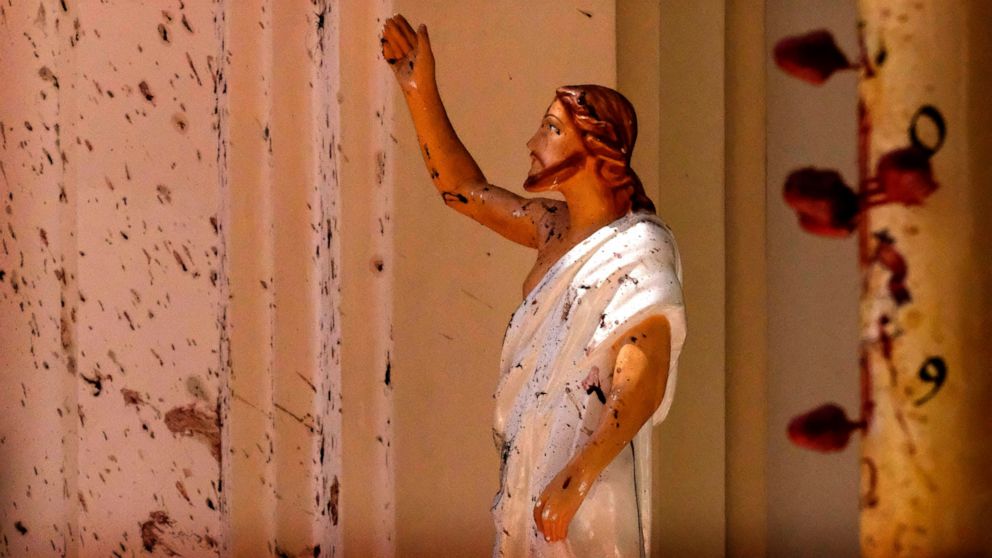
Church in Negombo, Sri Lanka after the attack on Easter Sunday
Jesus said, “I am the resurrection and the life. Whoever believes in me, though he die, yet shall he live.” (John 11:25)
Yesterday, as people around the world gathered to celebrate the resurrection of Jesus, terrorists attacked three churches in Sri Lanka, killing nearly 300 and injuring over 500. [source]
The irony of the situation is profound: The goal of terrorism is to incite fear by taking lives, but they carried out their attacks on the day when Christians revel in the fact that we can live without fear because of the hope that we have in eternal life.
What Jesus’ resurrection means for Christians, is that not only did Jesus die to forgive our sins, but he rose from the grave to conquer over death forever, so that we can have eternal life.
1 Corinthians 15 tells us that Jesus is the “first fruits” of those who are going to be resurrected to eternal life, and because that is true, death has lost its sting! Death will not have the final word.
As a result of this great truth, we who have this hope of eternal lives are free to live without fear. We are free to be courageous and generous, because we have nothing to lose – and the greatest gain is already ours!
Paul the Apostle put it this way: “If the dead are not raised, then we should just eat and drink for tomorrow we die.” (1 Corinthians 15:32) The idea is that, if this life is all we’ve got, then it would make sense for us to be selfish and short-sighted with the time we’ve got, since this is all we have. However, if Jesus did indeed rise from the dead, and we will too – then “to live is Christ, and to die is gain!” (Philippians 1:21)
If you have the hope of eternal life, then this life isn’t as good as it will ever get for you, rather, this life is as bad as it will ever be for you. If you know that you’ve got a thousand, million, billion years ahead of you, in which you will experience joy, security, adventure and love, then you are truly free to use the little window of time you’ve got here on Earth in the service of others, and in the service of God.
If you have the hope of eternal life, you are free to love sacrificially, and to give without holding back!
In other words: Jesus’ resurrection makes us brave, because it gives us hope.
Jesus’ disciples who saw him after his resurrection were so transformed by it, that they went from being timid and fearful to being bold, to the point where they came out of hiding and publicly proclaimed their faith, unwaveringly – even in the face of violence towards them and their families. As Paul says in Acts 13:31, they became “witnesses to the people”; rather than fearing for their lives, they boldly carried out a mission.
Our hearts break, and our prayers go out for those who are suffering from injuries, as well as for the families who were affected by this horrible act of violence. Our hearts ache as we look around and see the brokenness in the world, manifesting itself in hatred and violence. But as Christians, we must refuse to live in fear.
Instead, we set our hearts and minds all the more on the fact that we are pilgrims in this world, and our purpose here is not comfort or security. The time for comfort and security will come – fully and forever! But our time here on Earth is to be dedicated to courageously doing the will of God and carrying out His mission in the world, to bring to others the love of God and the good news of Jesus: the light of the world, who conquered death, and through whom we can have eternal life.
In John 3:13, Jesus says, “No one has ever gone into heaven except the one who came from heaven-the Son of Man,”
Is this saying that people didn’t go to Heaven before Jesus’ death and resurrection?
Where had everyone who died gone before Jesus died and rose?
Did this change after his death and resurrection?
What verses can you share with me about this?
Let me answer each of those questions in order:
Is this saying that people didn’t go to Heaven before Jesus’ death and resurrection?
Yes, I believe so.
Where had everyone who died gone before Jesus died and rose?
The Old Testament talks a lot about “Sheol” which is the dwelling place of the dead. Psalm 139:7-8, for example, says: “Where shall I go from your Spirit? Or where shall I flee from your presence? If I ascend to heaven, you are there! If I make my bed in Sheol, you are there!”
Is this saying that God is present in Hell? No. It’s saying He is present in Sheol.
It would seem (I’ll give Scriptural justification for this below) that Sheol was divided into two sections: Abraham’s Bosom and Hades.
Abraham’s Bosom was a place of comfort for those who died in faith. Since they had not yet been redeemed through the death and resurrection of Jesus, they could not go to Heaven, so this was a sort of holding place, or waiting room for the souls of the Old Testament believers who died in faith, trusting not in their own works or performance to garner them favor before God, but casting themselves on God’s mercy and grace to save them through the Messiah who was to come.
Hades, on the other hand, was a place of torment for those who died apart from awareness of their shortcomings and apart from faith and trust in God’s mercy and grace. Hades, like Abraham’s Bosom, was/is a holding place or waiting room for the souls of those who have died apart from faith, and though those in Hades suffer torment presently, one day Hades will be emptied into the Lake of Fire, meaning that Hades is not the final destination for those who have died apart from faith.
Did this change after Jesus’ death and resurrection?
It seems that in the time between Jesus’ death and resurrection, Jesus descended into Sheol and released those from Abraham’s Bosom and led them to Heaven. Those who die now in faith in Jesus go to Heaven, i.e. the presence of God.
Hades, on the other hand, remains in tact, and those who die apart from faith still go there.
What verses can you share with me about this?
Luke 16:19-31: The Rich Man and Lazarus
Luke 16:19-31 gives us insight to this through the story of the rich man and Lazarus: Lazarus, a poor man who died in faith, is taken to Abraham’s bosom, whereas the rich man who died apart from faith is taken to Hades. Between the two parts of Sheol, the story tells us, is an uncrossable chasm, and there is no escape.
The rich man desperately wants someone to go and speak to his family members, and plead with them lest they end up in Hades as well, but the man is told that his family members have been given Moses and the Prophets (i.e. the Scriptures), and they should listen to them.
Ephesians 4:8-10: He Led Captives in His Train
In Ephesians 4:8-10 we read this: Therefore it says, “When he ascended on high he led a host of captives (in his train), and he gave gifts to men.” (In saying, “He ascended,” what does it mean but that he had also descended into the lower regions, the earth? He who descended is the one who also ascended far above all the heavens, that he might fill all things.)
The Apostles Creed, one of the oldest Christian creeds, includes this phrase:
He suffered under Pontius Pilate, was crucified, died, and was buried; he descended to hell. The third day he rose again from the dead.
Going back to Jesus’ apostles, who spoke with him after his resurrection, there seems to have been an understanding that Jesus descended into Sheol, and did two things:
Released those “captives” from Abraham’s Bosom and led them to the immediate presence of God (Heaven). (Ephesians 4:8)
Preached to the spirits in prison (1 Peter 3:19-20)
The latter of these was not evangelism, but a pronouncement of judgment upon those spirits in Hades. We know this because of the qualifying text in 1 Peter 3:20.
Revelation 20:11-15 describes how, after the judgement of the living and the dead at the end of all things, Hades will be cast into the Lake of Fire.
And the sea gave up the dead who were in it, Death and Hades gave up the dead who were in them, and they were judged, each one of them, according to what they had done. Then Death and Hades were thrown into the lake of fire. This is the second death, the lake of fire. And if anyone’s name was not found written in the book of life, he was thrown into the lake of fire. (Revelation 20:13-15)
A New Heavens and a New Earth
Heaven, as it is now experienced, is different than what will be after the final judgment, where Revelation 21 tells us that there will be a new heavens and a new Earth, for the first heaven and the first Earth will have passed away, and will be no more. (Revelation 21:1)
Jesus said in Matthew 24:35 that Heaven and Earth will pass away, but his words never will.
2 Peter 3:7 says, But by the same word the heavens and earth that now exist are stored up for fire, being kept until the day of judgment and destruction of the ungodly.
And 2 Peter 3:10 says, But the day of the Lord will come like a thief, and then the heavens will pass away with a roar, and the heavenly bodies will be burned up and dissolved, and the earth and the works that are done on it will be exposed.
Thus, after the final judgment, there will be a new heavens and a new Earth, which will be not only the restoration of Eden, but the fulfillment of what Eden would have been had sin not entered in.
In the New Jerusalem, once again, we see humankind together with God, with no sin nor shame, nor any of the destructive effects of sin (i.e. sickness, pain), and that the Tree of Life is there. Whereas Eden was a garden, the New Jerusalem will be a garden city.
Submit Your Questions!
Thanks for these great questions! Keep studying the Word, and feel free to send more questions to me by filling out this form.












 Theology for the People