Should I Tithe if I’m in Debt?

One of the questions I am frequently asked as a pastor is whether people who are in debt should tithe to their church, or if they should rather dedicate that money to paying off their debt.

UPDATE: Since this post was written, my wife and I have paid off our debt. More about that in this post: Debt Free!

First of all, I should say that the New Testamnet does not require that a person give a tithe (10% of their income donated to the congregation where they worship) per se. Although this requirement did exist in the Old Testament for the nation of Israel, the New Testament teaches that we are to give unto the Lord not out of obligation but from a cheerful heart, to contribute to the work of the Lord and the community of faith. Many, however, including myself, believe that the Old Testament standard of a tithe, although not required by the New Testament, is a good guideline for giving.

According to Business Insider, the average American household is $6,500 in debt – that’s consumer debt not related to their mortgage.

The average American household carries $6,500 of consumer debt

There is a good chance that MOST people in any given church in America are in thousands of dollars of debt. That means that there are multitudes of faithful Christians who desire to honor God with their money by giving to Him of their first fruits and investing in building His Kingdom and spreading the Gospel – who wonder if giving a few hundred dollars in tithe to their church every month should rather be directed towards paying off their debt.

The short answer? Yes, I think you should regularly give tithes and offerings, even if you are in debt.

I know that some people will not agree with that – but please understand that I do not say that lightly at all. I too am in debt, and yet I tithe. I don’t want to be in debt, in fact, I’m working very hard to get out of debt. Last year we had some unexpected expenses which we deemed worthy of going into debt for. So, I say this as one who is in the same boat – carrying debt and struggling with whether to give a tithe or offering to my church or use that money to help pay off our debt.

I too am in debt, and yet I tithe

Here is why I tithe even though I have debt:

The tithe is not God’s way of raising money, it’s God’s way of raising kids.

I tithe because it is a values issue, and it trains my heart. By making the first check I write every month my tithe check, I am making a clear statement of my priorities and values. And it sends a message to my heart, that for us, we would rather invest in the Kingdom of God and the furtherance of the Gospel than just buying more stuff.

‘But, wait’ – you might say: ‘You wouldn’t be using that money to buy more stuff, you would be using that money to pay off your debt for the stuff you already bought.’ That’s nice in theory, but in practice, most people, with a few hundred more dollars in their pocket, won’t regularly devote that money to aggressively paying off their debt, it will just be a cushion on their budget.

The key to getting out of debt for many people is changing your lifestyle, not having a little more money – and tithing helps you change your lifestyle.

People who have more money – guess what they do? They spend more money. I watched a documentary on Netflix the other day about how an astonishing number of professional athletes go broke within just a few years of retirement. They had a lot of money and they spent a lot of money. What we need is a lifestyle change, not just more money. I have found that letting go of some of my money and giving it to God as the first thing I do when I get paid releases me from the grip of money – and helps me to change my lifestyle.

I have found then when I tithe vs when I don’t tithe, I don’t really end up with more money in my pocket, or get ahead with getting out of debt.

A sacrifice is only a sacrifice if it hurts.

David said, I will not sacrifice to the Lord that which cost me nothing (2 Samuel 24:24)  The woman who gave 2 mites – it was a relatively insignificant amount to the rest of us, but for her IT HURT. And Jesus publicly commended her for giving in a sacrificial way, although she could have just as well used that money to buy milk or bread which she probably had need of. She gave sacrificially, and Jesus not only commended her for it – God made sure it was recorded for all time so that generation after generation could learn from her example.

Worship and sacrifice are very closely related. We all sacrifice for what we worship. If we don’t sacrifice as an act of worship, well just put some thought into what that says about who you worship…

God is looking for vessels He can pour into, who will then pour back out what He has given them in ways that He desires. If we show ourselves faithful stewards with little, he will entrust us with more. I believe that God honors those who step out in faith and give radically and generously – because He is a God who also gives radically and generously, and when we do that, it aligns us in a greater way with His heart.

Is this a hard, fast rule? No. It’s a principle. But yet, it is the one principle, which God challenges us to test him on (see Malachi 3:10).

God loves a joyful giver. He doesn’t want people to give out of a sense of coercion or obligation. But this is a principle of which God says: “If you want to live the full life that I have designed for you, if you want to experience joy, then walk in this way,” – ‘the way everlasting’.


The Fat Belongs to the Lord

This Sunday at White Fields I taught 1 Samuel 2 and the story of Hophni and Phineas, the priests who were doing shameful things in the Tabernacle. (Click here for audio of that sermon: “Messed-Up Ministry”). There was a detail of that story that at first seems a bit odd and obscure, but is worth serious consideration.

In 1 Samuel 2:15-17 we read about how the Law required that the fat be burned off the meat before it was eaten. The law about this is found in the Book of Leviticus – and as I mentioned on Sunday, the reason for this is because at that time, the fat of the meat was considered the best, most luxurious part. But God required that when a sacrifice was made as an act of worship, the fat be burned, which would create a lot of smoke and it would be a “fragrant offering” unto the Lord.  Any of you who like the smell of bacon cooking know what I’m talking about. Those of you who are vegans, well, you can eat your tofu bacon and pretend you know what I’m talking about!  

The fat belongs to the Lord

But the idea that the fat belonged to the Lord represented a fundamental belief that we should give the best to God. Many people are in the habit of doing just the opposite – keeping the best for themselves, and giving the rest (the left-overs) to God. Rather than making their offering check the first check they write every month, they wait until the end of the month to see if they have anything left over. God asks that we give him the best, not the rest.

But there’s something else worth taking note of here: when the people in those days gave the fat of the meat to the Lord, they thought they were really giving up a lot – they were really “sacrificing” something, in obedience to God. They were giving up luxury and “the good life”. However, what we now know is that fat kills. At our last men’s prayer breakfast, one man brought a creation called the “bacon explosion” made of various lard extracts which I am convinced reduced my life span by 2 months per bite!
But here’s the point: by telling them to sacrifice the fat on the altar, not only was God teaching them an important values lesson, but he was also sparing them from something which was bad for them, even though they couldn’t possibly know that yet! It would only be thousands of years later that people would realize that God wasn’t only asking them to give something up, he was actually protecting them – even though they didn’t understand it yet, much like all of us parents do with our children.

God is good and all his ordinances – the things he tells you to do and what he tells you to steer clear of – each and every one flows out of his love and care for you.

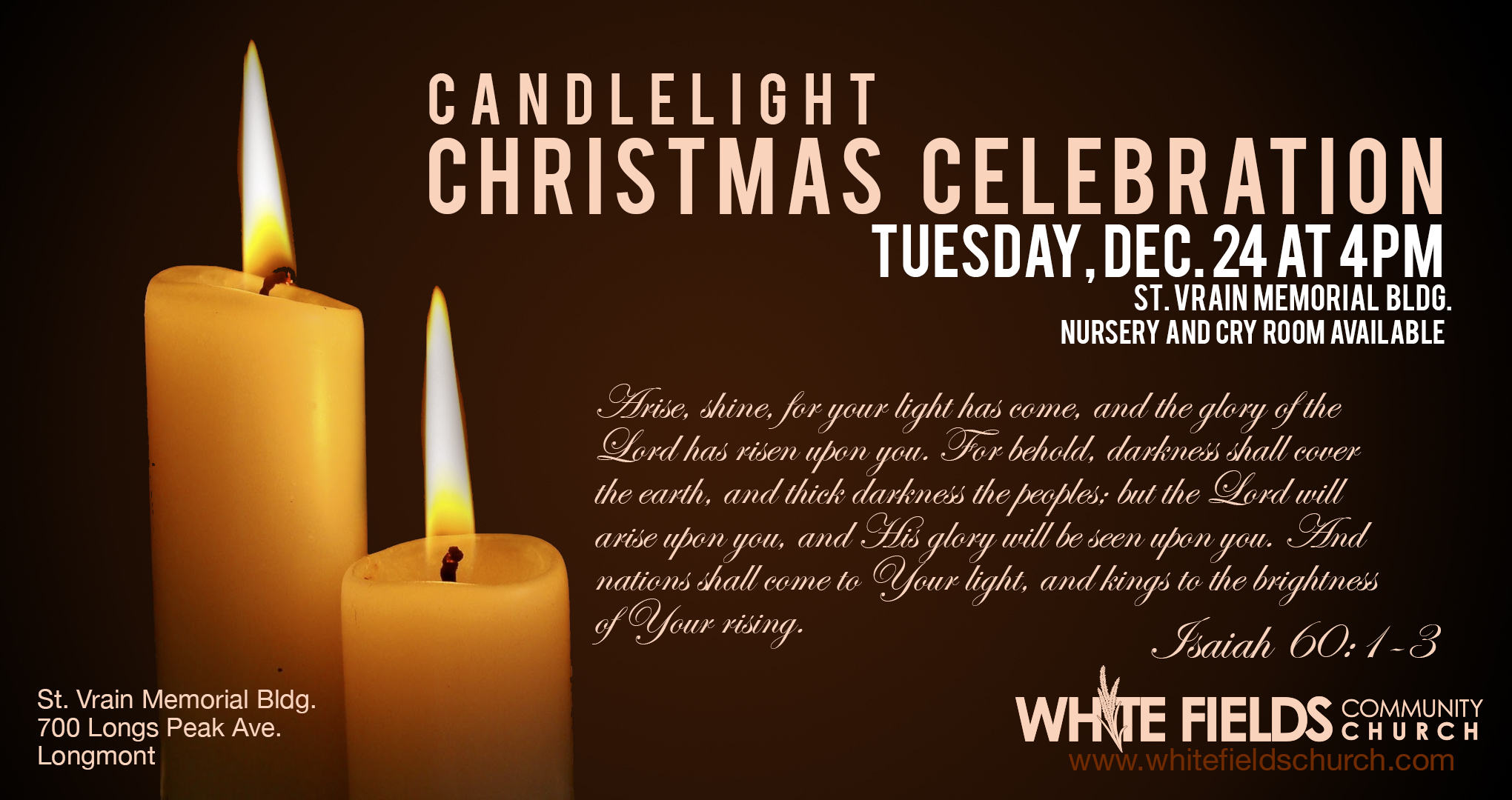
Join us on Christmas Eve at White Fields!

Image

If you live near Longmont, then I’d like to invite you to join us on Christmas Eve for our Candlelight Christmas Celebration.

We will have a special band leading us in Christmas carols and worship, as well as a children’s choir and “glad tidings of great joy for all people”.

Hope you will join us!

A Message from Ukraine

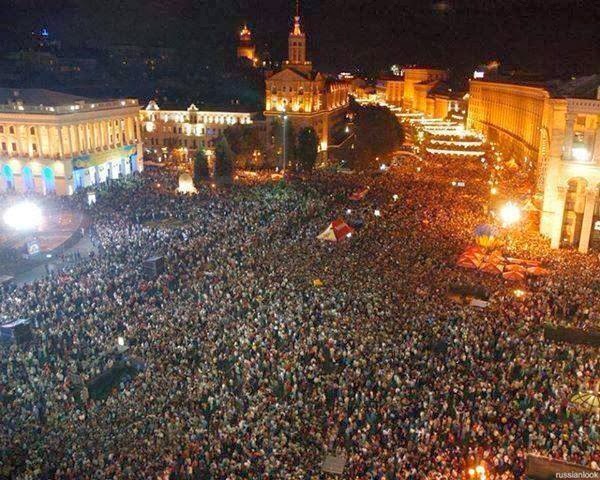
Maybe you have heard about what’s happening in Ukraine – where upwards of 25,000 people have taken to the streets in anti-government protests. 

Image

A friend of mine who is a pastor in Ukraine spoke at our church here in Longmont a few months ago (click here to watch that video), and today I asked him to write a brief synopsis on what is going on in Ukraine and how we can be praying for them. Here is what he wrote:

“And if one member suffers, all the members suffer with it…” 1 Cor. 12:26

You may have seen in the news recently that Ukraine, a former Soviet republic sandwiched between Russia and the European Union, is in the middle of massive street protests.  These protests were originally in reaction to the president breaking his promise to sign an association agreement with the EU.  People were angry and began to protest on the main square of the capital, Kiev.  After a few days on Nov. 30th, the president tried to end the protest with a massive show of violence, sending out special forces and riot police to beat peaceful protesters with batons.  They struck in the middle of the night when the fewest number of protesters were there to resist.  They beat both men and women indiscriminately and savagely, though the protesters posed no threat.  The president hoped that he would be able to put a stop to the people calling him to accountability for his broken promises.  He was wrong.  The reaction was the opposite and the next day many more people joined the protest.  This became no longer primarily a question of economics or which countries to build alliances with, but an outcry against human rights abuses, violence and oppression.  
Last night the president sent in troops and police again to try to clear the main square, though with more restraint as far as violence goes.  They attack began around 1:30am local time, again when there were less protesters to resist.  Many believers across Ukraine began praying.  We called each other, sent texts, waking one another up to stand before our mighty God and Savior and ask for Him to intervene.  It looked like this was the end of the protest and there was a thin line of protesters holding back a flood of riot police.  But then little by little people flocked to the square from all over Kiev in the middle of the night.  Soon the numbers were even.  Then the protesters were the majority.  By a miracle of the grace of God and in response to the prayers of His people, the protesters endured through the night and are still there.  The morning found a renewed protest and masses flocked to rebuild the barricades the police and special forces had torn down during the night.  
But the conflict is not over.  Tonight promises to be an important and difficult night on Independence Square in Kiev.  The protesters are more organized now, talking about organizing shifts for the night watch, but even then it will not be easy.  Also, the temperatures dipped down to almost 5F during the night last night.  Many of our brothers and sisters in Christ, including many pastors, are on the main square and will spend the night there ministering to the people and praying for God’s protection and peace and that His justice would triumph.  Near the beginning of the protests, some pastors set up an inter-denominational prayer tent on the square and people are coming to pray and even receiving Christ during this difficult time!  
The Word of God calls us to stand in unity and solidarity with both our brothers and sisters in Christ and with the oppressed and weak.  In this case, there is great overlap in those two categories.  I would beg you to stand together with the church in Ukraine before God and intercede at this pivotal moment in the nation’s history.  

Please pray for the following points:
1. Not against any party or person per se, but for the nation of Ukraine, that God would pour out His blessing and mercy on this people.

2. That God, who is not a God of disorder, but of peace (1 Cor 14:33) would establish His peace, order and justice in this land.

3. That God, who hates the hands that shed innocent blood (Pr. 6:17) would protect the people from violence and bloodshed, regardless of political affiliation.

4. That God would bless those currently in power by bringing them to repentance and the knowledge of Him and that they would rule in submission to God and turn from their wickedness, that we might live quietly and peaceably. (2 Tim. 2:2)

5. That the people would not be cursed in turning their hope to yet another man or political party in this time of trouble, but would be blessed by putting their hope in the Lord. (Jer. 17:5-7)

6. That the true enemy of man, Satan, who desires to steal, kill and destroy, would be cast down and that his plots would not prevail. (Eph. 6:12)

7. That, as our Lord Himself taught us to pray, the kingdom of God would come and His will be done on earth as in heaven. (Mt. 6:10)

Thank you for standing together as one body with your brothers and sisters in Ukraine.  God bless you and God bless the people of Ukraine!

What is the best thing happening at your church?

About 2 months ago I got invited to a pastors’ lunch up in Berthoud. There were about 12 of us there from different churches in Northern Colorado – I was the only one from Longmont. There was a guest speaker, Ray, who pastors a large church in Sacramento.

I’ve been to these kinds of meetings before – but this one was different, because Ray asked a question that I wasn’t expecting:

“What is the best thing happening at your church?”

That was the question which he opened the meeting with, and it caught me off guard! I had expected Ray to talk about the great things that he is doing, or to ask: ‘what needs to change at your church?’ – but I wasn’t ready for that question: “What is the BEST thing happening at your church?”

It seems that the other pastors in the room were caught off guard by it too, because many of them didn’t know what to say. Quickly though, momentum picked up and everyone had plenty to say on that topic – including me.

Ray went on to explain that we need to stop focusing on what is lacking, and we need to start focusing on what is right – the areas where our church is knocking it out of the park and killing it, the things that we just naturally do well, and we need to do those things more and better!

I have found this concept to be so freeing, so invigorating and exciting and so vision-focusing – not only when it comes to visioneering for church, but when it comes to life and who God has called me to be.
The essence is: Who is it that God has uniquely gifted and called you to be? What is that niche that God has created you for and called you to?  You can’t be everything – but you can be something, and if you learn to focus on being and doing what God has uniquely called and gifted you to do and be, then you will thrive, and it won’t be contrived, it won’t be a burden – it will feel like you just stepped into the fast-current on the lazy river ride at the water park, rather than being stuck in the whirlpool.

This is important when it comes to church, because the fact is that there are other churches out there. And there are many churches that are doing things that we aren’t – or can’t. BUT – there are things that we can do better than any of them; there is a culture that we have, that they don’t. There is a place and a role that God has uniquely given us in the Body of Christ in this place. There is a reason why people come to our church – and it’s not because they don’t know that there are other churches out there.

So I’ve been asking the question: What are the greatest things happening at White Fields church?
And THOSE are the things I want to be focused on. Those are the things I want to turn the dial UP on and make better. Rather than focusing on what we aren’t (yet) – I want to focus on what we ARE and what makes us great, uniquely – and turn up the dial on that! When you start thinking that way, you are no longer “competing” with other churches, but you realize that you are each filling a different role in the Body of Christ.

The danger is, that if we spend all our energy focused on what we aren’t (yet), we can neglect the things which to us are as easy and natural as falling off a log – and then those things will suffer as a result. The end result of that? We are mediocre at EVERYTHING and great at nothing. Rather, our focus should be on being GREAT at the things which God has uniquely gifted us to be and do – and those are usually the things which come most naturally to us – which are as easy as falling off a log.

People wanted David to fight Goliath the way that Goliath was good at fighting. David knew that he could probably do that – but it wasn’t what he was good at. He knew that he wasn’t Goliath. But he also knew what he was: he was David. And he had certain abilities and strengths, that he was uniquely gifted at: he could sling a rock like no one else! So he went out to battle with his strength, and ended up victorious.
It is important to know who you are, who you aren’t – and how God has uniquely gifted and called you. Go to battle with that, and you are much more likely to be victorious.

This doesn’t just apply only to church – it applies to many areas of life, business, etc. Who has God uniquely called you to be? What is the niche that God has called you to fill?  You don’t have to be everything! But God has called you and gifted you uniquely for somethings. Focus on those things. Go and kill it in those areas, and focus on developing those areas and being GREAT at those things.

Leave me a comment below and tell me: What’s the BEST thing happening in your church?


Busyness: The Enemy of the Soul

“How have you been?” “Busy!”
“Haven’t seen you much lately. What have you been up to?” “Oh, I’ve just been really busy.”
“We should really get together sometime.” “Yeah, I’d love to. Things are just really busy right now.”

We live in a culture that is chronically busy. Many of us, myself included, are busy doing a lot of really great things – but if we don’t watch out, our busyness with all these great things can destroy us.

What legacy will you have to show for all your running around?

Recently I’ve been listening to some audiobooks given to me by a friend. One of them is about how to get out of debt – a topic I’m very interested in. And what I see is that there is a parallel between how our culture handles money and time.

You see – because of technological developments of everything from cars to the internet, we now have more time on our hands, which frees us up to many more possibilities! We can go more places and do more things and connect with more people than ever before. In the same way – money and products are also readily available, perhaps like no other time before. Even if you have no money, there are a myriad of ways to finance purchases, which you can leverage to buy GOOD things, like houses and cars, you couldn’t have before. But, if you are always spending your money on every good thing that comes your way – after a while, you end up with very little to show for your years of hard work. The statistics on how much money passes through the average middle-class home in America are astounding.

Similarly, with busyness – if we stay busy doing a lot of really good things, we can easily find ourselves BUSY, but then looking back we have very little to show for it. Sure we might accomplish a few things along the way and spend time with some people – but what legacy will we have to show for all of our running around?

On a website I recently read about how the difference between chronically broke people and those who have financial security is found not in income, but in habits. One defining factor is that a much higher percentage of those who attain financial security set out concrete goals for themselves to work towards, whereas many chronically broke people never set out goals to work towards; they go through life living day to day.

The same principle can and should be applied to time-management. What are the goals that you would like to attain with your time? Who is the person you would like to be? What is the big-picture thing you hope to accomplish? What has God called you to do? If you are a spouse or a parent, that is a calling. If you are a Christian, by definition, you have a calling on your life – because to be a Christian is to be one who has been commissioned by Jesus Christ to join Him in His mission.

What do you want your legacy to be?  Do you want to raise a Christian family?  Do you want to have a closer walk with the Lord?  Do you want to be used by God for His purposes in the world? 

Once you have identified what you want to attain, what you are shooting for – then THAT will dictate how you spend your time, it will prioritize your options. Otherwise, you will be just like everyone else: running around like crazy, but with very little to show for it. In fact, being super busy with no purpose and direction – well that will quickly kill your creativity, and it will quickly kill relationships – with people and with God.

Guess what the first thing is that many God-fearing people cut out when they are feeling too busy:  Church. Time with spouse and kids. Bible study. Devotions.  “Oh, I’ll do those things when I am not so busy.”  But if you let your calling in life and the end goals that you hope to attain dictate your priorities, then seeking the Lord and being in fellowship with other believers is always a priority.

Certainly there are many things which might be dialed back in a busy schedule – but figuring out which ones you should dial back is the result of evaluating your goals and focusing yourself on attaining them.

Don’t wind up a victim of your own busyness! Figure out what it is that God has called you to do – and what it is that you hope to attain, and let those things dictate how you spend your time.

Project Greatest Gift – A Longmont Initiative to Help Children in Foster Care

One of the great outreaches we do here at White Fields church in Longmont is a home-grown initiative called Project Greatest Gift, which is our ministry at Christmastime to children in foster care.

Project Greatest Gift has been a tradition at White Fields since the beginning of our church, but in the past it was limited in the number of families we were able bless. After looking at ways to broaden its impact on the community and considering alternative programs such as Operation Christmas Child, we decided to attempt to bless the “orphans” of Northern Colorado. Since no orphanages existed in this area, God led us to reach out to local foster families. A couple in the church was heavily involved in the foster system and they offered to make contacts within that system to find families in need. Beginning in 2009, as a result of God’s provision and their efforts, we were able to begin blessing the foster families in Weld and Adams counties through the generous gifts of the congregation at White Fields.  Over the years, we have continued to see God’s great provision for us so we are able to continue to share His abundance with others.

In past years, our church family has provided gifts for around 40 to 60 kids. This year we have had a great outpouring of generosity, and people from our congregation have signed up to provide gifts for 90 children in Adams and Weld counties!

For those of you unfamiliar with the purpose of foster care, it is safe homes, loving caregivers and other family members who take in and provide for children whose living situation is unsafe.  Unfortunately, through no fault of their own, many children live in homes with parents addicted to drugs, who are neglectful or abusive, or who do not know how to care for children appropriately.  So foster homes are critical to meet the needs of these children while birth parents work to recover and learn to parent.  Sometimes, foster homes are also where children’s needs are met while they await a forever home through adoption.  Children in foster care experience grief and loss.  Even when their living situation was unsafe, children mourn its loss, as that is all they had ever known.  Foster parents serve not only as loving caretakers, but often also as counselors as they help the children in their care through this grief and loss.  We are so thankful that we can in some way bless these foster families too by helping provide gifts at Christmastime.

In addition to the blessing of Christmas gifts, please pray for these children that they would soon have a forever family, and more importantly, that they would come to know Jesus Christ as their savior, and God as their Heavenly Daddy.

Atheist Mega-churches: What they mean and what we can learn from them

Image
Sunday Assembly in Los Angeles

Recently a new movement has been getting a lot of publicity. Dubbed “atheist mega-churches” – the movement is being spearheaded by two British comedians. They call their meetings “sunday assemblies,” and they have all of the look and feel of a contemporary Christian church service, without one key factor: God.

Co-founders, Sanderson Jones and Pippa Evans have stated that their goal is to export the original concept, first started in London, around the world. They are currently on tour visiting 40 major cities; right now they are in the US, going from New York to Los Angeles, trying to establish Sunday Assemblies and propagating their message of humanist community gatherings.

At these Sunday assemblies, they do everything that your average Christian church does: they sing songs, they drink tea and coffee and chat in the lobby, they raise money for humanitarian causes – they take offerings, and they have a sermon each week! In an interview, Sanderson Jones answered the obvious question of what they preach on if they don’t have the Bible or another “sacred text”. His answer was astounding and something that should cause Christians everywhere some serious consideration. He said that ‘preaching without God isn’t hard at all – after all, most preaching in churches these days is basically tips and strategies about how to be a kinder, more balanced, well-rounded person; we embrace that whole heartedly, and we don’t believe we need God to do that.’

‘preaching without God isn’t hard at all – after all, most preaching in churches these days is basically tips and strategies about how to be a kinder, more balanced, well-rounded person; we embrace that whole heartedly, and we don’t believe we need God to do that.’

Here are my thoughts on these “atheist mega-churches”:

1. Mega-churches? Hardly.

Although they have been dubbed “mega-churches” by the media, if you look at the pictures, you will notice that if this were a Christian church, it would not be qualify as a “mega-church”. Furthermore, let’s not forget that the gatherings getting the most press are the ones in which Jones and Evans are present and leading the meetings – two British celebrities, who have been getting a lot of press attention lately for these Sunday Assemblies. This is a special event, not a church – not a committed community of people, and certainly not a mega-church. Even the original Sunday Assembly is not all that big. I understand that “mega-church” pops out on a page – but let’s make sure we’re not blowing this all out of proportion.

2. Novelty = Media Hype

“Atheist Mega-church” is a novelty of a phrase that grabs people’s attention. Perfect for the media. Is there much substance to it? Will we see this as a growing movement for years to come? I don’t think so. I don’t believe it is sustainable. In fact, if it hadn’t been started by two celebrities, I don’t think it would have ever gotten off the ground. I see this fizzling out in the weeks, months and years to come as media hype wears off and moves on to the next amusing story. The reason why “Christian music and movies” are never as good as the original is simply this: they are not original – they are trying to copy someone else’s idea and put a Christian twist on it. It is often second-rate as a result. This smacks of the same thing, only more so.

3. A Very Important Critique

The quote from Sanderson Jones above is a VERY important critique for Christians, and particularly church leaders. Because here’s the deal: ANYBODY can “do church”! And Sanderson is right – you don’t need God to just get together, drink some bad coffee, sing a few songs and hear an inspiring talk about 10 ways to have your best life now. YOU DON’T NEED GOD FOR THAT! He’s right!

ALL that we have as Christians is the Gospel of Jesus Christ. If we get away from that, then we have become nothing more than a community gathering – in which it doesn’t matter if God is there or not.

Recently I had someone come to our church, and they told me that they had been attending another church previously, but came to realize that the sermons that were being preached could have easily been speeches given at a high school graduation or by a politician. God’s name was mentioned, but if it hadn’t been, it wouldn’t have changed the substance of the message. In other words: it didn’t matter if God was there or not. They were giving tips and strategies for how to be a kinder, more-balanced, well-rounded person – and the fact is, that you don’t need God to do that.

The Gospel of Jesus Christ and the Word of God are what we have as Christians. They are what we should major on, and never neglect in an effort to give practical advice. The Gospel is life-changing and transforming, and we must crank it up rather than water it down. Only then will people really be transformed.

What do you think of these atheist mega-churches and my estimation of them?  Are they just a flash in the pan, or are they here to stay?  And what does this mean for Christianity and society in general?

A “Christian Nation” and the End of an Era

Have you ever heard the term “Christendom”? I have often heard it used to refer to the “invisible community of Christians everywhere” – kind of along the lines of the term “blogosphere”.

While that use of Christendom isn’t wrong – it isn’t the historical use of the word either. Historically, Christendom referred to the “Christian nations.” It was a way of dividing up the globe, into “Christendom” and “heathendom”.

One of my professors from seminary, Llyod Pietersen, recently wrote a book titled Reading the Bible After Christendom.

In the book he includes two lists: the first is a list characterizing Constantinian Christianity and culture, and the second characterizes the shift away from it. They are particularly interesting in regard to thinking of the United States or the United Kingdom (or any country for that matter) in our modern era as a “Christian nation.”  Whether or not our founders were God-fearing people, or whether we have a history of movements of God in our country – we need to assess the reality of the modern situation. Sweden, for example, like a number of other European countries, is still technically a Christian nation, whilst practically they shifted away from Christendom long ago.

The other thing you realize from these lists is that maybe Christendom wasn’t actually as great as people think it was. One of the great downfalls of a “Christian nation” is that you give people a false sense of security in their salvation – simply because they were born into a “Christian” culture or society. At least in a pluralistic society (which is what we are in – but was also the situation Paul the Apostle and the Christians in the Book of Acts were in!) people realize the immediate and pressing need for them to make a choice to follow Jesus, and the radical implications that come with it!

Rather than bemoaning the end of Christendom, I believe that Christians are faced with a great new opportunity in pluralistic society – the opportunity to bring to bear on all people the challenges of the Gospel and the call to follow Jesus Christ, because being a Christian is no longer a “given”.

Here are those lists:

Characteristics of the shift to Christendom:

  • The adoption of Christianity as the official religion of city, state, or empire.
  • Movement of the church from the margins to the center of society.
  • The creation and progressive development of a Christian culture or civilization.
  • The assumption that all citizens (except Jews) were Christian by birth.
  • The development of a “sacral society,” corpus Christianum, where there was no freedom of religion and political power was divinely authenticated.
  • The definition of “orthodoxy” as the belief all shared, determined by powerful church leaders with state support.
  • Imposition, by legislation and custom, of a supposedly Christian morality on the entire society (though normally Old Testament morality was applied).
  • Infant baptism as the symbol of obligatory incorporation into Christian society.
  • The defense of Christianity by legal sanctions to restrain heresy, immorality, and schism.
  • A hierarchical ecclesiastical system based on a diocesan and parish arrangement, analogous to the state hierarchy and buttressed by state support.
  • A generic distinction between clergy and laity, and relegation of laity to a largely passive role.
  • Two-tier ethics, with higher standards of discipleship (“evangelical counsels”) expected of clergy and those in religious orders.
  • Sunday as an official holiday and obligatory church attendance, with penalties for non-compliance.
  • The requirement of oaths of allegiance and oaths in law court to encourage truth telling.
  • The construction of massive and ornate church buildings and the formation of huge congregations.
  • Increased wealth of the church and obligatory tithes to fund the system.
  • Division of the globe in “Christendom” and “heathendom” and wars waged in the name of Christ and the church.
  • Use of political and military force to impose Christianity, regardless of personal conviction.
  • Reliance on the Old Testament, rather than the New, to justify these changes.

Characteristics of the shift into post-Christendom:

  • The Christian story and churches have moved from the center to the margins.
  • Christians are now a minority.
  • Christians therefore no longer feel at home in the dominant culture.
  • Christians no longer enjoy automatic privileges but find themselves as one community among many in a plural society.
  • The church no longer exercises control over society but instead Christians can exercise influence only through faithful witness to the Christian story and its implications.
  • The emphasis is now no longer on maintaining the status quo but on mission in an contested environment.
  • Churches can no longer operate mainly in institutional mode, but must learn to operate once again as part of a movement.


What do you think?  Are there any Christian nations these days?  Do we really want to be one?

Jesus didn’t live in a Christian nation, neither did Paul. And I don’t think they thought our goal as Christians was to establish them either.

Longmont Church Officials Face Charges In Assault Case

What happened at VineLife is grievous, and the worst kind of offense. In a place where people, especially youth, should be safe, an offense like this is especially terrible.
What makes it worse in this case is that pastors and elders were involved in covering up the situation and not reporting it to police.
There is biblical precedent for dealing with things internally rather than going to court, but I believe this regards civil disputes rather than crimes, especially felonies.
The other thing this story brings to awareness for pastors and church leaders is the fact that pastors, like teachers, are mandatory reporters. A friend of mine who works at a school was recently held responsible before the law because he heard a rumor, investigated it himself, was convinced that nothing had happened – yet did not report it to police. That’s against the law. Pastors in America need to keep that in mind – and we must never cover up crimes. This all falls under the category of respecting the authorities that God has placed over us and the laws of the land in which we live (Romans 13).