We Who Cut Mere Stones…

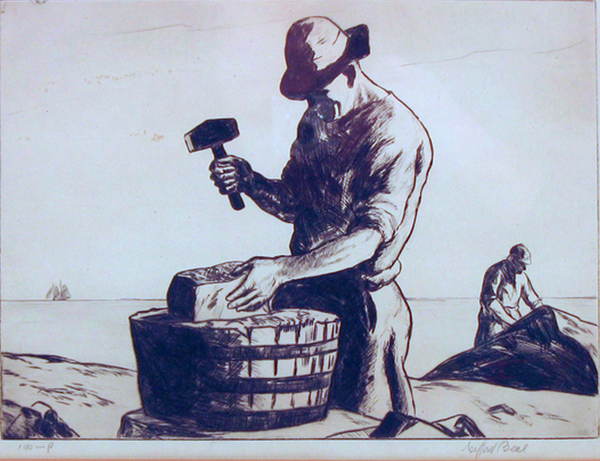
We who cut mere stones must always be envisioning cathedrals.

This was the creed of some medieval quarry workers, which served to remind them of the bigger picture of what their work was accomplishing. To remember that they were not just cutting rocks, but that they were a vital part of a grand and wonderful project which would serve many people and even generations to come – changed their perspective on their work completely.

I think this is applicable to many of us, in whatever field you may find yourself in, and I think it is particularly applicable to Christian service as well.

Martin Luther used this example: In the Lord’s Payer, Jesus instructed his disciples to pray: “Give us this day our daily bread.” Take a moment though to consider how many people and how many jobs are involved in God answering that one prayer: there is a farmer who plants and waters and harvests the grain. There’s a miller, who grinds up the grain to make flour. There’s a person who produces oil. There’s a person who transports the materials. There’s a baker, who takes the materials and bakes them. There is a grocer who sells the bread. And all of these people, as they do their jobs, are all doing the work of God as they are contributing to the answering of this prayer: “Give us this day our daily bread.” (For more on this subject, click here to listen to the message: Soli Deo Gloria)

In other words, the Bible teaches that a person’s daily work is not merely something for them to endure, so they can get on to the “good stuff,” but rather a calling and a summons from God to serve others and to do His work in the world, for His glory. Psalm 147 says that “God feeds every living thing.” How does God do that? Is it not through the farmer, the baker, the retailer, the website programmer, the truck driver, the banker, and everyone else involved in the process? Likewise, Psalm 147 says that God is the one who strengthens and protects a city. And yet it is done through the work of lawmakers and police officers.

If a person keeps this perspective, they will have a much higher view of their work than if they were to only see themselves as “mere quarry workers” or “mere shop workers”, “mere teachers,” “mere artists,” etc. If you can see the vital role that your work plays in a bigger picture and in doing the work of God, it will change the way you view your work, and the attitude with which you approach your work.

This is true in Christian service as well. At White Fields, for example, we have people who serve in many different ministries, from prayer to teaching children, to setting up chairs, to running sound. If a person who sets up chairs sees their ministry as “merely” setting up chairs, they might easily become discouraged. It is important that whatever role they play, they see it as the vital and crucial part of the ministry and the Kingdom of God which it truly is.

“We who cut mere stones must always be envisioning cathedrals.”

How can you apply this to your work and/or ministry today to change your perspective on what you do?

Taking Back the Story of Saint Nicholas

December 6 is the feast day of St. Nicholas. Particularly in Europe, it is celebrated as St. Nicholas Day, and the tradition is to put chocolate and gifts into the children’s shoes for them to find in the morning – a tradition that my wife keeps in our home.

I don’t know if you’ve met them or not, but there are some Christians who think that Santa Claus is evil and that he takes away from the true meaning of Christmas. Not to mention, some would point out, that Santa is nothing more than a misspelling of SATAN, which must be why he goes around in those obnoxious red clothes: because he is from HELL and wants to take you and your kids back there with him!
This of course, is based on a sad lack of knowledge regarding the origin of Santa Claus – the name (in English) being simply a direct derivative of “Saint Nicholas”.

For this reason, some Christians protest anything to do with Santa Claus, and tell their kids that Santa is not real, he is bad, and he takes away from the true meaning of Christmas, which of course is Jesus.

This Christmas season, as we do every year, we will tell our kids the story of the real Saint Nicholas – who was not a mythical fat man in red clothes who rode through the skies on a sleigh pulled by flying reindeer, but a devout Christian man, a pastor, who was persecuted for his faith, and gained fame because of his generosity to the poor and needy.

We don’t avoid Santa Claus – we don’t even want to. We see it as a great opportunity to teach our kids about a great Christian man who loved Jesus and was generous and kind because of the love of God which was in his heart. THAT is the “Christmas spirit”.

We tell our kids that there are many people in the world who want to follow the example of Saint Nicholas, and that is why they will meet a Santa at their school and at the mall – and some of them will have very fake beards, because none of them are the real Saint Nick. We also teach our kids that, as Christians, we want to be like Saint Nicholas too, and we are going to be generous to the poor and needy too because God loved us so much that he gave us his Son, Jesus, so that we could have eternal life and have a relationship with God.

The Story of the Real Saint Nicholas

The real Saint Nicholas was born in the 3rd century in the village of Patara, in what is now southern Turkey, into a wealthy family. That’s right – no North Pole and reindeer for the real Santa, but palm trees and white sand beaches. His parents died when he was young, and he was taken in and raised by a local priest. Following Jesus’ call to the Rich Young Ruler (Mark 10:21) to “sell what you own and give the money to the poor”, Nicholas dedicated to use his entire inheritance to assist the sick, needy and suffering.
He became a pastor, and was later made Bishop of Myra. He became famous for his generosity and love for children.

Nicholas suffered persecution and imprisonment for his Christian faith during the Great Persecution (303-311) under Roman emperor Diocletian.
As a bishop, he attended the Council of Nicaea (325), at which he affirmed the doctrine of the deity of Christ against the Arian heresy.
Nicholas died in 343 in Myra. The anniversary of his death became a day of celebration, the Feast of St. Nicholas, December 6th.

As Christians, we should take back the true story of St. Nicholas

Many stories are told about St. Nicholas’ life and deeds. Perhaps the most famous story is one of a poor man who had three daughters who were of marrying age. Because the man was poor, he was unable to provide a dowry for his daughters, which meant that they would not be able to find a descent husband, and would either be married into further poverty or would have to become slaves. After Nicholas found out about this family’s situation, he visited the family’s house, leaving them 3 anonymous gifts – each time a bag of gold, which was tossed through an open window while the family was sleeping. Legend has it that the gold fell into their shoes, the reason for the tradition in Europe that St. Nicholas leaves gifts in children’s shoes. Nicholas provided for these poor girls to help them break out of the cycle of poverty.

My favorite story about Nicholas is what he did at the the Council of Nicaea, where bishops from all over the world gathered to study the scriptures and address the major doctrinal controversies facing the church. Chief among these was Arianism, propagated by Arius, which denied the full deity of Jesus, saying instead that he was a created being – a view that is carried on today by the Jehovah’s Witnesses. The debate got very heated, and based on the study of the scriptures, Arianism was deemed heretical. Nicholas argued from the scriptures for the deity of Christian and against Arianism, and at one point got so upset with something that was said about Jesus from the other side, that he slapped an Arian. That’s my kind of Santa!

Rather than trying to make Christmas Santa-free, let’s take back the true story of Saint Nicholas and take hold of this opportunity to talk about a Christian man who loved Jesus, championed good theology and exemplified Christ through compassion and generosity to the needy.

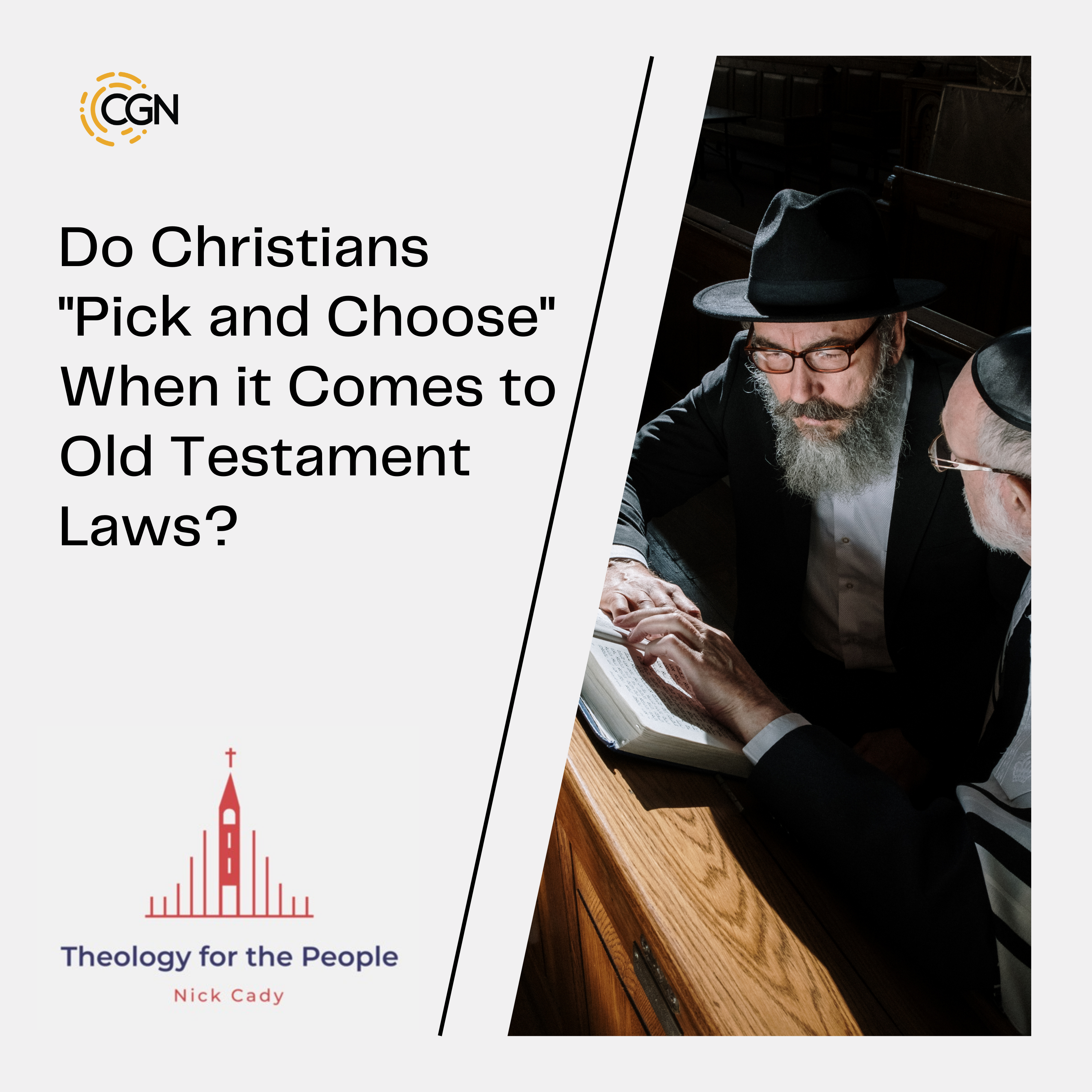
Do Christians Pick and Choose When It Comes to Old Testament Laws?

One of the criticisms that is sometimes aimed at Christians, is that we “pick and choose” from the Old Testament laws, applying some of them to today, and not others. For example, we agree with the command “You shall not commit adultery”, but we seem to ignore other commands, such as the command not to eat pork and shellfish, or not to wear clothing made of fabrics made up of more than one material (i.e. that poly-cotton blend shirt). Why, someone might ask, do Christians say that the commandments about certain sexual behaviors are still applicable, but they don’t say the same about other commandments, such as executing people for breaking the Sabbath? Aren’t they just arbitrarily picking and choosing according to whatever they deem convenient for them?

The answer is: because we must differentiate between the different types of laws in the Old Testament. To do so isn’t arbitrary at all, in fact it is the only faithful way of handling the Old Testament laws.

John Calvin, the 16th-century reformer, pointed out that the New Testament treated the 613 Old Testament laws in three different ways. There were:

  • Civil Laws, which governed the nation of Israel, dealing with behaviors and the punishments for crimes.
  • Ceremonial Laws, about “clean” and “unclean” things, various sacrifices and other ritual practices.
  • Moral laws, which declared what God deemed right and wrong, such as the 10 Commandments.

For the people of Israel, all three types of laws blended together. Breaking a moral law had civil and ceremonial consequences. Breaking a civil or a ceremonial law was a moral problem. These laws went hand-in-hand because Israel was in a unique place historically, being both a nation and a worshiping community. God was their sovereign, their king, their ruler, not only over their worship, but over their entire civil society. They had no concept of “the separation of church and state.” Since that is the case for us today, our relationship to the Law is obviously different.

This helps us to understand what often seems contradictory about the New Testament view of the Law. The New Testament says that Jesus came not to abolish the Law, but to fulfill the Law (Matthew 5:17) and because of what He did in his life, death and resurrection, we are released from the Law (Romans 7:1-6; Galatians 3:25).

Understanding how Jesus is the fulfillment of the Law helps us see why we still look to some of the Old Testament laws to instruct and guide us, and “ignore” others.

The Civil Laws were set up to benefit the nation of Israel. However, we are not bound by the civil codes of the Old Testament because there is no longer a theocratic nation-state on earth. We may wisely glean from some of the principles in Israel’s civil laws, such as those regarding public health, caring for the poor, etc. – but in Christ, we have become a “new nation”, the people of God spread out through every tribe, tongue and nation of the Earth, who are subject to the ruling authorities of our respective countries when it comes to civil laws (see Romans 13:1-7)

Things like not eating shellfish, for example, were incredibly thoughtful and merciful commands in the ancient world, for people who did not have refrigeration and did not understand microbes and bacteria. The same is true of pork. As they submitted to these laws without understanding why God had commanded them or what God’s purpose was with them, even if they might have seemed arbitrary to them at the timethe Jewish people benefited from them. There is certainly a lesson for us in that in regard to obeying God’s commands, even when we don’t understand why He has given them.

The Ceremonial Laws illustrate God’s holiness and our unholiness and the inherent problem that we have in approaching God. As the book of Hebrews shows us, the sacrifices were fulfilled in Jesus’ perfect life and death. He is the final sacrifice, who cleanses us inwardly, not only outwardly, and makes us acceptable before God.

The Moral Laws were fulfilled by Jesus in that He lived a perfect life, free of moral failure. Unlike the civil and ceremonial laws, which were bound to particular times and situations, the moral laws show God’s assessment of good and evil, right and wrong. They reflect God’s character, and since His character doesn’t change, neither do His views on morality. In fact, whenever Jesus talked about the moral laws, he either re-affirmed them or intensified them! (see Matthew 5:21-48).

Thus the reason why Christians “pick and choose” from the Old Testament laws is not at all arbitrary, rather it is faithful to understanding the roles and purpose of the different laws, and it is faithful to the teaching of the New Testament.

For more on the topic of the moral law, read: “Oh, How I Love Your Law” – the Role of the Law in the Life of a Believer is More than Just Showing You that You Need a Savior

“Oh, How I Love Your Law” – the Role of the Law in the Life of a Believer is More than Just Showing You that You Need a Savior

img_20171123_164134

For Thanksgiving I took my family to California to visit family and friends. We drove out; it’s a 15-16 hour drive each way, but this afforded me the chance to listen to 3 audiobooks.

The first was The Sun Also Rises by Ernest Hemingway. Earlier this year I read A Farewell to Arms and loved it, particularly the ending, and how Hemingway is clearly expressing his own wrestling with faith and belief in God. However, The Sun Also Rises was not like that at all. Besides the detailed account of bull fighting, I didn’t really like the book.

The second book I listened to was The Whole Christ by Sinclair Ferguson, on the topic of the Marrow Controversy, a debate which split the Scottish Presbyterian churches in the 18th Century over the topics of legalism and antinomianism (anti – nomos (law) = against the law).

Ferguson points out that legalism and antinomianism are like cousins who are more related to each other than they are to the gospel. The legalist looks to rules and performance to earn status and favor with God. Clearly this is a wrong and unbiblical view. But the other extreme is antinomianism – a rejection, even antagonism towards the Law, i.e. the moral commandments, rules and obligations which the Bible lays out.

The thinking behind antinomianism is that the Law served one purpose: to show us that we are sinners who need a Savior, and once that work is done, we have no further use for the Law, and we should have nothing to do with it in our lives, beyond historical reference.

It is true that the Law serves to show us that we are sinners who have not lived up to God’s perfect standards, and therefore we need a Savior. Romans and Galatians make this point crystal clear. But is this the only function of the Law in the life of a believer? The answer is: No.

So then what is the role of law in the life of a believer – one who has been set free in Christ – beyond just showing us that we are sinners who need a savior?

1. The Law points us to Christ as the Fulfiller of the Law

The Bible is full of moral principles and injunctions towards things like kindness, compassion, honesty, forgiveness, generosity, humility, etc. The problem is that very often we read these (or teach them) without reference to Christ. Paul writes in Galatians 3:24 “So then, the law was our guardian until Christ came, in order that we might be justified by faith.”  The Law shows us that we are sinners who desperately need a Savior. But, we see the perfect fulfillment of the Law in Christ—and only in Him! The Law points us to Christ not only by condemning us for breaking it, but by pointing to Christ who is the fulfillment of it! Jesus said: Do not think that I have come to abolish the Law or the Prophets; I have not come to abolish them but to fulfill them. (Matthew 5:17)

2. The Law Reveals God’s Character and Shows His Glory

The Law reveals the Glory of God, by showing us His holiness, how He is “other”, different, perfect and good. Where we fall short, He does not.

The Law leads us to reverence and worship of a God who is greater than us. This leads us to a posture of humility before God. 

Humble yourselves before the Lord, and he will lift you up. (James 4:10)

3. God’s Law is a playbook for the redeemed person to use in bringing Him pleasure

We ought not look to God’s moral injunctions as the means by which to garner His love or favor, nor as a way of earning or meriting anything from Him. But for the redeemed person, the Law becomes a playbook in our hands, which tells us what God likes and dislikes – and therefore how we, as people who love God, can bring joy and pleasure to His heart.

I recently taught a class at White Fields’ School of Ministry on the Minor Prophets. The last book, Malachi, talks a lot about obeying God by keeping His law, and specifically talks twice (in only three chapters) about tithing. The question I asked the students was: What is the role of keeping God’s Law, and specifically of tithing, for the New Testament believer?

The answer was that, as people who don’t relate to the Law as a means of earning or meriting anything from God, we approach it as a playbook which instructs us about what God loves and hates, and therefore helps us to respond in love to Him who has poured out His love in our hearts by the Holy Spirit and redeemed us from the pit and set us on a rock in Christ. When we obey His moral instructions and commands, it doesn’t make Him love us more, but it is a way that we can bring Him joy and pleasure.

May we not become antinomian in our view of the Law, but may we see it for the good and glorious thing that it is, and say with the Psalmist: “Oh, how I love your Law!” (Psalm 119)

The Role of Doubt in Faith

“For most people who reject Christianity, their reasons for doing so are not usually intellectual, they’re personal.”

The book of the Bible called “The Letter to the Hebrews” was written to people who were discouraged, to the point of giving up. The reason? Because they didn’t see anything happening. They had put their faith in a God who loved them and cared about them, in a God whom they had been assured would hear their prayers when they called out to him, and yet their lives were characterized by frustration and difficulty.

Probably they knew that the promised salvation didn’t guarantee them a problem-free life – but they wondered: If God is good and loves me, then why are these bad things happening to me? They were struggling with doubt. They were weary and discouraged. And because of this, some of them were thinking of backing off of Christianity, or even turning their backs on it completely.

I’ve heard it said before that for most people who reject Christianity, their reasons for doing so are not intellectual (like not believing in the supernatural), they are personal. Something happened in their life which deeply hurt them or which they are frustrated with and can’t understand, and they wonder: Why? If there’s a supposedly a God who loves and cares about me, then why doesn’t he do more to make my life better?

There is a powerful statement found in the short New Testament letter of Jude:

“Have mercy on those who doubt.” – Jude 1:22

You can see that this is how God treats people who doubt as well. Think of Gideon, whom God called to do something, but then Gideon asked for a sign. Once he got the sign, he still wasn’t satisfied, so he asked for another sign! Rather than being a good practice that we should follow, Gideon’s requests for signs was essentially a lack of faith in God and his word, and yet – God was merciful towards Gideon.

Doubt is an inherent part of faith. If we could see everything, there would be no need for faith, but because we don’t see, we must have faith, and implicit to faith is doubt. Doubt is not necessarily the enemy of faith, it can actually be something that strengthens faith – but, there are different kinds of doubt: there is an honest form of doubt, which wants to believe but honestly struggles with some questions, and there is a cynical kind of doubt which says, “Don’t bother me with the facts, I’ve already made up my mind not to believe.”

In Timothy Keller’s book The Reason for God: Belief in an Age of Skepticism, he writes:

A faith without some doubts is like a human body without any antibodies in it. People who blithely go through life too busy or indifferent to ask hard questions about why they believe as they do will find themselves defenseless against either the experience of tragedy or the probing questions of a smart skeptic. A person’s faith can collapse almost overnight if she has failed over the years to listen to her own doubts, which should only be discarded after long reflection. Believers should acknowledge and wrestle with doubts—not only their own, but their friends’ and neighbors’.

But even as believers should learn to look for reasons behind their faith, skeptics must learn to look for a type of faith hidden within their reasoning. All doubts, however skeptical and cynical they may seem, are really a set of alternative beliefs. You cannot doubt Belief A from a position of faith in Belief B. For example, if you doubt Christianity because ‘There can’t be just one true religion,’ you must recognize that this statement is itself an act of faith. No one can prove it empirically, and it is not a universal truth that everyone accepts. If you went to the Middle East and said, ‘There can’t be just one true religion,’ nearly everyone would say, ‘Why not?’ The reason you doubt Christianity’s Belief A is because you hold unprovable Belief B. Every doubt, therefore, is based on a leap of faith.

So, not only is doubt normal and even healthy (if handled properly), but all forms of doubt are based on faith and belief in something. May we be those who not only wrestle with questions and come to a stronger, more robust faith – but may we be those who doubt our doubts, and help others to do the same!

The Empty Soul

This past Sunday we finished the 5 Solas series at White Fields with our study of Soli Deo Gloria (to the glory of God alone) – click here to listen to that message. Something I learned through preparing for this study, is that for the Reformers, Soli Deo Gloria referred specifically to their view of work: that everything a person does, not just work in and for the Church, can be service to God. They rightly elevated the place of work – and all God-honoring, people-benefiting work – to its biblical place of significance and importance. This doctrine went hand in hand with the teaching of “the priesthood of all believers.”

Here is an excerpt from Luther’s article “To the Christian Nobility of the German Nation” on this topic:

It is pure fiction that Pope, bishops, priests, and monks are called the “spiritual estate” while princes, lords, artisans, and farmers are called the “temporal estate.” This is indeed a piece of deceit and hypocrisy. Yet no one need be intimidated by it, and that for this reason: all Christians are truly of the spiritual estate, and there is no difference among them except that of office. . . . We are all consecrated priests by baptism, as St. Peter says: “You are a royal priesthood and a priestly realm” (1 Pet. 2: 9). The Apocalypse says: “Thou hast made us to be kings and priests by thy blood” (Rev. 5: 9– 10).

As I was preparing for this message last week, I came across something interesting written by Dorothy Sayers, who has written a lot on the topic of the integration of faith and work.

While the biblical view of work is that it is good and part of God’s good design for us as human beings, there are certainly some pitfalls that we can fall into in regard to how we see our work. If we look to our work to “make a name for ourselves” – rather than looking to God to receive our “name” (identity, status, value) from him, then we will inevitably have an unhealthy, and destructive, relationship with our work.

Dorothy Sayers, in Creed or Chaos?, points out that there is a common misunderstanding about the meaning of “sloth” or “slothfulness” – one of the traditional seven deadly sins. Usually, we tend to think of sloth as laziness, but the Greek word Acedia means more of a life which is consumed only with cares about oneself.

Acedia is the sin which believes in nothing, cares for nothing, enjoys nothing, loves nothing, hates nothing, finds purpose in nothing, lives for nothing and only remains alive because there is nothing for which it will die. We have known it far too well for many years, the only thing perhaps we have not known about it is it is a mortal sin.

She goes on to say that because a person characterized by acedia only cares about their own needs, interests and comforts, they might not necessarily be lazy at all. They might seem quite driven, in fact. She says though that acedia is “the sin of the empty soul.”

We think that if we are busily rushing about and doing things we cannot be suffering from Sloth. Gluttony offers a world of dancing, dining, sports, and dashing very fast from place to place to gape at beauty spots. Covetousness rakes us out of the bed at an early hour in order that we may put pep and hustle into our business; Envy sets us to gossip and scandals, to writing cantankerous letters to the paper, and to the unearthing of secrets and scavenging of desk bins; Wrath provides the argument that the only fitting activity in a world so full of evil doers and evil demons is to curse loudly and incessantly, while Lust provides that round of dreary promiscuity that passes for bodily vigor. But these are all disguises for the empty heart and the empty brain and the empty soul of Acedia. In the world it calls itself Tolerance but in hell it is called Despair.

Timothy Keller, referring to Sayers’ writings on Acedia in his book Every Good Endeavor, points out that Acedia is really misdirected passion. It is passion that only cares about oneself, but true passion – like the Jesus’ Passion – is passion for the good and well-being of others.

Jesus said: For whoever wants to save their life will lose it, but whoever loses their life for me and for the gospel will save it. (Mark 8:35)

To live for yourself, caring for your own needs, interests and comforts, will leave you with an empty soul – but to give your life in service to God and others in response to the gospel will leave you with a soul that is full to overflowing. Jesus emptied Himself for you, but in doing so, His heart was full! May He empower us to live that way as well!

Martin Luther on Music and Song Writing

One of Luther’s great contributions to Christianity was that he pointed out that much of the common thinking about Christian living and attitudes comes from Plato and Aristotle, rather than from the Bible.

Plato, for example, was a dualist – who viewed the physical world as inherently bad, and the unseen spiritual world as inherently good. Therefore, Plato taught that physical pleasure should be avoided; it was better to live a life of suffering and eschew pleasure in order to be more spiritual. This thinking worked its way into Christianity, to the point where things intended by God to be blessings for our enjoyment were rejected and forbidden. One such area was music.

Augustine of Hippo had written about music in the 5th century, stating that he was “troubled in conscience whenever he caught himself delighting in music.” Luther, who greatly looked up to Augustine, responded by saying: “I have no use for cranks who despise music, because it is a gift of God.” He went on to say, “Next after theology I give to music the highest place and the greatest honor,” and “next to the Word of God only music deserves to be extolled as the mistress and governess of the feelings of the human heart.”

“Next after theology I give to music the highest place and the greatest honor.”

“Next to the Word of God only music deserves to be extolled as the mistress and governess of the feelings of the human heart.”

Luther is the one who introduced, or at least re-introduced congregational singing to the church. It may be hard to imagine, but until Luther brought singing to the church, there had been no such thing for at least several hundred years, if not more. Furthermore, the fact that there is congregational singing in Catholic churches today is directly because of Luther, and most hymns sung in the Roman Catholic Church today were written by Protestants.

Luther also believed that music was a great tool for teaching spiritual truths. He wanted to put good doctrine into congregational songs to reinforce the teaching that was coming from the pulpit. Luther wrote many hymns himself, but he also reached out to others for help. In a letter to his friend Georg Spalatin in 1523, Luther wrote:

Our plan is to follow the example of the prophets and the ancient fathers of the church and to compose songs for the people in the vernacular, that is: spiritual songs so the Word of God may be among the people also in the form of music. Therefore we are searching everywhere for poets. Since you are endowed with a wealth of knowledge and elegance in the German language, and since you have polished it through much use, I ask you to work with us in this project.

I would like you to avoid any new words or the language used at court. In order to be understood by the people, only the simplest and most common words should be used for singing; at the same time, however, they should be pure and apt; and further, the sense should be clear and as close as possible to the [Bible]. You need a free hand here; maintain the sense, but don’t cling to the words; [rather] translate them with other appropriate words.

Furthermore, unlike Zwingli in Zürich, who forbade the use of musical instruments, Luther encouraged the use of musical instruments in church.

Martin Luther not only introduced music back into the church, but he defined the parameters of what makes for good Christian church music.

Sola Scriptura: All Scripture is Breathed Out by God

Yesterday we began a 5-week series at White Fields in which we are looking at the 5 Solas of the Reformation: the slogans that the Reformers used to summarize their core beliefs:

  • Sola Scriptura (Scripture Alone)
  • Sola Gratia (Grace Alone)
  • Sole Fide (Faith Alone)
  • Solus Christus (Christ Alone)
  • Soli Deo Gloria (To the Glory of God Alone)

We started by looking at the first of these: Sola Scriptura.

sola_scriptura__artwork__dark-01

Sola Scriptura means: the Bible alone is our highest authority.

Martin Luther and the other Reformers found themselves in a situation, where – having read the Bible, they discovered that many practices and teachings of the church in their time were actually in direct opposition to the clear teaching of the Bible – particularly on the issues of absolution of sin and justification.

This is what led to Martin Luther’s famous statement at the Diet (Congress) of Worms:

Unless I am convinced by the testimony of the Scriptures or by clear reason (for I do not trust either in the pope or in councils alone, since it is well known that they have often erred and contradicted themselves), I am bound by the Scriptures I have quoted and my conscience is captive to the Word of God. I cannot and will not recant anything, since it is neither safe nor right to go against this knowledge. May God help me. Amen.

Sola Scriptura does not mean that we reject other sources of truth and wisdom, nor that we reject or ignore tradition. To do so would not only be foolish, but it would be ignorant of the fact that the very way that we got the canon of Holy Scriptures that we now have was in large part by God working through reason and tradition to transmit the Scriptures to us.

What Sola Scriptura means is that when it comes to what we believe and how we live, there is no higher voice, no greater authority than the Holy Scriptures, and everything must by judged by them.

So, if church councils say one thing, but the Bible says another: Who wins?  The Bible does. If our culture and society says one thing, but the Bible says something else, then who do we believe?  Who do we submit to?  The answer is: the Scriptures.

Did the New Testament Writers Know They Were Writing Scripture?

2 Timothy 3:16 says: All Scripture is breathed out by God and profitable for teaching, for reproof, for correction, and for training in righteousness

What Scriptures are being referred to here?

Obviously it is referring to the Old Testament scriptures, but interestingly, this comes from 2 Timothy, the last letter which Paul wrote, at the end of his life. By this time — almost all of the books that we have in our New Testaments had already been written, and were being distributed amongst the Christians, to be read and studied in their churches.

So, when Paul says, “All Scripture” — he’s not just talking about the Old Testament, he’s also talking about the New Testament!

In the New Testament, what you find is that the Apostles understood that God was using them in their time to bring about a New Testament of Holy Scriptures, by the inspiration of the Holy Spirit.

Here are a few examples:

  • In 2 Peter 3:15-16, Peter refers to the writings of Paul as “Scriptures”
  • In 2 Thessalonians 2:13, Paul referred to his own message as “the word of God”
  • In 1 Timothy 5:18, Paul takes a quotation from the Gospel of Luke – and he calls it “Scripture” (Luke 10:7)
  • In some of his letters, Paul instructs the recipients to distribute his letters and have them read in the churches. (Colossians 4:16, 1 Thessalonians 5:27)

What Paul is telling Timothy in this text is to stick to the Scriptures, because they come from God, not from man.

The Bible is not only inspired in the sense that it is like a great work of art that we might say is “inspired” – but it is inspired in the greater sense, that the words it contains were breathed by God Himself!

What that means is that the Bible is no ordinary book — it is the very word of God to us, and therefore it alone is worthy to be the highest authority in our lives.

Take Joy in Being the People of God

Last night I went to an event where author Eric Metaxas was speaking about his new book, a biography of Martin Luther. It was held at a church in Greenwood Village, and after speaking for about an hour about Luther and the writing of the book, he answered questions and then signed books.

IMG_20171024_194254.jpg

During the Q&A time, Metaxas said a few things which I thought were particularly powerful. The question was one about how Christians should always be reforming the church. Eric responded by saying that: yes, the Reformation must always continue, but in his opinion, oftentimes the church is too critical of the church. That Christians spend a lot of time deriding Christians and bemoaning the church, when in fact we should find an immense amount of joy in being the people of God who are called to take the message of God’s grace and love into the world. This is something we should revel in!

He went on to say that he grew up in the secular culture, and that for him – he saw the church as a living connection to God. When you’re drowning and someone throws you a rope, he said, it may be an imperfect rope, but it is a rope nonetheless, and rather than focusing on its flaws, you are thankful for the rope!

Metaxas went on to point out that the cultural elites in our day all speak the same language of secular humanism, and they together have collectively agreed that Christianity is old fashioned, obsolete and passé – and too often, we as Christians bow down to that and say: ‘Yeah, you’re right,’ and we shrink back into the shadows or retreat into an insular Christian sub-culture. Instead, we should stand in confidence as the people of God, with the truth of God, and use all avenues available to us to bring God’s truth and the message of the gospel into our society.

Eric has done this very well with his radio program and his books, which are published by a mainstream publisher (Viking Books) and several of which have made the New York Times bestseller list. He has a unique perspective on the church, having become a Christian later in life, studying at Yale and living in New York City, none of which are generally considered particularly friendly towards Christianity. He has been a good steward of the gifts that God has given him and has become an important and influential voice in our society, heralding the gospel as he can.