

The Prodigal Mom: What Eunice and Lois Teach Us About Motherhood

remembering_mothers_shutterstock_1600x500

In his second letter to his protégé, Timothy, Paul mentions Timothy’s mother and grandmother, who played a formative role in his life and his faith:

I am reminded of your sincere faith, a faith that dwelt first in your grandmother Lois and your mother Eunice and now, I am sure, dwells in you as well. (2 Timothy 1:5)

Timothy’s mother and grandmother are also alluded to in the third chapter of that same letter:

But as for you, continue in what you have learned and have firmly believed, knowing from whom you learned it and how from childhood you have been acquainted with the sacred writings, which are able to make you wise for salvation through faith in Christ Jesus. (2 Timothy 3:14-15)

Here’s what we know about Timothy’s mother and grandmother:

Eunice Wasn’t Always a Woman of Faith

Timothy’s mother was Jewish, but Timothy’s father was a Greek pagan, and as a result, Timothy was not circumcised (Acts 16:1-3). This tells us two things: that at the time of their marriage, and during Timothy’s early years, his Jewish mother was not practicing her faith. Married to a Greek, she would have been “unequally yoked”, and going against Jewish custom and God’s instructions in the Old Testament that Jewish people should not marry people of other faiths.

Perhaps more interesting, is that “Jewishness” is passed down through the mother, and yet the fact that Eunice never had Timothy circumcised indicates that she was not actively practicing her faith during his childhood.

However, what we know is that Eunice at some point became a Christian and joined the church in Lystra. Paul met Timothy on his second missionary journey when he visited the church there. Timothy was likely in his teens at the time, and Timothy then left home to join Paul in his missionary work.

Eunice: A Single Mom?

The fact that we don’t know much about Timothy’s father, and the fact that his grandmother played an active role in his upbringing could indicate that Timothy’s father died or left at some point, leaving Eunice a single-mom raising her son. At very least, it seems that Timothy’s father was not involved in his spiritual upbringing since only his mother and grandmother are mentioned as contributing to his faith by acquainting him with the Holy Scriptures.

Lois as the Mom of a Wayward Daughter

We can only imagine what must have gone on in Lois’s (Timothy’s grandmother’s) life in regard to her daughter Eunice marrying an unbelieving Greek pagan. Perhaps she grieved to see her daughter not living out the faith that she had raised her to have in the God of Israel, or perhaps Lois herself had been a nominal or non-practicing Jew and had raised her daughter in that same way.

Either way, we know that Lois also came to put her faith in Jesus, and then together Lois and Eunice poured into young Timothy, introducing him to the Scriptures, taking him to church, and sharing their faith with him.

The Best Gift Mothers and Grandmothers Can Give Their Kids

We don’t know what kinds of birthday presents Lois and Eunice gave young Timothy, or if they ever took any family vacations, or if they ever bought Tim a pony or an iPhone. The one thing we know is that they gave him the most important gift a mother and grandmother can give to their children and grandchildren: a knowledge of the Word of God, and a heritage of modeling what it looks like to love him, obey him and seek him. This is what changed the trajectory of Timothy’s life.

On this Mother’s Day, may I encourage you mothers and grandmothers that whatever good gifts you give your children and grandchildren, the very best gift you can give them is to point them to Jesus.

Teach them the Word of God. Present Jesus to them in all of his goodness and beauty. Explain to them how you came to surrender your life to him, and why you love him. Help them to see Jesus and his gospel as the most desirable, wonderful, source of joy and hope – as he indeed is!

Video: Christianity and Politics

“The Gospel is an inherently political message.”

See what we mean by that in this episode in which Mike and I have a discussion about Christianity and politics, and we consider some guiding principles for how Christians should view and engage with this often polarizing and divisive topic.

I’d love to hear your thoughts on this subject, so please leave a comment below.

You can also listen on Soundcloud, and don’t forget to subscribe to our channel on YouTube and Soundcloud so you’ll be able to get new content when it comes out.


Is There a Moral Argument for the Existence of God?

Many people ask the question: Can you prove there is a God?

The answer to that question is: there are many proofs of God’s existence. Taken together, these arguments from cosmology, morality, design, etc. come together to form a very strong case for the fact that God exists.

Check out this video, in which Mike and I discuss the moral argument for God.

For more on this topic, check out yesterday’s post: David Silverman, American Atheists and the Attempt to be Good Without God

David Silverman, American Atheists and the Attempt to be Good Without God

Last week American Atheists issued a statement that they had fired their firebrand president of many years, David Silverman, as a result of moral failure.

In an interview, a spokesperson for American Atheists stated that Silverman was dismissed because of an issue regarding promotion of a recent book, as well as for a conflict of interest issue where he promoted a girlfriend to a high level position. It then came out that there were accusations of sexual misconduct with two other women who had come out to the media. Right before that story broke, American Atheists’ board quickly met to dismiss David Silverman.

The thing which is most intriguing about the statement from American Atheists is the closing sentence:

We have zero tolerance for the type of behavior alleged in these accounts. We will continue to demand the highest standards and accountability from our leaders, staff, and volunteers.

This brings up several very important issues:

If morality has no basis, then it is only opinion.

In the above statement, they mention demanding “the highest standards”. What are those standards, and how do they determine them?

The idea that people can be good without God is a major tenant of modern popular humanism and atheism. Many atheists would suggest that their ability to be good without God shows that they have more inner fortitude than “religious” folks, because they don’t need to have a threat of punishment over them in order to coerce them into good behavior.

Christians who understand the gospel are actually willing to agree with this in one sense. Belief in God does not automatically mean that a person will be morally superior to those who do not believe in God. It should not surprise Christians to find atheists or people who follow other religions who are honest, hard-working, kind people. After all, people do not become Christians by their moral effort but by their trust in God’s gracious work on their behalf.

The question is: is morality an innate thing, which people intuitively know, or is it a social construct?

Most prominent atheist thinkers argue that it is a social construct. As I have written about before – see “Why Ethics Depends on Origin” – prominent atheist writers say that ethics are not based in reality, they are social constructs which help our society to function better.

But what about when they don’t?

For example, eugenics (the science of improving a human population by controlled breeding to increase the occurrence of desirable heritable characteristics) might actually help our society function better. If we were to abort all babies who were seen to have disabilities, if we were to forcibly end the lives of those who are a drain on society, then wouldn’t that be a benefit to society? That’s what the Nazis and others in the 19th and 20th Centuries suggested… And yet people push back against that and say it is wrong. Why? If morals are not actually based in reality but only exist to help society, then why not take that thought to its logical conclusion?

The reason is because:

Nobody believes that morality is only a matter of opinion.

The idea that morality is a social construct brings up other big questions, such as: what if my morality is different than your morality?

For example, David Silverman has denied any wrongdoing in regard to the above mentioned allegations. Essentially, he is saying that he thinks the things he did were just fine. In other words, the idea that he did something wrong is just the company’s opinion.

It could be argued that male-initiated, non-consensual sex is practiced regularly in some cultures of the world. So, they can’t really say that what he did was wrong, only that they didn’t like it.

The problem is: nobody actually believes that. We all believe that rape, murder and the like are wrong. Even with people, like David Silverman, who claim that nothing is wrong with what he did, others look at it and say: That’s wrong – and it’s not just our opinion, it’s just flat out wrong.

Mark Clark puts it this way:

We do believe in right and wrong. We believe hurting a child is wrong. We believe raping and pillaging the environment is wrong. We believe all races should be equal. That there is such a thing called justice that tells us mercy is better than hate. That loyalty is a virtue, and that there is evil in the world. All of these convictions give meaning to our lives, but if there is no absolute right and wrong, all of them go away; they are but a mirage. Meaningless. Weightless. Worth abandoning with every other construct of modernity.

Case Study: The Sexual Revolution vs. the Vietnam War

Take the 1960’s and 1970’s for example: On the one hand, there was a “sexual revolution” in which people were saying “No one can tell me what to do with my body, don’t try to impose your moral standards on me.” And yet, those same people protested the Vietnam War by saying that it was unjust and immoral because of the use of bombs and napalm.

They didn’t want anyone to impose a moral standard (regarding sex) on them, but they didn’t think twice about trying to assert their moral standard (regarding war and napalm) on others. They said on the one hand that morality is subjective, and in the next breath they said that there is a morality which everyone should accept as normative.

Case Study: Arguments

CS Lewis begins Mere Christianity by talking about the topic of: arguments.

“That’s my seat, I was there first”—“Leave him alone, he isn’t doing you any harm”—“Why should you shove in first?”—“Give me a bit of your orange, I gave you a bit of mine”—“Come on, you promised.” People say things like that every day, educated people as well as uneducated, and children as well as grown-ups. Now what interests me about all these remarks is that the man who makes them is not merely saying that the other man’s behavior does not happen to please him. He is appealing to some kind of standard of behavior, which he expects the other man to know about. . . . It looks, in fact, very much as if both parties had in mind some kind of Law or Rule of fair play or decent behavior or morality or whatever you like to call it, about which they really agreed.

So, then – if morality is not merely a social construct, but is actually something we intuitively or innately know, then:

Morality points us to the existence of God.

The idea that there are some things that are right and some things that are wrong points us to the fact that there is a design. If there is a design, there must be a designer.

If there is a moral rule or standard, then there must be something or someone which determines this standard.

The Bible explains this point in this way:

“For when Gentiles, who do not have the law, by nature do what the law requires . . . they show that the work of the law is written on their hearts, while their conscience also bears witness” (Romans 2:14–15).

The fact that we are repelled by things such as sexual misconduct, lying and cheating, and that we advocate for equal treatment of all people regardless of their race, economic level, gender or physical ability – all those things things point to something beyond what is simply natural. They are proof of the fact that the heart of God is stitched into our very being.

Easter Math: How Does it Add Up?

Have you ever wondered why the date of Easter changes every year?

Have you ever wondered how it can be that Jesus was in the grave for three days and three nights if he was crucified on a Friday and rose on a Sunday?

How does the Jewish Passover Week correspond with Jesus’ final week leading up to his crucifixion?

Check out this video in which Mike and I discuss these questions!  (Hint: Good Friday is indeed good, but it wasn’t a Friday…)


Is Good Friday Actually “Good”?

thebible-crucifixion-630-jpg_225818

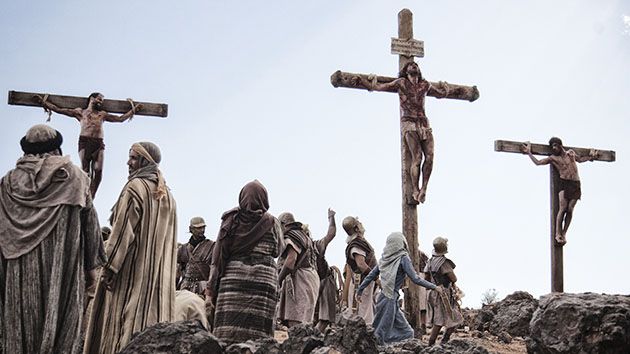
This is the day on which we celebrate the death of an innocent man – and not just any man: the greatest man who ever lived. It is the day when we remember that the Light of the World was overcome by darkness; that the Savior of the World was murdered by those He came to save.

Why in the world would we call this day “Good Friday”?

John Stott put it this way:

“The essence of sin is that we substitute ourselves for God; we put ourselves where only God deserves to be … that’s the essence of sin. But the essence of salvation is that God substitutes himself for us; God puts himself where we deserve to be … that’s the essence of salvation.”

2 Corinthians 5:21 says: “For our sake he (God) made him (Jesus) to be sin who knew no sin, so that in him we might become the righteousness of God.”

In this verse we see what it is that makes Good Friday so incredibly “good”. It is something we call “imputation”, and it has two sides: On the cross, God imputed your flawed record to Jesus, so that He could impute Jesus’ perfect record to you. On the cross, God treated Jesus as if he had lived your life, so he could treat you as if you had lived his life.

Jesus’ act of substitution, God’s act of imputation – lead to our reconciliation with God.

And the way to receive this gift of God’s grace, the Bible tells us, is to “receive him, who believe in his name.” (John 1:12) This kind of belief isn’t merely to believe that it happened, but to believe it personally, in the sense of trusting in it, relying on it, and clinging to it.

If you do that, then today will indeed by a Good Friday for you!

Longmont Pastor Video Blog – Episode 4: The Trouble with Christianity Is…

In last week’s episode we discussed common hurdles that people in our society face when it comes to believing and embracing Christianity.

Check out the video and then help us spread the word by giving the video a like and sharing it on your social media or sending it directly to some friends. Follow us on YouTube or Vimeo and Soundcloud.

Longmont Pastor Video Blog – Episode 3: Is Christianity in Decline?

Every week we are releasing new episodes of the Longmont Pastor Video series. Last week we discussed the topic of whether or not Christianity is in decline in our society and around the world.

You can help us spread the word by giving the video a like and sharing it on your social media or sending it directly to some friends. Follow us on YouTube or Vimeo and Soundcloud.

For email and WordPress subscribers, click here to see the video.

What Sets Christians Apart? – An Ancient Summary

education_05_0_temp-1509265699-59f59123-620x348

The Letter to Diognetus dates to sometime in the 2nd Century (approx. 130-180 AD), and is one of the earliest examples of Christian apologetics outside of the Bible. Apologetics is the practice of giving a defense of, or an explanation of, one’s faith for those who have questions or doubts.

The letter, whose author and recipient are unknown, gives us a glimpse into life and thought of early Christians as well as the way that people in their communities viewed them and thought of them.

Here is an excerpt from Chapter 5, on the topic of what sets Christians apart from others in society:

Christians are not distinguished from other men by country, language, nor by the customs which they observe. They do not inhabit cities of their own, use a particular way of speaking, nor lead a life marked out by any curiosity. The course of conduct they follow has not been devised by the speculation and deliberation of inquisitive men. The do not, like some, proclaim themselves the advocates of merely human doctrines.

Instead, they inhabit both Greek and barbarian cities, however things have fallen to each of them. And it is while following the customs of the natives in clothing, food, and the rest of ordinary life that they display to us their wonderful and admittedly striking way of life.

They live in their own countries, but they do so as those who are just passing through. As citizens they participate in everything with others, yet they endure everything as if they were foreigners. Every foreign land is like their homeland to them, and every land of their birth is like a land of strangers.

They marry, like everyone else, and they have children, but they do not destroy their offspring.

They share a common table, but not a common bed.

They exist in the flesh, but they do not live by the flesh. They pass their days on earth, but they are citizens of heaven. They obey the prescribed laws, all the while surpassing the laws by their lives.

They love all men and are persecuted by all. They are unknown and condemned. They are put to death and restored to life.

They are poor, yet make many rich. They lack everything, yet they overflow in everything.

They are dishonored, and yet in their very dishonor they are glorified; they are spoken ill of and yet are justified; they are reviled but bless; they are insulted and repay the insult with honor; they do good, yet are punished as evildoers; when punished, they rejoice as if raised from the dead. They are assailed by the Jews as barbarians; they are persecuted by the Greeks; yet those who hate them are unable to give any reason for their hatred.

This poetic and beautiful description of Christian lifestyle encourages me and challenges me to want myself, my family and my church to be seen as a counter-cultural community  with convictions, who are for the community where we live because God so loved the world and He has poured his love into our hearts by the Holy Spirit.

The rest of the letter is also worth reading, particularly Chapters 6 & 9, the latter of which talks about the doctrine of justification.

You can read the letter in its entirety here.


Longmont Pastor Video Blog – Episode 1

Starting today, every Wednesday we will be dropping a new episode, in which we will be covering some of the topics addressed here on the blog, as well as others topics and interviews with guests about topics relevant to life, culture and the gospel.

Check out Episode 1: The Role of the Law in the Life of the Believer, and follow us on YouTube or Vimeo and Soundcloud.

You can help us spread the word by giving the video a like and sharing it on your social media or sending it directly to some friends.

Here’s the video (email and WordPress subscribers click here):

Thanks to Ocean Babin for all his hard work recording and editing this video, as well as to CryBaby Design for the great background image. We also want to thank Nick Morris Sound Services for making the music for the intro!

For the content mentioned in this video, check out these posts: