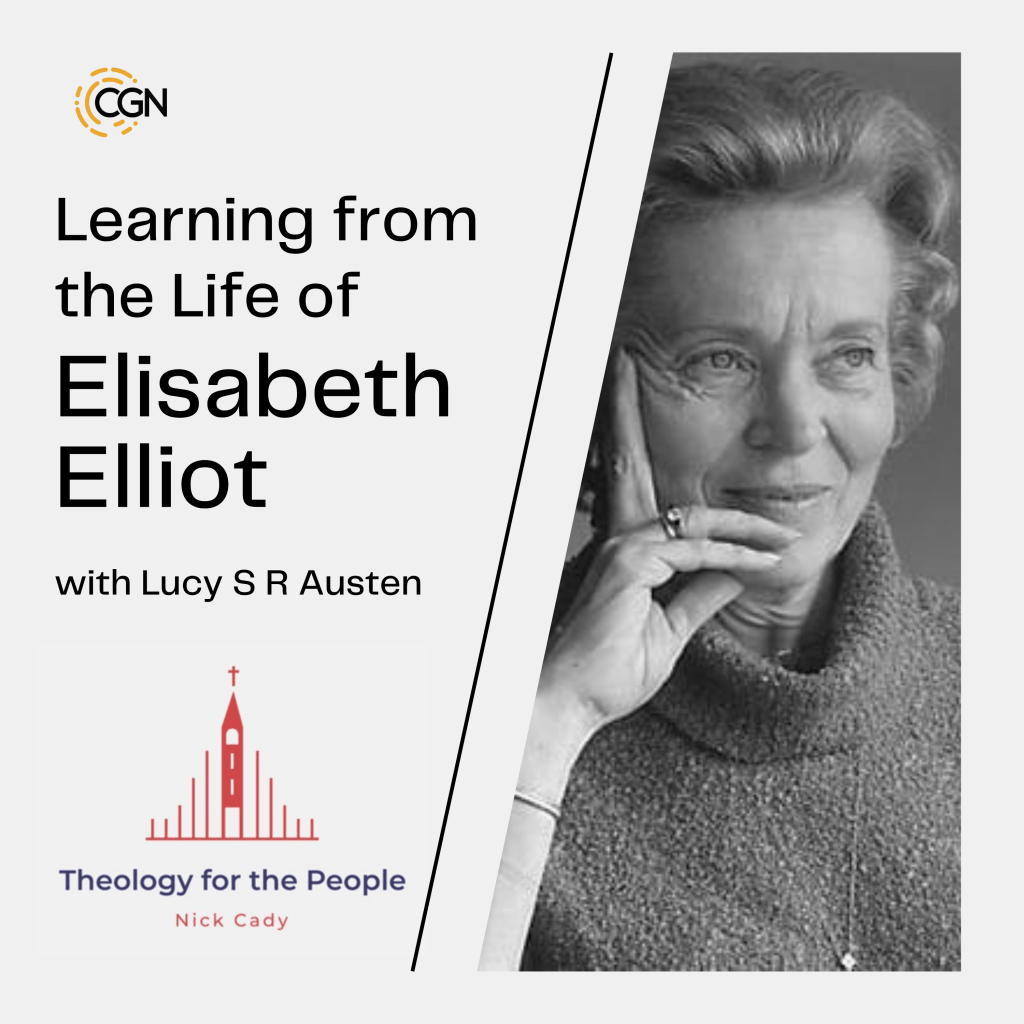
Elisabeth Elliot was one of the most well-known and influential figures of the late 20th century, and early 21st century, both in evangelical circles, but also in the culture at large.
On this episode Lucy and I speak about who Elisabeth Elliot was and the influence she had.
As Lucy points out, Elisabeth Elliot was a sometimes controversial figure, who changed her views on things throughout her life, and her life reflects much of the history of evangelicalism in the 20th century.
Elisabeth Elliott was one of the most well-known and influential figures of the late 20th century, and early 21st century, both in evangelical circles, but also in the culture at large. Recently a biography of her life was written by Lucy S R Austen, and published by Crossway Publishing, titled Elisabeth Elliot: A Life.
On this episode of Theology for the People, I speak with Lucy S R Austen about who Elisabeth Elloitt was and the influence that she had. As Lucy points out, Elisabeth Elliot was a sometimes controversial figure, who changed her views on things throughout her life, and her life reflects much of the history of evangelicalism in the 20th century.
Visit the Theology for the People website at nickcady.org
A few weeks ago, I was sitting in the car with my kids on a family trip, and my teenage daughter asked me, “Dad, why is it wrong to be gay?”
I responded that, first we needed to discuss what she meant by “gay”; did she mean: “Is it a sin to feel attraction to people of the same sex?” or did she mean, “Is it a sin to perform sexual activities with people of the same sex?” – because those are two very different questions, which have two different responses from the Bible.
She clarified by saying, “Well, why is it wrong for two people of the same sex to be in love?”
I responded, “The Bible encourages people of the same sex to love each other. We are all called to love everyone God puts in our path, but that certainly doesn’t mean that we are to have sex with everyone God puts in our path.” “For example, the Bible says that David loved Jonathan more than he loved any woman. But that doesn’t mean that they performed sexual acts together; rather that they had a close and intimate friendship. In other words, when we reduce ‘love’ down to sex, we are cheapening it. Further, the Bible’s vision is for people of the same sex to have meaningful, loving friendships, but that’s different than having sex with someone.”
She clarified once again, “Why is it that people of the same sex can’t have romantic relationships?”
I responded, “What do you mean by romantic? Are you talking about an exclusive relationship which is characterized by touching of a sexual nature?”
At this point, she said, “Okay, I get it,” and we changed the subject.
My daughter did not ask these questions from a heart of rebellion against God, but out of genuine curiosity and interest, and because she has sincere questions. Certainly the questions she asked were shaped by the cultural influences she faces at school and in the world in general. You can imagine people asking her these questions, and her wondering how to respond. As a father, I’m glad she asked me, and gave me the chance to help her understand.
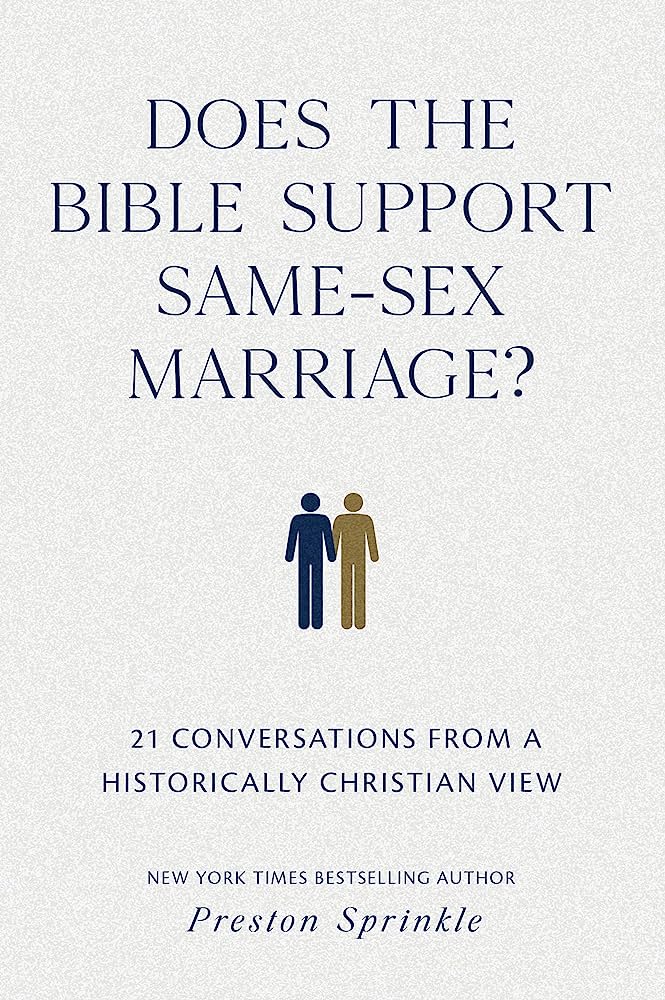
I received an advance copy of this book to read and review a few months ago. The book was released to the public on August 1, 2023 and is now available wherever books are sold.
The book begins with two chapters which give “Foundations,” or principles which need to be clarified up front. The first is about how to have a fruitful conversation about these topics which are highly charged when it comes to emotions and politics, in the world today. The second foundation is an explanation of the historically Christian view of marriage. This chapter is helpful, in that it looks at how Christians have viewed and understood marriage for the past 2000 years, and why. It looks at the Bible and the writings of church fathers, and more.
Then, the book goes into a response to 21 common questions or claims, which people use as justification for why same-sex marriage should be affirmed by Christians. Preston then responds to these in brief but content-rich chapters. He does so with tact and empathy, which I appreciated very much. He also shares data, statistics, history, facts, and quotes to support his responses.
Overall, the recurring theme of his answers is that sex difference is part of God’s design for marriage and that both same-sex sexual activity as well as all sex outside of marriage is considered “sexual immorality” (porneia in Greek) in the Bible.
For me, the most helpful chapters were Conversations 12-14, which addresses the claims that:
Jesus’ Sabbath Hermeneutic Informs How We Should Interpret Same-Sex Prohibitions
God’s Acceptance of Gentiles Mirrors How We Should Accept LGB People
The Trajectory of Women and Slavery Justifies Same-Sex Prohibitions
There are other chapters which are more “ground-level,” which address questions and claims which may be more common, such as:
Love is Love
Some People are Born Gay, So It Must Be Okay
Paul Was Not Talking about Consensual Same-Sex Relationships
The Word Homosexual Was Added to the Bible in 1946
In each chapter, Preston begins by giving a summary of the claim or viewpoint of those who argue for that particular position, then he follows it by sharing a few points of agreement, and finally gives a response.
In the end, Preston’s answer to the question posed in the title of the book is: No, the Bible does not support same-sex marriage. Yet he gives this answer in a thoughtful and helpful manner, which shows respect for his readers and those whose claims he seeks to refute. Finally, he urges the church to truly live out a biblical vision of being a community where the same-sex attracted can find acceptance, love, and care, so that they have a loving community to support them in faithfully following Jesus, including God’s instructions about sexual ethics.
I recommend this book as a helpful resource on this very relevant issue. It would be better if more Christians were well equipped to answer the questions people are asking about same-sex issues, with love and truth.
In recent years it has become increasingly popular for people who grew up in Christianity to go through a process of “deconstruction” in which they seek to examine and question the origins of their beliefs.
Deconstruction isn’t always a bad thing, but the deconstruction movement, powered by social media, largely targets younger people and encourages them to cast off their Christiaan beliefs.
This episode of the Theology for the People podcast is the recording of a workshop which Nick Cady and Aaron Salvato co-lead at the 2023 Calvary Global Network International Conference on the Topic of Doubt and Deconstruction.
We start out by defining deconstructionism and examining its philosophical roots, then we look at the impact of this movement and some of the common themes in its claims. Finally, we discuss a Biblical response to doubt and deconstruction and give some helpful tips for addressing the questions that those who are deconstructing may have.
In recent years it has become increasingly popular for people who grew up in Christianity to go through a process of “deconstruction” in which they seek to examine and question the origins of their beliefs.
Deconstruction isn’t always a bad thing, but the deconstruction movement, powered by social media, largely targets younger people and encourages them to cast off their Christiaan beliefs.
This episode of Theology for the People is the recording of a workshop which Nick Cady and Aaron Salvato co-lead at the 2023 Calvary Global Network International Conference on the Topic of Doubt and Deconstruction.
We start out by defining deconstructionism and examining its philosophical roots, then we look at the impact of this movement and some of the common themes in its claims. Finally, we discuss a Biblical response to doubt and deconstruction and give some helpful tips for addressing the questions that those who are deconstructing may have.
Check out more from Aaron Salvato on the Good Lion Podcast.
My book, The God I Won't Believe In: Facing Nine Common Barriers to Embracing Christianity, can be found here.
Visit the Theology for the People blog at nickcady.org
We talk about how the Beatitudes are meant to be understood, and how people have misread them throughout history. Further, we also discuss what the eschatological nature of the Beatitudes, and what they mean for practical areas of life, such as lament, power, and politics.
In this discussion, we talk about different interpretations of the Beatitudes, from Martyn Lloyd-Jones to Robert Schuller, to the church fathers. We also talk about Nietzsche, Constantine, and the question of whether Christianity creates emasculated men under the heading of “meekness,” and what it looks like to live out the ethic of Jesus in our modern world.
Chris Castaldo is the Lead Pastor of New Covenant Church in Naperville, Illinois. He has a PhD from London School of Theology, where he studied under Dr. Tony Lane; the same professor who was my mentor for my Masters dissertation.
Chris Castaldo is the Lead Pastor of New Covenant Church in Naperville, Illinois. In this episode we discuss his recent book The Upside Down Kingdom: Wisdom for Life from the Beatitudes. We talk about how the Beatitudes are meant to be understood, and how people have misread them throughout history. Further, we also discuss what the eschatological nature of the Beatitudes, and what they mean for practical areas of life, such as lament, power, and politics.
Chris has a PhD from London School of Theology, and he is a fellow at the Center for Pastor Theologians. He has authored and contributed to several books including: Talking with Catholics about the Gospel: A Guide for Evangelicals.
You can find more about Chris and read his writings at chriscastaldo.com.
How do we know when the books of the New Testament were written? Is it important?
In this episode of the Theology for the People podcast, I speak with Shane Angland about the dating of the Gospels and Revelation, and why the answer to that question might be more important than you think.
We discuss relative and absolute dating methods. We also look at some of the evidences for why we can be confident that the Gospels were written shortly after Jesus’ life and ascension. Additionally we talk about the Book of Revelation, and how the dating of Revelation actually determines how we interpret it.
Shane ss a teaching elder at Ennis Evangelical Church in County Clare, Ireland. He is a graduate of Dallas Theological Seminary (Th.M.) and holds a BA in History and Politics from the University of Limerick. Shane also served for several years as a missionary in Kharkiv, Ukraine.
The book Shane recommends at the end of this episode is: Redating the New Testament by John A.T. Robinson. Although Shane doesn’t agree with Robinson’s theology at some points, this work was groundbreaking because it showed that the books of the New Testament were most likely all written within the first century, and therefore were not pseudographs written in the Second Century, or later, as some, like Walter Bauer, had claimed in the 19th Century.
When were the Gospels & Revelation Written? And Why It Matters – with Shane Angland –
Theology for the People
How do we know when the books of the New Testament were written? Is it important?
In this episode, I speak with Shane Angland about the dating of the Gospels and Revelation, and why the answer to that question might be more important than you think. We look at some of the evidences for why we can be confident that the Gospels were written shortly after Jesus' life and ascension. Additionally we talk about the Book of Revelation, and how the dating of Revelation actually determines how we interpret it.
Shane ss a teaching elder at Ennis Evangelical Church in County Clare, Ireland. He is a graduate of Dallas Theological Seminary (Th.M.) and holds a BA in History and Politics from the University of Limerick. Shane also served for several years as a missionary in Kharkiv, Ukraine.
The book Shane recommends at the end of this episode is: Redating the New Testament by John A.T. Robinson
Check out Shane's blog here: http://anglandicus.blogspot.com/
Visit the Theology for the People blog at nickcady.org, where you can read articles and suggest topics for future episodes.
In this episode, we discuss the topic of prayer and the Lord’s Prayer specifically.
The Lord’s Prayer is a beautiful, subversive prayer given to the church by Jesus. It forms our imaginations and—given time—transforms us. Dan explains how what you pray shapes what you believe, which in turn shapes how you live.
What was Jesus’ intention in giving us this prayer? Was it to give us a model of how to pray, or was it intended to be given to us as what to pray? Dan and I discuss the historical usage of the Lord’s Prayer, as well as the value and dangers of both praying written prayers and praying extemporaneously.
Dan is a graduate of Denver Seminary, and we discuss some of the cultural uniquenesses of different parts of the United States, and how those affect the way we minister to others.
Dan Marotta is the founding Rector of Redeemer Anglican Church in Richmond, Virginia, and the author of Liturgy in the Wilderness: How the Lord's Prayer Shapes the Imagination of the Church in a Secular Age.
In this episode, we discuss the topic of prayer and the Lord's Prayer specifically.
The Lord’s Prayer is a beautiful, subversive passage of words given to the church by Jesus. It forms our imaginations and—given time—transforms us. Dan explains how what you pray shapes what you believe, which in turn shapes how you live.
Visit the Theology for the People blog at nickcady.org, where you can read articles and suggest topics for future episodes.
On this last day of 2022, it’s nice to stop and reflect on the past year. Sadly, this year saw the Russian invasion of Ukraine, resulting in the suffering of many innocent people. On a personal note, in 2022 I released my first book, which has sold many more copies than I ever imagined. In reflecting on this past year, there is much to mourn and grieve, as well as much to celebrate. Such is life on this beautiful but broken planet. Come quickly, Lord Jesus!
Here are some highlights from this past year as regards this blog and podcast:
Increased Readership
Readership of this site grew this year by 68% to over 150,000 visits.
In early 2023, we will be releasing a study guide companion to The God I Won’t Believe In. This was developed in our youth group, and we hope it can serve as a helpful curriculum for youth groups and small groups.
By the end of 2023, I hope to release another book based on the Gospel of John, tentatively titled: So That You May Believe
I will also be continuing the Theology for the People podcast, with new episodes scheduled to come out in February 2023.
Happy New Year, and stay tuned for good things to come!
Justice Roberts was asked to give the commencement speech for his son’s graduating class, but the speech he gave was different than the advice and platitudes commonly given at such events. Rather than wishing them good luck, he essentially told them that he wished they would experience hardship, because of the important things which can only be learned through these experiences.
Now the commencement speakers will typically also wish you good luck and extend good wishes to you. I will not do that, and I’ll tell you why.
From time to time in the years to come, I hope you will be treated unfairly, so that you will come to know the value of justice. I hope that you will suffer betrayal because that will teach you the importance of loyalty. Sorry to say, but I hope you will be lonely from time to time so that you don’t take friends for granted.
I wish you bad luck, again, from time to time so that you will be conscious of the role of chance in life and understand that your success is not completely deserved and that the failure of others is not completely deserved either. And when you lose, as you will from time to time,
I hope every now and then, your opponent will gloat over your failure. It is a way for you to understand the importance of sportsmanship. I hope you’ll be ignored so you know the importance of listening to others, and I hope you will have just enough pain to learn compassion.
Whether I wish these things or not, they’re going to happen. And whether you benefit from them or not will depend upon your ability to see the message in your misfortunes.
What John Roberts says here is true. Some of the most formative moments in my life have been as a result of experiencing pain and hurt from other people. Sometimes we develop our most deeply held convictions and values as a result of negative experiences.
In ministry, I know that some of the most important lessons I’ve learned have been from negative examples and experiences, which I then determined not to replicate or perpetuate.
Sometimes we learn to treat people well, as a result of being treating poorly and realizing that it isn’t right.
If we are able to turn those negative experiences into positive lessons, rather than becoming bitter, it can be something that helps us grow more into the image of Christ.
This is why James is able to say: “Count it all joy, my brothers, when you meet trials of various kinds, for you know that the testing of your faith produces steadfastness. And let steadfastness have its full effect, that you may be perfect and complete, lacking in nothing.” (James 1:2-4)
It’s why Paul is able to write that we, as Christians, rejoice not only in the hope of the glory of God, but we can also “rejoice in our sufferings, knowing that suffering produces endurance, and endurance produces character, and character produces hope, and hope does not put us to shame, because God’s love has been poured into our hearts through the Holy Spirit who has been given to us.” (Romans 5:3-5)
May the painful things we experience in this life be used by God to shape us more into the image of Christ, to the glory of God, and may it better equip us to show the compassion and love of Christ to others.
Several groups have told me that that they have used the book for group studies, for small groups at their church and for youth groups. One person told me about a lunchtime study group she started at her workplace using the book.
Study Guide Coming Soon
To help those who want to use the book for group studies, I am currently writing a Group Study Guide resource to be a companion to the book, and I’m doing it by teaching the youth group at our church, White Fields Community Church. I’ve had some great help in creating the content from some of the excellent leaders at White Fields.
When the guide comes out, each session will include a group activity, a synopsis, and several study questions which correspond to the content of each chapter. Additionally, we are planning to create a series of videos which can be watched along with the study guide, for groups to use.
That study guide should be coming out in early 2023.
New book in the works
Additionally, I am working on another book called, So That You May Believe, which will be based on the evidence given in the Gospel of John about who Jesus is, and why you should believe in him.
Since my first book was The God I Won’t Believe In, hopefully this next book will be a good follow-up or companion, showing people the evidence for who Jesus is and why he came, So That You May Believe.
I hope to be able to release that book by the end of 2023.
In this week’s episode of the Theology for the People podcast, I speak with Dominic Done. We talk about what the Bible means when it talks about the “soul,” and what God’s vision is for how your soul can flourish.
Dominic is a pastor and author based out of Colorado Springs, where he leads a ministry called Pursuing Faith.
Dominic has served as Professor of Applied Theology at George Fox University, lead pastor of Westside: A Jesus Church in Portland, Oregon. He has a Master’s Degree in Theology from the University of Oxford and is currently working on his PhD at the University of Oxford under Alister McGrath.
For more information about the Calvary Global Network (CGN) conference taking place in Costa Mesa, CA from June 26-29, at which Dominic will be speaking, visit conference.calvarychapel.com
If you find this episode interesting or helpful, please share it with others and leave a rating and review on your podcast app, as that helps other people discover this podcast and its content.
Dominic Done is a pastor and author based out of Colorado Springs, where he leads a ministry called Pursuing Faith.
Dominic has served as Professor of Applied Theology at George Fox University, lead pastor of Westside: A Jesus Church in Portland, Oregon. He has a Master’s Degree in Theology from the University of Oxford and is currently working on his PhD at the University of Oxford under Alister McGrath.
He has written two books. His first book, When Faith Fails: Finding God in the Shadow of Doubt, addresses the topics of doubt and deconstruction. His latest book, Your Longing Has a Name: Come Alive to the Story You Were Made For, was just released this year.
Dominic was recently a guest on Unbelievable? in which he debated with an atheist philosopher on the origin of virtues.
For more information about the Calvary Global Network (CGN) conference taking place in Costa Mesa, CA from June 26-29, at which Dominic will be speaking, visit conference.calvarychapel.com






 Theology for the People