
Mary Did You Know? – Questions About Jesus’ Childhood

ask blackboard chalk board chalkboard

A few weeks ago I created a page where you can submit questions or suggest topics. A reader sent in this question:

In John 2:3-5, Mary asks Jesus to do a miracle in order to save a wedding feast where they have run out of wine.

How did Mary know to ask Jesus for help? Was she even asking for help?

Did she know who he was and what he was here to do?

Why are there no stories of Jesus’ childhood, except in the gnostic gospels?

I recently taught this section at White Fields, during our Advent series. In the sermon I talk about how this first of Jesus’ miracles points to the eschatological hope of the gospel. You can listen to that message here: From Shame to Joy

Let me answer each of your questions in order.

Was Mary Asking Jesus for Help?

Yes, I think that is clear from two things we see in the narrative:

  1. Jesus’ apparent frustration with the request.
  2. Mary’s instructions to the servants to do whatever Jesus tells them to do.

How Did Mary Know to Ask Jesus for Help? Did She Know Who He Was and What He Was Here to Do?

Yes, Mary absolutely did know that Jesus was the Messiah! This is the woman who got pregnant without having sex. I think that’s something that would be hard to forget.

This is the woman who had the angel Gabriel appear to her to announce that she was pregnant with the Messiah (Luke 1:26-38). This is the woman who sang the “Magnificat” (Luke 1:46-56). This is the woman whose cousin Elizabeth and her husband Zechariah also had a visitation from the Lord. Joseph also had a visitation to tell him the identity of the child (Matthew 1)

Lest we forget, this is the woman who also experienced:

  1. The visit of the shepherds who had heard the divine proclamation (Luke 2)
  2. The visit of the magi who came from the East following the star which proclaimed the birth of a new king (Matthew 2)
  3. Interactions with Simeon and Anna in the temple (Luke 2)

Furthermore, this is the woman who had to flee with her baby in the night to Egypt, where they stayed for several years as refugees until Herod the Great died, because he was committed to killing this one who was the rightful heir to the throne of David, i.e. the promised Messiah.

Mary and Joseph had an acute awareness of who Jesus was, and I would expect that they also talked about this with Jesus. One question that theologians debate is whether Jesus innately knew that he was the Messiah, or if it was revealed to him by the Spirit. I expect that his mother and father would have talked to him about it as well, recounting to him as a young child why they had to live as refugees in Egypt, and telling him stories of the angels’ visitations and all the crazy stuff that happened at his birth.

The word Messiah means anointed one. There were three people in ancient Israel who were anointed with oil as a symbol of the Spirit of God upon them to empower them for their ministry: Prophets, Priests and Kings. The eschatological Messiah was known to be one who would be the perfect fulfillment of all three of these offices: he would be the ultimate priest, the true prophet (remember Moses’ prophecy in Deuteronomy 18:15 of the prophet whom God would raise up… the Jews understood this to be a Messianic prophecy – see John 1:21), and the true king (for more on this, read: If Jesus is God, Why is He Called the Son of God and the Firstborn of All Creation?)

Being that Jesus is the true and greatest prophet, it would be expected that he would perform miracles, like the “wonder-working prophets” Elijah and Elisha. This is why one of the expectations of the Jews from Jesus was that he validate his ministry through performing miracles. Jesus pushed back at this, knowing their hearts – but the fact is that he did perform many miracles.

Why are there no stories of Jesus’ childhood, except in the gnostic gospels?

It says clearly in John 2:11 that this was the first of Jesus’ miracles, or rather “signs”, by which he manifested his glory. This, by the way, goes to show the dubious nature of the childhood narrative of the gnostic Gospel of Thomas, which purports Jesus doing miracles to heal birds.

My guess is that the reason there isn’t more written about Jesus’ childhood is because there wasn’t much to talk about. He spent his first several years in Egypt, then at age 12, his parents noticed that he had a keen desire to know the Father and study the Scriptures. Beyond that, Jesus and his parents would have always known that he was the Messiah, but he didn’t do anything in that role until his baptism at age 30.

Thanks for these great questions! Keep studying the Word, and feel free to send more questions to me by filling out this form.

Atul Gawande’s ‘Being Mortal’ and the Need for Hope

Image result for being mortal atul

I recently finished Atul Gawande’s book Being Mortal. It was given to me by a friend from church who recommended I read it, and I’m glad I did.

The Author and his beliefs

Atul Gawande is an American medical doctor, the son of two doctors who immigrated to the U.S. from India. He was raised nominally Hindu, but by his own admission he is functionally secular and non-religious, and the focus of his book is not at all on giving hope beyond this life, only on dealing with the death from a clinical perspective.

However, I would argue that whatever you believe about the future invariably affects the way you interpret the meaning and purpose of life, as well as how you cope with mortality, and this does come through in some of his conclusions.

Content and Highlights

The book begins with a description of physical changes that happen as people age, beginning at age 35.

Dying Well

Next, Atul Gawande gives a brief history of nursing homes. I found this part very interesting. About 50% of Americans die in nursing homes. Some might say this is very sad, which in some ways it is – however, understanding the way that most people died in the past makes you see that this is actually a great improvement over 100 years ago, when many people died in state-funded “poor houses” which even at their best had awful conditions.

He then goes on to describe the development of “assisted living” facilities, and how many have now deviated from their original purpose and design. He also tells stories of people who have sought to improve these facilities through innovation, such as bringing living things, e.g. plants, animals and children into these homes to improve residents’ quality of life.

While the author does say that the older model of a multi-generational home in which elderly people are cared for at home until they die has some benefits, he also shows its limits and downsides, using his own grandfather as an example.

Palliative Care

Atul also describes the benefits of palliative care for elderly people, which is focused on improving a person’s quality of life rather than on invasive treatments which may reduce a dying person’s quality of life even though they have little to no chance of curing them or significantly prolonging their life.

Even though palliative care has been shown to help improve and often prolong a person’s life, one of the sad things Gawande points out is that many insurance providers have stopped paying for palliative care, but they continue paying for invasive treatments, even if they are unnecessary or unhelpful to patients. This perpetuates a cycle of doing everything possible for patients, even if those treatments are not likely to lengthen their life and will probably make their quality of life worse.

The Big Point

Atul Gawande’s main point is summed up in this statement:

“Over and over, we in medicine inflict deep gouges at the end of people’s lives and then stand oblivious to the harm done.”

He argues that as people live longer and more die of old age, we should be focused on helping people stay in control of their lives as long as possible, achieve their goals, and die with dignity.

A Reason for Living

It is impossible to talk about dying without some sort of existential discussion about what gives life meaning and purpose.

At one point, Atul Gawande references the Harvard philosopher Josiah Royce, who said that “simply existing – merely being housed and fed and safe and alive – seems empty and meaningless to us.” He goes on to explain that we all seek a cause beyond ourselves, and it is in ascribing value to the cause and seeing it as worth sacrificing for, that gives our lives meaning.

Royce said that this reason for living was the opposite of individualism. An individualist puts self-interest first, seeing his or her own pain, pleasure and existence as their greatest concern. For the individualist, self-sacrifice makes no sense, but since their own self is the highest cause for which they live, their life has no meaning other than to make themselves happy. Ironically, it is for this reason that happiness and satisfaction will always elude them. For the individualist death is meaningless and ultimately terrifying.

It is for this reason, Gawande explains, that we all need something beyond ourselves and outside of ourselves to live for, and this is why elderly people who have pets, for example, tend to live longer lives.

The problem with Gawande’s search for meaning

The problem with Gawande’s search for meaning, is that he has identified a real need, and yet he basically says in the end that since he doesn’t believe there is anything beyond this life, therefore it is better to give someone the illusion that their life has meaning and purpose and value beyond themselves, even though no such thing really exists.

He does mention that people want their lives to make a difference after they are gone, but what he fails to answer is: to what end?  Why should anyone care about what happens after they are gone, if life is actually meaningless, and after this light burns out there is only darkness? From this same logic, a totally selfish existentialism could also be argued for – such as that of the Epicureans: “Let us eat and drink, for tomorrow we die!” – in other words #YOLO – since we only live once, who cares what destruction we leave in our wake for others to deal with?! It’ll be their problem, not ours!

The solution which only the gospel gives

In this search for meaning and purpose, I would argue that it is only the gospel message of Jesus Christ which gives a satisfactory answer to humankind’s search for meaning and hope beyond this life.

It is only the gospel which gives us real hope beyond this life, and a real mission in this life which has more than just illusionary results. In the gospel we have hope for life beyond this one, and the effects of our mission are eternal in nature.

As CS Lewis put it at the end of the Chronicles of Narnia:

“For us, this is the end of all the stories…but for them it was only the beginning of the real story. All their life in this world and all their adventures in Narnia had only been the cover and the title page: now at last they were beginning Chapter One of the Great Story which no one on earth has read: which goes on for ever: in which every chapter is better than the one before.” – CS Lewis, The Last Battle

In order to truly “die well”, what we need is not just dignity, but HOPE. And this is found only and ultimately in the gospel message of Jesus Christ.

Should you read it?

I would recommend Atul Gawande’s Being Mortal. It was full of important thoughts about the process of dying in Western society today. However, I recommend reading the book with an eye to its one glaring shortcoming: it fails to address the need for and the source of HOPE both for this life and the one to come.

Podcasts I’m Listening to Right Now

silver iphone x with airpods

Craig Groeschel said, ‘You become like who you listen to.’ I heard him say that in his podcast…because I listen to his podcast.

In no particular order, here are some of the podcasts I’ve been listening to lately:

There are a few others I subscribe to and visit from time to time, and of course you should totally subscribe to the White Fields Community Church podcast, so you can listen to my sermons, as well as those of our other teachers and guests.

What podcasts do you listen to? 

Leave a comment with your recommendations for good content that you enjoy and that you think other people should check out.

Trust Your Instruments

two pilot inside aircraft

This winter our church has been partnering with Agape Family Services, a Longmont-based non-profit which helps people who have been homeless to transition to independence. Agape provides shelter, food, help with overcoming addiction and assistance in finding jobs and a place to live during their 6 month program.

White Fields partners with Agape by teaching a Tuesday morning Bible study for those in the program. It has been great seeing Agape’s work, the effectiveness of the program, and how the people are progressing. One man, for example, who comes to Bible study every week and reads his Bible avidly has, with Agape’s help, gotten sober, found a job, married his girlfriend and is working on finding a place to live when he graduates from the program in the spring. It has been great to witness his progress over the past few months, and to see his completion and countenance improve each week.

This past Tuesday, a man from White Fields named Brad led the Bible study. Brad used to fly corporate jets for a living, and he used an example from that world to illustrate what it means to live and walk by faith:

When Trusting Your Feelings Will Kill You

Brad said that pilots often experience “spacial disorientation”, which means that even if the plane is flying perfectly level, they will feel like they are tilted to one side, and that the plane isn’t going straight, when it actually is.

The danger with this is that if the plane is actually tilted, it will pick up momentum and spiral out of control. So this feeling of “spacial disorientation” triggers panic in your mind and body which tells you that you need to straighten out the plane or else you’re going to spiral out of control – except, if the pilot follows that feeling and “corrects” the plane, they will actually be tilting the plane which can result in entering into a “death spiral” from which they can’t pull out.

The pilot needs to know that what their body and mind are telling them might be incorrect, and rather than relying on those feelings, what they need to do is trust their instruments.

On the instrument panel, a pilot has multiple gyros (in case one fails), which tell them whether they are level. It is an act of faith to trust your instruments rather than your feelings, but if you don’t, you (and your passengers) will experience disaster and tragedy.

Slow Down and Think

I recently finished reading Malcom Gladwell’s book Blink: The Power of Thinking Without Thinkingin which he talks about rapid cognition and intuition. In the book, he discusses this same issue: that generally our minds are very powerful and our rapid cognition is trustworthy, but sometimes it’s not, and we must slow down in order to make the right decision.

He used the example of police brutality in the cases of Rodney King and other incidents, and how rather than being caused primarily by racism, they are caused by officers being in a heightened state of arousal (high heart rate) as a result of a chase, which causes their minds to shut off, and they begin acting without thinking. As a result of research, police departments have gone to great lengths to slow down procedures in order to create more “white space” for officers to be able to think before acting, knowing that sometimes their instincts will lead them to do things in an instant which they wouldn’t have done had they had time to think.

Landing the Plane

Similarly, as Christians, we know that our hearts can be deceitful (Jeremiah 17:19). Proverbs 14:12 tells us that ‘There is a way that seems right to a man, but its end is the way to death.’

So rather than “following our hearts” or doing what feels good in the moment, it is important to think before we act, and trust our instruments, i.e. what God’s Word says is true, not just what we might feel in the moment.

This applies to how we think about ourselves, how we assess our situations and circumstances, and how we react to others.

In our recent study of Habakkuk, we saw that Habakkuk was a man who was struggling to understand why God was allowing certain things to happen, and why God had chosen a course of action which, to Habakkuk, seemed wrong and unfair. God’s response was to remind Habakkuk to “trust the instruments” in those instances when things seemed to be spiraling out of control; he was to remember who God is (e.g. sovereign, good, just), and then look at his circumstances through that lens, trusting that God was working out a plan, even if Habakkuk couldn’t see the whole thing just yet.

You can listen to that study of Habakkuk here: Habakkuk: The Righteous Shall Live by Faith

May we be those who trust the instruments God has given us, lest we end up off-course or in a death spiral – so we reach our final destination.

Chinese Conviction & American Apathy

Image result for chinese christianity

In 2018, the Chinese government acted to crack down on unregistered Christian churches. These churches are sometimes called “house churches,” which is a misleading term, since many of these churches have hundreds, even thousands of members and own their own buildings.

Chinese law requires Christians to worship only in congregations registered with the Three-Self Patriotic Movement, a government-sanctioned organization which manages churches. Millions of Chinese Christians meet in unregistered churches which defy these government regulations, seeing them as compromising the church, especially considering the Communist government’s atheistic agenda.

Over the past few months, the Chinese government has stepped up their persecution of Christians by destroying crosses, burning Bibles, confiscating religious materials and closing churches, even demolishing their buildings, as can be seen in this video:

In December 2018, more than 100 Christians who attend a Reformed church in Chengdu were arrested and charged with “inciting subversion of state power.”

Chinese Conviction

The pastor of that church, Wang Yi, a former human-rights lawyer and law professor, who has been an influential intellectual in China, issued a statement along with other Chinese Christian leaders titled: “My Declaration of Faithful Disobedience,” in which they stated that they would not cease gathering together for worship and studying the Bible.

Additionally, around 500 Chinese Christian leaders have signed a document called “A Declaration for the Sake of the Christian Faith,” in which they stated that they were prepared to bear all losses, even the loss of their freedom and their lives, for the sake of the gospel.

For Chinese Christians, gathering together for worship and Bible study is an act of resistance and social disobedience. It brings with it the possibility of arrest, punishment and persecution. And yet – believers are resolute: they will not stop gathering for public worship services, no matter what the cost.

American Apathy

At the same time, on the other side of the world, the American church is seeing a rising wave of apathy.

Some of the reports of the decline of Christianity in the United States are misleading, as I’ve written about here: Is Christianity in Decline? Yes and No. – Part 1 & Part 2.

However, other reports show that while reports of the decline of Christianity in the US may be overstated, there is a growing sense of apathy in regard to church attendance.

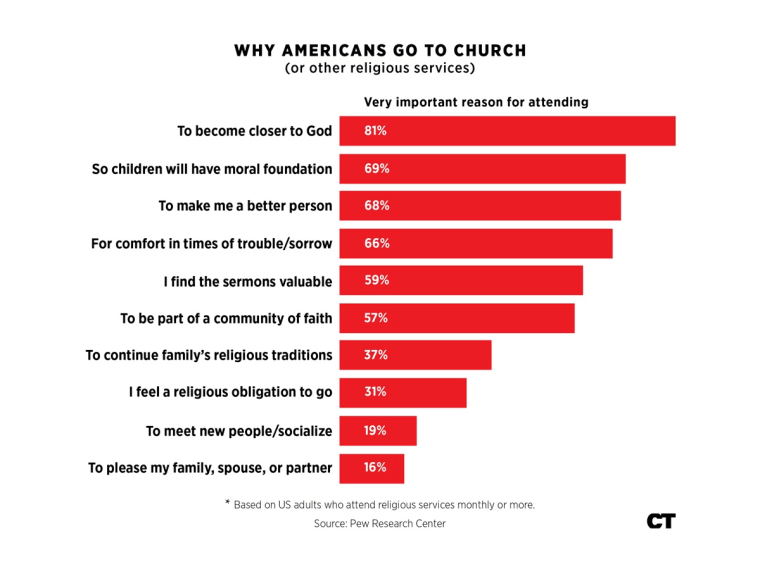
Christianity Today recently published these infographics based on data from Pew Research Center:

image.pngimage.png

Read the full report here: Pew: Why Americans Go to Church or Stay Home

Two significant things that these infographics reveal: 1) Americans view Christianity as being important for the purpose of moral formation, 2) Americans tend to think that church is superfluous when it comes to Christian faith.

The Irony

Comparing the Chinese situation with the American one, what we see is that the people who stand to lose the most from going to church (the Chinese) are the most resolute in doing so, even though doing so will likely hurt them financially, socially, and even physically. Conversely, those who have the most freedom and stand to lose nothing are the most apathetic about public worship.

Whereas many Chinese Christians see gathered worship as central to their faith, something they absolutely cannot give up or do without, and an act of resistance – many American Christians see it as extraneous.

Who is Right?

I believe that we in the West can afford to learn something from our brothers and sisters in the East.

Christianity was formed and grew in the crucible of persecution, and perhaps the worst thing for Christians is to experience such ease and comfort that we lose the understanding that following Jesus is a radical and subversive thing in this world.

Perhaps the greatest danger our faith can face is not direct persecution, but patronizing “pats on the head” and people thinking that Christianity is “nice”.

Sinclair Ferguson has put it this way:

“We are not saved individually and then choose to join the church as if it were some club or support group. Christ died for his people, and we are saved when by faith we become part of the people for whom Christ died.”

Recently I read an article by Simon Chan from the theological journal Pneuma, in which he very astutely wrote this:

[Western Christians] have a very weak sociological concept of the church. This has two negative consequences. First, the church tends to be seen as essentially a service provider catering to the needs of individual Christians. Rarely are individuals thought of as existing for the church. When the church is seen as existing for the individual, then the focus of ministry is on individuals: how individual needs can be met by the church. But when individuals are seen as existing for the church, the focus shifts from the individual needs to our common life in Christ: how we as the one people of God fulfill God’s ultimate purpose for the universe, namely, to glorify and enjoy God forever.

Chan is challenging us to ask the question: Contrary to our consumeristic mentality, isn’t it actually true that the church does not exist for us as much as we exist for the church, and the church exists for God?

I believe that we in the West can afford to look to the East and learn from our Christian brothers and sisters in China about the importance of gathered worship.

Feed the Goose & Use Your Calendar

white eggs in brown nest

One of Aesop’s fables tells the story of a man who found a goose who laid golden eggs. Every morning, he went and found another golden egg that the goose had laid, until one day he became greedy, and decided to cut the goose open so he could get more golden eggs. Of course, by doing so, not only did he not get any extra golden eggs, but he also ceased getting the daily eggs he had previously received, since the goose was now dead.

You can read the parable here or listen to this 1 minute audio version:

The point of the fable, Aesop said, is that greed often overreaches itself. However, like with most parables, there are several applicable truths packed into this very short story.

Many of the best things are acquired indirectly

The golden eggs in the story represent a desired outcome: something you want. For you, that might mean spiritual growth in your relationship with God, it might mean increased knowledge of the Bible or theology. It might mean deep and meaningful friendships, developing a skill, or increasing your success in your work. It might be making an impact on the world around you.

But what this fable illustrates for us, is that whatever the “golden egg” is for you, it is usually acquired indirectly. When the man in the story pursued the golden eggs directly, seeking to bypass the goose, he ended up with nothing, and killed the thing which gave him that which he wanted.

CS Lewis writes about how friendship works in a similar way. Friendship, he points out, must be about something else other than the friendship itself. The basis of a friendship is that both people are committed to and passionate about something beyond their friendship. “This is why,” Lewis says, “those pathetic people who simply ‘want friends’ can never make any.” “Those who have nothing can share nothing,” he points out, and concludes: “those who are going nowhere can have no fellow travelers.” (The Four Loves, ch. 4)

The same is true of spiritual growth. To quote from John Piper: “Doctrine is the fuel for worship.” The way to grow, the way towards deeper worship, is indirect: it is through getting to know more about who God is and what He has done and will do, which fuels growth and worship.

If you’ve ever met someone who is purposefully seeking to “climb the ladder” or make a name for themselves in an organization or community, it often backfires, because it is seen as off-putting and self-serving. On the other hand, those who make a practice of genuinely and faithfully serving others will not remain anonymous for very long.

If you want to keep getting “golden eggs”, then make sure you feed the “goose”

The goose in the fable is the thing which you must “feed” in order to get the desired results.

If your goal is spiritual growth, then to “feed the goose” means to do those things which will result in spiritual growth, e.g. reading the Bible, prayer, attending worship services, joining a community group.

At White Fields, something our leadership has done is develop a plan that guides us in doing the qualitative activities which we believe will lead to our desired outcome (our vision): to build and foster a passionate, engaged and spiritually healthy Christian community to influence and bless Longmont and beyond. The way we go about doing this (our mission) is by making disciples of Jesus Christ through teaching the Word of God, engaging in the mission of God, and raising up leaders. In order to accomplish that mission, we have tried to determine what things we should be doing, which will lead to those outcomes.

The same is true on a personal level: a few years ago, after a doctor visit in which I was told I was pre-diabetic, I decided I wanted to get in better shape. Since running seemed to give the best return on investment, I decided to do that. Rather than setting weight-loss goals, I’ve set running goals, knowing that if I run a certain amount, whether I lose weight or not, I will be in better shape.

Make sure that the “golden eggs” you’re after are godly and aligned with God’s heart and will for your life, and then determine what the “goose” is that will produce that outcome, and feed that goose.

Check out: Inputs and Outputs for Growth and Maturity

Moving beyond good intentions and wishful thinking

I have found that using my calendar is the best way to make sure I’m feeding the “goose”.

Reading through the Bible in a year is a great goal, as is family devotional time and committed church attendance. However, if you don’t use your calendar to block out times for those things, they won’t often move beyond the realm of good intentions. I have found that by putting things in my calendar, I am able to prioritize things according to my values, rather than being a slave to the “tyranny of the urgent.”

May God lead you, as you seek Him, to determine the right “golden eggs” to pursue, the right way to “feed the goose” and the ability to be intentional in doing so.

What Does It Mean to Live “Coram Deo”?

Image result for coram deo

What does it mean to be “in the presence of God”?

This past Sunday at White Fields we studied Isaiah 6 as part of our series, Remember the Prophets

You can listen to the audio of the message here: A Vision of God

In Isaiah chapter 6, Isaiah gives an account of his call to ministry, which took place through a vision he had of God. In our community groups, one of the discussion questions had to do with what it means to be in the “presence” of God.

Coram Deo

Coram Deo is a Latin phrase which literally means “before God”. For Christians, throughout history, the phrase has been used to describe a life that is lived before God, i.e. in constant awareness of His presence, and seeking to experience communion with Him – not just at church or in dedicated times of prayer (although those are not to be neglected!), but as you go throughout your day.

An Uber Driver and a Stay-at-Home Mom

This past week I had two conversations which illustrated the importance of this:

The first was with a lady in community group who drives Uber several hours a day. She described how, sitting in her car, she is able to commune with God; she listens to sermons and even as she’s driving, she converses with God in her soul.

The second was a stay-at-home mom who called in to Calvary Live, the weekly call-in radio show I host on Mondays on GraceFM. She described how she struggles to find time to pray because she is so busy with her toddler, so she has developed a system where she will set timers throughout the day, and when they go off she will pray for 3 minutes uninterrupted. I suggested that perhaps it would be helpful for her to learn instead the practice of “Coram Deo”: living your whole life before the face of God, and conversing with Him throughout the day, not only in dedicated stints.

Pray Without Ceasing & The Practice of the Presence of God

Paul the Apostle wrote to the Thessalonians that they ought to pray without ceasing (1 Thessalonians 5:17). It was in heeding this call that some throughout history were drawn to monastic movements: they became monks and nuns, went away to Bible colleges and the like, so they could truly pray without ceasing. But how can you do that if you have a job or a toddler? For most of the population, retreating from the duties and responsibilities of life in order to pray without ceasing is not feasible, and we must ask the question: even if it were feasible, would it actually be the right thing to do? I would say, No! God has given us a mission in this world, and in order to fulfill that mission, we are not called to retreat from the world, otherwise we cannot be salt and light; a city on a hill is not meant to be hidden (cf. Matthew 5:13-16)

A famous book written in the 17th Century by a monk who called himself Brother Lawrence, is: The Practice of the Presence of God. In it, Brother Lawrence describes his practice of ongoing conversation with God as he went about the duties of his day, which included dishwashing and other chores. Throughout his day, he was living Coram Deo: before the face of God.

An Integrated, Rather than Compartmentalized Life

The principle of Coram Deo is important, because it reminds us that our lives as the people of God are to be integrated, not compartmentalized. In other words: it isn’t that our lives are compartmentalized into different areas: work, family, faith, etc… – but that our faith is integrated into every aspect of our lives: we do our work before the face of God, and unto God’s glory! Our family life is lived before the face of God, and unto His glory!

In other words, to live Coram Deo means to seek to be constantly aware of God’s presence (which is there whether you realize it or not), seeking to live in constant communion with God, and integrating your relationship with God into every aspect of your life.

This means that you don’t have to be a monk or a nun in order to pray without ceasing. It means that you don’t have to be in vocational ministry (working for a church or Christian organization) in order to serve God through your work!

For more on this, read: Vocation and Calling According to the Reformers

I invite you to join me in seeking to live Coram Deo today and everyday moving forward!

For more on Isaiah’s vision of God, check out this video discussion I had with Worship Pastor Mike Payne:

New Feature: Ask a Question or Suggest a Topic

A lot of the topics that I write about here are inspired by conversations I have or questions I’ve received from readers.

In order to better serve you with content that is relevant to questions that you have about the Bible, culture or current events, I created a new page with a form that can be filled out to submit a question or suggest a topic.

You can access it from the menu or by clicking here: Ask a Question or Suggest a Topic

Martin Luther King Jr. On Christianity and the Gospel

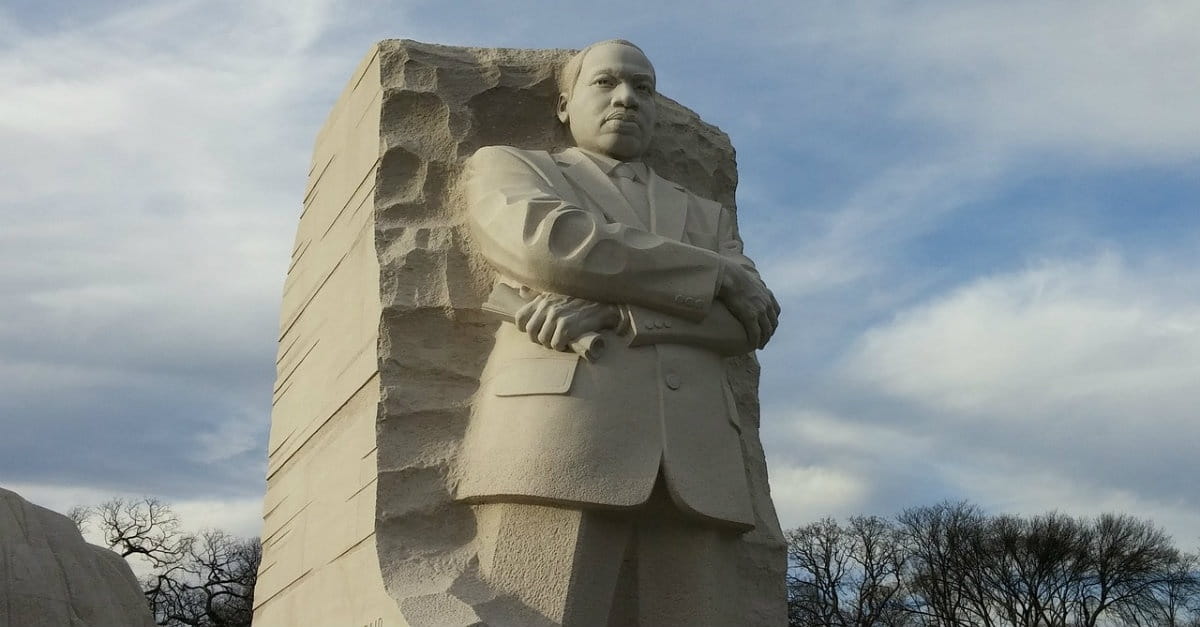
31 Powerful Quotes by Dr. Martin Luther King, Jr.

Today is Martin Luther King Jr. Day in the United States, the day when we commemorate the civil rights leader, who was also an ordained Baptist pastor.

I’ve written before about MLK Jr.’s letter to fellow pastors from his jail cell in Birmingham, and about his most famous speech.

Here are a few things he said about Christianity and the gospel:

1. “The end of life is not to be happy, nor to achieve pleasure and avoid pain, but to do the will of God, come what may.”

2. “There is so much frustration in the world because we have relied on gods rather than God. We have worshiped the god of pleasure only to discover that thrills play out and sensations are short-lived.”

3. “The early Christians rejoiced when they were deemed worthy to suffer for what they believed. In those days the Church was not merely a thermometer that recorded the ideas and principles of popular opinion; it was a thermostat that transformed the mores of society.”

4. “If any earthly institution or custom conflicts with God’s will, it is your Christian duty to oppose it.”

5. “We need to recapture the gospel glow of the early Christians who were nonconformists in the truest sense of the word . . . Their powerful gospel put an end to such barbaric evils as infanticide and bloody gladiatorial contests.”

6. “Faith is taking the first step even when you don’t see the whole staircase.”