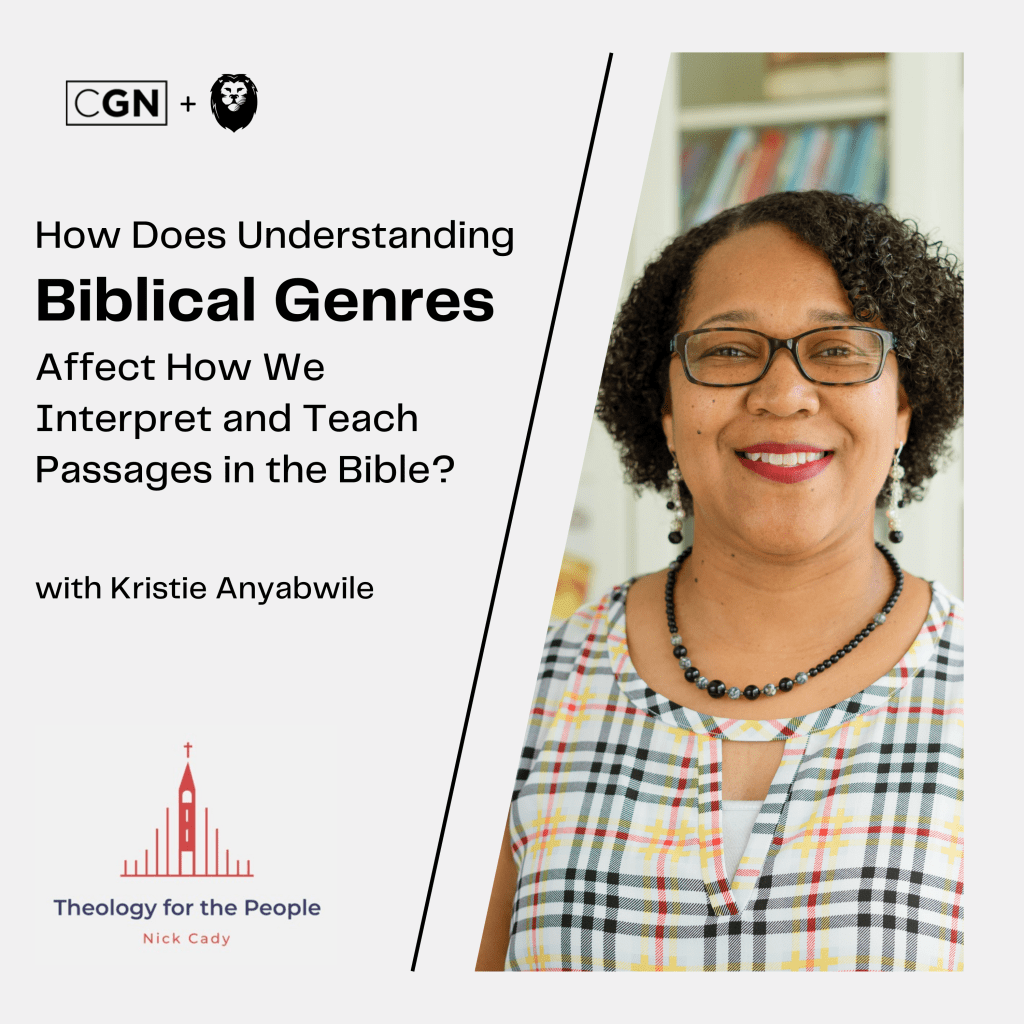
We discuss the difference between interpreting the Bible “literally” and interpreting it “literarily,” i.e. according to the genre of a given passage. Kristie describes the 8 major literary genres found in the Bible, and their unique aspects. We give a few examples of how not taking genre into account can lead to misinterpretation and misapplication of particular texts.
Kristie is married to Pastor Thabiti Anyabwile and they serve at Anacostia River Church in Washington D.C. For more about Kristie, visit her website: kristieanyabwile.com.
Kristie also shares with us in this episode the meaning of her last name!
Also mentioned in this episode are two groups Kristie is involved with:
If you find this episode interesting or helpful, please share it with others and leave a rating and review on your podcast app, as that helps other people discover this podcast and its content.
How Does Understanding Biblical Genres Affect How We Interpret and Teach Passages in the Bible? –
Theology for the People
In this episode, I speak with Kristie Anyabwile, who recently wrote a book called, Literarily: How Understanding Bible Genres Transforms Bible Study.
We discuss the difference between interpreting the Bible "literally" and interpreting it "literarily," i.e. according to the genre of a given passage. Kristie describes the 8 major literary genres found in the Bible, and their unique aspects. We give a few examples of how not taking genre into account can lead to misinterpretation and misapplication of particular texts.
Kristie is married to Pastor Thabiti Anyabwile and they serve at Anacostia River Church in Washington D.C. For more about Kristie, visit her website: kristieanyabwile.com.
Also mentioned this episode are:
Charles Simeon Trust
The Pelican Project
If you find this episode interesting or helpful, please share it with others and leave a rating and review on your podcast app, as that helps other people discover this podcast and its content.
Make sure to visit the Theology for the People blog at nickcady.org
As part of the discussion, Aaron asked Mike and I about our worst Easter sermon ever. As I was telling about my worst Easter sermon, I remembered something that happened on our first Easter (also our first Sunday) planting a church in Eger, Hungary. It wasn’t something I did (or even saw), but it was something which probably made it the worst Easter service ever for those who attended 😂. Here’s the video of that part of our discussion:
Aaron broke up our discussion into sections and created a helpful article, with Mike and I discussing about Good Friday, how to support staff and volunteers amongst the busyness of Easter weekend, and how to keep Easter fresh.
On this week’s episode of the Theology for the People podcast, Aaron Salvato interviews me about hypocrisy can be a barrier to people embracing Christianity, and what the solution is to this problem.
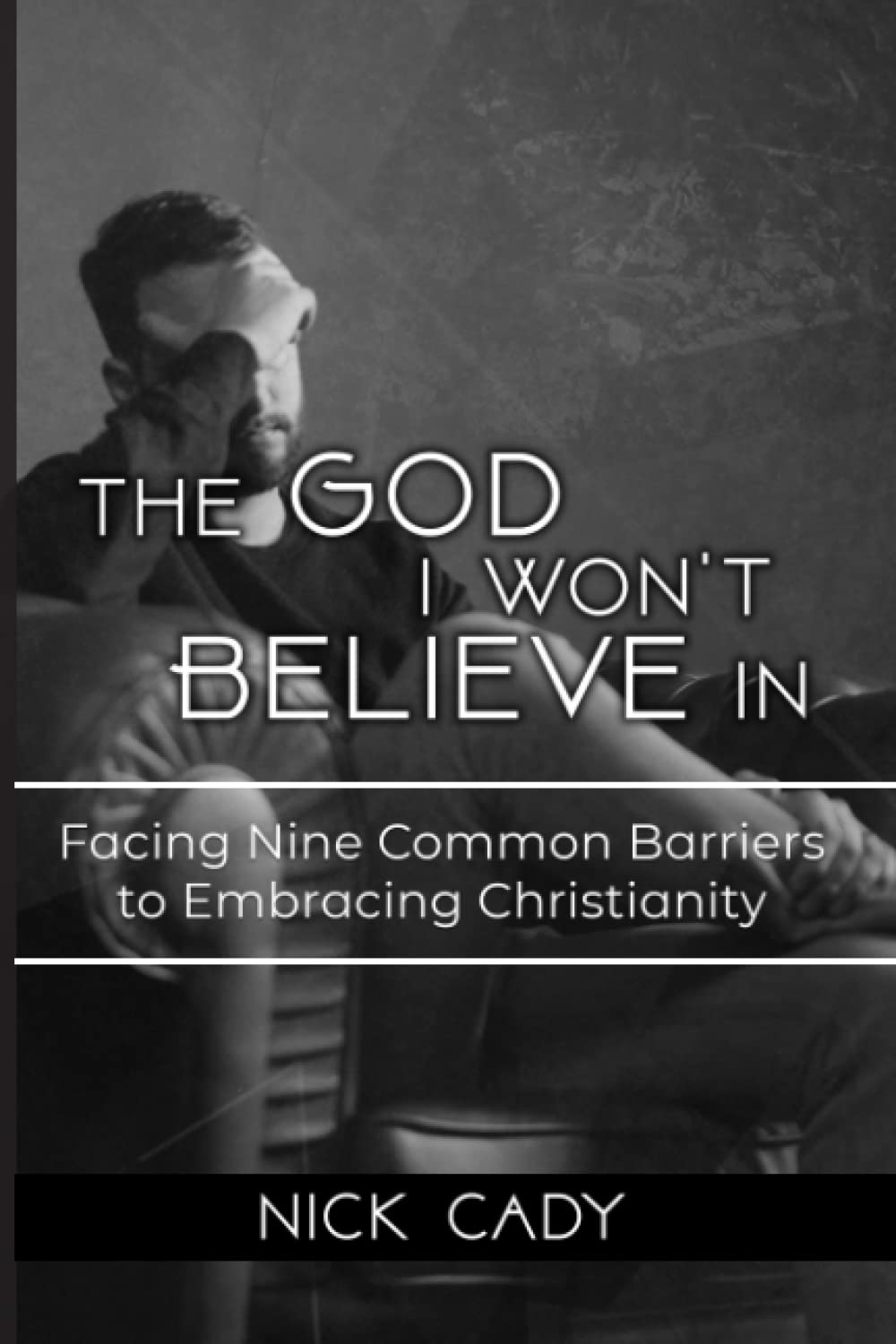
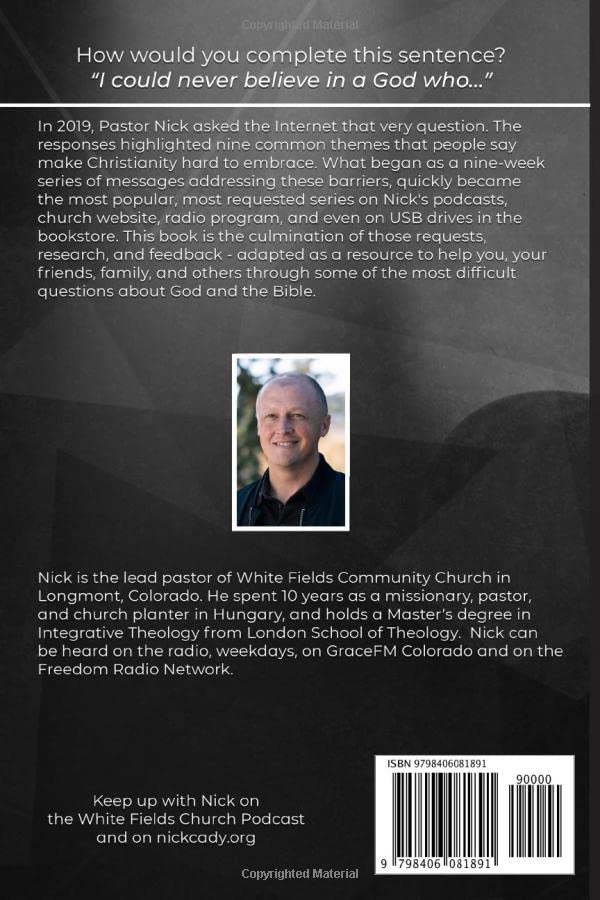
In my recent book, The God I Won’t Believe In: Facing Nine Common Barriers to Embracing Christianity, one of the chapters addresses the question of how Christianity can really be true if many of its adherents are hypocritical or hateful people. Can this problem be blamed on Christianity itself? Or is there another explanation? Either way, it certainly hurts Christian witness, so what, if anything, should or can be done about it?
If you find this episode interesting or helpful, please share it with others and leave a rating and review on your podcast app, as that helps other people discover this podcast and its content.
On this week’s episode of the Theology for the People podcast, I speak with Michael Payne, worship pastor at White Fields Community Church, about Jesus’ ascension into Heaven.
Is the ascension simply something that happened, which we acknowledge, or did it actually accomplish something which could not have happened otherwise? How did the early Christians and the Church Fathers understand the ascension? What difference should the ascension make for our lives today?
In 2021, I asked Mike to teach on the Ascension, as part of our Eastertide series, “The Risen Life,” in which we looked at the appearances of Jesus in the Gospels after His resurrection. As Mike studied and prepared for that teaching, he found that the ascension really deserves more attention than it generally gets in most churches today.
In this episode, I speak with Michael about his discoveries, and he explains what the church has lost by not focusing enough on Jesus ascension, and he explains why Jesus’ ascension matters for the gospel and for us.
If you find this episode interesting or helpful, please share it with others and leave a rating and review on your podcast app, as that helps other people discover this podcast and its content.
Does the Ascension Deserve More Attention? – Why Does Jesus' Ascension Matter for the Gospel and for Us? –
Theology for the People
In this episode, Nick Cady and Michael Payne discuss Jesus' ascension into Heaven and why it matters for the gospel and for us.
Is the ascension simply something that happened, which we acknowledge, or did it actually accomplish something which could not have happened otherwise? How did the early Christians and the Church Fathers understand the ascension? What difference should the ascension make for our lives today?
If you find this episode interesting or helpful, please share it with others and leave a rating and review on your podcast app, as that helps other people discover this podcast and its content.
Make sure to visit the Theology for the People blog at nickcady.org
We have paperback copies of the book for sale in our church’s bookstore, and it will be available in other churches and through book distributors soon.
If you would like to get copies for your church or group at bulk discount, contact us here.
Each chapter begins with the phrase: “I Could Never Believe in a God Who…”
A God Who Hasn’t Proven His Existence
A God Who Gave Us a Faulty Bible
A God Who Condoned Genocide in the Old Testament
A God Who Creates Hateful, Hypocritical Followers
A God Who Suppresses Women and Minorities
A God Who Sends People to Hell
A God Who Says Some Love is Wrong
A God Who Lets Bad Things Happen to Good People
A God Who Doesn’t Answer My Prayers
Book Signing This Sunday
For those who are within driving distance of Longmont, Colorado, this Sunday I will be signing copies of the book after each of our 3 services at White Fields Church. We will have copies for sale on site. If you can make it out, I’d love to see you there!
Both God the Father and the Son have distinct and obvious eternal roles that we see played out in the Bible, with Jesus being more obvious, but as I was thinking through the role of the Holy Spirit in eternity, I couldn’t come up with anything concrete. Could you give a brief overview of the roles of the triune persons of God as it pertains to eternity? I’m mostly interested in the Holy Spirit, but would love a pastor’s perspective on the other two also.
The “Ontological Trinity” and the “Economic Trinity”
There are two fields of discussion when it comes to the Trinity. The “ontological” and the “economic.” “Ontological” refers to who God is, i.e. that which pertains to being, whereas “economic” refers to what God does.
Specifically applied to the Trinity, study of the “ontological Trinity” is focused on those parts of the Bible which communicate that the Father is God, the Son is God, and the Holy Spirit is God, and yet these three, while distinct persons, are one God. Study of the “economic Trinity” is focused on the passages in the Bible which tell us what each of these three persons does as their role in “the Godhead.”
So, ontologically, it is important to point out that eternality is part of God’s nature. God is eternal, and each person of the godhead is eternal. So, the role of God in eternity is merely a continuation of who God has been until now, and who God will forever be.
However, the question above is about the economics of the Triune God after this present age is over, and we have transitioned into what the Bible calls “the new heavens and new Earth.” What will the functions of the three persons of the Triune God be in “the age to come”?
The Role of the Son in the Age to Come
The Son, we are told, is currently seated at the right hand of the Father, and for eternity he will reign and rule as king over all of redeemed creation. (See Revelation 22:3)
Currently, Jesus is making intercession for believers, advocating for us, and is seated on a throne, but for eternity, all we really know is that he will be an eternal sovereign, ruling over a kingdom of righteousness and peace which will never end.
The Role of the Father in the Age to Come
Along with ruling over the redeemed creation from a heavenly throne, revelation tells us that God (not necessarily just the Father) will be a source of light, which will preclude the need for the sun to illuminate, since God himself will be our light.
The Role of the Holy Spirit in the Age to Come
The one thing that sticks out about the Holy Spirit’s role in eternity, is that, whereas the Father and the Son have a throne in the New Heavens and New Earth, the Holy Spirit does not (Revelation 22:3).
Beyond this, I can’t think of any verses which speak specifically about a role of the Holy Spirit in the age to come – but that is not surprising, and here’s why:
What we read regarding the economic Trinity mostly has to do with the work of God to redeem human beings. Remember, the Bible is a book about Jesus: who he is, and how he saves us.
Since the Bible is focused on the story of the salvation and redemption of humankind, it does not tell us very much about what God did before creating the world, nor does it tell us much about what God will do after the redemption of the world is complete.
“The Great Story Which No One on Earth has Read”
This reminds me of the final paragraph of C.S. Lewis’ The Final Battle, which is the final book in the Chronicles of Narnia series, which is full of allegories about biblical passages and teachings.
C.S. Lewis poetically describes “the age to come” in this way:
“…but the things that began to happen after that were so great and beautiful that I cannot write them. And for us this is the end of all the stories, and we can most truly say that they all lived happily ever after. But for them it was only the beginning of the real story. All their life in this world and all their adventures in Narnia had only been the cover and the title page: now at last they were beginning Chapter One of the Great Story which no one on earth has read: which goes on for ever: in which every chapter is better than the one before.”
C.S. Lewis, The Last Battle
The Bible doesn’t tell us much about what the three persons of the Trinity will do in eternity, because that is not the story which the Bible exists to tell.
God Will Do What God Did Before
Prior to the creation of the world, it is important to remember that God existed from eternity past. Without human beings to rescue, sanctify, and redeem, what did God do?
What we can be sure of, is that God was neither bored nor lonely.
From eternity past, the one God, who exists as Father, Son, and Holy Spirit existed as a mutually edifying and glorifying community unto himself. Creation, was God inviting us to join in the “perichoresis,” the eternal relationship which exists between Father, Son, and Holy Spirit, sometimes referred to as “the dance of God.”
In other words, in eternity, we can expect that God will do what God did before: delighting in himself, with each person fueling this mutually edifying and glorifying relationship.
Ask a Question or Suggest a Topic
If you have a question or would like to suggest a topic for me to address here on the blog, click here: Ask a Question or Suggest a Topic
I found the book to be an interesting history of some parts of American evangelicalism. I emphasize that the book is about some parts of American evangelicalism, because the author focuses her writing specifically on a particular corner of the evangelical Christian world: a particular subculture within American evangelicalism associated with Jerry Falwell, the Moral Majority, and militant masculinity. This part of evangelicalism has less to do with the core evangelical beliefs and convictions, and more to do with a culture propagated by certain people.
For this reason, while I found Kobes Du Mez to be an excellent writer, and found her book to be an entertaining read, I also found it incredibly frustrating because it feels that she paints evangelicalism with too broad of a brush, and in some cases she seems to misrepresent certain groups and events in an attempt to bolster her main thesis that Christianity in America has been coopted and altered by men, who have changed it into something it was never meant to be, namely: militaristic, and a tool for white male hegemony.
Not My Evangelicalism
Here’s the thing: Kobes Du Mez isn’t completely wrong in this thesis. However, it must be noted that her scope is very limited.
The fact is: evangelicalism is not monolithic. Evangelicalism is a movement which began in Germany in the 16th century, and is about restoring the place of the Bible to its rightful place of primacy in our theological method, and about “religion of the heart,” AKA: a personal relationship with God.
The word “evangelical” comes from the Greek word euangelion (gospel). An evangelical Christian is a “gospel Christian.”
This definition from Wikipedia is cobbled together from different sources, but accurately summarizes what evangelicalism is, and what its core values entail:
Evangelical Christianity is a worldwide trans-denominational movement within Protestant Christianity that maintains the belief that the essence of the Gospel consists of the doctrine of salvation by grace alone, solely through faith in Jesus’ atonement. Evangelicals believe in the centrality of the “born again” experience in receiving salvation (see Jesus’ words in John 3:3), in the authority of the Bible as God’s revelation to humanity, and in spreading the Christian message.
It is important to note that Kobes Du Mez is a Christian, and admits that she herself would be categorized as an evangelical. What Kobes Du Mez takes issue with in this book is a particular subculture which developed within American evangelicalism. She rightly points out that many of the behaviors of those in this subculture differ from the teachings and heart of Jesus.
British evangelicalism, the setting in which I did my theological studies, embraces the core values listed above, without the cultural trappings of this particular corner of American evangelical subculture which Kobes Du Mez criticizes.
Furthermore, the particular churches I have been a part of in the United States have not aligned themselves with characters like Jerry Falwell, or many of the things which Kobes Du Mez talks about in her book. Part of the reason why I found the book interesting was because much of the what Kobes Du Mez talks about, which she portrays as normative for evangelical Christianity in the United States, was foreign to me and my experience.
I would challenge Kobes Du Mez to keep in mind the fact that evangelicalism is not an American phenomenon – neither in origin, nor in majority. Most evangelicals in the world are not American. Where anyone has created an aberrant form of Christianity, it should be called out. This applies to evangelicals, and it also applies to all other movements and groups. This is, actually, the heart of the Reformation, the adherents of which were the first to call themselves “evangelicals”!
Stretching It…
One of my biggest qualms with the book is the number of ways in which the author attempts to strengthen her point by using examples which may sound convincing to the untrained eye, but which are actually a bit misleading.
For example: Kobes Du Mez critiques evangelicals for using sports and military analogies to describe and explain Christianity. The problem with this critique is that the Bible itself uses military and sports analogies to describe the Christian faith! (See: Philippians 2:25, Philemon 1:2, 2 Timothy 2:3-4, 1 Corinthians 9:7, Ephesians 6:10-18, 2 Corinthians 9:24-27, 2 Timothy 2:5, and others)
Kobes Du Mez dedicates an entire chapter to the Promise Keepers movement of the 1990’s. She seems to only reluctantly admit that this evangelical movement contradicted her entire thesis about American evangelicalism, in that it emphasized servanthood, love, and kindness over militarism and dominance, and focused on racial reconciliation. At one point, in what seems like a desperate attempt to find something wrong with the Promise Keepers, Kobes Du Mez states that at the height of the Promise Keepers in the 1990’s, only about 10% of their members were African American. What she doesn’t point out is that, at the time, African Americans made up 12% of the US population. In other words, Promise Keepers’ membership closely resembled the ethnic makeup of the country at the time.
Additionally, Kobes Du Mez criticizes American evangelicalism for seeking to reach men with their messaging, by trying to show that following Jesus isn’t contrary to being masculine. Having spent over a decade in Europe, where many churches are small and made up mostly of elderly women and girls, I have to say that I don’t see anything wrong with seeking to reach men by showing them that following Jesus isn’t contrary to being masculine. I remember hearing from many men in Hungary that “religion is for women and the weak.” I don’t believe this is true at all, and countering this narrative is simply a form of apologetics and evangelism.
The author also claims that the focus on Jesus as a warrior is a uniquely American evangelical aberration of Christianity, and that it would be better to focus on other aspects of Jesus instead. Once again, the problem with this is that the Latin term and concept of Cristus Victor has a long history, predating the United States of America, and even the Protestant Reformation. Misguided militarism in the name of Christianity has cropped up at various times in history, such as the obvious example of the Crusades, and is not an American evangelical invention. Furthermore, the Bible itself, in both the Old and New Testaments, foretells the time of “the great and terrible Day of the Lord,” when God will come to wage war against those who do evil and oppress. This is not an American concept, it’s a biblical concept, and highlighting it is not an American novelty, but has much historic precedent.
A Question for the Author
My question for the author would be how much of her thesis is shaped by biblical concerns, and how much is shaped by current popular discourse in American culture?
Conclusion
In conclusion, I will say once again that I found the book to be an enjoyable read, in that it introduced me to a part of American evangelical subculture that I had only heard about from a distance, but with which I was not very familiar. I agree with many of the author’s critiques, and think they are necessary.
However, I would not encourage others to read this book, because I feel that too much of what Kobes Du Mez writes is potentially misleading in its tone, and what it seeks to imply. It’s not so much what she says, it’s what she leaves out, which I think makes the book unhelpful.
Recently someone wrote in asking about the meaning of John 10:34-36, where Jesus, having been accused of blasphemy for claiming to be God, responds by saying:
Jesus answered them, “Is it not written in your Law, I said, you are gods’? If he called them gods to whom the word of God came—and Scripture cannot be broken— do you say of him whom the Father consecrated and sent into the world, ‘You are blaspheming,’ because I said, ‘I am the Son of God’?
John 10:34-36
There are two schools of thought on this, which are related and are not mutually exclusive.
Viewpoint #1: “gods” = judges
First of all, this passage is interesting because it shows that Jesus had a high view of the Old Testament scriptures. He says that it is written in the “Law,” but then proceeds to quote from Psalm 82:1 & 8, showing that He believed the Psalms to be the inspired Word of God in the same way as the Pentateuch (the first 5 books of the Bible). Some people at this time, e.g. the Sadducees, only accepted the Pentateuch as the inspired Word of God, but Jesus spoke of the Psalms as being part of the canon of Scripture, and just as much “the Bible” as the Pentateuch.
Jesus’ main argument is that he should not be accused of blasphemy for calling himself the “Son of God” (see: What Does It Mean that Jesus is the “Son of God”?) since God himself had used the word “gods” to refer to the Jewish people in His inerrant Word.
The word “gods” (Elohim in Hebrew) can also mean “judges.” An example of this is found in Exodus 21:6 & 22:8, where the word translated “master” in English (because it refers to a human master), is actually “Elohim” in the Hebrew text… but since it is referring to a human master, it is understood that though the word for “elohim” is used, it is not talking about Yahweh, but about human “masters.”
E.A. Blum explains, in his commentary on the Gospel of John:
“Psalm 82 speaks of God as the true Judge (Ps. 82:1, 8) and of men, appointed as judges, who were failing to provide true judgment for God (Ps. 82:2–7). “Gods” in Psalm 82:1, 6 refers to these human judges. In this sense, God said to the Jews, You are gods. In no way does this speak of a divine nature in man. Jesus was arguing that in certain situations (as in Ps. 82:1, 6) men were called “gods.” The Hebrew word for God or gods is ’ělōhîm.This word is used elsewhere (e.g., Exodus 21:6; 22:8) to mean human judges. Since the inerrant Bible called their judges “gods,” the Jews could not logically accuse Him of blasphemy for calling Himself God’s Son since He was under divine orders and sent into the world on God’s mission.”
Blum, E. A. (1985). John. In J. F. Walvoord & R. B. Zuck (Eds.), The Bible Knowledge Commentary: An Exposition of the Scriptures (Vol. 2, p. 312). Victor Books.
Viewpoint #2: “Living like gods”
C.G. Kruse explains another viewpoint, based on the rabbinic exegesis of Psalm 82:6-7:
The full text of Psalm 82:6–7 reads: “I said, ‘You are “gods”; you are all sons of the Most High.’ But you will die like mere men; you will fall like every other ruler.”
The statement ‘You are gods’ was understood in later rabbinic exegesis to be God’s word to the Israelites at Sinai when they received the law. God said to them, ‘You are gods,’ because in receiving the law and living by it they would be holy and live like gods. But because they departed from the law and worshipped the golden calf while still at Sinai, he said to them, ‘you will die like mere men’. The opening words of Jesus’ argument, ‘If he called them “gods”, to whom the word of God came’, suggest that he interpreted the quotation from the psalm in relation to the Sinai events as did later rabbinic scholars.
Jesus used the exegetical methods of his opponents to show they had no grounds for accusing him of blasphemy.
Kruse, C. G. (2003). John: an introduction and commentary (Vol. 4, pp. 240–241). InterVarsity Press.
What Jesus is Not Saying
Jesus is not saying here that all human beings are divine – we are not.
Jesus is not downplaying his own divinity – he affirms it multiple times and in various ways throughout the Gospel of John.
Jesus is not saying that Psalm 82 was incorrect – just the opposite: he references one of the most confusing passages for modern non-Hebrew literate Bible readers, in order to make us dig in to seek understanding of that passage!
What Jesus was Doing
Jesus was masterfully diffusing a situation by using the very Scriptures and exegetical methods of his attackers, to show them they they were being inconsistent in their theological method.
One of my favorite Christmas carols is “O Holy Night,” mostly because I love the first verse:
Long lay the world in sin and error pining, ‘til He appeared and the soul felt its worth.
A thrill of hope, the weary world rejoices, for yonder breaks a new and glorious morn!
THE WEARY WORLD
If there is one word that accurately describes the feeling in the world right now, it is probably “weary.”
We are weary from two years of pandemic. We are weary of restriction and new variants. We are weary of our friends and family members getting sick, and even dying. We are weary from the divisiveness in society. We are weary of inflation, tragedy, tension, and strife.
But, as this song reminds us, the coming of Jesus into the world is good news for the weary world. It gives us weary people a reason to rejoice. Why? Because it tells us that, “yonder breaks a new and glorious morn.”
THE DAY DAWNS
One of the greatest metaphors the Bible uses to describe where we are at currently in the big picture of human history is: Dawn.
The true light, which gives light to everyone, was coming into the world. – John 1:9
Dawn is an interesting period; *it is a time when night and day, darkness and light, exist simultaneously in the same space, yet neither are in full force*.
At dawn, the darkness that formerly ruled the night is broken by the light, but it is still dark out … though not as dark as it used to be. However, at dawn, even though light has come, the light is not yet present in its full form, because although the light has appeared, it has not yet broken over the horizon to fully dispel the darkness.
Peter expressly uses this metaphor of dawn in his second letter:
We have the prophetic word more fully confirmed, to which you will do well to pay attention as to a lamp shining in a dark place, until *the day dawns* and *the morning star* rises in your hearts. – 2 Peter 1:19
THE MORNING STAR
Jesus is called “the morning star.” The “star” known as the morning star is not actually a star, but the planet Venus. The reason it is called the morning star is because it is the last “star” that is visible in the sky once the dawn has come.
The meaning and message of Christmas is that the true light has come into the world, and the dawn has begun. The beginning of dawn is an irreversible occurrence; once the first light of dawn has broken the darkness of night, it is only a matter of time before the sun crests the horizon, totally dispelling the darkness, bringing about the full light of the new day.
We live in a time right now where there is darkness in the world. It touches our lives, and we groan, along with all of the fallen creation, under the weight of the curse of sin and death. And yet, with the coming of Jesus into the world in His first advent, dawn has come: The light of life has come into our world in the person of Jesus Christ. We have the light of God’s Word to guide us … as we wait with eager expectation for Jesus’ second advent when He comes again!
For our world, covered in the shroud of darkness, a darkness which permeates even our own hearts, the message is clear: The advent of Jesus is the death knell of darkness and the guarantee that a new day is on the horizon.
Let us look to the morning star to give us hope until that day comes!
Some people view God as a cosmic killjoy: one who sits in Heaven with a frown on his face, looking down on the world to make sure anyone down here isn’t having too much fun…
The fact is, for many of us, our view of God is shaped not only by the Bible, but by interactions we’ve had with other people, including those who claimed to be Christians, authority figures, peers, etc. The result, is that for many people, our view of God is not wholly biblically formed, and we can pick up assumptions about God that are actually inaccurate.
Consider the following verses:
“You shall rejoice before the Lord your God…” (Leviticus 23:40). “Shout for joy!” (Psalm 32:11). “Sing and rejoice, O daughter of Zion” (Zechariah 2:10).
An Islamic Perspective: “There is No Humor in Islam”
For comparison, here’s a quote from Ruhollah Khomeini, the grand ayatollah of Iran.
“Allah did not create man so that he could have fun. The aim of creation was for mankind to be put to the test through hardship and prayer. An Islamic regime must be serious in every field. There are no jokes in Islam. There is no humor in Islam. There is no fun in Islam. There can be no fun and joy in whatever is serious. Islam does not allow swimming in the sea and is opposed to radio and television serials. Islam, however, allows marksmanship, horseback riding and competition.”
Peter Hussein, Islam in Its Own Words (Morrisville: Lulu Self Publishing, 2018), 16. cited in S.E. Zylstra, The Weary World Rejoices (The Gospel Coalition, 2021)
In contrast to that, consider Isaiah 65:18: “But be glad and rejoice forever in that which I create; for behold, I create Jerusalem to be a joy, and her people to be a gladness.” Furthermore, the Israelites’ “mouths were filled with laughter, [their] tongues with songs of joy” (Psalm 126:2).
Rather than being a cosmic killjoy, humor and friendship are part of God’s design.
The First of Jesus’ Signs
Something unique about the Gospel of John is that John refers to Jesus’ miracles as “signs.”
The nature of a sign is that a sign points to something beyond itself. Thus, what John is telling us, is that Jesus’ miracles weren’t just cool things that Jesus could do, but those miracles were actually signs which pointed to something beyond themselves.
This is significant when you consider that Jesus’ first sign was that he turned water into wine at the wedding feast at Cana in order to prolong the party.
This, the first of his signs, Jesus did at Cana in Galilee, and manifested his glory.
John 2:11
They say you only get one chance to make a first impression. So it’s interesting that Jesus would choose this to be his first miracle: turning water into wine, so a celebration wouldn’t have to end.
In the ancient world (and even today), wine was a symbol of merriment and joy – of celebration and festivity. And so, if the wine ran out, the party was over.
Throughout the Bible: in both the Old Testament and the New Testament, Heaven is described as being like a wedding feast; it’s the ultimate party, which never ends.
Look at how the Prophet Isaiah describes what Heaven will be like:
On this mountain the Lord Almighty will prepare a feast of rich food for all peoples, a banquet of aged wine—the best of meats and the finest of wines. On this mountain he will destroy the shroud that enfolds all peoples, the sheet that covers all nations; he will swallow up death forever. The Sovereign Lord will wipe away the tears from all faces; he will remove his people’s disgrace from all the earth. The Lord has spoken.
Isaiah 25:6-7
This first of Jesus’ miracles wasn’t only a cool thing he did, it was a sign, pointing to who Jesus was and why He had come. That first miracle at Cana was a glimpse, a preview, a foreshadowing of the Kingdom which Jesus came to bring — a Kingdom there will be joy and celebration forever, without end.
Sin is the ultimate joy killer, and in this sin-tainted world we will have tribulation, but we can take heart because the hope of the gospel is that the Kingdom or eternal joy will indeed come.
You can be sure that God is not a cosmic killjoy, but the author of joy, whose ultimate joy is that we would experience joy in His presence, both now and forever.