
What Palm Sunday Teaches Us About True Worship

This article was originally published on CalvaryChapel.com

As Jesus rode into Jerusalem on a donkey, the crowds erupted in praise. They laid their cloaks on the road, waved palm branches, and shouted, “Hosanna to the Son of David! Blessed is he who comes in the name of the Lord!” (Matthew 21:9).

And yet, Luke’s Gospel tells us that while the crowds cheered, Jesus wept (Luke 19:41). He knew that the fanfare was not going to last, and that many of the people were going to reject the salvation He had come to bring.

The people of Jerusalem wanted a Messiah who could free them from Roman rule. Jesus had come to do something much bigger, and even better, than the best thing they could imagine in that moment. He had come to bring salvation for their souls and establish an everlasting kingdom.

One of the most important lessons we can learn from the events of Palm Sunday is what it means to truly worship Jesus.

1. True Worship Involves Honoring Jesus as King

Jesus’ entry into Jerusalem on a donkey was a deliberate declaration: By fulfilling the prophecy in Zechariah 9:9, Jesus was announcing that He was the long-awaited “Son of David,” the one who would restore the throne of David, which God had promised would be an everlasting house.

And yet, Jesus was also declaring that He was a different kind of king than what many people might have anticipated. Conquering kings ride warhorses. Jesus rode on the foal of a donkey—not even a full-grown donkey! He was coming not to make war against the Romans but to sacrifice His life.

As the people shouted “Hosanna” (“Save now!”), they acknowledged Jesus as their king, even if many of them underestimated the breadth of the nature of the salvation He had come to bring. And yet, they were right to acknowledge Him as their king! The essence of worship is surrender to Jesus as your king: to give Him the place of ultimate authority over every area of your life. True worship means surrendering our plans and expectations into His hands and entrusting ourselves wholly over to Him.

This Palm Sunday, it is worth asking yourself the following: Have I made Jesus my king?

My pastor, Tom Stipe, used to say, “I just want to be a penny in God’s pocket that He can spend wherever and however it pleases Him best.” The essence of worship is surrender, and like Isaiah, who saw a glimpse of God’s glory, when we really understand who God is—both His majesty and His grace—it causes us to respond to His call and surrender our lives to His will. To make Jesus your king means letting Him sit on the throne over you, and following His lead in every area of life.

2. True Worship Involves Receiving His Salvation

When Jesus entered Jerusalem, the city was stirred (Matthew 21:10). The Greek word used here is seismos—the same word used for earthquakes. His arrival shook the city.

But rather than leading the crowds up to the Roman garrison at the Atonia Fortress to overthrow the Romans, Jesus led them up onto the Temple Mount, where He overturned the tables of the money changers and spoke out against the corruption of Israel’s religious elites.

The salvation that Jesus came to bring was not the salvation they had been hoping for. Truly, it was something better, but many of them were not able to see that yet. Similarly, there are times in our lives when God does not do what we expect or perhaps hoped He would. True worship in these cases involves walking with God by faith: trusting in His character, His promises, and His Word, and embracing His plan for your life, knowing that He knows what you truly need, and that He who did not spare even His own Son, but gave Him up for you, will surely work all things together for your good, since you are called according to His purpose (Romans 8:28, 32).

3. True Worship Involves Yielding to His Purifying Work

When Jesus arrived at the Temple, He did something that surprised those who were gathered there: He overturned tables, drove out the money changers, and said, “Is it not written, ‘My house shall be called a house of prayer for all the nations’? But you have made it a den of robbers” (Mark 11:17).

The religious leaders had turned the “courtyard of the Gentiles” into a marketplace. Here, Jesus is quoting two Old Testament passages. The first, Isaiah 56:7, describes the coming of the Gentiles to worship the Lord in the Temple. The second, Jeremiah 7:11, describes how people in Jeremiah’s time wrongly assumed that they could escape God’s judgment for their sins by hiding out in the Temple. Rather than reaching out to the world with God’s love and truth, the religious leaders of that time had turned the space meant for welcoming outsiders to come near to God into a place that lined their own pockets with revenue from the fees paid by merchants who sold goods. By cleansing the Temple, Jesus was asserting that He is the Lord over the Temple, and He was reclaiming it for its true purpose.

In the New Testament, we are told that we are now God’s temple, both corporately, as the church, and individually as believers in whom God’s Spirit dwells (1 Corinthians 6:19; 1 Peter 2:5). Just as Jesus cleansed the Temple back then, Jesus desires to cleanse and purify us as well, and claim us for the purpose He intends and desires for our lives and our churches to have.

Are there things in your life that Jesus desires to overturn and drive out—things that are not helpful, and need to go? Perhaps there are sinful attitudes or unhelpful practices that He wants to cleanse out of your life. Like the religious leaders, we can resist His purifying work. But when we yield to the cleansing He desires to do, we find greater joy, freedom, and increased effectiveness for His purposes in and through our lives.

How Will You Respond to Jesus this Palm Sunday?

The people of Jerusalem welcomed Jesus with praise—but when He didn’t meet their expectations, their worship faded into rejection.

How about you?

Will you honor Jesus as your King by giving Him the place of authority over your life?

Will you receive His salvation by putting your faith and trust in Him today? Will you yield to His purifying work, allowing Him to cleanse you from anything that is holding you back from living out the fullness of His purpose for you?

True worship is about surrendering every area of our lives to Jesus, trusting that His kingdom, His salvation, and His cleansing work are what we need most.

Returning to Give Thanks: Learning from the Grateful Leper

This article was originally published on CalvaryChapel.com.

“Thou that hast giv’n so much to me,
Give one thing more, a gratefull heart:
. . . . . . . . . . . . . . . . . . . . . . . . . . . . . . . . .
Not thankfull when it pleaseth me,
As if Thy blessings had spare days;
But such a heart whose pulse may be
Thy praise.“
(George Herbert, “Gratefulnesse,” 1633)

There is a tendency I have noticed in myself: I am quick to pray and ask God for things that I need. In fact, if I were to categorize my prayers, the majority are requests. There is nothing inherently wrong with this; Jesus encouraged us to ask the Father for what we need (e.g., Matthew 7:7-11). When we ask God to do things that are beyond our capabilities, we honor Him because it shows that we believe in his power and ability, and it expresses our reliance on Him. I often encourage our church to honor the Lord by praying for big and great things rather than assuming that such things are “too big” for Him.

However, the tendency I have noticed in myself is that I often fail to stop, reflect, and thank God for the things that He has done, and the prayers He has answered. I am quick to move on to the next need or the next task without stopping to praise God for His provision and His faithfulness.

A Lesson from the Lepers (Luke 17:11-12)

In the Gospel of Luke, we read about a time when Jesus passed between Samaria and Galilee. As He entered a certain village, He was met by ten lepers, who stood at a distance and cried out to Jesus, saying, “Jesus, Master, have mercy on us.”

These lepers were helpless, and they were hopeless. Their incurable disease not only destroyed their bodies but also made them outcasts from society. Cut off from their families, communities, and places of worship, their lives were characterized by isolation and suffering.

Leprosy is often recognized as a type, or a picture, of sin and what sin does in our lives. Like leprosy, sin leads to a hardening of the heart, a loss of feeling; it causes a person to lose parts of themselves, and it ultimately ruins them and leads to death. Because there was no cure for leprosy, the fact that Jesus healed lepers was a sign that He was the Messiah (Matthew 11:2-5).

Hearing their cries for help, Jesus had mercy on these ten lepers, and He healed them. He told them to go and show themselves to the priests so that the priests could inspect them according to the Law of Moses (Leviticus 13-14), to verify that they had been healed and pronounce them as clean so they could be restored to society.

Quickly, the ten lepers ran off, overjoyed and eager to have their cleansing verified by the priests — but one of them stopped and turned back. While the others ran off ahead, this one returned and “praising God in a loud voice, he fell on his face at Jesus’ feet, giving thanks” (Luke 17:15-16).

To make the story even more surprising, Jesus points out that the one who returned to give thanks was a Samaritan, a group whom many Jews considered themselves superior to. Jesus then expressed His consternation that, whereas ten were healed, only one returned to give thanks and praise God for what he had received.

Pausing to Praise and Give Thanks

This story challenges us to consider our own actions: When God hears your prayers, how do you respond?

Like those lepers, those whose faith is in Jesus have been cleansed from an incurable condition; we have been saved from death and destruction and given a new destiny. Additionally, we have experienced God’s faithfulness through His provision. God hears our prayers and has provided for our needs. How ought we to respond to this?

There is nothing wrong with making requests of God; not only does He invite us to do it, but we honor Him by doing so. However, what we see from this passage is the importance of returning to the Lord, acknowledging what He has done, and thanking Him and praising Him for His faithfulness and goodness.

For those who are celebrating Thanksgiving this week, we have the opportunity to do just that. May this Thanksgiving holiday be a reminder to us to stop and give thanks, and may it spark a habit of thanksgiving in our hearts that lasts throughout the year.

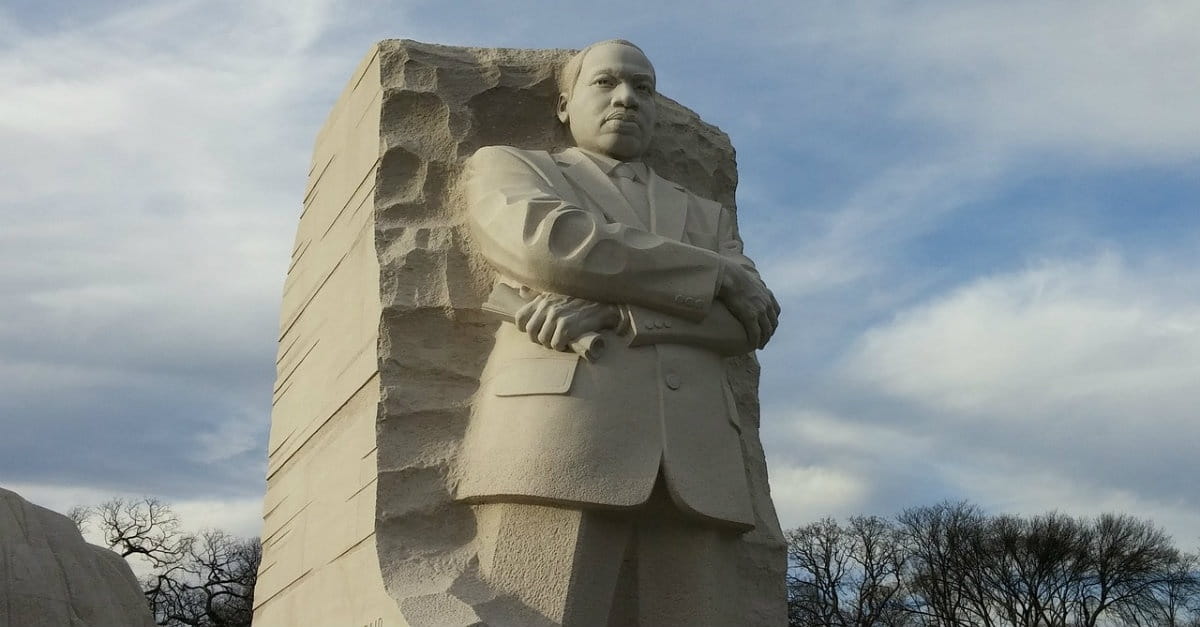
Martin Luther King Jr. On Christianity and the Gospel

31 Powerful Quotes by Dr. Martin Luther King, Jr.

Today is Martin Luther King Jr. Day in the United States, the day when we commemorate the civil rights leader, who was also an ordained Baptist pastor.

I’ve written before about MLK Jr.’s letter to fellow pastors from his jail cell in Birmingham, and about his most famous speech.

Here are a few things he said about Christianity and the gospel:

1. “The end of life is not to be happy, nor to achieve pleasure and avoid pain, but to do the will of God, come what may.”

2. “There is so much frustration in the world because we have relied on gods rather than God. We have worshiped the god of pleasure only to discover that thrills play out and sensations are short-lived.”

3. “The early Christians rejoiced when they were deemed worthy to suffer for what they believed. In those days the Church was not merely a thermometer that recorded the ideas and principles of popular opinion; it was a thermostat that transformed the mores of society.”

4. “If any earthly institution or custom conflicts with God’s will, it is your Christian duty to oppose it.”

5. “We need to recapture the gospel glow of the early Christians who were nonconformists in the truest sense of the word . . . Their powerful gospel put an end to such barbaric evils as infanticide and bloody gladiatorial contests.”

6. “Faith is taking the first step even when you don’t see the whole staircase.”


Taking Back the Story of Saint Nicholas

December 6 is the feast day of St. Nicholas. Particularly in Europe, it is celebrated as St. Nicholas Day, and the tradition is to put chocolate and gifts into the children’s shoes for them to find in the morning – a tradition that my wife keeps in our home.

I don’t know if you’ve met them or not, but there are some Christians who think that Santa Claus is evil and that he takes away from the true meaning of Christmas. Not to mention, some would point out, that Santa is nothing more than a misspelling of SATAN, which must be why he goes around in those obnoxious red clothes: because he is from HELL and wants to take you and your kids back there with him!
This of course, is based on a sad lack of knowledge regarding the origin of Santa Claus – the name (in English) being simply a direct derivative of “Saint Nicholas”.

For this reason, some Christians protest anything to do with Santa Claus, and tell their kids that Santa is not real, he is bad, and he takes away from the true meaning of Christmas, which of course is Jesus.

This Christmas season, as we do every year, we will tell our kids the story of the real Saint Nicholas – who was not a mythical fat man in red clothes who rode through the skies on a sleigh pulled by flying reindeer, but a devout Christian man, a pastor, who was persecuted for his faith, and gained fame because of his generosity to the poor and needy.

We don’t avoid Santa Claus – we don’t even want to. We see it as a great opportunity to teach our kids about a great Christian man who loved Jesus and was generous and kind because of the love of God which was in his heart. THAT is the “Christmas spirit”.

We tell our kids that there are many people in the world who want to follow the example of Saint Nicholas, and that is why they will meet a Santa at their school and at the mall – and some of them will have very fake beards, because none of them are the real Saint Nick. We also teach our kids that, as Christians, we want to be like Saint Nicholas too, and we are going to be generous to the poor and needy too because God loved us so much that he gave us his Son, Jesus, so that we could have eternal life and have a relationship with God.

The Story of the Real Saint Nicholas

The real Saint Nicholas was born in the 3rd century in the village of Patara, in what is now southern Turkey, into a wealthy family. That’s right – no North Pole and reindeer for the real Santa, but palm trees and white sand beaches. His parents died when he was young, and he was taken in and raised by a local priest. Following Jesus’ call to the Rich Young Ruler (Mark 10:21) to “sell what you own and give the money to the poor”, Nicholas dedicated to use his entire inheritance to assist the sick, needy and suffering.
He became a pastor, and was later made Bishop of Myra. He became famous for his generosity and love for children.

Nicholas suffered persecution and imprisonment for his Christian faith during the Great Persecution (303-311) under Roman emperor Diocletian.
As a bishop, he attended the Council of Nicaea (325), at which he affirmed the doctrine of the deity of Christ against the Arian heresy.
Nicholas died in 343 in Myra. The anniversary of his death became a day of celebration, the Feast of St. Nicholas, December 6th.

As Christians, we should take back the true story of St. Nicholas

Many stories are told about St. Nicholas’ life and deeds. Perhaps the most famous story is one of a poor man who had three daughters who were of marrying age. Because the man was poor, he was unable to provide a dowry for his daughters, which meant that they would not be able to find a descent husband, and would either be married into further poverty or would have to become slaves. After Nicholas found out about this family’s situation, he visited the family’s house, leaving them 3 anonymous gifts – each time a bag of gold, which was tossed through an open window while the family was sleeping. Legend has it that the gold fell into their shoes, the reason for the tradition in Europe that St. Nicholas leaves gifts in children’s shoes. Nicholas provided for these poor girls to help them break out of the cycle of poverty.

My favorite story about Nicholas is what he did at the the Council of Nicaea, where bishops from all over the world gathered to study the scriptures and address the major doctrinal controversies facing the church. Chief among these was Arianism, propagated by Arius, which denied the full deity of Jesus, saying instead that he was a created being – a view that is carried on today by the Jehovah’s Witnesses. The debate got very heated, and based on the study of the scriptures, Arianism was deemed heretical. Nicholas argued from the scriptures for the deity of Christian and against Arianism, and at one point got so upset with something that was said about Jesus from the other side, that he slapped an Arian. That’s my kind of Santa!

Rather than trying to make Christmas Santa-free, let’s take back the true story of Saint Nicholas and take hold of this opportunity to talk about a Christian man who loved Jesus, championed good theology and exemplified Christ through compassion and generosity to the needy.

Cat’s in the Cradle

I realize it’s a little late to be posting about Father’s Day, but here goes:

On Father’s Day I preached a sermon in our Parables of Jesus series about the Parable of the Sower called Lessons from the Dirt

After church we went out to lunch with my dad and then we drove to South Dakota for a few days away as a family in the Black Hills and the Badlands, that filled us with a strong desire to watch Dances with Wolves when we got back.

My family got me an ENO hammock for Father’s Day, which I look forward to getting a lot of use out of.

IMG_20170622_204930

I’ve always hated the song “Cat’s in the Cradle” by Harry Chapin. It’s a haunting and depressing message about how quickly kids grow up and about the regret of a father who wasn’t around for his son.  So I was glad when I came across this video put out by TD Ameritrade for Father’s Day of that song with re-worked lyrics, telling a different story of fatherhood.

https://youtu.be/Sb7M4fnaeZ0

See what great love the Father has lavished on us, that we should be called children of God! And that is what we are!   (1 John 3:1)

Happy Reformation Day!

luther-posting-95-theses-560x366

499 years ago today, Martin Luther – a German professor of theology, priest and monk, nailed his 95 Theses to the door of the All Saints Church (ironically on the eve of All Saints Day – AKA: Halloween) in Wittenburg, Germany. This act is considered the spark which ignited the Protestant Reformation.

If you own a Bible in your own language, that you can read any time you want, you have the Reformers to thank for that. It was not always that way; people fought for these things.

Before Luther, there were others who sought to bring reform to the church. John Wycliffe (1331-1384) published the first English translation of the Bible. Jan Hus (1369-1415) started a movement of the prolific teaching of the Bible to the common people, and was ultimately executed in Prague. Peter Waldo (1140-1218) commissioned a translation of the New Testament into the local vernacular of southern France. Each of these people were persecuted for trying to put the Scriptures into the hands of the common people.

In 1516, John Tetzel was sent to Germany to raise money for the building of Saint Peter’s Basilica in Rome. His means of raising money was the sale of plenary indulgences, which promised the release of a person from purgatory, based on their purchase.

The sale of plenary indulgences had been one of Jan Hus’ major contentions with the medieval Catholic Church, and Luther took issue with it as well: the idea that God’s favor or blessings could somehow be earned, not to mention purchased, was something he whole-heartedly rejected. Furthermore, the concept of purgatory is in conflict with the Biblical teaching of the sufficient atonement of Christ on the cross.

Luther had long struggled with feelings of condemnation and never being able to measure up, but had experienced an epiphany when he read Habakkuk 2:4: Behold, as for the proud one, His soul is not right within him; But the righteous will live by his faith.

This led Luther to the other places in the Bible where this phrase is repeated: in Romans 1:17, in Galatians 3:11, in Hebrews 10:38 – where the message is clear: It is not by our own works that we are justified before God, but it is God who justifies us as an unearned gift of His grace, and we receive that justification by FAITH. That is how Abraham became righteous (Abraham believed and it was credited to him as righteousness – Genesis 15:6; Romans 4:3 & 22), and that is how we receive God’s righteous, which he has provided for us in Christ!

Luther’s re-discovery of this Biblical truth came through his reading of the Scriptures. He became convinced that everyone needed to be able to read the Scriptures for themselves, and that the practice of the church at that time, of keeping the Scriptures out of the hands of the common people, was something that needed to end. He believed that people had the capacity and the right to read and interpret the Holy Scriptures for themselves. Luther himself, in the pursuant years, translated the Bible into German, a translation which is widely used to this day.

Luther came to believe that the Scriptures alone are the source of theology, that justification is by Christ alone through faith alone.

The 5 “solas” (alone statements) of the Reformation are:

  • Sola Scriptura (by Scripture alone)
    • The Bible is the only source of Christian doctrine
  • Sola Fide (by faith alone)
    • Justification is received by faith alone
  • Sola Gratia (by grace alone)
    • Justification is by God’s grace alone
  • Sola Christus (through Christ alone)
  • Soli Deo gloria (glory to God alone)

This October 31st, I hope you’ll remember that there is something much better than “fun size” candy bars: having God’s Word available to you, for you to read and understand yourself.

After all – what is “fun” about “fun size”?  There’s nothing fun about tiny candy bars. They should be called “sad size”…

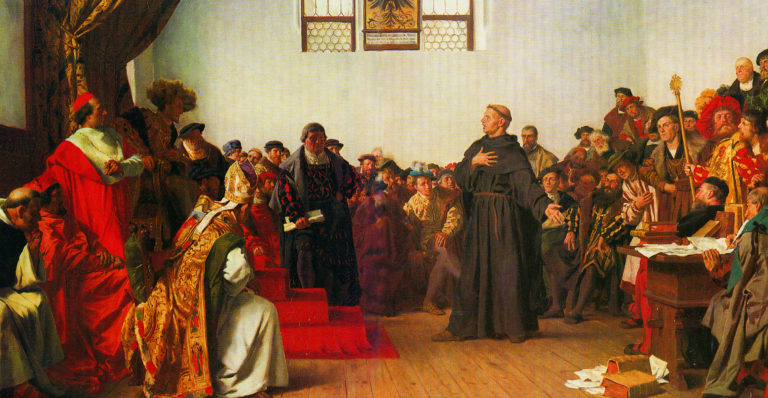
In April 1521, Luther was brought before Holy Roman Emperor Charles V at the Diet of Worms, at which Luther was commanded to recant his teachings. Luther thought he would have a chance to defend his ideas. Charles would only accept an absolute recantation. Luther refused to do so.

martin-luther-at-the-diet-of-worms-anton-von-werner-1877-768x398

Here is a portion of Luther’s statement at the Diet of Worms:

“Unless I am convinced by the testimony of the Holy Scriptures or by evident reason – for I can believe neither pope nor councils alone, as it is clear that they have erred repeatedly and contradicted themselves – I consider myself convicted by the testimony of Holy Scripture, which is my basis; my conscience is captive to the Word of God. Thus I cannot and will not recant, because acting against one’s conscience is neither safe nor sound. God help me.”

If the Reformers could speak to us today, they would tell us this: the Reformation never ends. It is a continual movement of returning to the Scriptures and examining our lives and our practices in light of them.

Happy Reformation Day!

The Impact on Kids of Dad’s Faith and Church Attendance

Dream Lake landscape  Rocky Mountain National Park

According to LifeWay Research Group, Fathers Day is the holiday with the single lowest average church attendance – statistically lower than Labor Day, Memorial Day and even the Fourth of July.

This is interesting, especially when you consider that Mothers Day tends to be the day with the third highest church service attendance, after Easter and Christmas.

So, Mothers Day is one of the most highly attended Sundays of the year, and Fathers Day is one of the lowest. What does this tell us?

Scott McConnell, director of LifeWay Research, gives this assessment:

“Clearly, mothers want to be present for the affirmation that is typically offered in most churches, but families also are present knowing their attendance will honor their mother.

The attendance difference between Mothers Day and Fathers Day is telling,” said McConnell. “Either churches are less effective in affirming fathers, or families believe Christian fathers don’t value their participation in worship services.”

Surely there are other factors involved, including travel and the time of year. On Mothers Day school is still in session, on Fathers Day it isn’t – so families travel to visit relatives, or go on vacation.

But all these factors and statistics aside, here’s what’s really striking: when you see the research on the impact of a dad’s faith and practice on their families.

According to data collected by Promise Keepers and Baptist Press, if a father does not go to church, even if his wife does, only 1 child in 50 will become a regular worshiper. If a father does go regularly, regardless of what the mother does, between two-thirds and three-quarters of their children will attend church as adults. If a father attends church irregularly, between half and two-thirds of their kids will attend church with some regularity as adults.

If a mother does not go to church, but a father does, a minimum of two-thirds of their children will end up attending church. In contrast, if a father does not go to church, but the mother does, on average two-thirds of their children will not attend church. 

Another study, focused on Sunday School, found similar results on the impact of fathers:

  • When both parents attend Bible study in addition to the Sunday service, 72% of their children attend Sunday school when grown.
  • When only the father attends Sunday school, 55% of the children attend when grown.
  • When only the mother attends Sunday school, 15% of the children attend when grown.
  • When neither parent attends Sunday school, only 6% of the children attend when grown.

Another survey found that if a child is the first person in a household to become a Christian, there is a 3.5% probability everyone else in the household will follow. If the mother is the first to become a Christian, there is a 17% probability everyone else in the household will follow. However, when the father is first, there is a 93% probability everyone else in the household will follow. 

Here’s the point of all these statistics: Dad’s impact on the kids’ faith and practice is HUGE.

Dads, let me encourage you with these words which Moses spoke by the inspiration of the Holy Spirit to the dads of the new generation in Deuteronomy:

And these words that I command you today shall be on your heart. You shall teach them diligently to your children, and shall talk of them when you sit in your house, and when you walk by the way, and when you lie down, and when you rise. You shall bind them as a sign on your hand, and they shall be as frontlets between your eyes. You shall write them on the doorposts of your house and on your gates. (Deuteronomy 6:6-9)

Obligatory Post Bemoaning Black Friday

As a pastor, there are a few things you are expected to blog about at Thanksgiving:

  • Thanksgiving is the best holiday ever.
  • Black Friday is the worst thing that has ever happened, ever. It is the epitome of American consumerism encroaching on family.

This week, the Longmont Times-Call ran an article about a woman who is heading up an initiative to take turkey sandwiches to employees of businesses that are open for sales on Thanksgiving day. Nice, right? Well, the lady heading it up also mentions in the article that she is planning to take her family out to eat at a restaurant on Thanksgiving day, so they can spend time together rather than spending the day cooking. Um… is she the only one who doesn’t see the irony in that? In the comments section, she claims that the difference is that retail workers ‘have to be there on Thanksgiving even though they would rather be with their families.’ I guess the restaurant workers are at work by choice on Thanksgiving day…and wouldn’t rather be home with their families?

Here’s my take on Black Friday – sales are awesome. But we should limit this whole thing to the internet. That way everyone can stay home with their families, and we can all get great prices on stuff without having to leave the house or wait in line in the cold at night. I think it would be a win-win.

Hope you have a great Thanksgiving!

I will give thanks to the Lord with my whole heart; I will recount all of your wonderful deeds. (Psalm 9:1)

In case I forgot to mention it: Thanksgiving is the best holiday ever.