Here are some upcoming events I’ll be attending. I would love to have you join me if you are in the area, or pass the info on to anyone you know in these places.
January 27-31, 2020: Calvary Chapel European Pastors & Leaders Conference – Millstatt, Austria. More information and registration: http://eplc.calvarychapel.com/
February 21-22, 2020: Expositors Collective Training Weekend – Las Vegas, Nevada. More information and Registration: https://www.expositorscollective.com
March 7, 2020: Expositors Collective Training Day – Budapest, Hungary.
March 10, 2020: Ukrainian Evangelical Theological Seminary – Kyiv, Ukraine. More information: https://www.uets.net/
Our church’s website was recently updated, including a major overhaul of the sermon archive, which now allows you to browse by series and books we have taught through. Check it out here: White Fields Community Church Sermons
If you haven’t done so yet, you can subscribe to our podcast here, or just search White Fields Community Church in whatever podcast app you use. If you like what you hear, please rate and review us, as that helps boost us in their algorithm, and helps other people discover us.
I recently switched to the Overcast app for listening to podcasts. I like that it cuts out pauses and regulates audio to a consistent level, and allows me to make playlists. Overcast is only available for iOS, but the best app for Android, which has many of the same features is Podcast Addict. My wife’s biggest hesitation with switching to an iPhone recently was that she would lose Podcast Addict.
These sermons I preached in 2019 were listened to and downloaded the most:
A few things pop out at me from this list. First of all, the fact that some of our more recent sermons are in the top ten means that listenership to our podcast is increasing.
Secondly our biographical look at the prophets, called “Remember the Prophets” was a lot of fun. Those books and their authors are often overlooked for various reasons, but their messages are very important.
Finally, our apologetics series “I Could Never Believe in a God Who…” was our second consecutive year doing a series like this, and clearly it struck a chord with a lot of people. These kinds of series are helpful both for engaging with those who might be skeptical about Christianity, and for teaching Christians how to respond well to those who ask questions. Oftentimes many of us who are Christians struggle with questions even though we choose to trust God and believe. As the church we engage with those issues and equip others to do so as well.
What Didn’t Make the List?
Leave me a comment below and let me know which sermon from this year made the biggest impact on you!
If need to refresh your memory, a list of our past sermons from this year can be found here: White Fields Sermons
We recently updated our website at White Fields Community Church. The bulk of the work was done by our Administrative Assistant: Ocean – and our friends over at CryBaby Design: a great company based here in Boulder County; check them out if you have any design needs.
Browse the site and let me know if you find any broken links or things that are out of order: whitefieldschurch.com
Advent Series
Also, this Sunday we are starting a new series for Advent called God With Us.
In our first message, we will be looking at one of the most over-looked episodes in Christmas story: the killing of the innocent children by King Herod, and why this story illuminates important aspects of who Jesus was and why He came as the promised Savior to defeat evil and reconcile us to God.
If you’re in Longmont, or nearby on Colorado’s Front Range, we’d love to have you join us on a Sunday this Advent. More information here.
Dictionary.com defines the word “preachy” as: “tediously or pretentiously didactic.”
Apparently this is what the word “preaching” evokes in the minds of many people. Perhaps for this reason, some people I have encountered have suggested that churches abandon the word “preaching” in favor of the word “sharing.” Rather than someone “preaching a sermon,” they suggest we ought to have someone “share a message.”
Is this just splitting hairs? Does it even matter?
A Matter of Semantics…
Semantics: the branch of linguistics that deals with the meanings of words and sentences
Words do matter. Words not only convey meaning, but the reason we have synonyms, i.e. multiple words for a given thing, is because each of these words relates to a slightly different way of thinking about or portraying that thing, and different words convey different feelings.
At the same time, words are culturally shaped, and the meaning of a word can change over time – even if it refers to an objective reality which does not change. Western society, with its emphasis on equality, tends to be more inclined to a word like “sharing” as opposed to “preaching.”
A Biblical Matter
However, we must also recognize the fact that the Bible uses the word “preach” over 150 times (in the NKJV), and doesn’t use the word “share” at all in the sense of speaking with other people about God.
I remember talking to someone once who claimed that Jesus only “taught”, he didn’t “preach”. Her point was that Jesus wasn’t “preachy”; the only problem with her argument is the fact that there are dozens of verses which tell us that Jesus preached. In fact, not only does it say that Jesus preached, but Jesus himself said that the very reason He came was to preach, and then he trained and commissioned his disciples to preach.
“I must preach the kingdom of God…because for this purpose I have been sent.” (Jesus in Luke 4:43)
A Practical Matter
To preach means to proclaim. It means to announce and declare something.
Martyn Lloyd-Jones said that what makes preaching unique, is that the one who preaches “is there to ‘declare’ certain things; they are a person under commission and under authority… an ambassador [who] comes to the congregation as a sent messenger.” [1]
To preach, in the biblical sense, therefore, is not to speak on one’s own authority, or to share one’s own thoughts. Preaching, in the biblical sense, is to convey a message from God to people.
For this reason, I believe we should hold onto this biblical term. However, I believe it is important that our preaching should not be preachy, i.e. “tediously or pretentiously didactic.” It should not be condescending, and it should come from a person who understands and conveys that they are the equal of their listeners – and yet, they come to them not with their own ideas and musings, but with a message from God which deserves their utmost attention.
Martyn Lloyd-Jones on the Role and Importance of Preaching
Here are some further quotes from Martyn Lloyd-Jones on preaching, from his classic Preaching and Preachers:
The most urgent need in the Christian Church today is true preaching; and as it is the greatest and the most urgent need in the Church, it is obviously the greatest need of the world also.
You cannot read the history of the Church, even in a cursory manner, without seeing that preaching has always occupied a central and a predominating position in the life of the Church.
At this point, Lloyd-Jones clarified that ministry to and care for the poor and marginalized is a ministry and a duty of the church, it must happen simultaneous to, not in place of, the proclamation of the Word of God. He points to Acts 6 to make this point, where the apostles appointed deacons, capable people full of the Holy Spirit, to ministry to the needs of the needy in their community, so that they could devote themselves to prayer and the ministry of the Word, deeming it improper for them to neglect those things.
Paul’s last word to Timothy was: ‘Preach the word; be ready in season and out of season; reprove, rebuke, exhort with all longsuffering and doctrine.’
What is it that always heralds the dawn of a Reformation or of a Revival? It is renewed preaching.
Preaching is logic on fire. It is theology coming through a person who is on fire.
The chief end of preaching is to give men and women a sense of God and His presence.
Preaching should make such a difference to those who are listening, that they are never the same again.
The preacher cares about the people they are preaching to; that is why they are preaching. The preacher is anxious about them; anxious to help them, anxious to tell them the truth of God. So they do it with energy, with zeal, and with obvious concern for people.
May God use us to preach, teach, and share His truth with others, so that hearts, minds, and lives will be changed for the better.
Recently I sat down with Matthew Spencer of #LongmontPrays, a local initiative to encourage prayer in Longmont.
In this interview, I share some thoughts on prayer, such as that intimacy is created through shared experience, and we get to share experience with God through prayer, thus building intimacy.
We go on to talk about Jesus and how he was the embodiment of God’s glory, and that he showed us by example what it means to be dependent on the Father.
Check out the interview; I hope it encourages and blesses you!
White Fields Church is excited to host our 9th annual Easter Egg Hunt & Festival on Saturday, April 20th in Longmont’s Roosevelt Park, in partnership with Longmont Recreation.
This event has grown over the years to become the largest event of its kind in Boulder County and we hope it will become a true Longmont tradition.
The event starts at 10:00 AM, and will include an egg hunt as well as a puppet show, inflatable obstacle courses and bounce houses, face painting and a craft station.
We will have a coffee truck on-site making craft coffee drinks, as well as our friends from GraceFM who will be handing out t-shirts and other swag for free.
It’s fun for the whole family and we hope you will join us!
Easter Sunday
We also invite you to join us on Easter Sunday at White Fields Community Church to celebrate Jesus’ resurrection, the reason we can have hope!
We will have two services on Easter Sunday, at 8:45 & 10:30 AM.
There will be a nursery (birth-2 years) and a wiggle room available at the 8:45 service, and full children’s ministry available at the 10:00 service (birth-middle school).
Join us, and invite a friend or family member to join you, as this is one of the occasions when many people who don’t regularly attend church say that they would attend if invited by a friend or family member. Don’t miss that opportunity!
A few weeks ago, I posted an anonymous poll here on the site, in which I asked the question: How would you, or others you know, finish this sentence: “I could never believe in a God who ________”? (click here for that post)
If you haven’t filled out that poll yet, you can access it here.
I got a good number of answers, but the bigger the sample size, the better for this sort of thing, so I would love it if you would go over and fill out the poll and send it to others who wouldn’t mind giving their voice.
This poll was done in preparation for a sermon series we will do at White Fields starting April 28, the week after Easter.
Here’s what the poll results have shown so far:
Theodicy is the biggest issue for those who took our poll
The top two responses were: “I could never believe in a God who:”
Sends people to Hell
Allows bad things to happen to good people
There were several write in answers which were related to these two, such as: “I could never believe in a God who:”
Can heal, but doesn’t heal all
Allows good people to die, but lets awful people live
Allowed the Sandy Hook massacre
Allows miscarriages
Chooses some and not others
These issues all fall under the category of Theodicy, which essentially means “the defence of God’s goodness”
The Trilemma of Theodicy
Very famous in this regard is what is called the trilemma of theodicy. A trilemma is like a dilemma, only instead of two issues (di) that are at odds with each other, in a trilemma there are three (tri).
The trilemma of theodicy states that there are three things the Bible states are true about God, which cannot all be true at the same time:
God is loving
God is all-powerful
Evil exists
The argument goes that since evil exists, either: God must not really be loving, or God must not really be all-powerful. Either God is incapable of stopping evil, even though he’d like to – in which case he is not all-powerful, or God is capable of stopping evil, but chooses not to, in which case he must not be truly loving.
The logical flaw in the trilemma
The big flaw in this thinking is that it takes into account only two of God’s attributes: his love and his power.
But does God have only two attributes? Certainly not! God has a myriad of attributes, including that he is: all-knowing, providential, eternal, etc. Simply adding another attribute of God to the equation changes it fundamentally, and removes the “lemma” out of the tri-lemma!
For example, if we say that God is not only loving and all-powerful, but also all-knowing and/or providential, it changes things completely. It means that it is possible for God to allow bad things and use them for good purposes, and even for our ultimate benefit. The fact that God is eternal reminds us that comfort in this life is not the pinnacle of existence, therefore it is also possible for an eternal God to allow temporal hardship in order to work an eternal good purpose. The Bible says this explicitly in 2 Corinthians 4:17 – For this light momentary affliction is preparing for us an eternal weight of glory beyond all comparison.
An Unloving God Who Creates Unloving Followers?
Following closely behind in popularity were: “I could never believe in a God who:”
Doesn’t affirm some people’s sexuality
Creates hateful and hypocritical followers
Surprising Lesser-Issues
To my surprise, the questions which seem to not be major issues in people’s minds are were:
The reliability of the Bible
Proof of the existence of God
I wonder if this is the result of much effort put into these areas by Christian apologists, including CS Lewis with Mere Christianity and Timothy Keller with The Reason for God, or if, on the other hand, Christians are putting a lot of effort into questions which people don’t currently perceive to be pressing questions which cause them to be skeptical of Christianity. Either way, these issues are certainly fundamental to Christian faith and belief, and speaking into them can hardly be said to be in vain.
Other lesser-issues, which I expected would receive more responses were:
Apparent genocides in the Old Testament
Suppression and subjugation of women and minorities
I wonder if the reason for this is because there are very well-known evidences that Christianity and the Bible have done more to encourage the uplifting of women and minorities around the world, evidenced by the fact that wherever Christianity has gone in the world, women and minorities have been empowered and there has been movement towards equal rights, equal pay, etc. Surely there is room for improvement in these areas, but the point is that the Bible provides the theology which empowers women and promotes equality for people of all races. How it is implemented is a human issue.
More to Come
I will write more on some of these issues in the weeks to come, and will address them in the upcoming sermon series.
In 2018, the Chinese government acted to crack down on unregistered Christian churches. These churches are sometimes called “house churches,” which is a misleading term, since many of these churches have hundreds, even thousands of members and own their own buildings.
Chinese law requires Christians to worship only in congregations registered with the Three-Self Patriotic Movement, a government-sanctioned organization which manages churches. Millions of Chinese Christians meet in unregistered churches which defy these government regulations, seeing them as compromising the church, especially considering the Communist government’s atheistic agenda.
Over the past few months, the Chinese government has stepped up their persecution of Christians by destroying crosses, burning Bibles, confiscating religious materials and closing churches, even demolishing their buildings, as can be seen in this video:
The pastor of that church, Wang Yi, a former human-rights lawyer and law professor, who has been an influential intellectual in China, issued a statement along with other Chinese Christian leaders titled: “My Declaration of Faithful Disobedience,” in which they stated that they would not cease gathering together for worship and studying the Bible.
Additionally, around 500 Chinese Christian leaders have signed a document called “A Declaration for the Sake of the Christian Faith,” in which they stated that they were prepared to bear all losses, even the loss of their freedom and their lives, for the sake of the gospel.
For Chinese Christians, gathering together for worship and Bible study is an act of resistance and social disobedience. It brings with it the possibility of arrest, punishment and persecution. And yet – believers are resolute: they will not stop gathering for public worship services, no matter what the cost.
American Apathy
At the same time, on the other side of the world, the American church is seeing a rising wave of apathy.
However, other reports show that while reports of the decline of Christianity in the US may be overstated, there is a growing sense of apathy in regard to church attendance.
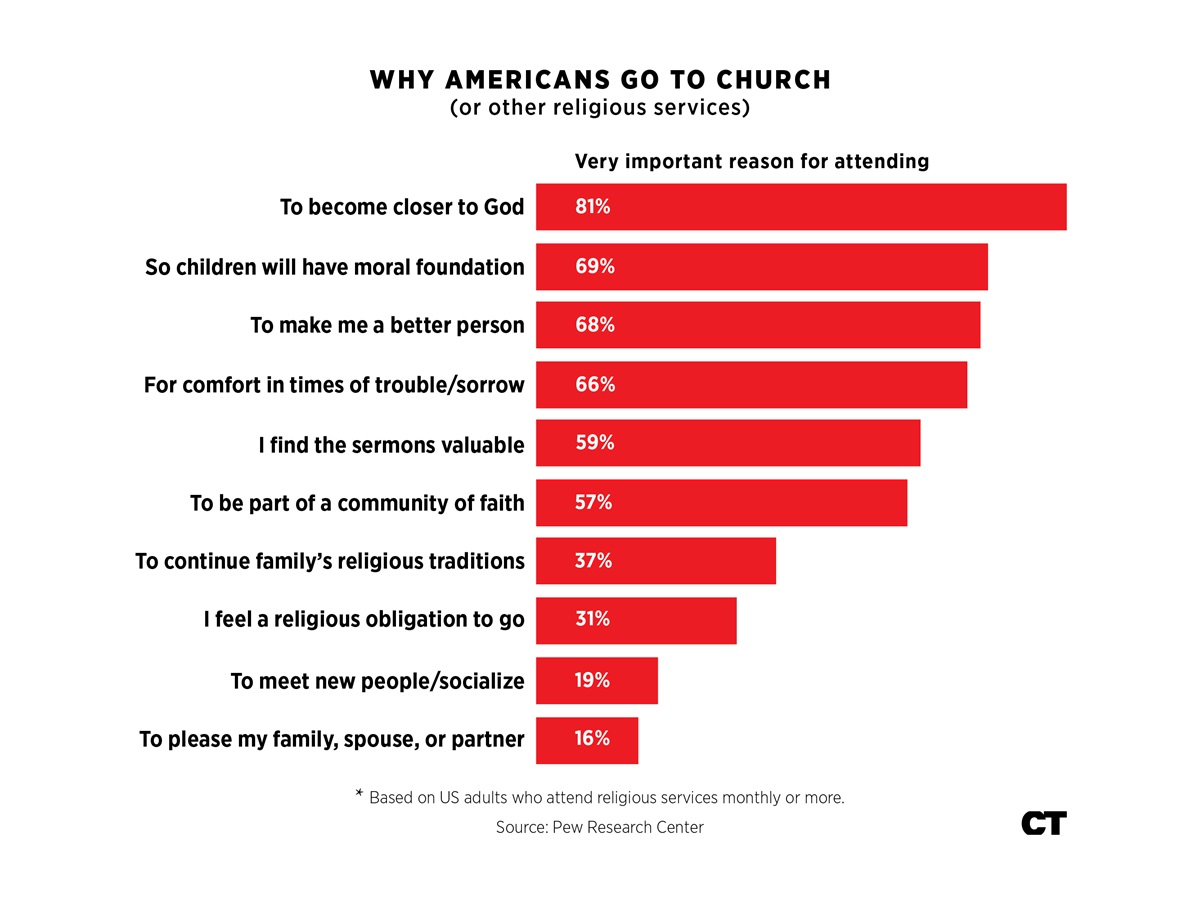
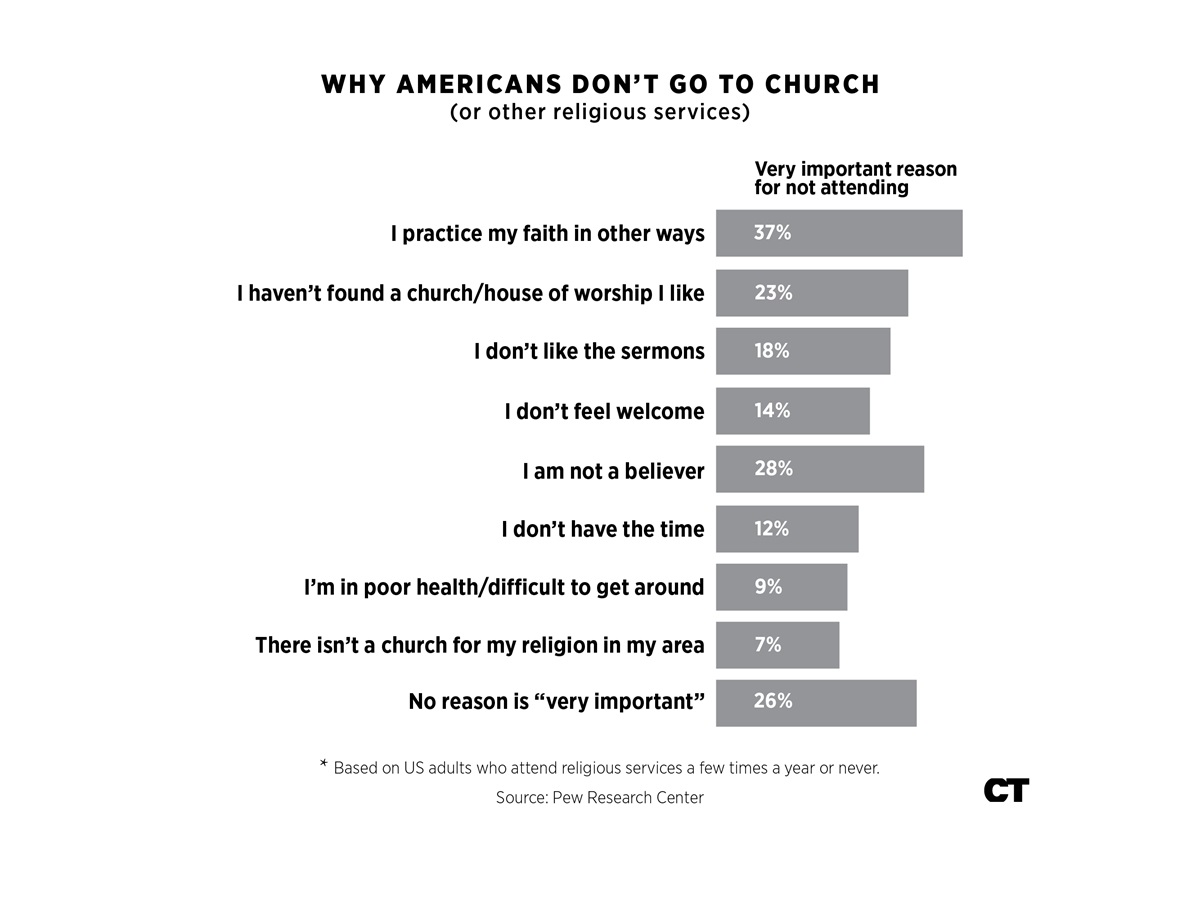
Christianity Today recently published these infographics based on data from Pew Research Center:
Two significant things that these infographics reveal: 1) Americans view Christianity as being important for the purpose of moral formation, 2) Americans tend to think that church is superfluous when it comes to Christian faith.
The Irony
Comparing the Chinese situation with the American one, what we see is that the people who stand to lose the most from going to church (the Chinese) are the most resolute in doing so, even though doing so will likely hurt them financially, socially, and even physically. Conversely, those who have the most freedom and stand to lose nothing are the most apathetic about public worship.
Whereas many Chinese Christians see gathered worship as central to their faith, something they absolutely cannot give up or do without, and an act of resistance – many American Christians see it as extraneous.
Who is Right?
I believe that we in the West can afford to learn something from our brothers and sisters in the East.
Christianity was formed and grew in the crucible of persecution, and perhaps the worst thing for Christians is to experience such ease and comfort that we lose the understanding that following Jesus is a radical and subversive thing in this world.
Perhaps the greatest danger our faith can face is not direct persecution, but patronizing “pats on the head” and people thinking that Christianity is “nice”.
Sinclair Ferguson has put it this way:
“We are not saved individually and then choose to join the church as if it were some club or support group. Christ died for his people, and we are saved when by faith we become part of the people for whom Christ died.”
Recently I read an article by Simon Chan from the theological journal Pneuma, in which he very astutely wrote this:
[Western Christians] have a very weak sociological concept of the church. This has two negative consequences. First, the church tends to be seen as essentially a service provider catering to the needs of individual Christians. Rarely are individuals thought of as existing for the church. When the church is seen as existing for the individual, then the focus of ministry is on individuals: how individual needs can be met by the church. But when individuals are seen as existing for the church, the focus shifts from the individual needs to our common life in Christ: how we as the one people of God fulfill God’s ultimate purpose for the universe, namely, to glorify and enjoy God forever.
Chan is challenging us to ask the question: Contrary to our consumeristic mentality, isn’t it actually true that the church does not exist for us as much as we exist for the church, and the church exists for God?
I believe that we in the West can afford to look to the East and learn from our Christian brothers and sisters in China about the importance of gathered worship.
One of Aesop’s fables tells the story of a man who found a goose who laid golden eggs. Every morning, he went and found another golden egg that the goose had laid, until one day he became greedy, and decided to cut the goose open so he could get more golden eggs. Of course, by doing so, not only did he not get any extra golden eggs, but he also ceased getting the daily eggs he had previously received, since the goose was now dead.
The point of the fable, Aesop said, is that greed often overreaches itself. However, like with most parables, there are several applicable truths packed into this very short story.
Many of the best things are acquired indirectly
The golden eggs in the story represent a desired outcome: something you want. For you, that might mean spiritual growth in your relationship with God, it might mean increased knowledge of the Bible or theology. It might mean deep and meaningful friendships, developing a skill, or increasing your success in your work. It might be making an impact on the world around you.
But what this fable illustrates for us, is that whatever the “golden egg” is for you, it is usually acquired indirectly. When the man in the story pursued the golden eggs directly, seeking to bypass the goose, he ended up with nothing, and killed the thing which gave him that which he wanted.
CS Lewis writes about how friendship works in a similar way. Friendship, he points out, must be about something else other than the friendship itself. The basis of a friendship is that both people are committed to and passionate about something beyond their friendship. “This is why,” Lewis says, “those pathetic people who simply ‘want friends’ can never make any.” “Those who have nothing can share nothing,” he points out, and concludes: “those who are going nowhere can have no fellow travelers.” (The Four Loves, ch. 4)
The same is true of spiritual growth. To quote from John Piper: “Doctrine is the fuel for worship.” The way to grow, the way towards deeper worship, is indirect: it is through getting to know more about who God is and what He has done and will do, which fuels growth and worship.
If you’ve ever met someone who is purposefully seeking to “climb the ladder” or make a name for themselves in an organization or community, it often backfires, because it is seen as off-putting and self-serving. On the other hand, those who make a practice of genuinely and faithfully serving others will not remain anonymous for very long.
If you want to keep getting “golden eggs”, then make sure you feed the “goose”
The goose in the fable is the thing which you must “feed” in order to get the desired results.
If your goal is spiritual growth, then to “feed the goose” means to do those things which will result in spiritual growth, e.g. reading the Bible, prayer, attending worship services, joining a community group.
At White Fields, something our leadership has done is develop a plan that guides us in doing the qualitative activities which we believe will lead to our desired outcome (our vision): to build and foster a passionate, engaged and spiritually healthy Christian community to influence and bless Longmont and beyond. The way we go about doing this (our mission) is by making disciples of Jesus Christ through teaching the Word of God, engaging in the mission of God, and raising up leaders. In order to accomplish that mission, we have tried to determine what things we should be doing, which will lead to those outcomes.
The same is true on a personal level: a few years ago, after a doctor visit in which I was told I was pre-diabetic, I decided I wanted to get in better shape. Since running seemed to give the best return on investment, I decided to do that. Rather than setting weight-loss goals, I’ve set running goals, knowing that if I run a certain amount, whether I lose weight or not, I will be in better shape.
Make sure that the “golden eggs” you’re after are godly and aligned with God’s heart and will for your life, and then determine what the “goose” is that will produce that outcome, and feed that goose.
Moving beyond good intentions and wishful thinking
I have found that using my calendar is the best way to make sure I’m feeding the “goose”.
Reading through the Bible in a year is a great goal, as is family devotional time and committed church attendance. However, if you don’t use your calendar to block out times for those things, they won’t often move beyond the realm of good intentions. I have found that by putting things in my calendar, I am able to prioritize things according to my values, rather than being a slave to the “tyranny of the urgent.”
May God lead you, as you seek Him, to determine the right “golden eggs” to pursue, the right way to “feed the goose” and the ability to be intentional in doing so.











 Theology for the People