Why Did Jesus Tell Some People to Keep Quiet about His Miracles and Identity?

I received this question from a reader:
There are a number of times in the gospels that Jesus performs a miracle and then tells the person healed and those who witnessed to not tell anyone…. I wonder: why?
The obvious answer from a human perspective is because he feared the Jews and those who wanted to shut him down. But since He is God, why would he not just be glad for the good news to spread far and wide? Being fearful of sinful men strikes me as not really his nature…
Thanks for this question, this is one that many people wonder about. Here are a few things to consider which help us understand why he did this on occasion:

Sometimes Jesus told people not to tell others about his miracles and identity, but other times he told them to tell everyone.

There are three main instances in which Jesus instructed people not to tell others who he was or what he had done:
  1. After confirming to his disciples that he was indeed the Messiah, Jesus instructed them not to tell anyone. (Matthew 16:20; Mark 8:29-30; Luke 9:20-21)
  2. Jesus healed a leper and told him not to tell anyone that it was he who had done this. The man, however, did not comply with this request. (Mark 1:40-44; Matthew 8:1-4; Luke 5:12-15)
  3. Jesus told demons not to speak about him and tell others who he was. (Mark 1:34, 3:11-12)

Conversely, there are occasions where Jesus tells people to go out and tell everyone what he did for them:

  1. Mark 5:18-20 (also found in Luke: 8:38-39): As he was getting into the boat, the man who had been possessed with demons begged him that he might be with him. And he did not permit him but said to him, “Go home to your friends and tell them how much the Lord has done for you, and how he has had mercy on you.” And he went away and began to proclaim in the Decapolis how much Jesus had done for him, and everyone marveled.
  2. Matthew 28:18-20 (also Mark 16:15-16): And Jesus came and said to them, “All authority in heaven and on earth has been given to me. Go therefore and make disciples of all nations, baptizing them in the name of the Father and of the Son and of the Holy Spirit, teaching them to observe all that I have commanded you.

What was the reasoning behind these different approaches, and why would Jesus ever tell people not to tell others what he did or who he was?

Here are two reasons:

A Matter of Publicity

One problem with people spreading the word about Jesus healing them was that it resulted in large crowds following him around. This was the case with the leper who did not comply with Jesus’ request that he keep quiet about it. That man went out and “began to talk freely about it, and to spread the news,” and the result was: “so Jesus could no longer openly enter a town, but was out in desolate places, and people were coming to him from every quarter.” (Mark 1:45)

If everyone was crowding around him trying to touch him and clamoring to be healed, it would be harder for him to preach – and preaching, not healing, was his primary objective (see Luke 4:42-43).

When it came to demons, Jesus understandably didn’t want demons to be proclaiming who he was, lest people associate him with demons, or they misrepresent him.

Furthermore, the Jews had many misconceptions of who the Messiah was going to be. Some didn’t believe there would be a Messiah; others thought there would be two Messiahs (a king descended from David and a Levite priest); still others were waiting for a warrior-king to overthrow the Romans. In many cases, Jesus wanted to introduce himself to people first, before telling them that he was the Messiah, so he could teach them things without the baggage of their expectations influencing the way they heard the things he said to them.

A Matter of Timing

Jesus had a very keen sense of timing.  According to prophecy, he had to die in Jerusalem at the Passover. (For more on that, check out: Easter Math: How Does It Add Up?)

There are several passages which show Jesus’ sense of timing and his caution to not come out too early.

  • John 2:4: Jesus tells his mother that the time to begin his ministry had not yet come.
  • John 7:6: when his brothers challenged him to go to the festival, Jesus tells them that “the right time for me has not yet come.”
  • Luke 9:51: it says that the time was approaching for him to be taken to heaven, and at that time, he turned his face resolutely toward Jerusalem.

In John 6:15 we read that some people, hearing that Jesus was the Messiah, wanted to come and make him their king, by force!

However, once the timing was right, Jesus revealed himself as king on Palm Sunday (Matthew 21), and encouraged his followers to tell everyone. For Jesus, this was a matter of publicity and timing.


David Silverman, American Atheists and the Attempt to be Good Without God

Last week American Atheists issued a statement that they had fired their firebrand president of many years, David Silverman, as a result of moral failure.

In an interview, a spokesperson for American Atheists stated that Silverman was dismissed because of an issue regarding promotion of a recent book, as well as for a conflict of interest issue where he promoted a girlfriend to a high level position. It then came out that there were accusations of sexual misconduct with two other women who had come out to the media. Right before that story broke, American Atheists’ board quickly met to dismiss David Silverman.

The thing which is most intriguing about the statement from American Atheists is the closing sentence:

We have zero tolerance for the type of behavior alleged in these accounts. We will continue to demand the highest standards and accountability from our leaders, staff, and volunteers.

This brings up several very important issues:

If morality has no basis, then it is only opinion.

In the above statement, they mention demanding “the highest standards”. What are those standards, and how do they determine them?

The idea that people can be good without God is a major tenant of modern popular humanism and atheism. Many atheists would suggest that their ability to be good without God shows that they have more inner fortitude than “religious” folks, because they don’t need to have a threat of punishment over them in order to coerce them into good behavior.

Christians who understand the gospel are actually willing to agree with this in one sense. Belief in God does not automatically mean that a person will be morally superior to those who do not believe in God. It should not surprise Christians to find atheists or people who follow other religions who are honest, hard-working, kind people. After all, people do not become Christians by their moral effort but by their trust in God’s gracious work on their behalf.

The question is: is morality an innate thing, which people intuitively know, or is it a social construct?

Most prominent atheist thinkers argue that it is a social construct. As I have written about before – see “Why Ethics Depends on Origin” – prominent atheist writers say that ethics are not based in reality, they are social constructs which help our society to function better.

But what about when they don’t?

For example, eugenics (the science of improving a human population by controlled breeding to increase the occurrence of desirable heritable characteristics) might actually help our society function better. If we were to abort all babies who were seen to have disabilities, if we were to forcibly end the lives of those who are a drain on society, then wouldn’t that be a benefit to society? That’s what the Nazis and others in the 19th and 20th Centuries suggested… And yet people push back against that and say it is wrong. Why? If morals are not actually based in reality but only exist to help society, then why not take that thought to its logical conclusion?

The reason is because:

Nobody believes that morality is only a matter of opinion.

The idea that morality is a social construct brings up other big questions, such as: what if my morality is different than your morality?

For example, David Silverman has denied any wrongdoing in regard to the above mentioned allegations. Essentially, he is saying that he thinks the things he did were just fine. In other words, the idea that he did something wrong is just the company’s opinion.

It could be argued that male-initiated, non-consensual sex is practiced regularly in some cultures of the world. So, they can’t really say that what he did was wrong, only that they didn’t like it.

The problem is: nobody actually believes that. We all believe that rape, murder and the like are wrong. Even with people, like David Silverman, who claim that nothing is wrong with what he did, others look at it and say: That’s wrong – and it’s not just our opinion, it’s just flat out wrong.

Mark Clark puts it this way:

We do believe in right and wrong. We believe hurting a child is wrong. We believe raping and pillaging the environment is wrong. We believe all races should be equal. That there is such a thing called justice that tells us mercy is better than hate. That loyalty is a virtue, and that there is evil in the world. All of these convictions give meaning to our lives, but if there is no absolute right and wrong, all of them go away; they are but a mirage. Meaningless. Weightless. Worth abandoning with every other construct of modernity.

Case Study: The Sexual Revolution vs. the Vietnam War

Take the 1960’s and 1970’s for example: On the one hand, there was a “sexual revolution” in which people were saying “No one can tell me what to do with my body, don’t try to impose your moral standards on me.” And yet, those same people protested the Vietnam War by saying that it was unjust and immoral because of the use of bombs and napalm.

They didn’t want anyone to impose a moral standard (regarding sex) on them, but they didn’t think twice about trying to assert their moral standard (regarding war and napalm) on others. They said on the one hand that morality is subjective, and in the next breath they said that there is a morality which everyone should accept as normative.

Case Study: Arguments

CS Lewis begins Mere Christianity by talking about the topic of: arguments.

“That’s my seat, I was there first”—“Leave him alone, he isn’t doing you any harm”—“Why should you shove in first?”—“Give me a bit of your orange, I gave you a bit of mine”—“Come on, you promised.” People say things like that every day, educated people as well as uneducated, and children as well as grown-ups. Now what interests me about all these remarks is that the man who makes them is not merely saying that the other man’s behavior does not happen to please him. He is appealing to some kind of standard of behavior, which he expects the other man to know about. . . . It looks, in fact, very much as if both parties had in mind some kind of Law or Rule of fair play or decent behavior or morality or whatever you like to call it, about which they really agreed.

So, then – if morality is not merely a social construct, but is actually something we intuitively or innately know, then:

Morality points us to the existence of God.

The idea that there are some things that are right and some things that are wrong points us to the fact that there is a design. If there is a design, there must be a designer.

If there is a moral rule or standard, then there must be something or someone which determines this standard.

The Bible explains this point in this way:

“For when Gentiles, who do not have the law, by nature do what the law requires . . . they show that the work of the law is written on their hearts, while their conscience also bears witness” (Romans 2:14–15).

The fact that we are repelled by things such as sexual misconduct, lying and cheating, and that we advocate for equal treatment of all people regardless of their race, economic level, gender or physical ability – all those things things point to something beyond what is simply natural. They are proof of the fact that the heart of God is stitched into our very being.

Is Good Friday Actually “Good”?

thebible-crucifixion-630-jpg_225818

This is the day on which we celebrate the death of an innocent man – and not just any man: the greatest man who ever lived. It is the day when we remember that the Light of the World was overcome by darkness; that the Savior of the World was murdered by those He came to save.

Why in the world would we call this day “Good Friday”?

John Stott put it this way:

“The essence of sin is that we substitute ourselves for God; we put ourselves where only God deserves to be … that’s the essence of sin. But the essence of salvation is that God substitutes himself for us; God puts himself where we deserve to be … that’s the essence of salvation.”

2 Corinthians 5:21 says: “For our sake he (God) made him (Jesus) to be sin who knew no sin, so that in him we might become the righteousness of God.”

In this verse we see what it is that makes Good Friday so incredibly “good”. It is something we call “imputation”, and it has two sides: On the cross, God imputed your flawed record to Jesus, so that He could impute Jesus’ perfect record to you. On the cross, God treated Jesus as if he had lived your life, so he could treat you as if you had lived his life.

Jesus’ act of substitution, God’s act of imputation – lead to our reconciliation with God.

And the way to receive this gift of God’s grace, the Bible tells us, is to “receive him, who believe in his name.” (John 1:12) This kind of belief isn’t merely to believe that it happened, but to believe it personally, in the sense of trusting in it, relying on it, and clinging to it.

If you do that, then today will indeed by a Good Friday for you!

Overcoming Blind Spots

brand-perception-800x450

Have you ever heard a recording of your voice and been appalled by how it sounds? “Surely there must be something wrong with that recording,” we think, “because there’s no way that that’s how I really sound!”

But guess what: That’s how you actually sound to other people. The problem isn’t with the recording, it’s that your perception of how you sound doesn’t match the reality of how you actually sound.

From Time’s article: “Why Do I Hate the Sound of My Own Voice?“: “When you hear people talking, sound waves travel through the air and into your ears, vibrating your ear drums. Your brain then transforms those vibrations into sound. However, when you’re the one talking, your vocal cords and airways vibrate. That means you receive two sources of sound: the sound waves that travel into your ears, as well as vocal cord vibrations.”

What is true of our voices is also true of us in general: we aren’t very good judges of how we really are. There is some amount of discrepancy between our perception of ourselves and how other people see us.

We call these things “blind spots.” They are the things about ourselves that we do not see clearly, or are completely unaware of. They can be habits, attitudes, fears, insecurities or other idiosyncrasies.

For example: I can see things in my wife that she doesn’t realize about herself. She is blind to them, but I can see them. The same is true the other way around.

We all have blind spots, but if you were to ask me, “Hey Nick, what are your blind spots?”, my response would be: “How the heck should I know?! By definition they are things that I am blind to! – that I don’t see about myself!”

And oftentimes our blind spots are our greatest weaknesses; they’re the things which can do the most damage to us or hold us back from reaching our goals – they’re the things which will lead us into ruin and trouble!

If that’s the case, then we’ve got a big problem! Because if there are things about us which have the potential to hold us back and even hurt us or wreck us, but we are unable to see them, then we are in big trouble! What can we do to overcome our blind spots?

The only way to overcome our blind spots is by having other people in our lives whom we allow to get to know us well enough that they can see those things about us, and by giving those people permission to speak into your life.

Not any old person will do for this. It doesn’t take a genius to figure out what someone’s weaknesses or blind spots are, but it does take a loving person to be willing to come alongside someone and help them see their blind spots in a way that helps rather than hurts. This is why the Bible says, “Faithful are the wounds of a friend” (Proverbs 27:6). Critiques which come from those who are not committed, loyal friends may often be accurate, but they can often be crushing.

Recently at a conference I spoke about the importance of bringing other people into a creative process. In this case I was speaking particularly about writing sermons, but I believe it is true of other creative processes as well. In order for you to overcome your blind spots, you need people who can help you overcome your idiosyncrasies and weaknesses, but who will do it from a place of commitment and a desire to help. I have experienced this, not only on a creative level, but on a personal level as well.

In order to become the people God is calling us to be, we need brothers and sisters.

Let brotherly love continue. (Hebrews 13:1)

For more on the subject of Christian community, check out this recent message from White Fields Church:

Poll: Common Hurdles to Believing Christianity

Starting the Sunday after Easter, we will be doing a series at White Fields called “The Trouble Is…”, in which we will be talking about and addressing common questions and objections that people have about Christianity.

You can help me by taking a second to fill out this quick anonymous poll to let me know what are some of the biggest hurdles to faith that you have experienced yourself or encountered in other people. Thanks!

(email subscribers can click here to access the poll)

How to Read the Bible When You’re Struggling or Depressed

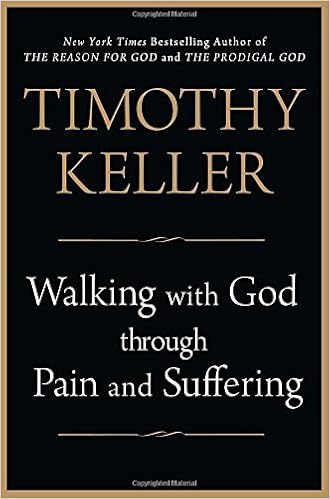
In his book, Walking with God Through Pain and SufferingTimothy Keller quotes from John White’s book, The Masks of Melancholy, in which the author recalls a time in his life when he was seriously depressed, and he says that during that time,

“what saved my soul was a dry-as-dust grappling with Hosea’s prophecy. I spent weeks, morning by morning, making meticulous notes, checking historical allusions in the text, and slowly I began to sense the ground under my feet growing steadily firmer. I knew without any doubt that healing was springing from my struggle to grasp the meaning of the passage.

If sufferers have any ability to concentrate, they should do solid inductive Bible study rather than devotional reading, because in most depressed people devotional reading is stopped altogether or degenerated into something unhealthy and unhelpful.”

White knew that when you are despondent, an effort to read the Bible devotionally (looking for inspiration and uplift) is not the answer. Instead, he counsels that you should read the Bible for content. Get the truth out of the text. Remind yourself of who God is and who you are in Christ, and what He has done for you. 

Keller then suggests that the Psalms are particularly helpful, because, not only are they filled with teachings about God, but they are prayers which cover the entire range of human experience. They show us people processing their condition before God. They are praying about their situation instead of merely thinking about it. We see Psalmists praying their tears, their doubts, their fears, their griefs, as well as their hopelessness – as well as their joys and blessings.

One of the things we learn from the Psalms is the practice of “defying ourselves” instead of simply listening to and submitting to our own thoughts. Keller asks, “Have you realized that so much of the unhappiness in your life is due to the fact that you are listening to yourself instead of talking to yourself?”

In Psalms 42 and 43, the Psalmist shows us how he uses this important strategy when he is discouraged: he defies himself and reminds himself who God is, what God has done, and what God has pledged himself to do. You may say to yourself, “It’s hopeless.” Defy yourself and answer back, “Well, that depends on what you were hoping in. Was that the right thing to put so much hope in?”

The Psalmist is defying himself, defying the devil and defying the whole world, by sending himself to God and determining to “praise Him still because He is my God.”

Read the Bible for content rather than inspiration. Fill your mind with the truth about God, and defy yourself when necessary.

5 Things to Keep in Mind When Making New Years Resolutions

There is a German saying: “Alles hat ein ende, nur die Wurst hat zwei.” (Everything has an end, only sausage has two [ends]).

As we approach the New Year, this changing of calendars gives us something to measure by. With the end of one year and the beginning of another, we have the opportunity to look back and assess the previous year, as well as to look forward and pray and plan for the year to come.

In his book, Finish: Give Yourself the Gift of Done, author Jon Acuff (who I first came to know about through his great blog: Stuff Christians Like) refers to a study at the University of Scranton(!) which determined that 92% of all resolutions go unfinished. Thus, in a world of bottomless possibilities and endless distractions, to be a person who finishes what you start is as rare, valuable and powerful thing.

92% of all resolutions go unfinished

I’ll admit to you right now, I’ve become a slight bit addicted to finishing things. If I start reading a book, I have to finish it, even if it’s bad (and I did read a few books like that this year). If I set a goal, I almost always finish it, even if it’s not always in a timely matter (like the 1.5 year landscaping project in my front yard).

I agree with what Ecclesiastes 7:8 says: “Better is the end of a thing than its beginning.” However, this in itself is one of the things which prevents people from completing their goals… Many people won’t even try to start doing something unless they are sure that they will be able to finish it. So they won’t even start exercising, because they are afraid they will give up.

Through Jon Acuff’s research, what he found is that the most common day that people give up on a goal is Day 2.

The most common day that people give up on a goal is Day 2.

In the past I was not a fan of New Years resolutions for the very reason that most of them don’t succeed, but perhaps I’ve become a bit less cynical (maybe I should have made that a resolution!), because I’ve really warmed up to the idea. So here are some things to consider when making resolutions and some tips on accomplishing them:

1. Don’t Neglect the Spiritual

The most common New Years resolutions are about 1) Health and Fitness and 2) Time Management. For Christians, we remember what Jesus said: that life is more than food, and the body more than clothing. (Luke 12:23) and that it is possible to “gain the whole world and yet lose your own soul.” (Mark 8:36).

2. Do Everything to the Glory of God

So whether you eat or drink or whatever you do, do it all for the glory of God. (1 Corinthians 10:31)
And whatever you do, in word or deed, do everything in the name of the Lord Jesus, giving thanks to God the Father through him. (Colossians 3:17)
I’ve spoken and written a lot on this topic recently in light of the 500th Anniversary of the Reformation. The idea of doing everything to the glory of God was a key teaching of the reformers, as they rebelled against the division of life into sacred and secular realms and showed that the Bible teaches that we should do everything we do for God’s glory, and if it is something which cannot be done for God’s glory, we should not do it.
For more on this topic see:

3. Set Goals That Are Not Easy, But Are Attainable

Jon Acuff mentions how many people will set a goal like running a marathon, but yet they underestimate the time and effort that goes into reaching a goal like that. He suggests instead setting a goal that is attainable, and exceed-able, such as running a 5k or 10k for someone who is not already a runner. Having reached that goal, you can set another. Whatever goal you set, it should stretch you, but it should still be attainable, if you want to increase the likelihood of success.

4. Write Them Down

God told the prophet Habakkuk to write down the revelation that God gave him and make it plain. (Habakkuk 2:2) As a result of Habakkuk and the other “writing prophets” writing down the visions that God gave them, we are now able to look back at them and have a record both of how God spoke to those people at that time, and how God fulfilled what He spoke to them.
Having a written record of a goal helps keep you accountable to yourself and motivated throughout the year. I like to keep a list in my desk and check it regularly.

5. Make it Fun

Jon Acuff points out that gaming your goals is one of the best ways to ensure that you make progress on them and don’t give up. So a Bible reading plan (I use the YouVersion Bible app and bible.com) that shows progress each time you complete a section can help you keep going.
I like to compete against myself, so things like this are very helpful for me. I recently installed a productivity app on my MacBook and smartphone called RescueTime. It monitors all the time you spend on your devices and gives you reports and graphs to see what you actually do and how much time you spend on certain websites or particular tests. I also gives you a productivity score of 1-100. I like to see that number grow, which encourages me to spend more time working on things that are truly important and in line with my goals – and less time on things which are a waste of time, which there is no lack of on the internet.

Maybe you’ve got some tips of your own. Leave a comment below and tell me what those are. And may this year be one for you in which you live for God’s glory fueled by gratitude for what He has done for you in Jesus!

What Science and the Bible Say About What Leads to Happiness

I recently stumbled upon the work of behavioral scientist Winfred Gallagher, author of Rapt: Attention and the Focused Life, which made the New York Times Bestseller list a few years back. I found the basic premise of the book quite interesting in that through her research Gallagher has validated something which the New Testament has been teaching for almost 2000 years.

For Gallagher, it was an unexpected event in her personal life which set her on this journey: she was diagnosed with an aggressive and advanced form of cancer. Going into her treatment, she had expected it to be a miserable time, but instead found it to be a surprisingly pleasant period of her life. Although physically uncomfortable, she enjoyed many things during this time, including going on walks, and her personal favorite: an evening martini. This led her to later pursue investigating the role that attention plays in a person’s happiness.

After 5 years of studying this topic, she came away with what she called “a grand theory of the mind:”

Like fingers pointing to the moon, other diverse disciplines from anthropology to education, behavioral economics to family counseling similarly suggest that the skillful management of attention is the sine qua non of the good life and the key to improving virtually every aspect of your experience, from mood to productivity to relationships.

If you could look backward at your years thus far, you’d see that your life has been fashioned from what you’ve paid attention to and what you haven’t. You’d observe that of the myriad sights and sounds, thoughts and feelings that you could have focused on, you selected a relative few, which became what you’ve confidently called “reality.” You’d also be struck by the fact that if you had paid attention to other things, your reality and your life would be very different.

The biggest factor which leads to happiness, in other words, is what you choose to focus your attention on.

Author Cal Newport, in reference to this says:

This concept upends the way that most people tend to think about their subjective experience of this life. We tend to focus on our circumstances: assuming that what happens to us, or fails to happen, determines how we feel. From this perspective, the small-scale details of how you spend your day aren’t that important, because what matters are the large-scale outcomes: whether you get a promotion or move to that nicer apartment. According to Gallagher, decades of research contradict this understanding.¹

In other words: our perception of the world and of ourselves is shaped less by our circumstances, and more by what we choose to focus on and pay attention to.

For readers of the Bible, this only serves to confirm what we already know and believe. This is the reason why the Bible says things like:

whatever is true, whatever is honorable, whatever is just, whatever is pure, whatever is lovely, whatever is commendable, if there is any excellence, if there is anything worthy of praise, think about these things…and the God of peace will be with you. (Philippians 4:8-9)

This is the reason why Paul the Apostle could write a letter from jail about being full of joy in Jesus; because he took his own advice to “seek the things that are above, where Christ is, seated at the right hand of God. Set your minds on things that are above, not on things that are on earth.” (Colossians 3:1-2)

This is the reason why to those suffering pressure and persecution as a result of their Christian faith, Paul’s advice was to “fix our eyes on Jesus, the author and perfecter of our faith, who for the joy that was set before him endured the cross, despising the shame, and is seated at the right hand of the throne of God.” (Hebrews 12:2-3)

As Winfred Gallagher rightly discerned: two people can be facing the same exact circumstances, but what they focus on will determine how they feel about it and deal with it. This has been a trademark of Christianity from its inception. However, as Christians, our focus is not on shallow pleasures and momentary distractions, but we draw from the deep well of hope that is found in Jesus Christ alone! For this reason:

we do not lose heart. Though our outer self is wasting away, our inner self is being renewed day by day. For this light momentary affliction is preparing for us an eternal weight of glory beyond all comparison, as we look not to the things that are seen but to the things that are unseen. For the things that are seen are transient, but the things that are unseen are eternal. (2 Corinthians 4:16-18)

Whatever you are going through today, may you fix your eyes on Jesus, and may the hope you find in Him define your reality, giving you joy in the face of anything life brings your way.

We Who Cut Mere Stones…

We who cut mere stones must always be envisioning cathedrals.

This was the creed of some medieval quarry workers, which served to remind them of the bigger picture of what their work was accomplishing. To remember that they were not just cutting rocks, but that they were a vital part of a grand and wonderful project which would serve many people and even generations to come – changed their perspective on their work completely.

I think this is applicable to many of us, in whatever field you may find yourself in, and I think it is particularly applicable to Christian service as well.

Martin Luther used this example: In the Lord’s Payer, Jesus instructed his disciples to pray: “Give us this day our daily bread.” Take a moment though to consider how many people and how many jobs are involved in God answering that one prayer: there is a farmer who plants and waters and harvests the grain. There’s a miller, who grinds up the grain to make flour. There’s a person who produces oil. There’s a person who transports the materials. There’s a baker, who takes the materials and bakes them. There is a grocer who sells the bread. And all of these people, as they do their jobs, are all doing the work of God as they are contributing to the answering of this prayer: “Give us this day our daily bread.” (For more on this subject, click here to listen to the message: Soli Deo Gloria)

In other words, the Bible teaches that a person’s daily work is not merely something for them to endure, so they can get on to the “good stuff,” but rather a calling and a summons from God to serve others and to do His work in the world, for His glory. Psalm 147 says that “God feeds every living thing.” How does God do that? Is it not through the farmer, the baker, the retailer, the website programmer, the truck driver, the banker, and everyone else involved in the process? Likewise, Psalm 147 says that God is the one who strengthens and protects a city. And yet it is done through the work of lawmakers and police officers.

If a person keeps this perspective, they will have a much higher view of their work than if they were to only see themselves as “mere quarry workers” or “mere shop workers”, “mere teachers,” “mere artists,” etc. If you can see the vital role that your work plays in a bigger picture and in doing the work of God, it will change the way you view your work, and the attitude with which you approach your work.

This is true in Christian service as well. At White Fields, for example, we have people who serve in many different ministries, from prayer to teaching children, to setting up chairs, to running sound. If a person who sets up chairs sees their ministry as “merely” setting up chairs, they might easily become discouraged. It is important that whatever role they play, they see it as the vital and crucial part of the ministry and the Kingdom of God which it truly is.

“We who cut mere stones must always be envisioning cathedrals.”

How can you apply this to your work and/or ministry today to change your perspective on what you do?

Bad Christmas Songs

One of the ways you can tell it’s Christmastime is because of the music. However, not all Christmas music is created equal.

Every year around Christmas, my wife likes to put on Christmas music and decorate the house with the kids. A few years ago, she put on a children’s Christmas music album. It wasn’t long before my four year old daughter came into the kitchen with a concerned look on her face and asked, “Why was mommy kissing Santa Claus?”

She had heard the song on the kids album and was understandably concerned, because, as a child, she didn’t understand the basic premise of the song which makes it cute and fun: that “Santa” is actually the kid’s dad dressed up in a Santa outfit, and the kissing is therefore completely appropriate.

Without that piece of the puzzle, this song is quite confusing and disturbing! Think about it: it’s the story of a young child, excited about Christmas, who comes out of his room late at night to discover that his mom is making out with Santa! How incredibly traumatic! Not only is his mother being unfaithful to his father, but on Christmas?! And with Santa?! Talk about disillusionment! Where’s dad? And Mom is seriously doing this behind dad’s back, in his own house?! And Santa… he’s a monster who is ripping apart our family! You can keep the presents Santa; I just want my family back, and I want mom to stop doing things like this to dad!

Or how about Rudolf the Red-nosed Reindeer? It’s essentially the story of a reindeer who gets bullied by the other reindeer, and the only time they want him around is when they need him to do something for them. So basically, they treat him terribly and then use him when it’s convenient to them…

Furthermore, if Santa apparently “sees you when you’re sleeping” and “sees when you’re awake”, and “he knows if you’ve been bad or good” — and he keeps a list of who’s been naughty and who’s been nice… well then that means that Santa knew that Rudolf was getting bullied, but he didn’t do anything about it!

Rather than judging him by the content of his character, they were judging him by the color of his nose…

There are some really good Christmas songs out there though; songs written by people for whom the Christmas message completely changed their lives and transformed them at their very core, and there is nothing they can do to stop themselves from erupting in song as a result of it.

They say things like: Joy to the World, the Lord has Come! Joy to the World, the Savior reigns! No more will sins and sorrows grow, nor thorns infest the ground: he comes to make his blessings flow – as far as the curse is found!

They sang rich theology and wonderful truths: Veiled in flesh the Godhead see, Hail the incarnate Deity! Born that man no more may die! — Born to raise the sons of Earth, Born to give us second birth!

That’s a song written by somebody who had something to sing about!

The very first Christmas carol was sung by Mary, the mother of Jesus, and it is known as “The Magnificat” because it begins with the words: My soul magnifies the Lord.

The occasion for this song was the Annunciation: the announcement to Mary that she was going to have a baby, who would be the long-awaited Savior of the World. It was Mary’s response to the news that for a reason based only on God’s sovereign choice, God had chosen to place his favor on her and chose her to be the one to bear, to care for, to raise the Messiah… Jesus.

Here’s what she sang:

My soul magnifies the Lord,
and my spirit rejoices in God my Savior,
for he has looked on the humble estate of his servant.
For behold, from now on all generations will call me blessed;
for he who is mighty has done great things for me,
and holy is his name.
And his mercy is for those who fear him
from generation to generation.
He has shown strength with his arm;
he has scattered the proud in the thoughts of their hearts;
he has brought down the mighty from their thrones
and exalted those of humble estate;
he has filled the hungry with good things,
and the rich he has sent away empty.
He has helped his servant Israel,
in remembrance of his mercy,
as he spoke to our fathers,
to Abraham and to his offspring forever.” (Luke 1:46-55)

In this song, Mary sings about God’s attributes, God’s purposes in history, and God’s incredible work of opposing the proud but exalting the humble.

May we humble ourselves before Him today, see what He has done for us, and receive His grace: the unmerited favor which He has shown us.

Then you’ll really have something to sing about this Christmas!