The standard joke among foreigners when I lived in Hungary was that Hungarian would be the language of Heaven, because it takes an eternity to learn.
But will there actually be diversity in Heaven? Will racial differences exist for eternity? Or will Heaven be homogenous?
One Race?
As recent events have highlighted disparities and tensions between ethnic groups in the United States and beyond, one response from Christians has been to point out that the Bible teaches that all people come from one set of common ancestors. Therefore, they say, there is truly only one race: the human race.
Why not? Because, while John would not disagree with the fact that all human beings descend from one common set of ancestors, he feels that saying that there is only one race detracts from the importance of racial diversity.
Is Racial Diversity Something to Erase or Celebrate?
This past Sunday we studied 1 Kings 11 at White Fields – watch or listen to that message here. This chapter talks about how King Solomon married many foreign women, contrary to God’s command that the people of Israel not do that.
However, upon further examination of the Bible, what you realize is that this prohibition against marrying foreign women was about faith, not about race. Several of the female heroes of the Bible were women who were not ethnically Jewish, but they became followers and worshipers of Yahweh, the true and living God: Ruth was from Moab, Rahab was a Canaanite. In Jesus’ family tree in Matthew 1, five women are listed by name, and three of them are of non-Jewish origin.
In fact, if you look at the origin of the Jewish people, they were a nation chosen by God from among the nations. They were a manufactured nation, not created on the basis of a shared ethnicity, but on the basis of a shared faith in God. This is why there are Jews from places like Ethiopia and East Asia who are not ethnically descended from the Middle East, and yet they are full-fledged Jews. Essentially, anyone who wanted to be a follower of Yahweh was welcome, no matter where they were from.
What made the early Christians unique was that, unlike most religions at that time, which were limited to a local ethnic group, Christianity – like Judaism – was a truly multi-ethnic faith. It claimed to the truth for all people everywhere, and it claimed that Jesus was the Savior not of only one group of people, but for the entire world.
This belief came from the Bible itself:
“Let the nations be glad and sing for joy, for you judge the peoples with equity and guide the nations upon earth.”
Psalm 67:4
Although in English we often use the word “nations” to speak of political or geographical entities, i.e. “countries.” The word “nations” in the Bible, however, is the Greek word ἔθνη (ethni, the plural form of ethnos), from which we get the English word: “ethnicity.”
So, the country of Russia, for example, is made up of 185 nations, i.e. ethnic groups. This is why in Canada, the indigenous people groups are called the “First Nations.”
So, what this passage is saying is, “Let all the [ethnicities] be glad,” because God judges all the ethnic groups of the world with equity and guides them.
In the “Great Commission,” Jesus instructed his disciples to preach the gospel to all “nations,” i.e. ethnic groups:
Go therefore and make disciples of all nations, baptizing them in the name of the Father and of the Son and of the Holy Spirit, teaching them to observe all that I have commanded you. And behold, I am with you always, to the end of the age.”
Matthew 28:19-20
In his address to the philosophers on Mars Hill in Athens, Paul the Apostle said:
And he made from one man every nation of mankind to live on all the face of the earth, having determined allotted periods and the boundaries of their dwelling place, that they should seek God, and perhaps feel their way toward him and find him. Yet he is actually not far from each one of us
Acts 17:26-27
Here Paul states that God, in His providence, has determined when and where people would live, with the goal that their setting and situations would drive them to seek Him.
Rather than being opposed to the plan of God, it would seem that diversity is part of God’s design and brings Him glory. In a fallen world, not all aspects of any culture will be good and reflect God’s character and heart, and every culture will have certain idolatries which are common to the people in that culture. Conversely, however, every culture will have some aspects which uniquely reflect God’s goodness and character (common grace), which will differ from the way other cultures reflect those things.
Ethnic Diversity in Heaven
In John’s vision of Heaven in Revelation chapter 7, he writes:
After this I looked, and behold, a great multitude that no one could number, from every nation, from all tribes and peoples and languages, standing before the throne and before the Lamb, clothed in white robes, with palm branches in their hands, and crying out with a loud voice, “Salvation belongs to our God who sits on the throne, and to the Lamb!”
Revelation 7:9-10
John gives three descriptions of the diversity of the people around the throne and before the Lamb: tribes, peoples, and languages. This is an escalating list, which goes from smallest to largest: languages may be used by people of multiple ethnicities, and ethnic groups may contain many tribes.
All three of these designations are present around the throne; thus it seems likely that even with our new “heavenly bodies” (see 1 Corinthians 15:35-49), ethnic diversity seems to be maintained and apparent in Heaven, for eternity.
Whereas divisions and oppression will cease, it seems that diversity will not.
It seems that who you are, because of your ethnic and cultural background, will be maintained for eternity, to bring glory to God. While the negative aspects of a culture will be done away with, the good, God-honoring and glorifying diversity will continue to bring glory to God and enrich others.
As we await that day, may God help us to honor and value ethnic diversity, and glean from one another.
Do the Signs of the Times Point to the Imminent Return of Jesus?
Considering the things that are currently going on in the world, including locust plagues in Africa, the possibility of famines, economic collapse, civil unrest and nations arming for war, and the pestilence of the coronavirus, do you think this means that the return of Jesus is going to happen soon?
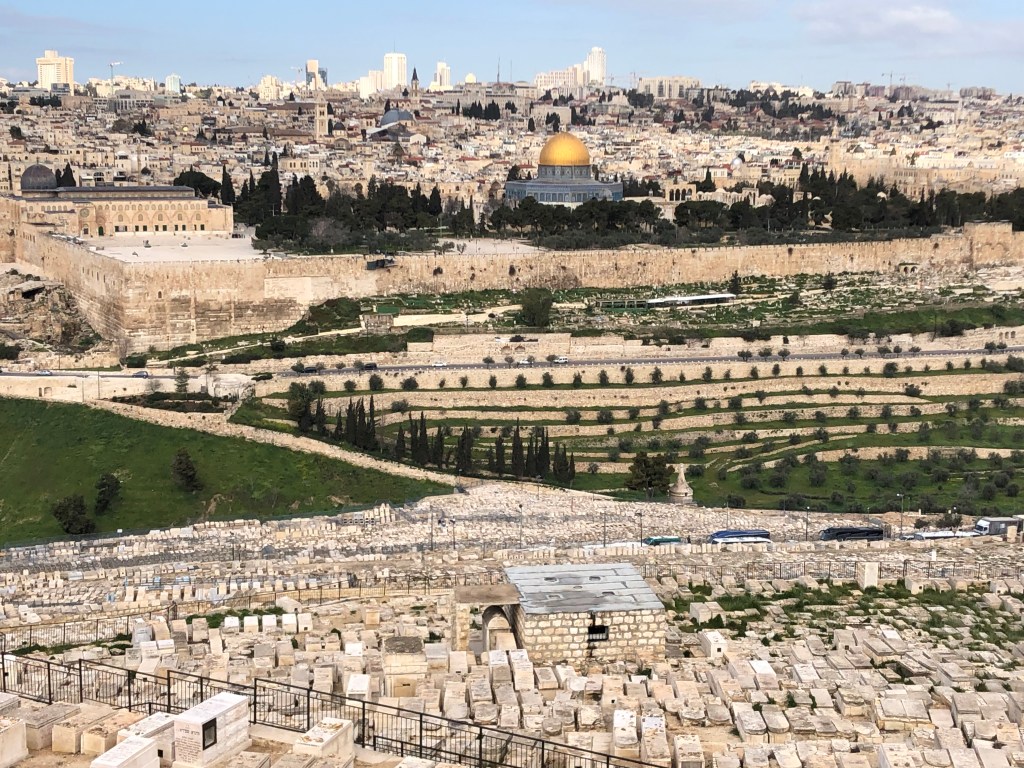
During Jesus’ final week in Jerusalem before he was crucified, he went up on the Mount of Olives, the hill in Jerusalem which stands opposite the Temple Mount, and he gave his famous “Olivet Discourse.”
The View From the Mount of Olives
As he sat on the Mount of Olives, the disciples came to him privately, saying, “Tell us, when will these things be, and what will be the sign of your coming and of the end of the age?” And Jesus answered them, “See that no one leads you astray. For many will come in my name, saying, ‘I am the Christ,’ and they will lead many astray. And you will hear of wars and rumors of wars. See that you are not alarmed, for this must take place, but the end is not yet. For nation will rise against nation, and kingdom against kingdom, and there will be famines and earthquakes in various places. All these are but the beginning of the birth pains.
Matthew 24:3-8
Jesus described the coming of the end of the age, which will culminate with His return, as being similar to “birth pains.” The thing about birth pains is they are building up to something, in this case the eschaton – “the final event,” from which we get the word eschatology. The closer we get to the eschaton, Jesus says, the more these “birth pains” will increase in both frequency and intensity.
Here are a few factors to keep in mind regarding these current events and what they mean about the return of Jesus:
We get closer to the eschaton every day. Just as you are older than you used to be, every day we are closer than we have ever been before.
The eschaton is something we should look forward to with eager expectation, not something we should fear or hope to postpone. In Titus 2:13, Paul describes the early Christians as: “in the present age, waiting for our blessed hope, the appearing of the glory of our great God and Savior Jesus Christ”. To the Thessalonians, Paul wrote about the return of Jesus in order to encourage them and comfort them (1 Thess. 4:13-18). The early Christians used the slogan, “Maranatha!”, an Aramaic phrase which means, “Our Lord, come!” and is found in 1 Corinthians 16:22 as well as in other ancient Christian writings, such as the Didache.The early Christians did not fear the eschaton, but eagerly looked forward to it, and the knowledge of its coming was a source of hope and encouragement for them, as it should be for us as well.
We should always be ready for the return of Jesus. In Matthew 25, in this same Olivet Discourse, Jesus told two parables: “The Parable of the Talents” and “The Parable of the Ten Virgins.” Both of these parables are about the topic of being “ready” for Jesus’ return. What does it mean, and what does it look like for us to be ready for Jesus’ return? According to these parables, to be “ready” means being busy about the Lord’s work – doing what He has called you to do, not becoming complacent and checking out, taking your foot off the gas because the end is near.
What Jesus would say if you asked him if His coming is near: In Acts 1:6, after His crucifixion and resurrection, Jesus’ disciples asked Him if it was now time for Him to restore the kingdom to Israel. He told them, “It is not for you to know times or seasons that the Father has fixed by his own authority. But you will receive power when the Holy Spirit has come upon you, and you will be my witnesses in Jerusalem and in all Judea and Samaria, and to the end of the earth.” (Acts 1:7-8). If you were to ask Jesus, “Is it almost time for you to return?”, His answer would be the same today: “It is not for you to know times or seasons that the Father has fixed by his own authority. But you will receive power when the Holy Spirit has come upon you, and you will be my witnesses…to the end of the earth.” In other words: Jesus wants us to be ready always for His return to happen at any moment, and that means being fully occupied with the work of His mission and His Kingdom.
What Does It Mean to “Believe in Jesus”?
In my sermon this past Sunday I addressed the question of what it means to “believe in Jesus” in order to receive salvation and forgiveness of your sins, as the Bible describes.
Now Jesus did many other signs in the presence of the disciples, which are not written in this book; but these are written so that you may believe that Jesus is the Christ, the Son of God, and that by believing you may have life in his name.
John 20:30-31
I explained that the kind of belief the Bible is talking about is not merely believing that Jesus was a historical person. No reputable historians deny that. Simply believing that Jesus existed doesn’t make you a Christian.
So does it mean believing that Jesus really died on a cross and rose from the grave? Again, it is possible to ascent to the validity of these historical events without being a Christian.
James explains this in his epistle:
You believe that God is one; you do well. Even the demons believe—and shudder!
James 2:19
Rather the word “belief” (pisteo in Greek) in this case means to trust in, to cling to, to rely on someone or something.
To believe in Jesus unto salvation, therefore, means that rather in trusting in yourself, or relying on someone or something, rather than clinging to your own merits to save you – you trust in, cling to, and rely on Jesus and what He did in order to save you.
On this point, I think the church fathers have a great deal to teach us, because when we today speak of what faith is or whether one has it, we are unwittingly obscuring the face that everyone already has faith. Everyone trusts in someone or something. That is, all people in their efforts to achieve fulfillment or happiness or anything else of value entrust those efforts to someone or something. Many of us entrust our lives to ourselves. Some of us entrust them to a religion or a philosophical worldview. Some of us entrust them to another person. Some of us entrust them to an institution. Christianity insists that for this trust to be salvific, it must be directed only toward Christ. He holds what is truly valuable in life – his relationship with the Father. He has shown the uttermost depths of love for us. He is able through his Spirit to unite us to his Father, to make us adopted sons and daughters. Our lives are infinitely safer in his hands than in our own hands or in the hands of anyone else or any institution or philosophy. He is the one to whome we should look, the one in whom we should trust. Jesus says, “Come to me, all you who are weary and burdened, and I will give you rest” (Matthew 11:28). In light of this, it is perhaps appropriate today for evangelicals to spend less time seeking to nail down exactly what faith is and instead to point other people to the one who is truly worth of their faith, Jesus Christ. Conversion to Christianity is not so much a process of gaining faith where one had none before as it is a process of transferring one’s trust from whatever or whomever one was trusting previously to Christ alone.
Fairbain, Life in the Trinity, p. 188
Amen!
Thank you for reading and sending in your questions!
The deaths of George Floyd and Ahmaud Arbery have led not only to widespread protests against police brutality and systemic racial bias, but have also led many evangelical Christians to pay more attention to the importance of temporal justice as it relates to the gospel.
The following is an essay I wrote as an assignment for a class on Liberation Theology when I was working on my first degree in theology. Several kinds of liberation theologies have been proposed since it was first articulated: Latin American, African American, Feminist, and one I find particularly intriguing: handicapped liberation theology.
What is liberation theology, does it have validity, and is there anything we can learn from it? Hopefully this essay answers some of those questions for you:
An Evaluation of the Key Contributions of Latin American Liberation Theology to Modern Theology
Latin American liberation theology is a distinct form of theology which originated in the Latin American situation of the 1960s and 1970s, particularly in South America. Although it arose from this particular setting, liberation theology has contributed to modern theology by raising significant practical and theological questions for Christians, such as the nature of salvation, the proper approach to hermeneutics, e.g. the starting point and sources of theology, and what the Bible says regarding politics, poverty and oppression.
Liberation theology is unabashedly a product of a particular historical situation. Latin America, even today, is the region of the world with the greatest economic and social inequality, where an elite minority possesses almost all the wealth, and the majority of people live in crushing poverty, with the poor often suffering and dying unnecessarily from lack of adequate food, healthcare and nutrition.
In seeking a solution to this problem, and functioning from an Enlightenment, ‘modern’ view of the the world, attempts were made in the 1950s and 1960s to bring development to LatinAmerica. These efforts did not succeed in improving the lot of the poor masses and many turned to an alternative analysis of the problem: Latin America does not suffer from underdevelopment, but from oppression; the real problem being unjust political, economic and social structures, both within individual countries and between the region and the developed world, that created and perpetuate the poverty and suffering of the great majority of the population.
A major factor in the development of liberation theology was the social teaching of Vatican II concerning human dignity and the need for structural change. Latin American bishops met in Medellín, Colombia in 1968 to discuss the implications of Vatican II for Latin America; the papers adopted by this council became the founding documents of liberation theology. The bishops talked about what Christianity had to say to the poor that had been neglected in the way that the gospel had been presented, and about a link between salvation and liberation from oppression.
The consensus of this meeting was that in many places in Latin America there existed a situation of injustice that should be recognised as ‘institutional violence,’ because the existing structures violated basic human rights; they said that this situation called for ‘far-reaching, daring, urgent changes.’
Other notable influences in the formation of liberation theology are political theology, Marxism, and popular religion. Jürgen Moltmann and political theology in Germany challenged the typical European theologian’s detachment from political objectives, Marxism was used by liberation theologians as a tool of social analysis and philosophy of history, and popular religion brought attention to the cultural specificity of distinct people groups as regards religious practices.
Some of the most influential figures in the formation of liberation theology are Gustavo Gutiérrez, Leonardo Boff and Jon Sobrino. Liberation theology is a diffuse movement, but there are some defining characteristics, most notably its orientation towards the poor and oppressed.
In liberation theology, Scripture is not read from the standpoint of wishing to understand the gospel, but out of the concern to apply its liberating insights to the situation of the poor and oppressed. Salvation is interpreted in terms of socio-political liberation and there is the notion of ‘structural sin’ – the belief that society, rather than the individual, is corrupted and requires redemption. Political, economic and social structures that keep the poor down must be abolished.
There is a fundamental belief that theology is not and should not be detached from social involvement or political action. It is argued that political neutrality is not possible for the church and that to profess neutrality is to support the status quo, which in the case of oppression is to support the oppressors rather than the oppressed. To do so, as the Roman Catholic Church in Latin America did for many years, is to go against God, who, in the words of José Míguez Bonino, is ‘clearly and unequivocally on the side of the poor.’ Thus, if God is on the side ofthe poor, then the church must also be on the side of the poor, and act on their behalf; it is then, from that position of active involvement, that a person does theology. This is the reason why Gutiérrez describes liberation theology as ‘a new way to do theology.’
Whereas classical Western theology regarded action as the result of reflection, liberation theology inverts the order: action (‘praxis’) comes first, followed by critical reflection – thus there is a rejection of the Enlightenment view that commitment to an ideology is a barrier to knowledge. In fact, according to Sobrino, ‘the poor are the theological source for understanding Christian truth and practice’.
One of the ways liberation theology has contributed to modern theology is that it has brought attention to the biblical theme of God’s concern for the oppressed and the vulnerable members of society, which is especially apparent in the Old Testament law and prophets, but is also a theme of the New Testament, e.g. in much of Jesus’ preaching and in the Epistle of James.
In bringing attention to this biblical theme, liberation theology has contributed to the current concern across the spectrum of Christianity for issues of social justice, which, beyond simply giving aid to the poor, are concerned with taking action to change social structures that enable oppression and exploitation of some human beings by others – even by working to change policies to defend and protect the poor, weak, and vulnerable. This is certainly not something completely new to Christianity; others, e.g. John Wesley, were known for their concerns for social justice, but it is certainly a major focus in modern theology, and has influenced Christian views on such topics as civil rights for women, minorities and other people who could be seen to be kept down by social structures.
Closely tied to this is the movement in modern theology away from the Enlightenment view that faith and politics are two separate spheres. Liberation theology has raised awareness of the political nature of faith, and that theology is not just something to be learned, but also something to be put into practice in our particular historical and political settings.
Liberation theology has also contributed to the recognition that all theological reflection takes place in a social context, and therefore different social situations give rise to different theological questions, so that the theological questions that are relevant in one part of the world are different than those that are relevant in another part of the world. For example, whereas Western cultures struggle with issues of faith in their post-Enlightenment context of skepticism, science and technology, other parts of the world like Africa and Latin America struggle with issues of faith in a post-colonial context of poverty, injustice and inequality. Whereas westerners might see defending the supernatural nature of God a pertinent theological issue, it may not be such in a place like Africa, where the supernatural is readily accepted, but where the pertinent theological issue is rather ‘where is the God of righteousness in a world of injustice?’ Liberation theology has contributed to the concept that if the Bible is a universal book, then it has something to say to people in every historical and social setting, addressing the issues they face.
Liberation theology has also shown a new way of doing theology – a new hermeneutic, shaped by praxis as opposed to the more traditional way of doing theology by a detached ‘objective’ determination of theological truth which then shapes ethical thought, which in turn drives practical action. Liberation theology has encouraged us to take more seriously the socio-cultural setting of the Bible and brought attention to the blindness of an interpreter to his or her own set of socio-cultural presuppositions.
Liberation theology does not even claim to be objective, because it begins not only with a situation, but with a particular analysis of that situation. It is in this way that Latin American liberation theology has provided a hermeneutical framework for other forms of liberation theology, e.g. feminist theology and black theology. This is also one of the inherent issues that the Vatican pointed out in 1984 in a document titled Instruction on Certain Aspects of the Theology of Liberation. While it affirmed the ‘preferential option for the poor’ and urged Christians to ‘become involved in the struggle for justice, freedom and human dignity’, it also warned against starting with a revolutionary praxis rather than belief, because to do so means that all contrary ideas are automatically discredited as reflecting the class interests of the oppressors.
This is precisely the disagreement between the proponents of the various liberation theologies: since they begin doing theology with praxis, what do they do with parts of the Scriptures which seem to contradict their beliefs or predetermined analysis of the situation? How does feminist liberation theology deal with verses such as 1 Corinthians 14:34- 35? Since liberation theology begins with praxis, Scripture is not the primary source of theology, therefore the Bible will be interpreted in light of the given agenda and related experiences.
Liberation theology has also contributed to modern theological discussion by stirring up discussion of a number of theological issues, such as the nature of salvation, the significance of the incarnation, what a Christian’s attitude should be towards politics and the government, and the implications of various eschatological beliefs.
Liberation theology does highlight the important biblical theme of God’s care for the poor, but on the other hand, Jesus seems to say that having a good life on this Earth is secondary to the salvation of one’s soul (Mk 8:36).
Liberation theology presents a legitimate protest against the over-spiritualisation of the biblical theme of poverty, but on the other hand, the Bible speaks of the wealth and poverty in regard to spiritual things as well (2 Cor. 6:10, 8:9; Lk. 12:13-21).
Liberation theology stirs up discussion on eschatology as well; is this world doomed and only going to get worse, until it is eventually destroyed and replaced (2 Pet. 3:7-13), or is this world and everything in it being redeemed by God, and any work we do of liberation is taking an active part in the redemptive work of God?
Should we as Christians rightly challenge the governments of the places we live, even if they are evil; should we work for top-down change in social structures – or should we simply seek to be a blessing to the place where we live (Jer. 29:7) and submit to the governing authorities, accepting them as those appointed by God for us? (Rom. 13:1-7) After all, Jesus lived in an oppressed society, but although he could have, the New Testament tells us he did not incite political revolution, nor encourage his followers to do so. However, although liberation theology may have incited such discussions, finding answers for these questions by studying the scriptures is not its main prerogative. Liberation theology is focused on doing theology from the perspective of the poor and oppressed and for purpose of the liberation and empowerment of the poor and oppressed.
In conclusion, Liberation theology was one of the most significant theological movements of the twentieth century; it has irretrievably changed the theological landscape. It has been both a product and a catalyst of modern shifts in thinking. Liberation theology highlighted the liberative nature of Christianity and the biblical theme of the concern that God has, not only for the spiritually poor and oppressed, but for those who are physically poor and oppressed and suffering in this life. It has raised awareness of the social structures that support and propagate oppression and has challenged us to consider how God feels about both our actions and our inactions for our fellow human beings. Liberation theology has discouraged us from viewing life as sterile and compartmentalised, and encouraged us to see it rather as a unified whole, in which areas such as theology, sociology, politics and economics are not separate, but rather intimately related. It has also shown a new paradigm for doing theology, driven by praxis. It has provoked all people who do theology to realize their own cultural blinders and to listen to the cry of the poor and see what God’s word says to them.
Bibliography
Bauckham, R., ‘Jürgen Moltmann’ in The Modern Theologians: An Introduction to Christian Theology Since 1918, 3rd edn, ed. by D. Ford and R. Muers (Oxford:Blackwell, 2005), pp. 147-162
Boff, L., ‘Christ’s Liberation via Oppression: an Attempt at Theological Reconstruction from the Standpoint of Latin America’, in Frontiers of Theology in Latin America, ed. R. Gibellini, (London: SCM Press, 1975), pp. 100-132
Chopp, R.S. and E. Regan, ‘Latin American Liberation Theology’ in The Modern Theologians: An Introduction to Christian Theology Since 1918, 3rd edn, ed. by D. Ford and R. Muers (Oxford: Blackwell, 2005), pp. 469-484
Conn, H.M., ‘Liberation Theology’ in New Dictionary of Theology, ed. by S.B. Ferguson, D.F. Wright and J.I. Packer (Leicester: Inter-Varsity Press, 1988), pp. 387-391
Ferguson, S.B., D.F. Wright and J.I. Packer, eds, New Dictionary of Theology (Leicester: Inter-Varsity Press, 1988)
Ford, D., R. Muers, eds, The Modern Theologians: An Introduction to Christian Theology Since 1918, 3rd edn (Oxford: Blackwell, 2005)
Hall, L., THY203 Issues in Modern Theology (Cheltenham: University of Gloucestershire, 2011)
Keller, T., Generous Justice: How God’s Grace Makes Us Just (New York: Dutton, 2010)
Lane, T., Exploring Christian Thought, Nelson’s Christian Cornerstone Series (Nashville, Tennessee: Thomas Nelson Publishers, 1996)
McGrath, A.E., Christian Theology: An Introduction, 4th edn (Malden, MA: Blackwell Publishing, 2007)
Now the weight of gold that came to Solomon in one year was 666 talents of gold…
1 Kings 10:14
This is the only time this number, 666, appears in the Bible other than in Revelation 13:18, where we read about the beast who rises from the earth and it says:
This calls for wisdom: let the one who has understanding calculate the number of the beast, for it is the number of a man, and his number is 666.
Revelation 13:18
Is this just a coincidence or is there some significance to this number having been used to describe Solomon’s annual income?
Pastor Mike and I discuss that question in this week’s Sermon Extra video:
This Sunday, June 7, will be our first Sunday of in-person services since the COVID-19 pandemic required churches to stop meeting in person. For the past three months we have gone online with our services (you can watch them here) and community groups, but we are excited to begin in-person services in our new building!
Wewillcontinueto provide our services online for those who cannot or should not join us in person, and we are taking precautions according to the guidelines issued by the CDC and the State of Colorado to make sure our gatherings are safe and we spread nothing but love, kindness, hope, and encouragement.
If you are local, there will be a prayer walk around the new building on Saturday, June 6 at 9:00 AM, and we would love to see you there!
Details for our in-person and online worship services:
These will be family services, which means there will be no NextGen classes for kids during service, but we will have a Wiggle Room and a Nursing Mothers Room available for those who need them.
In this video I give a walk-through of our building and share about some of the precautions we are taking:
In this video our NextGen director Michelle Pearl gives some information for family with children, including picking up NextGen lessons, what kids can do during service, and a walk through of the Wiggle Room.
We are so glad to serve the Lord and to serve you, both online and in person!
A recent Yahoo News/YouGov poll showed that 20% of Americans say that they would refuse a a COVID-19 vaccine, and that an additional 26% are not sure if they would take it.
Among those who are unsure, or decidedly against receiving the vaccine, some fear that the vaccine will have been rushed and not been properly tested, others say they are skeptical about the effectiveness of a vaccine, considering how viruses mutate, and given the relative ineffectiveness of annual flu vaccines.
However, there are also some who are concerned about possibly nefarious motives by governments and influential people, such as Bill Gates.
The suspicion of a sinister conspiracy behind the development of a coronavirus vaccine has been spurred on by comments from Bill Gates on March 18, in which he said that in the future “digital certificates” could trace who had recently been tested or who had received a vaccine. The idea is that those who will have received the vaccine will be allowed to do things which those who refused the vaccine would not be allowed to do, such as shopping, working, and enjoying entertainment or recreation in certain places. By the next day, a rumor had begun circulating that these “digital certificates” would be a microchip which would be hidden in the vaccine. [1]
For some people, this sounded similar to what the Bible says in Revelation 13 about the Mark of the Beast, without which people will not be able to buy or sell, leading to fears that by receiving this vaccine, you might inadvertently receive the Mark of the Beast, which would lead to the loss of your soul.
What is the Mark of the Beast?
The Book of Revelation is a vision that the Apostle John had while in exile on the island of Patmos. In this vision he was instructed to write down the things that he had seen, the things that are, and those that are to take place in the future. (Revelation 1:19)
Revelation is written in the apocalyptic genre, which its interpretation has been the source of much debate and speculation amongst Christians for the past 2000 years.
In Revelation chapter 13, John describes two beasts; one rises out of the sea (Rev. 13:1-10), the other rises out of the earth (Rev. 13:11-18). Here is what it says about the second beast:
Then I saw another beast rising out of the earth. It had two horns like a lamb and it spoke like a dragon. It exercises all the authority of the first beast in its presence, and makes the earth and its inhabitants worship the first beast, whose mortal wound was healed. It performs great signs, even making fire come down from heaven to earth in front of people, and by the signs that it is allowed to work in the presence of the beast it deceives those who dwell on earth, telling them to make an image for the beast that was wounded by the sword and yet lived. And it was allowed to give breath to the image of the beast, so that the image of the beast might even speak and might cause those who would not worship the image of the beast to be slain. Also it causes all, both small and great, both rich and poor, both free and slave, to be marked on the right hand or the forehead, so that no one can buy or sell unless he has the mark, that is, the name of the beast or the number of its name. This calls for wisdom: let the one who has understanding calculate the number of the beast, for it is the number of a man, and his number is 666.
Revelation 13:11-18
Throughout the years, Christians have tried to figure out what the Mark of the Beast is and what the number 666 means.
Adding fuel to the fears of a conspiracy is the fact that there is currently a bill before the House of Representatives numbered 6666, as well as a calculation of CORONA (6 letters in the word, and if you take the number of the order of the letters in the English alphabet, they add up to 66).
This isn’t the first time there have been rumors of the Mark of the Beast. Ronald Wilson Reagan (6 letters each = 6+6+6!) was accused of being the beast. Of course this is ridiculous for many reasons, not least of which is that it assumes that the Apostle John, who wrote in Greek, would give us a code which could only be deciphered in the English language (which did not even exist yet).
Many Bible scholars associate the number 666 with Caesar Nero, and there is good evidence for doing this. We know from Suetonius that many people were at the time toying with the numerical values of Nero’s name (Nero 39). This practice, known as gematria, took a letter of the alphabet and assigned it an equivalent number. So, for example, in the case of Greek, the first letter alpha would be given the number one. The second letter beta would be understood as two, and so on. When you take Nero’s name (Neron Kaisar) and transliterate it into Hebrew, the result is the number of the beast: 666. [2]
This doesn’t necessarily mean that the second beast in Revelation 13 was Nero; it could mean that it will be someone similar to or comparable to Nero.
The Mark of the Lamb?
What many people seem to forget when discussing the Mark of the Beast is that in the verses which immediately follow, the Mark of the Beast is juxtaposed with the Mark of the Lamb.
Perhaps some of you reading this have never even heard of the Mark of the Lamb. However, if we really desire to understand what the Mark of the Beast is, we have to understand it in light of the Mark of the Lamb.
Here’s what it says:
Then I looked, and behold, on Mount Zion stood the Lamb, and with him 144,000 who had his name and his Father’s name written on their foreheads. And I heard a voice from heaven like the roar of many waters and like the sound of loud thunder. The voice I heard was like the sound of harpists playing on their harps, and they were singing a new song before the throne and before the four living creatures and before the elders. No one could learn that song except the 144,000 who had been redeemed from the earth. It is these who have not defiled themselves with women, for they are virgins. It is these who follow the Lamb wherever he goes. These have been redeemed from mankind as firstfruits for God and the Lamb, and in their mouth no lie was found, for they are blameless.
Revelation 14:1-5
This is referenced earlier in the book as well:
Then I saw another angel ascending from the rising of the sun, with the seal of the living God, and he called with a loud voice to the four angels who had been given power to harm earth and sea, saying, “Do not harm the earth or the sea or the trees, until we have sealed the servants of our God on their foreheads.”
Revelation 7:2-3
So, any interpretation of what the Mark of the Beast is needs to consider that it must be something equal to and opposite of the Mark of the Lamb.
What are These Marks, and How Will You Know If You Have Them?
Considering how the Mark of the Beast is juxtaposed with the Mark of the Lamb, it seems clear that these two signs are identifiers, which identify your allegiance: either as person of the Dragon or as a person of the Lamb. It isn’t that you become a person of the Beast or the Lamb by receiving a mark, rather: the mark identifies you as what you already are. We see this in Revelation 7 & 14, where the mark given to God’s people is to identify them for who they already are, because they are already united to the Lamb.
In other words, these two marks are two opposite signs marking out two different types of people: the wicked and the righteous.
The Mark of the Beast is an identifier of loyalty and worship, and therefore is not something you could accidentally accept.
In the early 1980s, multiple books came out claiming that Uniform Product Codes (UPCs or “barcodes”) were the Mark of the Beast, since they were tied to buying and selling, with titles like: When Your Money Fails: The “666 System” is Here (1981) and The New Money System 666 (1982). In the late 80s and early 90s there were rumors that it could be something related to credit card companies. These ideas were predicated on the idea that the Mark of the Beast was something that could sneak up on you, and something you could accidentally use.
However, since the Mark of the Beast and the Mark of the Lamb are marks of loyalty and worship, a person will have full cognitive awareness of what they are doing (otherwise it is not worship). In other words, in order to take the Mark of the Beast, you would have to curse Christ and pledge devotion to his enemy – and it’s not something you could do on accident, or without realizing what you were doing.
In many countries, including the United States, it is almost impossible to function (think: buy or sell) without government-issued identification numbers, such as a Social Security Number or a Driver’s License Number. Almost everyone carries a mobile phone which contains a SIM card which can be tracked in different ways. Certain vaccines are required in order for children to attend public school. Whether these things are good or safe or whether the government has your best interest in mind may be valid points of discussion and consideration, but these things are not what the Mark of the Beast is about: it is about identification regarding allegiance and worship, and is therefore not something you can possibly receive against your will, desires, and full awareness of what you are doing.
Don’t Forget the Point of Revelation
It is important to remember that the revelation being given in the Book of Revelation is the revelation of Jesus (Rev. 1:1), not the revelation of the Beast!
The point and purpose of the book is not to make us scared about what the Beast is going to do, but to fill us with confidence because no matter what happens, Jesus is going to win!
Any interpretation of Revelation that results in “the beast” becoming the central focus (and dreaded fear) of your eschatology most definitely suggests that you’ve completely misunderstood the book entirely.
Matthew L. Halstead, Ph.D.
Neither the Dragon nor the Beast are the “star of the show” in Revelation, but Jesus, who comes to defeat them and redeem His people.
Let us remember that Jesus is the Good Shepherd who told us this:
My sheep hear my voice, and I know them, and they follow me. I give them eternal life, and they will never perish, and no one will snatch them out of my hand. My Father, who has given them to me, is greater than all, and no one is able to snatch them out of the Father’s hand. I and the Father are one.”
John 10:27-30
Whether you decide to receive a future vaccine or not is a decision for you to weigh and consider, but based on the clear teaching of the Bible, there is no need to fear that you will accidentally be taking the Mark of the Beast by doing so.
May we instead receive the mark and seal of the Lamb through heart-felt allegiance to Jesus, embracing the gospel whole-heartedly, with hope in the redemption He promises us, no matter what this life or any enemies may bring our way. This is the way of true security and confidence.
Hi Pastor Nick, Regarding James 2:14: is “works” or “deeds” limited to spiritual disciplines and obedience? Can you expand what an actual “works” is? Based on what I have researched in Strong’s [Greek & Hebrew Lexicon], this word “works” can be likened to evidence. If “works” is limited to spiritual disciplines and obedience, wouldn’t the Pharisee’s have been in the pocket when in comes to saving faith? Can a work, or evidence of saving faith be something like forgiveness, patience, or trusting belief? (John 6:28) I have been listening to you for quite some time online, and so I am thinking it could be “both”. lol. I believe that obedience and spiritual disciplines are VERY important, but they have been an overflow from my friendship with Jesus. They come very naturally to me the more time Jesus and I spend together. I have friends that tend to throw around this verse when they are not witnessing the type of obedience THEY feel should be demonstrated within the church. I tend to be very tolerable when it comes to most topics, but on this issue I get very agitated. I am not sure if it’s because I am denial, or because my friends are, in my opinion, using Scripture to justify moralism. I want to enjoy the book of James, come along side of it, not have any bitterness towards it.
Good question! It seems that James understands “works” to be outward expressions of faith. Clearly this includes acts of obedience, as James describes in chapter 2, using Abraham as an example, but it James also says that “Religion that is pure and undefiled before God the Father is this: to visit orphans and widows in their affliction, and to keep oneself unstained from the world” (James 1:27).
As Jesus explained, sin includes not just outward actions, but thoughts of the mind and attitudes of the heart. He also taught that to not forgive is a sin. Therefore, to keep oneself unstained from the world includes forgiveness and other attitudes that pertain to holiness. As you rightly mentioned, Jesus stated that the “work” of God is to believe in Jesus whom He sent (John 6:29).
It is possible to do good works apart from faith, but, as John Calvin stated, the motivation for good works in that case will be self-justification or self-glorification. This is what the Pharisees were guilty of, and why Jesus claimed that they were lost in spite of their good works. Calvin argued for “Total Depravity,” which he understood as meaning that apart from Christ, our motives for doing good deeds are skewed, and it is only once the love of God has been poured out in our hearts that we are capable of doing good for truly pure motives.
In his commentary on Romans, Martin Luther compared works to the heat and light that are exuded by fire. You can have light apart from fire, and you can have heat apart from fire, but if you have fire, it will naturally result in heat and light. In the same way, you can have works apart from faith, but faith naturally produces works.
Like so many of you, when I saw the video last night of what happened to George Floyd, I was horrified.
If someone was not there to film this incident, would we even know that this happened?
Was this an isolated incident? We have to recognize that a steady stream of “isolated incidents” constitutes a pattern, and racism and prejudice are alive and well in the world today.
As Christians, it is our theological duty to speak out against racism.
Racism asserts that some people are more valuable than others. This view is anathema to those who follow Jesus.
No matter the color of a person’s skin, no matter their economic or social status, no matter their level of ability or disability: all people are created in the image of God, and therefore endowed with an innate dignity as image bearers of the Divine.
When I pray “Lord, deliver us from evil”, I must remember that evil is multi-dimensional: There is personal, structural and spiritual evil.
On days like today, I remember that we need deliverance from them all.
It would not be uncommon to hear someone say that at the root of racism is sin. The question though is: What sin exactly is at the root of racism?
What underlies racism is the endeavor common to all human beings of seeking to establish an identity.
Every person is seeking to establish an identity, which can be defined as: evidence that we have value and worth, that we are deserving of love and acceptance.
People seek to do this in many ways, such as geography, ethnicity, morality, economics, social standing, education, etc.
However, when someone seeks to establish their identity in anything other than the redeeming work of Jesus, it leads to disaster.
This disaster, in some cases, may only be personal; it may only affect them. It will still be disaster because it will lead to emptiness, futility, and the loss of their soul (see Mark 8:36).
However, in many cases, the disaster of attempting to build an identity apart from Christ can affect others. This is what leads to wars, ethnic conflicts, tribalism, rivalries, and racism.
These are all forms of self-justification, or the attempt to prove one’s worth by means of something within them, whether that is their morality, their good deeds, or their race or tribe.
The Reformers, particularly Calvin, pointed out that while people can do good things apart from faith in Jesus and experiencing His regenerative work in their lives, all of their good works will ultimately be motivated by either self-justification or self-glorification.
Self-justification often seeks opportunities to justify oneself by looking for ways in which they can feel superior to others. It is endeavoring to build an identity for yourself – apart from Christ – that “proves” that you have worth, and many people go about that negatively by juxtaposing themselves against other people whom they deem to have “less worth.”
Considering It All Rubbish
In the third chapter of his letter to the Philippians, Paul the Apostle talks about how he formerly tried to build his identity apart from Christ in his ethnic background, in his morality, in his education, and in his zeal for God. (Philippians 3:4-9).
The result of these things, in every instance, was that they led him to look down on others who didn’t have his ethnic background, his morality, his education, or his zeal for God – and in at least one case it led him to physically and psychologically harm an entire group of people.
However, after coming to faith in Christ and embracing the gospel, Paul says that he now considers all of these things rubbish compared to the surpassing worth of knowing Christ Jesus, and being found in Him, with a righteousness that comes from Jesus, not from anything within Paul himself.
What the gospel offers us is value, worth, and belonging because of what God has done for us and who we are in Christ. This identity, rather than leading to oppression or rivalry, leads to love and charity.
May we be those who find our identity in Christ, and who recognize the inherent dignity of all people.
We have been monitoring very closely the COVID-19 situation from multiple angles, and are excited to announce that our church will begin gathering for in-person worship in our new building on June 7!
This is consistent with our previously announced Reopening Plan, and is in accordance with the state and federal guidelines.
In preparation for opening on June 7, we will be:
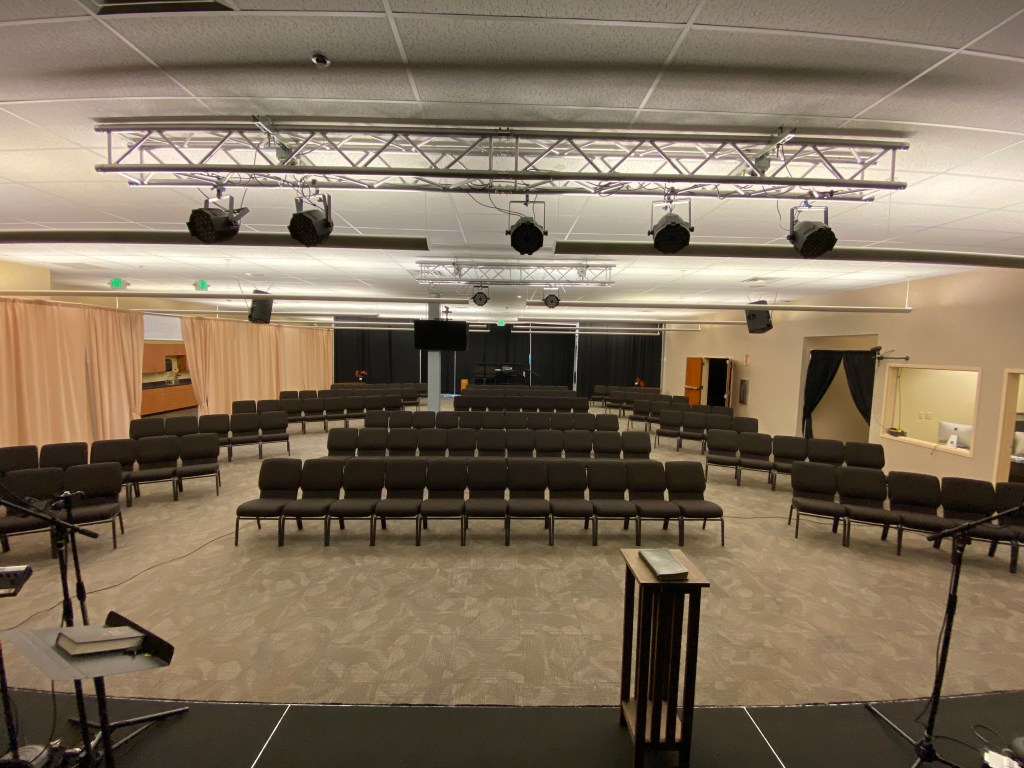
Rearranging our sanctuary and setting up an overflow room to accommodate social distancing
Working out the kinks with live-streaming our services
Setting up audio and video in the overflow room
Having the building cleaned by a professional cleaning company
Hanging our big sign on the outside of the building
Coordinating with our service teams to ensure a welcoming and safe environment for worship
We look forward to seeing you on June 7! Remember that we will be having two services, at 9:00 & 11:00 AM. These are family services, which means that there will not be NextGen classes for children or youth, but there will be a “Wiggle Room” available for parents with niños who need to get out their wiggles, as well as a Nursing Mothers room, complete with a screen where you can watch the service as you take care of your babies!
The wearing of masks is recommended, and we will be disinfecting between services. Those leading from the stage will not be wearing masks while they lead worship or teach, so please plan your seating accordingly if that is a concern for you. Families are encouraged to sit together, otherwise seating will be done with 6 foot distance (2 empty chairs between you and the next person). Hand sanitizer stations will be available.
If you are experiencing symptoms, or are not yet ready for public gatherings, you will still be able to join us online on our YouTube channel, our Facebook page, and whitefieldschurch.com live at 9:00 & 11:00 AM starting June 7. On May 31 we will still be broadcasting our service at 10:00 AM.
But since we were torn away from you, brothers, for a short time, in person not in heart, we endeavored the more eagerly and with great desire to see you face to face – 1 Thessalonians 2:17
We are excited for this new season for our church!
Love and blessings,
Pastor Nick
Sanctuary set up with 50% seating capacityOverflow room adjacent to sanctuaryOur big sign, ready to put hung on the front of the building!
Evangelist and apologist Ravi Zacharias went to be with the Lord today. Born and raised in India, Ravi travelled the world speaking in places like Princeton and Oxford universities, where he spoke persuasively about Christianity and answered the questions of septics, encouraging people to put their faith in Jesus and equipping believers.
Ravi also founded RZIM, and he leaves behind this thriving and fruitful organization which promotes Christianity for thinking people around the world.
As a non-westerner, Ravi’s voice had particular credibility in Asia, and he built a team of evangelists, including the late Nabeel Quereshi, who had converted from Ahmadiyya movement of Islam. Another member of RZIM’s team is Sam Allberry, who has written a lot on the topic of sexuality, and whose book, Why Does God Care Who I Sleep With, I recently reviewed in these posts:
Ravi will be missed, but he leaves behind a legacy and an ongoing ministry which will bear fruit for many years to come. May God raise up many more leaders like him in the days to come!
For those of you who are not familiar with Ravi, or would like to remember him, here is a lecture he gave at Princeton University on “Why I’m Not an Atheist”: