
How Do You Practically “Abide in Christ’s Love”?

82034485_2736402666395387_7737323707604926464_n
Abide and Bear Fruit is our theme for 2020 at White Fields Church

In my recent post, The Active Passive Actions of Relationship with God, I talked about how abiding in Christ (see John 15:1-11) may at first sound passive, but abiding actually requires action.

A Practical Guide to Abiding

Still, someone might ask: “How exactly do you abide in Christ though?

After all, in John 15:9, Jesus told his disciples:

As the Father has loved me, so have I loved you. Abide in my love.

But what does that mean? What does it look like on any given Wednesday, for example, for me to abide in the love of Christ?”

Thankfully, Jesus answered that question for us!

In John 15:10, here’s what Jesus said:

If you keep my commandments, you will abide in my love, just as I have kept my Father’s commandments and abide in his love.

So, the way to abide in Jesus’ love is to keep his commandments.

This is interesting, because just a few verses later Jesus says:

Greater love has no one than this, that someone lay down his life for his friends. You are my friends if you do what I command you. No longer do I call you servants, for the servant does not know what his master is doing; but I have called you friends, for all that I have heard from my Father I have made known to you. (John 15:13-15)

This is interesting because it tells us that there is a good and proper motivation for obeying God’s commandments: love for God and a desire to abide in his love.

Obeying God Matters, But It Also Matters Why You Obey God

Obeying God’s commandments matters. Consider what God told King Saul:

Has the Lord as great delight in burnt offerings and sacrifices,
as in obeying the voice of the Lord?
Behold, to obey is better than sacrifice,
and to listen than the fat of rams.
For rebellion is as the sin of divination,
and presumption is as iniquity and idolatry.  (1 Samuel 15:22-23)

But when it comes to obeying God, why you obey God also matters very much. It is possible to obey God for the wrong reasons. If your reason for obeying God is self-justification or self-glorification, you will find yourself in the position of being in opposition to God. As we are told in James 4:6,

God opposes the proud but gives grace to the humble.

On the other hand, if you love someone, and you want to express your love for them, if you want to experience the joy of fellowship with them, what do you do? You find out what they like, what they love, what makes them happy and brings them joy, and you do those things!

An Example: My Wife’s Birthday

My wife’s birthday is coming up. Knowing the things that she likes, what if I were to say: “I don’t have to do those things in order to win her love, since she already loves me. Therefore I will do nothing, because I don’t have to earn her love.”

Of course my wife will love me even if I don’t do anything for her birthday. However, because I love her and want to share a great experience with her (since intimacy is created through shared experiences), I want to do something for her that she will like. Thus, in my pursuit of her, in my desire to know her, one of my goals is to discover her likes and dislikes and do things she likes; not to earn her love, but as an expression of my love for her, and as a way of having fellowship with her.

In the same way, we can express love for God and experience fellowship with God by doing the things that we know He likes!

For more on this topic, see: “Oh, How I Love Your Law” – the Role of the Law in the Life of a Believer

May we be those who abide in Christ’s love, just as He abided in the love of the Father!

The Active Passive Actions of Relationship with God

82034485_2736402666395387_7737323707604926464_n.png
Abide and Bear Fruit is our theme this year at White Fields Church

The Bible uses a few terms to describe what a relationship with God looks like, and how it is to work in practice. Some of these terms imply movement, such as walking with God (Genesis 5:22, 6:9, 17:1; Luke 1:5).

There are other terms however, which at first glance appear passive. A further look into these terms reveals that they actually imply action:

Wait on the Lord

The word “wait” conjures up thoughts of waiting at government offices, hospital waiting rooms, or waiting for Christmas to come. All of these are passive actions: you have no control over the outcome, and many times these experiences of waiting sap our energy. Waiting for 2 hours at the DMV can be exhausting, even if you spend the whole time sitting in one place and not moving.

However, to “wait on the Lord” is not a completely passive action. The word “wait” in Hebrew is the word Qavah which means “to hope” or “to expect.” It can also be translated “to bind up,” or “gather together.”

While on the one hand, the outcome is out of your control, you are not completely passive nor inactive; you are doing something because you know the God who controls the outcome.

It is in this way that Isaiah the Prophet could say,

“Even youths shall faint and be weary,
and young men shall fall exhausted;
but they who wait upon the Lord shall renew their strength;
they shall mount up with wings like eagles;
they shall run and not be weary;
they shall walk and not faint. (Isaiah 40:30-31)

Whereas in many cases waiting can be an exhausting and energy-sapping experience, waiting on the Lord, Isaiah tells us, actually renews your strength and invigorates!

It is in this sense that the Psalm-writer says, “I wait for the Lord, my soul waits, and in His word I hope.” (Psalm 130:5)  This is not the waiting of passive inaction, but the hopeful expectation of trusting in God’s word and God’s promises.

Abide in Christ

At the Last Supper, Jesus told his disciples:

I am the vine; you are the branches. Whoever abides in me and I in him, he it is that bears much fruit, for apart from me you can do nothing.

By this my Father is glorified, that you bear much fruit and so prove to be my disciples.

As the Father has loved me, so have I loved you. Abide in my love.   (John 15:5,8-9)

To abide means “to remain, to dwell.” In the picture of a vine and its branches, the branch has to merely stay attached to the vine.

Yet, while on the outside it may not appear that there is any movement involved in the branch abiding in the vine, under the surface there is movement of nutrients from one to the other, providing life, health, and growth, which is seen by the fact that this abiding produces something: fruit.

For us to abide in Christ, on the one hand, involves not moving away from Christ, but the actions of abiding are anything but passive. Another definition of abide is to adhere to a pattern of life. Practically speaking, abiding in Christ requires intentional action to pursue fellowship with God.

These intentional actions by which you abide in Christ are also referred to by the term spiritual disciplines, things like prayer, studying the Scriptures, fellowship with other believers, generosity and giving, and more.

Click here for articles on spiritual disciples and spiritual formation.

In 2 Peter chapter 1, Peter urges the believers to “make every effort” to add to their faith: virtue, knowledge, self-control, steadfastness, godliness, brotherly affection, and love (2 Peter 1:5), stating that these things help us not to fall, and they help us to “grow in the grace and knowledge of our Lord and Savior Jesus Christ.” (2 Peter 3:18)

The outcome may ultimately be the Lord’s work in us, but we are invited to participate in working out what God has worked into us, and we get to participate in cultivating our own spiritual growth.

May we be those who trust in, wait up, and abide in the Lord Jesus, not passively – but actively. May we be those who work out our own salvation, knowing that it is God who works in us to will and do to His good pleasure. (Philippians 2:12-13)

For sermons from 2 Peter, click here: Pilgrim’s Progress: a Study Through 1 & 2 Peter

Identity Issues: Function, Labels, Sin & Jesus

close up of hand holding text over black background

Where does your identity come from? What defines who you are?

Many people look to their function to give them their sense of identity. This is wrought with peril, as it is an inherently fragile foundation; what you do can and will change throughout your life. You will lose abilities, positions, and even loved ones. Surely you are more than what you currently do.

Other people find their identity in appearance, culture, and other things. Sometimes we feel that a person’s identity is defined by their past actions, whether successes or failures.

As human beings, we have a tendency to categorize and label people in an attempt to try to more easily make sense of the world and our place in it. Labeling and categorizing is powerful, as it then shapes our perceptions of people, including ourselves.

This week, Mike and I sat down to discuss this issue – and it led to what I think was one of our best discussions yet, in which we reflected on some of our own struggles with identity. Check it out:

Last week I was in Austria for the Calvary Chapel European Pastors and Leaders Conference. It was a great time of fellowship, teaching, conversations, encouragement, and refreshment.

I arrived back from Austria on Saturday night, and preached on Sunday at White Fields, which was way harder than I had expected, but I wanted to be there to finish up our Vision series.

The final message in this series was: A Vision for Others, in which we looked at how God sees other people, including us, and the implications of that for us.

This issue of identity was also part of the message I shared in Austria. No matter what stage of life you are in, and no matter your vocation, identity is an important issue, and one that God thankfully has a lot to say about in His Word to give us guidance.

Check out the video and the sermon for the answer on the dangers of finding your identity in the wrong places, and the freedom that comes from finding your identity in Christ.

Most Listened-To Sermons of 2019

silver iphone x with airpods

Our church’s website was recently updated, including a major overhaul of the sermon archive, which now allows you to browse by series and books we have taught through. Check it out here: White Fields Community Church Sermons

If you haven’t done so yet, you can subscribe to our podcast here, or just search White Fields Community Church in whatever podcast app you use. If you like what you hear, please rate and review us, as that helps boost us in their algorithm, and helps other people discover us.

I recently switched to the Overcast app for listening to podcasts. I like that it cuts out pauses and regulates audio to a consistent level, and allows me to make playlists. Overcast is only available for iOS, but the best app for Android, which has many of the same features is Podcast Addict. My wife’s biggest hesitation with switching to an iPhone recently was that she would lose Podcast Addict.

These sermons I preached in 2019 were listened to and downloaded the most:

10. Amos: Faith that Works

9. Daniel: How to Live a God-Honoring Life in a Hostile Environment

8. How to Be Right When You are Wronged – 1 Peter 3:8-22

7. What is Your Life? – James 4:13-5:6

6. Encouragement for the Fainthearted – 2 Thessalonians 1:1-12

5. Count It All Joy – 1 Peter 1:1-9

4. I Could Never Believe in a God Who: Condoned Genocide in the Old Testament

3. I Could Never Believe in a God Who: Hasn’t Proven His Existence

2. I Could Never Believe in a God Who: Does Not Affirm Some People’s Sexuality

1. I Could Never Believe in a God Who: Sends People to Hell

Analysis

A few things pop out at me from this list. First of all, the fact that some of our more recent sermons are in the top ten means that listenership to our podcast is increasing.

Secondly our biographical look at the prophets, called “Remember the Prophets” was a lot of fun. Those books and their authors are often overlooked for various reasons, but their messages are very important.

Finally, our apologetics series “I Could Never Believe in a God Who…” was our second consecutive year doing a series like this, and clearly it struck a chord with a lot of people. These kinds of series are helpful both for engaging with those who might be skeptical about Christianity, and for teaching Christians how to respond well to those who ask questions. Oftentimes many of us who are Christians struggle with questions even though we choose to trust God and believe. As the church we engage with those issues and equip others to do so as well.

What Didn’t Make the List?

Leave me a comment below and let me know which sermon from this year made the biggest impact on you!

If need to refresh your memory, a list of our past sermons from this year can be found here: White Fields Sermons

Longmont Ranked the Number 1 ‘Boomtown’ in the United States

image.png

According to the Boulder Daily Camera, the financial advising and credit monitoring company SmartAsset recently named Longmont its No. 1 “boomtown” after conducting a study of 500 largest communities across the country.

CBS Denver explains that the designation is based on a variety of factors including unemployment, population growth, the number of businesses created, and the local housing market.

Also included in the top 10 boomtowns were Greeley (#5) and Denver (#7).

Here’s the report from SmartAsset: Top Boomtowns in America – 2019

For those of us who are Christians in Longmont, we know that God has called us here for such a time as this! Please pray for our city and God’s work here, especially through White Fields Community Church.

Christmas Eve Church Services in Longmont

Screen Shot 2019-12-11 at 10.05.58 AM

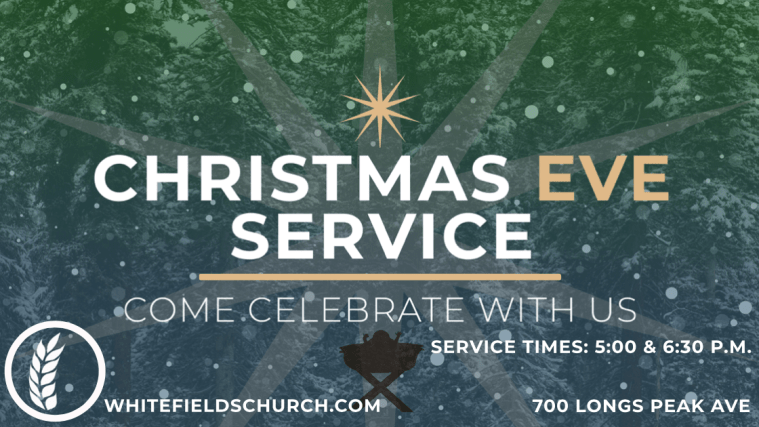
Join us at White Fields Community Church on December 24, 2019 at 5:00 or 6:30 PM for a special Christmas Eve service which will include Christmas music from our band and choir, as well as a reading of the Christmas story and a message titled, “In Thy Dark Streets Shineth”

Location: St. Vrain Memorial Building, 700 Longs Peak Ave. Longmont, CO 80501

Invite someone to join you as well! Studies have shown that most people are willing to attend church on Christmas Eve if they are invited by a friend or family member. Consider yourself invited, and invite someone to join you and get Christmas started by focusing on Jesus!

Is There a Prophecy that Says that Jesus Would Come from Nazareth?

jesus christ figurine

Matthew chapter 2 tells one of the most overlooked and skipped-over parts of the Christmas story: the mass killing of innocent infants and toddlers by king Herod “the Great.”

When you read the Christmas story to your children, you might likely leave this part out. Chances are that if you attend a school Christmas pageant, the kids will not act out this part of the story.

And yet, it’s an incredibly important part of the Christmas story, because in effect, it tells us what Christmas is really all about: God came to us in order to rescue us from the tyranny of evil, sin, suffering, and death.

This past Sunday we studied this story to kick off our Advent series, “God With Us.” You can listen to the message here: “The Hopes and Fears of All the Years”

One of the most interesting parts of Matthew chapter 2 is that Matthew points out several prophecies which Jesus fulfilled. However, Matthew 2:23 says that Jesus was raised in Nazareth to fulfill what was spoken by the prophets. However, you can look through the Old Testament all you want, but you won’t find a prophecy which mentions Nazareth as a city directly. What then is this verse referring to?

Mike and I sat down for our weekly Sermon Extra video to discuss this topic, and answer that question. Check it out:

If Satan Has Been Defeated, Why Is He Still “Prowling Around”?

lion painting

In 1 Peter 5:8, Peter the Apostle told us: Be sober-minded; be watchful. Your adversary the devil prowls around like a roaring lion, seeking someone to devour.

This is interesting because in Colossians 2:15, Paul the Apostle tells us that Jesus “disarmed the rulers and authorities and put them to open shame, by triumphing over them.”

If Jesus, through his life, death, and resurrection, defeated and disarmed Satan and the demonic powers, then how is it that the devil is still prowling around like a lion?

A Toothless Lion

Being that Satan has been disarmed, the real danger he poses is his “roar.”

A roar by itself can’t actually hurt you. Similarly, the devil can’t do anything to you without God’s permission (remember Job chapter 1). But whereas the devil needs God’s permission to harm you, you don’t need anyone’s permission to mess up your own life.

Jesus said this about the devil: “there is no truth in him. When he lies, he speaks his native language, for he is a liar and the father of lies.” (John 8:44) Ever since the Garden of Eden, one of the devil’s main strategies for our destruction has been deception. The serpent couldn’t hold Eve down and force her to take a bite of the forbidden fruit in order to destroy her. Instead, he had to talk her into destroying herself by falling into a trap.

For a look at some of the common traps the devil tries to lead us into, check out this message on 1 Peter 5:1-13 titled “Know Your Enemy”

Suffering According to the Will of God

Twice in 1 Peter, Peter speaks about people who suffer according to the will of God.

If Satan has been defeated, then why has God not yet destroyed him? We know that Satan’s fate is sealed: his final demise has been foretold in Revelation 20:10.

But why let him continue to exist and do destructive things, including testing / tempting people? The reason is because although God is not the author of evil, he is a redeemer, who uses bad and even terrible things to accomplish good purposes and carry out his plans.

One of my favorite examples of this is found in the genealogy of Jesus in the first chapter of the Gospel of Matthew, where we see multiple stories of how God redeemed people and situations in the family through which Jesus came. Check out: Redemption: The Knots in Jesus’ Family Tree

For more on this, check out this message on 1 Peter 4:12-19 titled “Suffering and the Will of God”

The Ultimate Humiliation

One of the biggest mistakes people make when it comes to thinking about the devil, is that the devil is God’s counterpart.

When Paul says in Colossians 2 that Jesus put Satan to “open shame” through the cross, he using a metaphor which his ancient readers would have been familiar with: it’s the picture of what a victorious army would do to the soldiers of the army they had defeated. They would not only bind them and lead them, humiliated, through the streets of every town on the road back to their capital, but they would often be sold as slaves.

The ultimate humiliation for a defeated soldier was something they might consider a fate worse than death: being forced to serve as a slave those by whom they had been defeated. This, Paul says, is what God now does with the devil: in his sovereignty and providence, what God allows the devil to do, He then uses to accomplish good and His purposes.

Mike and I discussed this in more depth in our Sermon Extra video this week. Check it out:

New Website and New Series

Website Update

We recently updated our website at White Fields Community Church. The bulk of the work was done by our Administrative Assistant: Ocean – and our friends over at CryBaby Design: a great company based here in Boulder County; check them out if you have any design needs.

Browse the site and let me know if you find any broken links or things that are out of order: whitefieldschurch.com

Screen Shot 2019-12-03 at 4.34.45 PM.png

Advent Series

Also, this Sunday we are starting a new series for Advent called God With Us.

God With Us Sermon graphic.jpg

In our first message, we will be looking at one of the most over-looked episodes in Christmas story: the killing of the innocent children by King Herod, and why this story illuminates important aspects of who Jesus was and why He came as the promised Savior to defeat evil and reconcile us to God.

If you’re in Longmont, or nearby on Colorado’s Front Range, we’d love to have you join us on a Sunday this Advent. More information here.

Project Greatest Gift 2019

Project Greatest Gift is White Fields’ annual outreach to children in foster and kinship care in Northern Colorado.

Last year we were able to provide for 241 kids and their caretakers, and this year the Health and Human Services departments from the counties we partner with asked if we could do more, and of course we said ‘yes’! So this year we are aiming to cover 314; the most we’ve ever done.

Clearly Project Greatest Gift is meeting a real need which is not going away.

In this video, Christine Appel shares some information about the great needs that these families face and how we can help:

Project Greatest Gift runs throughout the month of November, which means that we are already two weeks in, and over half of the kids and caretakers still need sponsorship.

It’s not too late to sign up to sponsor a family this year to help make Christmas more joyful, and ultimately to introduce them to the hope that we have in Jesus Christ.

Did you know that children in the foster system are an at-risk people group within our communities?

In almost every case, the reason children end up in foster care is because of an unsuitable home environment, which often involves violence, neglect, drugs and crime. These environments not only result in trauma, but they are also associated with poverty. Many foster care situations are kinship care, which means the child is cared for by a relative, which can create a financial burden, especially in the case of grandparents living on pension.

Poverty has a profound impact on a child’s mental and physical well-being. In other words, the suffering that a child who is raised in this environment endures is not only limited to their childhood, but can adversely impact the rest of their life.

Our church, White Fields Community Church, has a history of ministering to children in the foster system. Through some of our leaders, we have developed a great relationship with the Health and Human Services departments in Weld and Adams Counties, and we are able to make an impact in the lives of needy families in our area. In recent years, we have had the special opportunity to get to meet and serve these families at a Christmas event we help put on for them in Greeley at which the gifts are distributed.

If you would like to be involved, visit us on a Sunday morning this November, leave a comment below, or contact the church here.

If you can’t participate but would like to support this endeavor financially, you can make a donation by clicking here, and choosing Project Greatest Gift from the drop-down menu. 100% of your donation will go straight to the kids and their families.