How Did We Get the Bible? Exploring the Formation of the Biblical Canon – with Shane Angland

In this episode of the Theology for the People Podcast, I speak with Shane Angland about the question of how we got the Bible in its current form.

Shane has been a recurring guest on the podcast, and he has a keen mind and knowledge of historical theology. Shane lives in Ennis, Ireland where he serves at Ennis Evangelical Church. He holds a Masters of Divinity from Dallas Theological Seminary, and has served as a missionary in Ukraine.

From the formation of the Old and New Testaments to the question of the Apocrypha, to the impact of the Council of Trent, this conversation offers clarity on why the Bible is trusted as God’s inspired Word.

Key Topics Discussed

  • What is the Canon?
    • Definition: The canon is the list of inspired, authoritative Scriptures distinguished from other valuable writings.
    • Theological foundation: Scripture is “breathed forth” by God, carrying unique authority for the church (2 Timothy 3:16).
  • Old Testament Canon Formation
    • Begins with God’s redemptive acts, particularly after the Exodus and Sinai covenant (Exodus 24, Deuteronomy 31).
    • Jewish recognition of inspired texts from Moses to Malachi, with a prophetic silence post-Persian era.
    • Josephus and first-century Jewish consensus on 22 books (equivalent to the 39 books in modern Old Testaments).
    • No explicit criteria articulated, but guided by the Holy Spirit and covenantal context.
  • The Apocrypha and Deuterocanonical Books
    • Includes books like Tobit, Judith, Wisdom, Sirach, 1 & 2 Maccabees, Baruch, and additions to Esther and Daniel.
    • Historical debate: Some early Christians (e.g., Augustine) accepted these books, while others (e.g., Jerome) did not, aligning with Jewish tradition.
    • Council of Trent (1546): Roman Catholic Church dogmatically defined these books as canonical, partly in response to Reformation emphasis on scriptural authority (e.g., for doctrines like purgatory).
    • Eastern Orthodox churches maintain an open canon, avoiding infallible rulings.
  • New Testament Canon Formation
    • Tied to the new covenant and apostolic authority, with writings by or connected to apostles (e.g., Mark linked to Peter, Luke to Paul).
    • Criteria: Apostolic origin, Christ-centered message, and widespread church use in worship.
    • Early recognition: By the late first century, apostolic writings were distinguished (e.g., Clement’s letters vs. Paul’s epistles).
    • By the second century, 22–23 of the 27 books were widely accepted, with minor debates on smaller texts (e.g., 2 Peter, 3 John).
  • Misconceptions Addressed
    • Myth: The Council of Nicaea (325 CE) decided the canon. Reality: Nicaea focused on church governance, not canon selection.
    • Myth: Early Christians chose from hundreds of gospels. Reality: The four canonical gospels were the earliest, apostolic, and widely used.
    • Gnostic “gospels” (e.g., Gospel of Judas) lack historical or apostolic credibility and were not serious contenders.
  • Why the Delay in Formal Canon Lists of the New Testament?
    • The early church was decentralized, persecuted, and lacked centralized authority to compile lists.
    • Canonical texts were illegal, and possession could lead to martyrdom (e.g., 180 CE Carthage trial).
    • Earliest clear list: Athanasius’ Easter Letter (367 CE), reflecting existing church consensus.
  • Confidence in Scripture
    • The Bible’s unity across 66 books, three languages, and 1,500 years testifies to its divine inspiration.
    • The early church’s careful discernment reflects wisdom, not uncertainty.
    • Romans 3:2 affirms the Jewish role in preserving the Old Testament oracles, reinforcing trust in the canon’s reliability.

Resources Mentioned

  • Michael Kruger’s work on the canon (e.g., Canon Revisited).
  • Josephus’ Against Apion for first-century Jewish canon insights.
  • Augustine’s On Christian Doctrine.

Quotable Moments

  • “The canon begins with God’s work of redemption, not human decisions.” – Shane
  • “The church doesn’t establish the canon; it recognizes it through the Holy Spirit.” – Shane
  • “The Bible’s coherent message across 1,500 years is a miracle of God’s inspiration.” – Shane

Click here to listen to the episode, or listen in the embedded player below.

How Did We Get the Bible? Exploring the Formation of the Biblical Canon – with Shane Angland Th.M Theology for the People

In this episode, Nick Cady and Shane Angland tackle the critical question: How did the Bible come to be? They explore the formation of the biblical canon, addressing misconceptions, historical processes, and the theological significance of Scripture. From the Old Testament’s roots in God’s redemptive work to the New Testament’s apostolic authority, this conversation offers clarity on why the Bible is trusted as God’s inspired Word. They also discuss the Apocrypha, the Council of Trent’s impact, and how early Jewish and Christian communities recognized canonical texts.Connect with Theology for the PeopleWebsite: theologyforthepeople.comFollow on X: @nickcady
Seeing Jesus in the Psalms through Hebrews – with Daniel Stevens

In this episode of the Theology for the People Podcast, I speak with Daniel Stevens, who is Assistant Professor of New Testament Interpretation at Boyce College (the undergraduate college of Southern Seminary) and author of Songs of the Son: Reading the Psalms with the Author of Hebrews

In this episode, Daniel shares how his accidental dive into Hebrews sparked a decade-long passion, revealing how the Psalms prophetically point to Jesus. 
We talk about the question of who wrote Hebrews, and why it matters — and we talk about how reading the Psalms through the lens of Hebrews can deepen our worship and appreciation of Jesus.

Notable Quotes:
• Daniel on Hebrews’ Use of Psalms: “When the author to the Hebrews wanted to make an argument about Jesus, one of the most common places that he goes is to the Psalms.”
• On Christological Reading: “It’s not reading something into it, it’s reading what’s there and reasoning from it.”
• On Hebrews’ Argument: “It’s not comparing bad to good… it’s good to better.”
• For Believers: “If these Psalms aren’t first about us, but about a thing that Jesus has done for us… we can worship Him in finding them.”

More Resources: Follow Daniel on X

Click here to listen to the episode, or listen in the embedded player below.

Seeing Jesus in the Psalms through Hebrews – with Daniel Stevens Theology for the People

Daniel Stevens is Assistant Professor of New Testament Interpretation at Boyce College and author of Songs of the Son: Reading the Psalms with the Author of Hebrews. In this episode, Daniel shares how his accidental dive into Hebrews sparked a decade-long passion, revealing how the Psalms prophetically point to Jesus. We talk about the question of who wrote Hebrews, and why it matters — and we talk about how reading the Psalms through the lens of Hebrews can deepen our worship and appreciation of Jesus.Notable QuotesDaniel on Hebrews’ Use of Psalms: “When the author to the Hebrews wanted to make an argument about Jesus, one of the most common places that he goes is to the Psalms.”On Christological Reading: “It’s not reading something into it, it’s reading what’s there and reasoning from it.”On Hebrews’ Argument: “It’s not comparing bad to good… it’s good to better.”For Believers: “If these Psalms aren’t first about us, but about a thing that Jesus has done for us… we can worship Him in finding them.”More Resources: Follow Daniel on XConnect with Us:Subscribe to Theology for the People for more episodes.Visit the Theology for the People website and blog

Bible Translations, Manuscripts, and Understanding “Textual Variants”

In response to my last post: “Have Verses Been Removed from My Bible?,” a member of White Fields Church contacted me with some further insights and a chart.

I thought this might be of interest to my readers, so check it out and feel free to share thoughts in the comments.

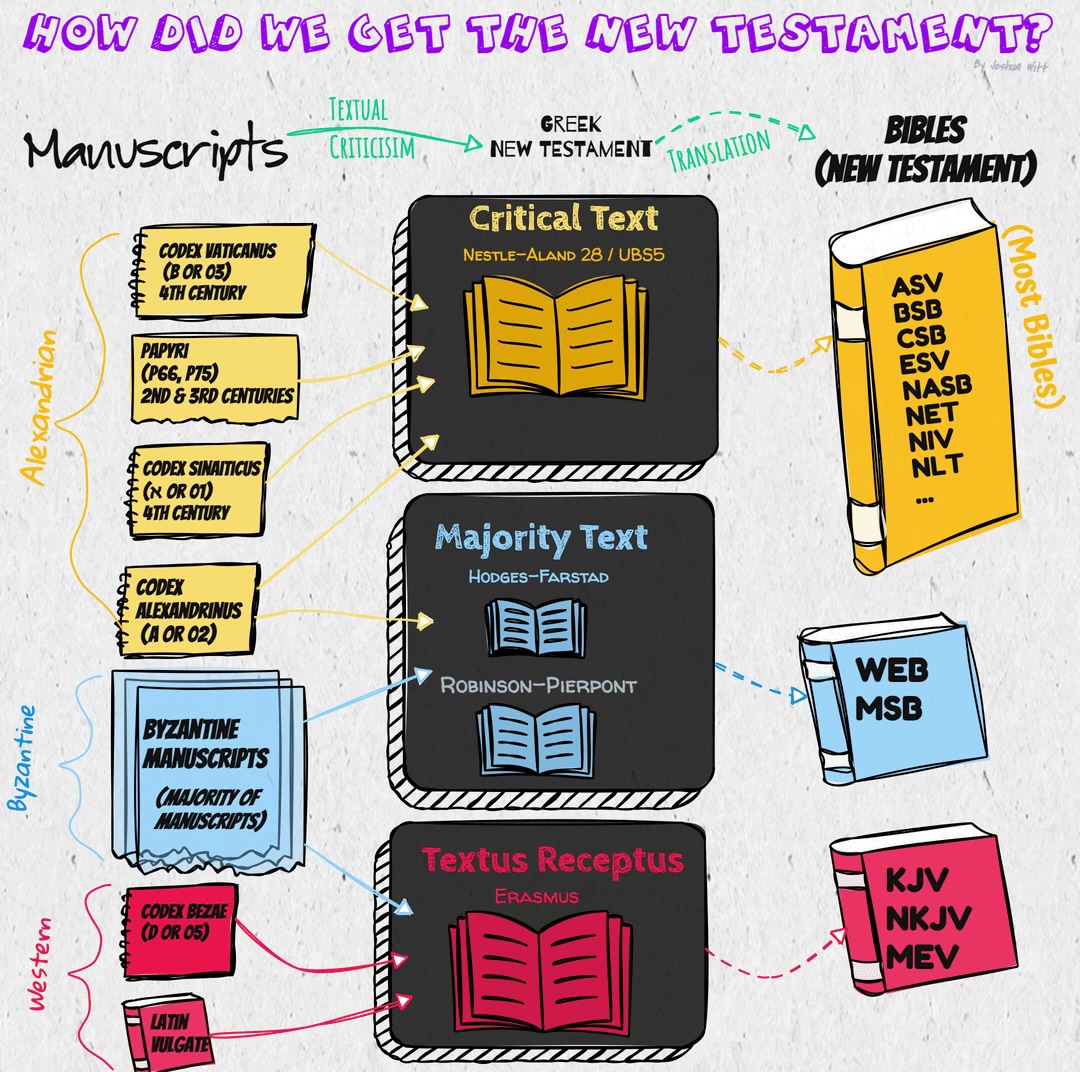
Many people may not realize that differences in verse inclusions across Bible translations often arise from the Greek New Testament edition chosen by the translators.

For instance, NIV translators didn’t “remove” verses present in the KJV; they were simply translating from different underlying manuscripts. These manuscripts have been compiled into two slightly different Greek New Testament editions.

Translation and textual criticism (determining which text is closest to the original) are related but distinct fields. Translation committees generally rely on the textual decisions made by textual critics who compile the Greek New Testaments used for translation.

Most Bible translations today are based on either the Textus Receptus (TR, or “Received Text”) or the Critical Text (CT, like the Nestle-Aland 28th Edition or United Bible Society 5th Edition). The KJV, NKJV, and MEV use the Textus Receptus, while the majority of other translations (such as the ESV, NIV, NASB, NLT, NET, and CSB) use the Critical Text.

Some translations, like the WEB and MSB, use a third option, the Majority Text (MT), which is less commonly known. Bible translations also vary in the number of textual footnotes they provide. For example, the NASB often includes fewer footnotes, while the NKJV has more than average, and the CSB, BSB, and WEB offer extensive notes (they’re the only translations I’ve seen with a note on the variant in Matthew 6:1).

A great resource for studying textual differences is the Text-Critical English New Testament: Byzantine Text Version, which shows the percentage of manuscripts supporting each reading. Sunday’s example was fascinating: most modern translations omit Matthew 17:21 (“But this kind does not go out except by prayer and fasting”) based on the Critical Text. However, a significant majority (87.7%) of Greek manuscripts do include this verse, whereas only a small fraction (0.6%) omit it.

While simply counting manuscripts isn’t necessarily the best way to determine authenticity, referring to 87.7% as merely “some” rather than “many” or “most” seems misleading.

It’s also unfortunate that the Majority Text and its close counterpart, the Byzantine Text, are so rarely discussed. God has blessed us with a rich manuscript tradition, and I think it’s important to consider the majority of these texts as part of faithfully stewarding this blessing.

Finally, I want to emphasize that I view all major modern evangelical translations as wonderful, reliable gifts from God. I use and recommend them all.

What is “Meekness”?

The only autobiographical statement Jesus gave of himself was this one:

Take my yoke upon you and learn from me, for I am meek and humble of heart; and you will find rest for yourselves.

Matthew 11:29 NASB

In that statement, one of adjectives that Jesus used of himself was “meek”.

Additionally, in the Beatitudes in the Sermon on the Mount, Jesus declared:

Blessed are the meek, for they shall inherit the earth.

Matthew 5:5 ESV

Thus, it seems it is pretty important to understand what “meekness” is, so we can understand who Jesus is, and what He was saying in the Beatitudes, about who will inherit the Earth.

“Meek” in Greek – Language & History

The word “meek” is the English translation of the Greek word Praús.

The Greek military leader Xenophon used the word to describe war horses that were well-trained; strong and spirited, yet highly disciplined.

Socrates said that a meek person is one who can argue his case without losing his temper.

Plato used the word to describe a victorious general who was merciful to a conquered people.

Aristotle referred to a meek person as someone concerned about justice, but whose anger does not degrade into revenge or retaliation.

The common theme in all these uses of the word is: “Power under control” – which certainly describes Jesus. [1]

How was Jesus “Meek”?

The Bible tells us that Jesus, though He is the almighty creator of the universe, He humbled Himself by taking on the form of a servant and submitting Himself to the Father. Though He was all-powerful, He set “emptied” Himself, becoming like us in all ways, in order to redeem us through His sacrifice for us.

What Does it Mean for Us to be “Meek”

For us to be meek means for us to bring ourselves, our intellects, our strengths, our agency, into submission to God’s call and commands for our lives. It means for us to use our strengths to serve Him and His mission, rather than to merely fulfill our own desires.

For more on the Beatitudes, here’s a recent sermon I taught on them at White Fields Church:

[1] cited in N.R. Pearcy, The Toxic War on Masculinity: How Christianity Reconciles the Sexes, ch 8.

Reader Response: Does the New Testament Require Tithing?

There is a page on this site where readers can submit questions or suggest topics. Recently I received the following question:

Do we still have to pay tithes in the New Testament?

Background: What is a “Tithe”?

The tithe (10% of income) was required by the Law of Moses (Leviticus 27:30-33, Numbers 18:21-24) to be given by Jewish people to support the ministry of the Levites and the Temple.

In addition to the tithe, other offerings were to be paid as well. The people of Israel were to be generous with their giving, both to support the ministry of the Temple, but also to care for the needs of the poor.

Jesus talked about Tithing

Jesus said:

“Woe to you, scribes and Pharisees, hypocrites! For you tithe mint and dill and cumin, and have neglected the weightier matters of the law: justice and mercy and faithfulness. These you ought to have done, without neglecting the others.”

Matthew 23:23

Jesus’ primary aim was to criticize the hypocrisy of the Pharisees, who tithed even off the herbs they grew in their garden, but neglected justice and mercy towards others. But notice, Jesus does say: “These you ought to have done without neglecting the others.”

In other words: Jesus is telling the Scribes and Pharisees that they should tithe! Jesus is saying that tithing is a good thing, and that people should do it!

This alone should be enough to say that tithing is taught in the New Testament, by Jesus himself.

Certainly Christians are required to be giving people, and generous people (see 1 Timothy 6:18).

Christians are encouraged to go above and beyond a Tithe

The most penetrating passage in the New Testament about giving is in 2 Corinthians 8-9. There we read about how the Corinthian Christians, though they were facing severe trials, “their abundance of joy and their extreme poverty have overflowed in a wealth of generosity on their part” (2 Corinthians 8:2).

The Corinthians first gave themselves to the Lord, and then to others [through their giving].

Thus, perhaps Christians should aim for 20% in their giving rather than 10%. Why not 30%?

For you know the grace of our Lord Jesus Christ, that though he was rich, yet for your sake he became poor, so that you by his poverty might become rich.

2 Corinthians 8:9

Maybe you’re asking the wrong question!

Many Christians unwittingly ask the question: “What is the LEAST amount that I can give, in order to make God happy/not break God’s rules?” Instead, the New Testament would encourage us to ask the question: “How can I rearrange my life, so that I can be more generous and give more to further the mission of God in the world?”

The tithe is not God’s way of raising money, it’s God’s way of raising kids.

An incredible thing that Paul writes to the Corinthians in 2 Corinthians 8, is that giving, or tithing “benefits you”! (2 Corinthians 8:10). Giving has a positive transformative effect on the person who gives.

Personally, I tithe because it is a matter of values, and it trains my heart. By making my tithe the first check (or automatic withdrawal) from my account ever month, I am making a clear statement of my priorities and values, which sends a message to my heart that it is more important to invest in the furtherance of God’s Kingdom, and the funding of God’s work in the world, than it is to be able to buy more stuff or do more things for recreation.

Tithing is a “keystone habit,” which means that it shapes the way that you live and affects all other areas of your life, when you make it a priority. In other words, choosing to tithe means that I will not be able to do certain things, which I would have been able to do if I didn’t tithe – and that’s good!

A sacrifice is only a sacrifice if it hurts.

David said, I will not sacrifice to the Lord that which cost me nothing (2 Samuel 24:24)  The woman who gave 2 mites, who Jesus pointed out to his disciples: that was a relatively insignificant amount of money to most people, but for her, it hurt!

Worship and sacrifice are very closely related. We all sacrifice for that which we worship. If you want to know what you truly worship, consider the things for which you are willing to sacrifice other things, especially things like time, family, or money.

God is looking for vessels He can pour into, who will then pour back out what He has given them in ways that He desires. If we show ourselves faithful stewards with the little things that God has entrusted to us, he may entrust us with more. Furthermore, God is a God who gives radically and generously; in fact he gave his all for the mission of bringing salvation to the world. To be like him and share his heart necessitates that we be willing to sacrifice for these same ends.

Do Christians Have to Tithe?

The New Testament does not explicitly state that Christians must tithe. However, it is a biblical principle, about which God invites and challenges us to test him! (see Malachi 3:10).

To Create Lines of Differentiation Between the Old and New Testament Risks Creating a False Dichotomy

To create a line of differentiation between the Old Testament and the New Testament risks creating a false dichotomy. There is only one mission and plan that God has been carrying out through the ages. The New Testament does not negate the Old Testament, but fulfills it. Thus, though we are no longer under obligation to keep the Law of Moses, Old Testament principles do not need to be restated in the New Testament to remain valid.

God loves a joyful giver. He doesn’t want people to give out of a sense of coercion or obligation. But this is a principle of which God says: “If you want to live the full life that I have designed for you, if you want to experience joy, then walk in this way,” – ‘the way everlasting’.

Related Post: Should I Tithe If I’m in Debt?

Ask a Question or Suggest a Topic

If you have a question or would like to suggest a topic for me to address here on the blog, click here: Ask a Question or Suggest a Topic

When were the Gospels & Revelation Written? And Why It Matters – with Shane Angland

How do we know when the books of the New Testament were written? Is it important?

In this episode of the Theology for the People podcast, I speak with Shane Angland about the dating of the Gospels and Revelation, and why the answer to that question might be more important than you think.

We discuss relative and absolute dating methods. We also look at some of the evidences for why we can be confident that the Gospels were written shortly after Jesus’ life and ascension. Additionally we talk about the Book of Revelation, and how the dating of Revelation actually determines how we interpret it.

Shane ss a teaching elder at Ennis Evangelical Church in County Clare, Ireland. He is a graduate of Dallas Theological Seminary (Th.M.) and holds a BA in History and Politics from the University of Limerick. Shane also served for several years as a missionary in Kharkiv, Ukraine.

The book Shane recommends at the end of this episode is: Redating the New Testament by John A.T. Robinson. Although Shane doesn’t agree with Robinson’s theology at some points, this work was groundbreaking because it showed that the books of the New Testament were most likely all written within the first century, and therefore were not pseudographs written in the Second Century, or later, as some, like Walter Bauer, had claimed in the 19th Century.

Check out Shane’s blog here: http://anglandicus.blogspot.com/

Click here to listen to the episode, or listen in the embedded player below.

When were the Gospels & Revelation Written? And Why It Matters – with Shane Angland Theology for the People

How do we know when the books of the New Testament were written? Is it important? In this episode, I speak with Shane Angland about the dating of the Gospels and Revelation, and why the answer to that question might be more important than you think. We look at some of the evidences for why we can be confident that the Gospels were written shortly after Jesus' life and ascension. Additionally we talk about the Book of Revelation, and how the dating of Revelation actually determines how we interpret it. Shane ss a teaching elder at Ennis Evangelical Church in County Clare, Ireland. He is a graduate of Dallas Theological Seminary (Th.M.) and holds a BA in History and Politics from the University of Limerick. Shane also served for several years as a missionary in Kharkiv, Ukraine. The book Shane recommends at the end of this episode is: Redating the New Testament by John A.T. Robinson Check out Shane's blog here: http://anglandicus.blogspot.com/ Visit the Theology for the People blog at nickcady.org, where you can read articles and suggest topics for future episodes.

What are the Keys of the Kingdom?

In Matthew 16, we read that in response to Peter’s confession that Jesus is “the Christ, the Son of the Living God” (Matthew 16:17), Jesus says:

And I tell you, you are Peter, and on this rock I will build my church, and the gates of hell shall not prevail against it. I will give you the keys of the kingdom of heaven, and whatever you bind on earth shall be bound in heaven, and whatever you loose on earth shall be loosed in heaven.”

Matthew 16:18-19

These verses have been used by the Roman Catholic Church to support the concepts of papal authority and papal succession, suggesting that Peter’s successors hold the keys of the kingdom.

But is this correct?

What was Jesus speaking about when he said “on this rock I will build my church”? And what are the “keys of the kingdom”?

In a recent Sermon Extra video, Pastor Mike and I discussed this topic. Here are some highlights, and then you can see the full video below.

What was Jesus speaking about when he said “on this rock I will build my church”?

There are 3 possible options:

  • Jesus is speaking about Peter as the first leader of the church
  • Jesus is referring to Peter’s confession that Jesus is the Christ (Messiah) and the Son of the Living God (deity)
  • Jesus is referring to himself as the rock (cornerstone) upon which the church is based

The strength of the first view (that Jesus is speaking about Peter) is the fact that Peter’s name means “stone.” So, perhaps Jesus is speaking about Peter through a play on words.

However, when Peter himself writes his first epistle (1 Peter), he writes that we who are believers are like living stones which are being built together into a spiritual house (temple), with Jesus Christ as the cornerstone. In Paul’s letter to the Ephesians, he says that we who are believers are members of the household of God, which is built on the foundation of the apostles and prophets, with Jesus Christ as the cornerstone (Ephesians 2:20).

When John (who was present when Jesus said those words recorded in Matthew 16) wrote his gospel, he made this statement his grand culmination:

Now Jesus did many other signs in the presence of the disciples, which are not written in this book; but these are written so that you may believe that Jesus is the Christ, the Son of God, and that by believing you may have life in his name.

John 20:30-31

It’s surprising just how similar John’s words are to Peter’s statement: that Jesus is the Christ, the Son of the living God. John says that this is the way to receive eternal life. So, is this confession of Jesus as Messiah and God the foundation of the church?

Here’s the thing: even if it is referring to Peter, and Jesus was giving Peter a position of primacy of leadership in the early church, it does not necessarily follow that Peter’s primacy of leadership would then be handed down in succession to whoever held his position in the future. This is especially true, since Peter’s position changed over the course of time in the early days of Christianity. Early on, we see Peter as a leader in the church in Jerusalem, but eventually he left Jerusalem. He eventually died in Rome, but the church in Rome was not started by him.

The idea of papal succession is quite a leap from this verse, and it has significant historical issues with it as well, as I explain in the video linked below.

What are the “Keys of the Kingdom”?

Keys are something which open doors and close doors. Did Jesus give these keys specifically to Peter, or were they given to Christian leaders in general, or even to believers in general?

If they were given to Peter, it is worth noting that Peter is the one who opened the doors to salvation through Jesus first to the Jews on the Day of Pentecost (Acts 2), then to the Samaritans (Acts 8), and then to the Gentiles (Acts 10-11).

It is certainly significant that the exact phrase that is used in Jesus’ statement in Matthew 16 about the keys of the kingdom: “whatever you bind on earth shall be bound in heaven, and whatever you loose on earth shall be loosed in heaven” is used again by Jesus only two chapters later in Matthew 18, when he is talking about how to deal with a fellow believer who has sinned against you.

There, after explaining the protocol for dealing with these situations, he says:

“Truly, I say to you, whatever you bind on earth shall be bound in heaven, and whatever you loose on earth shall be loosed in heaven. Again I say to you, if two of you agree on earth about anything they ask, it will be done for them by my Father in heaven. For where two or three are gathered in my name, there am I among them.”

Matthew 18:18-20

This is spoken to all of Jesus’ disciples, not just Peter, but the final statements seem to make it clear that this statement applies to all believers who gather in Jesus’ name.

Here’s the video in which we discuss this in a bit more detail, especially in regard to this historical development of interpretation within the Catholic, Orthodox, and Protestant churches:

Hermeneutics: How Do We Correctly Interpret What the Bible Says?

This week’s episode of the Theology for the People podcast is a discussion I had with pastors Benjamin Morrison and Craig Babcock on the topic of hermeneutics and Biblical interpretation.

Hermeneutics is the method by which we interpret communication, particularly texts. Legal hermeneutics, for example, is the study of how laws, or the constitution for example, are to be understood and put into practice.

Biblical hermeneutics is all about how to correctly interpret the Bible, so that we can be doers of the Word, not hearers only.

The reason hermeneutics is worth considering is because different people, reading the same Bible, can come to differing conclusions about what it means. The reason that happens is an issue of theological method (see: Theological Method: Sources of Theology and Why People Arrive at Different Conclusions About Matters of Faith & the Bible) and hermeneutics.

It must be said that not all hermeneutics are equally valid. Some hermeneutics are better than others. Sometimes we even intentionally use a hermeneutics in order to properly interpret something, as we do with “Christ-centered hermeneutics” – in which we intentionally read all of Scripture as pointing to Jesus, which we do because Jesus himself told us that this was the proper way to read and interpret the Old Testament Scriptures (see Luke 24:44-48).

Other examples of good hermeneutics would be “biblical hermeneutics,” in which read the Bible understanding all of the Bible to be the inspired Word of God, meaning that each individual part of the Bible should be understood in light of what the rest of the Bible says. We might intentionally choose to read the gospels through a Jewish lens, seeking to put ourselves sin their shoes in order to understand the things that happened or were said.

Oftentimes, however, our hermeneutics are not intentional, and we may not be aware of them, and they do impact how we interpret and understand what the Bible says. How then can we become aware of the hermeneutics we’re unintentionally using so that we can determine if they are good or not?

In this episode we discuss this and other questions surrounding the topic of hermeneutics. You can listen here or in the embedded player below.

Hermeneutics: How Do We Correctly Interpret What the Bible Says? – with Benjamin Morrison & Craig Babcock Theology for the People

In this episode Nick Cady and special co-host Craig Babcock speak with Benjamin Morrison, lead pastor of Calvary Chapel Svitlovodsk, Ukraine and coordinator for City to City Ukraine, about the topic of hermeneutics: the interpretation of texts, particularly the Bible. Hermeneutics and biblical interpretation is the focus of Ben's masters studies at London School of Theology, Nick's alma mater.  What is hermeneutics, and why is it important? Can't we just read the Bible without having to worry about interpretation? As Ben shows us, everyone who reads the Bible has a hermeneutics and we are all interpreters, the question is: are you a good and faithful interpreter of the biblical text? If, as Ben points out, not all hermeneutics are equally good, then how can we determine which ones are better than others and how do we identify our own hermeneutics in order to examine whether they are good or not? We discuss these questions in this episode.

The Formation of the New Testament Canon: Part 2 – Recognition, Disputes & the Gospel of Thomas

In Part 2 of this two-part series, Mike and I discuss the process through which the New Testament was recognized as Holy Scripture.

At what point were the books of the New Testament recognized as Scripture? Who was involved in that process, or who made that determination? What about the disputed books, and why was the Gospel of Thomas kept out of the Bible?

We answer these questions and more in this episode. (Click here to listen to Part 1.)

Click this link to listen this week’s episode, or listen in the embedded player below: The Formation of the New Testament Canon: Part 2 – Recognition, Disputes & the Gospel of Thomas

The Formation of the New Testament Canon: Part 2 – Recognition, Disputes & the Gospel of Thomas Theology for the People

In Part 2 of this two-part series, Nick and Mike discuss the process through which the New Testament was recognized as Holy Scripture. At what point were the books of the New Testament recognized as Scripture? Who was involved in that process, or who made that determination? What about the disputed books, and why was the Gospel of Thomas kept out of the Bible? We answer these questions and more in this episode. Make sure to check out the Theology for the People blog as well.

The Formation of the New Testament Canon: Part 1 – Nicaea, Constantine, & Conspiracy Theories

Last week Mike and I sat down to discuss some common misnomers and conspiracy theories regarding the formation of the New Testament canon.

What actually happened in Nicaea? Did Constantine play a role in the formation of the New Testament canon? Who was King James?

Did anything happen that should cause us concern that the Bible we have is not trustworthy, or has been tampered with?

We answer those questions in Part 1 of our 2-part episode on the formation of the New Testament canon. Click here to listen, or listen in the embedded player below: The Formation of the New Testament Canon: Part 1 – Nicaea, Constantine, & Conspiracy Theories

The Formation of the New Testament Canon: Part 1 – Nicaea, Constantine, & Conspiracy Theories Theology for the People

In Part 1 of this two-part episode, Nick and Mike discuss some common misnomers and conspiracy theories regarding the formation of the New Testament canon. What happened in Nicaea? Did Constantine play a role in the formation of the New Testament canon? If so, is there anything we should be concerned about? Check out the Theology for the People blog as well.