
Trying to Make the Good News Better

Recently I was asked by some members of our church to listen to a sermon from a church their friends attended, who had been alarmed by some things the pastor had been saying, and they wanted my 2 cents.

I listened to the message and agreed with them that the things they had been concerned about were indeed alarming – but aside from that particular issue, which I won’t go into detail about here, there was something else I heard in the message which caused me to pause.

The pastor was talking about a trip he had taken and how, as he was preaching, people were live-tweeting his message, and the most tweeted phrase was: “I am a good person, I just forgot.” The idea being, that you really are a good person, you just haven’t been acting like one. You just forgot to be good.

He then went on to say this: “When people come to church, they don’t want to be told about their shortcomings, they come to church because they want to hear some good news, and this is the good news: you really are a good person! You just forgot.”

On the surface, that might seem nice, but here’s the thing: is this really the “good news” that Christianity has to share with people? That ‘I am a good person’ – even though people innately have a deep-rooted sense of their own inadequacy? Isn’t the “good news” of the Gospel not that I am a good person, but that God loves me even when I’m not a good person?

The “good news” of the Gospel is not that I’m a good person, but that God loves me even in spite of the fact that he has seen me at my worst and even knows the darkest thoughts of my heart that, although I didn’t act upon them, I wished to do them?

Isn’t the “good news” of the Gospel rather that I am more flawed than I can even imagine, yet at the same time I am more loved by God than I ever dared dream possible – which He proved by giving Himself over to death in my place to rescue me, because I was so lost and so far-gone that I couldn’t save myself? Isn’t the good news of the Gospel that I am so broken that GOD HIMSELF had to die for me, yet against all odds or reason, I am so loved by God – undeservedly – that in some cosmic miracle of grace, he was GLAD to die for me?

It would seem to me that in an attempt to make the Good News better, they have lost the heart of the Good News! But in my opinion, when you really understand the weight of the predicament of human fallenness, and then you see the amazing grace and love of God in light of it, that is what sets your heart on fire, and stirs up hope and gratitude in your heart that a lifetime is not enough to express.

What we need is not to make the Good News better – as if that were even possible. It is already the best news in the world. We just need to let it sink deep down into our hearts and reflect on all the wonderful implications of it.
How to Truly Live

The final paragraph of CS Lewis’ Mere Christianity is incredible.  He’s speaking on the issue of how to truly live, and his point is that selfishness is not actually in our best self-interest.

Check it out:

The principle runs through all life from top to bottom. Give up yourself, and you will find your real self. Lose your life and you will save it. Submit to death, death of your ambitions and favorite wishes every day and the death of your whole body in the end: submit with every fiber of your being, and you will find eternal life. Keep back nothing. Nothing that you have not given away will be really yours. Nothing in you that has not died will ever be raised from the dead. Look for yourself, and you will find in the long run only hatred, loneliness, despair, rage, ruin, and decay. But look for Christ and you will find him, and with him everything else thrown in.

The Eschatological Significance of the Christian Sunday

Following up on a previous post on why Christians worship on Sunday and the correlation between the Jewish Sabbath and the Christian Sunday, I recently read something I found interesting.

While many people assume that Christianity just took the Jewish idea of Sabbath and moved it to Sunday, it turns out the reason for the Christian Sunday is deeply eschatological.

Check it out:

Jewish Sabbath

  • End (Saturday)
  • Rest from Creation
  • Happens after creation, within time: retrospective
  • Keeping of obligations
  • Preservation

Christian Sunday

  • Beginning (Sunday)
  • Commencement of the New Creation
  • Speaks to the aim of new creation: eternity = future-oriented
  • Celebrates that the obligations have been met by God through Christ
  • Resurrection

Christianity was not just a rebranding of Jewish practices, but an eschatological fulfillment of them.

The Christian Sunday is more than a day of rest for Christians, it is a day of new creation. In it, we remember not only to rest from our labor, but we are reminded that with the resurrection of Jesus, we stand at the dawn of eternity – and that one day soon, the Son will break over the horizon and usher in the New Day. In the death and resurrection of Jesus Christ we have witnessed the death of death and the birth of “the life that is truly life”.

What Makes for Good Preaching?

What differentiates good preaching from mediocre preaching?

Surely you know it when you hear it, but it can’t be just a subjective thing – there must be some criteria that differentiate good preaching from not-as-good preaching.

I recently heard Timothy Keller differentiate between good preaching and great preaching. He said that “good preaching” is the altar and that “great preaching” is when God brings the fire upon the altar. In other words: preachers shouldn’t strive to preach “great” sermons, but should work to preach “good” sermons – because only God can take a “good” sermon and by the power of the Holy Spirit make it a “great” sermon within the hearer.

So what makes for good preaching?

Here are some thoughts:

  • A good sermon, no matter what text it is preached from, has to preach the Gospel. Just as every town in England has a road which leads from it to London, every text in the Bible has a road from it which leads to Christ. If all the Scriptures ultimately point to Him, a good sermon must preach the Good News of Jesus Christ.
  • Yet, a good sermon must be faithful to the text. It must not manipulate the text to simply be a “proof text” to back up the point that the speaker wants to make; it must be true exegesis, which determines what the author, and God through the author, intended to communicate through that text.
  • Furthermore, good preaching is an art form – it must be informative, it must be touching emotionally, and it must be moving inspirationally.  I heard Timothy Keller say that when you are preaching, people should be taking notes, but when you get to the part of your sermon that is about Jesus, you should seek to portray him as so captivating that people can’t help but stop taking notes when you talk about Him, and when they leave, they should leave wanting to do something because of what they’ve heard.
  • Another friend of mine – and an elder at White Fields Church – put it this way:
    • In our conversation he even put it this way: “A good sermon takes you to a place you’ve never been before, or it takes you to a place that is so intimate that you are emotionally moved”

What do you think?  What are other essential elements of “good” preaching? Let me know your thoughts in the comments section below.

…The Harder They Fall

On my way home from church on Sunday I saw a Facebook message saying that the pastor of the largest church in the movement I’ve long been associated with had resigned due to moral failure.

I hate hearing this kind of stuff.

Over the last several days I have seen tons of posts on social media from other pastors about this pastor’s fall. I understand that they want to address what’s going on. I understand that they are upset and want to talk about it. I’m not sure if we should be posting that kind of news everywhere though. At what point is it just gossip? Gossip is still gossip if you present it as a “prayer request”. Isn’t it spreading sensational news about someone else’s junk that really has no bearing on us personally?

I opened the CNN app on my iPad on Monday, only to see an article on the front page about this pastor’s moral failure and resignation. Great – more fuel for those who are always looking for fodder against Christianity and the Church.

I’m upset that someone in that man’s position would risk his legacy, his family and the reputation of the Church of Jesus Christ for some fleeting moments of pleasure.

I am sad for his wife and kids who have to go through all of this in the public eye. I am concerned for that church, and pray that the people who attend there will have the maturity to walk through this process as a body, faithful to the heart and will of God.

I am glad to see that high moral standards are upheld, and exceptions aren’t made for someone because they are gifted, talented and popular. Personally, I loved listening to that man teach. He is truly a gifted communicator. I heard someone put it this way: “David kills Goliath no matter how you read the story, but some teachers are able to make the story come alive – whereas other teachers make you wish someone would hit you in the head with a stone and put you out of your misery.” This man is a great teacher. But I am glad that his skill and celebrity were not used as an excuse for making an exception to the rules for him when it comes to moral standards for those who will serve as leaders in the God’s church.

This situation is one more sober warning for Christians, and especially for those of us in leadership and ministry, that we must watch over our hearts with all dilligence, because it is from the overflow of our hearts that our actions proceed.


Why Does it Matter What Bono Thinks About Jesus? A Few Reasons

I recently ran across this video of Bono talking about his Christian faith in an interview:

http://www.youtube.com/watch?v=VIm7JRSo6w4

A lot has been made of Bono and his faith. I have heard some Christians declare that Bono is their pastor; I know several Christians who don’t listen to any “secular” music, but love U2 more than their first-born children – these ones typically own a guitar, on which they can play simple worship songs AND a few songs by U2, which they would say are “kinda like worship songs, you know, if you really think about it.”  In fact, I have known of churches where the worship leader has lead the congregation in a chorus of a U2 song during worship.

All that goes to say: There are quite a few Christians out there. Why should it matter what Bono in particular thinks of Jesus?

As I listen to Bono speak about his faith, I feel that he is almost hesitant to admit that he believes Jesus is the Messiah. The way he talks about church kind of rubs me the wrong way too. Jesus didn’t come to establish a private religion that people practice alone or in their home with just their family – Jesus came to start a worldwide movement which has corporate expression. The church is not a somewhat-necessary evil, it is intrinsic to why Jesus came.

Having said that – here are a few reasons why what Bono has to say about Jesus matters.

Why does it matter what Bono thinks about Jesus?  A few reasons:

1. He is not American

I think a lot of American’s don’t understand how the world outside of America views us. I remember the first time I travelled abroad, right after high school, I had this unarticulated view of people in other countries, that they were basically ‘the ones who hadn’t made it to America yet’. American culture tends to not have a clear understanding of how people outside of America really think about America. Often it is assumed that people either hate America or love America. In reality, it is much more nuanced than that.

One of the main views on America that I have heard abroad, is that we are a very religious country – which, statistically is absolutely true. Thus, people outside of the United States are used to American celebrities and politicians talking about their faith, oftentimes their evangelical Christian faith. However, when a European – an Irishman in Bono’s case – expresses evangelical Christian beliefs, the non-American world stops to listen a little more. And this is a great thing actually, because it helps the world to see that evangelical Christianity is not just an American phenomena – it is the natural outworking of taking the Bible seriously.

2. He is a celebrity who does a lot of good things

Bono has credibility in the eyes of the world because he has been so active in working for humanitarian causes. One of the criticisms evangelicalism has gotten (whether deserved or not), is that we are a relatively apathetic bunch when it comes to major social issues facing people around the world, such as AIDS, lack of clean drinking water, etc. Once again, the case can be made that this is certainly not the case – but there is a sense in which this is the reputation that evangelicals have gotten: that they are only concerned with getting “goose-bumps from Jesus” and getting the heck heaven out of here, that they are not concerned with the plights and suffering that people are facing. Bono, because of his well-publicized humanitarian efforts is generally considered a credible person. <— this is something to take note of for those of us who want to be heard.

3. He understands the outsider’s perspective

This is perhaps the greatest reason. Bono knows how to speak in a way that relates to those outside of the fold of Christianity and the church. I believe there are a great number of people who have some kind of latent faith in Jesus, but are not connected to any community of faith, because they are afraid that structured religion will kill their faith. Bono has a way of talking about Jesus which retains much of the mystery and awe for him, which is often lost by evangelicals. Yes, he comes across reluctant and non-conformist, but guess what: that’s how A LOT of people out there feel. Bono is good at speaking in a way that is relatable to the “outsider” because he is able to see things from their perspective – a very important skill we could all afford to grow in, by the way! I believe Jesus was a person who was able to relate to “outsiders” well too – and that was part of his magnetism.

I’d love to hear your thoughts on Bono and his faith below in the comments section!


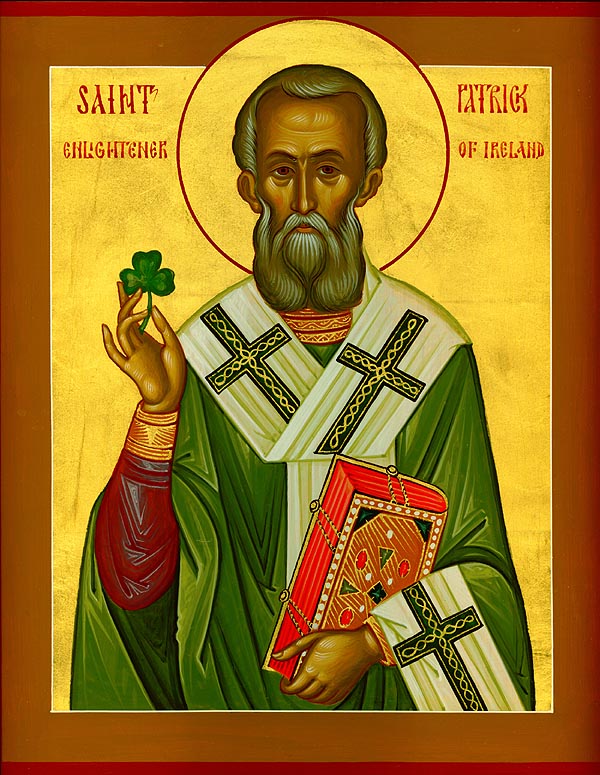
Who Was Saint Patrick?

0317patrick-ireland

I am an Irish-American. My dad’s family is all Irish, and I have an Irish last name. The only really Irish things I remember growing up were eating corned beef and hash and having a big Irish wake after my grandmother’s funeral. I personally feel that the Irish response to death is one of the great things about their culture – they know how to mourn a loss and celebrate a life at the same time.

Today is Saint Patrick’s Day – but who was Saint Patrick?

Well, interestingly enough, Patrick has never officially been named a saint by any church body. Furthermore, Patrick was not Irish! And if you’ve ever heard that Patrick drove the snakes out of Ireland – there never actually were snakes in Ireland, so that is just the stuff of legend.

The real Patrick was a Roman Briton born in Wales around 390 AD to a wealthy, noble family. His father was a deacon and his grandfather a pastor. When Patrick was 16 years old, he was captured by Irish marauders and taken to Ireland as a slave. After living there as a slave for 6 yrs, he managed to escape back to Britain. After his return to Britain, he joined a monastery and became a minister, and during this time he was burdened with a desire to go back to his former captors in Ireland and share with them the Gospel of Jesus Christ. So Patrick returned to Ireland in 432, this time not as a slave, but of his own volition – as a missionary.

Patrick was one of the earliest Christian missionaries to travel abroad to spread Christianity. One of the noteworthy things which Patrick did as a missionary was live in solidarity with the Irish people. Patrick wrote that he “sold his nobility” to enhance his commonality with his Irish audience. He spoke their language, and lived among; he became one of them, that he might reach them with the Gospel.

One of the first things that Patrick did was gain religious toleration for Christians from the Irish King. He also sought to evangelize prominent druids, knowing that others would likely follow if high profile druid leaders converted to Christianity. One of Patrick’s emphases amongst those who converted to Christianity was spiritual growth. Within 15 years Patrick has evangelized much of Ireland. In all, Patrick served as a missionary and pastor in Ireland for some 30 years.

One of the long-term fruits of Patrick’s ministry in Ireland was a movement of Irish missionaries that grew up in the generations following his establishment of Christianity in that country. One of these men was Columba (521-597) who was born in an Irish Christian family and became a priest in the church and somewhat of a church planter, establishing many churches in Ireland. At age 42 Columba left Ireland, saying he had been motivated by the ‘love of Christ’ and went to Scotland, where he established a monastery which served as a station for training and sending missionaries into the surrounding region.

Here’s to Patrick the missionary and to the Irish people!

Bonhoeffer on “Cheap Grace”

Earlier this week I finished reading Metaxas’ biography on Dietrich Bonhoeffer, and decided to go ahead and re-read Bonhoeffer’s Nachfolge – The Cost of Discipleship.

I’ve read it before, but the words of the first chapter are so compelling that I can’t help but return them time and time again. Bonhoeffer spoke against a Christianity that has been cheapened into anything less than a call to be a sold-out disciple of Jesus Christ.

Check out what Bonhoeffer has to say about grace. If you’ve read it before, read it again, and let it hit you with all its force once again: 

“Cheap grace means grace sold on the market like cheapjacks’ wares. The sacraments, the forgiveness of sin, and the consolations of religion are thrown away at cut prices. Grace is represented as the Church’s inexhaustible treasury, from which she showers blessings with generous hands, without asking questions or fixing limits. Grace without price; grace without cost! The essence of grace, we suppose, is that the account has been paid in advance; and, because it has been paid, everything can be had for nothing. Since the cost was infinite, the possibilities of using and spending it are infinite. What would grace be if it were not cheap?…

Cheap grace is the preaching of forgiveness without requiring repentance, baptism without church discipline, Communion without confession, absolution without personal confession. Cheap grace is grace without discipleship, grace without the cross, grace without Jesus Christ, living and incarnate.

Costly grace is the treasure hidden in the field; for the sake of it a man will go and sell all that he has. It is the pearl of great price to buy which the merchant will sell all his goods. It is the kingly rule of Christ, for whose sake a man will pluck out the eye which causes him to stumble; it is the call of Jesus Christ at which the disciple leaves his nets and follows him.

Costly grace is the gospel which must be sought again and again, the gift which must be asked for, the door at which a man must knock.

Such grace is costly because it calls us to follow, and it is grace because it calls us to follow Jesus Christ. It is costly because it costs a man his life, and it is grace because it gives a man the only true life. It is costly because it condemns sin, and grace because it justifies the sinner. Above all, it is costly because it cost God the life of his Son: “ye were bought at a price,” and what has cost God much cannot be cheap for us. Above all, it is grace because God did not reckon his Son too dear a price to pay for our life, but delivered him up for us. Costly grace is the Incarnation of God.” 

– Dietrich Bonhoeffer, The Cost of Discipleship

“Always Go To The Funeral”


I ran across this article from NPR’s All Things Considered called “Always Go To The Funeral.” It’s worth listening to or reading.

As a pastor, I attend a fair number of funerals. Since our congregation is relatively young, these aren’t usually funerals for our church members, but funerals for their loved ones who pass away.

I think going to funerals is important. There are certain moments and events in life that are worth inconveniencing yourself for; honoring the life of a human being is one of them. 

A lot of people avoid funerals because death is something that we all feel is a foreign imposition on us – something that is inherently wrong. We are right to feel that way actually;  God’s Word makes it clear that we were made to live forever, and that sickness, pain and death are a curse – part of the very curse that Jesus Christ came to set us free from. However, it’s that very reason why it’s a healthy thing for us to attend funerals – to be faced with the ultimate realities that make the hope of the Gospel truly good news.

One thing I’ve realized over the years as a pastor, is that most people aren’t prepared for how to handle those who suffer or grieve. On a recent trip to Hungary I taught a seminar for the church there, whose pastor had recently lost a child, on how to understand grief and how to love and minister to grieving people. This instruction is so helpful, because most people (at least over there) default to either avoiding the situation or saying things which aren’t helpful. In reality, one of the best things you can do for someone who is grieving is not say anything, but just be around – present, available.
Yes, funerals are uncomfortable. Guess who else doesn’t enjoy being at that funeral: the person who lost a loved one. Bless them by being there beside them in their time of loss.