Thoughts on the Refugee Crisis in Europe – and How You Can Help

Hungary has been in the news a lot lately because of the refugee crisis going on right now in Europe. Because my wife and I lived there for so long, many people have been asking for my opinion on what’s happening, so here goes:

What is happening right now is going to shape the future of Europe

This is something of historic proportions. Estimates range from 300,000 to over 1 million Syrian, Iraqi and Afghan migrants and refugees having entered already into Europe over the past several months. Countries like Hungary, Slovakia, Poland, Czech Republic are mostly homogeneous nations; they have had almost no muslim population to speak of. Until now, muslims in Europe have been based solely in the Western countries. That is now going to change.

I don’t believe that most of these migrants are muslim radicals; the great majority of them are people fleeing atrocities and horrible circumstances, which is very understandable. However, since the floodgates have opened up, there is no saying who all is coming into Europe right now, and I’m sure there is a mixed bag, with some of those radical elements being part of it, seeing a wide open door to Europe and taking the opportunity. Conspiracy theories are rampant as to the idea that this is a muslim invasion of Europe, but honestly, really radical muslims in Syria and Iraq who want an Islamic state would probably be most inclined to joining ISIS anyway, since that is what they want.

Long term solutions and short term responses

The long term solutions to this problem are certainly not something I’m qualified to give, but I would assume that peace and stability in Syria, and the defeat of ISIS is a big part of it.

The Dublin Agreement, which says that the first European Union country a migrant enters is responsible for registering them and then processing them is, in my opinion, unfair. It serves to protect the wealthy countries of North and West Europe and keep the burden on the poorer countries of Southern and Eastern Europe. I’m glad to see the Dublin Agreement being ignored and reconsidered. I do think the suggestion of Donald Tusk of Poland is fair, that the countries of the European Union should share the burden of these refugees. Some countries are not really affected by it, while others bear the brunt of it.

However, since the Dublin Agreement has been being ignored, with Austria and Germany accepting thousands of refugees who were “stuck” in Hungary, I expect even more refugees to come, as word of that spreads, and there is an apparent open door into Western Europe for anyone willing to make the journey. None of these people want to stay in Hungary. They are trying to go through Hungary into the wealthy countries of Western and Northern Europe.

In the short term, the response of Christians in Europe to the refugees has been amazing. I do believe that as Christians our calling is to love and serve those right in front of us, no matter their creed or nationality, and many of my friends and former colleagues in Hungary and Serbia are doing just that. Below I have included a link for how you can support their efforts.

The response of Hungarian citizens to the refugees in their country has been outstanding. They have treated them with love and respect. The video that was on the news yesterday of a Hungarian camerawoman at Röszke tripping and kicking refugees was despicable and not at all characteristic of the Hungarian people. This woman was filmed tripping a man carrying a child, so that he and the child fell, and later kicking a young refugee girl in the stomach as she tried to run by. It turns out this woman worked for a far-right wing news source, and even they didn’t approve of her actions and she was fired.

My wife Rosemary and I worked with refugees for years in Debrecen, Hungary – and what we found was that for many of these people from majority muslim countries, coming to Europe was the first time they had been exposed to Christianity and for most of them it was the first opportunity they had to hear the Gospel and read the Bible. We saw many people convert to Christianity, and I do believe that this may be a great opportunity for these muslim people to come to Europe and hear about Jesus. The work of Christians in loving them will make great strides towards this end. Pray that God would use this crisis as a way of bringing many of these people to a saving knowledge of Jesus Christ.

How you can help

Our friends at Calvary Chapel Bible College Europe in Vajta, Hungary – only a short drive from Röszke, the major flashpoint for refugees entering Hungary, are providing food and blankets, among other things, to the refugees who have been being kept at a temporary “camp” on the border, which is just a fenced off corn field, where refugees, including many children, are sleeping on the ground in increasingly cold temperatures. For the last few nights it has been 10 degrees Celsius / 50 degrees Fahrenheit.

Here is the link to where you can donate to support their efforts.

We also have friends in Szeged, Hungary, only a few kilometers from Röszke, and they have been very involved with the refugees as well. Here is a link to their blog where you can follow what they are doing.

Pray for the refugees and those serving them in the name of Jesus!

Counted Worthy

Friday I am heading to Europe with a mission team to Hungary and Romania and I will take a short jaunt down to Serbia on my own apart from the team. I will be teaching at a churches in Budapest and Eger, Hungary and in Subotica, Serbia, and the team will be doing 2 week-long youth outreaches – one in Eger, Hungary and the other in Bistrita, Romania – which will be youth camps where we will teach English and hope to build relationships through which will share the Gospel with these young people.

We created a website where you can follow us; all the team members are registered as authors, and will be posting photos and updates over the 2 week trip.  Here’s that site: https://whitefieldsmissions.wordpress.com

On Sunday I taught Acts chapter 5 at White Fields, and there is this phrase in there which is captivating: that the apostles rejoiced that they were counted worthy to suffer dishonor for the name [of Christ] (Acts 5:41).

That evening, my son told me that there was a “stinky mud” coming up from the drain into our basement shower. You might have already guessed, but it wasn’t exactly mud – it was sewage. I spent that whole night and most of the next day snaking our sewer line, ripping out carpet, and bleaching walls because of the sewage that had come up into the bathroom…

The next morning we got an email from the church in Eger, that many of their key members for this outreach had come down with the flu; one even had to be taken to the hospital.

My wife’s comment on Facebook in response to all of this?  “Rejoice that you are counted worthy to suffer for His name!”

What a grand perspective that is!  And what a much neglected perspective that is, amongst so many Christians! When the reaction of so many is: “Why would you let this happen to me, God!?”  – the response of rejoicing to be counted worthy to suffer for His name is absolutely counter-cultural.

Paul the Apostle talks about the “fellowship of suffering”:  that I may know [Christ] and the power of His resurrection and the fellowship of His sufferings (Philippians 2:10)

What Paul is talking about is a special kind of fellowship you can have with Jesus in your suffering.

Not to say that what we went through was particularly abnormal or outstanding, but I believe the perspective is a good and important one to have no matter the degree of your trial, and particularly when those trials come in relation to serving Jesus.

I’m Back – and Shelby the Elder

I just got back from a 12-day trip to Hungary and Ukraine, the bulk of which was spent visiting the church my wife and I planted in Eger, Hungary. This church was celebrating their 10 year anniversary, so I and my fellow pastor from White Fields Church went to celebrate with them at a weekend retreat where we did the teaching. We also had great times of fellowship with church members and were able to spend some quality and hopefully encouraging time with the church leadership.
Conference in Eger, Hungary

After Hungary we travelled to Ukraine, where we visited a church which White Fields partners with in the city of Svitlovodsk.

The stand of the Lenin statue in Svitlovodsk, which was toppled last year and then painted with the colors of the Ukrainian flag

It’s good to be back home and I look forward to writing more as time permits.

In the mean time – I wanted to recommend a new blog, authored by one of the elders I serve with at White Fields: Shelby the Elder.

Check him out, engage with him and leave him comments and encourage him to keep on writing!

When God Says “No”

One of the things we’ve been doing at White Fields Church is giving people the opportunity to text or tweet us questions during the sermon.

Yesterday morning I taught 2 Samuel ch 7, which is the time when David had a desire to build a house for the Lord, but God said “No!”  That has some interesting implications, because what David wanted to do was a good thing, and it was a biblical thing – yet God said “no”.

This question was texted in during that sermon:

This morning in the sermon, you discussed having a desire to be a missionary, pastor, etc. If we have that desire in our hearts, didn’t God put that there? So why would He close The door if He put that desire there?

That is a great question!  The first question is a particularly important one: Did God put that desire there?  I believe that as we get closer to the heart of God – delighting ourselves in the Lord, as David said (Psalm 37:4) – that our desires are changed and become more aligned with His desires. 

In the story we studied yesterday in 2 Samuel 7: David had a desire. It was a good, noble desire – it was even a Biblical desire. Did God put that desire there? Maybe! Or maybe not. We don’t know for sure. There is a way in which we could argue that God did put that desire in David’s heart – but that David’s role in fulfilling that was not to be directly involved in the building of the temple, but indirectly – as we saw, how David got the ball rolling with the building of the temple and had all of the items made which would be used in the temple.

Let me share an example from my own life: I gave my life to the Lord when I was 16, and almost immediately I developed a desire to minister to the people of the former Soviet Union, specifically Ukraine, where my family had immigrated from. When I was 18, I was invited to go on a ministry trip to Budapest, Hungary – to a conference for Calvary Chapel churches from Hungary and Ukraine. It was the Ukrainian part which I was interested in, and I went there with the hope that I could connect with some ministries in Ukraine. I was able to do that, but interestingly all of the “doors of opportunity” for me to serve in Ukraine seemed closed, however there was an incredible open door and an invitation for me to serve in Debrecen, Hungary – the pastor there told me he had been praying for someone exactly like me to come and work with them. I had no real desire to go to Hungary, my desire was to serve the Lord in Ukraine – but I prayed about it and came to the conviction that this is what God had for me at that point, and after serving there for a little while I could move to Ukraine, where I really desired to be. I committed to go to Debrecen, Hungary for 8 months. During those 8 months, I prayed for Ukraine constantly, I even tried to go to Ukraine to work with some of the people I had met the year before at the conference in Budapest, but once again all the doors of opportunity were closed!  My feeling was: God, why did you give me this desire to serve you in Ukraine, and then close all the doors before me?!  Yet, in the meantime, I had become very proficient in Hungarian and was involved in some very exciting and fruitful ministry in Hungary. I came to see that perhaps God had given me that desire to serve Him in Ukraine in order to get me to pray and to get me to Hungary – which hadn’t even been on my radar, but which ended up being the “land of blessing” for me, where I met my future wife, where I became a pastor, where my 3 kids were born, where I was involved in years of fruitful and wonderful ministry. Was it God who put that desire to serve Him in Ukraine in my heart? I’m not sure. But He certainly used that desire in my life to lead me to where He wanted me to be.

My desire to serve the Lord in Ukraine never went away; I still have it. But I have come to rest in believing that God gave me that desire not in order to move me to Ukraine, but so that I would carry the people of that country on my heart and pray for them, and support what God is doing through other people there – which is exactly what I strive to do! This desire to serve the Lord in Ukraine led me to start taking teams from our church in Eger up to a Hungarian-speaking region of Ukraine, where we would do evangelism and support ministries in that region. I also had the opportunity to take extended trips to Ukraine and teach in a Bible school there. Who knows what God has for the future, but I very much can relate to David – who, although he was not allowed to be directly involved in the building of the temple, found a way to still be involved in it in a signifiant and meaningful way, indirectly.

So, to the question: If you have a desire to be a pastor, missionary, etc. – did God put it there? If so, why would he then shut the door?    I think that 2 Samuel 7 shows us that even if God is the one who put that noble desire in your heart to serve the Lord in a particular way, perhaps the fulfillment of that desire is not found in you fulfilling the role you specifically have in mind – perhaps the fulfillment of that desire will come in a way that is completely from God, and has a greater impact, even in your own life, than you could have ever imagined.

The Problem with Free

Several years ago, my wife and I moved to Eger, Hungary to plant a church. Eger is a college town, and the first members of our church were college students, so we did a lot of outreach at the college campus.

One of the main ways we did outreach in the early years at the college, was by organizing lectures on various topics, such as intelligent design, business ethics – we even did a cultural night with Indian dancing and food as well as a lecture on the veracity of the Da Vinci Code, back when that was a hot topic. Each of these events was done for the purpose of evangelism and introducing people to the Gospel of Jesus Christ, and they were very effective.

The first such event we organized at the college was a lecture on intelligent design from an American speaker who is a friend of ours. We rented out a lecture hall at the college, organized all the logistics – and asked a friend of ours to be in charge of designing a flyer.

The flyer he designed had all the pertinent information on it – including the fact that this event was FREE.  At the very bottom of the flyer was a line of text which read: “And the best part is: It’s Free!”

After the flyers were printed, we began handing them out on the campus, inviting students to join us in the evening for this lecture. As I handed the flyer to one student, he stood and read it, and then handed it back to me and said: “If the best part of this event is that it’s free, then I think I’ll find something else to do.”

This gets to the idea of “Perceived Value”. Perceived value means: “the worth that a product or service has in the mind of the consumer. The consumer’s perceived value of a good or service affects the price that he or she is willing to pay for it.” (source)

In this situation, the ‘perceived value’ was ZERO, because we told everybody that the BEST thing about this event was that it was free!  #epicfail

In spite of this, we did pack the lecture hall out that night, and the event was a success, but we learned a valuable lesson. Interestingly, our most effective outreach in Hungary was (and still is) a camp, which the campers pay full price to attend!

What we have found is that when something COSTS someone something, the perceived value is higher. This has led to discussions about whether we should charge for outreaches, such as concerts, not because we have to, but because ironically more people come when something costs something – because we are wary of things that are free, wondering what the agenda or the catch is behind it being free.

I say all that to say this: I think one area where the Christian church has missed the mark, is when we say basically the same thing about God’s grace as we said on that flyer:  The BEST part is: It’s FREE!

Yes, Grace is freely given by God to the repentant – but in a very important way, Grace is not free: there is a cost to that Grace > it cost God EVERYTHING, it cost Jesus His whole life, AND it will cost YOU everything!  It will cost you your whole life, in order to take hold of it!

This is made very clear by Jesus, who tells parables about a man who found a treasure in a field, and, in his JOY, went and sold ALL THAT HE HAD, that he might purchase that field. Jesus says that you must take up your cross, you must DIE! – you must give up your whole life in order to take hold of the new life that He is making available to you!

Here’s the thing: when we portray that the BEST thing about the Gospel is that it is free, we are diminishing the perceived value. No wonder some people react with a less than enthusiastic response! No wonder some people say: Well, maybe later – you know, once I’m done doing my own thing – if that ever happens.

The point of what Jesus says when he says that the Kingdom of God is like a treasure hidden in a field, which a man finds and in his joy goes and sells all that he has and returns and buys that field – is that the knowledge of God, the ways of God, eternal life – these things are such incredible treasures, that if you could only understand how great they are, you would be willing to do ANYTHING and EVERYTHING necessary to take hold of them. In other words: No cost would be too high!

And it is only then, once we have helped people to understand this, that we bring them the good news: that it is God’s free gift to them. But the only way to take hold of it is to give all of yourself over to him who gave all of himself for you.

That kind of understanding is one that brings a person to their knees, to tears of thankfulness and gratefulness, where they are overwhelmed with the kindness and goodness and love of God.

The best part about grace is not that it is free. That’s just the icing on the cake. 

May we portray the Gospel of Jesus Christ in its true infinite value: something worth living for, something worth dying for, something worth giving EVERYTHING for.

Rustling with the Rumor

Growing up in Colorado, I took the natural beauty of this place for granted; how could I not? I didn’t know anything else, except for California and Oregon, where I spent summers with family – places which are also full of dramatic landscapes.

It took moving to Debrecen, Hungary, the center of the “Puszta” (some what of a mix between a plain and a wasteland) for me to realize how much I long for natural beauty. When it came time for me to venture out from Debrecen to plant a church, it was a great gesture of love and grace on God’s part that he called me to Eger, in the north of Hungary, flanked by the Bükk mountains on one side and the Mátra range on the other. It is a region of waterfalls and forests, very different from the rest of the country.

Living in Colorado once again, this time I appreciate it more.

Why is it though, that we have this great longing for the grand landscapes?

According to C.S. Lewis, it is because we see in nature the grandeur of beauty and grace that we yearn for for ourselves.

Blaise Pascal spoke of this longing and explained it in this way: There’s something nostalgic and reminiscent in us, that longs to get back to the place from which we have come. And that is because we came from perfection and we were made for perfection. And that is why we have this sort of lingering memory of it, and therefore we long to return to that place where everything is as God intended it to be.

Here is what C.S. Lewis wrote about this in his book, The Weight of Glory:

We do not want merely to see beauty, though, God knows, even that is bounty enough. We want something else which can hardly be put into words: to be united with the beauty we see, to pass into it, to receive it into ourselves, to bathe in it, to become part of it.

That is why we have peopled air and earth and water with gods and goddesses and nymphs and elves-that, though we cannot, yet these projections can, enjoy in themselves that beauty grace, and power of which Nature is the image. That is why the poets tell us such lovely falsehoods. They talk as if the west wind could really sweep into a human soul; but it can’t. They tell us that ‘beauty born of murmuring sound’ will pass into a human face; but it won’t. Or not yet.

For if we take the imagery of Scripture seriously, if we believe that God will one day give us the Morning Star and cause us to put on the splendour of the sun, then we may surmise that both the ancient myths and the modern poetry, so false as history, may be very near the truth as prophecy.

At present we are on the outside of the world, the wrong side of the door. We discern the freshness and purity of morning, but they do not make us fresh and pure. We cannot mingle with the splendours we see. But all the leaves of the New Testament are rustling with the rumour that it will not always be so. Someday, God willing, we shall get in.”


English Camp in Hungary

This July I was in Hungary for just under 2 weeks, leading a team from White Fields Community Church in Longmont to serve at the English Camp outreach hosted by Golgota Eger.

My wife and I started this camp when we were living in Eger and looking for a way to effectively reach young people with the Gospel. This was the 9th English Camp in the hills outside of Eger – and over the years, we have seen God do such great things through it and so much great fruit come out of it.

For the past several years, the camp has been at full capacity of what we can fit at this location, and the amount of kids we can reasonably handle and minister to well – around 130.

Here is are 2 short videos which highlight the long-term impact that this outreach is having on youth in this part of Hungary:


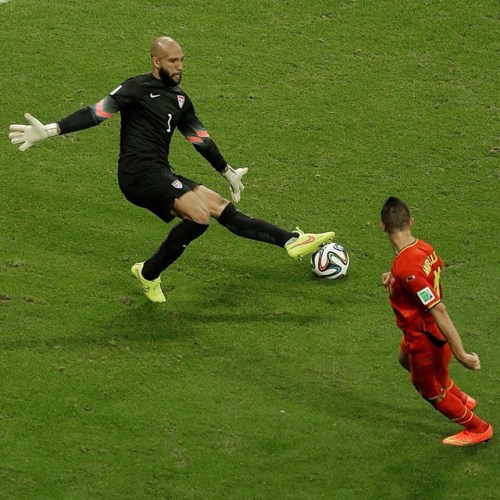
Reasons Why I Love Tim Howard

Team USA goaltender Tim Howard made a record 16 saves at the World Cup game between the US and Belgium, but couldn’t save the American team from being knocked out in the 2-1 Belgian win.

Did you know:

  • Tim Howard is HUNGARIAN!    Tim was born in New Jersey to an African-American father and a native Hungarian mother named Fekete Eszter!  He is a dual citizen of USA and Hungary, but unfortunately, aside from a few words, he doesn’t speak Hungarian.  Szeretünk téged, Tim! Hajrá magyarok!
  • Tim Howard is a CHRISTIAN.   Tim has spoken about his Christian faith, saying: “The most important thing in my life is Christ. He’s more important to me than winning or losing or whether I’m playing or not. Everything else is just a bonus.”
  • Tim Howard has Tourette Syndrome, an Autism Spectrum Disorder.
  • Tim is 35 years old and has been on the US national team since 2002.  I don’t know if this was his last world cup, but after this performance today, he seems like he is at the top of his game!

Having Passed the Baton

For many years, the third week of June was one of the highlights of the year for my wife and I. That’s because this is the time when the Foundations Conference takes place in Vajta, Hungary. Foundations is a conference for Calvary Chapel missionaries and national workers from all over Eastern Europe to gather together for a week of fellowship and teaching. It was a time for us of seeing friends we often only saw at that conference, as well as a time of being recharged physically and spiritually, and seeking the Lord.

This year I’ve been keeping up with some of what’s happening at Foundations on Instagram, where I get to see familiar faces and places.

Today on Instagram I saw this photo, which filled me with so many emotions:

In that picture are friends of mine, and they are praying for a young man named Jonathan, who is serving as a missionary in Eger, Hungary at the church Rosemary and I started 9 years ago. Standing behind him is Jani, a man who I first met when he was not a Christian, but who I had the privilege of leading to The Lord, pouring into, raising up in ministry, and who is now the pastor of that church in Eger.

I remember how on the last night of one of these Foundations conferences several years ago, I was up front praying for people, and Jani came up and asked me to pray that God would bless him and his wife with a baby. Only a few months later, we got the good news that Tünde, his wife, was pregnant with their first child.

I’m a bit jealous that I can’t be there withy them right now, but it fills me with so much joy to see these guys who now carry that baton, going for it with all they’ve got. It is a good feeling when something you started takes on a life of its own.

How did I know it was time to leave Hungary?

My wife and I were missionaries in Hungary for over 10 years, where we were doing church planting and humanitarian work with Calvary Chapel. In 2012, we moved from Eger, Hungary to Longmont, CO.

A friend recently asked me how I knew it was time to leave Hungary, and how God spoke to me and led me during that transition. I thought that a video blog would be the best forum for answering that question. Check out my response in this video.

If you have any questions about this topic, leave a comment below – and if you have any questions you’d like me to answer here on the blog, feel free to email me at nick [at] whitefieldschurch.com