A Timeline of Jesus’ Post-Resurrection Appearances

At White Fields Church, I have been teaching through the Gospel of Matthew [listen to the series here] for almost two years, and this past Sunday we reached the final chapter.

After my sermon on Matthew 28:1-15, someone asked a great question:

“How does Mary Magdalene weeping at the tomb in John 20:11-18 fit with Matthew’s account of the women meeting Jesus on the way in Matthew 28:8-10?”

After looking into it, there’s a simple and satisfying explanation. But also, this question touches on a larger issue, of how the different Gospel accounts fit together. The different Gospel writers give different perspectives which ultimately complement, rather than contradict each other.

The Women Who Went to the Tomb

  • Mary Magdalene (Matthew 28:1, Mark 16:1, Luke 24:10, John 20:1)
  • The other Mary (Matthew 28:1; Mark 15:40; Luke 24:10) — most likely Mary the mother of James and Joseph (also called Joses; cf. Matthew 27:56)
    • This seems to be the same person Mark calls “Mary the mother of James” (Mark 16:1)
    • Some people believe this is Mary the Mother of Jesus, while others believe it’s a separate person.
  • Salome (mother of James and John, the sons of Zebedee) (Mark 16:1)
  • Joanna (wife of Chuza, a steward in Herod’s household) (Luke 24:10, cf. Luke 8:3)
  • Other unnamed women who had followed Jesus from Galilee (Luke 23:55; 24:10)

All four Gospel accounts mention Mary Magdalene. John’s Gospel only mentions Mary Magdalene, not to the exclusion of the other women, but only to focus on her previously undocumented encounter with Jesus at the tomb. The fact that Mary Magdalene was not alone is alluded to by John 20:2, “They have taken the Lord out of the tomb, and we do not know where they have laid him.” The plural “we” indicates she wasn’t alone.

The Women Arrive at the Tomb, but Mary Leaves Immediately

As this group of women arrived at the tomb with spices to anoint Jesus’ body, they saw that the stone had been rolled away. At this point, Mary Magdalene appears to separate from the group and run ahead. Having seen the open tomb, she assumes the worst: that someone has taken the Lord’s body (John 20:2). She runs to tell Peter and John, while the other women remain at the tomb.

The Women Encounter the Angel

Matthew 28:2–7; Mark 16:5–7; Luke 24:4–8: While Mary Magdalene is gone, the other women encounter angels at the tomb. Matthew focuses on one angel, who is sitting on the stone, while Mark and Luke mention two inside the tomb.

The angels proclaim the good news: Jesus has risen, just as He said. The women are told to go and tell the disciples that Jesus is alive and will meet them in Galilee. Shaken by what they had seen, and filled with joy, they rush off from the tomb to share the message with the disciples.

Peter and John Run to the Tomb

John 20:2-10; Luke 24:12: Meanwhile, Mary Magdalene reaches Peter and John with the news that, “They have taken the Lord out of the tomb, and we don’t know where they have laid Him.”

Peter and John sprint to the tomb. John arrives first, looks in, and sees the linen clothes. Peter then arrives; he goes in and notices the face-cloth folded up in a place by itself. This detail indicates that whatever happened in the tomb took place in an orderly manner, rather than a chaotic hurry.

Peter and John realize that something significant has happened, but they don’t yet understand that Jesus has risen. They then head back home (to the place where the disciples were staying in Jerusalem).

Mary Magdalene Weeping at the Tomb

John 20:11-18: Once Peter and John have left, Mary is alone at the tomb. She stands outside the tomb weeping. As she weeps, she stops to look inside the tomb. In the tomb, she sees two angels seated where Jesus’ body had lain. She speaks with the angels, but then turns around and sees Jesus standing there, but does not recognize that it is Him (possibly because of back-lighting, or possibly due to the difference in appearance of Jesus’ resurrection body).

Jesus asks Mary why she is weeping. Mary assumes that he is the gardener, but then Jesus speaks her name: “Mary.” Mary then recognizes that the person speaking to her is Jesus.

Mary embraces Jesus, but He tells her not to cling to Him, but to go and tell his “brothers” (disciples) that He is soon going to ascend to the Father.

It seems that Mary is the first eyewitness of the risen Jesus, and she tells the others that she has seen the Lord.

Jesus Appears to the Other Women

Matthew 28:8-10: As the other women are on the way from the tomb, sent by the angels to tell the disciples, Jesus meets them. The women fall at his feet and worship Him – grasping onto Him.

This likely happened shortly after Mary’s encounter. Jesus tells these women to go and tell the disciples to go to Galilee, promising that they will see Him there.

The Women Report to the Other Disciples

Luke 24:9-11; Mark 16:8-11: The women tell the disciples what they have seen, but their words seem like “an idle tale,” and the disciples are reluctant to believe it.

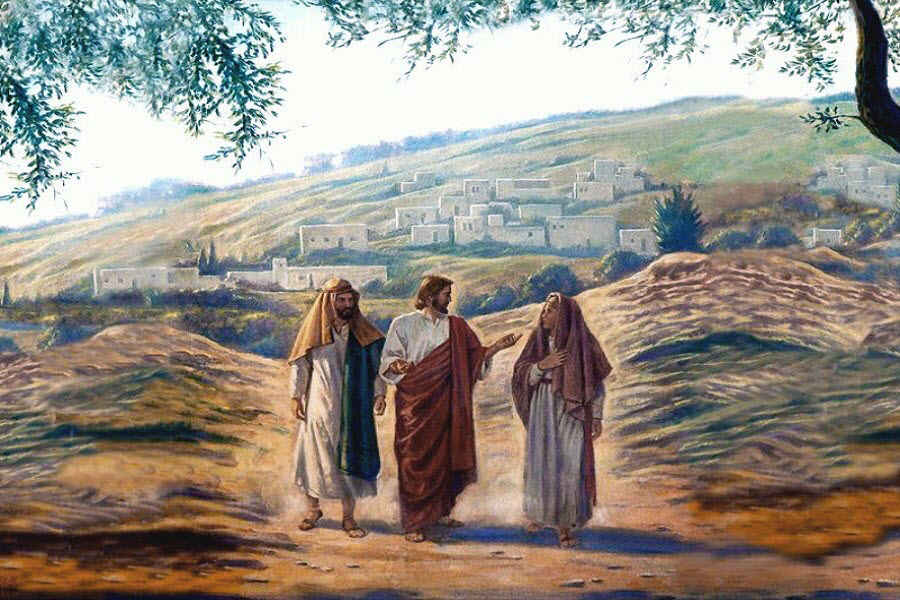
The Road to Emmaus

Luke 24:13-35: Later that day, two disciples are walking toward the village of Emmaus, talking about what happened to Jesus and trying to make sense of it. We don’t know who these disciples were, or if they belonged to “the eleven” or were part of the larger group of Jesus’ followers.

Jesus joins them as they walk and engages them in conversation. They explain their confusion: they had thought that Jesus was the Messiah, but when He was captured and killed, they began to doubt. They also mention the report of the women who had been to the tomb, and that they are struggling to know whether to believe it, because despite the women claiming to have seen the angels and Jesus, when the disciples (including Peter and John) went to check it out for themselves, they saw neither Jesus nor angels at the tomb.

Jesus then said to them, 25“O foolish ones, and slow of heart to believe all that the prophets have spoken! 26Was it not necessary that the Christ should suffer these things and enter into his glory?” 27And beginning with Moses and all the Prophets, he interpreted to them in all the Scriptures the things concerning himself. 

When the disciples arrive to their destination, Jesus acts as if He will go on further down the road, but they press Him to eat with them. 30When he was at table with them, he took the bread and blessed and broke it and gave it to them. 31And their eyes were opened, and they recognized him. And he vanished from their sight.

They then rush back to Jerusalem to tell the others.

Jesus Appears to the Disciples Behind Locked Doors in Jerusalem

Luke 24:36–43; John 20:19–23: On the evening of that same day, as the disciples were gathered together behind locked doors, Jesus appeared in the room with them.

Jesus showed them His hands and side. He ate with them. He then breathed on them, imparting the Holy Spirit to them (as promised in John 14:17), and conveyed His mission to them. Despite imparting the Spirit, He also tells them to wait in Jerusalem until they are clothed with power from on high – speaking of the empowerment they would receive on Pentecost (cf. Acts 1:8). Even though the disciples have been called to meet with Jesus in Galilee, they will return to Jerusalem for Jesus’ ascension (40 days after the resurrection) and to wait for this empowerment (received 50 days after the resurrection).

During this meeting, Jesus opened their minds to understand the Scriptures, and explained to them everything written about Him in the Law of Moses, the Prophets, and the Psalms (i.e. the entire Hebrew Bible, AKA “Old Testament”). By doing this, Jesus showed them the hermeneutical key to understanding the Bible; that it is a book about Him.

Thomas was not present on this occasion.

Jesus Appears to the Disciples with Thomas Present

John 20:26-29: Eight days later, apparently in the same location in Jerusalem, Jesus appears to the disciples again, this time with Thomas present.

Jesus calls Thomas to not disbelieve, but believe. Having seen Jesus’ wounds and heard His call to believe, Thomas exclaims a confession of faith in Jesus as “My Lord and my God!”

In Galilee

Matthew 28:16-20: Assumedly after the meeting in Jerusalem where Thomas was present, Jesus’ disciples meet Him on a mountain in Galilee, where the disciples worship Him, and Jesus commissions them to go and make disciples of all nations, baptizing them in the name of the Father, the Son, and Holy Spirit.

John 21:1-23: Jesus meets with the disciples on the shore of the Sea of Galilee, where they share breakfast and Jesus restores Peter to a leadership role after Peter’s denial of Jesus on the night of His arrest.

Other Appearances

In 1 Corinthians 15:5-7 Paul the Apostle lists some other appearances of Jesus, but we aren’t quite sure when or where they took place:

  • A private meeting with Peter (1 Corinthians 15:5)
  • A large group of over 500 people at one time (1 Corinthians 15:6)
  • A meeting with James — likely the half-brother of Jesus, who later became the leader of the Jerusalem church and the author of the Epistle of James – (1 Corinthians 15:7)
  • An appearance to “all the apostles” (apparently a broader group than just “the twelve” (cf. 1 Cor. 15:5)

Conclusion

By harmonizing the Gospel accounts, we get a three-dimensional picture of Jesus’ post-resurrection appearances.

For further study, check out the series of messages I taught a few years ago called “The Resurrected Life” – in which I preached about some of the post-resurrection passages: The Risen Life (2021)

Reader Questions: What Will Be the Work of the Holy Spirit in Eternity?

There is a page on this site where readers can submit questions or suggest topics. Recently I received the following question:

Both God the Father and the Son have distinct and obvious eternal roles that we see in the Bible, but as I was thinking through the role of the Holy Spirit in eternity, I couldn’t come up with anything concrete.

Could you give a brief overview of the role of the Holy Spirit in eternity?

Great question! I would begin by stating, that from God’s perspective, eternity is not a future reality, but an ongoing reality. Jesus said (speaking to the Father): “this is eternal life, that they know you, the only true God, and Jesus Christ whom you have sent.” (John 17:3) In other words, eternity is the continuation of what has already been ongoing for eternity past. For that reason, there are many things about the Holy Spirit which will not change, but, there are some that will.

I laid out the distinction between the “ontological Trinity” (who the members of the Trinity are) and the “economic Trinity” (what the members of the Trinity do) in this post, which is worth checking out: The Trinity: Ontological & Economic

What will not change

For eternity, the Holy Spirit will continue to be the third person of the Trinity—fully God, co-equal and co-eternal with the Father and the Son.

Furthermore, the Spirit, who now dwells in believers as a guarantee of our inheritance (Ephesians 1:13–14), will continue to indwell God’s people, enabling perfect love, worship, and joy in the presence of the Triune God.

What will change

Some of the roles of the Spirit in the present age include:

  • Conviction of sin and the need for a savior
  • Empowerment for mission and fulfilling God’s callings
  • Sanctification of believers

In eternity, these roles will not continue, because they will no longer be needed. However, the indwelling Spirit will continue to unite the redeemed, not only with one another, but also with the Father and Son as we are brought into the eternal communion of the Godhead in a greater way than we experience now here on Earth.

What is the Baptism of the Holy Spirit – with Dr. Alan Stoddard

In this episode of the Theology for the People Podcast, I speak with Dr. Alan Stoddard, who interviews me about the baptism of the Holy Spirit.

What is the baptism of the Holy Spirit? Does it happen simultaneously with salvation, or is it a subsequent experience? How should our understanding of the baptism with the Holy Spirit shape our practice in the church?

Alan is a pastor and church planter with over 25 years of ministry experience. Alan holds a Master’s Degree from Southwestern Seminary, and a Doctorate in preaching from Gordon Conwell. 
Both Nick and Alan serve as Adjunct Professors at Calvary Chapel Bible College. Alan also teaches at Rockbridge Seminary. Nick and Alan also serve on the Leadership Team of Expositors Collective.
This year, on Easter Sunday, Alan launched a new church plant called Imagine Church in Cressen, Texas.

In this episode, Nick and Alan discuss the prepositional approach to understanding the Spirit’s work, and how it helps to address some common questions and even some misconceptions about the baptism of the Holy Spirit.

Resources to check out:
Perspectives on Spirit Baptism – book, recommended by Alan
• Article by Nick: “Is the “Baptism in the Spirit” the Same as Being “Filled” With the Holy Spirit? Yes and No. Here’s Why”
• Subscribe to the Theology for the People Podcast for more episodes.

Click here to listen to the episode, or listen in the embedded player below.

What is the Baptism of the Holy Spirit – with Dr. Alan Stoddard Theology for the People

What is the baptism of the Holy Spirit? Does it happen simultaneously with salvation, or is it a subsequent experience? How should our understanding of the baptism with the Holy Spirit shape our practice in the church? In this episode, Pastor Nick Cady is interviewed by Dr. Alan Stoddard about this topic.Alan is a pastor and church planter with over 25 years of ministry experience. Alan holds a Master’s Degree from Southwestern Seminary, and a Doctorate in preaching from Gordon Conwell. Both Nick and Alan serve as Adjunct Professors at Calvary Chapel Bible College. Alan also teaches at Rockbridge Seminary. Nick and Alan also serve on the Leadership Team of Expositors Collective. This year, on Easter Sunday, Alan launched a new church plant called Imagine Church in Cressen, Texas.In this episode, Nick and Alan discuss the prepositional approach to understanding the Spirit’s work, and how it helps to address some common questions and even some misconceptions about the baptism of the Holy Spirit.Resources to check out: Perspectives on Spirit Baptism – book, recommended by AlanArticle by Nick: "Is the “Baptism in the Spirit” the Same as Being “Filled” With the Holy Spirit? Yes and No. Here’s Why"Subscribe to Theology for the People for more episodes.Visit the Theology for the People website and blog

Understanding the Person and Work of the Holy Spirit – with Fred Sanders

Who is the Holy Spirit, and how does an understanding of the person and work of the Holy Spirit contribute to our life and faith as believers in Jesus?

In this episode of the Theology for the People podcast, I speak with Fred Sanders. Fred is professor of theology at the Torrey Honors College at Biola University. He is the author of a much sought-after series of theological comic books, as well as the recently published book, The Holy Spirit: An Introduction, which is part of the Short Studies in Systematic Theology series put out by Crossway Publishing.

Fred has focused much of his theological work on the topic of the Trinity, so when it comes to talking about the person and work of the Holy Spirit, he has a unique and helpful perspective.

In this episode we talk about what the Bible says and doesn’t say about the Holy Spirit, whether it’s okay to pray to the Holy Spirit, and more.

Click here to listen to the episode, or listen in the embedded player below.

Understanding the Person and Work of the Holy Spirit – with Fred Sanders Theology for the People

Who is the Holy Spirit, and how does an understanding of the person and work of the Holy Spirit contribute to our life and faith as believers in Jesus?  Fred Sanders is professor of theology at the Torrey Honors College at Biola University. He is the author of a much sought-after series of theological comic books, as well as the recently published book, The Holy Spirit: an Introduction, which is part of the Short Studies in Systematic Theology series put out by Crossway Publishing. Fred has focused much of his theological work on the topic of the Trinity, so when it comes to talking about the person and work of the Holy Spirit, he has a unique and helpful perspective.  In this episode we talk about what the Bible says and doesn’t say about the Holy Spirit, whether it’s okay to pray to the Holy Spirit, and more. Make sure to visit the Theology for the People website at nickcady.org

Is Praying in the Spirit Speaking in Tongues?

Recently at White Fields Church, we studied the Epistle of Jude, which contains a phrase which is also used in elsewhere the Bible: “Praying in the Holy Spirit”.

In this Sermon Extra video, Pastor Michael Payne and I discuss whether praying in the Spirit is the same thing as speaking in tongues, what speaking in tongues is, and what it means to pray in the Spirit.

Responding to Arguments for Biblical Unitarianism (Non-Trinitarianism)

Unitarianism is the belief that God is not Trinitarian in nature.

This belief can take many forms, such as Modalism: the belief that the Father, the Son, and the Spirit are “modes” in which God sometimes manifests, or in Partialism: the belief that the Father, the Son, and the Spirit are “parts” of who God is.

Other unitarians believe that Jesus is not divine and that there was a time when Jesus was not, i.e. that at one point in time, Jesus came into being – and that he has not existed from eternity past, as the Father has. Further, unitarians might believe that the Holy Spirit is either essentially the Father, or that the Holy Spirit is an impersonal force, but not a “person” of the Trinity.

The following is a list of responses to common Unitarian claims, written by Pastor Jason Cralley, Executive Pastor at White Fields Community Church.

Creeds show progression of development towards the Trinity. 

False. The creeds were developed to fight heresy. As one heresy appears, they created a creed to address it. When another heresy appeared around the same topic, they would change the creed to make it more specific. According to the earliest Christian writings it is very clear that they believed in the trinity. Ignatius of Antioch, Polycarp of Smyrna, Theophilus of Antioch, Tertullian, and others all church fathers that wrote about the Trinity long before the first creed was ever written.

The Old Testament foretold that Jesus would be a human being. 

True. But it also said he would be God. Isaiah 9:6 “For to us a child is born, to us a son is given; and the government shall be upon his shoulder, and his name shall be called Wonderful Counselor, Mighty God, Everlasting Father, Prince of Peace.” Isaiah 7:14 “Behold, the virgin shall conceive and bear a son, and shall call his name Immanuel.” As Matthew 1:23 points out, Immanuel means “God with us.” The Biblical Unitarians argue that the Jews never understood that these meant the Messiah would be God. True. But as we knew they misunderstood most of the prophecies about Jesus. They thought he would come and set up an earthly kingdom. We cannot take what they believed as truth.

The New Testament teaches that Jesus was a man. 

True. But it also teaches that Jesus was God. We have to take the Bible as a whole and not take some verses to make a theology and leave others out. Jesus has divine attributes that only God possesses: he is omnipresent (Matt. 28:20), Omniscient (Mark 2:8, John 6:64; 16:30; 21:17), Omnipotent (Matt. 28:18, Mark 4:37-41; 6:30-44), Created all things (John 1:3, Col. 1:16-17), he keeps the universe going by his power (Heb. 1:3). Jesus thought himself as God: he forgave sins (Mark 2:3-12) and the everyone knew that was something only God could do as they tried to kill him (Luke 7:48-50), he accepted worship as God and never rejected it (Matt. 28:9, 17; Luke 24:52; John 9:38; 20:28), He stated he was God (John 10:30-33, Mark 14: 61-62, Rev. 1:8).

The Bible teaches that Jesus was a created being. 

False. Jesus explains his own preexistence ((John 3:13; 6:33, 38, 62; 8:23; 16:28) and that he existed before Abraham (John 8:58). God sent his Son proving that Jesus existed before his incarnation (Rom. 8:3; 1 John 1:2; Gal. 4:4). He didn’t create a son but sent the one that already existed.The New Testament teaches that Jesus is eternal: He existed before creation (John 1:1-3; 17:5), Jesus holds all creation together therefore he had to preexist before his birth (Col. 1:17), Jesus has always been and always will be (Heb. 13:8, Rev. 1:8), created all things meaning he was there before creation (John 1:3, Col. 1:16-17), he keeps the universe going by his power so he had to be preexistent (Heb. 1:3).

The Bible teaches that Jesus has a God. 

True and False. Jesus has two natures: fully human (Gal. 4:4) and fully divine (John 1:1, 14; Col. 2:9; Heb. 1:8). When he came down to earth he humbled himself and cooperated with the limitations of being a human (Phil 2:5-8, Heb. 2:9). Jesus the man had someone he would call his God (the Father). Jesus still has a human nature (1 Tim. 2:5; Col. 2:9). Jesus will always have a human nature and will therefore always call the Father God. This does not mean that Jesus doesn’t share the same divine nature as God the Father. 

Biblical Unitarianism commits the logical fallacy of equivocation where the meaning of a word changes as it is used. Saying “The Trinity is the teaching that the one God of all existence, consists of three divine persons: The Father, the Son, and the Holy Spirit” is not the same as “The Father is God, the Son is God, and the Holy Spirit is God.” The first sentence uses God as a quantitate, dealing with how many gods there are. The second sentence is qualitative, dealing with the nature of divinity. The Unitarians are confusing the qualitative with the quantitative. Jesus is qualitatively stating that the Father is God. He is not quantitatively stating that only the Father is God, and he is not. 

Jesus Called the Father the only true God. 

True. But Jesus claims that the Father and he are one (John 10:30) which his opponents knew to mean that Jesus was claiming to be God and picked up stones to kill him (John 10:31). He later states the Father is in him, and he is in the Father (John 10:36-38). So, if the Father is the one true God, then so is he. The Triune God is the one true God.The Holy Spirit is simply the Father. False. The Holy Spirit is distinct from the Father. The Father sent the Spirit (John 14:26). The Spirit does the will of the Father (Rom. 8:27). The Holy Spirit is mentioned with the Father and Son (Matt. 28:19). If the Father was the Spirit, none of these would make sense.

What is Biblical Unitarianism? – Considering the Best Arguments For and Against It

In this episode of the Theology for the People podcast, Nick Cady and Jason Cralley respond to the best arguments for Biblical Unitarianism, which is the a non-Trinitarian interpretation of biblical texts about who God, Jesus, and the Holy Spirit are.

In doing this, we look at the history of Arianism and Trinitarian formulations of who God is, including a discussion about Constantine and the First Council of Nicaea, and the Nicene Creed.

Further, we look into the arguments put forth regarding certain Biblical passages that Unitarians point to as evidence of God’s non-trinitarian, or unitarian nature, and give a defense for trinitarian beliefs.

Below, you can find a link to the video mentioned in the episode about Bad Trinitarian Analogies.

Click here to listen to the episode or listen in the embedded player below.

What is Biblical Unitarianism? – Considering the Best Arguments For and Against It Theology for the People

In this episode, Nick Cady and Jason Cralley respond to the best arguments for Biblical Unitarianism, the a non-Trinitarian interpretation of biblical texts about who God, Jesus, and the Holy Spirit are. In doing this, they look at the history of Arianism and Trinitarian formulations of who God is, including a discussion about Constantine and the First Council of Nicaea, and the Nicene Creed. Further, they look into the arguments put forth regarding certain Biblical passages that Unitarians point to as evidence of God's non-trinitarian, or unitarian nature, and give a defense for trinitarian beliefs. Make sure to visit the Theology for the People website at nickcady.org

The Trinity: Ontological & Economic

As Christians, we confess that there is one God who eternally exists in three distinct persons: Father, Son, and Holy Spirit.

The three persons of the Trinity are equal in power and glory, are co-eternal, and are of the same essence (Ousia in Greek).

The Father is God, the Son is God, the Spirit is God, but the Father is not the Son, the Son is not the Father, nor is the Spirit the Father or the Son. 

The three persons of the Trinity also have unique functions, and relate to each other in unique ways. As a result, we can speak about the Trinity in two ways: the “Ontological Trinity” and the “Economic Trinity.”

Ontological Trinity

“Ontological” has to doing with “being.” So, to speak of the Ontological Trinity is to explain who God is, and who the three persons of the Godhead are. 

The major ecumenical councils of the church, such as Nicaea and Chalcedon, focused on the ontological nature of the persons of the Trinity, and affirmed that Jesus, the Son, is very God of very God, and that the Holy Spirit is not an impersonal force, but is, indeed, God. 

So, to speak about the Trinity ontologically, is to affirm both the divine nature and the unique personhood of the three persons of the Trinity.

Economic Trinity

“Economic” has to do with action, roles, and function: what God (and each person of the Godhead) does.

So, when we take an economic view of the Trinity, we are talking about the things which the Father does, or which the Spirit does, which are unique to that person of the Godhead.

For example, it is the role and function of the Holy Spirit to perform the sealing and sanctifying functions of God in the life of a believer.

Jesus, the divine Son, uniquely took on human flesh, came to Earth, lived a sinless life, and died on a cross for our redemption. 

The Father sent the Son, the Son submitted to the Father and obeyed the Father, the Father and the Son sent the Spirit. The Spirit glorifies and points to the Son. The Son glorifies the Father. The Father exalts the Son. The Son ever lives to make intercession for us. The Spirit indwells believers, reminding them of what the Son said, and bringing about conviction of sin, righteousness, and judgment.

Application

One important application of these principles, is the understanding that economic actions, such as submission, leadership, and difference of roles, does not diminish or take away from a person’s ontological identity, value, dignity, or identity.

This is communicated explicitly in Philippians 2, where we are told that Jesus, although he was equal with the Father, as God (ontologically), did not regard equality with [the Father] (economically) something to be grasped, but emptied himself, taking the form of a servant, being born in the likeness of men, and humbled himself in obedience, even to the point of death on a cross. 

The point here is that Jesus’ economic activity did not detract from his ontological nature. 

A point of application is made in the New Testament, in the complementary roles of men and women in the church. Though men are called to teach and exercise authority in the “household of God” (1 Timothy 3:15), this does not diminish or take away from the ontological equality of men and women as human beings, and as children of God, but is rather a matter of economic function. If this is true of the Trinity (and clearly it is), then it should not surprise us that it is true in the “household of God,” acted out by those who reflect His image to the world.

For more on this, check out this discussion of 1 Timothy 2:8-15, which I had with my wife, Rosemary, for our church’s weekly Sermon Extra video:

What is the Role of the Holy Spirit in Eternity?

There is a page on this site where readers can submit questions or suggest topics

Recently someone submitted this question:

Both God the Father and the Son have distinct and obvious eternal roles that we see played out in the Bible, with Jesus being more obvious, but as I was thinking through the role of the Holy Spirit in eternity, I couldn’t come up with anything concrete.
Could you give a brief overview of the roles of the triune persons of God as it pertains to eternity? I’m mostly interested in the Holy Spirit, but would love a pastor’s perspective on the other two also.

The “Ontological Trinity” and the “Economic Trinity”

There are two fields of discussion when it comes to the Trinity. The “ontological” and the “economic.” “Ontological” refers to who God is, i.e. that which pertains to being, whereas “economic” refers to what God does.

Specifically applied to the Trinity, study of the “ontological Trinity” is focused on those parts of the Bible which communicate that the Father is God, the Son is God, and the Holy Spirit is God, and yet these three, while distinct persons, are one God. Study of the “economic Trinity” is focused on the passages in the Bible which tell us what each of these three persons does as their role in “the Godhead.”

So, ontologically, it is important to point out that eternality is part of God’s nature. God is eternal, and each person of the godhead is eternal. So, the role of God in eternity is merely a continuation of who God has been until now, and who God will forever be.

However, the question above is about the economics of the Triune God after this present age is over, and we have transitioned into what the Bible calls “the new heavens and new Earth.” What will the functions of the three persons of the Triune God be in “the age to come”?

The Role of the Son in the Age to Come

The Son, we are told, is currently seated at the right hand of the Father, and for eternity he will reign and rule as king over all of redeemed creation. (See Revelation 22:3)

Currently, Jesus is making intercession for believers, advocating for us, and is seated on a throne, but for eternity, all we really know is that he will be an eternal sovereign, ruling over a kingdom of righteousness and peace which will never end.

The Role of the Father in the Age to Come

Along with ruling over the redeemed creation from a heavenly throne, revelation tells us that God (not necessarily just the Father) will be a source of light, which will preclude the need for the sun to illuminate, since God himself will be our light.

The Role of the Holy Spirit in the Age to Come

The one thing that sticks out about the Holy Spirit’s role in eternity, is that, whereas the Father and the Son have a throne in the New Heavens and New Earth, the Holy Spirit does not (Revelation 22:3).

Beyond this, I can’t think of any verses which speak specifically about a role of the Holy Spirit in the age to come – but that is not surprising, and here’s why:

What we read regarding the economic Trinity mostly has to do with the work of God to redeem human beings. Remember, the Bible is a book about Jesus: who he is, and how he saves us.

Since the Bible is focused on the story of the salvation and redemption of humankind, it does not tell us very much about what God did before creating the world, nor does it tell us much about what God will do after the redemption of the world is complete.

“The Great Story Which No One on Earth has Read”

This reminds me of the final paragraph of C.S. Lewis’ The Final Battle, which is the final book in the Chronicles of Narnia series, which is full of allegories about biblical passages and teachings.

C.S. Lewis poetically describes “the age to come” in this way:

“…but the things that began to happen after that were so great and beautiful that I cannot write them. And for us this is the end of all the stories, and we can most truly say that they all lived happily ever after. But for them it was only the beginning of the real story. All their life in this world and all their adventures in Narnia had only been the cover and the title page: now at last they were beginning Chapter One of the Great Story which no one on earth has read: which goes on for ever: in which every chapter is better than the one before.”

C.S. Lewis, The Last Battle

The Bible doesn’t tell us much about what the three persons of the Trinity will do in eternity, because that is not the story which the Bible exists to tell.

God Will Do What God Did Before

Prior to the creation of the world, it is important to remember that God existed from eternity past. Without human beings to rescue, sanctify, and redeem, what did God do?

What we can be sure of, is that God was neither bored nor lonely.

From eternity past, the one God, who exists as Father, Son, and Holy Spirit existed as a mutually edifying and glorifying community unto himself. Creation, was God inviting us to join in the “perichoresis,” the eternal relationship which exists between Father, Son, and Holy Spirit, sometimes referred to as “the dance of God.”

In other words, in eternity, we can expect that God will do what God did before: delighting in himself, with each person fueling this mutually edifying and glorifying relationship.

Ask a Question or Suggest a Topic

If you have a question or would like to suggest a topic for me to address here on the blog, click here: Ask a Question or Suggest a Topic

Will God Remove the Holy Spirit from a Person Because of Disobedience?

Click this image to listen to the podcast version of this article

Recently at White Fields, we did a 5-week study on the person and work of the Holy Spirit, called “The Spirit Filled Life” (click here to view that series).

One of the questions that is sometimes asked about the Holy Spirit, is whether God will ever remove the Holy Spirit from a person because of disobedience or sinful actions.

Certainly there are verses which talk about God removing the Holy Spirit from people, such as Psalm 51:11, where King David prays, “Cast me not away from your presence, and take not your Holy Spirit from me.” David prayed this in the wake of his sin with Bathsheba (2 Samuel 11), so that brings up the question: Are there times when God removes the Holy Spirit from someone if they do something really bad?

Furthermore, in 1 Samuel 16, is says that the Spirit of the Lord departed from King Saul, and in the Book of Judges, it says that the Spirit of the Lord departed from Samson.

So, does this mean that God will REMOVE his Spirit from YOU, if you live in a bad way? If so, that would be a pretty big problem, because Romans 8:9 says “Anyone who does not have the Spirit of Christ does not belong to him.”

Understanding the Three Relationships the Holy Spirit has with different groups of people

In order to answer this question and understand what it meant for David, Saul, and Samson – and what it means for us today, we have to first understand the 3 different relationships that the Bible tells us the Holy Spirit has with different groups of people.

Relationship 1: “WITH” All People

In John 14:17, Jesus told his disciples that the Holy Spirit had been with them up until that point.

Jesus then he told them that the work of the Spirit in the world is that He brings about conviction in people’s hearts and minds about 3 things: Sin, Righteousness, and Judgment (John 16:8)

In other words, the Holy Spirit is at work in the world in every country, with all people, and he is whispering in their ears and speaking to their hearts about the fact that 1) They are sinners (they have fallen short of God’s perfect standard), and 2) God is righteous, so therefore 3) There is coming a day of judgment when they will have to stand before that righteous God and give account for their lives.

The purpose of this conviction is not to just make people feel bad about themselves; the purpose is to draw them to Jesus by bringing them to a realization of why they need a savior, so they will embrace Jesus and what He has done in order to save them.

Relationship 2: “IN” those who have been redeemed by Jesus

Jesus told his disciples in John 14:17The Holy Spirit has been WITH YOU up until this point — but soon, the Holy Spirit will also be IN YOU.

This indwelling of the Holy Spirit is something that was prophesied by the Old Testament prophets Ezekiel and Jeremiah, that one day God was going to put His Spirit within His people (Ezekiel 36:27), in order to transform them from the inside out.  

For people in the Old Testament, the indwelling of the Holy Spirit was always a future event, but after Jesus had died and resurrected, we read in John 20:22 that Jesus met with his disciples and he breathed on them and said to them, “Receive the Holy Spirit.” It was at this moment, that the disciples received the Holy Spirit within them, and it was at this moment that they were “born again.” (See also: “What does it mean to be “Born Again”?)

What it comes down to is this: Only those who have put their faith in Jesus have the Holy Spirit within them, and every person who has put their faith in Jesus has the Holy Spirit dwelling with them.

The Bible tells us that when you put your faith in Jesus, God puts his seal on you and gives you His Spirit in as a guarantee (2 Corinthians 1:23). Furthermore, the regenerating and indwelling Spirit is called “the Spirit of Adoption” (Romans 8:15) It’s His guarantee that you belong to Him, and you are His.

The indwelling Spirit sanctifies, leads, guides, strengthens, and transforms from within.   

Relationship 3: “UPON” Some people at different times, to empower them to do what God has called them to do

Remember how in John 20 Jesus breathed on his disciples and said, “Receive the Holy Spirit”? Well, right after that, Jesus told his disciples to stay in Jerusalem and wait until the Holy Spirit came upon them. (Luke 24 & Acts 1:4)

But… if they just RECEIVED the Holy Spirit, then why did Jesus tell them to wait for the Holy Spirit?

Because: this is speaking about two different relationships with the Holy Spirit!

When Jesus breathed upon them, they received the Spirit IN them (and they were born again) — but then they were to wait in Jerusalem for the Holy Spirit to come UPON them:  to EMPOWER THEM to carry out the mission Jesus had given them.

That’s why Jesus His disciples in Acts 1:8, “But you will receive power when the Holy Spirit has come UPON you, and you will be my witnesses in Jerusalem and in all Judea and Samaria, and to the end of the earth.” 

Throughout the Old Testament, before people could have the Holy Spirit WITHIN them — we read that the Holy Spirit would come UPON people, to empower them to do things God had called them to do. For example, it says that the Spirit of the Lord came upon Gideon! (Judges 6:34 NKJV) We’re also told that the Holy Spirit came UPON Samson, and UPON David, and UPON Elisha, and others — to EMPOWER them to do what God had called them to do.

So, Jesus was promising his disciples (and us) — that the Holy Spirit will also come upon us, to empower us to carry out the callings He has placed upon our lives.

Un-Adopting? Un-Sealing?

Remember: in the Old Testament, the Spirit was WITH people (to bring conviction) and the Holy Spirit was UPON people (to empower them), but at that point that Spirit was not yet WITHIN people. So when we read in the Old Testament about God “removing” his Spirit, it’s not in the sense of a person who had the Holy Spirit dwelling within them, rather it’s in the sense of God removing the empowering work of the Holy Spirit from those people.

But for a person who has been sealed by the Holy Spirit indwelling them, we never read of God removing His Spirit from someone in that sense. The indwelling Holy Spirit is the Spirit of Adoption. God does not un-adopt us when we make mistakes and mess up, rather: he disciplines us like a loving Father (see Hebrews 12).

If He has SEALED you, as a guarantee of your salvation, that’s exactly what it is: He has placed his Spirit within you as a guarantee that He will see you through and bring to completion the good work that He has begun in you.

If you are His child, He won’t give up on you – and that’s really good news!

Further Study

For more on the 3 Relationships with the Holy Spirit, see this study: The Promised Helper

For more on the question of God removing His Spirit, see this study: The Work of the Holy Spirit in the Life of a Believer