After Chalcedon: The Role of Early Church Councils for Evangelicals Today – with Matt Pursely

What is the enduring legacy of the early church councils, and what role should they play in the lives of Bible-believing Christians today?

In this episode of the Theology for the People Podcast, I am joined once again by Matt Pursely, Executive Pastor at Park Hill Church in San Diego, California and graduate of Westminster Theological Seminary with a focus on Historical Theology, to discuss what happened after the Council of Chalcedon (451 AD), and why it matters for believers today.

We also discuss the views of William Lane Craig, who holds to a Neo-Apolinarian Christology which many see as being in conflict with Chalcedon. We explain his view, and how other early councils, such as Constantinople III, speak to it.

We also explain the importance of the debate over monothylitism and dyathelitism and the question of impeccability vs. peccability and whether Jesus was truly tempted internally or if his temptations were merely external.

Click here to listen to the episode, or listen in the embedded player below.

After Chalcedon: The Role of the Early Church Councils for Evangelicals Today – with Matt Pursely Theology for the People

What is the enduring legacy of the early church councils, and what role should they play in the lives of Bible-believing Christians today?In this episode, host Nick Cady is joined again by Matt Pursely, Executive Pastor at Park Hill Church in San Diego, California and graduate of Westminster Theological Seminary with a focus on Historical Theology, to discuss what happened after Chalcedon, and why it matters for believers today.We also discuss the views of William Lane Craig, who holds to a Neo-Apolinarian Christology which some see as being in conflict with Chalcedon. We explain what this view is, and how other early councils, such as Constantinople III speak to it. We also explain the importance of the debate over monothylitism and dyathelitism and the question of impeccability vs. peccability and whether Jesus was truly tempted internally or if his temptations were merely external. Subscribe to the Theology for the People YouTube Channel here.Visit the Theology for the People website here.

I have also started posting more on the Theology for the People YouTube channel. You can watch this interview on video here:

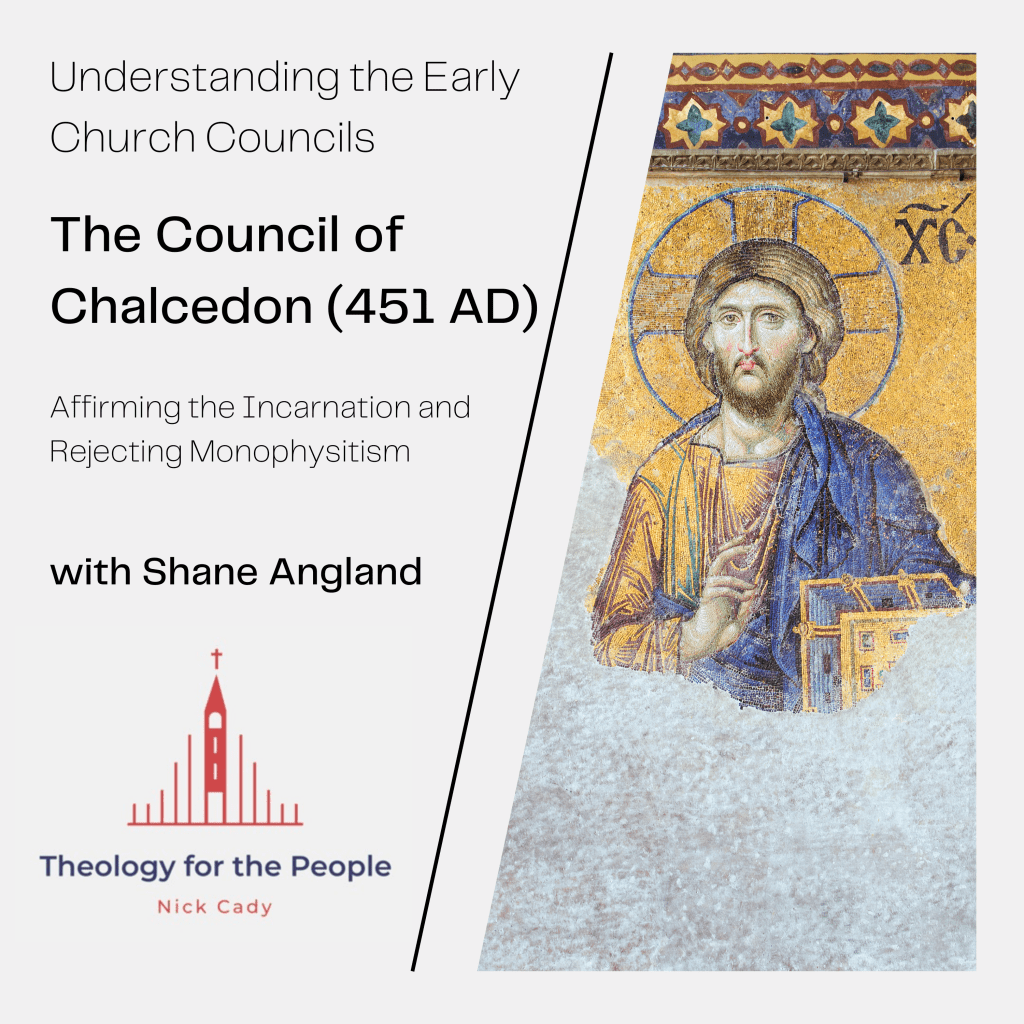
The Council of Chalcedon (451 AD) – with Shane Angland

In this episode of the Theology for the People Podcast, I sit down with returning guest Shane to explore the Council of Chalcedon (AD 451), the fourth ecumenical council of the early church.

Recorded live in Colorado during an Expositors Collective training weekend, this conversation traces the events leading up to Chalcedon, its theological breakthroughs, and its messy aftermath.

From the fallout of the Council of Ephesus, to the clash between the Alexandrian and Antiochian schools of Christology, and the mess of Ephesus II, Shane breaks down the stakes: how do we understand the two natures of Christ—human and divine—in one person?

The episode also tackles the political power plays, the deposition of bishops, and the schisms that followed, including the rise of the Oriental Orthodox churches. Plus, hear why Shane sees Chalcedon as both a triumph and a tragedy—and what it still teaches us today.

Resources Mentioned:

Click here to listen to the episode, or listen in the embedded player below.

The Council of Chalcedon (451 AD) – with Shane Angland Theology for the People

In this episode, Nick sits down in person with returning guest Shane to explore the Council of Chalcedon (AD 451), the fourth ecumenical council of the early church. Recorded live in Colorado during an Expositors Collective training weekend, this conversation traces the events leading up to Chalcedon, its theological breakthroughs, and its messy aftermath. From the fallout of the Council of Ephesus to the clash between the Alexandrian and Antiochian schools of Christology, Shane breaks down the stakes: how do we understand the two natures of Christ—human and divine—in one person? The episode also tackles the political power plays, the deposition of bishops, and the schisms that followed, including the rise of the Oriental Orthodox churches. Plus, hear why Shane sees Chalcedon as both a triumph and a tragedy—and what it still teaches us today.Resources Mentioned:The Definition of Chalcedon (available online for further reading).Bruce Shelley’s Church History in Plain Language (Fifth Edition).Augustine’s The Unity of the Church on the role and limits of councils.Visit TheologyforthePeople.com

The Council of Ephesus (431 AD) – with Matthew Pursely

In this episode of the Theology for the People Podcast, we continue our series on the first four ecumenical councils of the early church, diving into the Council of Ephesus (431 AD).

Matthew Pursely, Executive Pastor at Park Hill Church in San Diego, CA, joins us again to explore the theological debates surrounding Nestorius, the nature of Christ, and the implications of the hypostatic union—Jesus being fully God and fully man.

We discuss how this council addressed Nestorianism, affirmed Mary as the “Theotokos” (God-bearer), and shaped Christian understanding of communion and humanity’s connection to Christ.

Click here to listen to the episode, or listen in the embedded player below.

The Council of Ephesus (431 AD): Hypostatic Union, Nestorianism, & Theotokos – with Matt Pursely Theology for the People

In this episode, we continue our series on the first four ecumenical councils of the early church, diving into the Council of Ephesus (431 AD). Matthew Pursely joins us again to explore the theological debates surrounding Nestorius, the nature of Christ, and the implications of the hypostatic union—Jesus being fully God and fully man. We discuss how this council addressed Nestorianism, affirmed Mary as the "Theotokos" (God-bearer), and shaped Christian understanding of communion and humanity’s connection to Christ.Recommended ResourcesFor those wanting to dive deeper into the councils and related theology:Edward Siecienski – The Filioque: History of a Doctrinal ControversyAdonis Vidu – Exploring the Doctrine of Divine InseparabilityJohn Behr – The Nicene Faith (2 volumes) and John the Theologian and the Mystery of ChristKallistos Anatolios – Retrieving NicaeaJohn Henry Newman – Arians of the Fourth CenturyWilliam Bright – Notes on the Canons of the First Four General CouncilsTodd Miles – Superheroes Can’t Save You: Epic Examples of Historic Heresies (compares heresies to superhero archetypes—highly recommended entry-level read).Connect with Us:Subscribe to the Theology for the People podcastVisit the Theology for the People website at theologyforthepeople.com

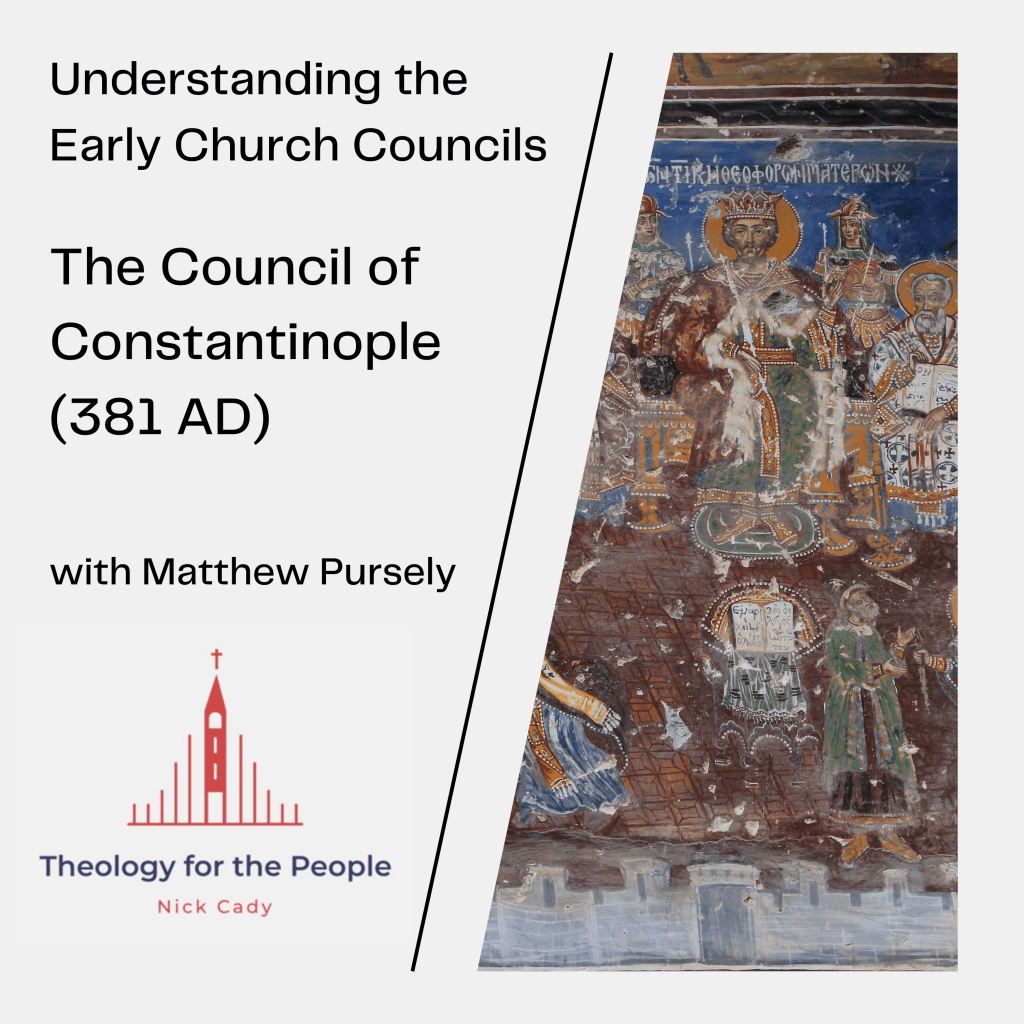
The Council of Constantinople – with Matthew Pursely

How did the early church come to a clear understanding of who Jesus is and how the Holy Spirit relates to the Father and the Son? And why did it take more than one council to settle these questions?

In this episode, I’m joined again by Matthew Pursley, Executive Pastor at Park Hill Church in San Diego, CA, and an expert in historical theology. Last time, we discussed the Council of Nicaea, and in this episode, we continue the conversation by diving into the Second Ecumenical Council—Constantinople (381 AD).

We discuss why the Council of Constantinople was necessary even after Nicaea, the role of the Cappadocian Fathers in defining the Trinity, the Filioque controversy, and how this council still shapes our faith to this day.

Click here to listen to the episode, or listen in the embedded player below.

The Council of Constantinople (381 AD) – with Matthew Pursely Theology for the People

How did the early church come to a clear understanding of who Jesus is and how the Holy Spirit relates to the Father and the Son? And why did it take more than one council to settle these questions?In this episode, I'm joined again by Matt Pursley, Executive Pastor at Park Hill Church in San Diego, CA, and an expert in historical theology. Last time, we discussed the Council of Nicaea, and in this episode, we continue the conversation by diving into the Second Ecumenical Council—Constantinople (381 AD).We discuss why the Council of Constantinople was necessary even after Nicaea, the role of the Cappadocian Fathers in defining the Trinity, the Filioque controversy, and how this council still shapes our faith to this day. Make sure to visit the Theology for the People website.

Do Christians and Muslims Worship the Same God?

concrete dome buildings during golden hour

Recently SBC pastor J.D. Greear received some criticism over claims that he said that Muslims and Christians worship the same God. 

In all fairness, that’s not exactly what J.D. said. In his book Breaking the Islam Code: Understanding the Soul Questions of Every MuslimJ.D. stated that while the Christian and Muslim conceptions of God are irreconcilably different, there are some shared assumptions about God which can be used in apologetic conversations with Muslims, e.g. monotheism, affirmation of the Old and New Testaments, recognition of Jesus as a prophet, etc.

You can hear, watch and read J.D. Greear speak on this subject in his own words here.

Allah and God

Earlier this year I had the opportunity to visit Israel, and during my time there I met several Israeli Christians, including some Arab-Israeli Christians. Arab-Israeli Christians refer to God by the Arabic word for God: Allah. Just as the English word God is of Germanic origin, and is not itself particularly tied to the God of the Bible, but is a “generic” name for deity, Allah is a similar word in Arabic. As monotheists, who believe there is only one God, we use this word to speak of the one supreme God rather than using a personal name for God to differentiate Him from other deities, since we do not believe any other so-called god is a rival to Him. There is precedent for this in the Bible, in which the ancient Hebrew word, with its Mesopotamian origins is used: אל (“El”), and in the New Testament, the Greek word Θεός (“Theos”).

Islam is different than Christianity in their belief that the Quran cannot be translated to any other language other than Arabic. Muslims are required to pray in Arabic, meaning that non-Arabic speakers are not allowed to pray to God in their mother tongue, but must memorize and recite Arabic prayers. Furthermore, when they read the Quran, they must read it in Arabic. There are “interpretations” of the Quran into other languages, but they are not considered scripture; only the Arabic-language Quran is considered valid and legitimate. It is for this reason, that muslims all over the world refer to their deity as Allah and not God in English, Gott in German, Бог in Russian, and so on.

So, the real issue is not: “What is the difference between Allah and God?”, but rather: “What is the difference between the God of Islam and the God of the Bible?” Even though they are both monotheistic supreme deities, they have different attributes, and therefore, even though they are both called “God”, they are not the same.

Why Islam is Like Mormonism

As the above tweet mentions, when Islam first came on the scene in the 7th Century, Christians did not consider it a different religion per se, they originally considered it a Christological heresy, and they considered Muhammed to be a false prophet.

In the Near East at that time, the majority of the population, particularly in urban areas, was Christian. In the Arabian peninsula, where Muhammed was located, polytheism was still practiced by the majority of the population, many of whom were nomadic. Muhammed led the Arabic people into monotheism, but a new and unique form of monotheism, which built on, but changed, the teachings of Judaism and Christianity.

The reason Islam was considered a Christological heresy was because Islam affirms both the Old Testament and the New Testament, considering them both holy scriptures, upon which Islam seeks to build. However, they claim that both the Old Testament and the New Testament have been severely altered and redacted, and therefore are not trustworthy. They argue that as a result, the Quran, which they claim is a new and trustworthy revelation given to Muhammed, the last and greatest in the long line of prophets, is the only trustworthy revelation available to us, and the Quran “sets the record straight” regarding things which have been altered and redacted in the Old and New Testaments.

For more information on why we can be sure that the Bible has not been altered (neither the Old nor the New Testament), check out this article in which I discuss historicity, attestation, and canonization.

Some of the things Islam claims were changed in the Bible: God’s choosing of Isaac instead of Ishmael (they claim Ishmael was the chosen son, since they trace their ancestry through him – and they claim the Jews changed the Bible to say that God chose Isaac). They also claim that what the New Testament says about Jesus was radically changed by Christians in order to claim that Jesus was God, when in fact (as they say), he was only a prophet. They do however, acknowledge that Jesus was sinless, unlike Muhammed.

Thus, Muslims deny Jesus’ deity, and along with that comes a denial of his identity as Savior. As a result, they teach salvation by works, whereas Christianity teaches salvation by grace, through faith, through the atoning work of Jesus on our behalf. The Christian gospel is that God imputes Christ’s righteousness to us, which is the basis for our standing before Him, as opposed to Islam, which claims that you must earn your way before God by trying hard enough to keep the 5 Pillars of Islam, so that hopefully your good works with outweigh your bad works, and then God will allow you into Heaven. These are two radically different soteriologies (doctrines of salvation, i.e. how one is saved).

In a way, Islam is quite similar to Mormonism. Consider the similarities:

  • Both claim to build upon the Old and New Testaments, but claim that both have been corrupted and are therefore not trustworthy in the present form in which we have them.
  • Both claim a “new revelation”: the Quran and the Book of Mormon
  • Both claim a new prophet: Muhammed and Joseph Smith
  • Both change the identity and story of Jesus
  • Both teach a works-based soteriology (doctrine of salvation)

Are there bridges of shared assumptions between Christians and Muslims which can be used for apologetic and/or evangelistic purposes?

I believe there are. My wife and I, before we were married, used to serve together in a refugee camp in Hungary which was populated mostly by Muslims from Asia. We provided humanitarian aid to them, and as we built relationships with them, we got the opportunity to share our faith with them as well. We found that they had an affinity for the New Testament and an openness and interest in reading it, so we provided them with copies of the New Testament in their own languages. Many of them, though they had been taught that the New Testament was one of their holy books, had never had the opportunity to read it, assumedly because of the teaching in Islam that the New Testament has been changed and is not trustworthy. However, as these people read the New Testament, many of them were captivated by Jesus, and decided to become Christians. The inbuilt affinity for the Old and New Testaments, for Jesus, and their monotheistic belief, are great starting points for sharing the gospel.

An example of this in the Bible can be seen in how the Apostle John, in the Gospel of John, begins in chapter 1 by identifying Jesus as the divine Λογος (Logos = “the Word”). The concept of the divine Logos was a Greek philosophical concept, which basically meant: “the grand idea” or “the grand force” of the universe. John identified the Logos (translated: the Word) as Jesus. By doing so, John was tapping into an existing belief for apologetic and evangelistic purposes, like Paul did in Acts 17 in Athens, where he appealed to the Athenians on the basis of their altar to “the unknown god.”

Like Paul and like John, may we be uncompromising in our biblical beliefs, and yet wise to use opportunities to share the gospel with people in ways they can grab ahold of, that they might find love, joy, hope, freedom, and salvation in Jesus.

Resources for Families: Responding to Reader Questions

Earlier this year I added a page on this site where readers can submit questions or suggest topics (click here for that page). Recently I received a few questions about resources for families:

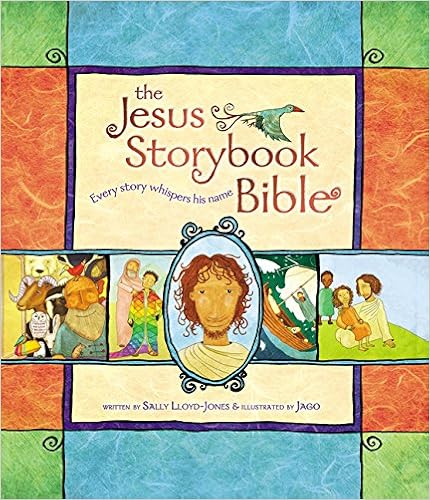
Question 1: In a recent Calvary Live you mentioned a ‘kids’ Bible you read to your kids. Can you tell me the name and publisher of that Bible?

The name of that Children’s Bible is The Jesus Storybook Bibleand it is published by Zonderkidz, which is the children’s branch of Zondervan.

I love this Bible because, to put it in semi-technical terms, it uses a Christo-centric hermeneutic and a Biblical theological approach to teaching kids the stories of the Bible, which is so important. Almost every children’s Bible I have come across presents a moralistic message to children, rather than one which helps them to see Christ in all of Scripture, and that all of the Bible points to Him and is fulfilled in Him.

On a similar note, I have found that many Children’s Ministry curricula are moralistic in nature, and can err on the side of telling Bible stories, but not explaining how those stories point to Jesus or fit into the narrative of the Bible which culminates in Jesus’ saving actions on our behalf. However, there are some good ones out there; at White Fields we use The Gospel Project, and we love how well it points our kids to the gospel every week and helps them learn to read the Bible through a christological lens.

This children’s Bible is a breath of fresh air, and I have often found myself choking up as I read it to my children, because the message of the gospel and the brilliance of God’s love and grace comes through so clearly.

Personally, I think every adult should read this too. It is a wonderful introduction to Christ-centered hermeneutics and biblical theology, which everyone, not just children would benefit from.

Question 2: I am the leader of a small group in my church. We want to study parenting but are having a difficult time finding materials. I was hoping you might be able to suggest some?

My recommendation would be Family Life’s Art of Parenting course.

I haven’t used this material yet myself, but we are considering hosting a class at our church based on it, and I trust the publisher. They have both group materials and a self-service online course.

Thanks for your questions! Keep them coming, and I hope these resources help.