On Sunday mornings at White Fields I have been teaching through 1 Samuel; this past Sunday I taught the second half of chapter 16, in which David has already been anointed king of Israel, but it will be another 15-20 years of hardship before David will sit on the throne of Israel as king.
David is king already, but not yet.
And this phrase, “already, but not yet” sums up so much of the Christian life. In Christ we are justified, glorified, made holy, seated with Christ in the heavenly places – already! But not yet.
Yesterday a great lady woman from church sent me this poem she wrote, inspired by Sunday’s message:
Sometimes life just seems to drag on And sometimes we grow weary of the wait We want it all, we want it now We shout out in whispered pleas Begging for speed, hurry please But He answers not yet, He asks us to wait Discouraged and let down we struggle on Don’t struggle on Don’t falter when you can run Don’t struggle when you have won He has already won It’s already done We are waiting for an end that is already won So hold on Hold on to His promises Hold onto His love Hold onto the Hope that it’s already ready It’s already done But not yet
Big Ben is the most famous clock in the world. It towers over the city of London, over Westminster Abbey and the Parliament.
What most people, in fact, what most Londoners don’t know, is that the music in the chimes that keep the time of Big Ben are from an old hymn: “I Know that My Redeemer Liveth”, from Handel’s “Messiah”.1
Every day, Londoners set their clocks and schedule their lives based on a tune about the resurrection of Jesus Christ, that sings out multiple times every day over that great city which is arguably the ‘center of the world’.
I will be preaching on the text from which the title of that song is taken this Sunday at White Fields Church in Longmont. If you’re in the area, I hope you’ll join us!
On my way home from church on Sunday I saw a Facebook message saying that the pastor of the largest church in the movement I’ve long been associated with had resigned due to moral failure.
I hate hearing this kind of stuff.
Over the last several days I have seen tons of posts on social media from other pastors about this pastor’s fall. I understand that they want to address what’s going on. I understand that they are upset and want to talk about it. I’m not sure if we should be posting that kind of news everywhere though. At what point is it just gossip? Gossip is still gossip if you present it as a “prayer request”. Isn’t it spreading sensational news about someone else’s junk that really has no bearing on us personally?
I opened the CNN app on my iPad on Monday, only to see an article on the front page about this pastor’s moral failure and resignation. Great – more fuel for those who are always looking for fodder against Christianity and the Church.
I’m upset that someone in that man’s position would risk his legacy, his family and the reputation of the Church of Jesus Christ for some fleeting moments of pleasure.
I am sad for his wife and kids who have to go through all of this in the public eye. I am concerned for that church, and pray that the people who attend there will have the maturity to walk through this process as a body, faithful to the heart and will of God.
I am glad to see that high moral standards are upheld, and exceptions aren’t made for someone because they are gifted, talented and popular. Personally, I loved listening to that man teach. He is truly a gifted communicator. I heard someone put it this way: “David kills Goliath no matter how you read the story, but some teachers are able to make the story come alive – whereas other teachers make you wish someone would hit you in the head with a stone and put you out of your misery.” This man is a great teacher. But I am glad that his skill and celebrity were not used as an excuse for making an exception to the rules for him when it comes to moral standards for those who will serve as leaders in the God’s church.
This situation is one more sober warning for Christians, and especially for those of us in leadership and ministry, that we must watch over our hearts with all dilligence, because it is from the overflow of our hearts that our actions proceed.
I think sometimes it can be easy for Christians to forget what Romans 1:19-20 says: “For what can be known about God is plain to [all people], because God has shown it to them. For his invisible attributes, namely, his eternal power and divine nature, have been clearly perceived, ever since the creation of the world, in the things that have been made.”
What that means is that all people are grappling with ideas and questions about God. Christians can be quick to discount what people “outside the fold” think or say about God – but the truth is that sometimes they have some pretty astute and profound things to say, even though they may have no commitment to Jesus. On the other hand, I am sometimes frustrated with the trite nature and shallow lyrics of some “Christian” music.
The are some “secular” songs out there which put some “Christian songs” to shame, because they reflect a deeper, more sincere, more REAL engagement with questions about the person and character of God.
Here are a few examples for you. If you have any others to suggest, leave me a comment below!
First: Regina Spektor
Second: Dashboard Confessional. Listen especially to the middle of this one, where Chris Carrabba is asking God to help him with the sin he wants to be set free from and talks about his struggles with unbelief.
This website was created by a church in Tennessee as a forum for people in the food service industry, especially servers at restaurants, to tell their stories of how they have been mistreated by the “church crowd” on Sundays. The goal is to raise awareness of how Christians are often totally missing it in the eyes of people outside the walls of their churches by behaving badly.
Check it out and let me know what you think in the comments section below.
I recently ran across this video of Bono talking about his Christian faith in an interview:
A lot has been made of Bono and his faith. I have heard some Christians declare that Bono is their pastor; I know several Christians who don’t listen to any “secular” music, but love U2 more than their first-born children – these ones typically own a guitar, on which they can play simple worship songs AND a few songs by U2, which they would say are “kinda like worship songs, you know, if you really think about it.” In fact, I have known of churches where the worship leader has lead the congregation in a chorus of a U2 song during worship.
All that goes to say: There are quite a few Christians out there. Why should it matter what Bono in particular thinks of Jesus?
As I listen to Bono speak about his faith, I feel that he is almost hesitant to admit that he believes Jesus is the Messiah. The way he talks about church kind of rubs me the wrong way too. Jesus didn’t come to establish a private religion that people practice alone or in their home with just their family – Jesus came to start a worldwide movement which has corporate expression. The church is not a somewhat-necessary evil, it is intrinsic to why Jesus came.
Having said that – here are a few reasons why what Bono has to say about Jesus matters.
Why does it matter what Bono thinks about Jesus? A few reasons:
1. He is not American
I think a lot of American’s don’t understand how the world outside of America views us. I remember the first time I travelled abroad, right after high school, I had this unarticulated view of people in other countries, that they were basically ‘the ones who hadn’t made it to America yet’. American culture tends to not have a clear understanding of how people outside of America really think about America. Often it is assumed that people either hate America or love America. In reality, it is much more nuanced than that.
One of the main views on America that I have heard abroad, is that we are a very religious country – which, statistically is absolutely true. Thus, people outside of the United States are used to American celebrities and politicians talking about their faith, oftentimes their evangelical Christian faith. However, when a European – an Irishman in Bono’s case – expresses evangelical Christian beliefs, the non-American world stops to listen a little more. And this is a great thing actually, because it helps the world to see that evangelical Christianity is not just an American phenomena – it is the natural outworking of taking the Bible seriously.
2. He is a celebrity who does a lot of good things
Bono has credibility in the eyes of the world because he has been so active in working for humanitarian causes. One of the criticisms evangelicalism has gotten (whether deserved or not), is that we are a relatively apathetic bunch when it comes to major social issues facing people around the world, such as AIDS, lack of clean drinking water, etc. Once again, the case can be made that this is certainly not the case – but there is a sense in which this is the reputation that evangelicals have gotten: that they are only concerned with getting “goose-bumps from Jesus” and getting the heckheaven out of here, that they are not concerned with the plights and suffering that people are facing. Bono, because of his well-publicized humanitarian efforts is generally considered a credible person. <— this is something to take note of for those of us who want to be heard.
3. He understands the outsider’s perspective
This is perhaps the greatest reason. Bono knows how to speak in a way that relates to those outside of the fold of Christianity and the church. I believe there are a great number of people who have some kind of latent faith in Jesus, but are not connected to any community of faith, because they are afraid that structured religion will kill their faith. Bono has a way of talking about Jesus which retains much of the mystery and awe for him, which is often lost by evangelicals. Yes, he comes across reluctant and non-conformist, but guess what: that’s how A LOT of people out there feel. Bono is good at speaking in a way that is relatable to the “outsider” because he is able to see things from their perspective – a very important skill we could all afford to grow in, by the way! I believe Jesus was a person who was able to relate to “outsiders” well too – and that was part of his magnetism.
I’d love to hear your thoughts on Bono and his faith below in the comments section!
Evangelism, proselytizing, seeking to convert people to our faith – these are things which are inherent to Christianity if one is to take the words of Jesus as true and relevant.
However, some – even some Christians – feel that this is presumptuous; that Christians should just do their thing and let other people be drawn to it if they will – but not actively attempt to convert others to their faith.
I found this quote to give a helpful perspective:
A major aspect of the Great Commission is the emphasis that Jesus places upon his authority. This is vitally important, because unless Jesus has such authority how can he give such a command? This is a kingly command which assumes that he is Lord over all peoples. If Jesus is not the King, his Commission is presumptuous and without foundation. If he is King, then the whole of life ought to be subject to his royal authority. The fact that God is King is the heart of the Gospel message.
The authority of the missionary lies therefore in the very person of Christ. If Jesus is the King of God’s Kingdom then the missionary has the right, even the duty, to go to all people. If he is not King, then the missionary has no right to seek to take his religious ideas to others. Is Jesus Lord? This is the vital question.
– D. Burnett, “God's Mission: Healing the Nations”
“If there lurks in most modern minds the notion that to desire our own good and to earnestly hope for the enjoyment of it is a bad thing, I suggest that this notion has crept in from Kant and the Stoics and is no part of the Christian faith. Indeed, if we consider the unblushing promises of reward and the staggering nature of the rewards promised in the Gospels, it would seem that our Lord finds our desires, not too strong, but too weak. We are half-hearted creatures, fooling around with drink and sex and ambition when infinite joy is offered us, like an ignorant child who wants to go on making mud pies in a slum because he cannot imagine what is meant by the offer of a holiday at the sea. We are far too easily pleased.”
I love this quote from CS Lewis’ The Weight of Glory. Unfortunately, usually only the second half of it is quoted. I think the first part is perhaps even more important than the second, where Lewis states that the assumption that true spirituality consists of depriving oneself or pleasure, or that to seek pleasure is unspiritual, is not a Christian teaching, but comes from Kant and the Stoics.
I would add to Lewis’ comment that this is also rooted in Plato-an thinking, which holds the physical to be inherently bad and the ethereal to be good. Plato-an philosophy was also at the root of one of the first great heresies in the church – Gnosticism, and the lingering effects of this are still present in much thinking amongst Christians as to what makes one truly spiritual.
True spirituality is not found in depriving oneself of pleasure, but in walking in step with the Spirit of God to the point where your pleasures are re-aligned – properly aligned with the heart of God.
Yesterday, while riding the lift at Eldora, I had an interesting conversation with a guy who, like me, was up snowboarding alone.
He was from Boulder, probably in his late 20’s or early 30’s, and works in some area of the tech industry.
He was very interested when he found out I was a pastor, because he said he’d always been interested in what goes on in churches, but had never been to church himself. Here’s how our conversation went:
“Wow, you’re a pastor?! Like in a church?”
“Yeah”
“So, what do you do there?”
“I teach the Bible and counsel people and lead the church as an organization in all the endeavors we are involved in.”
“Do you like emcee the shows and stuff?”
“You mean the church services? Yes, I lead the worship services.”
“So you’re kinda like an emcee! That’s dope!”
“Wait, so you’re married? (I had mentioned my wife and kids to him)
“Yeah, I’m married”
“I thought priests couldn’t get married”
“Well, that’s a rule in the Catholic church – but we’re not Catholic. In fact, even in the Catholic church, they only introduced that rule a couple hundred years after Jesus lived and established the church, so most Christians don’t follow that rule, and most pastors get married.”
“Wow. I always thought that would be a pretty dope job, but the one downside is that you couldn’t have girls. But, you know, if you can have girls, then that’s like the dopest job ever!”
“Well, I mean, as a pastor, you can’t just go around having lots of girls – you can have a wife and a family, but it has to be monogamous.”
“Yeah, but same thing – you get to have a girl. That’s dope!”
About this time the lift reached the top of the mountain – and I encouraged him that he should really check out a church sometime for himself, and that he ought to give some consideration to who Jesus was and what he taught. After that, we bid each other farewell and got off the lift, and went separate ways. Who knows if we’ll ever meet again.
It did surprise me though, how little this man knew about church and about Jesus. It served as a reminder that we live in a post-Christendom society. Boulder has long been considered a trend-setting, cultural hub for Colorado and the Western United States. That means that as Christians, increasingly we can no longer expect that most people in our society have a basic understanding of Christian doctrine and practice, and know who Jesus was and what God requires of them. More and more people in our society are growing up without that, and we as Christians need to be prepared to present Jesus and the message of the Gospel to people without the assumption that they have some basic background understanding of Christianity – because more and more do not.
I am an Irish-American. My dad’s family is all Irish, and I have an Irish last name. The only really Irish things I remember growing up were eating corned beef and hash and having a big Irish wake after my grandmother’s funeral. I personally feel that the Irish response to death is one of the great things about their culture – they know how to mourn a loss and celebrate a life at the same time.
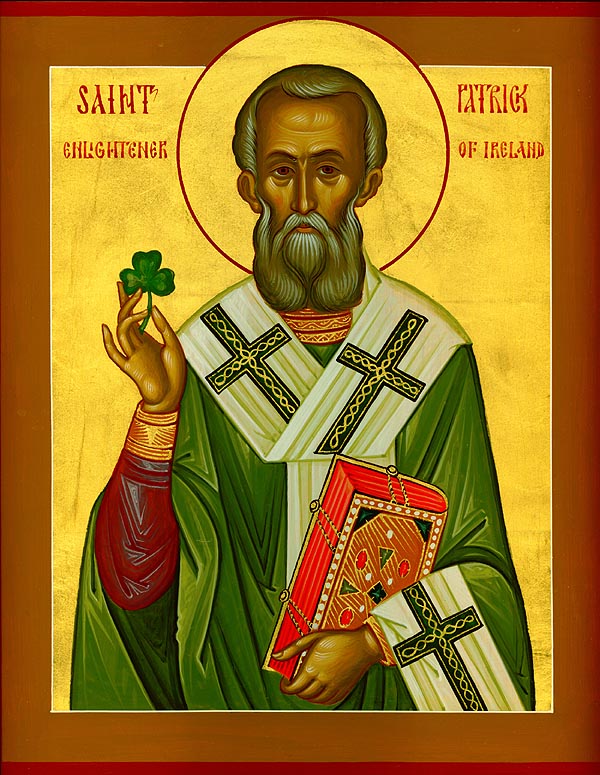
Today is Saint Patrick’s Day – but who was Saint Patrick?
Well, interestingly enough, Patrick has never officially been named a saint by any church body. Furthermore, Patrick was not Irish! And if you’ve ever heard that Patrick drove the snakes out of Ireland – there never actually were snakes in Ireland, so that is just the stuff of legend.
The real Patrick was a Roman Briton born in Wales around 390 AD to a wealthy, noble family. His father was a deacon and his grandfather a pastor. When Patrick was 16 years old, he was captured by Irish marauders and taken to Ireland as a slave. After living there as a slave for 6 yrs, he managed to escape back to Britain. After his return to Britain, he joined a monastery and became a minister, and during this time he was burdened with a desire to go back to his former captors in Ireland and share with them the Gospel of Jesus Christ. So Patrick returned to Ireland in 432, this time not as a slave, but of his own volition – as a missionary.
Patrick was one of the earliest Christian missionaries to travel abroad to spread Christianity. One of the noteworthy things which Patrick did as a missionary was live in solidarity with the Irish people. Patrick wrote that he “sold his nobility” to enhance his commonality with his Irish audience. He spoke their language, and lived among; he became one of them, that he might reach them with the Gospel.
One of the first things that Patrick did was gain religious toleration for Christians from the Irish King. He also sought to evangelize prominent druids, knowing that others would likely follow if high profile druid leaders converted to Christianity. One of Patrick’s emphases amongst those who converted to Christianity was spiritual growth. Within 15 years Patrick has evangelized much of Ireland. In all, Patrick served as a missionary and pastor in Ireland for some 30 years.
One of the long-term fruits of Patrick’s ministry in Ireland was a movement of Irish missionaries that grew up in the generations following his establishment of Christianity in that country. One of these men was Columba (521-597) who was born in an Irish Christian family and became a priest in the church and somewhat of a church planter, establishing many churches in Ireland. At age 42 Columba left Ireland, saying he had been motivated by the ‘love of Christ’ and went to Scotland, where he established a monastery which served as a station for training and sending missionaries into the surrounding region.
Here’s to Patrick the missionary and to the Irish people!

 Big Ben is the most famous clock in the world. It towers over the city of London, over Westminster Abbey and the Parliament.

 Theology for the People