We do not know what to do…

I was inspired this morning reading the story of King Jehoshaphat – he’s one of the bright spots in the chronicles of the kings of Israel and Judah.

In 2 Chronicles 20, we read how Jehoshaphat was faced with a difficult situation: the Moabites and the Ammonites, people groups who Israel had respected and lived beside peaceably as good neighbors, teamed up to attack and conquer Israel.

When Jehoshaphat received the news that these attacking armies were already in the land of Israel, on his doorstep, “he was afraid” – understandably – but look how he reacted: “[Jehoshaphat] set his face to seek the LORD, and proclaimed a fast throughout all Judah. And Judah assembled to seek help from the LORD; from all the cities of Judah they came to seek the LORD.” (2 Chronicles 20:3-4)

There are so many ways that people respond to bad news. I love the response of Jehoshaphat! Would to God that I would respond that way myself!

I once heard the statement that the key to leadership is that when you get bad news, you respond in great ways. That’s what Jehoshaphat did.

Key to leadership: When you get bad news, you respond in great ways

After calling the people together, Jehoshaphat led them in prayer – and he prayed fervently, from his heart, with faith. He says: “If disaster comes upon us, the sword, judgment, or pestilence, or famine, we will stand before this house and before you – for your name is in this house – and cry out to you in our affliction, and you will hear and save.” (2 Chronicles 20:9)

But most of all, I love the heart with which he ends the prayer: For we are powerless against this great horde that is coming against us. We do not know what to do, but our eyes are on you.” (2 Chronicles 20:12)

We do not know what to do, but our eyes are on you.

There is something about that sentiment which resonates with me. There are so many situations about which I feel the same way: I don’t know what to do. Riots in Ferguson, war in Ukraine, strife and conflict in families in our own community. The list could go on. I sympathize with the heart of Jehoshaphat: I don’t know what to do, Lord!  But his conclusion couldn’t be more right on: But our eyes are on you. Lord, we are looking to you to save and deliver and change and redeem. We can’t do it – so we look to you, Lord!

If you read the end of the story, what you find out is that Jehoshaphat and Judah win the battle; the tide turns when Jehoshaphat organizes the people to both fight and to worship. May that be true of us as well in the situations that we face – that we would have the heart of Jehoshaphat in those times.

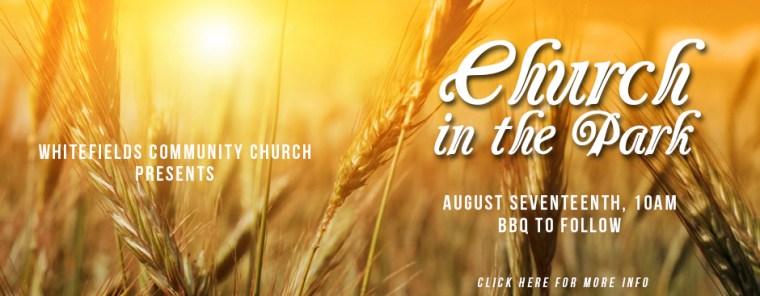
Church in the Park – upcoming event in Longmont’s Roosevelt Park

CHURCHINTHEPARK

White Fields Community Church will be hosting Church in the Park on August 17th in Longmont’s Roosevelt Park (700 Longs Peak Avenue).

This outdoor service will be held under the shade of the trees in the South-East corner of the park, right in front of the St Vrain Memorial building.

We will be joined by guest Pastor Pete Nelson, who will be sharing the Word with us.  Hope you will join us!

Give…expecting nothing in return

One of the sayings of Jesus that I find most inspiring and challenging is in the Gospel of Luke, chapter 6, where Jesus says:

“If you love those who love you, what benefit is that to you? For even sinners love those who love them. And if you do good to those who do good to you, what benefit is that to you? For even sinners do the same. And if you lend to those from whom you expect to receive, what credit is that to you? Even sinners lend to sinners, to get back the same amount. But love your enemies, and do good, and lend, expecting nothing in return, and your reward will be great, and you will be sons of the Most High, for he is kind to the ungrateful and the evil.

(Luke 6:32-35 ESV)

Most of us do things for others with at least some expectation that we will receive something in return. If we are nice to others, we expect that they will be nice to us in return. If they are not, we tend to get upset about it.

Many of us give with the expectation, that at least the recipient will be appreciative of our generosity.

Many of us love, with the expectation that our love will be reciprocated – and if it is not, then we tend to “clam up”, because to love is to make oneself vulnerable, and unreciprocated love leaves us more vulnerable than reciprocated love.

But here is Jesus challenging us toward something that does not come naturally: to GIVE, expecting nothing in return.

Nothing.

Why? Because that is how God loves.  And if you do that, then you will understand the heart of the Father in a profound way, and you will be like Him. Because He gives to the ungrateful and the evil – He blesses people who don’t deserve it and don’t even appreciate it.  

If He gets nothing out of it, then why does He do it?   Because that is what divine love does: it gives, not as a means of coercion, but simply gives out of pure love.

I want to be that kind of person, to my wife, to my kids, to those around me – even to my “enemies”. This is the vision; only by the grace of God can I carry it out.

Back from Costa Mesa

Last week I was in Costa Mesa, CA for the annual Calvary Chapel Senior Pastors Conference. It was a great time of encouragement and fellowship, catching up with friends from all over the world who I only see at events like this.

This was the first SPC since Pastor Chuck Smith died, and the focus was on not forgetting the past, but not living in the past either – rather pressing ahead, building upon the foundation we’ve been given.

The messages at the conference were great, particularly what Brian Brodersen shared from Haggai ch 2, about how “the glory of the latter house will surpass that of the former”. May it be so!

Many of the sentiments shared at the conference, such as that Calvary Chapel must not be insular, but must understand its place in the wider body of Christ, and that we must stay on mission rather than being distracted by peripheral issues, definitely resonated with me.

I’m looking forward to everything that God will do through this movement in the years to come.

Boulder County clerk to begin issuing same-sex marriage licenses

Boulder County clerk to begin issuing same-sex marriage licenses

Same-sex marriage has made it’s way to Colorado, and unsurprisingly, the first place it will begin is right here in Boulder County.

Boulder County will begin issuing same-sex marriage licenses immediately, County Clerk and Recorder Hillary Hall announced Wednesday afternoon.

The action was in response to the 10th Circuit U.S. Appellate Court ruling earlier in the day that Utah’s ban on same-sex marriage violates the U.S. Constitution’s guarantees of equal protection and due process.

There are a lot of opinions out there, even amongst Christians, as to what our stand on this should be.

Earlier this week, a Methodist pastor, who had been defrocked for going against church regulations and officiating his son’s wedding to another man, was reinstated.

Some Christians might say: Who cares? If homosexuals want to get married, why should I care?  There are plenty of things that are legal, but are not in accordance with God’s will or desires. It doesn’t affect me – I’m just trying to follow Jesus.  

My guess is that this is the majority opinion amongst most in the younger generation.

Others might say: Our laws shape our society’s understandings of what is acceptable and normative. Redefining marriage is bad for our society.

Here’s one thing I noticed: on social media there’s tons of praise for this. That doesn’t mean that everybody is in favor of it – it means that those who don’t like it are less and less willing to speak up and voice their opinion, because they know the kind of backlash that will come upon them if they do.

Woe to those who call evil good and good evil, who put darkness for light and light for darkness, who put bitter for sweet and sweet for bitter! (Isaiah 5:20)

Having Passed the Baton

For many years, the third week of June was one of the highlights of the year for my wife and I. That’s because this is the time when the Foundations Conference takes place in Vajta, Hungary. Foundations is a conference for Calvary Chapel missionaries and national workers from all over Eastern Europe to gather together for a week of fellowship and teaching. It was a time for us of seeing friends we often only saw at that conference, as well as a time of being recharged physically and spiritually, and seeking the Lord.

This year I’ve been keeping up with some of what’s happening at Foundations on Instagram, where I get to see familiar faces and places.

Today on Instagram I saw this photo, which filled me with so many emotions:

In that picture are friends of mine, and they are praying for a young man named Jonathan, who is serving as a missionary in Eger, Hungary at the church Rosemary and I started 9 years ago. Standing behind him is Jani, a man who I first met when he was not a Christian, but who I had the privilege of leading to The Lord, pouring into, raising up in ministry, and who is now the pastor of that church in Eger.

I remember how on the last night of one of these Foundations conferences several years ago, I was up front praying for people, and Jani came up and asked me to pray that God would bless him and his wife with a baby. Only a few months later, we got the good news that Tünde, his wife, was pregnant with their first child.

I’m a bit jealous that I can’t be there withy them right now, but it fills me with so much joy to see these guys who now carry that baton, going for it with all they’ve got. It is a good feeling when something you started takes on a life of its own.

How Does Marriage Affect Violence Against Women and Children?

How Does Marriage Affect Violence Against Women and Children?

This article in the Washington Post this week showed that statistically, women and children in married families suffer far less domestic violence than those in other situations.

Married women are notably safer than their unmarried peers, and girls raised in a home with their married father are markedly less likely to be abused or assaulted than children living without their own father.

As Christians, one of the best things we can do for society is to uphold and promote strong biblical ethics.

The Interactive Sermon

The past 2 Sundays at White Fields we’ve been trying something new, where our background slide invites people to text or tweet their questions in during the sermon. Once we get these questions, I will answer some during the service if we have time, or I will answer them on The City – our church’s in-house social network.

The response we’ve gotten to this has been really good! I’ve really enjoyed engaging with people and answering their questions. You can read some of those discussions here. Look for the posts titled “Sermon Follow-Up”.

I think that in this day and age, with the proliferation of the internet especially, sermons need to be more interactive. Finding the right way to do this though, is what is hard.

Timothy Keller, at his Sunday night services in NYC, has had a question and answer time for years. It’s a main part of the service – and it invites skeptics to come and do what New Yorkers do best: be skeptical and inquisitive. Tim Keller has said that the average young adult in New York is a thinker and thinkers have questions, and if you want them to really consider Christianity, you have to give them a chance to have their questions answered.

Nowadays, any news article you read online gives readers the option to engage in a comments section, where they can have a discussion about the content of the article. Any attitude in churches of “don’t question anything” is completely disconnected from where our culture is at today, especially with young people. Furthermore, I feel that if pastors are not answering the real questions that people are asking and struggling with, if we are not addressing the issues that people are really wondering about and discussing, then we have become irrelevant talking heads. If everywhere in the world there is transparency and discussion is encouraged, but at church we have smokescreens and we don’t like questions, what does that communicate to people? Perhaps that we lack the confidence that is required to allow people to ask questions? That shouldn’t be the case.

However, the danger in opening up to engagement like this, is that it inevitably gives a platform to haters – people who don’t have sincere questions, but who ask questions in order to be critical or in an attempt to trip others up. This is something that Jesus dealt with a lot from the Pharisees and Sadducees, who put a lot of effort into tripping him up. I’m sure that Timothy Keller gets tons of people like this as well, but it doesn’t deter him from encouraging people to ask questions and give him the chance to offer a biblical answer.

What are your thoughts on encouraging engagement with sermons? How have you seen it done effectively – or ineffectively?

Strength to Press On

I love Colorado. Especially this time of year, when everything is green.

I grew up in Colorado, but growing up here, I didn’t appreciate it as much as I should have. I started to appreciate it a lot more in my later teenage years, but soon moved away. The 10 years that I was away, I lived in and traveled to amazing and (sometimes) beautiful places in Europe, but all that time I dreamt about the Rocky Mountains in Colorado. The only problem I have with Colorado is there’s not enough Hungarian-speakers here 🙂  When I moved back to Colorado, I determined to appreciate and enjoy the grandeur and beauty of this place as much as possible. 

Today, as I was biking outside of Lyons with a friend, I started reflecting on a regret I have: something I would change if I could roll back time. It’s not a major one – and it’s certainly not too late to correct.

Here it is: If I could roll back time, I would have done more things as a younger man to train myself in endurance. It’s not that I don’t have endurance, but I wish I had even greater endurance than I currently do – and I wish I had started training myself in it earlier in life. Had I done so, my endurance level would probably be higher than it is now.

Endurance is key to success in climbing mountains, biking, snowshoeing, backpacking and hiking. It’s also key in many areas of life. Paul the Apostle encouraged us to “run with endurance the race which is set before us” (Hebrews 12:1). The race he was speaking of was the life lived following after Jesus Christ and pursuing God and his will.

At church on Sunday I shared this quote from Dietrich Bonhoeffer: “Christianity is less about cautiously avoiding sin than about courageously and actively dong the will of God.”

That race isn’t a 100 meter dash – it’s a marathon. And marathons require endurance.

Endurance is something that can be gained, it is something can be cultivated, something you can train yourself in – and we would all do well to do so. Having a successful marriage requires endurance. Having success in raising a family, in doing a ministry – it requires endurance. Anybody can have a burst of energy and make a “flash in the pan” – but in order to regularly produce lasting fruit over a sustained period requires endurance. 

I also believe the promise of God’s Word, that to those who seek after Him with their whole hearts, God will give the grace and endurance to run this race and finish it well.

Why do you say, O Jacob, and speak, O Israel, “My way is hidden from the LORD, and my right is disregarded by my God”? Have you not known? Have you not heard? The LORD is the everlasting God, the Creator of the ends of the earth. He does not faint or grow weary; his understanding is unsearchable. He gives power to the faint, and to him who has no might he increases strength. Even youths shall faint and be weary, and young men shall fall exhausted; but they who wait for the LORD shall renew their strength; they shall mount up with wings like eagles; they shall run and not be weary; they shall walk and not faint. (Isaiah 40:27-31 ESV)

The Most Misused Verses in the Bible

A few weeks ago I saw a promotion on Twitter, offering this book for free on Kindle. I assumed it would be somewhat cliché and predictable, but I’ve been pleasantly surprised!

The book is thoughtful and gives context to many verses which are frequently quoted out of context, and then explains how they are usually misapplied and gives their proper application.

If you’re looking for something to read, I recommend it.

Christianity suffers from too many trite clichés and platitudes; too many scriptures are stripped of their original meanings and used to say things they were never meant to say.

Here are a few quotes from the chapter on Matthew 7:1 – “Do not judge, or you too will be judged.”

When we take a closer look at the context of Matthew 7 and the teachings of the rest of Scripture, it is clear that this verse cannot be used to substantiate unrestrained moral freedom, autonomy, and independence. This was not Jesus’ intent. He was not advocating a hands-off approach to moral accountability, refusing to allow anyone to make moral judgments in any sense. Quite the opposite, Jesus was explicitly rebuking the hypocrisy of the Pharisees, who were quick to see the sins of others but were blind and unwilling to hold themselves accountable to the same standard they were imposing on everyone else.

No one will reach perfection in this life, but together we are to wage war against and forsake the sin that results from living in our fallen flesh. We are to “take off the old life,” so to speak, and “put on the new,” growing in holiness out of reverence for God. But the reality is we can’t accomplish this without the help of the indwelling Holy Spirit and the mutual encouragement and accountability of our fellow brothers and sisters in Christ. We can’t do this alone; we need each other! This then, is why the apostles called us to help one another in our struggle with sin. For example, James says: My brothers, if one of you should wander from the truth and someone should bring him back, remember this: Whoever turns a sinner from the error of his way will save him from death and cover over a multitude of sins. (5: 19– 20 NIV 1984) Paul said something similar in the book of Galatians: Brothers, if someone is caught in a sin, you who are spiritual should restore him gently. But watch yourself, or you also may be tempted. Carry each other’s burdens, and in this way you will fulfill the law of Christ. (6: 1– 2 NIV 1984) Notice that both James and Paul assume two things. First, there will be times when fellow believers will wander off the straight and narrow path. Second, they assume that other Christians, out of love, will seek to come alongside that brother or sister in an effort to bring him or her back from the error of their ways and save them from the destructive power of sin (see Jesus’ method for doing this in Matthew 18: 15– 17). Since we have been commissioned to proclaim a message of repentance and faith to those outside the church who need to hear the good news, certainly we need to proclaim the same message of repentance and faith to those inside the church.

Therefore, Jesus does not forbid all moral judgment or accountability. Rather, he forbids harsh, prideful, and hypocritical judgment that condemns others outright without first evaluating one’s own spiritual condition and commitment to forsake sin. It is my contention that the popular misuse of “do not judge” reveals just how far the discipline of sound biblical study has slipped in recent years. More than that, it sheds light on the state of our culture, a culture that seeks to avoid accountability and responsibility for personal actions. This current trend and mentality runs counter to the teachings of Scripture. For the collective teaching of the Bible insists that those who are created in the image of God are morally responsible to God and to one another. So to use “do not judge” as a means of dismissing oneself from moral responsibility would be to interpret it in a way that pits it against the rest of Scripture.

Bargerhuff, Eric J. (2012-05-01). The Most Misused Verses in the Bible,Surprising Ways God’s Word Is Misunderstood (pp. 25-30). Baker Publishing Group. Kindle Edition.

This book is worth the price. Check it out.