Something Worth Listening To

A friend from White Fields Church recently recommended I check out the Eric Metaxas Show podcast. I’ve enjoyed reading Eric’s books and I would highly recommend his biographies of Dietrich Bonhoeffer as well as his shorter 7 Men and 7 Women.

I recently subscribed to the podcast and have been listening to it while I drive. If you’re looking for something good to listen to, I recommend it. Below I’ve embeded an episode to get you started, in which Eric interviews someone from Voice of the Martyrs and talks about the life and legacy of Richard Wurmbrand, a Lutheran pastor who was tortured for his Christian faith in communist Romania and became an advocate for persecuted Christians worldwide.

Another great podcast I’d recommend is the Ask Pastor John podcast with John Piper.

And of course, don’t forget to subscribe to the White Fields Community Church podcast, available in the iTunes podcast store.

If you are looking for a good podcast app for Android, I like Podcast Addict.

Here’s that episode:

About Those Muslims…

I ran across this factoid in my reading today:

In my experience working with muslim refugees from places like Iran, Afghanistan and Kosovo, I found that many people born and raised in muslim families in majority muslim countries are open to hearing and considering the Gospel – sometimes more open than people in “Christian” Europe and North America.

Many people born and raised in Islam know very little about what the Koran teaches, and for them being muslim is more about cultural identity than theological conviction.

Consider this: the majority of muslims in the world do not speak Arabic, yet the Koran is to be read only in its “pure” form: in Arabic. What this means is that the majority of muslims have not read the Koran for themselves. The largest muslim majority country in the world by population is not even in the Middle East: it is Indonesia, and in Indonesia Christianity is legal, there is a sizable Christian population and there is opportunity for muslim people to hear the Gospel.

Did you know that Christianity is the most culturally and racially diverse religion in the world – by far?!  Every other major faith has 80% or more of its adherents on 1 or 2 continents, but roughly 20% of Christians are in Africa, 20% are in South America, a little less than 20% are in Asia, a little more than 20% are in Europe and North America each.  No other religion even comes close to the ethnic and cultural diversity of Christianity.

One of the differences between Christianity and Islam is that whereas Christianity affirms other cultures and languages, Islam does not. Wherever Islam has spread it imposes a foreign (Arabic) language and culture, including dress, art, music and other forms of expression upon its adherents. Christianity does not; rather Christianity liberates the African to be fully African and the European to be fully European in regard to language, dress, art, music and other forms of cultural expression. Considering the fact that the majority of muslims live outside of the Arabian Peninsula, this is a particularly compelling aspect of Christianity compared to Islam, which has imposed Arabic culture upon people at the cost of suppressing their African, Persian, Indian, etc. forms of cultural expression. For the Arab, while Islam does represent a distinctly Arab cultural expression, the fact remains that for 600 years a strong and healthy, culturally-Arab Christian community thrived in the Middle East, the remnants of which still remain – although they are currently endangered – in Syria, Lebanon and Iraq.

Christians, we have been given a mission which is greater than protecting and preserving our comforts. We have been given a mission to “preach the Gospel to all creatures” and to “make disciples of all nations”.  This includes the 1.6 billion people on around the world who self-identity as muslim. We live in unprecedented times, in which more people raised muslim have come to faith in Jesus Christ in the last 20 years than in the previous 1400 combined. May God do an even greater work in the years to come, and may we share His heart for all people.

O Little Town of Bethlehem: What are the Odds?

A reader of this blog contacted me this week asking if I could write a few words about Micah 5:2

But you, O Bethlehem Ephrathah,
who are too little to be among the clans of Judah,
from you shall come forth for me
one who is to be ruler in Israel,
whose coming forth is from of old,
from ancient days.

Bethlehem = “House of Bread” – it is a small town only a few kilometers outside of Jerusalem. It was also the ancestral home of King David.

The older, pre-Jewish name of Bethlehem was Ephrathah, which is used on several occasions to speak of it in the Bible.

Micah’s prophecy is about the impending destruction of Samaria and Judea, including Jerusalem for their sins and refusal to repent of them and turn their hearts back to God. As a result, destruction would come upon them from other nations and they would be carried off in exile.

However, the final word of this prophetic message is one of hope and restoration, the message that God has not abandoned his people, but is wholly committed to them, and at a time when they have repented, he will fulfill his promises to them.

What promises were these? In particular it was the promise of a ruler, a King in the line of David, who would establish a Kingdom which would have no end; a kingdom of peace and justice and righteousness which would last forever.

That’s a pretty steep promise! Is it just meant as hyperbole, or was it meant to be taken as a literal promise? How could any king rule forever?

When you begin to take the different promises about this king together, the picture comes together of a King who is more than just a man, but who is actually divine in nature. Notice how Micah says that “his coming forth is from old, from ancient days” – this is saying that one is going to be born, who has existed from eternity past. This is speaking of divinity being born into the world to establish an everlasting kingdom. This is speaking of the incarnation: God coming to us, born in human flesh.

And where would this happen? In Bethlehem. A village of no consequence, only famous as the ancestral home of Israel’s greatest king – and significantly, a king who was promised by God that one of his descendants would establish an everlasting kingdom.

Micah 5:2 is one of 300+ prophecies found in the Hebrew Bible (what Christians call the Old Testament) about the Messiah, which speak of who he would be, what he would do, and how his coming would take place. 300+ – fulfilled by one person! What are the odds?

Peter Stoner, in Science Speaks (Moody Press) attempts to show how coincidence is ruled out by the science of probability. Stoner says that by using the modern calculation of probability in reference to eight prophecies, “we find that the chance that any man might have lived down to the present time and fulfilled all eight prophecies is 1 in 1017.” That would be 1 in 100,000,000,000,000,000.  In order to help us comprehend this staggering probability, Stoner illustrates it by supposing that “we take 1017silver dollars and lay them on the face of Texas. They will cover all of the state two feet deep.

“Now mark one of these silver dollars and stir the whole mass thoroughly, all over the state. Blindfold a man and tell him that he can travel as far as he wishes, but he must pick up one silver dollar and say that this is the right one. What chance would he have of getting the right one? Just the same chance that the prophets would have had of writing these eight prophecies and having them all come true in any one man.”

Stoner considers 48 prophecies and says, “we find the chance that any one man fulfilled all 48 prophecies to be 1 in 10157. The estimated number of electrons in the universe is around 1079. It should be quite evident that Jesus did not fulfill the prophecies by accident.”

Advent Meditations: 13 – The Reason the Son of God Appeared

The reason the Son of God appeared was to destroy the works of the devil. – 1 John 3:8

I have been away for a few days from this because my wife gave birth to our baby girl this past weekend! We feel very blessed.

With every new life comes the promise of hope and joy and the light that this new life will bring into the world, but over every life there looms the shadow of a cloud on the horizon… a debt which will one day come due: the inevitability of death.

Every child is born into a world that is cracked and broken, with remnants of what it was originally intended and designed to be and we live with a lingering memory – an ancestral notion of how things were meant to be.

The message of Christmas is that the Son of God appeared to destroy the works of the devil – to restore things to the way they were meant to be. This is the hope of the Gospel and the hope that we celebrate at Advent: that the day is coming, and is ever nearer, when this hope of ours will be realized. The meaning of Christmas is that there is a new inevitability: that that day is coming, and will be here before we realize it.

The Son of God appeared to destroy the works of the devil: in the world, and also in each of us. He came to make the world what it was meant to be, and to make each of us what we were meant to be.

Joy to the world – the Lord has come!  The Savior reigns!


Advent Meditations: 10 – Christmas Joy

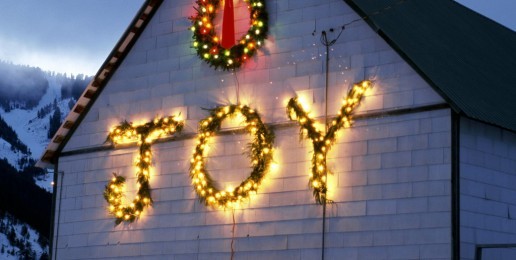
christmas-joy-516x260

And the angel said to them, “Fear not, for behold, I bring you good news of great joy that will be for all the people. For unto you is born this day in the city of David a Savior, who is Christ the Lord. – Luke 2:10-11

What is the joy of this season?    Is it Tradition?  Family?  Giving and receiving?

The thing about each of these, is that the joy of these things is something very temporal and easily lost.

If the joy of Christmas is family, then what about those who have no family?  Does this season hold no joy for them?

If the joy of Christmas is tradition, then what is there for those who have suffered loss of loved ones – or even of financial resources?  For them, Christmas will be pure pain.
If the joy of Christmas is tied to traditions: decorating a house, eating certain foods, doing certain things – then if those things are no longer possible, because you had to give up the house, or because a family member passed away, or any other reason, then Christmas will not be a time of joy, but of pain and heartache.

If the joy of Christmas is in giving and receiving, then once again, what about those who have nothing to give and/or no one to receive from?  If the joy of Christmas is in giving and receiving, then Christmas brings loneliness and shame rather than joy.

These things are what are commonly held by many people to be the joys of Christmas, but let me tell you: these should not be – they cannot be – the wellspring of joy that Christmas brings, because it is only a matter of time, before all of these things run dry…and make Christmas a time of pain and bitter longing rather than life-giving joy.

What is the true joy of Christmas?  It is this: A Savior is born to you, who is Christ the Lord.

One of the verses in the Bible that I find most moving is Matthew 1:21:

She will bear a son, and you shall call his name Jesus, for he will save his people from their sins – Matthew 1:21

This is the joy of Christmas: that though you were lost, God pursued you and found you!   That though you were without hope, God came near to you to give you hope that extends beyond the grave!  That though you were destined for darkness and death, God broke into time and space to bring you light and life!

That is a joy that doesn’t disappear when financial resources dry up!  That is a joy that doesn’t grow dimmer as loved ones pass away – but rather grows all the more vibrant and beautiful!

May this be the joy of Christmas for you!

And may we not teach our children, whether in word or in deed, to find the joy of Christmas primarily in tradition or in giving or receiving, or even in family – but in the hope of the Gospel of Jesus Christ.


Advent Meditations: 9 – No Room at the Inn

And she gave birth to her firstborn son and wrapped him in swaddling cloths and laid him in a manger, because there was no place for them in the inn – Luke 2:7

It is striking how many details came together at the birth of Jesus; so many separate strands came together at one time and place to prepare the perfect setting for his coming – political movements, an empire-wide census which brought Joseph and Mary to Bethlehem, a star in the sky which directed Magi to Bethlehem.

The coming of Jesus into the world happened at a time and in a way that we can clearly see was providentially directed by and planned by God.

Don’t you think then, that the God who can align the stars, the God who can bring down and raise up political leaders, the God who can coordinate a census at just the right time, so that the Messiah will be born in Bethlehem, according to the prophecy… don’t you think that such a sovereign God could have also seen to it that there be an available guest room in Bethlehem for the burgeoning family to stay in?

Of course He could have. But He didn’t.

You see, it isn’t a question of what God could have done, it’s a question of what God willed to do.  (The same is true in our lives, by the way).

God could have made sure there was a place at the inn. God could have brought Jesus into the world in a wealthy family.  But what God willed to do was to have Jesus come into the world through a poor family in an unclean place.

Why?   It was for your sake.   For your sake He became poor, that through Him you might become rich – with a wealth beyond material riches. The kind of wealth that can never be taken from you, that moth and rust cannot destroy, that is imperishable, undefiled, and unfading, kept in heaven for you (1 Peter 1:4).

Jesus’ mission didn’t begin only in his 30th year. No, the road to Calvary began in Bethlehem, in the barn, where the Holy One came into the world in the midst of uncleanness…    What a picture of the incarnation that is.

For you know the grace of our Lord Jesus Christ, that though he was rich, yet for your sake he became poor, so that you by his poverty might become rich. – 2 Corinthians 8:9


Advent Meditations: 5 – The Model for Missions

As you sent me into the world, so I have sent them into the world. – John 17:18

“Christmas is a model for missions and missions are a reflection of Christmas.” – John Piper

The meaning of Christmas is the mission of God: a God who loves and cares so much, that He left Heaven to come and reach out to us with love and truth.

Christmas is a model for missions: God was so moved by love and the conviction that there is something better for us which we desperately need, that He left what was comfortable to Him and at great expense to Himself, came to us, to speak to us in our language, on our level. That is the model of Christian mission both locally and cross-culturally.

Christian mission is a reflection of Christmas: by going out in mission we are imitating our Father and our Lord. We are doing for others what He did for us, albeit obviously not on the same scale.

The purpose of Christmas is joy. God gave us His comfort, that we might have JOY. What a gift!  What a sacrifice, and what love it is that motivates such a sacrifice for the sake of others – others who do not always (or perhaps often) reciprocate that love.

these things I speak in the world, that they may have my joy fulfilled in themselves. – John 17:13

Not only is the purpose of Christmas joy, but the purpose of Christian mission is joy!   Joy for those who come to know the love of God BUT ALSO: joy for those who participate in the mission.

We were made for mission, and we will only know true joy when we get on board with the one ultimate mission: the only mission which has significance beyond this life and even this world: the mission of God to bring salvation to the world. It is in this mission that we can be truly fulfilled and that is a fountain of joy.


Advent Meditations: 4 – Set Free

manger-cross-3

Since therefore the children share in flesh and blood, he himself likewise partook of the same things, that through death he might destroy the one who has the power of death, that is, the devil, and deliver all those who through fear of death were subject to lifelong slavery. – Hebrews 2:14-15

Last night I was at the hospital with the family and close friends of a woman who was passing on from this life. She was a wonderful wife, mother and friend, and she will be dearly missed.

But although she has passed from this life, she is not dead – she is alive and we will see her again.

That is the hope of the Gospel, and she and her husband believe and embrace the Gospel.

The verse above sums up the significance of Christmas more succinctly and clearly than almost any other passage in the Bible: because we, God’s children, are flesh and blood, HE took on flesh and blood, that through his death, he might destroy death and the devil and set us free from bondage to the fear of death.

The reason Jesus was born was so he could die. God became a man, because as God he could not die, but as a man he could. Therefore, he had to become human. Good Friday is the reason for Christmas.

Because of his death, we are set free from the power of death, and therefore we can be free of the fear of death. Our ultimate security has an immediate affect on our lives. The happy ending takes away the slavery to fear in the here and now.

When you no longer fear the last and greatest enemy: death, then you are truly free to live a bold, courageous life of pursuing things that really matter and giving of yourself radically in a way that makes a difference in the lives of others and the world, because you have nothing to lose.

Live in that freedom today.

Advent Meditations: 3 – Paradoxes and Promises

In an article for Christianity Today, Michael Horton began with a captivating introduction:

“It was confusing to grow up singing both ‘This World is Not My Home’ and ‘This is My Father’s World.’ Those hymns embody two common and seemingly contradictory Christian views of the world.” One sees this world as a wasteland of godlessness, with which the Christian should have as little possible to do. The other regards the world as part of God’s good creation to be enjoyed and redeemed.

Which is correct? Well, to some degree both.

Here’s another one for you: God is sovereign, yet “the whole world lies in the power of the evil one.” (1 John 5:19)

Which one is true? Is God sovereign, or is the whole world under the power of the evil one?  It would seem that the answer is: both.

These are paradoxes, things which seem that they should be mutually exclusive or contradictory, but yet both are true at the same time: this world is part of God’s good creation for us to enjoy and redeem AND this world is a fallen broken place, which is not our home, and from which we long to be set free. God is sovereign; God is in heaven and He does all that He wants (Psalm 115:3), AND the whole world lies in the power of the evil one.

Yesterday I watched the news unfold as multiple shooters entered a holiday party in San Bernardino, California at a center for people with disabilities and proceeded to open fire, killing 14 and wounding 17 more. And like most people, my response was a mixture of grief, sadness and exasperation that events like this have become so commonplace in our country and in our world.

At times like this it’s easy to believe that the whole world lies in the power of the evil one, and perhaps harder to believe that God is sovereign over all things. When you see the reports that there have been more mass shootings in the United States than days this year, it’s easy to conclude that this world is a dark place from which we hope to escape – and it’s harder to believe that the world is beautiful and good and that our focus should be on redeeming it for the flourishing of people to the glory of God. And yet, both are true.

These paradoxical statements are at the same time promises. And the hope of Advent is that the true light which gives life to all people has come into the world, and the darkness has not – and will not – overcome it.

Both sides of these paradoxes are true. Both sides of these paradoxes are promises – but only because of Christmas! Only because God became a man in order to redeem us can we have confidence that our redemption is nigh, and that though the darkness is real, the new day will soon dawn and the darkness will be fully abolished.

Advent Meditations: 2 – The Dawn

dawn-sunset-night-sunrise

The true light, which gives light to everyone, was coming into the world. – John 1:9

One of the greatest metaphors the Bible uses to describe where we are at currently in the big picture of human history is: Dawn.

Dawn is an interesting time; dawn is where the night and the day exist simultaneously in the same space, yet neither in full force.

At dawn, the darkness is broken by the light, but it is still dark… but not as dark as it used to be. However, even though light has come, the light is not yet present in its full form, because although the light has appeared, it has not yet broken over the horizon to fully dispel the darkness.

Peter expressly uses this metaphor of dawn in his second letter:

we have the prophetic word more fully confirmed, to which you will do well to pay attention as to a lamp shining in a dark place, until the day dawns and the morning star rises in your hearts. – 2 Peter 1:19

Jesus is called “the morning star.”  The “star” known as the morning star is actually not a star, but the planet Venus. The reason it’s called the morning star is because it is the last “star” that is visible in the sky once the dawn has begun.

What Christmas means is that the true light has come into the world and the dawn has begun. The beginning of dawn is an irreversible moment, and it is only a matter of time before the sun breaks over the horizon and totally dispels the darkness, bringing about the full light of day.

For our world, covered in the shroud of darkness, a darkness which permeates our very hearts, the message is clear: with the coming of Jesus Christ in to the world, the dawn has begun. The darkness has been broken. And while it is still present, it is no longer in full force. And while the light is neither yet in full force, it is a matter of time before the new day fully dawns and the darkness is abolished and fully overcome by the light.

Christmas is the death knell of the darkness. Look to the morning star and see that the dawn has begun!