

What is Expository Preaching? – Some Thoughts from Martyn Lloyd-Jones

bible book close up eyeglasses

The approach to preaching that we champion at White Fields is called “expository preaching.” I’m also involved with a movement called the Expositors Collective – which will have its next event in Bradenton, Florida on Nov 30-Dec 1, and which has a great podcast you should check out!

What is Expository Preaching?

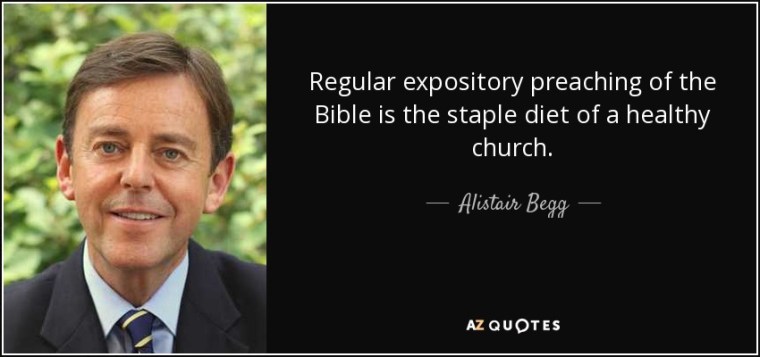
The root word of “expository” is “expose” – and expository preaching is all about exposing the meaning of the text, as opposed to imposing a meaning upon the text. 

The goal of expository preaching is to let the Bible speak for itself, rather than using it as a “prooftext” to validate what we already think or what we really want to say. As opposed to coming to the Scriptures with a pre-conceived notion or goal and then looking for verses which back that up, expository preaching/teaching is focused on coming to the Bible and understanding what it has to say to us.

For this reason, we usually teach and preach through the Bible in a verse-by-verse fashion, but expository preaching can be done when addressing topics as well.

However, just teaching verse-by verse does not necessarily equal expository preaching. An expository sermon aims to expose as clearly as possible the meaning of the text, which means that it will have an effective structure for doing so, and will bring in other biblical texts to reach that goal.

Martyn Lloyd-Jones on Expository Sermons vs. Running Commentary

Consider these words from Martyn Lloyd-Jones’ classic: Preaching and Preachers

A sermon should always be expository. But, immediately, that leads me to say something which I regard as very important indeed in this whole matter. A sermon is not a running commentary on, or a mere exposition of, the meaning of a verse or a passage or a paragraph.

I emphasise this because there are many today who have become interested in what they regard as expository preaching but who show very clearly that they do not know what is meant by expository preaching. They think that it just means making a series of comments, or a running commentary on a paragraph or a passage or a statement. They take a passage verse by verse; and they make their comments on the first, then they go on to the next verse, and do the same with that, then the next, and so on. When they have gone through the passage in this way they imagine they have preached a sermon. But they have not; all they have done is to make a series of comments on a passage.

I would suggest that far from having preached a sermon such preachers have only preached the introduction to a sermon! This, in other words, raises the whole question of the relationship of exposition to the sermon. My basic contention is that the essential characteristic of a sermon is that it has a definite form, and that it is this form that makes it a sermon. It is based upon exposition, but it is this exposition turned or moulded into a message which has this characteristic form.

A phrase that helps to bring out this point is one which is to be found in the Old Testament in the Prophets where we read about ‘the burden of the Lord’. The message has come to the prophet as a burden, it has come to him as an entire message, and he delivers this. That is something, I argue, which is not true of a mere series of comments upon a number of verses.

I maintain that a sermon should have form in the sense that a musical symphony has form. A symphony always has form, it has its parts and its portions. The divisions are clear, and are recognised, and can be described; and yet a symphony is a whole. You can divide it into parts, and yet you always realise that they are parts of a whole, and that the whole is more than the mere summation or aggregate of the parts.

One should always think of a sermon as a construction, a work which is in that way comparable to a symphony. In other words a sermon is not a mere meandering through a number of verses; it is not a mere collection or series of excellent and true statements and remarks. All those should be found in the sermon, but they do not constitute a sermon. What makes a sermon a sermon is that it has this particular ‘form’ which differentiates it from everything else.

Lloyd-Jones, D. Martyn. Preaching and Preachers (pp. 82-84). Zondervan

He then goes on to make the point that “Spirit-led” does not mean structureless. We must not assume that structure and organization is at odds with being open to the leading of the Holy Spirit.

The ultimate goal of expository preaching is to let God’s Word speak and be understood as clearly, and with appropriate force upon the life of the hearers, that they might know God’s Word to them.

quote-regular-expository-preaching-of-the-bible-is-the-staple-diet-of-a-healthy-church-alistair-begg-86-93-91

What is Dual-Covenant Theology and What Does it Mean that “All Israel will be saved”?

Romans 11:26 makes an interesting statement, which has led to much confusion and debate:

“And in this way all Israel will be saved.” (Romans 11:26a)

Context

As we’ve been studying through Romans at White Fields on Sunday mornings, we have come to chapters 9-11, which deal with questions concerning Israel, such as: Has God forsaken Israel? Since the Old Testament contains many promises to the nation of Israel, are those promises no longer valid? How do we make sense of the fact that many Jews have  rejected Jesus as Messiah – and that most Christians are not ethnically Jewish?

In answering these questions, Paul is quick to assert that, No, God’s word has not failed in regard to Israel (Romans 9:6), nor has God forsaken Israel (Romans 11:1).

Paul explains Jewish unbelief in two important ways:

  1. The remnant argument: “Not all who are descended from Israel are Israel,” (Romans 9:4), & “And Isaiah cries out concerning Israel: ‘Though the number of the sons of Israel be as the sand of the sea, only a remnant of them will be saved'” (Romans 9:27).
    Additionally, it is understood that many who are not ethnically Jewish will be added to the “chosen people of God” – As indeed he says in Hosea, “Those who were not my people I will call ‘my people,’ and her who was not beloved I will call ‘beloved.’” “And in the very place where it was said to them, ‘You are not my people,’ there they will be called sons of the living God.’” (Romans 9:25-26)
  2. The responsibility argument: “But of Israel he says, “All day long I have held out my hands to a disobedient and contrary people.” (Romans 10:21)

Dual-Covenant Theology?

In an attempt to explain this idea that “all Israel will be saved”, some have adopted a dual-covenant theology, which basically says that the Jews are going to be saved under the old covenant (law), but Gentiles are saved under the new covenant (Jesus, grace).

The problem with dual-covenant theology is that it goes against everything Paul has been teaching in Romans, and what the rest of the Bible teaches: that Jesus is the only way of salvation for all people, both for Jews and Gentiles (i.e. everyone in the world).

John Stott writes this:

There is no hint of a special way of salvation for the Jews which dispenses with faith in Christ. It is understandable that since the holocaust Jews have demanded an end to Christian missionary activity among them, and that many Christians have felt embarrassed about continuing it. It is even mooted that Jewish evangelism is an unacceptable form of anti-Semitism. So some Christians have attempted to develop a theological basis for leaving Jews alone in their Judaism. Reminding us that God’s covenant with Abraham was an ‘everlasting covenant’, they maintain that it is still in force, and that therefore God saves Jewish people through their own covenant, without any necessity for them to believe in Jesus. This proposal is usually called a ‘two-covenant theology’.

Bishop Krister Stendahl was one of the first scholars to argue for it,47 namely that there are two different salvation ‘tracks’—the Christian track for the believing remnant and believing Gentiles, and the track for historical Israel which relies on God’s covenant with them. Professor Dunn is surely right to reject this as ‘a false and quite unnecessary antithesis’.

Romans 11 stands in clear opposition to this trend because of its insistence on the fact that there is only one olive tree, to which Jewish and Gentile believers both belong. Jewish people ‘will be grafted in’ again ‘if they do not persist in unbelief’. So faith in Jesus is essential for them. Whether or not Dr Tom Wright is correct in the notion of ‘a large-scale, last-minute salvation of ethnic Jews’, his emphasis on present evangelism (‘now’, three times in verses 30 and 31) is healthy: ‘Paul is envisaging a steady flow of Jews into the church, by grace through faith.’

The two-covenant theology also has the disastrous effect of perpetuating the distinction between Jews and Gentiles which Jesus Christ has abolished. ‘The irony of this’, writes Tom Wright, ‘is that the late twentieth century, in order to avoid anti-Semitism, has advocated a position (the non-evangelization of the Jews) which Paul regards precisely as anti-Semitic.’ ‘It would be quite intolerable to imagine a church at any period which was simply a Gentile phenomenon’ or ‘consisted only of Jews’.

Stott, John. The Message of Romans: God’s Good News for the World (The Bible Speaks Today Series) (pp. 304-305). InterVarsity Press.

If not dual-covenant theology, then how will “all Israel” be saved?

Since Paul has made it clear that “not all who are descended from Israel are Israel,” i.e. not every ethnically Jewish person is part of Israel, i.e. the remnant of God’s chosen people who will be saved – and that additionally, many non-ethnically Jewish people will be grafted into the “olive tree” (Israel) as “wild branches”, from which many “natural branches” have been cut off (Romans 11:17-24), it is in this way that we understand that “all Israel” (the remnant of believing Israel) will be saved, along with the “fullness of the Gentiles” (Romans 11:25) who will be “grafted in”.

Here’s a short video discussion we had about this topic this week:

An Antinomy, Not a Contradiction

In our study of Paul’s Letter to the Romans at White Fields, we have recently been looking at chapters 8, 9 and 10 which talk about divine election, predestination and how those relate to human responsibility. What these chapters teach is that God is sovereign over all things, and yet we are responsible for our actions.

In theological terms, this is called an “antinomy.” As opposed to a contradiction, antinomy refers to the tension between two things which seem at odds, but are yet both true at the same time. Antinomy is not to be confused with antinomianism (a rejection of, and even antagonism towards the moral commandments, rules and obligations which the Bible lays out. For more on antinomianism read: “Oh, How I Love Your Law” – the Role of the Law in the Life of a Believer)

John Stott writes that “few preachers have maintained this antinomy better than Charles Simeon of Cambridge, who said:

‘When I come to a text which speaks of election, I delight myself in the doctrine of election. When the apostles exhort me to repentance and obedience, I give myself up to that.’ “

To illustrate this antinomy, Simeon borrowed an illustration from the Industrial Revolution:

‘As wheels in a complicated machine may move in opposite directions and yet subserve a common end, so may truths apparently opposite be perfectly reconcilable with each other, and equally subserve the purposes of God in the accomplishment of man’s salvation.’

Here is a short video we recorded in follow-up to a sermon which touched on the topics of predestination and election:

Ravencrest Chalet

This week I’m teaching at a Bible College in Estes Park.

I had driven by their sign on Hwy 36 many times coming into Estes Park, but was never quite sure what Ravencrest was, or what their Bible school was like.

img_20180924_085552

Last year I got a call from the director, inviting me to come up for the day; it turns out we have some common friends in Hungary, and several people I know had studied here.

Over the past few months, I’ve enjoyed getting to know Frank and the staff here at Ravencrest, and they invited me to come up these week as a guest lecturer. I’m teaching Genesis for the first-year students and teaching “Leadership in the Local Church” for the second-year students.

They have a great facility up here, and a good ministry that brings people in from all over the world. Along with the Bible School, they function as a conference and retreat center and in the summer they organize camps for youth, including some backpacking retreats into Rocky Mountain National Park.

Check them out online here: ravencrest.org

Adoption, the Gospel and Michael Ketterer

As we’ve been studying through the book of Romans at White Fields, one of the topics we recently looked at was how the Bible says that adoption is a one of the most profound Earthly pictures that we have of what God has done for us in the gospel.

Adoption is a picture of the gospel

We who were not children of God – destitute, orphans – God reached out to us, and not only did he pardon us and forgive us, not only does he give us his Spirit to help us in our weakness, but he has reached out to us and adopted us. At great cost to himself, doing something for us that we could never have done for ourselves, he has given us a new identity, paid our debts, given us a new belonging, a new future, a new family and a great inheritance.

For more on this topic, check out the sermon: Adopted by God from Romans 8:12-17.

Adoption is close to my heart for personal reasons

Adoption is something close to my heart. In 2008 we began foster parenting an 8th grader from the church I pastored at the time, and in 2011 we adopted him.

When you adopt a child, you are making the decision to love someone and care for someone, not because you have to, but because you choose to. While all adoption is beautiful, I am particularly moved by people who adopt not because they cannot have biological children, but because they understand adoption as a ministry and a way that they can live out the gospel – a way that they can live out what God has done for them in Christ, and bless someone else in a way which will absolutely change their life.

Michael and Ivey Ketterer

It’s been a while since I’ve watched America’s Got Talent, but I recently heard about Michael Ketterer, who appeared on the show and performed so well that he was fast-tracked from the audition process straight to the live show round of the competition.

Michael Ketterer is a musician who is part of United Pursuit, a Los Angeles based collective of Christian artists and musicians. He describes himself as a part-time worship leader, part-time nurse, and full-time dad.

Michael and his wife Ivey have 6 children, 5 of whom were adopted through foster care, and one of whom suffers from cerebral palsy – the neurological disorder which we were initially told that our daughter would have (Read: I Believe in Miracles; Here’s Why).

download
The Ketterer Family

Michael and Ivey share their story of foster parenting and adoption in this video. With the exception of the part where he talks about demons (3:20), (we aren’t to resist evil on the basis of who we are, our own name and authority, but only in the name of Jesus and on the basis of his authority – see Jude 1:9) this is a great and moving testimony of love and being moved by the love of God to love others. I encourage you to watch the whole clip:

Here is the video of Michael’s first appearance on AGT:

Also check out Michael’s album, The Wild Inside, which he recorded with United Pursuit here:

You can help White Fields in our efforts to make a difference in the lives of children and care-takers in the foster system here in Colorado. Click on these links to learn more about our two annual outreaches to foster families on the Front Range:

Project Greatest Gift – A Longmont Initiative to Help Children in Foster Care

Project Back to School

Finally, maybe there are some of you whom God would lead to get involved with foster parenting or adoption through the foster system. Here is a link with information about foster parenting and adoption in Colorado: Co4Kids.org For those of you outside of Colorado, information can be easily found for every local area with a quick internet search.

For all who are led by the Spirit of God are sons of God. For…. you have received the Spirit of adoption as sons, by whom we cry, “Abba! Father!” (Romans 8:14-15)

Parents’ Religious Hypocrisy a Leading Factor in Atheism

An article posted by Relevant Magazine today cited a recent study published in the Religion, Brain and Behavior Journal, which sought to understand why people choose to become atheists.

Although the researches expected to find that most people became atheists because they grew up outside of a religious setting, what they found was that many who call themselves atheists became so, at least in part, as a result of observing their parents to be insincere, hypocritical or unfaithful.

Furthermore, the study found that the more choice a child or youth was given to choose their own way, including whether or not to attend church services, the more likely those youth were to reject their parents’ faith before reaching adulthood compared to those who were not offered that choice. Additionally, other research has shown the positive impact that faithful religious practice has on children as they grow into adulthood.

The researchers pointed out that there were plenty of cases in which someone had chosen atheism in spite of growing up with religious parents who were devout, loving and sincere. However, it does seem that where hypocrisy did exist, it was a factor which contributed to their decision to reject their parents’ faith.

Interestingly, in a poll I took earlier this year, in which I asked the question: “What are the biggest hurdles that people have when it comes to embracing Christianity?”, the number one response I got was: “Hypocrisy”. This aligns with the results of a 2007 Barna research project, in which they asked people why they rejected Christianity.

Read: “I Took a Poll; Here’s What I’ve Learned So Far

It should be remembered, that Jesus himself took great issue with religious hypocrisy; he neither tolerated it, nor remained silent about it. In fact, he said something so extreme, that if Jesus himself hadn’t said it, most people wouldn’t dare go as far as saying something like this:

If anyone causes one of these little ones–those who believe in me–to stumble, it would be better for them to have a large millstone hung around their neck and to be drowned in the depths of the sea.  (Matthew 18:6)

Clearly, hypocrisy is a big deal – both to God and to people. Children are perceptive, and they intuit the discrepancies in people’s words and their actions, the latter of which tend to reveal our true values and beliefs.

May God help us who call ourselves Christians to be sincere, humble, repentant and loving, while we hold onto very important convictions about the truth – in order that we might shine like lights in the world (see Philippians 2:14-15) and draw people to Jesus.

Here is a message from a series I taught earlier this year called, “The Trouble Is…”, in which I address the issue of religious hypocrisy, both for Christians and for those who are not Christians, or who are unsure of where they stand:

Also check out the follow-up discussion we recorded about this topic:

Does the Bible Ever Actually Prohibit Sex Before Marriage? What about Polygamy?

In the latest episode of the Longmont Pastor Video Series, Mike and I sat down to discuss the often-asked question of what the Bible says about sex between two consenting adults who are not married.

While the Bible clearly prohibits adultery, does it ever actually prohibit sex before marriage? Or what about polygamy? It seems that many of the Bible’s “heroes” practiced it, so why do Christians believe it is wrong?

Check out our discussion of these topics:

Pastors, Depression and Suicide

This past weekend, a young head pastor from an influential church in Southern California took his own life. From all outward appearances, Pastor Andrew Stoecklein of Inland Hills Church in Chino had it all: a successful ministry, a photogenic family. And yet, he struggled with depression.

Please join me in praying for Andrew’s wife and three sons. My heart breaks for them.

40172461_10156643630617436_2553742259476496384_n
Pastor Andrew Stoecklein and family

Sometimes people have asked me questions like: “I see the statistics on pastors, about burnout and how many pastors leave the ministry every year. What is it about being a pastor that makes it more difficult than other work?”

My main answer to that question has usually been that what makes it hard is the personal aspect. Pastoring people is highly relational, and with that comes high highs and low lows.

It has been said that in order to be a pastor, one must have the mind of a scholar, the heart of a child, and the hide of a rhinoceros.

Another pastor summed it up this way:

In this generation, pastors are expected to be business savey, Instagram quotable preaching celebrities, fully accessible, deeply spiritual, not too young, not too old, and if a pastor doesn’t quite measure up to someone’s expectation at any given moment, you are given a two out of five star rating on Google.

I certainly don’t want to come across as whining or complaining. Pastors get to do the greatest thing in the world: to love people, teach them and lead them towards Jesus. We get to be there in the most crucial moments of people’s lives, and minister the gospel to them. We get to lead people towards the building up of God’s Kingdom and the spreading of the message of ultimate life, hope and joy!

If ever we feel that we are used or taken for granted by people – isn’t that what we signed up for? Isn’t that what Jesus himself experienced, and part of what made him so great? Isn’t that what it means to get to “share in his sufferings”? (See Philippians 3:8-10)

But in light of this high profile suicide of a well-known pastor, I think it is worth talking about, and taking the opportunity to encourage you to pray for your pastor and look for ways to encourage them.

Here is a good article written on this subject from Thom Rainer: 5 reasons pastors get depressed (and why they don’t talk about it)

Finally, whoever you are, if you are struggling with depression, please reach out for help.
(Suicide Hotline: 1-800-273-8255)


Are some parts of the Bible more inspired by God than others?

48556-bible-table-unsplash-800w-tn

Are some parts of the Bible more the “Word of God” than other parts of the Bible? For example: are the gospels (and within them the words of Jesus) more inspired by God than the Psalms or the historical books or the Apostolic epistles?

A related question is: Are some parts of the Bible more important than others?

A Canon Within the Canon

The word canon means the “measuring rod”, the “standard” by which other things are measured. This is the word the church has used to describe the collection of 66 books which are considered authoritative because they are uniquely inspired by God and are treated as “holy scripture.”

In 2 Timothy 3:16, we are told: All Scripture is breathed out by God and profitable for teaching, for reproof, for correction, and for training in righteousness.
(For a discussion of which Scriptures Paul was referring to here, see: Did the New Testament Writers Know They Were Writing Scripture?)

Although the Christian church as a whole officially recognizes this written canon, every denomination, local church and individual Christian has their theology shaped by greater reliance on some parts of the canon than others. This creates, in practice, a “canon within the canon”; certain parts of the Bible which are considered more authoritative, or even more inspired by God, than other parts of the Bible.

While this is very common, we must challenge ourselves by asking whether this is appropriate, and whether it is congruent with our understanding of what it means that the Bible is “inspired” or “breathed out” by God.

How was the Bible “Inspired”?

When it comes to understanding what it means that Scripture is God-breathed, on the one end of the spectrum are those who believe that God dictated the Bible word for word in Hebrew, Aramaic and Greek, and the writers were simply secretaries who recorded those words. At the other end of spectrum are those who believe that God inspired the writers in the way that an artist, musician or author feels “inspired” by a sunset or something else which “inspires” them to create a masterpiece.

The problem with the “dictation” view of inspiration is that the writing styles of the various human authors are very apparent in what they wrote. Paul’s very long complicated sentences are very different than the short simple sentences of 1 John or the Gospel of Mark. The Gospel of John recounts the life of Jesus in a very different way and from a very different point of view than that of Matthew or Luke. Furthermore, many of the Psalms are cries of imperfect people who are voicing their complaints to God – or expressing sentiments which are not God’s heart.

The problem with the artistic view of inspiration is that the Bible clearly tells us that Scripture is not just a great human book, but the “Word of God”; a message which has been conveyed from God to us. 2 Peter 1:21 puts it this way: “For no prophecy was ever produced by the will of man, but men spoke from God as they were carried along by the Holy Spirit,” and Romans 15:4 says that “everything that was written in the past was written to teach us.”

So, what is the correct understanding of Biblical “inspiration”?

Dynamic Verbal Plenary Inspiration

Dynamic

The biblical writers conveyed God’s message in terms of their own personalities and historical circumstances, and yet they transmitted the message fully and exactly as God desired.

Verbal

As opposed to the idea that God only inspired the thoughts of the writers, or gave them the “big ideas,” which they then wrote down in their own words, we know that God’s inspiration of Scripture extends even to the words that were used.

For example, in Galatians 3:16 Paul wrote, “the promises were made to Abraham and to his offspring. It does not say, “And to offsprings,” referring to many, but referring to one, “And to your offspring,” who is Christ.” By making this distinction about the significance of the particular word that was used in the Scriptures, he is making the point that God’s inspiration of Scripture is to be understood as “verbal,” i.e. that God inspired certain words to be used instead of other words in order to convey His particular message.

In Matthew 5:17-18, Jesus said, “Do not think that I have come to abolish the Law or the Prophets; I have not come to abolish them but to fulfill them. For truly, I say to you, until heaven and earth pass away, not an iota, not a dot, will pass from the Law until all is accomplished.” Jesus is here affirming that the smallest details of the Scriptures are inspired by God. If the punctuation is inspired, how much more so the very words?

Plenary

Plenary means “complete or full,” and when used to describe the inspiration of the Scriptures, it means that all parts of the Bible are equally of divine origin and equally authoritative.

Dynamic Verbal Plenary Inspiration acknowledges that the Bible is both a human book and a divine book. To put it simply: The Holy Spirit so guided the writers of Scripture so that they gave us, in their own unique manner, exactly the message God intended.

This begs one final question: Just because all parts of the Bible are equally authoritative, does that mean that all parts of the Bible are equally important?

Are all parts of the Bible equally important?

While all parts of the Bible are divinely authoritative, there are some parts of Scripture which we can say are more important, or at least more relevant, than other parts.

The progressive nature of revelation

Hebrews 1:1-2 says: “Long ago, at many times and in many ways, God spoke to our fathers by the prophets, but in these last days he has spoken to us by his Son, whom he appointed the heir of all things, through whom also he created the world.”

God’s revelation has had a progressive nature throughout history, culminating in Jesus’ coming, his teachings and his life, death and resurrection, along with his explanations of the significance of these things (see Luke 24:13-49).

Therefore, books like Romans and Hebrews contain a later and fuller revelation of the gospel, the core message of the Bible, than do books like Ecclesiastes, for example. Ecclesiastes, I would argue, can only be fully understood in light of Jesus and the significance of his life, death and resurrection.

Thus, while all parts of the Bible are to be understood as authoritative and of divine origin (this, by the way, was the criteria for the solidifying of the canon at the early church councils), we understand that the progressive nature of revelation means that some books will be more relevant than others, or that some earlier books must be understood in light of what is revealed in later books.

Conclusion

The Bible is God’s gift to humanity; our guide for life and eternity. It is the only book that is “God-breathed,” and it is important that we be careful to avoid creating a “canon within the canon.”

Further Reading:

Did the New Testament Writers Know They Were Writing Scripture?

2 Timothy 3:16 says: All Scripture is breathed out by God and profitable for teaching, for reproof, for correction, and for training in righteousness

What Scriptures are being referred to here?

Obviously it is referring to the Old Testament scriptures, but interestingly, this comes from 2 Timothy, the last letter which Paul wrote, at the end of his life. By this time — almost all of the books that we have in our New Testaments had already been written, and were being distributed amongst the Christians, to be read and studied in their churches.

So, when Paul says, “All Scripture” — he’s not just talking about the Old Testament, he’s also talking about the New Testament!

In the New Testament, what you find is that the Apostles understood that God was using them in their time to bring about a New Testament of Holy Scriptures, by the inspiration of the Holy Spirit.

Here are a few examples:

  • In 2 Peter 3:15-16, Peter refers to the writings of Paul as “Scriptures”
  • In 2 Thessalonians 2:13, Paul referred to his own message as “the word of God”
  • In 1 Timothy 5:18, Paul takes a quotation from the Gospel of Luke – and he calls it “Scripture” (Luke 10:7)
  • In some of his letters, Paul instructs the recipients to distribute his letters and have them read in the churches. (Colossians 4:16, 1 Thessalonians 5:27)

What Paul is telling Timothy in this text is to stick to the Scriptures, because they come from God, not from man.

The Bible is not only inspired in the sense that it is like a great work of art that we might say is “inspired” – but it is inspired in the greater sense, that the words it contains were breathed by God Himself!

What that means is that the Bible is no ordinary book — it is the very word of God to us, and therefore it alone is worthy to be the highest authority in our lives.