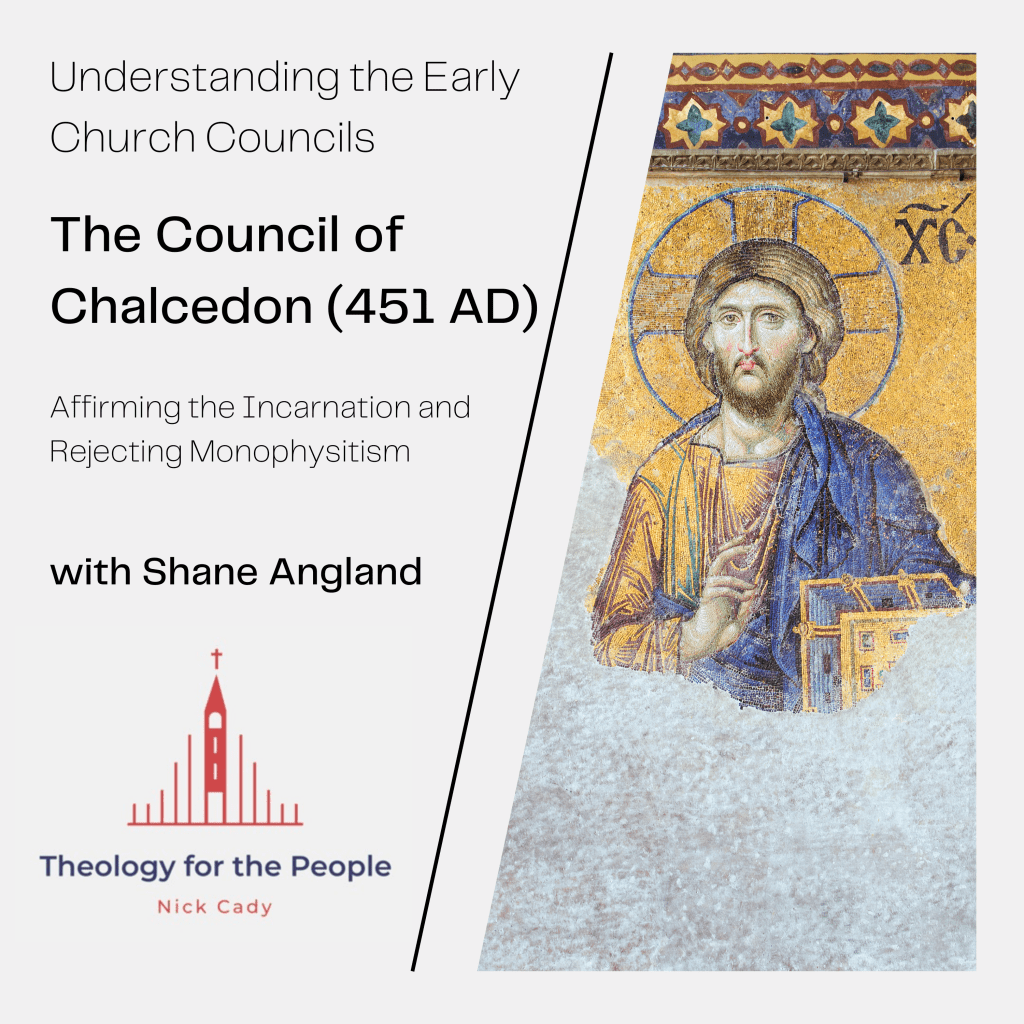
In this episode of the Theology for the People Podcast, I sit down with returning guest Shane to explore the Council of Chalcedon (AD 451), the fourth ecumenical council of the early church.
Recorded live in Colorado during an Expositors Collective training weekend, this conversation traces the events leading up to Chalcedon, its theological breakthroughs, and its messy aftermath.
From the fallout of the Council of Ephesus, to the clash between the Alexandrian and Antiochian schools of Christology, and the mess of Ephesus II, Shane breaks down the stakes: how do we understand the two natures of Christ—human and divine—in one person?
The episode also tackles the political power plays, the deposition of bishops, and the schisms that followed, including the rise of the Oriental Orthodox churches. Plus, hear why Shane sees Chalcedon as both a triumph and a tragedy—and what it still teaches us today.
Resources Mentioned:
The Definition of Chalcedon (available online for further reading).
In this episode, Nick sits down in person with returning guest Shane to explore the Council of Chalcedon (AD 451), the fourth ecumenical council of the early church. Recorded live in Colorado during an Expositors Collective training weekend, this conversation traces the events leading up to Chalcedon, its theological breakthroughs, and its messy aftermath. From the fallout of the Council of Ephesus to the clash between the Alexandrian and Antiochian schools of Christology, Shane breaks down the stakes: how do we understand the two natures of Christ—human and divine—in one person? The episode also tackles the political power plays, the deposition of bishops, and the schisms that followed, including the rise of the Oriental Orthodox churches. Plus, hear why Shane sees Chalcedon as both a triumph and a tragedy—and what it still teaches us today.Resources Mentioned:The Definition of Chalcedon (available online for further reading).Bruce Shelley’s Church History in Plain Language (Fifth Edition).Augustine’s The Unity of the Church on the role and limits of councils.Visit TheologyforthePeople.com
In this episode of the Theology for the People Podcast, we continue our series on the first four ecumenical councils of the early church, diving into the Council of Ephesus (431 AD).
Matthew Pursely, Executive Pastor at Park Hill Church in San Diego, CA, joins us again to explore the theological debates surrounding Nestorius, the nature of Christ, and the implications of the hypostatic union—Jesus being fully God and fully man.
We discuss how this council addressed Nestorianism, affirmed Mary as the “Theotokos” (God-bearer), and shaped Christian understanding of communion and humanity’s connection to Christ.
The Council of Ephesus (431 AD): Hypostatic Union, Nestorianism, & Theotokos – with Matt Pursely –
Theology for the People
In this episode, we continue our series on the first four ecumenical councils of the early church, diving into the Council of Ephesus (431 AD). Matthew Pursely joins us again to explore the theological debates surrounding Nestorius, the nature of Christ, and the implications of the hypostatic union—Jesus being fully God and fully man. We discuss how this council addressed Nestorianism, affirmed Mary as the "Theotokos" (God-bearer), and shaped Christian understanding of communion and humanity’s connection to Christ.Recommended ResourcesFor those wanting to dive deeper into the councils and related theology:Edward Siecienski – The Filioque: History of a Doctrinal ControversyAdonis Vidu – Exploring the Doctrine of Divine InseparabilityJohn Behr – The Nicene Faith (2 volumes) and John the Theologian and the Mystery of ChristKallistos Anatolios – Retrieving NicaeaJohn Henry Newman – Arians of the Fourth CenturyWilliam Bright – Notes on the Canons of the First Four General CouncilsTodd Miles – Superheroes Can’t Save You: Epic Examples of Historic Heresies (compares heresies to superhero archetypes—highly recommended entry-level read).Connect with Us:Subscribe to the Theology for the People podcastVisit the Theology for the People website at theologyforthepeople.com
How did the early church come to a clear understanding of who Jesus is and how the Holy Spirit relates to the Father and the Son? And why did it take more than one council to settle these questions?
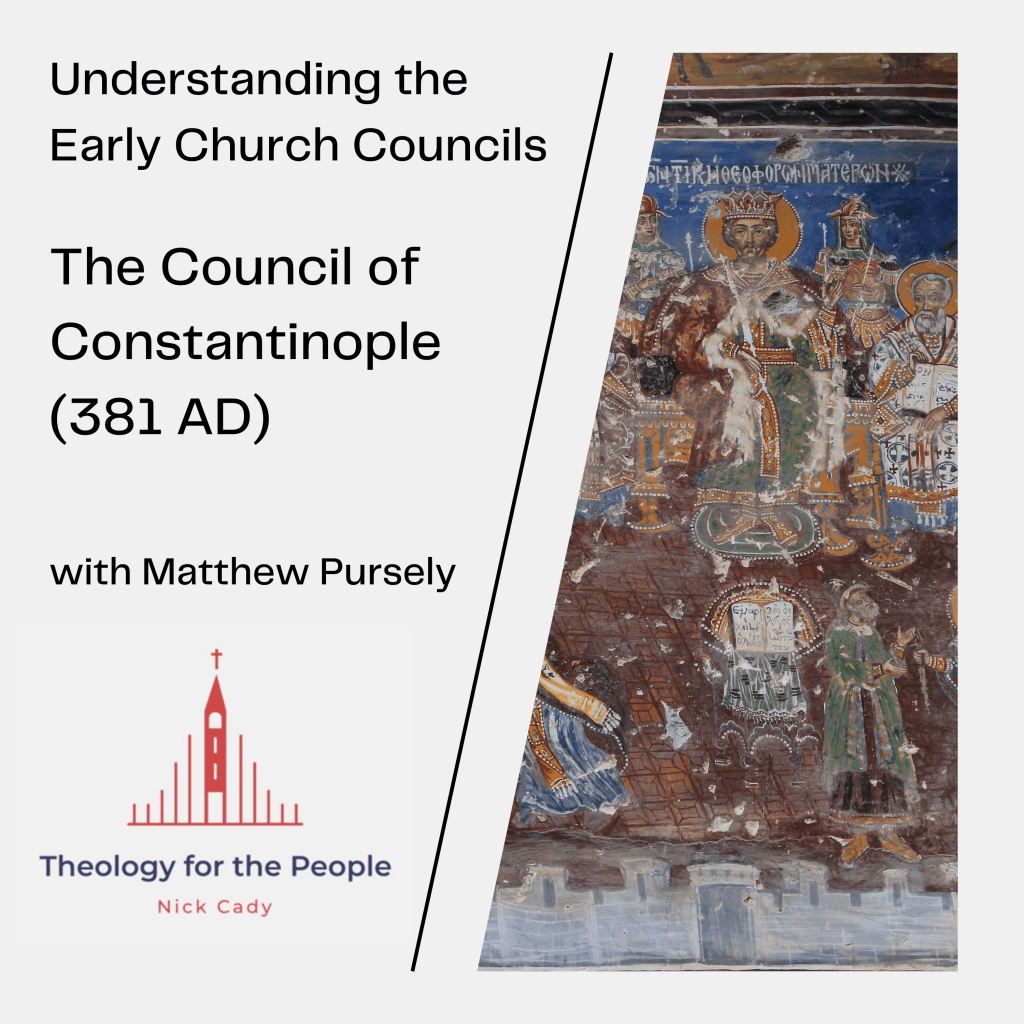
In this episode, I’m joined again by Matthew Pursley, Executive Pastor at Park Hill Church in San Diego, CA, and an expert in historical theology. Last time, we discussed the Council of Nicaea, and in this episode, we continue the conversation by diving into the Second Ecumenical Council—Constantinople (381 AD).
We discuss why the Council of Constantinople was necessary even after Nicaea, the role of the Cappadocian Fathers in defining the Trinity, the Filioque controversy, and how this council still shapes our faith to this day.
How did the early church come to a clear understanding of who Jesus is and how the Holy Spirit relates to the Father and the Son? And why did it take more than one council to settle these questions?In this episode, I'm joined again by Matt Pursley, Executive Pastor at Park Hill Church in San Diego, CA, and an expert in historical theology. Last time, we discussed the Council of Nicaea, and in this episode, we continue the conversation by diving into the Second Ecumenical Council—Constantinople (381 AD).We discuss why the Council of Constantinople was necessary even after Nicaea, the role of the Cappadocian Fathers in defining the Trinity, the Filioque controversy, and how this council still shapes our faith to this day. Make sure to visit the Theology for the People website.
In the latest episode, I speak with theologian, author, and pastor Sam Storms about what it truly means to experience the love of God.
In a culture where love is often redefined and misunderstood, how can we anchor ourselves in the steadfast love that Scripture proclaims? We discuss how culture has distorted the meaning of love, the biblical concept of God’s covenantal and unshakable love, and why love is meant to be more than just a doctrine we affirm—it’s meant to be a reality we feel.
Sam and I also explore how God’s love transforms us, the tension between love and truth in our world today, and practical steps for keeping ourselves in the love of God.
What does it truly mean to experience the love of God? In a culture where love is often redefined and misunderstood, how can we anchor ourselves in the steadfast love that Scripture proclaims?In this episode, I sit down with theologian, author, and pastor Sam Storms to talk about his latest book, The Steadfast Love of the Lord. We discuss how culture has distorted the meaning of love, the biblical concept of God's covenantal and unshakable love, and why love is meant to be more than just a doctrine we affirm—it’s meant to be a reality we feel.We also explore how God's love transforms us, the tension between love and truth in our world today, and practical steps for keeping ourselves in the love of God.Resources Mentioned:The Steadfast Love of the Lord Sam Storms' website: www.samstorms.orgExpositors Collective Training WeekendVisit TheologyForThePeople.com
I thought this might be of interest to my readers, so check it out and feel free to share thoughts in the comments.
Many people may not realize that differences in verse inclusions across Bible translations often arise from the Greek New Testament edition chosen by the translators.
For instance, NIV translators didn’t “remove” verses present in the KJV; they were simply translating from different underlying manuscripts. These manuscripts have been compiled into two slightly different Greek New Testament editions.
Translation and textual criticism (determining which text is closest to the original) are related but distinct fields. Translation committees generally rely on the textual decisions made by textual critics who compile the Greek New Testaments used for translation.
Most Bible translations today are based on either the Textus Receptus (TR, or “Received Text”) or the Critical Text (CT, like the Nestle-Aland 28th Edition or United Bible Society 5th Edition). The KJV, NKJV, and MEV use the Textus Receptus, while the majority of other translations (such as the ESV, NIV, NASB, NLT, NET, and CSB) use the Critical Text.
Some translations, like the WEB and MSB, use a third option, the Majority Text (MT), which is less commonly known. Bible translations also vary in the number of textual footnotes they provide. For example, the NASB often includes fewer footnotes, while the NKJV has more than average, and the CSB, BSB, and WEB offer extensive notes (they’re the only translations I’ve seen with a note on the variant in Matthew 6:1).
A great resource for studying textual differences is the Text-Critical English New Testament: Byzantine Text Version, which shows the percentage of manuscripts supporting each reading. Sunday’s example was fascinating: most modern translations omit Matthew 17:21 (“But this kind does not go out except by prayer and fasting”) based on the Critical Text. However, a significant majority (87.7%) of Greek manuscripts do include this verse, whereas only a small fraction (0.6%) omit it.
While simply counting manuscripts isn’t necessarily the best way to determine authenticity, referring to 87.7% as merely “some” rather than “many” or “most” seems misleading.
It’s also unfortunate that the Majority Text and its close counterpart, the Byzantine Text, are so rarely discussed. God has blessed us with a rich manuscript tradition, and I think it’s important to consider the majority of these texts as part of faithfully stewarding this blessing.
Finally, I want to emphasize that I view all major modern evangelical translations as wonderful, reliable gifts from God. I use and recommend them all.
Have you ever wrestled with doubts about your faith? If so, then you are in good company. The Bible contains several stories of men and women of faith who also had seasons in which they struggled with doubts.
In this episode Dr. Ryken shares advice for those currently struggling with doubts, with the goal of also helping others to be equipped to help those around them to come to greater confidence in Jesus and a more vibrant faith.
Faith Under Pressure: How Wrestling Through Your Doubts Can Lead to Deeper Faith – with Dr. Philip Ryken –
Theology for the People
Have you ever wrestled with doubts about your faith? If so, then you are in good company. The Bible contains several stories of men and women of faith who also had seasons in which they struggled with doubts.
Dr. Philip Ryken is the President of Wheaton College in Wheaton, Illinois. He has a Doctorate in Philosophy from Oxford University, and he is the author of over 50 books. His latest book is called I Have My Doubts: How God Can Use Your Uncertainty to Reawaken Your Faith.
In this episode Dr. Ryken shares advice for those currently struggling with doubts, with the goal of also helping others to be equipped to help those around them to come to greater confidence in Jesus and a more vibrant faith.
Listen to Dr. Ryken's previous episode on Theology for the People: The Role of Beauty in Theology
Visit the Theology for the People website at nickcady.org
How is expository Bible teaching different than non-expository teaching?
David Jackman is the founder and director of the Cornhill Training Course, a UK-based initiative which teaches people how to teach the Bible expositorally.
David has served as a pastor and as president of Proclamation Trust, which exists to equip Bible teachers around the world.
In this episode, David explains the value of expository preaching, both in how it honors God’s Word, and in the ways it benefits those who hear it.
We discuss common pushbacks to expository preaching, such as that Jesus was not an expository preacher, and we get into the mechanics of effective Bible teaching, including how to include application, and more.
What is Expository Preaching and How Do We Do It Well? – with David Jackman –
Theology for the People
How is expository Bible teaching different than non-expository teaching?
David Jackman is the founder and director of the Cornhill Training Course, which teaches people how to teach the Bible expositorally. He has also served as a pastor and as president of Proclamation Trust, which exists to equip Bible teachers around the world.
In this episode, David explains the value of expository preaching, both in how it honors God’s Word, and in the ways it benefits those who hear it.
We discuss common pushbacks to expository preaching, such as that Jesus was not an expository preacher, and we get into the mechanics of effective Bible teaching, including how to include application, and more.
Check out David's recent book, Proclaiming the Word, as well as Expositors Collective.
When we talk about “the Early Church” many people’s minds immediately go to the first generation of Christianity, recorded in the Book of Acts and addressed in the New Testament. But what happened after that, and why does it matter for Christians living today?
Matt Pursley is the Executive Pastor at Park Hill Church in San Diego, California. He has a Masters in Christian History, and in this episode, Matt and I discuss the First Council of Nicaea: what led to it and what it produced.
We address many of the common misconceptions about Nicaea, and we discuss the early heresies of Marcionism, Gnosticism, and Arianism, and why it’s important for Christians today to understand those heresies, and why they were rejected.
Along the way we also talk about Jordan Peterson, who Matt says is a modern Marcionite, and how the errors of both liberalism and fundamentalism have a similar origin.
The First Council of Nicaea: What Actually Happened & Why Does It Matter for Us Today? –
Theology for the People
When we talk about “the Early Church” many people’s minds immediately go to the first generation of Christianity, recorded in the Book of Acts and addressed in the New Testament. But what happened after that, and why does it matter for Christians living today?
Matt Pursley is the Executive Pastor at Park Hill Church in San Diego, California. He has a Masters in Christian History, and in this episode, Matt and I discuss the First Council of Nicaea: what led to it and what it produced.
We address many of the common misconceptions about Nicaea, and we discuss the early heresies of Marcionism, Gnosticism, and Arianism, and why it’s important for Christians today to understand those heresies, and why they were rejected.
Along the way we also talk about Jordan Peterson, who Matt says is a modern Marcionite, and how the errors of both liberalism and fundamentalism have a similar origin.
Visit the Theology for the People website at nickcady.org
Last Thursday I hosted a YouTube LIVE Q&A for the first time, and it went better than I expected!
I answered questions about politics, the Holy Spirit, suicide, and demonic possession – and more people tuned in than I had anticipated!
Here’s the video of that recording if you’d like to watch back. If you turn on the comments, you can see people posting their questions and feedback.
We’re Doing It Again!
Since it went so well, we are going to be doing this more regularly; we’re currently aiming for doing it weekly on Thursdays – so please join us for that, and please help us spread the word about it, so more people can be part of it and ask their questions!
On this particular occasion, I will be going live from the clubhouse of a golf course because I already had a tee time scheduled before we decided to start doing these live Q&A videos! So please join me in praying that the wifi works well at the clubhouse! And if you want to see my golf attire, you’ll have to tune in!
Here’s the link for that scheduled video, and with this you’ll also be able to watch it (or re-watch it) afterwards:
This Weekend: Rhythm at Roosevelt + Live Q&A On Site!
This Saturday (September 21, 2024) is the Rhythm at Roosevelt festival in Longmont, at Roosevelt Park from 2-10 PM.
White Fields Church will have a booth there, so please come by if you attend. We will be handing out popcorn and free swag and hoping to connect with many people in the community.
As part of our time there, we will be doing a Live Q&A, which will be broadcasted on YouTube, and people will have the opportunity to ask questions in person as well.
Here’s the link for that YouTube event, if you can’t come out in person:
Golf Marathon for YoungLife in the St Vrain Valley
On Monday, Sept. 23rd I am participating in a fundraiser to support YoungLife in the St. Vrain Valley. To raise money, I will be playing a marathon of 45 holes of golf in one day!
My wife Rosemary volunteers with YoungLife and both my high schoolers attend their gatherings. YoungLife specializes in building relationships with teenagers, walking with them through the highs and lows of their teen years, and introducing them to Jesus. YoungLife establishes mentoring relationships between Christian adults and teens, many of whom have no connection to church.
This video is a clip from a message I presented at an Expositors Collective training event, on the topic of Christ-Centered Hermeneutics. I didn’t realize they had isolated this clip and turned it into a video, but I’m glad they did, and I’d love for you to check it out: