Recently, in light of the October 7 attack in Israel by Hamas terrorists, many people have been curious how to think about these events from a biblical perspective, as well as how they should pray, and if there are any ways that they can help.
How to Pray
These are just a few of the many ways to pray:
Pray for the peace of Jerusalem (Psalm 122:6)
Pray for the victims of the terrorist attacks, the injured, those taken hostage, the families of those killed or held captive, and those who live in fear of attack or injury
Pray for the innocent civilians who are being impacted by the conflict
Pray for justice to prevail
Pray for the safety of Jewish people around the world who are being targeted, as anti-semitism has seen a sharp rise
Pray for the many Christians in the West Bank and the estimated 800-1000 Christians living in Gaza
How to Think About These Events from a Biblical Perspective
I shared my views on this in this recent video:
How to Help
For those looking for a good Christian ministry to support in Israel, Netivah Ministries was recommended by a pastor friend who says that he knows this group personally and recommends the good work they are doing. Here is a recent update and video from them:
Dear Friends! It has been a month since the horrific Saturday on the 7 of October, and many of you have been asking how we are coping, praying for our safety and contributing to the work we are doing here. THANK YOU SO MUCH! We are blessed, encouraged and strengthened by all your support. We also know that during these days the most important thing is to be a light and a voice of hope in these dark times, encouraging our loved ones that are on the front line, those that have been displaced, and sharing the hope to our people that are hurting and confused. Four of our NETIVAH team have been called up and the rest of us are working to be effective and supportive for the Body of Yeshua, for the displaced families and for our young men and women in the service.
Thank you for your Prayers, Concern and Support during these days. Yours in Yeshua,
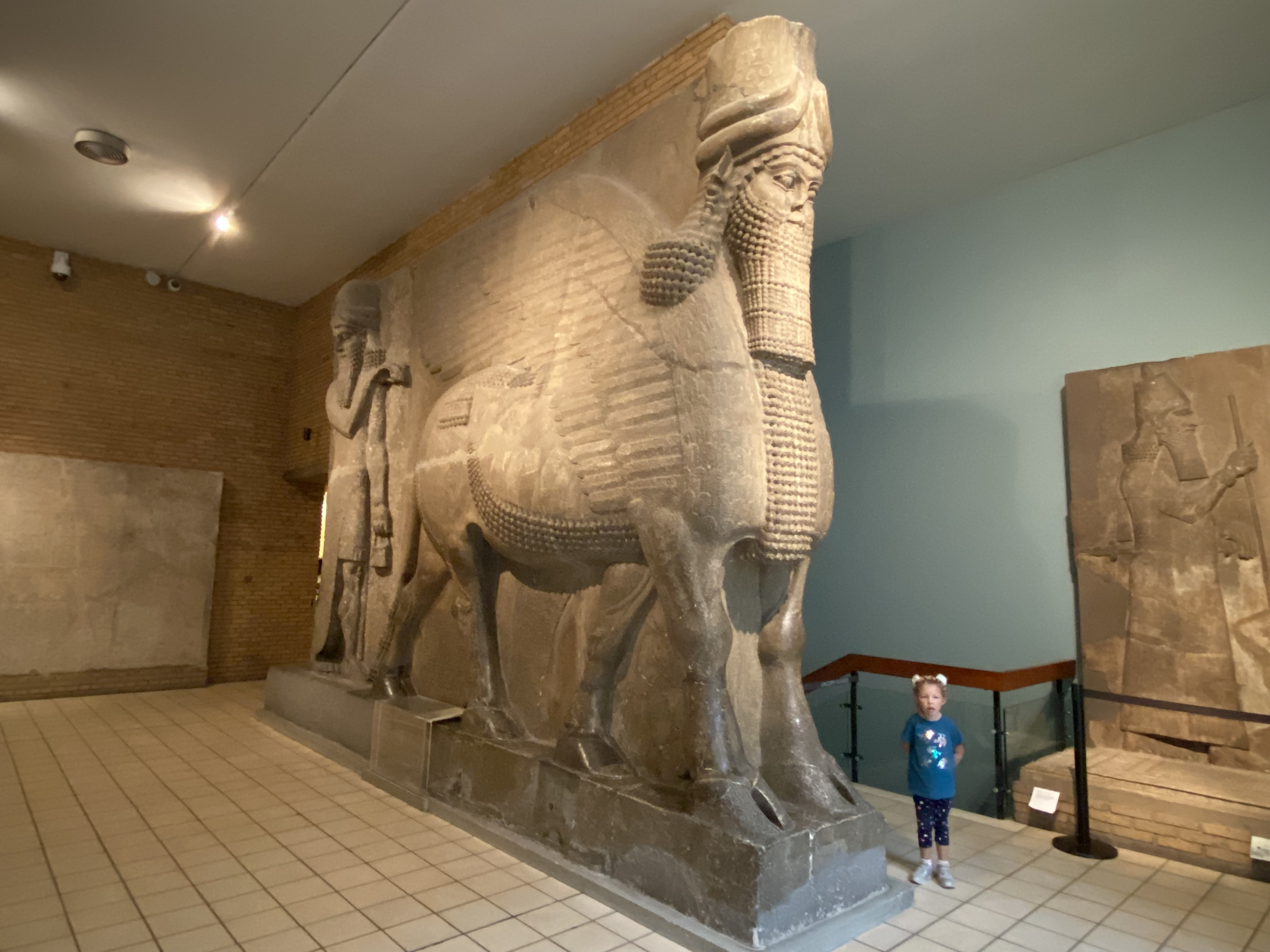
The British Museum in London is one of the greatest museums in the world. It includes the Roseta Stone, which broke the code to reading Egyptian Hieroglyphics, as well as Easter Island statues, and many things of biblical significance. It’s also completely free to the public!
My daughter Hope in front of one of the winged bulls of Assyria at the British Museum
There are so many things of biblical significance in the British Museum that there are entire books dedicated to the subject, such as:
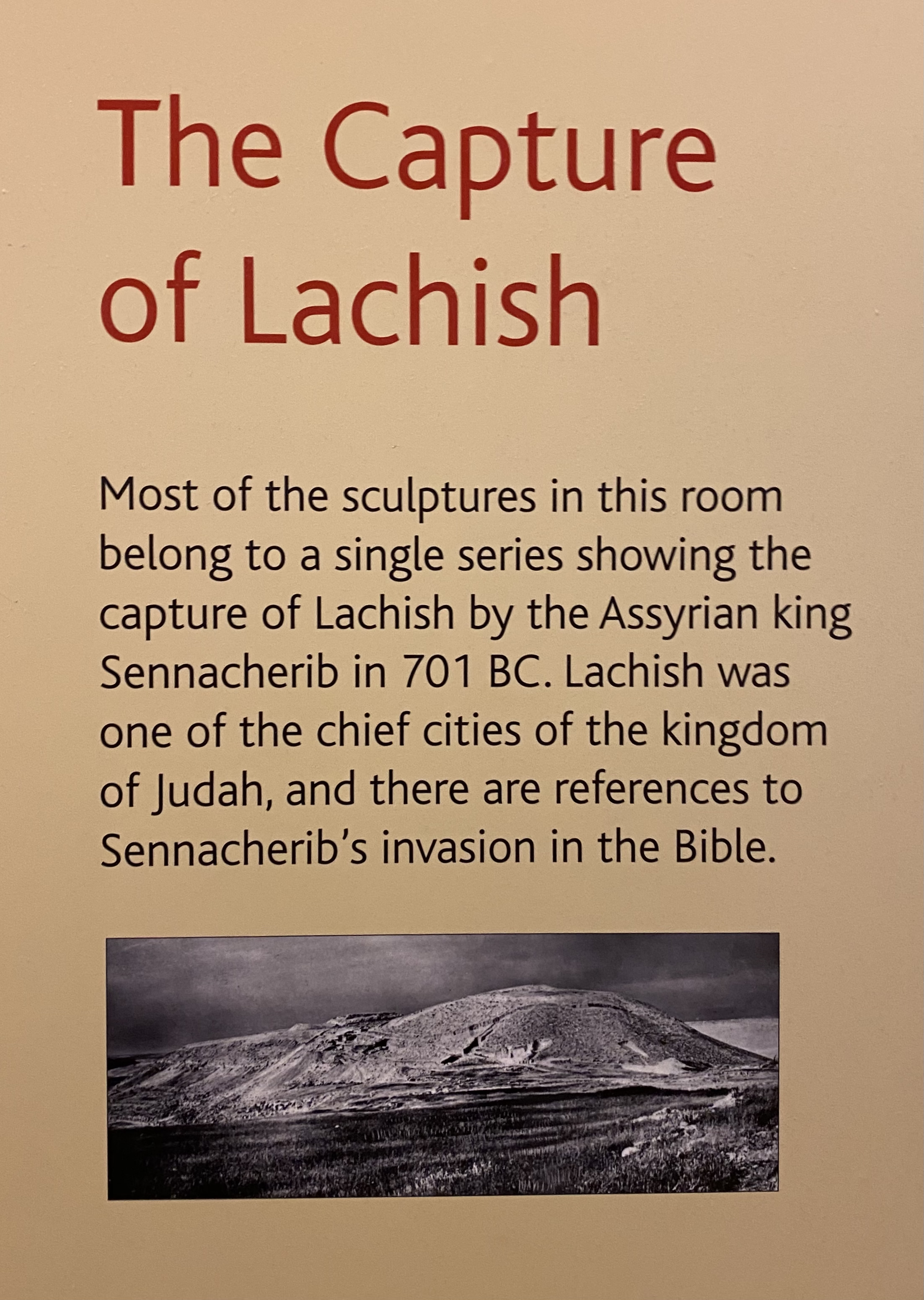
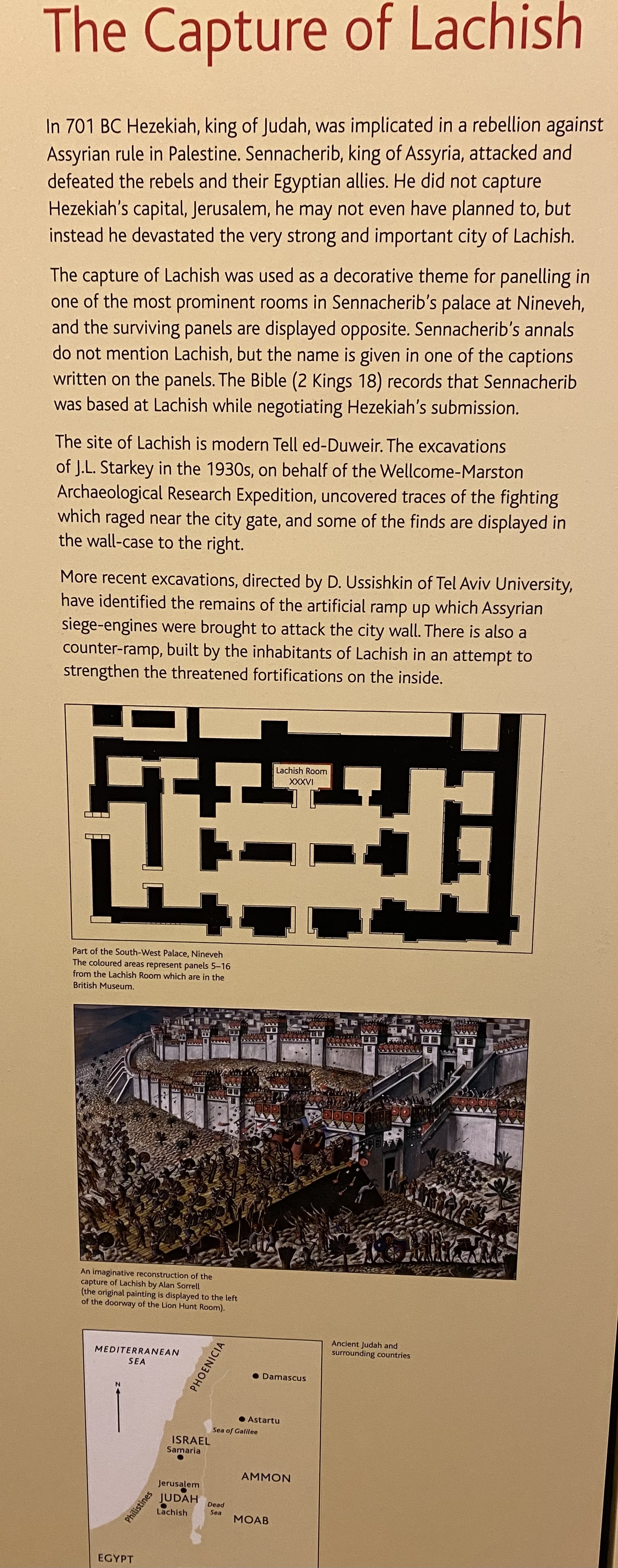
The British Museum: Depiction of the Capture of Lachish from Sennacharib’s Palace in Nineveh
In 2 Kings 18, the Bible tells the story of how Sennacharib, King of Assyria attacked Hezekiah, King of Judah, and that at this time, Sennacharib captured the city of Lachish (2 Kings 18:13) and made it his base of operations in Judah (2 Kings 18:14).
Sennacharib, 2 Kings 19 tells us, tried to intimidate Hezekiah into submission and sent him a threatening letter. The Prophet Isaiah encouraged Hezekiah to defy Sennacharib, and he prophesied Sennacharib’s fall.
In the British Museum, you can see sculptures and base reliefs from Sennacharib’s palace in Nineveh (the capital of Assyria, the same place where Jonah went and against which Nahum prophesied), which depict the Assyrian capture of Lachish.
Interestingly, another item which is held in the British Museum is the annals of Sennacharib, which describe his conquest of much of Judah. These annals mention how he made Jerusalem pay tribute to him (recorded in 2 Kings 18), but while they chronicle the many cities he succeeded in conquering, Jerusalem is left out of the list – which is exactly what the Bible says in 2 Kings 18-19.
The importance of these artifacts, in other words, is that the corroborate the fact that the Bible is historically accurate.
Here are the sermons I preached on 2 Kings 18 & 19 in our “Desiring the Kingdom” series:
In a previous post I showed some of the famous paintings in the Louvre Museum in Paris which wrongly depict Bible stories: Bible Stories Gone Wrong in the Louvre
But the Louvre is more than just an art museum, it is also an archaeology museum, including items of incredible significance, such as Hammurabi’s Code and Tutankhamen’s sarcophagus.
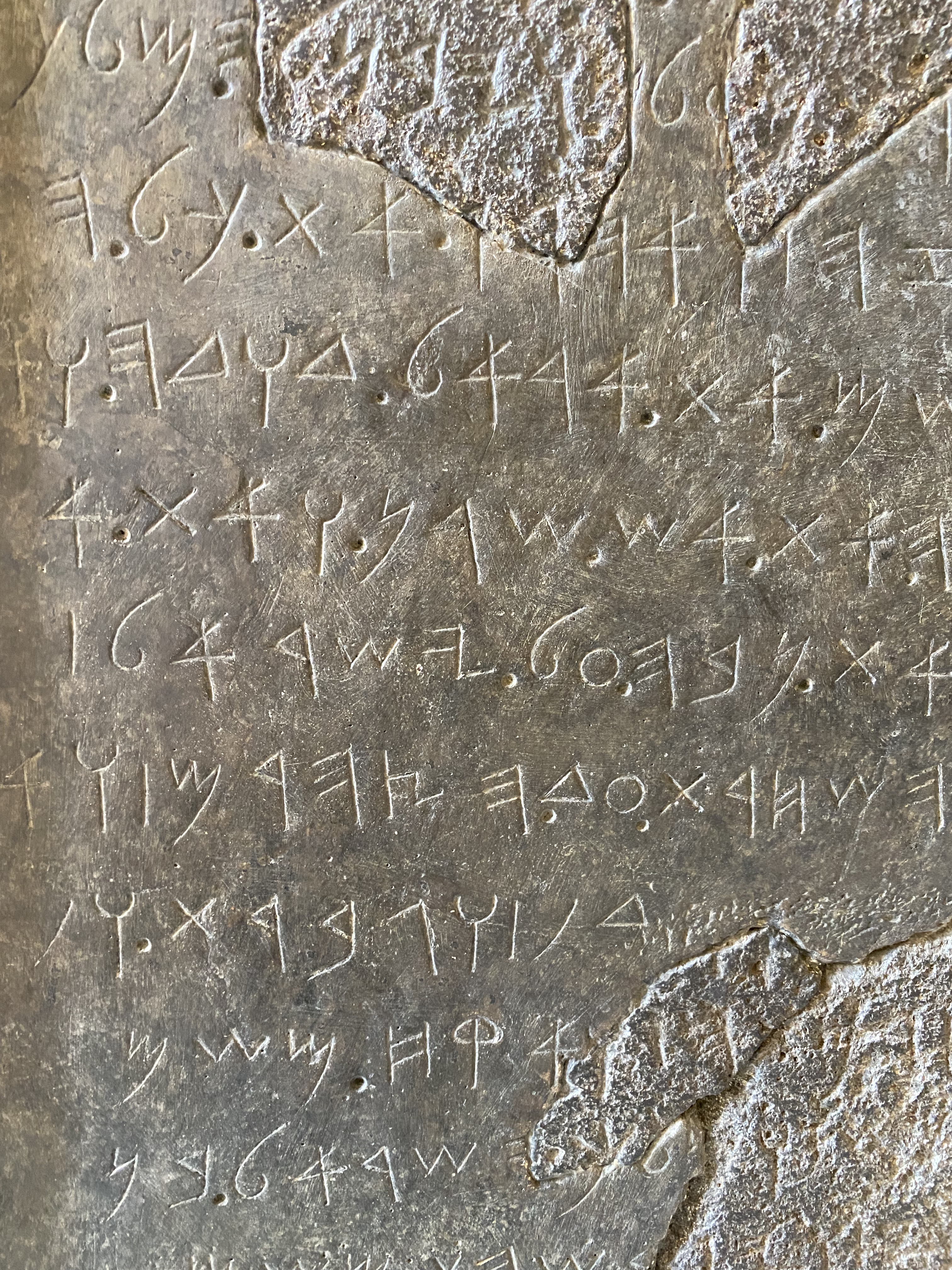
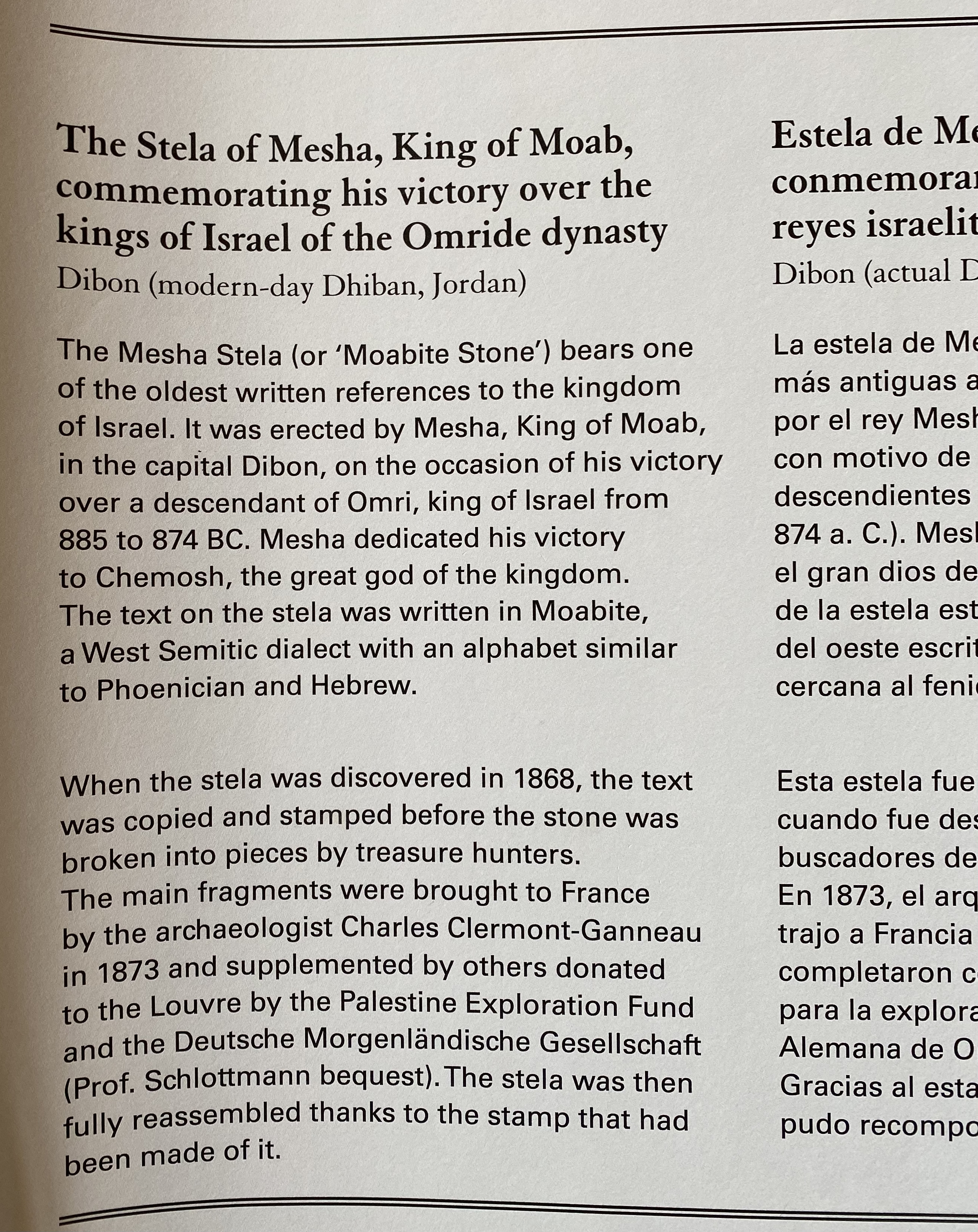
There are also items in the Louvre of biblical relevance, such as the “Moab Stone,” which bears one of the oldest written references to the Kingdom of Israel. It mentions specifically a victory which Moab had in a battle against the Israel, whom it refers to as the House of Omri.
This parallels a story found in 2 Kings 3.
Omri was the sixth king of Israel, and the most famous king to come from the House of Omri was Ahab, who famously tried to convert Israel into a pagan nation, with Baal worship as its official religion. Elijah confronted the prophets of Baal in 1 Kings 18, in which God sent fire from heaven upon a sacrifice as a sign that He alone is God.
Another important element of the Moabite Stone is that it refers to Yahweh as the God of Israel.
These and other items in these museums help us to see that the Bible is trustworthy and accurate, and as archaeologists make more discoveries, those discovers validate, rather than contradict, the historicity of the Biblical accounts.
Through the prophet Habakkuk, God spoke to the people of Judah, telling them this:
“Look among the nations, and see; wonder and be astounded. For I am doing a work in your days that you would not believe if told.”
Habakkuk 1:5
But what exactly would this thing be that God was going to do, which was so incredible that people wouldn’t have believed it even if they were told? The very next verse reveals the answer:
For behold, I am raising up the Chaldeans, that bitter and hasty nation, who march through the breadth of the earth, to seize dwellings not their own.
Habakkuk 1:6
The Chaldeans are also known as the Babylonians. What God was telling the people through Habakkuk was that He was going to raise up the Babylonian Empire to bring judgment on both the Assyrians and… upon Jerusalem!
The result of the Babylonian attack on Jerusalem would be that the Temple would be destroyed and the people of Judah would be carried off into exile for an entire generation.
The idea that God would allow a wicked nation like Babylon to attack and destroy Jerusalem was inconceivable to the people of Judah; it was the kind of news that was so incredible that they wouldn’t have believed even if someone told them!
After all, they were the people of God! Didn’t God love them? Then why would he let this wicked nation to attack them, defeat them, destroy the Temple, and carry them off into exile, making them slaves and subjects who lived as minorities under pagan rulers?
The Unexpected Blessings of the Exile
But perhaps even more difficult to believe, would have been the fact that in many ways, though the exile was painful, it would end up being one of the best things that ever happened to the people of Israel.
The destruction of the Temple and exile in Babylon were their greatest fears, and what God was telling them was that their greatest fears were going to become reality. The people of Israel assumed that because they were God’s chosen people, God would never let anything like that happen to them, and yet He did.
It begs the question: if God loved them, why would He let this happen to them?
The answer is: God intended to use this to accomplish good things in their lives that wouldn’t happen any other way.
In Hebrews 12, God tells us that as a loving father, he disciplines His children. He does this not in spite of His love for us, but because of His love for us!
Here are some of the blessings that Israel experienced in exile:
The divided kingdoms of Israel and Judah were reunited (because Babylon conquered Assyria), and they would come out of the exile as a united nation once again.
Many of the people turned back to God and forsook the worship of idols, which had long plagued them as a people.
A new form of worship was born: because they were cut off from the Temple, the Jewish people began gathering together in Synagogues, where they would study the Scriptures and pray.
Synagogues developed during the exile, and the Jewish people brought them back home with them and continued them after the exile and after the rebuilding of the Temple. Prior to the exile, the people of Israel had a relatively weak relationship with the Scriptures. Consider the fact that when King Josiah found a copy of the Scriptures in the Temple during the renovation, it was the only known copy, and no one had seen it in many years!
Because of the exile, and fueled by the lack of a Temple, the people began regularly studying the Word of God in Babylon, and as they became familiar with it, their hearts were being prepared for the coming of Jesus in the years to come.
The exile was the people’s greatest fear, it was a form of chastisement from God, but ultimately it was one of the best things that ever happened to the people of Israel.
More Than Conquerors
The idea of being in exile was considered by the early Christians to be a good picture of what it means to be a Christian: we are a minority group living in a place that is not our home, and in this place we experience hardships.
As Paul wrote to the Philippians: to be a Christian is to live on Earth, but to have your primary citizenship and identity rooted in Heaven. And yet, as foreigners and sojourners in this world, we understand that God has us here for a purpose.
Just as the exile and the destruction of Jerusalem were the greatest fears of the people of Judah, we might have things in our lives that we consider to be our greatest fears: whether on a social or a personal level. Yet what we learn from Israel’s exile and the realization of their greatest fears, is that God uses even terrible and painful things to accomplish beautiful things in and through our lives.
This is what it means in Romans 8:37 when Paul says that in Christ we are “more than conquerors”: it means that because of what Jesus did for us to redeem us and make us children of God, the worst things that could ever happen to us in this life are also the best things that can ever happen to us! And if that’s the case, then you have absolutely nothing to fear!
Trials and difficulties will be used by God for your good and for His purposes. Hardships will draw you closer to Him. Death will literally bring you to Him. All the worst things that can possibly happen to you, in Christ, are also the best things that can ever happen to you – because of God’s love for you and commitment to you. In him, you are bulletproof! You are more than a conqueror through Him who loved you!
That is very good news that can fill us with confidence, that no matter what comes our way in this life, we can face it boldly and without fear, knowing that we are here in this place for a short time, with a mission from God to carry out with however much time we have left: to be representatives of His Kingdom and messengers of the good news of what Jesus has done to save souls from this present darkness unto eternal life.
The standard joke among foreigners when I lived in Hungary was that Hungarian would be the language of Heaven, because it takes an eternity to learn.
But will there actually be diversity in Heaven? Will racial differences exist for eternity? Or will Heaven be homogenous?
One Race?
As recent events have highlighted disparities and tensions between ethnic groups in the United States and beyond, one response from Christians has been to point out that the Bible teaches that all people come from one set of common ancestors. Therefore, they say, there is truly only one race: the human race.
Why not? Because, while John would not disagree with the fact that all human beings descend from one common set of ancestors, he feels that saying that there is only one race detracts from the importance of racial diversity.
Is Racial Diversity Something to Erase or Celebrate?
This past Sunday we studied 1 Kings 11 at White Fields – watch or listen to that message here. This chapter talks about how King Solomon married many foreign women, contrary to God’s command that the people of Israel not do that.
However, upon further examination of the Bible, what you realize is that this prohibition against marrying foreign women was about faith, not about race. Several of the female heroes of the Bible were women who were not ethnically Jewish, but they became followers and worshipers of Yahweh, the true and living God: Ruth was from Moab, Rahab was a Canaanite. In Jesus’ family tree in Matthew 1, five women are listed by name, and three of them are of non-Jewish origin.
In fact, if you look at the origin of the Jewish people, they were a nation chosen by God from among the nations. They were a manufactured nation, not created on the basis of a shared ethnicity, but on the basis of a shared faith in God. This is why there are Jews from places like Ethiopia and East Asia who are not ethnically descended from the Middle East, and yet they are full-fledged Jews. Essentially, anyone who wanted to be a follower of Yahweh was welcome, no matter where they were from.
What made the early Christians unique was that, unlike most religions at that time, which were limited to a local ethnic group, Christianity – like Judaism – was a truly multi-ethnic faith. It claimed to the truth for all people everywhere, and it claimed that Jesus was the Savior not of only one group of people, but for the entire world.
This belief came from the Bible itself:
“Let the nations be glad and sing for joy, for you judge the peoples with equity and guide the nations upon earth.”
Psalm 67:4
Although in English we often use the word “nations” to speak of political or geographical entities, i.e. “countries.” The word “nations” in the Bible, however, is the Greek word ἔθνη (ethni, the plural form of ethnos), from which we get the English word: “ethnicity.”
So, the country of Russia, for example, is made up of 185 nations, i.e. ethnic groups. This is why in Canada, the indigenous people groups are called the “First Nations.”
So, what this passage is saying is, “Let all the [ethnicities] be glad,” because God judges all the ethnic groups of the world with equity and guides them.
In the “Great Commission,” Jesus instructed his disciples to preach the gospel to all “nations,” i.e. ethnic groups:
Go therefore and make disciples of all nations, baptizing them in the name of the Father and of the Son and of the Holy Spirit, teaching them to observe all that I have commanded you. And behold, I am with you always, to the end of the age.”
Matthew 28:19-20
In his address to the philosophers on Mars Hill in Athens, Paul the Apostle said:
And he made from one man every nation of mankind to live on all the face of the earth, having determined allotted periods and the boundaries of their dwelling place, that they should seek God, and perhaps feel their way toward him and find him. Yet he is actually not far from each one of us
Acts 17:26-27
Here Paul states that God, in His providence, has determined when and where people would live, with the goal that their setting and situations would drive them to seek Him.
Rather than being opposed to the plan of God, it would seem that diversity is part of God’s design and brings Him glory. In a fallen world, not all aspects of any culture will be good and reflect God’s character and heart, and every culture will have certain idolatries which are common to the people in that culture. Conversely, however, every culture will have some aspects which uniquely reflect God’s goodness and character (common grace), which will differ from the way other cultures reflect those things.
Ethnic Diversity in Heaven
In John’s vision of Heaven in Revelation chapter 7, he writes:
After this I looked, and behold, a great multitude that no one could number, from every nation, from all tribes and peoples and languages, standing before the throne and before the Lamb, clothed in white robes, with palm branches in their hands, and crying out with a loud voice, “Salvation belongs to our God who sits on the throne, and to the Lamb!”
Revelation 7:9-10
John gives three descriptions of the diversity of the people around the throne and before the Lamb: tribes, peoples, and languages. This is an escalating list, which goes from smallest to largest: languages may be used by people of multiple ethnicities, and ethnic groups may contain many tribes.
All three of these designations are present around the throne; thus it seems likely that even with our new “heavenly bodies” (see 1 Corinthians 15:35-49), ethnic diversity seems to be maintained and apparent in Heaven, for eternity.
Whereas divisions and oppression will cease, it seems that diversity will not.
It seems that who you are, because of your ethnic and cultural background, will be maintained for eternity, to bring glory to God. While the negative aspects of a culture will be done away with, the good, God-honoring and glorifying diversity will continue to bring glory to God and enrich others.
As we await that day, may God help us to honor and value ethnic diversity, and glean from one another.
For a long time I have wanted to study the books of 1 & 2 Kings with our church.
These are historical books which tell the history of the nation of Israel after the time of King David, beginning with the “Golden Age” of King Solomon, and following the downward spiral that began with his apostasy, followed by the division of the people into two rival kingdoms, and their subsequent apostasies and exiles in Assyria and Babylon.
This history is, on the one hand tragic, and on the other hand full of hope. One of the great “narrative plot lines” that runs throughout the Bible is that of the desire for a king and a kingdom.
While on the one hand these books show us how even the best people are merely people at best, we are constantly reminded of and pointed to the promised Eternal Kingdom and its coming King: the Messiah, Jesus Christ. He alone remains as the sole hero of the stories in these books!
Through the failed kings of Israel and Judah, we are reminded of our desire for a kingdom and a king, and the ever-increasing realization that what we desire will be fulfilled in Jesus and His Kingdom.
Last year I added a page on this site where readers can submit questions or suggest topics (click here for that page). Recently I received this question:
I have been watching an archaeologist/historian video series. She says Jesus could not have been of David’s bloodline because David was Judean from Judea. Any thoughts?
The claim that Jesus could not have been of David’s bloodline because David was a Judean from Judea fails to take into account the fact of the Babylonian captivity.
The Judeans were taken to Babylon for roughly 70 years (it’s “roughly 70 years” because they didn’t all return at once; they returned in waves). Upon return from the captivity, many settled in different places, such as the much more fertile north of Israel, which was also more highly populated and therefore had more work opportunities. Joseph was a builder (“carpenter“ implies wood work in English, but the term used in the Bible implies more that he was more generally a construction worker) and Nazareth was a Jewish settlement right outside of the large Hellenistic city of Sepphoris, where it seems that the Jews of Nazareth went to work every day as laborers.
The lush and fertile north of Israel
Despite their resettlement after the exile, the Jewish people would have kept track of their ancestral hometowns and villages. 70 years is not so long that you would lose connection with your past, especially for ancient people who were more inclined than modern people to keep track of that and value it.
The argument that Jesus could not have been descended from David since he grew up in Nazareth is the same argument made by Nathaniel in John 1. It was an argument which neglected to recognize the fact that while Jesus grew up in Nazareth, his family was originally from Bethlehem, hence the reason Mary and Joseph had to travel there for the census.
Matthew 2 tells us about how Mary and Joseph left Bethlehem because Herod the Great attempted to kill Jesus, fearing him as a threat to his throne. Mary and Joseph took baby Jesus to Egypt, and upon their return they moved to Nazareth in order to stay off the radar of the Herod family even after the death of Herod the Great.
Earlier this year I added a page on this site where readers can submit questions or suggest topics (click here for that page). Recently I received this question:
I have big trouble with The Song of Solomon. It’s often used for looking at marital intimacy, but I’m always thinking: ‘Which wife is Solomon talking about?’ He had so many. And it seems as if having all these wives was just a way of committing adultery (legally). So then I don’t understand why people use these verses to look at the loveliness of marriage?
The Song of Solomon is important theologically because it extols marital intimacy, showing romantic love as being for the purpose of enjoyment and the binding of spouses together, not only for the purpose of procreation. This stands in contrast to many ancient (and modern) views on sexuality which extol asceticism (the denial of pleasure) and eschew physical pleasure.
What We Know
According to the first verse of Song of Solomon, this is a song written by Solomon. This would make it one of the 1005 songs that Solomon wrote (1 Kings 4:32), but the title “Song of Songs” (S.o.S. 1:1) is a superlative, meaning that this is the best of all his songs.
Based on 1 Kings 4:32, it is assumed this song was written early in Solomon’s reign.
It is a lyrical poem, and the main character is a “Shulamite woman”. Shulamite simply means “from Jerusalem” – so this woman is from Jerusalem. This is important, because the first marriage of Solomon’s that we’re told about in 1 Kings 3:1 is his marriage to the daughter of Pharaoh, whom he brought to his palace in Jerusalem.
So the big question is this: Who is the Shulamite woman? Several suggestions have been made, as I will outline in the next section.
Four Possible Interpretations
It has been said that “perhaps no book in the biblical canon has had a greater diversity of interpretative strategies.”[1] Here are the four most popular:
1. Allegorical Interpretation
This view sees the sensuous descriptions of love as a picture of the love between God and his people, and then between Christ and his bride (either the church or the individual soul). This view was very common in the Middle Ages. Its weakness is that it runs the risk of diminishing the book’s endorsement of marital intimacy. Virtually all scholarly interpreters today see the book primarily as a celebration of love and the gift of sexual intimacy, many would say that it also sheds light on the intensity of the spiritual love-relationship between God and his people (see Eph. 5:22–33).
2. Anthology Interpretation
This interpretation views the Song of Solomon as a collection of poems or lyrics, arranged around the common theme of intimate love between a man and a woman—celebrating love’s longing, ecstasy, joy, beauty, and exclusivity. This understanding rejects the idea that the book contains a narrative plot.
3. The Shepherd Hypothesis
This is an interesting hypothesis which became popular in the 1800’s. It says that the Shulamite woman and the shepherd boy are two peasants who are in love, and King Solomon is seeking to win the woman’s into his harem. The woman ultimately resists Solomon’s flattery and returns home to marry the shepherd.
Several evangelical interpreters advocate this interpretation, because it accounts for what we know about Solomon having many wives later in life, but its weakness is that it does not give us any way of knowing when the shepherd is speaking and when Solomon is speaking. In fact, the speech patterns of the main characters (e.g., the descriptive titles they use for each other) favor the idea that there are only two lovers. Also, it would mean that Solomon wrote this song, in which he portrayed himself as the bad guy, and praised the love of this couple. While that’s not impossible, it does seem unlikely.
The following outline shows how the Shepherd Hypothesis understands the structure of the book:
Solomon Meets the Shulammite in His Palace (1:2–2:7)
The Beloved Visits and the Shulammite Searches for Him in the Night (2:8–3:5)
Solomon Displays His Wealth and Sings of His Love (3:6–5:1)
The only problem with this view, is that we don’t know who this Shulamite woman is. It is possible, that Solomon is singing this about the daughter of Pharaoh, whom he dubs a “Shulamite”, since he has brought her to Jerusalem. Another suggestion is that prior to his wedding with the daughter of Pharaoh in 1 Kings 3:1, Solomon was married to another woman from Jerusalem, which 1 Kings never tells us about, and this song is a poetic retelling of that relationship.
What About Solomon’s Many Wives?
According to 1 Kings, it was only later in life that Solomon abandoned the monogamous standard of Scripture and started accumulating many wives. So it is entirely possible that at the time he wrote this song, his romantic interests were not yet tainted, and what we read about in this book is indeed the portrayal of something pure and beautiful.
1 Kings 11 makes it clear that Solomon turned away from the Lord in his heart, and the Lord was not pleased with what Solomon did. Many times, especially in the Old Testament, the Bible “reports the news” and leaves it to us to determine if what they did was good or not, based on what we know about God’s character and standards. Clearly, what Solomon did with his many wives was sin, and not an example for us to follow.
Solomon is a classic example of someone who started well, but did not finish well. Whereas his early life is an inspiration, his later life is a warning.
It has been said, “The last mile is the least crowded.” May we be those who finish well in this life of faith!
Joaquin Phoenix is playing Jesus in the film “Mary Magdalene,” which releases this week on Good Friday, and attempts to look at the story of Jesus through the eyes of Mary Magdalene.
The movie takes a few liberties with the story, however. For example, in the case of the healing of the blind man in John 9, the man is replaced by a woman, and Joaquin Phoenix refused to act out how the actual miracle took place: by making mud with saliva and dirt, and rubbing it on the blind man’s eyes.
Having said these things, he spit on the ground and made mud with the saliva. Then he anointed the man’s eyes with the mud and said to him, “Go, wash in the pool of Siloam” (which means Sent). So he went and washed and came back seeing. (John 9:6-7)
Here’s what Phoenix told CNN about why he wouldn’t reenact this particular miracle:
“I knew about that scene from the Bible, but I guess I had never really considered it. When I got there, I thought, ‘I’m not going to rub dirt in her eyes. Who the f— would do that?’ It doesn’t make any sense. That is a horrible introduction to seeing.”
Instead, Phoenix chose to lick his thumb and rub the woman’s eyes. [source]
However, I think that Joaquin Phoenix, in claiming to know better than Jesus, is actually detracting from a major aspect of what made that miracle significant.
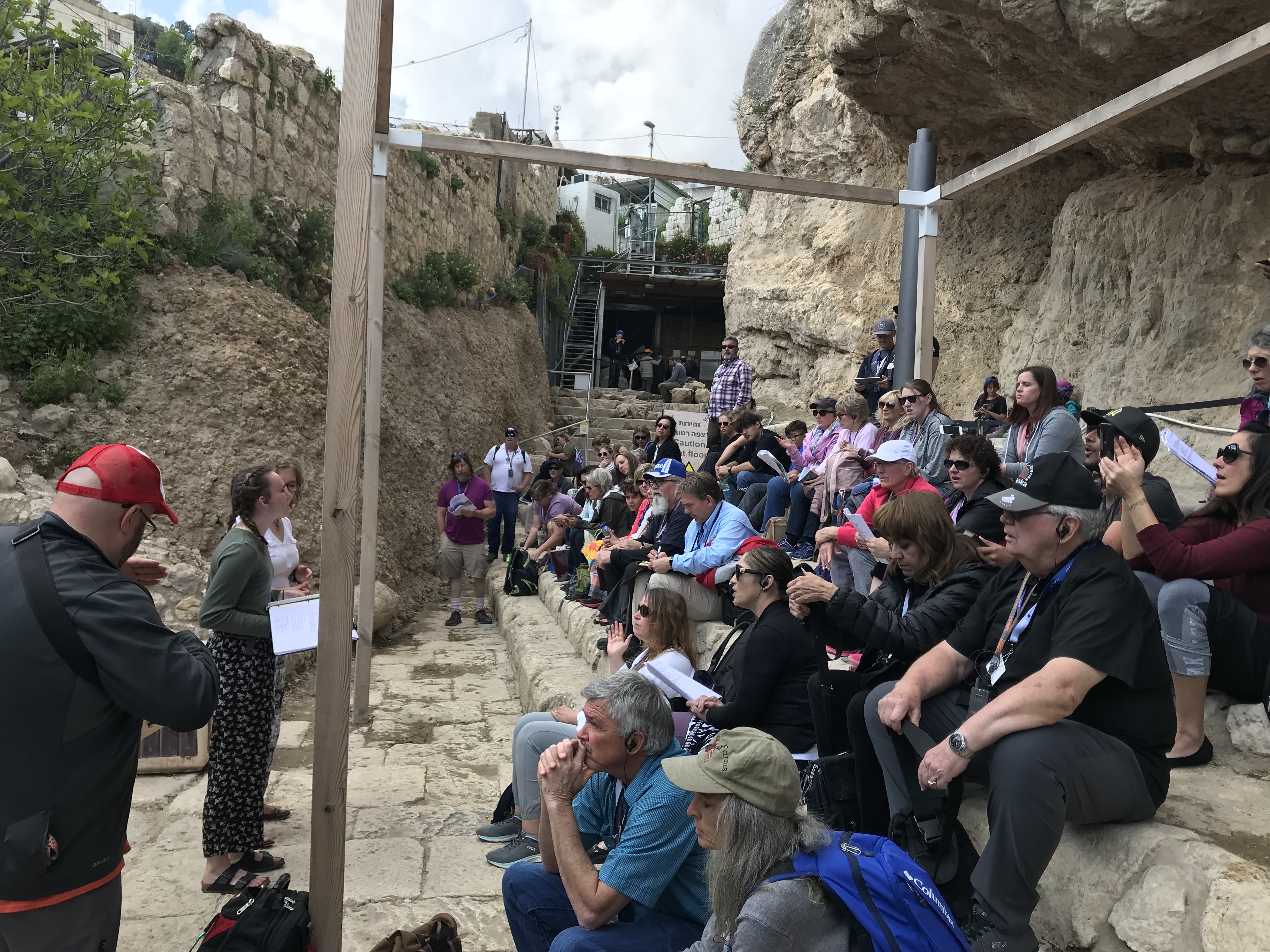
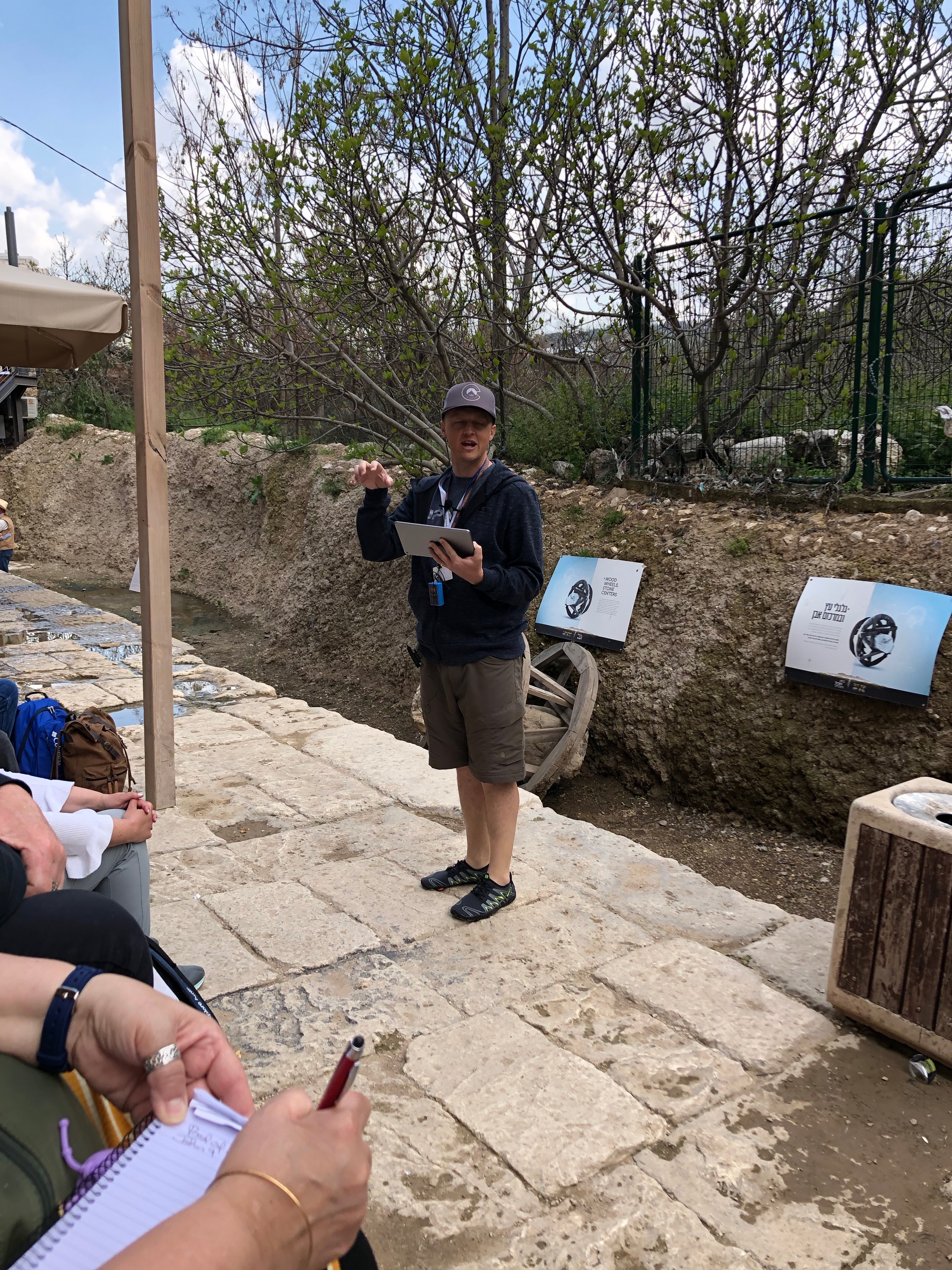
On my recent trip to Israel, I had the opportunity to visit the Pool of Siloam, which is currently being excavated. I even had the chance to teach about this miracle from John 9, right on site to our group.
Teaching at the Pool of Siloam after having walked through Hezekiah’s Tunnel
One of the key features of the parable is that the way Jesus healed this man required the man to respond in faith to what Jesus did and said. Jesus didn’t simply touch this man and he was healed; he did something which would have seemed odd and confusing (applying mud to his eyes) and then told him to do something which also seemed to not make sense: to go and wash in the Pool of Siloam.
The Pool of Siloam was originally used to provide water for the Temple. Water was brought from outside the city, via the Gihon spring, through Hezekiah’s Tunnel, to the pool, where it was collected. In the time of Herod the Great, other pools were created, closer to the Temple, such as the Israel Pool, and those were used in the service of the Temple instead; the Pool of Siloam was then used as a public mikvah, or ritual bath, used for Jewish purification rites.
Here’s why the way Jesus performed this miracle matters:
1. It required the man to respond in faith and obedience
Faith has been defined as “trusting God enough to do what he says.” This man had probably washed his face many times in his life; how would washing mud off his face on this day help him see? It didn’t make sense, and yet that’s kind of the point: it required faith for him to obey rather than cynically refuse to do so, saying “Why would that help?” or “Why would today be any different?”
2. It communicated a theological message
The theological message implicit in Jesus covering this man’s eyes with dirt and telling him to wash in a ritual bath, was that we need to be cleansed.
But beyond that, here is Jesus – God incarnate – the one who created humankind out of the dirt of the Earth, yet we are now broken and fallen as a result of our sins and failures. And so here is the creator, come to us to heal our brokenness, once again putting his hands in the dirt and re-forming that which has become broken.
It’s a powerful picture. What a shame that Joaquin Phoenix doesn’t get it and robs the audience of it.
3. It was public, not private
When this man was healed in this public pool, many people would have seen it, as John 9 tells us they did. This was not a private thing between Jesus and this man; it was done for all to see, to bring glory to God.
Let’s stick with letting Jesus’ words and actions stand on their own!
I have been in Israel for the past week with a group from White Fields and Calvary Chapel Brighton.
We spent the beginning of our trip on the coast, visiting Joppa and Caesarea, both important sites in the Book of Acts, and then headed up to the region of Galilee, where Jesus did the majority of his ministry. Then we drove to Jerusalem, following the Jordan River, and passing places such as Gilgal (see Joshua 4) and the site of Jesus’ baptism and the wilderness where he was tempted directly afterwards.
After seeing some important places in Jerusalem, including the Mount of Olives, the Garden of Gethsemane, the southern steps of the Temple and the Western Wall, we spent a day at the Dead Sea, visiting the place where Jesus was baptized in the Jordan River, seeing En Gedi where David hid from Saul in 1 Samuel 24, and going to Qumran where the Dead Sea scrolls were found and where John the Baptist was likely connected.
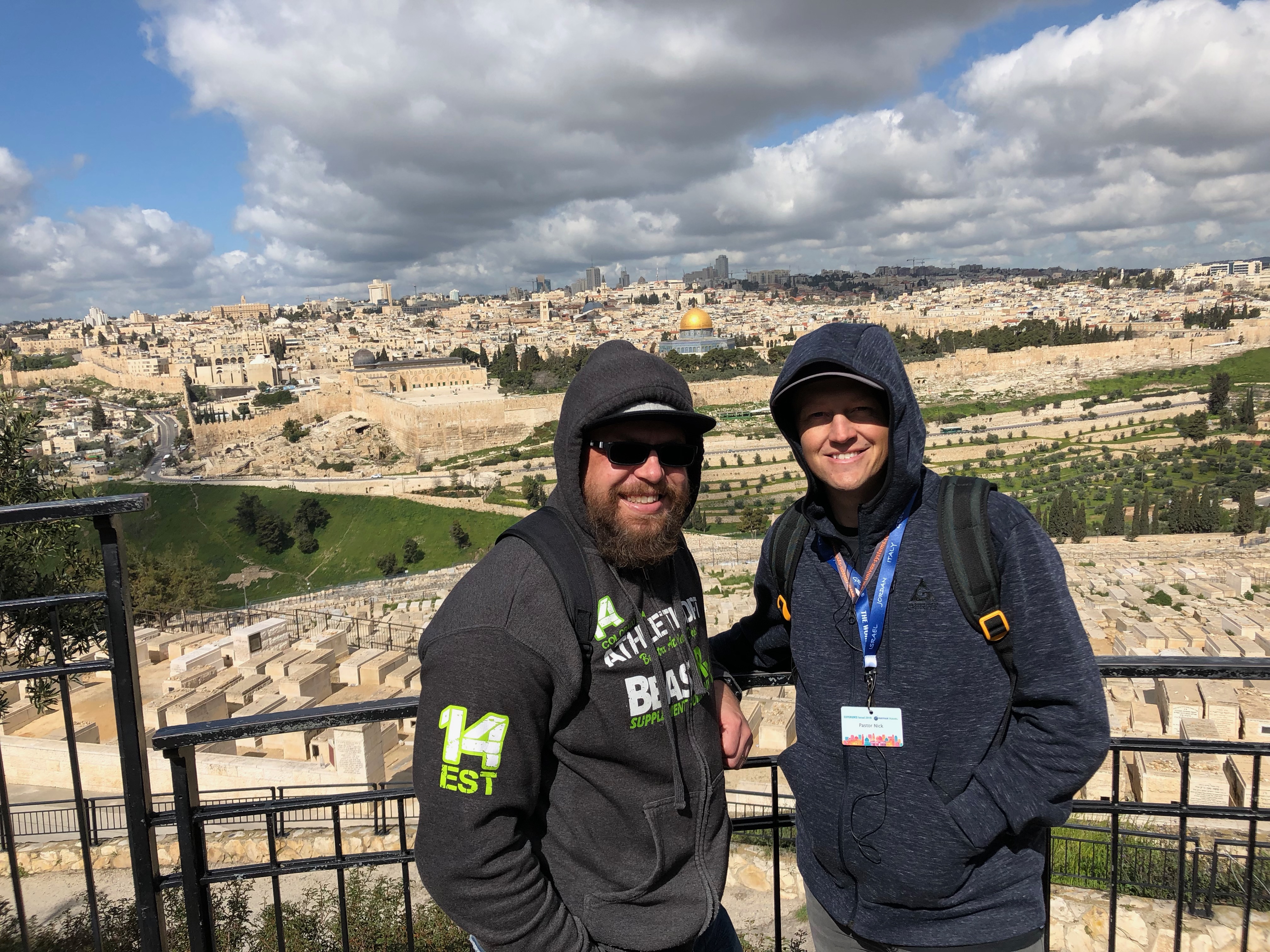
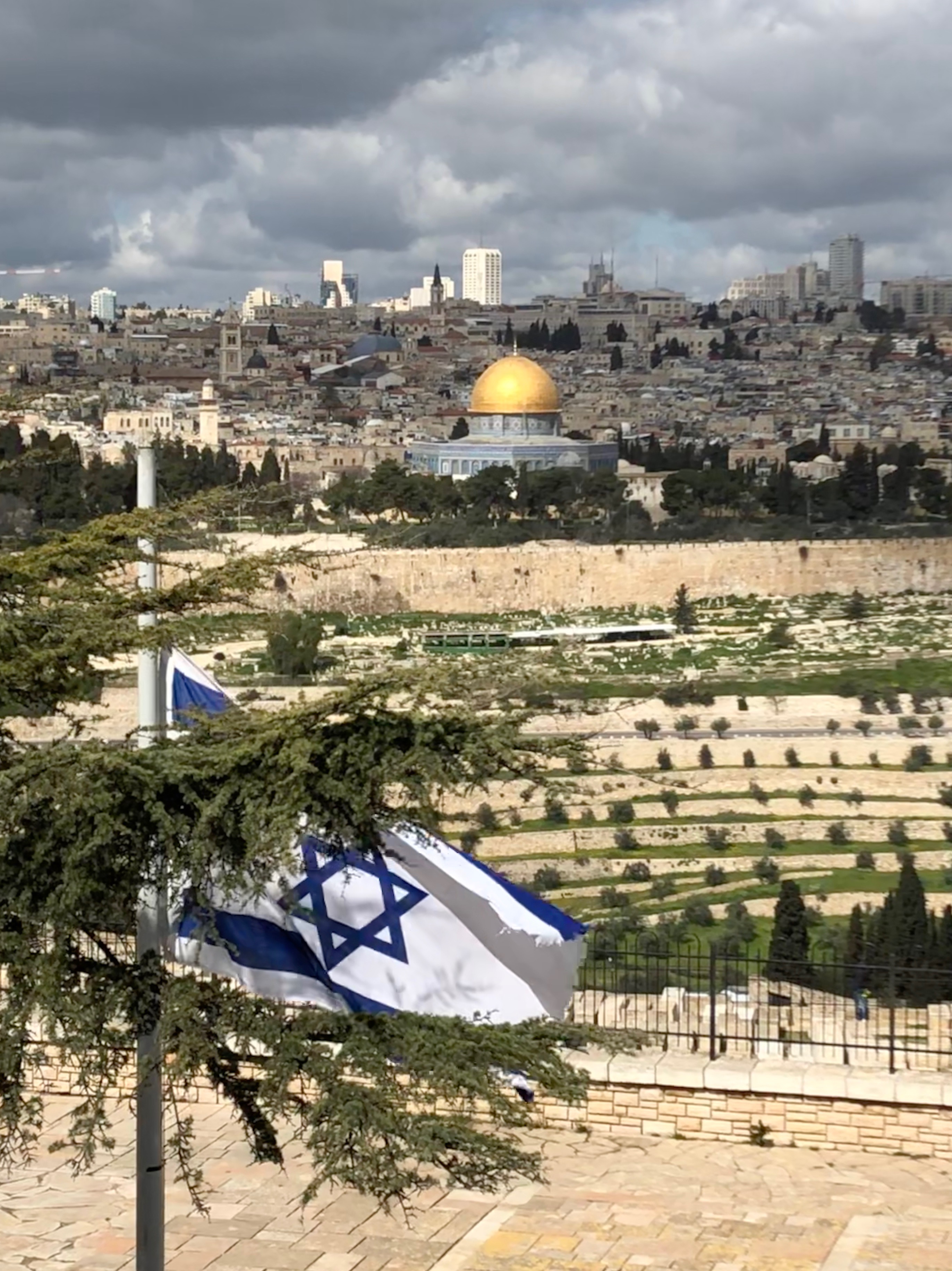
Jerusalem from the Mount of Olives, looking over the Kidron Valley
We will conclude the trip by visiting the Pool of Bethesda (John 5), following the way of the cross to Golgotha and seeing the garden tomb.
The trip has been incredible. I have particularly enjoyed getting the lay of the land and realizing the distances between places, and what they look like. Praying in the Garden of Gethsemane and standing where the church was born on Pentecost have been incredible experiences.
Why Should Christians Visit Israel?
Someone jokingly suggested that the benefit of visiting Jerusalem is that you can get the “before and after effect”: when the New Jerusalem comes (see Revelation 21), you will be able to compare it with the Old Jerusalem and see how much it’s improved! (Personally, I hope they clean up the Muslim Quarter a little bit…)
Interestingly, there is a neighborhood in Jerusalem called “New Jerusalem”. I went there, and it was nice, but not “streets of gold” nice. I’m looking forward to the real thing 🙂
All joking aside, there is one key reason why it is beneficial for Christians to visit Israel: Because, out of all world religions, what makes Christianity unique is that our faith is not based on abstract concepts, but on historical events which either happened or they didn’t.
What you learn from a tour of Israel, is that the New Testament accounts stand up to scrutiny. The New Testament talks about real places and real people and real events which had many witnesses, and which have been verified by archaeologists and historians. As Paul the Apostle said: “These things were not done in a corner!” (Acts 26:26)
In fact, because archaeology is a relatively young science, archaeologists are uncovering new findings all the time, and their findings corroborate rather than contradict New Testament accounts.
A visit to Israel is helpful for Christians, because it builds your faith in the historical events upon which Christian faith is based. This has been my first trip to Israel, but I expect it won’t be my last.
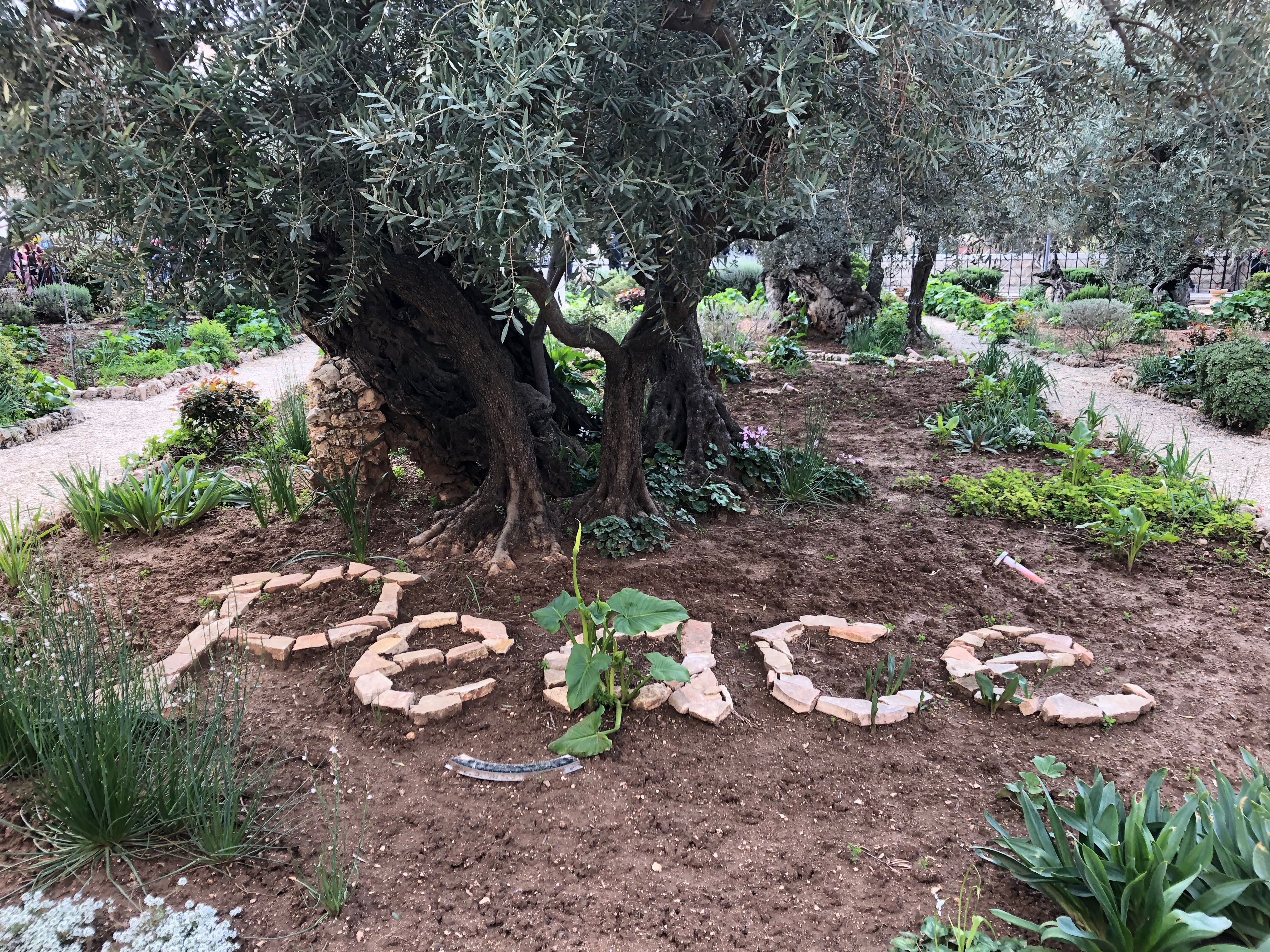
Olive Trees in the Garden of Gethsemane. Some are over 2000 years old. #eyewitnesses
In my recent post, Was it Necessary for Our Salvation that Jesus be God?, I mentioned that one of the issues that some people struggle with is regard to the deity of Christ is that the New Testament calls him the “Son of God” and Colossians 1:15 says that he is “the firstborn over all creation.”
If Jesus is God, why is he called the “Son of God”? And if Jesus was not created, as Christians claim, then why is he called “the firstborn over all creation?”
Let’s look at these two questions one at a time:
Why is Jesus Called the Son of God?
The long and short of it is that “Son of God” is a Messianic title, which means that Jesus is the long-awaited, promised king of Israel whom God had promised to send to save the people and set them free in an eternal and ultimate way.
The most important text for understanding this is Psalm 2, which is a “coronation psalm,” meaning it would be read at the coronation of a king.
It includes this line: I will tell of the decree: The Lord said to me, “You are my Son; today I have begotten you. (Psalm 2:7) This line is quoted and applied to Jesus in Acts 13:33 and Hebrews 1:5 & 5:5.
Most important is to understand the context of this phrase “Son of God” in reference to the king. In the Ancient Near East (ANE) kings were considered to have a special relationship with God. In many cases, like in Ancient Mesopotamia and Egypt, the king was considered to be deity themselves. Such an idea would be an abomination to the Jews and in complete contradiction to everything their Scriptures said about God. However, they too believed, as we see in Psalm 2 and other “royal psalms” that the king had a special relationship with God.
Thus, the term “son of God” spoke of the king’s special relationship with God, but throughout the Old Testament there is the hope of a true and better king, the one who will establish the throne of David forever and rule over an everlasting kingdom which will have no end (see: the Davidic Covenant in 2 Samuel 7). Then though there were many kings of Israel, none of them were the ideal, TRUE KING that God had promised and Israel waited for.
To call Jesus THE Son of God is a reference to him being THE king whom God promised to send to set the people free and save them ultimately and eternally, i.e.: the Messiah.
Why is Jesus called “the firstborn over all creation”?
Does Colossians 1:15 imply that Jesus was the first creature whom the uncreated God created? If Jesus is the uncreated God, then why is a term like “firstborn” used of him – I mean, it actually contains the word “born” in it, which implies coming-into-being, does it not?
The word firstborn (prototokos) is also applied to Jesus in Colossians 1:18, Romans 8:29, Hebrews 1:6, and Revelation 1:5. In each and every case, when this word is used of Jesus, it refers to supremacy in rank.
All ancient culture had a practice called “primogeniture” – which meant that the firstborn son got all the wealth of the father and he got all the father’s status and power. From a legal standpoint, a firstborn son was equal with the father.
So when this title is used of Jesus, it in no way means that Jesus is less than God, or that he was created by God, rather it refers to supremacy of rank. To say that Jesus is the firstborn of all creation means that he holds the position of primacy over all of creation, i.e.: no one and nothing holds a candle to him; he has all the status and power of the Father and is equal to the Father, although still distinct from the Father.
Interestingly, John Lightfoot cites Jewish rabbis who sometimes referred to God as “the firstborn of the world,” meaning that God was supreme over all of the world — that there is none higher than him.
How do we know this interpretation of Colossians 1:15 is the correct one? By looking at the verses which immediately follow, which declare Jesus to be the uncreated creator.
Colossians 1:16-17 say: For by him (Jesus) all things were created, in heaven and on earth, visible and invisible, whether thrones or dominions or rulers or authorities—all things were created through him and for him. And he is before all things, and in him all things hold together.
The Bible begins by telling us that God created all things, and here it tells us that Jesus created all things. The clear message is that Jesus is God in the same way that the Father is God. He is beginning-less creator, equal to the Father in substance, status and power, and yet distinct from the Father.
Thus, rather than undercutting trinitarian theology, Colossians 1:15-17 undergirds the foundation of trinitarian belief.