…and twisting together a crown of thorns, they put it on his head and put a reed in his right hand. And kneeling before him, they mocked him, saying, “Hail, King of the Jews!”
– Matthew 27:29
Today is Good Friday, the day on which some 2000 years ago Jesus of Nazareth was nailed to a Roman cross just outside the walls of Jerusalem.
Have you ever wondered why Jesus wore a crown of thorns?
Clearly, the Roman soldiers put it on his head to mock him. Jesus had been hailed “King of the Jews”, so the Romans considered him an insurrectionist.
But there is a deeper meaning.
Back in Genesis chapter 3, we read about what happened when sin entered the world. When by their rebellion and disobedience to his commands, people first told God, “we don’t trust you and we don’t want you – we know better than you what is best for us” – as sin entered into the world, it brought with it a curse: the curse of death.
This curse affected all of creation, and amongst the various effects of this curse, we read:
cursed is the ground because of you;
in pain you shall eat of it all the days of your life;
thorns and thistles it shall bring forth for you
– Genesis 3:18
Do you see the symbolism of the crown of thorns? Thorns, the symbol of the curse of sin and death, were placed upon Jesus’ head because on the cross Jesus was taking our curse upon himself, so that we might be set free from it.
He hung on a wooden cross. Why? Because in his death, he was taking our curse – the curse of sin and death – upon himself.
Christ redeemed us from the curse of the law by becoming a curse for us—for it is written, “Cursed is everyone who hangs on a tree”
– Galatians 3:13
In the same way, the crown of thorns symbolized our curse, which Jesus took upon himself on the cross, so we could be redeemed.
Have a wonderful Good Friday, reflecting on the fact that “It is Finished!”
And don’t forget: Sunday is coming…
Today is Maundy Thursday, the day of Holy Week when Jesus and his disciples celebrated their last supper.
On this day, we read that they rented a room in which to eat the traditional Passover meal, full of symbolism, of which Jesus was the ultimate fulfillment.
Being that people wore open sandals and that the roads were dirt, it meant that if they had been walking around outside, people’s feet were dirty. Not only were they dirty from dusty roads, but without modern sewage systems, a lot of waste would end up in the streets, adding to the level of grime and filth on a person’s feet after simply going about a day’s business outside. Especially, considering that dinner was eaten sitting on pads on the floor, this foot washing was important because of the close proximity people would be in to each other’s feet – smelly feet ruin appetites.
For this reason, the custom was for people who entered a house to remove their sandals and wash their feet. If you were a guest at someone’s house, usually that foot washing would be taken care of by the host, or if the host could afford it, by a servant.
However, Jesus and his disciples were using a borrowed room, so there was no host to welcome them, and no servant assigned to wash people’s feet.
Luke’s Gospel tells us that as they sat at this dinner table, eating the passover – the disciples began to argue over which of them was the greatest. Presumably, part of this discussion was also to determine which one of them was the least – which one of them should become the servant of all and wash everyone’s feet.
And then something happened which no one expected: Jesus stood up and wrapped a towel around his waist and one by one, he washed the feet of his disciples.
Peter, seeing this, protested! How could he let Jesus serve him?! He should be serving Jesus! But Jesus told Peter: If you don’t let me serve you, you can have no part in me.
And Jesus explained to them – that if anyone would be the greatest in His Kingdom, he must become the servant of all. In His Kingdom, those who humble themselves are the greatest, and those who exalt themselves will be humbled. Jesus explained: “The kings of the Gentiles exercise lordship over them, and those in authority over them are called benefactors. But it will not be so amongst you. Rather, let the greatest among you become as the least, and the leader as one who serves.”
At another point Jesus had said: “The Son of Man came not to be served but to serve, and to give his life as a ransom for many.”
How are you doing as a servant? Pursue true greatness and be like Jesus: a servant.
Big Ben is the most famous clock in the world. It towers over the city of London, over Westminster Abbey and the Parliament.
What most people, in fact, what most Londoners don’t know, is that the music in the chimes that keep the time of Big Ben are from an old hymn: “I Know that My Redeemer Liveth”, from Handel’s “Messiah”.1
Every day, Londoners set their clocks and schedule their lives based on a tune about the resurrection of Jesus Christ, that sings out multiple times every day over that great city which is arguably the ‘center of the world’.
I will be preaching on the text from which the title of that song is taken this Sunday at White Fields Church in Longmont. If you’re in the area, I hope you’ll join us!
One of the things I’m intrigued by in the Bible is the meaning of salvation. I have noticed in myself and others a tendency to settle for a narrower understanding of the scope of the salvation that is promised to us in Jesus than the fullness of what is found in the scriptures.
Of course this is not to distract from or undermine the central concern for our relationship with God and our need to be put right with him (justification). But when you see the scope of salvation in the Bible, beyond saving us from damnation, it is exciting!
For example, in chapter 19 of the Gospel of Luke, Zacchaeus, having spent years ripping people off, turns to Jesus and repents of his greed and sin, and also shows signs of true repentance when he gives back the money he ripped off to the people he took it from, even though it may have happened years prior – and Jesus declares: “salvation has come to this house today” (Luke 19:9). Salvation for Zacchaeus was salvation for his soul, AND deliverance from bondage to vain things AND salvation unto a new course in life as a disciple of Jesus – which inherently means taking an active role in God’s mission to bring salvation to the world.
The very name Jesus means “Savior”! Here are some quotes on the meaning and scope of the salvation that’s found in Jesus:
Salvation itself, the salvation Christ gives to his people, is freedom from sin in all its ugly manifestations, and liberation into a new life of service, until finally we attain ‘the glorious liberty of the children of God. (J. Stott, Christian Mission in the Modern World)
In the Old Testament the word ‘salvation’ speaks of ‘shalom’, or complete wholeness of being, in every dimension of life. (A. Motyer, The Prophecy of Isaiah)
The three tenses of salvation – past, present and future – are united into an organic whole; they may be distinguished but must not be separated. The salvation that the gospel proclaims is not limited to man’s reconciliation to God. It involves the remaking of man in all the dimensions of his existence. It has to do with the recovery of the whole man according to God’s original purpose for his creation. (R. Padilla, Mission Between the Times)
The full gospel brought by Jesus Christ is both salvation from sin and salvation into the capacity to be fully human and truly free. (D. Webster)
Yesterday, while riding the lift at Eldora, I had an interesting conversation with a guy who, like me, was up snowboarding alone.
He was from Boulder, probably in his late 20’s or early 30’s, and works in some area of the tech industry.
He was very interested when he found out I was a pastor, because he said he’d always been interested in what goes on in churches, but had never been to church himself. Here’s how our conversation went:
“Wow, you’re a pastor?! Like in a church?”
“Yeah”
“So, what do you do there?”
“I teach the Bible and counsel people and lead the church as an organization in all the endeavors we are involved in.”
“Do you like emcee the shows and stuff?”
“You mean the church services? Yes, I lead the worship services.”
“So you’re kinda like an emcee! That’s dope!”
“Wait, so you’re married? (I had mentioned my wife and kids to him)
“Yeah, I’m married”
“I thought priests couldn’t get married”
“Well, that’s a rule in the Catholic church – but we’re not Catholic. In fact, even in the Catholic church, they only introduced that rule a couple hundred years after Jesus lived and established the church, so most Christians don’t follow that rule, and most pastors get married.”
“Wow. I always thought that would be a pretty dope job, but the one downside is that you couldn’t have girls. But, you know, if you can have girls, then that’s like the dopest job ever!”
“Well, I mean, as a pastor, you can’t just go around having lots of girls – you can have a wife and a family, but it has to be monogamous.”
“Yeah, but same thing – you get to have a girl. That’s dope!”
About this time the lift reached the top of the mountain – and I encouraged him that he should really check out a church sometime for himself, and that he ought to give some consideration to who Jesus was and what he taught. After that, we bid each other farewell and got off the lift, and went separate ways. Who knows if we’ll ever meet again.
It did surprise me though, how little this man knew about church and about Jesus. It served as a reminder that we live in a post-Christendom society. Boulder has long been considered a trend-setting, cultural hub for Colorado and the Western United States. That means that as Christians, increasingly we can no longer expect that most people in our society have a basic understanding of Christian doctrine and practice, and know who Jesus was and what God requires of them. More and more people in our society are growing up without that, and we as Christians need to be prepared to present Jesus and the message of the Gospel to people without the assumption that they have some basic background understanding of Christianity – because more and more do not.
I am an Irish-American. My dad’s family is all Irish, and I have an Irish last name. The only really Irish things I remember growing up were eating corned beef and hash and having a big Irish wake after my grandmother’s funeral. I personally feel that the Irish response to death is one of the great things about their culture – they know how to mourn a loss and celebrate a life at the same time.
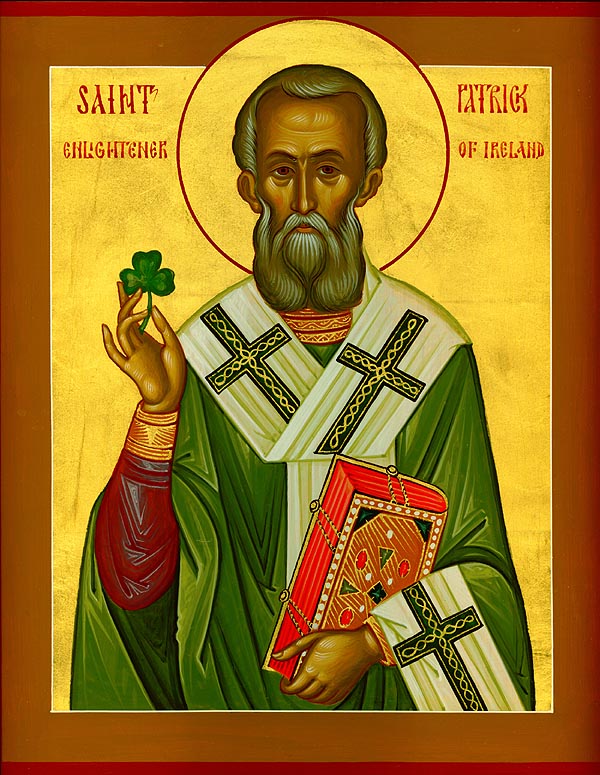
Today is Saint Patrick’s Day – but who was Saint Patrick?
Well, interestingly enough, Patrick has never officially been named a saint by any church body. Furthermore, Patrick was not Irish! And if you’ve ever heard that Patrick drove the snakes out of Ireland – there never actually were snakes in Ireland, so that is just the stuff of legend.
The real Patrick was a Roman Briton born in Wales around 390 AD to a wealthy, noble family. His father was a deacon and his grandfather a pastor. When Patrick was 16 years old, he was captured by Irish marauders and taken to Ireland as a slave. After living there as a slave for 6 yrs, he managed to escape back to Britain. After his return to Britain, he joined a monastery and became a minister, and during this time he was burdened with a desire to go back to his former captors in Ireland and share with them the Gospel of Jesus Christ. So Patrick returned to Ireland in 432, this time not as a slave, but of his own volition – as a missionary.
Patrick was one of the earliest Christian missionaries to travel abroad to spread Christianity. One of the noteworthy things which Patrick did as a missionary was live in solidarity with the Irish people. Patrick wrote that he “sold his nobility” to enhance his commonality with his Irish audience. He spoke their language, and lived among; he became one of them, that he might reach them with the Gospel.
One of the first things that Patrick did was gain religious toleration for Christians from the Irish King. He also sought to evangelize prominent druids, knowing that others would likely follow if high profile druid leaders converted to Christianity. One of Patrick’s emphases amongst those who converted to Christianity was spiritual growth. Within 15 years Patrick has evangelized much of Ireland. In all, Patrick served as a missionary and pastor in Ireland for some 30 years.
One of the long-term fruits of Patrick’s ministry in Ireland was a movement of Irish missionaries that grew up in the generations following his establishment of Christianity in that country. One of these men was Columba (521-597) who was born in an Irish Christian family and became a priest in the church and somewhat of a church planter, establishing many churches in Ireland. At age 42 Columba left Ireland, saying he had been motivated by the ‘love of Christ’ and went to Scotland, where he established a monastery which served as a station for training and sending missionaries into the surrounding region.
Here’s to Patrick the missionary and to the Irish people!
Earlier this week I finished reading Metaxas’ biography on Dietrich Bonhoeffer, and decided to go ahead and re-read Bonhoeffer’s Nachfolge – The Cost of Discipleship.
I’ve read it before, but the words of the first chapter are so compelling that I can’t help but return them time and time again. Bonhoeffer spoke against a Christianity that has been cheapened into anything less than a call to be a sold-out disciple of Jesus Christ.
Check out what Bonhoeffer has to say about grace. If you’ve read it before, read it again, and let it hit you with all its force once again:
“Cheap grace means grace sold on the market like cheapjacks’ wares. The sacraments, the forgiveness of sin, and the consolations of religion are thrown away at cut prices. Grace is represented as the Church’s inexhaustible treasury, from which she showers blessings with generous hands, without asking questions or fixing limits. Grace without price; grace without cost! The essence of grace, we suppose, is that the account has been paid in advance; and, because it has been paid, everything can be had for nothing. Since the cost was infinite, the possibilities of using and spending it are infinite. What would grace be if it were not cheap?…
Cheap grace is the preaching of forgiveness without requiring repentance, baptism without church discipline, Communion without confession, absolution without personal confession. Cheap grace is grace without discipleship, grace without the cross, grace without Jesus Christ, living and incarnate.
Costly grace is the treasure hidden in the field; for the sake of it a man will go and sell all that he has. It is the pearl of great price to buy which the merchant will sell all his goods. It is the kingly rule of Christ, for whose sake a man will pluck out the eye which causes him to stumble; it is the call of Jesus Christ at which the disciple leaves his nets and follows him.
Costly grace is the gospel which must be sought again and again, the gift which must be asked for, the door at which a man must knock.
Such grace is costly because it calls us to follow, and it is grace because it calls us to follow Jesus Christ. It is costly because it costs a man his life, and it is grace because it gives a man the only true life. It is costly because it condemns sin, and grace because it justifies the sinner. Above all, it is costly because it cost God the life of his Son: “ye were bought at a price,” and what has cost God much cannot be cheap for us. Above all, it is grace because God did not reckon his Son too dear a price to pay for our life, but delivered him up for us. Costly grace is the Incarnation of God.”
It’s been said that if you minister to hurting people, you will never lack an audience.
But one of the things I believe we need to equip Christians with is how to love and care for hurting people. Christians are no different than most people, in that they feel uncomfortable around people who are suffering, and desperately want to make it all better. But as those who have been called to be salt and light in the world, I think we should be prepared and equipped to minister to those around us who are hurting – whether they be neighbors or people we are in community with at church.
In the video above, these pastors talk about what not to say to people who are suffering. A lot of people, because they feel that they should say something, and they want so bad to give a solution and fix the problem and alleviate the pain, say things which aren’t actually helpful. I have been on the receiving end of a few of these before: things like “I know what you’re going through” – “everything’s going to be fine” – and other things people say to try to quickly restore happiness.
But as the pastors mention towards the end of the video: the Gospel is big enough to handle our pain and to accept that tragedies happen and they are bad. The Gospel doesn’t shy away from the blood and guts of the reality of life in a fallen world. The Gospel is also big enough to give hope in the most dire circumstances by pointing to the ultimate happy ending that belongs to those who have been redeemed in Jesus.
Question: What is the most helpful thing someone has said to you or done for you during a difficult time in your life?
As a pastor, I attend a fair number of funerals. Since our congregation is relatively young, these aren’t usually funerals for our church members, but funerals for their loved ones who pass away.
I think going to funerals is important. There are certain moments and events in life that are worth inconveniencing yourself for; honoring the life of a human being is one of them.
A lot of people avoid funerals because death is something that we all feel is a foreign imposition on us – something that is inherently wrong. We are right to feel that way actually; God’s Word makes it clear that we were made to live forever, and that sickness, pain and death are a curse – part of the very curse that Jesus Christ came to set us free from. However, it’s that very reason why it’s a healthy thing for us to attend funerals – to be faced with the ultimate realities that make the hope of the Gospel truly good news.
One thing I’ve realized over the years as a pastor, is that most people aren’t prepared for how to handle those who suffer or grieve. On a recent trip to Hungary I taught a seminar for the church there, whose pastor had recently lost a child, on how to understand grief and how to love and minister to grieving people. This instruction is so helpful, because most people (at least over there) default to either avoiding the situation or saying things which aren’t helpful. In reality, one of the best things you can do for someone who is grieving is not say anything, but just be around – present, available. Yes, funerals are uncomfortable. Guess who else doesn’t enjoy being at that funeral: the person who lost a loved one. Bless them by being there beside them in their time of loss.
Recently a new movement has been getting a lot of publicity. Dubbed “atheist mega-churches” – the movement is being spearheaded by two British comedians. They call their meetings “sunday assemblies,” and they have all of the look and feel of a contemporary Christian church service, without one key factor: God.
Co-founders, Sanderson Jones and Pippa Evans have stated that their goal is to export the original concept, first started in London, around the world. They are currently on tour visiting 40 major cities; right now they are in the US, going from New York to Los Angeles, trying to establish Sunday Assemblies and propagating their message of humanist community gatherings.
At these Sunday assemblies, they do everything that your average Christian church does: they sing songs, they drink tea and coffee and chat in the lobby, they raise money for humanitarian causes – they take offerings, and they have a sermon each week! In an interview, Sanderson Jones answered the obvious question of what they preach on if they don’t have the Bible or another “sacred text”. His answer was astounding and something that should cause Christians everywhere some serious consideration. He said that ‘preaching without God isn’t hard at all – after all, most preaching in churches these days is basically tips and strategies about how to be a kinder, more balanced, well-rounded person; we embrace that whole heartedly, and we don’t believe we need God to do that.’
‘preaching without God isn’t hard at all – after all, most preaching in churches these days is basically tips and strategies about how to be a kinder, more balanced, well-rounded person; we embrace that whole heartedly, and we don’t believe we need God to do that.’
Here are my thoughts on these “atheist mega-churches”:
1. Mega-churches? Hardly.
Although they have been dubbed “mega-churches” by the media, if you look at the pictures, you will notice that if this were a Christian church, it would not be qualify as a “mega-church”. Furthermore, let’s not forget that the gatherings getting the most press are the ones in which Jones and Evans are present and leading the meetings – two British celebrities, who have been getting a lot of press attention lately for these Sunday Assemblies. This is a special event, not a church – not a committed community of people, and certainly not a mega-church. Even the original Sunday Assembly is not all that big. I understand that “mega-church” pops out on a page – but let’s make sure we’re not blowing this all out of proportion.
2. Novelty = Media Hype
“Atheist Mega-church” is a novelty of a phrase that grabs people’s attention. Perfect for the media. Is there much substance to it? Will we see this as a growing movement for years to come? I don’t think so. I don’t believe it is sustainable. In fact, if it hadn’t been started by two celebrities, I don’t think it would have ever gotten off the ground. I see this fizzling out in the weeks, months and years to come as media hype wears off and moves on to the next amusing story. The reason why “Christian music and movies” are never as good as the original is simply this: they are not original – they are trying to copy someone else’s idea and put a Christian twist on it. It is often second-rate as a result. This smacks of the same thing, only more so.
3. A Very Important Critique
The quote from Sanderson Jones above is a VERY important critique for Christians, and particularly church leaders. Because here’s the deal: ANYBODY can “do church”! And Sanderson is right – you don’t need God to just get together, drink some bad coffee, sing a few songs and hear an inspiring talk about 10 ways to have your best life now. YOU DON’T NEED GOD FOR THAT! He’s right!
ALL that we have as Christians is the Gospel of Jesus Christ. If we get away from that, then we have become nothing more than a community gathering – in which it doesn’t matter if God is there or not.
Recently I had someone come to our church, and they told me that they had been attending another church previously, but came to realize that the sermons that were being preached could have easily been speeches given at a high school graduation or by a politician. God’s name was mentioned, but if it hadn’t been, it wouldn’t have changed the substance of the message. In other words: it didn’t matter if God was there or not. They were giving tips and strategies for how to be a kinder, more-balanced, well-rounded person – and the fact is, that you don’t need God to do that.
The Gospel of Jesus Christ and the Word of God are what we have as Christians. They are what we should major on, and never neglect in an effort to give practical advice. The Gospel is life-changing and transforming, and we must crank it up rather than water it down. Only then will people really be transformed.
What do you think of these atheist mega-churches and my estimation of them? Are they just a flash in the pan, or are they here to stay? And what does this mean for Christianity and society in general?


 Big Ben is the most famous clock in the world. It towers over the city of London, over Westminster Abbey and the Parliament.


 Theology for the People