Having Passed the Baton

For many years, the third week of June was one of the highlights of the year for my wife and I. That’s because this is the time when the Foundations Conference takes place in Vajta, Hungary. Foundations is a conference for Calvary Chapel missionaries and national workers from all over Eastern Europe to gather together for a week of fellowship and teaching. It was a time for us of seeing friends we often only saw at that conference, as well as a time of being recharged physically and spiritually, and seeking the Lord.

This year I’ve been keeping up with some of what’s happening at Foundations on Instagram, where I get to see familiar faces and places.

Today on Instagram I saw this photo, which filled me with so many emotions:

In that picture are friends of mine, and they are praying for a young man named Jonathan, who is serving as a missionary in Eger, Hungary at the church Rosemary and I started 9 years ago. Standing behind him is Jani, a man who I first met when he was not a Christian, but who I had the privilege of leading to The Lord, pouring into, raising up in ministry, and who is now the pastor of that church in Eger.

I remember how on the last night of one of these Foundations conferences several years ago, I was up front praying for people, and Jani came up and asked me to pray that God would bless him and his wife with a baby. Only a few months later, we got the good news that Tünde, his wife, was pregnant with their first child.

I’m a bit jealous that I can’t be there withy them right now, but it fills me with so much joy to see these guys who now carry that baton, going for it with all they’ve got. It is a good feeling when something you started takes on a life of its own.

How Does Marriage Affect Violence Against Women and Children?

How Does Marriage Affect Violence Against Women and Children?

This article in the Washington Post this week showed that statistically, women and children in married families suffer far less domestic violence than those in other situations.

Married women are notably safer than their unmarried peers, and girls raised in a home with their married father are markedly less likely to be abused or assaulted than children living without their own father.

As Christians, one of the best things we can do for society is to uphold and promote strong biblical ethics.

The Interactive Sermon

The past 2 Sundays at White Fields we’ve been trying something new, where our background slide invites people to text or tweet their questions in during the sermon. Once we get these questions, I will answer some during the service if we have time, or I will answer them on The City – our church’s in-house social network.

The response we’ve gotten to this has been really good! I’ve really enjoyed engaging with people and answering their questions. You can read some of those discussions here. Look for the posts titled “Sermon Follow-Up”.

I think that in this day and age, with the proliferation of the internet especially, sermons need to be more interactive. Finding the right way to do this though, is what is hard.

Timothy Keller, at his Sunday night services in NYC, has had a question and answer time for years. It’s a main part of the service – and it invites skeptics to come and do what New Yorkers do best: be skeptical and inquisitive. Tim Keller has said that the average young adult in New York is a thinker and thinkers have questions, and if you want them to really consider Christianity, you have to give them a chance to have their questions answered.

Nowadays, any news article you read online gives readers the option to engage in a comments section, where they can have a discussion about the content of the article. Any attitude in churches of “don’t question anything” is completely disconnected from where our culture is at today, especially with young people. Furthermore, I feel that if pastors are not answering the real questions that people are asking and struggling with, if we are not addressing the issues that people are really wondering about and discussing, then we have become irrelevant talking heads. If everywhere in the world there is transparency and discussion is encouraged, but at church we have smokescreens and we don’t like questions, what does that communicate to people? Perhaps that we lack the confidence that is required to allow people to ask questions? That shouldn’t be the case.

However, the danger in opening up to engagement like this, is that it inevitably gives a platform to haters – people who don’t have sincere questions, but who ask questions in order to be critical or in an attempt to trip others up. This is something that Jesus dealt with a lot from the Pharisees and Sadducees, who put a lot of effort into tripping him up. I’m sure that Timothy Keller gets tons of people like this as well, but it doesn’t deter him from encouraging people to ask questions and give him the chance to offer a biblical answer.

What are your thoughts on encouraging engagement with sermons? How have you seen it done effectively – or ineffectively?

Strength to Press On

I love Colorado. Especially this time of year, when everything is green.

I grew up in Colorado, but growing up here, I didn’t appreciate it as much as I should have. I started to appreciate it a lot more in my later teenage years, but soon moved away. The 10 years that I was away, I lived in and traveled to amazing and (sometimes) beautiful places in Europe, but all that time I dreamt about the Rocky Mountains in Colorado. The only problem I have with Colorado is there’s not enough Hungarian-speakers here 🙂  When I moved back to Colorado, I determined to appreciate and enjoy the grandeur and beauty of this place as much as possible. 

Today, as I was biking outside of Lyons with a friend, I started reflecting on a regret I have: something I would change if I could roll back time. It’s not a major one – and it’s certainly not too late to correct.

Here it is: If I could roll back time, I would have done more things as a younger man to train myself in endurance. It’s not that I don’t have endurance, but I wish I had even greater endurance than I currently do – and I wish I had started training myself in it earlier in life. Had I done so, my endurance level would probably be higher than it is now.

Endurance is key to success in climbing mountains, biking, snowshoeing, backpacking and hiking. It’s also key in many areas of life. Paul the Apostle encouraged us to “run with endurance the race which is set before us” (Hebrews 12:1). The race he was speaking of was the life lived following after Jesus Christ and pursuing God and his will.

At church on Sunday I shared this quote from Dietrich Bonhoeffer: “Christianity is less about cautiously avoiding sin than about courageously and actively dong the will of God.”

That race isn’t a 100 meter dash – it’s a marathon. And marathons require endurance.

Endurance is something that can be gained, it is something can be cultivated, something you can train yourself in – and we would all do well to do so. Having a successful marriage requires endurance. Having success in raising a family, in doing a ministry – it requires endurance. Anybody can have a burst of energy and make a “flash in the pan” – but in order to regularly produce lasting fruit over a sustained period requires endurance. 

I also believe the promise of God’s Word, that to those who seek after Him with their whole hearts, God will give the grace and endurance to run this race and finish it well.

Why do you say, O Jacob, and speak, O Israel, “My way is hidden from the LORD, and my right is disregarded by my God”? Have you not known? Have you not heard? The LORD is the everlasting God, the Creator of the ends of the earth. He does not faint or grow weary; his understanding is unsearchable. He gives power to the faint, and to him who has no might he increases strength. Even youths shall faint and be weary, and young men shall fall exhausted; but they who wait for the LORD shall renew their strength; they shall mount up with wings like eagles; they shall run and not be weary; they shall walk and not faint. (Isaiah 40:27-31 ESV)

The Most Misused Verses in the Bible

A few weeks ago I saw a promotion on Twitter, offering this book for free on Kindle. I assumed it would be somewhat cliché and predictable, but I’ve been pleasantly surprised!

The book is thoughtful and gives context to many verses which are frequently quoted out of context, and then explains how they are usually misapplied and gives their proper application.

If you’re looking for something to read, I recommend it.

Christianity suffers from too many trite clichés and platitudes; too many scriptures are stripped of their original meanings and used to say things they were never meant to say.

Here are a few quotes from the chapter on Matthew 7:1 – “Do not judge, or you too will be judged.”

When we take a closer look at the context of Matthew 7 and the teachings of the rest of Scripture, it is clear that this verse cannot be used to substantiate unrestrained moral freedom, autonomy, and independence. This was not Jesus’ intent. He was not advocating a hands-off approach to moral accountability, refusing to allow anyone to make moral judgments in any sense. Quite the opposite, Jesus was explicitly rebuking the hypocrisy of the Pharisees, who were quick to see the sins of others but were blind and unwilling to hold themselves accountable to the same standard they were imposing on everyone else.

No one will reach perfection in this life, but together we are to wage war against and forsake the sin that results from living in our fallen flesh. We are to “take off the old life,” so to speak, and “put on the new,” growing in holiness out of reverence for God. But the reality is we can’t accomplish this without the help of the indwelling Holy Spirit and the mutual encouragement and accountability of our fellow brothers and sisters in Christ. We can’t do this alone; we need each other! This then, is why the apostles called us to help one another in our struggle with sin. For example, James says: My brothers, if one of you should wander from the truth and someone should bring him back, remember this: Whoever turns a sinner from the error of his way will save him from death and cover over a multitude of sins. (5: 19– 20 NIV 1984) Paul said something similar in the book of Galatians: Brothers, if someone is caught in a sin, you who are spiritual should restore him gently. But watch yourself, or you also may be tempted. Carry each other’s burdens, and in this way you will fulfill the law of Christ. (6: 1– 2 NIV 1984) Notice that both James and Paul assume two things. First, there will be times when fellow believers will wander off the straight and narrow path. Second, they assume that other Christians, out of love, will seek to come alongside that brother or sister in an effort to bring him or her back from the error of their ways and save them from the destructive power of sin (see Jesus’ method for doing this in Matthew 18: 15– 17). Since we have been commissioned to proclaim a message of repentance and faith to those outside the church who need to hear the good news, certainly we need to proclaim the same message of repentance and faith to those inside the church.

Therefore, Jesus does not forbid all moral judgment or accountability. Rather, he forbids harsh, prideful, and hypocritical judgment that condemns others outright without first evaluating one’s own spiritual condition and commitment to forsake sin. It is my contention that the popular misuse of “do not judge” reveals just how far the discipline of sound biblical study has slipped in recent years. More than that, it sheds light on the state of our culture, a culture that seeks to avoid accountability and responsibility for personal actions. This current trend and mentality runs counter to the teachings of Scripture. For the collective teaching of the Bible insists that those who are created in the image of God are morally responsible to God and to one another. So to use “do not judge” as a means of dismissing oneself from moral responsibility would be to interpret it in a way that pits it against the rest of Scripture.

Bargerhuff, Eric J. (2012-05-01). The Most Misused Verses in the Bible,Surprising Ways God’s Word Is Misunderstood (pp. 25-30). Baker Publishing Group. Kindle Edition.

This book is worth the price. Check it out.


Supreme Court Upholds Allowing Christian Prayers at City Council Meetings

Supreme Court Upholds Allowing Christian Prayers at City Council Meetings

A narrowly divided Supreme Court upheld decidedly Christian prayers at the start of local council meetings Monday, declaring them in line with long national traditions although the country has grown more religiously diverse.

Yes, our country is increasingly diverse, and we should respect that diversity, but I think this is a victory for the American people. 

What do you think?  Take this poll over at the Longmont Times-Call, and see what other people think.


National Day of Prayer

Today is the National Day of Prayer. 
All around the nation today, people will be gathering in churches and at flagpoles to pray for our nation. Click here to find a list of observances near you.

I will be taking part in the Longmont-area noon observance, which is open to all. It will be held at 737 Bross St. in Longmont from 12:00-1:00 PM.

Wherever you are today, set aside your time today to pray for our nation.

Pray for All People First of all, then, I urge that supplications, prayers, intercessions, and thanksgivings be made for all people, for kings and all who are in high positions, that we may lead a peaceful and quiet life, godly and dignified in every way. This is good, and it is pleasing in the sight of God our Savior, (1 Timothy 2:1-3 ESV)

The Importance of Old Testament Ideas of Sacrifice in a Christian Understanding of Atonement

This is an article I wrote for a seminary class on Christology and Atonement, which I have found to be particularly relevant in many discussions – especially the part towards the end about “expiation” vs. “propitiation”.
Feel free to leave feedback in the comments section below.

The Christian doctrine of atonement is an attempt to achieve an understanding of the event of the crucifixion of Christ and the benefits of Christ gained for believers by his death. Atonement theories deal with the question of how an historical event in a specific place and time – the crucifixion of Jesus Christ – can somehow constitute universal saving power in perpetuity, as the New Testament claims that it does (1 Jn 2:2, Heb. 10:10-14). Unarguably, it is from the sacrificial system of ancient Israel that we have inherited the framework and terminology of the Christian idea of atonement. A consideration, therefore, of the Old Testament ideas of sacrifice gives insight into and shapes our view of what was accomplished through the crucifixion.

The Christian claim from scripture and tradition is that Christ’s action constituted God’s gift of salvation, and was not merely illustrative of it. Gunton points out that sacrifice is the primary New Testament metaphor regarding the crucifixion. The early church interpreted Jesus’ death in sacrificial terms, which developed out of a context of the temple cult. It is important to remember that the setting in which Jesus and the early Christians lived was one in which the Old Testament sacrifices were still being offered; in fact, these sacrifices were being offered during practically the whole period of the composition of the New Testament. The antecedents of New Testament ideas of atonement are found in the Old Testament sacrificial system. The book of Leviticus, therefore, gives some of the clearest insights into biblical religion and is fundamental to the New Testament’s understanding of atonement.

In the Old Testament, sacrifice is the divinely appointed way of securing atonement, and the need for atonement exists because humankind is estranged from God by sin, hence the need for reconciliation or ‘at-one-ment’ between humans and God. An important understanding in the Old Testament is the distinction between the holy and the common, the clean and the unclean. One of the duties of the priest was to distinguish between these (Lev. 10:10). Cleanness in the Old Testament understanding has little to do with hygiene; it has to do with imperfection, a distortion of existence. Examples of what would make someone unclean were things like contact with a dead body, a bodily excretion, and committing acts of sin or lawbreaking – either intentionally or unintentionally. God is the super-holy and should anyone unclean come near God, they are liable to be destroyed. Sacrifice was God’s way of removing human uncleanness, so that people could be restored to fellowship with God.

Leviticus lists five main sacrifices: the burnt offering, the grain offering, the peace offering, the sin offering and the guilt offering. Each of these, besides the grain offering, included the shedding of the blood of animals. Each was a sacrifice in the metaphorical sense, in that they were of significant cost to the person who presented the sacrifice, which drives home the idea that atonement has a high price and sin is never to be taken lightly. The sin offering and the guilt offering were for the purpose of atonement for committed sins. The sin offering was particularly focused on purification, whereas the guilt offering carried more of the metaphor of compensation for wrongdoing.

In each of the animal sacrifices, the blood of the animal is shed, and the animal dies. Thus, it is clear that in the Old Testament it was recognised that death was the penalty for sin (Ezek. 18:20), but that God graciously permitted the death of a sacrificial victim to substitute or ransom for the death of the unclean person. Herein we have the basis for the substitutional and representative death of Jesus as a sacrifice on behalf of humankind. This same understanding of substitutional sacrificial death which results in atonement can be found elsewhere in the Old Testament, e.g. in Ex. 32, where Moses seeks to make atonement for the sin of the people by asking God to blot him out of the book which he has written. However, in the Old Testament sacrifices, it is not the death of the animal which is the climax of the rite, but rather what is done with its blood. The blood of the sin offering acts as a spiritual cleanser. Jesus’ blood is also spoken of as that which cleanses from sin, e.g. 1 Jn 1:7. In the Old Testament sacrificial system, the sacrificed creature was required to be unblemished, representing perfection, hence the importance in the New Testament that Jesus was without sin (2 Cor. 5:21, Heb. 4:15, 7:26, 9:14, 1 Pet. 2:22, 1 Jn 3:5); otherwise he would not have been qualified to be an atoning sacrifice.

God says in Leviticus 17:11 of the atoning blood ‘I have given it for you on the altar to make atonement for your souls, for it is the blood that makes atonement by the life.’ From this we learn that although human estrangement from God is because of human shortcomings, God took the initiative to provided the means for atonement. This idea carried into the New Testament view of atonement, in which, once again, God is the one who provides the means for our atonement by sending Jesus to be our atoning sacrifice.

Furthermore, the greatest day in the Old Testament calendar was the Day of Atonement, which was so significant that it became simply referred to as ‘the Day’. On this day, special sin offerings were made by the high priest for himself and for the whole nation. One of the elements of the Day of Atonement was the scapegoat ceremony in which the high priest laid his hands on the goat and confessed all the sins of the people, thereby symbolising the transferring of the nation’s sins onto the goat. Herein we have the basis for the understanding of making atonement for a large group of people at one time, rather than only for individuals, as well as the idea of transference of sin and guilt onto an innocent party – both of which are central to the Christian concept of atonement, in which our sins are transferred onto Jesus, and he who knew no sin becomes sin for us (2 Cor. 5:21, Is. 53:6, Jn 1:29, 1 Pet. 2:24).

The importance of Old Testament ideas of sacrifice in the Christian account of atonement are perhaps nowhere more greatly pronounced than in the letter to the Hebrews, which David Ford calls ‘the most fully developed theology of the death of Jesus in the New Testament’. The great concern of the letter to the Hebrews is to show that the Old Testament sacrifices were inadequate except as types, which foreshadowed and pointed to Christ. This is proven by the fact that they cannot provide entrance into the holy of holies, nor free the conscience from guilt. Rather than remedies for sin, they are reminders of sin, imposed until a time of reformation. (Heb. 9:6-10, 10:3), which has now come in Christ, who was the true and final sacrifice, after which no more sacrifices for atonement are needed (Heb. 10:11-14).

Furthermore, according to Hebrews, Jesus is not only the atoning sacrifice, but he is also the fulfilment of the high priest, who enters heaven (the reality of which the holy of holies was merely a representation), not with the blood of bulls and goats, but with his own blood. (Heb. 9:23-26). Thus, Jesus’ death is not simply seen as having been the result of wicked men rising up against him and overcoming him because he was not able to resist them, but as an intentional sacrifice, which Jesus came to present, in order to make atonement for humankind (Mk 10:45).

However, it is not only the letter to the Hebrews which reflects this understanding of Jesus’ crucifixion as being an atoning sacrifice. References to atoning sacrifice, which use the language and imagery of the Old Testament sacrificial system are found throughout the New Testament. He is spoken of as the true passover lamb (1 Cor. 5:6-8) and as a sin offering (Rom. 8:3). Jesus spoke of his blood as the blood of the covenant which was poured out for the forgiveness of many (Matt. 26:28).

Historically, Christian accounts of atonement have been culturally mediated, deriving from their socio-political contexts, and reflective of prevailing philosophical ideas. In this sense, it is understandable why Christianity, born in a Jewish context, would have drawn so heavily on Old Testament ideas and imagery of sacrifice. In modern times, the idea of a sacrificial cult in which blood has to be shed in order for forgiveness of sins to take place is generally considered crude, primitive and unsophisticated, and it has been suggested that Christians should take on different views of the significance of Jesus’ life, death and resurrection, for example an exemplarist view, in which we learn from Christ the virtue of self-sacrifice, and are moved by his act of self-sacrifice to repentance and faith and are motivated to live a life of holiness. Wellhausen’s moral evolution account has contributed to this line of thinking, in which he claimed to see a critique of cultic practices present in the prophets. However, since most of the prophets were also priests, they were involved with sacrifice and were rather criticising the practice of making offerings in the wrong spirit rather than critiquing the cultic practice of sacrifice itself. Another modern emphasis on sacrifice is that it be understood metaphorically in terms of a ‘gift’. Fiddes points out that this is a slippage form the ancient use of the term which formed the context for early Christian reflection on the death of Christ. Even in Old Testament times, there was precedent, e.g. in the Psalms, to speak of sacrifice in metaphorical terms (‘spiritual sacrifice’), but this was not a substitution of the literal animal sacrifices. In fact, early Christians drew on both the spiritual sacrifices and the literal sacrifices to provide a backdrop and meaning for the death of Jesus.

During the Reformation, one of the theories of atonement which became popular was that of penal substitution; that the law of God demanded punishment from those who breached it and that God, as a strategy of love, effectively propitiated himself in Christ, satisfying the demands of his own justice. The attraction of this theory has been that it does appear to explain how the death of Christ is a final and decisive event, and after his death the anger or truth of God needs not be propitiated again. However, the shortcoming of this theory of atonement is that when we consider the Old Testament sacrificial system, what we find is that atonement is centred around cleansing the unclean person from that which makes them unclean, rather than about dealing with the reaction of God against sin. If we are to claim that the Old Testament sacrificial system is the basis for the Christian understanding of atonement, then we must recognise that the Old Testament sacrificial system was not focused on dealing with God’s reaction to sin, but with removing sin and making the unclean clean. Fiddes contends that when Romans 3:25 says that Jesus was ‘propitiation by his blood’, that the word translated propitiation (‘hilasterion’) should rather be understood as ‘expiation’ (‘to wipe away’), because God is always the subject of the process of atonement, never the object. Although the word ‘hilasterion’ means ‘propitiation’ when it is used in other texts of the period, Fiddes claims that when the New Testament writers use it they are intentionally changing its meaning to mean expiation, which is what the Old Testament atoning sacrifices describe. Certainly the Bible does depict God being angry against sin (e.g. Rom. 1:18). But even though God does feel anger and wrath towards sin, when he acts to make atonement he is not acting to satisfy his anger, but to remove sin. Those who refuse to appropriate this atonement will remain unclean and estranged from God.

It is clear that the writers of the New Testament drew heavily on the imagery of the Old Testament sacrificial system in regard to the significance of the life and death of Jesus. This imagery was not only used by the writer to the Hebrews, but is also found in the writings of Paul, Peter, John and the writers of the Gospels, who give us examples of Jesus speaking in such terms about himself. If then the Old Testament sacrifices are the basis of our Christian account of atonement, we can gain insight into what the crucifixion of Christ did and did not mean when we consider the purposes and effects of the Old Testament sacrifices.

Bibliography:
Beckwith, R.T., ‘Sacrifice and Offering’ , in New Bible Dictionary, 3rd edn, ed. by I.H. Marshall, A.R. Millard, J.I. Packer, and D.J. Wiseman, eds, New Bible Dictionary, 3rd edn (Leicester: Inter-Varsity Press, 1996), pp. 1035-1044
Carter, D., THY303 Christology and Atonement in Historical Perspective (Cheltenham: University of Gloucestershire, 2012)
Currid, J., K. Nobuyoshi and J.A. Sklar, ‘Leviticus’, in ESV Study Bible, ed. by L.T. Dennis, W. Grudem, J.I. Packer, C.J. Collins, T.R. Schreiner and J. Taylor (Wheaton, Illinois: Crossway, 2008), pp. 211-256
Fiddes, P.S., Past Event and Present Salvation: The Christian Idea of Atonement (Louisville: Westminster/John Knox Press, 1989)
Gunton, C.E., The Actuality of Atonement: A Study of Metaphor, Rationality and the Christian Tradition (Grand Rapids: Eerdmans, 1989)
Goldingay, J., ‘Old Testament Sacrifice and the Death of Christ’ in John Goldingay, (ed.) Atonement Today, a Symposium at St. John’s College, Nottingham (London: SPCK, 1995), pp. 3-20
Marshall, I.H., A.R. Millard, J.I. Packer, and D.J. Wiseman, eds, New Bible Dictionary, 3rd edn (Leicester: Inter-Varsity Press, 1996)
McGrath, A.E., Christian Theology: An Introduction, 4th edn (Malden, MA: Blackwell Publishing, 2007)
Morris, L.L., ‘Atonement’, in New Bible Dictionary, 3rd edn, ed. by I.H. Marshall, A.R. Millard, J.I. Packer, and D.J. Wiseman, eds, New Bible Dictionary, 3rd edn (Leicester: Inter-Varsity Press, 1996), pp. 102-104
Morris, L.L., “Theories of the Atonement”, Monergism <http://www.monergism.com/thethreshold/articles/onsite/atonementmorris2.html&gt; [28/06/13]
Wenham, G.J., The Pentateuch, Exploring the Old Testament: Volume 1 (London: SPCK, 2003)

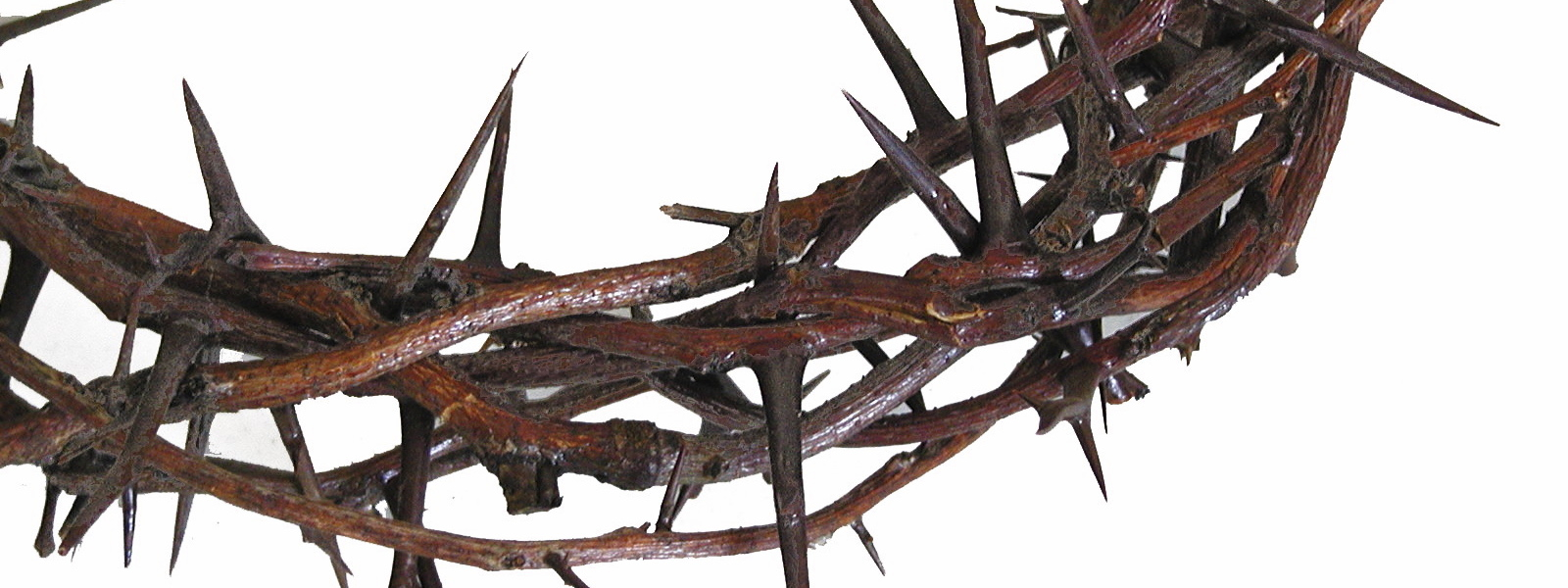
The King’s Crown

…and twisting together a crown of thorns, they put it on his head and put a reed in his right hand. And kneeling before him, they mocked him, saying, “Hail, King of the Jews!”
– Matthew 27:29

Today is Good Friday, the day on which some 2000 years ago Jesus of Nazareth was nailed to a Roman cross just outside the walls of Jerusalem.

Have you ever wondered why Jesus wore a crown of thorns?

Clearly, the Roman soldiers put it on his head to mock him.  Jesus had been hailed “King of the Jews”,  so the Romans considered him an insurrectionist.

But there is a deeper meaning.

Back in Genesis chapter 3, we read about what happened when sin entered the world. When by their rebellion and disobedience to his commands, people first told God, “we don’t trust you and we don’t want you – we know better than you what is best for us” – as sin entered into the world, it brought with it a curse: the curse of death.

This curse affected all of creation, and amongst the various effects of this curse, we read:

cursed is the ground because of you;
in pain you shall eat of it all the days of your life;
thorns and thistles it shall bring forth for you
– Genesis 3:18

Do you see the symbolism of the crown of thorns?  Thorns, the symbol of the curse of sin and death, were placed upon Jesus’ head because on the cross Jesus was taking our curse upon himself, so that we might be set free from it.

He hung on a wooden cross. Why? Because in his death, he was taking our curse – the curse of sin and death – upon himself.

Christ redeemed us from the curse of the law by becoming a curse for us—for it is written, “Cursed is everyone who hangs on a tree”
– Galatians 3:13

In the same way, the crown of thorns symbolized our curse, which Jesus took upon himself on the cross, so we could be redeemed.

Have a wonderful Good Friday, reflecting on the fact that “It is Finished!”
And don’t forget: Sunday is coming…

Maundy Thursday – The Greatest Servant

Today is Maundy Thursday, the day of Holy Week when Jesus and his disciples celebrated their last supper.

On this day, we read that they rented a room in which to eat the traditional Passover meal, full of symbolism, of which Jesus was the ultimate fulfillment.

Being that people wore open sandals and that the roads were dirt, it meant that if they had been walking around outside, people’s feet were dirty.  Not only were they dirty from dusty roads, but without modern sewage systems, a lot of waste would end up in the streets, adding to the level of grime and filth on a person’s feet after simply going about a day’s business outside. Especially, considering that dinner was eaten sitting on pads on the floor, this foot washing was important because of the close proximity people would be in to each other’s feet – smelly feet ruin appetites.

For this reason, the custom was for people who entered a house to remove their sandals and wash their feet. If you were a guest at someone’s house, usually that foot washing would be taken care of by the host, or if the host could afford it, by a servant.

However, Jesus and his disciples were using a borrowed room, so there was no host to welcome them, and no servant assigned to wash people’s feet.

Luke’s Gospel tells us that as they sat at this dinner table, eating the passover – the disciples began to argue over which of them was the greatest. Presumably, part of this discussion was also to determine which one of them was the least – which one of them should become the servant of all and wash everyone’s feet.

And then something happened which no one expected: Jesus stood up and wrapped a towel around his waist and one by one, he washed the feet of his disciples.

Peter, seeing this, protested! How could he let Jesus serve him?! He should be serving Jesus!   But Jesus told Peter: If you don’t let me serve you, you can have no part in me.

And Jesus explained to them – that if anyone would be the greatest in His Kingdomhe must become the servant of all. In His Kingdom, those who humble themselves are the greatest, and those who exalt themselves will be humbled. Jesus explained: “The kings of the Gentiles exercise lordship over them, and those in authority over them are called benefactors. But it will not be so amongst you. Rather, let the greatest among you become as the least, and the leader as one who serves.”

At another point Jesus had said: “The Son of Man came not to be served but to serve, and to give his life as a ransom for many.”

How are you doing as a servant? Pursue true greatness and be like Jesus: a servant.