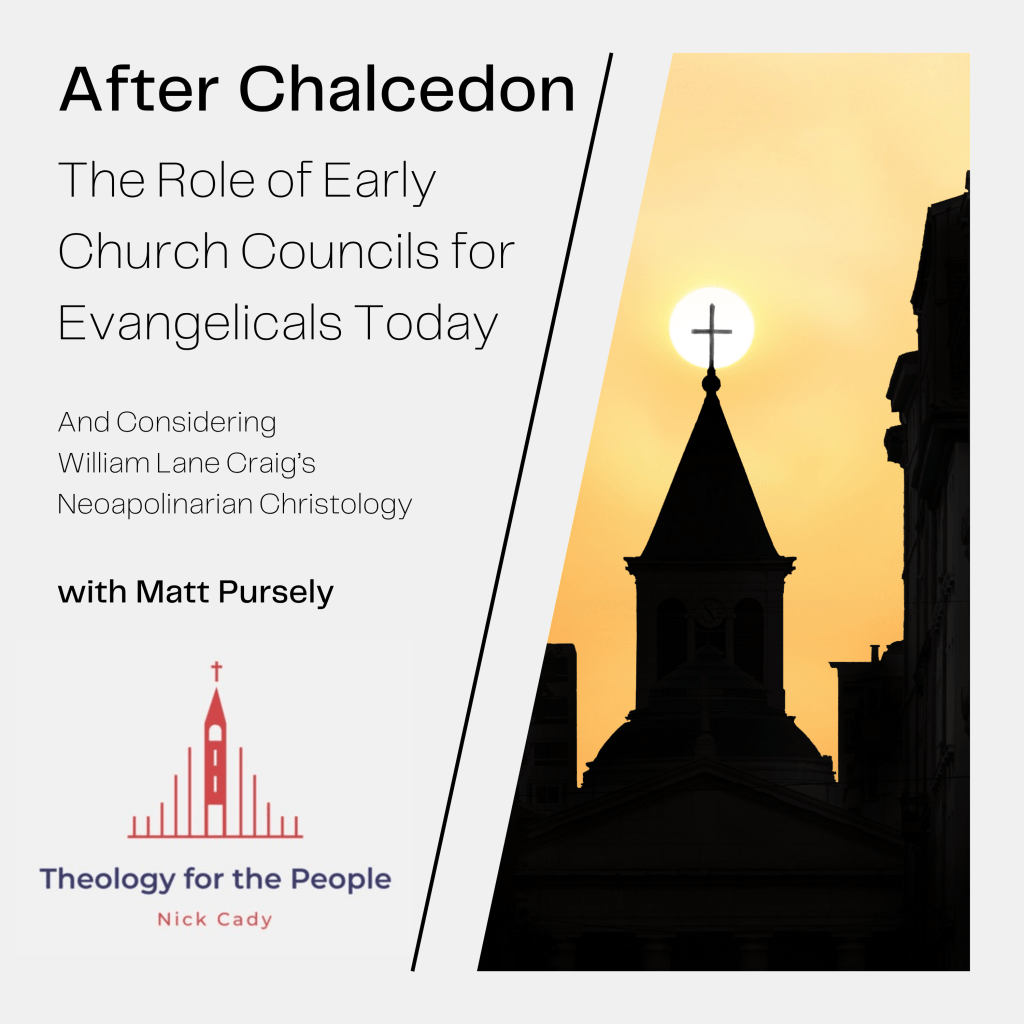

After Chalcedon: The Role of Early Church Councils for Evangelicals Today – with Matt Pursely

What is the enduring legacy of the early church councils, and what role should they play in the lives of Bible-believing Christians today?

In this episode of the Theology for the People Podcast, I am joined once again by Matt Pursely, Executive Pastor at Park Hill Church in San Diego, California and graduate of Westminster Theological Seminary with a focus on Historical Theology, to discuss what happened after the Council of Chalcedon (451 AD), and why it matters for believers today.

We also discuss the views of William Lane Craig, who holds to a Neo-Apolinarian Christology which many see as being in conflict with Chalcedon. We explain his view, and how other early councils, such as Constantinople III, speak to it.

We also explain the importance of the debate over monothylitism and dyathelitism and the question of impeccability vs. peccability and whether Jesus was truly tempted internally or if his temptations were merely external.

Click here to listen to the episode, or listen in the embedded player below.

After Chalcedon: The Role of the Early Church Councils for Evangelicals Today – with Matt Pursely Theology for the People

What is the enduring legacy of the early church councils, and what role should they play in the lives of Bible-believing Christians today?In this episode, host Nick Cady is joined again by Matt Pursely, Executive Pastor at Park Hill Church in San Diego, California and graduate of Westminster Theological Seminary with a focus on Historical Theology, to discuss what happened after Chalcedon, and why it matters for believers today.We also discuss the views of William Lane Craig, who holds to a Neo-Apolinarian Christology which some see as being in conflict with Chalcedon. We explain what this view is, and how other early councils, such as Constantinople III speak to it. We also explain the importance of the debate over monothylitism and dyathelitism and the question of impeccability vs. peccability and whether Jesus was truly tempted internally or if his temptations were merely external. Subscribe to the Theology for the People YouTube Channel here.Visit the Theology for the People website here.

I have also started posting more on the Theology for the People YouTube channel. You can watch this interview on video here:

Ministry in French Canada: A Pastor’s Journey from ShowBiz to the Secular City – with Sébastien Frappier

In this episode of the Theology for the People Podcast, I speak with Sébastien Frappier his incredible journey from a professional acting career to planting a church in the highly secular city of Montreal, Quebec.

Sebastian shares how a moment of spiritual emptiness led him to encounter Jesus through a Gideon Bible on Guadalupe Mountain in Texas. He reflects on his 12-year journey of preparation, the unique challenges of ministry in a post-Christian culture, and how his acting background informs his preaching and evangelism.

The conversation also covers the unique cultural and spiritual aspects of Quebec, effective evangelism strategies in Montreal, and the importance of discipleship in a context where biblical knowledge is minimal.

Sebastian offers practical advice for church planters in secular urban settings and shares how listeners can support Calvary Montreal’s mission.

Key Topics:

Sebastian’s Journey to Faith: From a successful acting career in Montreal to a transformative encounter with Jesus while reading the Sermon on the Mount in Texas.

Ministry in Montreal: The challenges of pastoring in a highly secular, post-Christian city with less than 0.3% evangelical Christians.

Acting and Preaching: How Sebastian’s training in method acting and the Meisner technique shapes his passionate, authentic approach to teaching the Bible.

Cultural Context of Quebec: The impact of the Quiet Revolution, the decline of Catholicism, and the rise of humanism in Quebec’s spiritual landscape.

Evangelism Strategies: The effectiveness of street and subway evangelism in Montreal, emphasizing authenticity and genuine relationships over large-scale events.

Discipleship in a Secular Context: Focusing on basic biblical teachings and one-on-one discipleship due to limited biblical literacy among new believers.

Challenges and Encouragement: Sebastian’s experience with a recent church split, the financial struggles of ministry in Quebec, and the joy of seeing individual souls saved.

Call to Action: How listeners can pray for, support, or participate in short-term mission trips to support Calvary Montreal.

Calvary Montreal Website: calvarymontreal.com – Find information on the church, how to get involved, and support their mission.

Click here to listen to the episode, or listen in the embedded player below.

Ministry in French Canada: Church Planting in Montreal, Quebec – with Sebastien Frappier Theology for the People

In this episode, Nick Cady in joined by Sebastian Frappier, to discuss his incredible journey from a professional acting career to planting a church in the highly secular city of Montreal, Quebec. Sebastian shares how a moment of spiritual emptiness led him to encounter Jesus through a Gideon Bible on Guadalupe Mountain in Texas. He reflects on his 12-year journey of preparation, the unique challenges of ministry in a post-Christian culture, and how his acting background informs his preaching and evangelism. The conversation also covers the unique cultural and spiritual aspects of Quebec, effective evangelism strategies in Montreal, and the importance of discipleship in a context where biblical knowledge is minimal. Sebastian offers practical advice for church planters in secular urban settings and shares how listeners can support Calvary Montreal’s mission.Sebastian’s Journey to Faith: From a successful acting career in Montreal to a transformative encounter with Jesus while reading the Sermon on the Mount in Texas.Ministry in Montreal: The challenges of pastoring in a highly secular, post-Christian city with less than 0.3% evangelical Christians.Acting and Preaching: How Sebastian’s training in method acting and the Meisner technique shapes his passionate, authentic approach to teaching the Bible.Cultural Context of Quebec: The impact of the Quiet Revolution, the decline of Catholicism, and the rise of humanism in Quebec’s spiritual landscape.Evangelism Strategies: The effectiveness of street and subway evangelism in Montreal, emphasizing authenticity and genuine relationships over large-scale events.Discipleship in a Secular Context: Focusing on basic biblical teachings and one-on-one discipleship due to limited biblical literacy among new believers.Challenges and Encouragement: Sebastian’s experience with a recent church split, the financial struggles of ministry in Quebec, and the joy of seeing individual souls saved.Call to Action: How listeners can pray for, support, or participate in short-term mission trips to support Calvary Montreal.Calvary Montreal Website: calvarymontreal.com – Find information on the church, how to get involved, and support their mission.Subscribe to Theology for the People for more inspiring conversations about faith and ministry.Share this episode with friends or your church community to raise awareness about the mission in Montreal.Visit the Theology for the People website at theologyforthepeople.com

How Did We Get the Bible? Exploring the Formation of the Biblical Canon – with Shane Angland

In this episode of the Theology for the People Podcast, I speak with Shane Angland about the question of how we got the Bible in its current form.

Shane has been a recurring guest on the podcast, and he has a keen mind and knowledge of historical theology. Shane lives in Ennis, Ireland where he serves at Ennis Evangelical Church. He holds a Masters of Divinity from Dallas Theological Seminary, and has served as a missionary in Ukraine.

From the formation of the Old and New Testaments to the question of the Apocrypha, to the impact of the Council of Trent, this conversation offers clarity on why the Bible is trusted as God’s inspired Word.

Key Topics Discussed

  • What is the Canon?
    • Definition: The canon is the list of inspired, authoritative Scriptures distinguished from other valuable writings.
    • Theological foundation: Scripture is “breathed forth” by God, carrying unique authority for the church (2 Timothy 3:16).
  • Old Testament Canon Formation
    • Begins with God’s redemptive acts, particularly after the Exodus and Sinai covenant (Exodus 24, Deuteronomy 31).
    • Jewish recognition of inspired texts from Moses to Malachi, with a prophetic silence post-Persian era.
    • Josephus and first-century Jewish consensus on 22 books (equivalent to the 39 books in modern Old Testaments).
    • No explicit criteria articulated, but guided by the Holy Spirit and covenantal context.
  • The Apocrypha and Deuterocanonical Books
    • Includes books like Tobit, Judith, Wisdom, Sirach, 1 & 2 Maccabees, Baruch, and additions to Esther and Daniel.
    • Historical debate: Some early Christians (e.g., Augustine) accepted these books, while others (e.g., Jerome) did not, aligning with Jewish tradition.
    • Council of Trent (1546): Roman Catholic Church dogmatically defined these books as canonical, partly in response to Reformation emphasis on scriptural authority (e.g., for doctrines like purgatory).
    • Eastern Orthodox churches maintain an open canon, avoiding infallible rulings.
  • New Testament Canon Formation
    • Tied to the new covenant and apostolic authority, with writings by or connected to apostles (e.g., Mark linked to Peter, Luke to Paul).
    • Criteria: Apostolic origin, Christ-centered message, and widespread church use in worship.
    • Early recognition: By the late first century, apostolic writings were distinguished (e.g., Clement’s letters vs. Paul’s epistles).
    • By the second century, 22–23 of the 27 books were widely accepted, with minor debates on smaller texts (e.g., 2 Peter, 3 John).
  • Misconceptions Addressed
    • Myth: The Council of Nicaea (325 CE) decided the canon. Reality: Nicaea focused on church governance, not canon selection.
    • Myth: Early Christians chose from hundreds of gospels. Reality: The four canonical gospels were the earliest, apostolic, and widely used.
    • Gnostic “gospels” (e.g., Gospel of Judas) lack historical or apostolic credibility and were not serious contenders.
  • Why the Delay in Formal Canon Lists of the New Testament?
    • The early church was decentralized, persecuted, and lacked centralized authority to compile lists.
    • Canonical texts were illegal, and possession could lead to martyrdom (e.g., 180 CE Carthage trial).
    • Earliest clear list: Athanasius’ Easter Letter (367 CE), reflecting existing church consensus.
  • Confidence in Scripture
    • The Bible’s unity across 66 books, three languages, and 1,500 years testifies to its divine inspiration.
    • The early church’s careful discernment reflects wisdom, not uncertainty.
    • Romans 3:2 affirms the Jewish role in preserving the Old Testament oracles, reinforcing trust in the canon’s reliability.

Resources Mentioned

  • Michael Kruger’s work on the canon (e.g., Canon Revisited).
  • Josephus’ Against Apion for first-century Jewish canon insights.
  • Augustine’s On Christian Doctrine.

Quotable Moments

  • “The canon begins with God’s work of redemption, not human decisions.” – Shane
  • “The church doesn’t establish the canon; it recognizes it through the Holy Spirit.” – Shane
  • “The Bible’s coherent message across 1,500 years is a miracle of God’s inspiration.” – Shane

Click here to listen to the episode, or listen in the embedded player below.

How Did We Get the Bible? Exploring the Formation of the Biblical Canon – with Shane Angland Th.M Theology for the People

In this episode, Nick Cady and Shane Angland tackle the critical question: How did the Bible come to be? They explore the formation of the biblical canon, addressing misconceptions, historical processes, and the theological significance of Scripture. From the Old Testament’s roots in God’s redemptive work to the New Testament’s apostolic authority, this conversation offers clarity on why the Bible is trusted as God’s inspired Word. They also discuss the Apocrypha, the Council of Trent’s impact, and how early Jewish and Christian communities recognized canonical texts.Connect with Theology for the PeopleWebsite: theologyforthepeople.comFollow on X: @nickcady

What is the Baptism of the Holy Spirit – with Dr. Alan Stoddard

In this episode of the Theology for the People Podcast, I speak with Dr. Alan Stoddard, who interviews me about the baptism of the Holy Spirit.

What is the baptism of the Holy Spirit? Does it happen simultaneously with salvation, or is it a subsequent experience? How should our understanding of the baptism with the Holy Spirit shape our practice in the church?

Alan is a pastor and church planter with over 25 years of ministry experience. Alan holds a Master’s Degree from Southwestern Seminary, and a Doctorate in preaching from Gordon Conwell. 
Both Nick and Alan serve as Adjunct Professors at Calvary Chapel Bible College. Alan also teaches at Rockbridge Seminary. Nick and Alan also serve on the Leadership Team of Expositors Collective.
This year, on Easter Sunday, Alan launched a new church plant called Imagine Church in Cressen, Texas.

In this episode, Nick and Alan discuss the prepositional approach to understanding the Spirit’s work, and how it helps to address some common questions and even some misconceptions about the baptism of the Holy Spirit.

Resources to check out:
Perspectives on Spirit Baptism – book, recommended by Alan
• Article by Nick: “Is the “Baptism in the Spirit” the Same as Being “Filled” With the Holy Spirit? Yes and No. Here’s Why”
• Subscribe to the Theology for the People Podcast for more episodes.

Click here to listen to the episode, or listen in the embedded player below.

What is the Baptism of the Holy Spirit – with Dr. Alan Stoddard Theology for the People

What is the baptism of the Holy Spirit? Does it happen simultaneously with salvation, or is it a subsequent experience? How should our understanding of the baptism with the Holy Spirit shape our practice in the church? In this episode, Pastor Nick Cady is interviewed by Dr. Alan Stoddard about this topic.Alan is a pastor and church planter with over 25 years of ministry experience. Alan holds a Master’s Degree from Southwestern Seminary, and a Doctorate in preaching from Gordon Conwell. Both Nick and Alan serve as Adjunct Professors at Calvary Chapel Bible College. Alan also teaches at Rockbridge Seminary. Nick and Alan also serve on the Leadership Team of Expositors Collective. This year, on Easter Sunday, Alan launched a new church plant called Imagine Church in Cressen, Texas.In this episode, Nick and Alan discuss the prepositional approach to understanding the Spirit’s work, and how it helps to address some common questions and even some misconceptions about the baptism of the Holy Spirit.Resources to check out: Perspectives on Spirit Baptism – book, recommended by AlanArticle by Nick: "Is the “Baptism in the Spirit” the Same as Being “Filled” With the Holy Spirit? Yes and No. Here’s Why"Subscribe to Theology for the People for more episodes.Visit the Theology for the People website and blog

Seeing Jesus in the Psalms through Hebrews – with Daniel Stevens

In this episode of the Theology for the People Podcast, I speak with Daniel Stevens, who is Assistant Professor of New Testament Interpretation at Boyce College (the undergraduate college of Southern Seminary) and author of Songs of the Son: Reading the Psalms with the Author of Hebrews

In this episode, Daniel shares how his accidental dive into Hebrews sparked a decade-long passion, revealing how the Psalms prophetically point to Jesus. 
We talk about the question of who wrote Hebrews, and why it matters — and we talk about how reading the Psalms through the lens of Hebrews can deepen our worship and appreciation of Jesus.

Notable Quotes:
• Daniel on Hebrews’ Use of Psalms: “When the author to the Hebrews wanted to make an argument about Jesus, one of the most common places that he goes is to the Psalms.”
• On Christological Reading: “It’s not reading something into it, it’s reading what’s there and reasoning from it.”
• On Hebrews’ Argument: “It’s not comparing bad to good… it’s good to better.”
• For Believers: “If these Psalms aren’t first about us, but about a thing that Jesus has done for us… we can worship Him in finding them.”

More Resources: Follow Daniel on X

Click here to listen to the episode, or listen in the embedded player below.

Seeing Jesus in the Psalms through Hebrews – with Daniel Stevens Theology for the People

Daniel Stevens is Assistant Professor of New Testament Interpretation at Boyce College and author of Songs of the Son: Reading the Psalms with the Author of Hebrews. In this episode, Daniel shares how his accidental dive into Hebrews sparked a decade-long passion, revealing how the Psalms prophetically point to Jesus. We talk about the question of who wrote Hebrews, and why it matters — and we talk about how reading the Psalms through the lens of Hebrews can deepen our worship and appreciation of Jesus.Notable QuotesDaniel on Hebrews’ Use of Psalms: “When the author to the Hebrews wanted to make an argument about Jesus, one of the most common places that he goes is to the Psalms.”On Christological Reading: “It’s not reading something into it, it’s reading what’s there and reasoning from it.”On Hebrews’ Argument: “It’s not comparing bad to good… it’s good to better.”For Believers: “If these Psalms aren’t first about us, but about a thing that Jesus has done for us… we can worship Him in finding them.”More Resources: Follow Daniel on XConnect with Us:Subscribe to Theology for the People for more episodes.Visit the Theology for the People website and blog

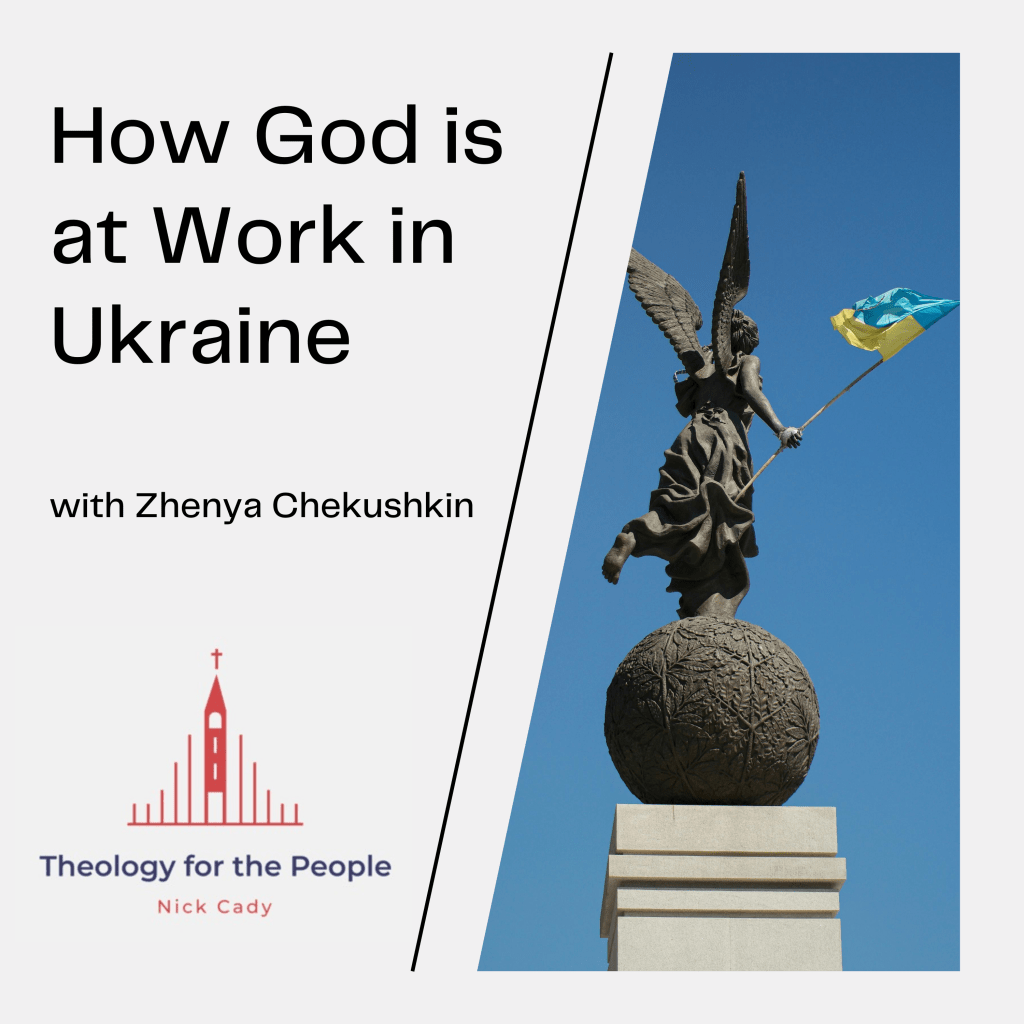
How God is at Work in Ukraine – with Zhenya Chekushkin

In this episode of the Theology for the People Podcast, I speak with Zhenya Chekushkin: a pastor from Western Ukraine and a longtime friend. Zhenya shares about his experience of growing up in a communist military family in the Soviet Union, coming to faith at age 13, and now leading a church through the ongoing war in Ukraine.

From the fall of the Soviet Union to the rise of evangelicalism and the current conflict, Zhenya offers a firsthand perspective on how God is moving amid chaos—and how listeners can join in.

How You Can be Involved and Support:
◦ Financially: Donate to the Ukraine Relief Fund at whitefieldschurch.com under the giving tab.
◦ In Person: Short-term mission trips (conferences, camps, building projects) or longer-term ministry—contact Jenia via White Fields or social media.
◦ Church Planting: Opportunities available with Calvary Chapel Ukraine’s support. See: cultivatechurchplanting.com
• Stay Updated: Email calvarychapelukraine@gmail.com to join Zhenya’s newsletter list (every 2-3 months).

Film Mention: The Book of Eli – A post-apocalyptic tale of a man preserving the Bible, reflecting on morality without God (not sponsored, just Zhenya’s pick!)

Click here to listen to the episode, or listen in the embedded player below.

How God is at Work in Ukraine – with Zhenya Chekushkin Theology for the People

Zhenya Chekushkin is a pastor from Western Ukraine and a longtime friend. Zhenya shares his unique story: growing up in a communist military family, coming to faith at 13, and now leading a church through the ongoing war in Ukraine. From the fall of the Soviet Union to the rise of evangelicalism and the current conflict, Zhenya offers a firsthand perspective on how God is moving amid chaos—and how listeners can join in.Support Options:Financially: Donate to the Ukraine Relief Fund at whitefieldschurch.com under the giving tab.In Person: Short-term mission trips (conferences, camps, building projects) or longer-term ministry—contact Jenia via White Fields or social media.Church Planting: Opportunities available with Calvary Chapel Ukraine’s support—reach out for details.Stay Updated: Email calvarychapelukraine@gmail.com to join Zhenya's newsletter list (every 2-3 months).Film Mention: The Book of Eli – A post-apocalyptic tale of a man preserving the Bible, reflecting on morality without God (not sponsored, just Zhenya's pick!).Connect with Us:Subscribe to Theology for the People podcastVisit the Theology for the People website at theologyforthepeople.com

Colorado Bill Takes Aim at Christian Parents

Here in Colorado a piece of legislation—House Bill 25-1312—is moving through the State Legislature under the banner of protecting transgender individuals. However, this bill poses significant risks to parental rights, especially for parents who hold a biblical view of human identity, design, and flourishing.

The bill has already passed the Colorado House of Representatives and is now before the State Senate. If it passes that, it will go to the desk of Governor Polis to be signed into law.

The Centennial Institute at Colorado Christian University strongly urges the Colorado Senate to vote ‘No’ on the proposed bill. “HB25-1312 sets a dangerous precedent by punishing those who live out their biblical convictions,” said Greg Schaller, Centennial Institute director.[1]

What the Bill Says

Among other things, HB25-1312:

  • Directs courts in child custody cases to consider behaviors such as deadnaming (addressing someone using their birth name) or misgendering (referring to someone by their biological pronouns) as forms of “coercive control.”
  • Prohibits Colorado courts from recognizing laws from other states that restrict access to “gender-affirming care” (hormone treatment and surgery) for minors without parental consent.
  • Frames a parent’s hesitance or objection to gender transitions as potentially harmful conduct in custody disputes.

What Does This Mean?

1. Loving Parents Could Lose Custody of Their Kids for Holding Biblical Convictions
A Christian parent who lovingly urges their child to embrace the gender which aligns with their biological sex, or does not sign off on making irreversible decisions like hormone therapy or surgery, could be accused of “coercive control” for upholding their biblical convictions, and have their children taken away.

2. Parental Disagreement Could Be Treated as Abuse
HB25-1312 equates disagreement with harm, if parents do not affirm the child’s new name or identity. These legislators are trying to define what constitutes a child’s “best interest,” taking that decision away from parents – not to mention that they are defining the child’s best interest based on a particular ideology. If someone doesn’t share their ideology, they are deemed to be abusive and not acting in the child’s “best interest.”

3. It Sets a Precedent Against Religious Belief
Christians believe biological sex is part of God’s design. To force parents to affirm something that they believe to be untrue puts them in a moral bind: give up their convictions or lose custody of their kids.

What Can Christians Do?

1. Read the bill

2. Contact State Senators
You can find your Colorado State Senator’s email address here.

3. Sign this Petition for the State Senate and Governor Polis to veto the bill

4. Pray that this bill does not get passed

The Council of Chalcedon (451 AD) – with Shane Angland

In this episode of the Theology for the People Podcast, I sit down with returning guest Shane to explore the Council of Chalcedon (AD 451), the fourth ecumenical council of the early church.

Recorded live in Colorado during an Expositors Collective training weekend, this conversation traces the events leading up to Chalcedon, its theological breakthroughs, and its messy aftermath.

From the fallout of the Council of Ephesus, to the clash between the Alexandrian and Antiochian schools of Christology, and the mess of Ephesus II, Shane breaks down the stakes: how do we understand the two natures of Christ—human and divine—in one person?

The episode also tackles the political power plays, the deposition of bishops, and the schisms that followed, including the rise of the Oriental Orthodox churches. Plus, hear why Shane sees Chalcedon as both a triumph and a tragedy—and what it still teaches us today.

Resources Mentioned:

Click here to listen to the episode, or listen in the embedded player below.

The Council of Chalcedon (451 AD) – with Shane Angland Theology for the People

In this episode, Nick sits down in person with returning guest Shane to explore the Council of Chalcedon (AD 451), the fourth ecumenical council of the early church. Recorded live in Colorado during an Expositors Collective training weekend, this conversation traces the events leading up to Chalcedon, its theological breakthroughs, and its messy aftermath. From the fallout of the Council of Ephesus to the clash between the Alexandrian and Antiochian schools of Christology, Shane breaks down the stakes: how do we understand the two natures of Christ—human and divine—in one person? The episode also tackles the political power plays, the deposition of bishops, and the schisms that followed, including the rise of the Oriental Orthodox churches. Plus, hear why Shane sees Chalcedon as both a triumph and a tragedy—and what it still teaches us today.Resources Mentioned:The Definition of Chalcedon (available online for further reading).Bruce Shelley’s Church History in Plain Language (Fifth Edition).Augustine’s The Unity of the Church on the role and limits of councils.Visit TheologyforthePeople.com

The Council of Ephesus (431 AD) – with Matthew Pursely

In this episode of the Theology for the People Podcast, we continue our series on the first four ecumenical councils of the early church, diving into the Council of Ephesus (431 AD).

Matthew Pursely, Executive Pastor at Park Hill Church in San Diego, CA, joins us again to explore the theological debates surrounding Nestorius, the nature of Christ, and the implications of the hypostatic union—Jesus being fully God and fully man.

We discuss how this council addressed Nestorianism, affirmed Mary as the “Theotokos” (God-bearer), and shaped Christian understanding of communion and humanity’s connection to Christ.

Click here to listen to the episode, or listen in the embedded player below.

The Council of Ephesus (431 AD): Hypostatic Union, Nestorianism, & Theotokos – with Matt Pursely Theology for the People

In this episode, we continue our series on the first four ecumenical councils of the early church, diving into the Council of Ephesus (431 AD). Matthew Pursely joins us again to explore the theological debates surrounding Nestorius, the nature of Christ, and the implications of the hypostatic union—Jesus being fully God and fully man. We discuss how this council addressed Nestorianism, affirmed Mary as the "Theotokos" (God-bearer), and shaped Christian understanding of communion and humanity’s connection to Christ.Recommended ResourcesFor those wanting to dive deeper into the councils and related theology:Edward Siecienski – The Filioque: History of a Doctrinal ControversyAdonis Vidu – Exploring the Doctrine of Divine InseparabilityJohn Behr – The Nicene Faith (2 volumes) and John the Theologian and the Mystery of ChristKallistos Anatolios – Retrieving NicaeaJohn Henry Newman – Arians of the Fourth CenturyWilliam Bright – Notes on the Canons of the First Four General CouncilsTodd Miles – Superheroes Can’t Save You: Epic Examples of Historic Heresies (compares heresies to superhero archetypes—highly recommended entry-level read).Connect with Us:Subscribe to the Theology for the People podcastVisit the Theology for the People website at theologyforthepeople.com

The Council of Constantinople – with Matthew Pursely

How did the early church come to a clear understanding of who Jesus is and how the Holy Spirit relates to the Father and the Son? And why did it take more than one council to settle these questions?

In this episode, I’m joined again by Matthew Pursley, Executive Pastor at Park Hill Church in San Diego, CA, and an expert in historical theology. Last time, we discussed the Council of Nicaea, and in this episode, we continue the conversation by diving into the Second Ecumenical Council—Constantinople (381 AD).

We discuss why the Council of Constantinople was necessary even after Nicaea, the role of the Cappadocian Fathers in defining the Trinity, the Filioque controversy, and how this council still shapes our faith to this day.

Click here to listen to the episode, or listen in the embedded player below.

The Council of Constantinople (381 AD) – with Matthew Pursely Theology for the People

How did the early church come to a clear understanding of who Jesus is and how the Holy Spirit relates to the Father and the Son? And why did it take more than one council to settle these questions?In this episode, I'm joined again by Matt Pursley, Executive Pastor at Park Hill Church in San Diego, CA, and an expert in historical theology. Last time, we discussed the Council of Nicaea, and in this episode, we continue the conversation by diving into the Second Ecumenical Council—Constantinople (381 AD).We discuss why the Council of Constantinople was necessary even after Nicaea, the role of the Cappadocian Fathers in defining the Trinity, the Filioque controversy, and how this council still shapes our faith to this day. Make sure to visit the Theology for the People website.