Vacation and Russian Novels

For the past week we have been on vacation in California. For the first week of it we were in Orange County where I attended the Calvary Chapel pastors conference in Costa Mesa. Rosemary and the kids spent time with friends and at the beach, and Rosemary was able to attend some parts of the conference as well. The conference was refreshing; a great time of focusing on the Lord and recentering as well as reconnecting with friends from all over the world. 

After that we went down to North San Diego and visited friends and family there, and then came to Los Angeles to stay with family. We’ll be back in Colorado for church on Sunday.

Overlooking Los Angeles from the Griffith Observatory in the Hollywood hills 

One of the books I’ve been reading on vacation is Dostoyevsky’s The Brothers Karamazov. Several years ago I read Crime and Punishment and it became one of my favorite books. I think Dostoyevsky was a brilliant writer, particularly how he developed characters and got inside their minds.
What was interesting about Crime and Punishment was that it wasn’t only a novel so much as it was a platform for Dostoyevsky’s view of human anthropology – in other words: what makes us tick. What I found even more interesting, as I looked more into Russian literature from that time period, was that the other great Russian author, Tolstoy, did the same thing with his novels, but he had distinctly different views. 

Tolstoy was a pacifist, who considered himself a Christian, but didn’t want anything to do with church in any way. In fact, the more you get to know his views, you realize that he was extremely legalistic and held many strange interpretations of Biblical passages. For example, Tolstoy said that since Jesus said in the Sermon on the Mount: “Do not resist an evil person” (Matthew 5:39), that means that we should not even have police, because the role of the police is to resist evil people. What he was arguing for was beyond pacifism to a form of anarchy, which was based on his fundamental belief in the basic goodness of humankind: that left to our own devices, with no outside intervention, people would trend towards good rather than evil, and that the trajectory of the human race is towards greater virtue, peace and harmony. Tolstoy’s views were a major influence on Ghandi and others.

Dostoyevsky on the other hand, did not share Tolstoy’s views about humanity. Dostoyevsky considered himself a serious Christian, something which is very apparent in his writing, and he held much more traditional (and biblical) views about the nature of humankind and what makes us tick. 

In Crime and Punishment, for example, the main character is a university student who ends up killing the older woman he lives with. The popular thinking at the time (and still in our time as well) was the Englightenment theory that people are basically good, and that when people do things that are wrong, the reason they do them is either because of lack of education or because of poverty. Thus, the thought is that if you can educate people and bring them out of poverty, then crime and violence, as well as racism and hatred will cease to exist. The Bible does not agree with this theory, and says that the reason people do bad things, is because we are sinful and broken, and sin doesn’t just affect us, but it dwells within us, it is part of our very core. We weren’t designed by God to be this way, and it is for this reason that Jesus came, to redeem us from the curse of sin and death. But apart from redemption, all people are sinful, which is the reason we do sinful things. 

If there is any question about this, Nazi Germany is a perfect case study of how the most educated society in the world, which was well off economically, committed some of the worst atrocities the world has ever seen. If the Englightenment theory was true, that shouldn’t have happened, but the Biblical view would say: educated and rich people are still sinners, they’re just educated and rich sinners. What all people need is a new heart, something which can only be found in and through Jesus Christ.
In Crime and Punishment the main character is an educated young man who kills his landlord simply because he wants to, because he’s curious what it will be like, and then he justifies his actions to himself. Why do people do bad things? Because sin dwells within us, rich or poor, educated or uneducated, Dostoevsky would say.

I am only 20% of the way through The Brothers Karamazov, but am very much enjoying it. It tells the story of a father and his 3 sons, actually 4 – as one of the servants is also the son of the man. The father is a foolish and base man, his oldest son is similarly base, but at least has a sense of conscience which his father seems to lack. The second son is an intellectual and considers himself an atheist, but is torn because he realizes that if there is no God and no afterlife and no Heaven or Hell, then there is no meaning to life. The third son is an apprentice monk at the local monastery, where he studies under a devout elder. There is another elder at the monastery who is crazy, and somehow in his derangedness is more popular with the people than the devout and humble  elder who actually says a lot of things which are good and biblical.

One of the points that Dostoyevsky is making in the book is that the life of sincere Christian faith put into practice is the truly good life. Through the characters he is showing the results of a life of sin and the meaninglessness and pain of life apart from God and encouraging the reader to forsake sin and turn to God.

At least that’s what I’ve gotten out of it so far. I’ll let you know if anything changes!

Here are some excerpts:

“Love God’s people, let not strangers draw away the flock, for if you slumber in your slothfulness and disdainful pride, or worse still, in covetousness, they will come from all sides and draw away your flock. Expound the Gospel to the people unceasingly. Do not love gold and silver. Have faith. Cling to the banner and raise it on high.”  – Father Zossima, the humble and sincere elder to Alyosha, the third son who is a Christian

“Remember, young man, unceasingly,” Father Païssy began, without preface, “[humanism], which has become a great power, has, especially in the last century, analyzed everything divine handed down to us in the holy books. But they have only analyzed the parts and overlooked the whole, and indeed their blindness is marvelous. Yet the whole still stands steadfast before their eyes, and the gates of hell shall not prevail against it. Has it not lasted nineteen centuries, is it not still a living, a moving power in the individual soul and in the masses of people? It is still as strong and living even in the souls of atheists, who have destroyed everything! For even those who have renounced Christianity and attack it, in their inmost being still follow the Christian ideal, for hitherto neither their subtlety nor the ardor of their hearts has been able to create a higher ideal of man and of virtue than the ideal given by Christ. When it has been attempted, the result has been only grotesque.

Playing Harps in Heaven? Don’t be Ridiculous

I have been reading CS Lewis’ Mere Christianity along with the men’s group at White Fields Church. I first read the book 18 years ago, and reading it again has been like reading it for the first time.

I came across this quote in the book, which I thought was excellent, in regard to the Christian belief in Heaven:

There is no need to be worried by facetious people who try to make the Christian hope of ‘Heaven’ ridiculous by saying they do not want ‘to spend eternity playing harps’.

The answer to such people is that if they cannot understand books written for grown-ups, they should not talk about them.

All the scriptural imagery (harps, crowns, gold, etc.) is, of course, a merely symbolical attempt to express the inexpressible. Musical instruments are mentioned because for many people (not all) music is the thing known in the present life which most strongly suggests ecstasy and infinity. Crowns are mentioned to suggest the fact that those who are united with God in eternity share His splendour and power and joy. Gold is mentioned to suggest the timelessness of Heaven (gold does not rust) and the preciousness of it. People who take these symbols literally might as well think that when Christ told us to be like doves, He meant that we were to lay eggs.

Lewis, C. S. Mere Christianity (p. 137).

I love his line about if you can’t understand a book written for grown-ups, then you shouldn’t be talking about it!

He says in another place in the book:

Very often a silly procedure is adopted by people who [oppose] Christianity. Such people put up a version of Christianity suitable for a child of six and make that the object of their attack.

When you try to explain the Christian doctrine as it is really held by an instructed adult, they then complain that you are making their heads turn round and that it is all too complicated.

It is no good asking for a simple religion. After all, real thing are not simple.

Lewis, C. S. Mere Christianity (p. 41).

I have found this to be true – not only in regard to discussions about Christianity, but in many debates about many things. People put up a caricature of the other person’s views and then proceed to destroy them. This is sometimes called a “straw man argument”.

It is important that we should not allow people to do that with Christian beliefs, and also that we should not do the same with other people’s beliefs. This is sometimes called “Presuppositional Apologetics” – the idea that you should try to frame the views of your “opponent” in such a way, that they would say, “I couldn’t have put it better myself.”

As Timothy Keller put it recently:


Done with School, and a Few Other Things

I love finishing projects that I start. The only thing is, I also really like starting projects. So I sometimes find myself with several long term projects – but over the past few weeks I've been able to finish up a few of them.

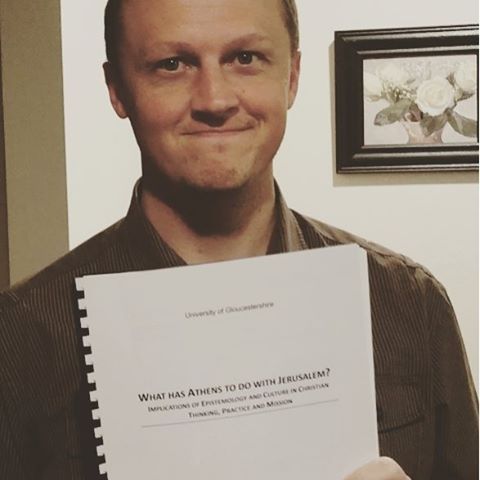
For the past several months I was very busy finishing my dissertation for my theology degree. I started at this university when my first child was the same age as my current youngest child: 5 months old. Now, in completing my dissertation, I am done – at least for now… I would like to continue.

The title of my dissertation: What has Athens to do with Jerusalem? Implications of Epistemology and Culture for Christian Thinking, Practice and Mission

Another thing I've been working on for a while that I was able to complete: During the 10 years that I lived in Hungary I spent a lot of time getting different kinds and levels of residence permits and visas. By the time I left I had permanent residence and a work permit, which I gave up when I moved to the US. No big deal, because I have no plan to move back. But about 2 years ago a friend in Hungary told me that I should look into becoming a Hungarian citizen and that I might meet the requirements for citizenship. I looked into it, and I did – so, a year ago I applied for Hungarian citizenship, and I just found out 2 weeks ago I received it. Last week I traveled to Los Angeles for my naturalization ceremony at the office of the Hungarian Consulate.

Receiving my Hungarian citizenship from Kálmán László, consulate general of Hungary.

I'm not really sure how it will benefit me, but it is meaningful nonetheless. My wife and kids are Hungarian citizens, and I does encourage me to spend more time making sure the kids learn Hungarian and have that identity.

Another long term project we've been working on is getting out of the debt we incurred from the adoption we did. It's been an exercise in budgeting, downsizing and penny pinching, inspired by a Dave Ramsey class, and at the end of June we will have that project complete as well.

I've also finished a few books recently:

The men's group at our church has been going through Mere Christianity by CS Lewis, following a study guide and video series by Eric Metaxas. A lot of the videos refer to Lewis' autobiography, Surprised by Joy, so I picked it up and started reading it. In it, Lewis tells the story of how he became an atheist and then the process by which he turned from atheism to deism and finally to Christianity. “Joy”, spelled with a capital J, is the thing which all people are looking for and get glimpses of throughout their lives in various ways, but which can only be found in and through a relationship with God through Jesus Christ.

Sounds interesting, right? I have to say, Surprised by Joy left me surprised with boredom. I had a really hard time getting through the book, and felt that a lot of the material was indulgent details which had nothing at all to do with the story he was telling. That part though, the story of his journey from a nominal Christian upbringing, to atheism, to deism and finally to Christianity, was truly captivating. The last chapter was particularly good. It's worth reading if you are a CS Lewis fan.

The other book I finished recently was John Steinbeck's The Winter of Our Discontent. I heard somewhere that it is good to read fiction because it fuels creativity and imagination in a way that other media does not. I read a lot of non-fiction, particularly theology books and biographies, and so I want to make sure that I read some good fiction from time to time as well and I have it in mind to read classic novels and literature.

The Winter of Our Discontent was interesting, particularly in how it dealt with moral and ethical issues, as well as issues of contentment, and pressures in society which create dissatisfaction. The novel describes how people often cross their own moral and ethical lines to get what they think they want, and when they get it, they are still discontent and often more miserable that they were before. I think it's a great commentary on society and on the fallen human condition.

Ironically, The Winter of Our Discontent and Surprised by Joy have their core theme in common. The only difference is that whereas Steinbeck didn't answer the question of what it is that human beings are ultimately looking for: the true quest beneath all our quests, Lewis did. And although Lewis' writing style is harder to read, Surprised by Joy actually answers the question posed by The Winter of Our Discontent.


I'm enjoying this season.


This Life and the One to Come

I’ve been preaching a lot on the topic of hope recently. It is a theme which I consider amongst the most beautiful in the world.

This past Sunday was Easter, and I taught a message titled: ‘A Living Hope’ (listen to it here).

In the sermon I spoke about Viktor Frankl and his book Man’s Search for Meaning, in which he says that life only has meaning if you have a hope which suffering and death cannot take away from you.

Interestingly – and perhaps tragically, however, it is not clear to me that Frankl ever discovered a hope worthy of that description.

This is the living hope which we have in Jesus, which Peter talked about in 1 Peter 1:3-9, speaking to people who were in fact suffering. It is a hope which is imperishable, unfading and kept in heaven for us – that’s how secure it is.

It is only that kind of hope which can enable us to live now and face any difficult which life might throw at us.

I recently came across a quote from CS Lewis: at the end of The Last Battle, the final book in the Chronicles of Narnia series, he says that for those of us who have received the gift of eternal life, when we get to the end of our lives here on Earth, we will realize that they were merely the title and the cover page, and then at last we will begin Chapter One of the Great Story which no one on Earth has ever read: which goes on forever, in which every chapter is better than the one before.

I don’t know about you, but that gives me goosebumps. I long for that day, and I desire to live with that perspective.

“And as He spoke, He no longer looked to them like a lion; but the things that began to happen after that were so great and beautiful that I cannot write them. And for us this the end of all the stories, and we can most truly say that they all lived happily ever after. But for them it was only the beginning of the real story. All their life in this world and all their adventures in Narnia had only been the cover and the title page: now at last they were beginning Chapter One of the Great Story which no one on earth has read: which goes on for ever: in which every chapter is better than the one before.”

CS Lewis, The Last Battle


Something Worth Listening To

A friend from White Fields Church recently recommended I check out the Eric Metaxas Show podcast. I’ve enjoyed reading Eric’s books and I would highly recommend his biographies of Dietrich Bonhoeffer as well as his shorter 7 Men and 7 Women.

I recently subscribed to the podcast and have been listening to it while I drive. If you’re looking for something good to listen to, I recommend it. Below I’ve embeded an episode to get you started, in which Eric interviews someone from Voice of the Martyrs and talks about the life and legacy of Richard Wurmbrand, a Lutheran pastor who was tortured for his Christian faith in communist Romania and became an advocate for persecuted Christians worldwide.

Another great podcast I’d recommend is the Ask Pastor John podcast with John Piper.

And of course, don’t forget to subscribe to the White Fields Community Church podcast, available in the iTunes podcast store.

If you are looking for a good podcast app for Android, I like Podcast Addict.

Here’s that episode:

Reading and Writing… but Mostly Reading


I haven't been posting much on this blog lately, mostly because I've been doing a lot of reading. I've had plenty of thoughts and ideas though, so I'll get caught up on some of those over the coming days and weeks, but below is a list of some of the books I've read lately. Most of them are theological, some are practical and others are fiction.

Earlier this year, around late summer/early fall, I felt a strong desire to get back into reading more, and so that's what I've done. Several authors and leaders that I respect have come out recommending that pastors read more fiction in order to excite the immagination and stir up God-given emotions which find their fulfilment in the salvation which Jesus gives, e.g. redemption, love without ceasing, heroism, sacrificial love, etc. The idea being, that everything we love in stories is deeply engrained within us because the story of the Gospel is written on our hearts, therefore these truths resonate within us and move us deeply whenever we encounter them. This was one of the convictions of CS Lewis and JRR Tolkien and the reasons why they wrote fiction as vehicles for communicating and celebrating the spiritual truths of the Gospel.

Here's that list:

Center Church, Timothy Keller – This is Tim Keller's treatise on pretty much everything he's ever thought about culture, the Gospel and church. I wish everyone could and would read this book. It's a bit laborious but you come away with basic instruction in many areas which are incredibly helpful in not only being a disciple of Christ but also a person who helps share the good news and make disciples. Absolutely great book.

Christ and Culture, Richard Nieburh – This is considered a classic on the subject of how Christians are to relate to culture. Rather than giving many (any?) answers to the question, in this book Nieburh helps to categorize different responses and explain the underly beliefs behind how Christians relate to culture, and showing how it has worked out throughout history. He gives 5 different approaches of Christians to culture, from rejection of culture to complete embracing of culture and the views in between. It's a very informative and helpful book; many consider it the seminal work on the subject.

Christ and Culture Revisited, D.A. Carson – As the title suggests, Carson revisits Nieburh's classic book, pointing out some areas (rightly) where Nieburh did not take as strong of a stand as he could (should) have, such as his claim that the Gnostics were simply Christians trying to embrace their culture. Carson claims that while Nieburh did good work, he should have been quicker to condemn certain approaches to culture and the Gospel which are actually heretical. There's more to this book, but unless you're really interested in the topic, I would suggest read Nieburh's book and spit out the seeds.

Egri Csillagok, Gárdonyi Géza – A classic Hungarian work of historical fiction which has as its setting the siege of the city of Eger by the Turkish army in the 15th century. Eger is the town my family lived in in Hungary, before moving to Colorado, so this book has long been on my list of things to read.

Ministering to Problem People in Your Church: What to do with Well-Intentioned Dragons, Marshall Shelly – An easy read, mostly of stories shared by pastors and help for understanding and ministering well to people who can be problematic in church, whether intentionally or not.

Tertullian, First Theologian of the West, Eric Osborn – I felt that Eric Osborn went out of his way to dispell any negative criticism of Tertullian. Perhaps that approach is justified, but I'm not sure it is in every case.

1984, George Orwell – I'd been meaning to read this for a while. It wasn't as good as I'd hoped, but I'm glad I can check it off the list. The thing about the TVs that watch you and you can only turn them down, but never off, was pretty interesting. I felt that the love story, although not totally unnecessary to the story, was given too much attention.

Issues in Missiology, Dwight Pentecost – A great overview of the theology of missions and the issues related to sharing a timeless message in changing and varied cultural settings. Definitely a good read for anyone interested in sharing the Gospel cross-culturally, both here and abroad, as many of us live in areas where other cultures are present and represented.

That's it for now. I've still got a stack of books on my desk waiting to be read…

Next up: The Brothers Karamazov, Fyodor Dostoyevsky

I'd love to hear your thoughts about what you've been reading, or if you've read any of these books. Leave me a comment below.


The Age of Technique

I have been reading Timothy Keller's new book: Preaching: Communicating Faith in an Age of Skepticism. Much of the material is familiar to me from lectures I've heard him give, but I am still very much enjoying reading it, and it is presented very well.

Here's one quote from the book which caught my attention:

Our era has been called the “age of technique.” No civilized society has put more emphasis on results, skills, and charisma— or less emphasis on character, reflection, and depth. This is a major reason why so many of the most successful ministers have a moral failure or lapse.

I think he's hit the nail on the head. Oh, that our society as a whole would care more about depth of character than simply pragmatic results – and that especially we who are Christians would be more focused on godly character than we often are.

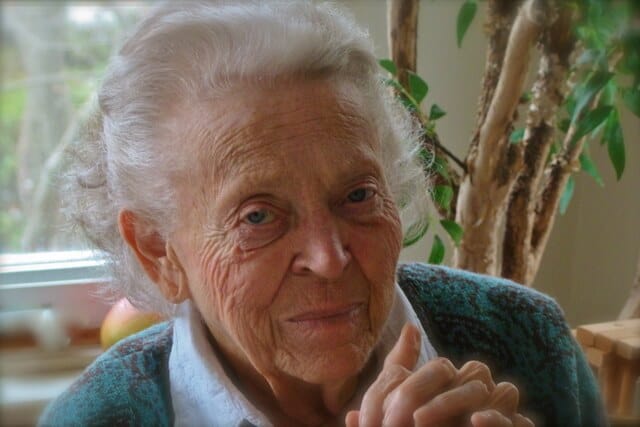
Farewell to Elisabeth Elliot

One of the first books I read as a missionary was the diary of Jim Elliot – missionary to Ecuador who was martyred by the people he went to tell about Jesus.

The diary of Jim Elliot details his thoughts and dreams, his hopes and prayers, as he went to Wheaton college,  went as a missionary to Ecuador, met and married his wife, Elisabeth, and then embarked on a journey to share the Gospel with the unreached Auca indians – an endeavor which ended in both tragedy and glory: tragedy because Jim and his missionary companions were murdered, but glory because after their deaths, the wives of the slain men continued to reach out to the Auca’s, forgave them for what they had done, and ultimately did lead them to Christ.

The reason Jim Elliot’s diary was available for me to read was because of the work of his wife: Elisabeth Elliot, who made it available to the world. Additionally, Elisabeth Elliot wrote two books about their missionary work in Ecuador – one titled Through Gates of Splendorwhich has been called one of the most influential books of the Twentieth Century.

Elisabeth Elliot went on to write many other books and became a prominent advocate for world missions.

Yesterday she entered through those Gates of Splendor herself at the age of 88 and was reunited with Jim in the presence of the God she loved and served her whole life.

Here’s more about Elisabeth Elliot from Christianity Today. Oh that God would give us more people like her! Oh that God would give us the kind of hearts for Him that she and Jim had.

Jim Elliot’s famous quote – brought to the world through the work and advocacy of Elisabeth Elliot:

He is no fool who gives what he cannot keep to gain that which he cannot lose.

Here’s a photo of that quote in Jim Elliot’s own handwriting:

Jim Elliot’s diary

Thoughts on “Unbroken” and the Power of the Gospel

On my recent road trip to Minnesota, my friend lent me an audio book of Unbroken: A World War II Story of Survival, Resilience and Redemption.

I listened to about half of the book while driving, and when I got home I purchased a copy of it because I wanted to know how it ended. I had heard that Louie Zamperini had became a Christian, and was curious to hear how that would be depicted in the book. I had also heard that the movie about the book hadn’t been such a big box office hit as was expected, partly because of the brutality of the depiction of Zamperini’s time as a POW in Japan.

I found the book incredible, and was moved to tears at the account of Zamperini’s conversion and how his heart and his life were transformed by the Gospel. It seemed that everything that had happened until that point – all of the brutality, all of the providence – had been building up to the radical redemption that God worked in his life.

Zamp became a man who was so changed by the Gospel that he was willing to forgive his abusers and was set free from addiction to love his family and work to see other broken people redeemed.

The title of the book has an intentional dual meaning: He was unbroken in the sense that he had survived intensely trying and difficult experiences – and he was un-broken in the sense that his brokenness was healed and he was restored by the power of the Gospel.

I’m not sure if I want to see the movie now after having read the book… I can’t imagine how they could fit into a relatively short film all of the aspects of Zamperini’s life and conversion that were so important to the story.

Here is a quote from the book I found particularly insightful from the period of Louie’s brokenness, before he received the Gospel:

The paradox of vengefulness is that it makes men dependent on those who have harmed them, believing that their release from pain will come only from making their tormentors suffer. In seeking [his tormentor]’s death, Louie had chained himself once again to his tyrant.

All he had left was his alcohol and his resentment, the emotion that, Jean Améry would write, “nails every one of us onto the cross of his ruined past”.

Family Christian Stores Files For Bankruptcy

America’s largest Christian retailer, Family Christian Stores, has filed for chapter 11 bankruptcy protection.

This doesn’t mean that they are closing down; they are doing this in order to save their company. They are going to restructure and try to stay in business.

Perhaps most interesting though, is that while Family Christian Stores is floundering, Lifeway Christian Bookstores is expanding.

What’s the difference between these two?  In short, I would put it this way: Lifeway has higher standards about what they sell and how they do business.

Earlier this year, when it came out that a certain big name pastor/author had committed rampant plagiarism, Lifeway immediately dropped his books from their shelves. Family Christian Stores, on the other hand specializes in cheesy Christian paraphernalia and selling whatever sells. I remember going into one of their stores once and being surprised to see a particular book on their shelves. My wife asked the manager why they sold that book – his response was very telling: he said he was ashamed to have that book on their shelves too, but corporate said that they had to, because they are first and foremost a business and people buy that product.

It would seem to me that the reason Family Christian Stores is struggling whereas Lifeway is flourishing must somehow be attributed to the fact that Christians actually have higher standards and are more discerning as to where they spend their money and what values they want their retailers to represent than Family Christians Stores gave them credit for.