The Most Misused Verses in the Bible

A few weeks ago I saw a promotion on Twitter, offering this book for free on Kindle. I assumed it would be somewhat cliché and predictable, but I’ve been pleasantly surprised!

The book is thoughtful and gives context to many verses which are frequently quoted out of context, and then explains how they are usually misapplied and gives their proper application.

If you’re looking for something to read, I recommend it.

Christianity suffers from too many trite clichés and platitudes; too many scriptures are stripped of their original meanings and used to say things they were never meant to say.

Here are a few quotes from the chapter on Matthew 7:1 – “Do not judge, or you too will be judged.”

When we take a closer look at the context of Matthew 7 and the teachings of the rest of Scripture, it is clear that this verse cannot be used to substantiate unrestrained moral freedom, autonomy, and independence. This was not Jesus’ intent. He was not advocating a hands-off approach to moral accountability, refusing to allow anyone to make moral judgments in any sense. Quite the opposite, Jesus was explicitly rebuking the hypocrisy of the Pharisees, who were quick to see the sins of others but were blind and unwilling to hold themselves accountable to the same standard they were imposing on everyone else.

No one will reach perfection in this life, but together we are to wage war against and forsake the sin that results from living in our fallen flesh. We are to “take off the old life,” so to speak, and “put on the new,” growing in holiness out of reverence for God. But the reality is we can’t accomplish this without the help of the indwelling Holy Spirit and the mutual encouragement and accountability of our fellow brothers and sisters in Christ. We can’t do this alone; we need each other! This then, is why the apostles called us to help one another in our struggle with sin. For example, James says: My brothers, if one of you should wander from the truth and someone should bring him back, remember this: Whoever turns a sinner from the error of his way will save him from death and cover over a multitude of sins. (5: 19– 20 NIV 1984) Paul said something similar in the book of Galatians: Brothers, if someone is caught in a sin, you who are spiritual should restore him gently. But watch yourself, or you also may be tempted. Carry each other’s burdens, and in this way you will fulfill the law of Christ. (6: 1– 2 NIV 1984) Notice that both James and Paul assume two things. First, there will be times when fellow believers will wander off the straight and narrow path. Second, they assume that other Christians, out of love, will seek to come alongside that brother or sister in an effort to bring him or her back from the error of their ways and save them from the destructive power of sin (see Jesus’ method for doing this in Matthew 18: 15– 17). Since we have been commissioned to proclaim a message of repentance and faith to those outside the church who need to hear the good news, certainly we need to proclaim the same message of repentance and faith to those inside the church.

Therefore, Jesus does not forbid all moral judgment or accountability. Rather, he forbids harsh, prideful, and hypocritical judgment that condemns others outright without first evaluating one’s own spiritual condition and commitment to forsake sin. It is my contention that the popular misuse of “do not judge” reveals just how far the discipline of sound biblical study has slipped in recent years. More than that, it sheds light on the state of our culture, a culture that seeks to avoid accountability and responsibility for personal actions. This current trend and mentality runs counter to the teachings of Scripture. For the collective teaching of the Bible insists that those who are created in the image of God are morally responsible to God and to one another. So to use “do not judge” as a means of dismissing oneself from moral responsibility would be to interpret it in a way that pits it against the rest of Scripture.

Bargerhuff, Eric J. (2012-05-01). The Most Misused Verses in the Bible,Surprising Ways God’s Word Is Misunderstood (pp. 25-30). Baker Publishing Group. Kindle Edition.

This book is worth the price. Check it out.


David and Jonathan: Man Love

Tomorrow at White Fields I will be teaching 1 Samuel 18 – which begins with David and Jonathan’s friendship. The text says that the soul of Jonathan was knit to the soul of David, and Jonathan loved him as his own soul (18:1).

This epic friendship between Jonathan and David includes Jonathan giving up his right to the throne in order to allow David to take the place given to him by God. Later on Jonathan helps protect David from Jonathan’s father, King Saul, who is determined to kill David.

After Jonathan’s death at the end of 1 Samuel, 2 Samuel begins with David’s mourning over the loss of his friend, which includes this statement: “I grieve for you, Jonathan my brother; you were very dear to me. Your love for me was wonderful, more wonderful than that of women.” (2 Samuel 1:26).

This statement of David’s has led some to believe that David and Jonathan were more than just friends, that they were actually lovers.

The word “love” in the Greek Septuagint is the word “agape” – as opposed to “eros” (erotic, sensual love) – so it is quite clear that David is not talking about “making love” with Jonathan, but about a deep bond between these two men which was deeper, richer and more profound than any romantic relationship.

And therein is an important point that is being made in the text here: that the deepest bonds between people are not based on physical intimacy, but on sharing the same heart and desires and by being in the trenches together through hard times and good – such an important principle to keep in mind in regard to marriage as well. Marriage can’t only be built on a physical romantic relationship – it has to be built on a spiritual bond and a friendship as well. This is part of the reason why the Bible tells Christians not to be unequally yoked: because the spiritual bond, the same heart for God is an important building block for a solid marriage relationship.


National Day of Prayer

Today is the National Day of Prayer. 
All around the nation today, people will be gathering in churches and at flagpoles to pray for our nation. Click here to find a list of observances near you.

I will be taking part in the Longmont-area noon observance, which is open to all. It will be held at 737 Bross St. in Longmont from 12:00-1:00 PM.

Wherever you are today, set aside your time today to pray for our nation.

Pray for All People First of all, then, I urge that supplications, prayers, intercessions, and thanksgivings be made for all people, for kings and all who are in high positions, that we may lead a peaceful and quiet life, godly and dignified in every way. This is good, and it is pleasing in the sight of God our Savior, (1 Timothy 2:1-3 ESV)

The Importance of Old Testament Ideas of Sacrifice in a Christian Understanding of Atonement

This is an article I wrote for a seminary class on Christology and Atonement, which I have found to be particularly relevant in many discussions – especially the part towards the end about “expiation” vs. “propitiation”.
Feel free to leave feedback in the comments section below.

The Christian doctrine of atonement is an attempt to achieve an understanding of the event of the crucifixion of Christ and the benefits of Christ gained for believers by his death. Atonement theories deal with the question of how an historical event in a specific place and time – the crucifixion of Jesus Christ – can somehow constitute universal saving power in perpetuity, as the New Testament claims that it does (1 Jn 2:2, Heb. 10:10-14). Unarguably, it is from the sacrificial system of ancient Israel that we have inherited the framework and terminology of the Christian idea of atonement. A consideration, therefore, of the Old Testament ideas of sacrifice gives insight into and shapes our view of what was accomplished through the crucifixion.

The Christian claim from scripture and tradition is that Christ’s action constituted God’s gift of salvation, and was not merely illustrative of it. Gunton points out that sacrifice is the primary New Testament metaphor regarding the crucifixion. The early church interpreted Jesus’ death in sacrificial terms, which developed out of a context of the temple cult. It is important to remember that the setting in which Jesus and the early Christians lived was one in which the Old Testament sacrifices were still being offered; in fact, these sacrifices were being offered during practically the whole period of the composition of the New Testament. The antecedents of New Testament ideas of atonement are found in the Old Testament sacrificial system. The book of Leviticus, therefore, gives some of the clearest insights into biblical religion and is fundamental to the New Testament’s understanding of atonement.

In the Old Testament, sacrifice is the divinely appointed way of securing atonement, and the need for atonement exists because humankind is estranged from God by sin, hence the need for reconciliation or ‘at-one-ment’ between humans and God. An important understanding in the Old Testament is the distinction between the holy and the common, the clean and the unclean. One of the duties of the priest was to distinguish between these (Lev. 10:10). Cleanness in the Old Testament understanding has little to do with hygiene; it has to do with imperfection, a distortion of existence. Examples of what would make someone unclean were things like contact with a dead body, a bodily excretion, and committing acts of sin or lawbreaking – either intentionally or unintentionally. God is the super-holy and should anyone unclean come near God, they are liable to be destroyed. Sacrifice was God’s way of removing human uncleanness, so that people could be restored to fellowship with God.

Leviticus lists five main sacrifices: the burnt offering, the grain offering, the peace offering, the sin offering and the guilt offering. Each of these, besides the grain offering, included the shedding of the blood of animals. Each was a sacrifice in the metaphorical sense, in that they were of significant cost to the person who presented the sacrifice, which drives home the idea that atonement has a high price and sin is never to be taken lightly. The sin offering and the guilt offering were for the purpose of atonement for committed sins. The sin offering was particularly focused on purification, whereas the guilt offering carried more of the metaphor of compensation for wrongdoing.

In each of the animal sacrifices, the blood of the animal is shed, and the animal dies. Thus, it is clear that in the Old Testament it was recognised that death was the penalty for sin (Ezek. 18:20), but that God graciously permitted the death of a sacrificial victim to substitute or ransom for the death of the unclean person. Herein we have the basis for the substitutional and representative death of Jesus as a sacrifice on behalf of humankind. This same understanding of substitutional sacrificial death which results in atonement can be found elsewhere in the Old Testament, e.g. in Ex. 32, where Moses seeks to make atonement for the sin of the people by asking God to blot him out of the book which he has written. However, in the Old Testament sacrifices, it is not the death of the animal which is the climax of the rite, but rather what is done with its blood. The blood of the sin offering acts as a spiritual cleanser. Jesus’ blood is also spoken of as that which cleanses from sin, e.g. 1 Jn 1:7. In the Old Testament sacrificial system, the sacrificed creature was required to be unblemished, representing perfection, hence the importance in the New Testament that Jesus was without sin (2 Cor. 5:21, Heb. 4:15, 7:26, 9:14, 1 Pet. 2:22, 1 Jn 3:5); otherwise he would not have been qualified to be an atoning sacrifice.

God says in Leviticus 17:11 of the atoning blood ‘I have given it for you on the altar to make atonement for your souls, for it is the blood that makes atonement by the life.’ From this we learn that although human estrangement from God is because of human shortcomings, God took the initiative to provided the means for atonement. This idea carried into the New Testament view of atonement, in which, once again, God is the one who provides the means for our atonement by sending Jesus to be our atoning sacrifice.

Furthermore, the greatest day in the Old Testament calendar was the Day of Atonement, which was so significant that it became simply referred to as ‘the Day’. On this day, special sin offerings were made by the high priest for himself and for the whole nation. One of the elements of the Day of Atonement was the scapegoat ceremony in which the high priest laid his hands on the goat and confessed all the sins of the people, thereby symbolising the transferring of the nation’s sins onto the goat. Herein we have the basis for the understanding of making atonement for a large group of people at one time, rather than only for individuals, as well as the idea of transference of sin and guilt onto an innocent party – both of which are central to the Christian concept of atonement, in which our sins are transferred onto Jesus, and he who knew no sin becomes sin for us (2 Cor. 5:21, Is. 53:6, Jn 1:29, 1 Pet. 2:24).

The importance of Old Testament ideas of sacrifice in the Christian account of atonement are perhaps nowhere more greatly pronounced than in the letter to the Hebrews, which David Ford calls ‘the most fully developed theology of the death of Jesus in the New Testament’. The great concern of the letter to the Hebrews is to show that the Old Testament sacrifices were inadequate except as types, which foreshadowed and pointed to Christ. This is proven by the fact that they cannot provide entrance into the holy of holies, nor free the conscience from guilt. Rather than remedies for sin, they are reminders of sin, imposed until a time of reformation. (Heb. 9:6-10, 10:3), which has now come in Christ, who was the true and final sacrifice, after which no more sacrifices for atonement are needed (Heb. 10:11-14).

Furthermore, according to Hebrews, Jesus is not only the atoning sacrifice, but he is also the fulfilment of the high priest, who enters heaven (the reality of which the holy of holies was merely a representation), not with the blood of bulls and goats, but with his own blood. (Heb. 9:23-26). Thus, Jesus’ death is not simply seen as having been the result of wicked men rising up against him and overcoming him because he was not able to resist them, but as an intentional sacrifice, which Jesus came to present, in order to make atonement for humankind (Mk 10:45).

However, it is not only the letter to the Hebrews which reflects this understanding of Jesus’ crucifixion as being an atoning sacrifice. References to atoning sacrifice, which use the language and imagery of the Old Testament sacrificial system are found throughout the New Testament. He is spoken of as the true passover lamb (1 Cor. 5:6-8) and as a sin offering (Rom. 8:3). Jesus spoke of his blood as the blood of the covenant which was poured out for the forgiveness of many (Matt. 26:28).

Historically, Christian accounts of atonement have been culturally mediated, deriving from their socio-political contexts, and reflective of prevailing philosophical ideas. In this sense, it is understandable why Christianity, born in a Jewish context, would have drawn so heavily on Old Testament ideas and imagery of sacrifice. In modern times, the idea of a sacrificial cult in which blood has to be shed in order for forgiveness of sins to take place is generally considered crude, primitive and unsophisticated, and it has been suggested that Christians should take on different views of the significance of Jesus’ life, death and resurrection, for example an exemplarist view, in which we learn from Christ the virtue of self-sacrifice, and are moved by his act of self-sacrifice to repentance and faith and are motivated to live a life of holiness. Wellhausen’s moral evolution account has contributed to this line of thinking, in which he claimed to see a critique of cultic practices present in the prophets. However, since most of the prophets were also priests, they were involved with sacrifice and were rather criticising the practice of making offerings in the wrong spirit rather than critiquing the cultic practice of sacrifice itself. Another modern emphasis on sacrifice is that it be understood metaphorically in terms of a ‘gift’. Fiddes points out that this is a slippage form the ancient use of the term which formed the context for early Christian reflection on the death of Christ. Even in Old Testament times, there was precedent, e.g. in the Psalms, to speak of sacrifice in metaphorical terms (‘spiritual sacrifice’), but this was not a substitution of the literal animal sacrifices. In fact, early Christians drew on both the spiritual sacrifices and the literal sacrifices to provide a backdrop and meaning for the death of Jesus.

During the Reformation, one of the theories of atonement which became popular was that of penal substitution; that the law of God demanded punishment from those who breached it and that God, as a strategy of love, effectively propitiated himself in Christ, satisfying the demands of his own justice. The attraction of this theory has been that it does appear to explain how the death of Christ is a final and decisive event, and after his death the anger or truth of God needs not be propitiated again. However, the shortcoming of this theory of atonement is that when we consider the Old Testament sacrificial system, what we find is that atonement is centred around cleansing the unclean person from that which makes them unclean, rather than about dealing with the reaction of God against sin. If we are to claim that the Old Testament sacrificial system is the basis for the Christian understanding of atonement, then we must recognise that the Old Testament sacrificial system was not focused on dealing with God’s reaction to sin, but with removing sin and making the unclean clean. Fiddes contends that when Romans 3:25 says that Jesus was ‘propitiation by his blood’, that the word translated propitiation (‘hilasterion’) should rather be understood as ‘expiation’ (‘to wipe away’), because God is always the subject of the process of atonement, never the object. Although the word ‘hilasterion’ means ‘propitiation’ when it is used in other texts of the period, Fiddes claims that when the New Testament writers use it they are intentionally changing its meaning to mean expiation, which is what the Old Testament atoning sacrifices describe. Certainly the Bible does depict God being angry against sin (e.g. Rom. 1:18). But even though God does feel anger and wrath towards sin, when he acts to make atonement he is not acting to satisfy his anger, but to remove sin. Those who refuse to appropriate this atonement will remain unclean and estranged from God.

It is clear that the writers of the New Testament drew heavily on the imagery of the Old Testament sacrificial system in regard to the significance of the life and death of Jesus. This imagery was not only used by the writer to the Hebrews, but is also found in the writings of Paul, Peter, John and the writers of the Gospels, who give us examples of Jesus speaking in such terms about himself. If then the Old Testament sacrifices are the basis of our Christian account of atonement, we can gain insight into what the crucifixion of Christ did and did not mean when we consider the purposes and effects of the Old Testament sacrifices.

Bibliography:
Beckwith, R.T., ‘Sacrifice and Offering’ , in New Bible Dictionary, 3rd edn, ed. by I.H. Marshall, A.R. Millard, J.I. Packer, and D.J. Wiseman, eds, New Bible Dictionary, 3rd edn (Leicester: Inter-Varsity Press, 1996), pp. 1035-1044
Carter, D., THY303 Christology and Atonement in Historical Perspective (Cheltenham: University of Gloucestershire, 2012)
Currid, J., K. Nobuyoshi and J.A. Sklar, ‘Leviticus’, in ESV Study Bible, ed. by L.T. Dennis, W. Grudem, J.I. Packer, C.J. Collins, T.R. Schreiner and J. Taylor (Wheaton, Illinois: Crossway, 2008), pp. 211-256
Fiddes, P.S., Past Event and Present Salvation: The Christian Idea of Atonement (Louisville: Westminster/John Knox Press, 1989)
Gunton, C.E., The Actuality of Atonement: A Study of Metaphor, Rationality and the Christian Tradition (Grand Rapids: Eerdmans, 1989)
Goldingay, J., ‘Old Testament Sacrifice and the Death of Christ’ in John Goldingay, (ed.) Atonement Today, a Symposium at St. John’s College, Nottingham (London: SPCK, 1995), pp. 3-20
Marshall, I.H., A.R. Millard, J.I. Packer, and D.J. Wiseman, eds, New Bible Dictionary, 3rd edn (Leicester: Inter-Varsity Press, 1996)
McGrath, A.E., Christian Theology: An Introduction, 4th edn (Malden, MA: Blackwell Publishing, 2007)
Morris, L.L., ‘Atonement’, in New Bible Dictionary, 3rd edn, ed. by I.H. Marshall, A.R. Millard, J.I. Packer, and D.J. Wiseman, eds, New Bible Dictionary, 3rd edn (Leicester: Inter-Varsity Press, 1996), pp. 102-104
Morris, L.L., “Theories of the Atonement”, Monergism <http://www.monergism.com/thethreshold/articles/onsite/atonementmorris2.html&gt; [28/06/13]
Wenham, G.J., The Pentateuch, Exploring the Old Testament: Volume 1 (London: SPCK, 2003)

What is the Scope of Salvation?

One of the things I’m intrigued by in the Bible is the meaning of salvation. I have noticed in myself and others a tendency to settle for a narrower understanding of the scope of the salvation that is promised to us in Jesus than the fullness of what is found in the scriptures.

Of course this is not to distract from or undermine the central concern for our relationship with God and our need to be put right with him (justification). But when you see the scope of salvation in the Bible, beyond saving us from damnation, it is exciting!

For example, in chapter 19 of the Gospel of Luke, Zacchaeus, having spent years ripping people off, turns to Jesus and repents of his greed and sin, and also shows signs of true repentance when he gives back the money he ripped off to the people he took it from, even though it may have happened years prior – and Jesus declares: “salvation has come to this house today” (Luke 19:9). Salvation for Zacchaeus was salvation for his soul, AND deliverance from bondage to vain things AND salvation unto a new course in life as a disciple of Jesus – which inherently means taking an active role in God’s mission to bring salvation to the world.

The very name Jesus means “Savior”!  Here are some quotes on the meaning and scope of the salvation that’s found in Jesus:

Salvation itself, the salvation Christ gives to his people, is freedom from sin in all its ugly manifestations, and liberation into a new life of service, until finally we attain ‘the glorious liberty of the children of God. (J. Stott, Christian Mission in the Modern World)


In the Old Testament the word ‘salvation’ speaks of ‘shalom’, or complete wholeness of being, in every dimension of life. (A. Motyer, The Prophecy of Isaiah)


The three tenses of salvation – past, present and future – are united into an organic whole; they may be distinguished but must not be separated. The salvation that the gospel proclaims is not limited to man’s reconciliation to God. It involves the remaking of man in all the dimensions of his existence. It has to do with the recovery of the whole man according to God’s original purpose for his creation. (R. Padilla, Mission Between the Times)


The full gospel brought by Jesus Christ is both salvation from sin and salvation into the capacity to be fully human and truly free. (D. Webster)

Exciting? I think so.

How to Avoid Failure

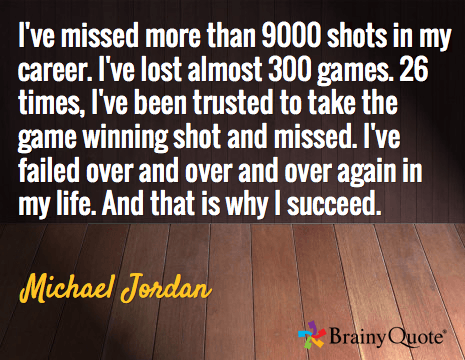
Kobe Bryant holds an NBA record. Do you know which one? Most missed shots. Of any player. Ever.

When Kobe set this record in the 2013 season with his 15,296th missed shot, guess whose record he broke… Michael Jordan. Until 2013, Michael Jordan had been the NBA player with the most missed shots ever.

Yet, Kobe and Michael are also 2 of only 5 players to ever score over 30,000 points in their NBA careers.

The other players? Kareem Abdul Jabar, Karl Malone and Wilt Chamberlain. Consequently, Karl Malone and Kareem Abdul Jabar also hold the number 4 and 5 spots for most shots ever missed.

Long before he went on to reach the 15,000 missed shots mark, Michael Jordan said this in an interview:

Image

Proverbs 14:4 says “Where there are no oxen, the manger is clean, but abundant crops come by the strength of the ox.”

Nobody likes messes. Messes are messy. If you want to completely avoid messes, then here’s an easy way: never have an ox.  If you have an ox, you will always have messes to clean up.  BUT – if you have an ox, then you will also have increase and profit and great things. BUT you will also inevitably have messes.

There is a sure-fire way to never fail: don’t try anything. Play it safe. Don’t take risks, don’t take chances. Don’t get invested in anything. Don’t wade out into the deep water – just splash around in the shallows.

If you do that – you will never fail. You will never have to deal with messes. There will never be anything to clean up. BUT, you will never reap the benefits which only come to those who dare to take a shot.

The Open Market and Songs About God

Following up on my recent post about Bono on Jesus:

I think sometimes it can be easy for Christians to forget what Romans 1:19-20 says: “For what can be known about God is plain to [all people], because God has shown it to them. For his invisible attributes, namely, his eternal power and divine nature, have been clearly perceived, ever since the creation of the world, in the things that have been made.”

What that means is that all people are grappling with ideas and questions about God. Christians can be quick to discount what people “outside the fold” think or say about God – but the truth is that sometimes they have some pretty astute and profound things to say, even though they may have no commitment to Jesus. On the other hand, I am sometimes frustrated with the trite nature and shallow lyrics of some “Christian” music.

The are some “secular” songs out there which put some “Christian songs” to shame, because they reflect a deeper, more sincere, more REAL engagement with questions about the person and character of God.

Here are a few examples for you. If you have any others to suggest, leave me a comment below!

First: Regina Spektor

Second: Dashboard Confessional.  Listen especially to the middle of this one, where Chris Carrabba is asking God to help him with the sin he wants to be set free from and talks about his struggles with unbelief.

Is Christian Evangelism Presumptuous?

Evangelism, proselytizing, seeking to convert people to our faith – these are things which are inherent to Christianity if one is to take the words of Jesus as true and relevant.

However, some – even some Christians – feel that this is presumptuous; that Christians should just do their thing and let other people be drawn to it if they will – but not actively attempt to convert others to their faith.

I found this quote to give a helpful perspective:

A major aspect of the Great Commission is the emphasis that Jesus places upon his authority. This is vitally important, because unless Jesus has such authority how can he give such a command? This is a kingly command which assumes that he is Lord over all peoples. If Jesus is not the King, his Commission is presumptuous and without foundation. If he is King, then the whole of life ought to be subject to his royal authority. The fact that God is King is the heart of the Gospel message.

The authority of the missionary lies therefore in the very person of Christ. If Jesus is the King of God’s Kingdom then the missionary has the right, even the duty, to go to all people. If he is not King, then the missionary has no right to seek to take his religious ideas to others. Is Jesus Lord? This is the vital question.

– D. Burnett, “God's Mission: Healing the Nations”


Sold into the Hand of Sisera

Last Sunday I preached on 1 Samuel 12, which is the speech that Samuel gives to the nation at the re-coronation of Saul.

There is a very intriguing statement in this section, which I didn’t address in the sermon, but I think is worthy of consideration.

And Samuel said to the people, “The Lord is witness, who appointed Moses and Aaron and brought your fathers up out of the land of Egypt. Now therefore stand still that I may plead with you before the Lord concerning all the righteous deeds of the Lord that he performed for you and for your fathers. When Jacob went into Egypt, and the Egyptians oppressed them, then your fathers cried out to the Lord and the Lord sent Moses and Aaron, who brought your fathers out of Egypt and made them dwell in this place. But they forgot the Lord their God. And he sold them into the hand of Sisera, commander of the army of Hazor, and into the hand of the Philistines, and into the hand of the king of Moab. And they fought against them. And they cried out to the Lord and said, ‘We have sinned, because we have forsaken the Lord and have served the Baals and the Ashtaroth. But now deliver us out of the hand of our enemies, that we may serve you.’ And the Lord sent Jerubbaal and Barak and Jephthah and Samuel and delivered you out of the hand of your enemies on every side, and you lived in safety. (1 Samuel 12:6-11, ESV)

Samuel says: Let me tell you of all the righteous deeds of the Lord that he performed for you.  Then he tells them that God “sold them into the hand of Sisera,” a Philistine general.

Notice – he didn’t ‘allow them to fall into the hand of Sisera’ – it wasn’t a passive allowance, but an active SELLING! He SOLD them into the hand of Sisera – and THIS, of all things, is given as an example of one of the righteous acts of the Lord, which he performed on behalf of the people of Israel because of his love and care for them!

This is a little bit different picture of God than what we usually get in the “moralistic therapeutic deism” which is passed for Christianity these days in many places – where God exists to be your friend, make your problems go away and make your wishes come true. When bad things happen, usually we are told that God passively allows these things to happen to you, so that you can grow through them.

But isn’t that a bit trite and simplistic?  Not to mention – that viewpoint has no capacity to deal with real evil – or even with scriptures such as the one mentioned above. The vision of God given here is of a God who is willing to sell you into the hand of Sisera if that’s what it takes to get you to turn back to Him! To God, in this story, it was obviously more important to Him that the people of Israel turn back to Him and pursue Him than that they be comfortable and problem-free.

What about you? Is it possible that the difficulties in your life have not just been passively “allowed” by God, but actively sent by God into your life for the purpose of moving you in a certain direction or getting you to a certain place, either physically or spiritually?

Could it be that God has sold you into the hand of Sisera in order to do a work in your heart, because He loves you?

I Believe in Miracles; Here’s Why.

I believe in miracles because I have one walking around in my house. Here’s our story:

In January of 2010, my wife Rosemary was in her final month of pregnancy with our second child, a girl whom we had decided to name Felicia, which means “happy”. It has been a pretty smooth pregnancy, with one exception: in the last trimester she experienced intense itchiness in her skin, like it was on fire. It was so unbearable that she was unable to sleep and sometimes resorted to standing outside in the cold to numb her skin. We now know that this was caused by a condition called cholestasis, in which the liver stops functioning, and isn’t cleaning the blood. This condition went undiagnosed, and led to what happened next.

Rosemary went into labor naturally, and was quietly getting ready to go to the hospital, but at one point her contractions suddenly went from being 9 minutes apart to being 2 minutes apart. She had a sense that something was wrong with the baby, so she told me that we needed to leave immediately, and left our 2 year old son with our neighbors and we rushed to the hospital.

We arrived at Markhót Ferenc Megyei Kórház, the hospital in Eger, Hungary which was about a 10 minute car ride from our home, just a minute or two after 8 o’clock that morning. The nurses took Rosemary into the room to measure her vital signs, while I waited outside in the hallway. At this point I assumed that everything was fine, and that I would be welcomed into the birthing room shortly, as I had been with our first child who was born in that same hospital. I started emailing my parents on my phone, letting them know that the baby was on her way.

Only a few minutes later, the door to the birthing ward was flung open, not by a nurse inviting me in as I had expected, but by the doctor, who came running into the hallway, nervously yelling to others down the hall to come immediately. He then turned to me and said, “There’s a problem with the baby”, and disappeared back behind the door of the birthing unit.

Over the next few minutes, 20 or so doctors and nurses ran past me into the room where my wife was. I didn’t know anything, and when I asked the nurses what was going on, they told me they couldn’t tell me anything — only the doctor was allowed to do that, but they privately said that it was bad and the baby may not survive. At one point a nurse ran into the birthing ward carrying a plastic tube of some kind, and a few minutes later 3 nurses ran out holding a little body wrapped in towels, while one of them pumped frantically on that same plastic device as they transported her to another area of the hospital.  After about an hour of nervously waiting for any news, I saw our doctor, who knew I was a pastor, and as he ran past me in the hall, simply said: “Pray!”.

Three hours passed as I waited for the doctor to call me in and tell me what had happened. I was called into the office of Dr. Kovács Krisztina, the head of the neonatal department. She explained that when they had first called Rosemary in for examination, they were not able to find the baby’s heartbeat, and they had to do an emergency caesarian. She explained that they didn’t know why, but that our daughter had gone without oxygen for quite a long period of time. At this point I asked the question which had been on my mind for hours: “Is my baby alive?” “Yes, she’s alive, but there is a good chance she will not live through the next 24 hours. And if she does, then you can be sure that she will have life-long serious disabilities, because she went so long without oxygen, that she has suffered serious brain damage.” Her APGAR score was a 1, the lowest score possible. She was not breathing at all, and the only reason she got an APGAR of 1 was because she did have a faint heartbeat.

Dr. Kovács explained to me that there is only one treatment for babies in this condition, but it is very experimental, and so I would need to sign a consent form. The treatment involved putting the newborn baby into a morphine induced coma and then subjecting them to hypothermia to try to salvage what was left of their brain and other vital organs which had started to die due to the lack of oxygen. I signed the papers, and then was taken into a room, where Felicia—whose body was completely grey and lifeless except for the fact that a respirator violently caused her chest to rise and fall—was in an incubator, and she was wheeled in to where Rosemary was. Rosemary had been put under during the emergency surgery and was just coming to—and they made her reach in the incubator and touch Felicia. Basically, they were making sure she got the chance to meet her baby and say goodbye.

Right after that, Felicia was wheeled outside, where she was taken by a special ambulance from the Peter Cerny foundation, which helps babies get to the Semmelweis university hospital neonatal intensive care unit in Budapest. Semmelweis is the best equipped hospital in the country for neonatal ICU, but they have limited space—room for 10 or so babies at a time, so they only take the worst of the worst. When Felicia arrived, we were told that she was in the worst condition of any of the babies in that unit.

I went home and packed up my son to go to Budapest to be with Felicia—and I quickly wrote a blog post asking people to pray for a miracle. I would continue writing posts about Felicia, which were then shared on social media and sent around the world. Thousands upon thousands of people began praying for Felicia’s healing from every corner of the globe, and messages began filling my inbox from places like India and Africa, from people I had never met, telling me they were praying for God to heal our little girl for His glory.

For the next 2 weeks, Felicia was unconscious. She had wires and tubes sicking out of every part of her little body and she was on a respirator, because she was not able to breathe on her own. During that time the doctors conducted a blood test and found an enzyme in her blood that indicated brain damage. A normal level of this enzyme would be 25 count – Felicia’s level was 1500 count; very disheartening news. The doctors told us to prepare for the worst. They were unsure if she would ever wake up from the coma, and even if she did, it was unsure if she would ever breathe on her own, not to mention whether her nervous system or vital organs would function properly. Not only had she gone without oxygen, but she had inhaled meconium, which filled her lungs and throat, which had developed into pneumonia. She had also inhaled meconium, which had then infected her digestive tract. We were told there was a good chance she would be in a vegetative state for her whole life.

DSC_0296
In the NICU during the coma

All we could do was pray. And so we asked everyone we possibly could to pray for her – churches around Hungary and throughout the world began praying for her. People I had never met began approaching me and telling me, “I’ve been praying for your daughter!” Our church in Eger came together to support our family; the community of Calvary Chapels in Hungary rallied around us, praying for us and encouraging us constantly.

After 7 days of being in the coma, Felicia woke up. Rosemary got to see her that day for the first time, but it was bittersweet. Although Felicia was alive and awake, she showed signs of being handicapped. Her eyes were crossed, she could not focus on anything, she could not swallow, and did not move. We left that night with a sense of heaviness, but once again wrote a blog post asking people to pray for Felicia to be fully healed.

The next day we walked into the ICU to find a different baby in Felicia’s bed; it was her, but she was so different than the night before, that we hardly recognized her! That night, her condition had changed completely. She made eye contact, was moving, had started swallowing milk and making noises!

After another week in that unit, Felicia was transferred to intermediate care, and then to Developmental Neurology at a different hospital in Budapest. She had suffered brain damage; even though seemed to be doing better, she was still very sick; she basically had no reflexes. Rosemary spent a week in the Developmental Neurology department being trained by doctors to do reflex therapy with Felicia at home in order to create new pathways in her brain, taking advantage of the abundance of stem cells that babies have. During this time we continued to pray for her healing.

For 8 months, we spent 6 hours a day doing therapy with Felicia. At times we had people come live with us to help cook and clean, so we would be free to care for our little girl. At one of our regular visits to the neurology department, after 8 months of therapy, we were told that Felicia was healed. She now had all the normal reflexes that a baby her age should have; reflexes being a key indicator of healthy brain function.

All the doctors and the nurses who witnessed Felicia’s recovery told us that it was a true miracle—that they had never seen a baby who was in that bad of a condition – the worst in the entire country when she arrived – get better, and not just get better, but to the point of having no symptoms!  Felicia had 5 different doctors who treated her, and each of them told us that surely God must have healed her.

On Felicia’s first birthday we had a party. To this 1 year old girl’s party, people came from all over Hungary and even from the United States. Most notably, the head doctor of the Neonatal Intensive Care Unit at Semmelweis, who had personally attended to Felicia during her time there, Dr. Szabó Miklós, as well as Dr. Kovács Krisztina came to the party, and Dr. Szabó spoke, and told everyone that as a doctor, he can attest to them, that Felicia’s healing was a genuine miracle. He said that he never accepts invitations from the families of his former patients, but he drove up to Eger from Budapest for Felicia, because her story was so special and remarkable to him.

God healed Felicia. When Felicia was 18 months old, we were told that she would no longer need a neurologist. She was given a completely clean bill of health!

In 1 Chronicles 16, David says:
[8] Oh give thanks to the LORD; call upon his name; make known his deeds among the peoples!
[9] Sing to him, sing praises to him; tell of all his wondrous works!
[10] Glory in his holy name; let the hearts of those who seek the LORD rejoice!
[11] Seek the LORD and his strength; seek his presence continually!
[12] Remember the wondrous works that he has done, his miracles and the judgments he uttered,
[23] Sing to the LORD, all the earth! Tell of his salvation from day to day.
[24] Declare his glory among the nations, his marvelous works among all the peoples!
[25a] For great is the LORD, and greatly to be praised,
[28] Ascribe to the LORD, O families of the peoples, ascribe to the LORD glory and strength!
[29] Ascribe to the LORD the glory due his name;
[31] Let the heavens be glad, and let the earth rejoice, and let them say among the nations, “The LORD reigns!”

Again and again in this song of David – he says “tell” of his wondrous works. Remember the miracles he has done, and bring glory to God by declaring those things to the nations, so that all will see that He indeed is Lord of heaven and Earth!

Today Felicia turned 4 years old, and she is completely healthy in every way!  She is a true miracle.

We will never forget, and we will continue to faithfully tell our story for His glory.

IMG_1068