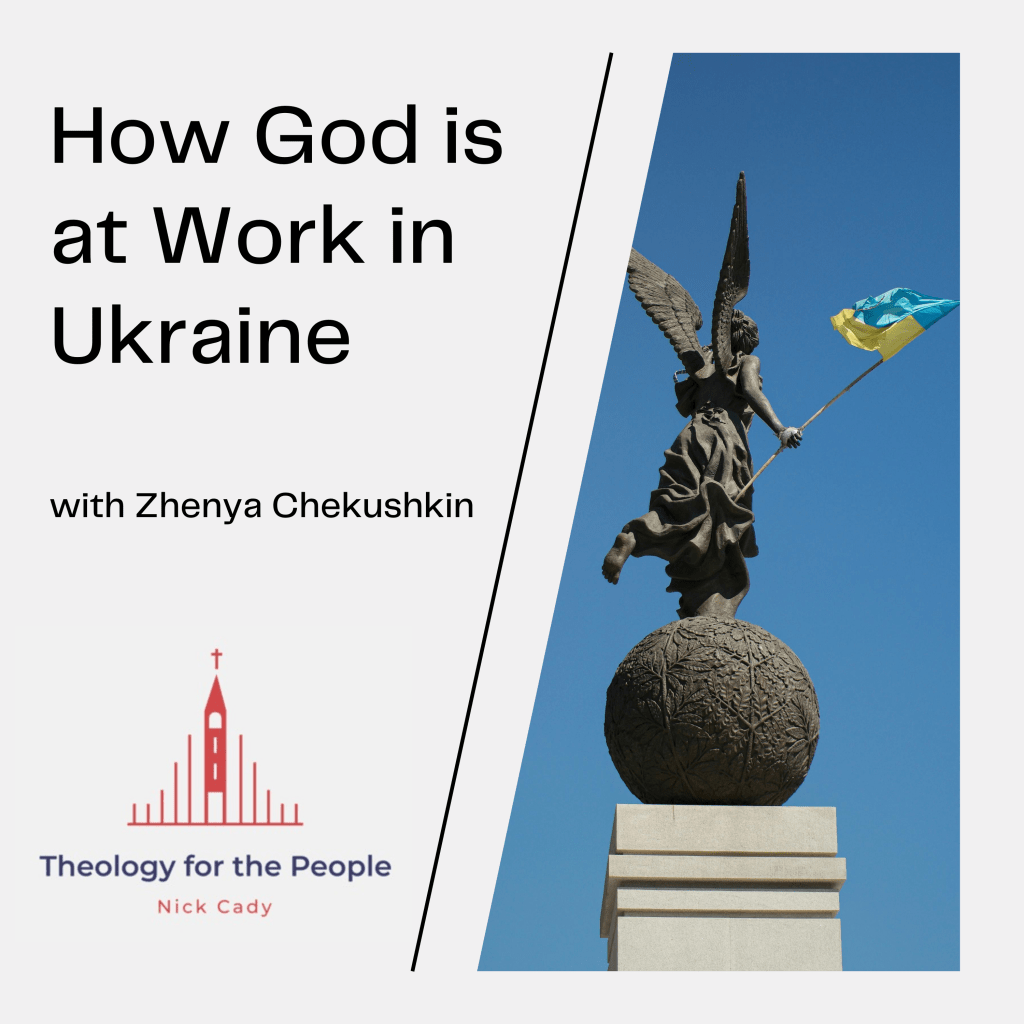
How God is at Work in Ukraine – with Zhenya Chekushkin

In this episode of the Theology for the People Podcast, I speak with Zhenya Chekushkin: a pastor from Western Ukraine and a longtime friend. Zhenya shares about his experience of growing up in a communist military family in the Soviet Union, coming to faith at age 13, and now leading a church through the ongoing war in Ukraine.

From the fall of the Soviet Union to the rise of evangelicalism and the current conflict, Zhenya offers a firsthand perspective on how God is moving amid chaos—and how listeners can join in.

How You Can be Involved and Support:
◦ Financially: Donate to the Ukraine Relief Fund at whitefieldschurch.com under the giving tab.
◦ In Person: Short-term mission trips (conferences, camps, building projects) or longer-term ministry—contact Jenia via White Fields or social media.
◦ Church Planting: Opportunities available with Calvary Chapel Ukraine’s support. See: cultivatechurchplanting.com
• Stay Updated: Email calvarychapelukraine@gmail.com to join Zhenya’s newsletter list (every 2-3 months).

Film Mention: The Book of Eli – A post-apocalyptic tale of a man preserving the Bible, reflecting on morality without God (not sponsored, just Zhenya’s pick!)

Click here to listen to the episode, or listen in the embedded player below.

How God is at Work in Ukraine – with Zhenya Chekushkin Theology for the People

Zhenya Chekushkin is a pastor from Western Ukraine and a longtime friend. Zhenya shares his unique story: growing up in a communist military family, coming to faith at 13, and now leading a church through the ongoing war in Ukraine. From the fall of the Soviet Union to the rise of evangelicalism and the current conflict, Zhenya offers a firsthand perspective on how God is moving amid chaos—and how listeners can join in.Support Options:Financially: Donate to the Ukraine Relief Fund at whitefieldschurch.com under the giving tab.In Person: Short-term mission trips (conferences, camps, building projects) or longer-term ministry—contact Jenia via White Fields or social media.Church Planting: Opportunities available with Calvary Chapel Ukraine’s support—reach out for details.Stay Updated: Email calvarychapelukraine@gmail.com to join Zhenya's newsletter list (every 2-3 months).Film Mention: The Book of Eli – A post-apocalyptic tale of a man preserving the Bible, reflecting on morality without God (not sponsored, just Zhenya's pick!).Connect with Us:Subscribe to Theology for the People podcastVisit the Theology for the People website at theologyforthepeople.com

Colorado Bill Takes Aim at Christian Parents

Here in Colorado a piece of legislation—House Bill 25-1312—is moving through the State Legislature under the banner of protecting transgender individuals. However, this bill poses significant risks to parental rights, especially for parents who hold a biblical view of human identity, design, and flourishing.

The bill has already passed the Colorado House of Representatives and is now before the State Senate. If it passes that, it will go to the desk of Governor Polis to be signed into law.

The Centennial Institute at Colorado Christian University strongly urges the Colorado Senate to vote ‘No’ on the proposed bill. “HB25-1312 sets a dangerous precedent by punishing those who live out their biblical convictions,” said Greg Schaller, Centennial Institute director.[1]

What the Bill Says

Among other things, HB25-1312:

  • Directs courts in child custody cases to consider behaviors such as deadnaming (addressing someone using their birth name) or misgendering (referring to someone by their biological pronouns) as forms of “coercive control.”
  • Prohibits Colorado courts from recognizing laws from other states that restrict access to “gender-affirming care” (hormone treatment and surgery) for minors without parental consent.
  • Frames a parent’s hesitance or objection to gender transitions as potentially harmful conduct in custody disputes.

What Does This Mean?

1. Loving Parents Could Lose Custody of Their Kids for Holding Biblical Convictions
A Christian parent who lovingly urges their child to embrace the gender which aligns with their biological sex, or does not sign off on making irreversible decisions like hormone therapy or surgery, could be accused of “coercive control” for upholding their biblical convictions, and have their children taken away.

2. Parental Disagreement Could Be Treated as Abuse
HB25-1312 equates disagreement with harm, if parents do not affirm the child’s new name or identity. These legislators are trying to define what constitutes a child’s “best interest,” taking that decision away from parents – not to mention that they are defining the child’s best interest based on a particular ideology. If someone doesn’t share their ideology, they are deemed to be abusive and not acting in the child’s “best interest.”

3. It Sets a Precedent Against Religious Belief
Christians believe biological sex is part of God’s design. To force parents to affirm something that they believe to be untrue puts them in a moral bind: give up their convictions or lose custody of their kids.

What Can Christians Do?

1. Read the bill

2. Contact State Senators
You can find your Colorado State Senator’s email address here.

3. Sign this Petition for the State Senate and Governor Polis to veto the bill

4. Pray that this bill does not get passed

The Council of Chalcedon (451 AD) – with Shane Angland

In this episode of the Theology for the People Podcast, I sit down with returning guest Shane to explore the Council of Chalcedon (AD 451), the fourth ecumenical council of the early church.

Recorded live in Colorado during an Expositors Collective training weekend, this conversation traces the events leading up to Chalcedon, its theological breakthroughs, and its messy aftermath.

From the fallout of the Council of Ephesus, to the clash between the Alexandrian and Antiochian schools of Christology, and the mess of Ephesus II, Shane breaks down the stakes: how do we understand the two natures of Christ—human and divine—in one person?

The episode also tackles the political power plays, the deposition of bishops, and the schisms that followed, including the rise of the Oriental Orthodox churches. Plus, hear why Shane sees Chalcedon as both a triumph and a tragedy—and what it still teaches us today.

Resources Mentioned:

Click here to listen to the episode, or listen in the embedded player below.

The Council of Chalcedon (451 AD) – with Shane Angland Theology for the People

In this episode, Nick sits down in person with returning guest Shane to explore the Council of Chalcedon (AD 451), the fourth ecumenical council of the early church. Recorded live in Colorado during an Expositors Collective training weekend, this conversation traces the events leading up to Chalcedon, its theological breakthroughs, and its messy aftermath. From the fallout of the Council of Ephesus to the clash between the Alexandrian and Antiochian schools of Christology, Shane breaks down the stakes: how do we understand the two natures of Christ—human and divine—in one person? The episode also tackles the political power plays, the deposition of bishops, and the schisms that followed, including the rise of the Oriental Orthodox churches. Plus, hear why Shane sees Chalcedon as both a triumph and a tragedy—and what it still teaches us today.Resources Mentioned:The Definition of Chalcedon (available online for further reading).Bruce Shelley’s Church History in Plain Language (Fifth Edition).Augustine’s The Unity of the Church on the role and limits of councils.Visit TheologyforthePeople.com

What Palm Sunday Teaches Us About True Worship

This article was originally published on CalvaryChapel.com

As Jesus rode into Jerusalem on a donkey, the crowds erupted in praise. They laid their cloaks on the road, waved palm branches, and shouted, “Hosanna to the Son of David! Blessed is he who comes in the name of the Lord!” (Matthew 21:9).

And yet, Luke’s Gospel tells us that while the crowds cheered, Jesus wept (Luke 19:41). He knew that the fanfare was not going to last, and that many of the people were going to reject the salvation He had come to bring.

The people of Jerusalem wanted a Messiah who could free them from Roman rule. Jesus had come to do something much bigger, and even better, than the best thing they could imagine in that moment. He had come to bring salvation for their souls and establish an everlasting kingdom.

One of the most important lessons we can learn from the events of Palm Sunday is what it means to truly worship Jesus.

1. True Worship Involves Honoring Jesus as King

Jesus’ entry into Jerusalem on a donkey was a deliberate declaration: By fulfilling the prophecy in Zechariah 9:9, Jesus was announcing that He was the long-awaited “Son of David,” the one who would restore the throne of David, which God had promised would be an everlasting house.

And yet, Jesus was also declaring that He was a different kind of king than what many people might have anticipated. Conquering kings ride warhorses. Jesus rode on the foal of a donkey—not even a full-grown donkey! He was coming not to make war against the Romans but to sacrifice His life.

As the people shouted “Hosanna” (“Save now!”), they acknowledged Jesus as their king, even if many of them underestimated the breadth of the nature of the salvation He had come to bring. And yet, they were right to acknowledge Him as their king! The essence of worship is surrender to Jesus as your king: to give Him the place of ultimate authority over every area of your life. True worship means surrendering our plans and expectations into His hands and entrusting ourselves wholly over to Him.

This Palm Sunday, it is worth asking yourself the following: Have I made Jesus my king?

My pastor, Tom Stipe, used to say, “I just want to be a penny in God’s pocket that He can spend wherever and however it pleases Him best.” The essence of worship is surrender, and like Isaiah, who saw a glimpse of God’s glory, when we really understand who God is—both His majesty and His grace—it causes us to respond to His call and surrender our lives to His will. To make Jesus your king means letting Him sit on the throne over you, and following His lead in every area of life.

2. True Worship Involves Receiving His Salvation

When Jesus entered Jerusalem, the city was stirred (Matthew 21:10). The Greek word used here is seismos—the same word used for earthquakes. His arrival shook the city.

But rather than leading the crowds up to the Roman garrison at the Atonia Fortress to overthrow the Romans, Jesus led them up onto the Temple Mount, where He overturned the tables of the money changers and spoke out against the corruption of Israel’s religious elites.

The salvation that Jesus came to bring was not the salvation they had been hoping for. Truly, it was something better, but many of them were not able to see that yet. Similarly, there are times in our lives when God does not do what we expect or perhaps hoped He would. True worship in these cases involves walking with God by faith: trusting in His character, His promises, and His Word, and embracing His plan for your life, knowing that He knows what you truly need, and that He who did not spare even His own Son, but gave Him up for you, will surely work all things together for your good, since you are called according to His purpose (Romans 8:28, 32).

3. True Worship Involves Yielding to His Purifying Work

When Jesus arrived at the Temple, He did something that surprised those who were gathered there: He overturned tables, drove out the money changers, and said, “Is it not written, ‘My house shall be called a house of prayer for all the nations’? But you have made it a den of robbers” (Mark 11:17).

The religious leaders had turned the “courtyard of the Gentiles” into a marketplace. Here, Jesus is quoting two Old Testament passages. The first, Isaiah 56:7, describes the coming of the Gentiles to worship the Lord in the Temple. The second, Jeremiah 7:11, describes how people in Jeremiah’s time wrongly assumed that they could escape God’s judgment for their sins by hiding out in the Temple. Rather than reaching out to the world with God’s love and truth, the religious leaders of that time had turned the space meant for welcoming outsiders to come near to God into a place that lined their own pockets with revenue from the fees paid by merchants who sold goods. By cleansing the Temple, Jesus was asserting that He is the Lord over the Temple, and He was reclaiming it for its true purpose.

In the New Testament, we are told that we are now God’s temple, both corporately, as the church, and individually as believers in whom God’s Spirit dwells (1 Corinthians 6:19; 1 Peter 2:5). Just as Jesus cleansed the Temple back then, Jesus desires to cleanse and purify us as well, and claim us for the purpose He intends and desires for our lives and our churches to have.

Are there things in your life that Jesus desires to overturn and drive out—things that are not helpful, and need to go? Perhaps there are sinful attitudes or unhelpful practices that He wants to cleanse out of your life. Like the religious leaders, we can resist His purifying work. But when we yield to the cleansing He desires to do, we find greater joy, freedom, and increased effectiveness for His purposes in and through our lives.

How Will You Respond to Jesus this Palm Sunday?

The people of Jerusalem welcomed Jesus with praise—but when He didn’t meet their expectations, their worship faded into rejection.

How about you?

Will you honor Jesus as your King by giving Him the place of authority over your life?

Will you receive His salvation by putting your faith and trust in Him today? Will you yield to His purifying work, allowing Him to cleanse you from anything that is holding you back from living out the fullness of His purpose for you?

True worship is about surrendering every area of our lives to Jesus, trusting that His kingdom, His salvation, and His cleansing work are what we need most.

The Council of Ephesus (431 AD) – with Matthew Pursely

In this episode of the Theology for the People Podcast, we continue our series on the first four ecumenical councils of the early church, diving into the Council of Ephesus (431 AD).

Matthew Pursely, Executive Pastor at Park Hill Church in San Diego, CA, joins us again to explore the theological debates surrounding Nestorius, the nature of Christ, and the implications of the hypostatic union—Jesus being fully God and fully man.

We discuss how this council addressed Nestorianism, affirmed Mary as the “Theotokos” (God-bearer), and shaped Christian understanding of communion and humanity’s connection to Christ.

Click here to listen to the episode, or listen in the embedded player below.

The Council of Ephesus (431 AD): Hypostatic Union, Nestorianism, & Theotokos – with Matt Pursely Theology for the People

In this episode, we continue our series on the first four ecumenical councils of the early church, diving into the Council of Ephesus (431 AD). Matthew Pursely joins us again to explore the theological debates surrounding Nestorius, the nature of Christ, and the implications of the hypostatic union—Jesus being fully God and fully man. We discuss how this council addressed Nestorianism, affirmed Mary as the "Theotokos" (God-bearer), and shaped Christian understanding of communion and humanity’s connection to Christ.Recommended ResourcesFor those wanting to dive deeper into the councils and related theology:Edward Siecienski – The Filioque: History of a Doctrinal ControversyAdonis Vidu – Exploring the Doctrine of Divine InseparabilityJohn Behr – The Nicene Faith (2 volumes) and John the Theologian and the Mystery of ChristKallistos Anatolios – Retrieving NicaeaJohn Henry Newman – Arians of the Fourth CenturyWilliam Bright – Notes on the Canons of the First Four General CouncilsTodd Miles – Superheroes Can’t Save You: Epic Examples of Historic Heresies (compares heresies to superhero archetypes—highly recommended entry-level read).Connect with Us:Subscribe to the Theology for the People podcastVisit the Theology for the People website at theologyforthepeople.com

The Council of Constantinople – with Matthew Pursely

How did the early church come to a clear understanding of who Jesus is and how the Holy Spirit relates to the Father and the Son? And why did it take more than one council to settle these questions?

In this episode, I’m joined again by Matthew Pursley, Executive Pastor at Park Hill Church in San Diego, CA, and an expert in historical theology. Last time, we discussed the Council of Nicaea, and in this episode, we continue the conversation by diving into the Second Ecumenical Council—Constantinople (381 AD).

We discuss why the Council of Constantinople was necessary even after Nicaea, the role of the Cappadocian Fathers in defining the Trinity, the Filioque controversy, and how this council still shapes our faith to this day.

Click here to listen to the episode, or listen in the embedded player below.

The Council of Constantinople (381 AD) – with Matthew Pursely Theology for the People

How did the early church come to a clear understanding of who Jesus is and how the Holy Spirit relates to the Father and the Son? And why did it take more than one council to settle these questions?In this episode, I'm joined again by Matt Pursley, Executive Pastor at Park Hill Church in San Diego, CA, and an expert in historical theology. Last time, we discussed the Council of Nicaea, and in this episode, we continue the conversation by diving into the Second Ecumenical Council—Constantinople (381 AD).We discuss why the Council of Constantinople was necessary even after Nicaea, the role of the Cappadocian Fathers in defining the Trinity, the Filioque controversy, and how this council still shapes our faith to this day. Make sure to visit the Theology for the People website.

Experiencing the Steadfast Love of God – with Sam Storm

The Theology for the People Podcast is back for a new season!

Season 5 began last week with an initial episode about the Using AI in Christian Ministry, in which Pastor Mike Neglia and I discuss the ethics, dangers, and best practices of using AI for Christian ministry.

In the latest episode, I speak with theologian, author, and pastor Sam Storms about what it truly means to experience the love of God.

In a culture where love is often redefined and misunderstood, how can we anchor ourselves in the steadfast love that Scripture proclaims? We discuss how culture has distorted the meaning of love, the biblical concept of God’s covenantal and unshakable love, and why love is meant to be more than just a doctrine we affirm—it’s meant to be a reality we feel.

Sam and I also explore how God’s love transforms us, the tension between love and truth in our world today, and practical steps for keeping ourselves in the love of God.

Resources Mentioned:
• Sam’s new book: The Steadfast Love of the Lord 
• Sam Storms’ website: www.samstorms.org

Click here to listen to the episode, or listen in the embedded player below.

Experiencing the Steadfast Love of God – with Sam Storms Theology for the People

What does it truly mean to experience the love of God? In a culture where love is often redefined and misunderstood, how can we anchor ourselves in the steadfast love that Scripture proclaims?In this episode, I sit down with theologian, author, and pastor Sam Storms to talk about his latest book, The Steadfast Love of the Lord. We discuss how culture has distorted the meaning of love, the biblical concept of God's covenantal and unshakable love, and why love is meant to be more than just a doctrine we affirm—it’s meant to be a reality we feel.We also explore how God's love transforms us, the tension between love and truth in our world today, and practical steps for keeping ourselves in the love of God.Resources Mentioned:The Steadfast Love of the Lord Sam Storms' website: www.samstorms.orgExpositors Collective Training WeekendVisit TheologyForThePeople.com

When Revelation Was Written & Why It Matters

Patmos (BiblePlaces.com)
The Island of Patmos

How should we understand the Book of Revelation?

  • Does it describe events which are yet to come (futurist view)?
  • Does it describe events which were already completed in 70 A.D. (preterist view)?
  • Or does it not describe any concrete events in the past or present, but poetically describes the battle between good and evil which will rage in every generation until Jesus returns (idealist view)?

One of the biggest factors in determining how Revelation is meant to be understood has to do with the question of WHEN Revelation was written.

Why I Hold a Futurist View of Revelation

I hold a futurist view of Revelation. This is based on a few factors, including internal evidence from the book, such as Revelation 1:19, where Jesus tells John, “Write therefore the things that you have seen, those that are and those that are to take place after this.” This verse gives us the outline of the Book of Revelation:

  1. “The things that you have seen” = Chapter 1: The vision of Jesus Christ
  2. “Those that are (now)” = Chapters 2-3: The messages to the seven churches
  3. “Those that are to take place after this” = Chapters 4-22

The words “after this” in Greek are: “Meta tauta.” Revelation chapter 4 begins with those exact words in Greek: “Meta tauta” – which indicates that this is the beginning of the section that will describe the things which are “to come,” i.e. future events.

Additionally, I hold a Futurist view of Revelation because I find the find the Idealist and Preterist views to be unconvincing and/or problematic.

When it comes to the Idealist view, I find it to be too simplistic. This view suggests that Revelation is a fantastical, poetic description of the ongoing battle between good and evil, and that in the end Jesus will win, and that it was written in order to encourage beleaguered and persecuted believers throughout history. If that is the case, then the length of the book is confusing; why write such a long and detailed book if none of the symbols actually correlate to anything concrete? Why not just say, “Things will be hard, but Jesus will win in the end.” Is this book some sort of ancient Manga or Fan Fiction? It seems to be more than that. Also, the book isn’t written only to encourage persecuted Christians, but to challenge complacent Christians.

Why Preterism Requires an Early Date for the Writing of Revelation

Whereas the Idealist view of Revelation takes an allegorical view of what is written in the text, the Preterist and Futurist positions both take a more literal approach to reading Revelation.

So, when we read in Revelation 1:3 that Revelation is a “prophecy” – that indicates that it is describing events which were yet to take place when the book was written.

Preterists read Revelation through the interpretive lens which views Revelation as a fantastical description of the destruction of Jerusalem, which took place in 70 A.D.. Adherents of this view believe that this was God’s judgment upon the Jewish people of that city for rejecting Jesus as the Messiah, and that this was the fulfillment of Jesus’ promise in Matthew 24 that He would “return.” They say that Jesus did not return physically or literally, but that He returned “figuratively” in the Roman military, in order to bring judgment upon the Jewish residents of Jerusalem who had rejected Him and had Him crucified, and who persecuted the early Christians.

In order for this view to work, Revelation must have been written in the 60’s A.D. in order to be a prophecy which foretold future events.

There are at least two major issues with this view:

  1. In this case, the book of Revelation would have only been a prophecy which spoke about future events for just a few years.
  2. Early Christian writings tell us that John wrote Revelation in the 90’s A.D.. The Preterist view is a later view, which was not held by those closest to the writing of the book, and it requires a person to dismiss the witness of those who were lived just a few decades after it was written and who tell us when John wrote the book.

Early Christian Sources Universally Support the View that Revelation was Written in the 90’s A.D.

The earliest and most authoritative historical source for the dating of Revelation is Irenaeus (c. A.D. 180). In his work Against Heresies (5.30.3), Irenaeus states that John received his apocalyptic vision “almost in our own generation, at the close of Domitian’s reign.”

Emperor Domitian reigned from 81 to 96 AD.

This testimony is significant because Irenaeus was a disciple of Polycarp, who was a disciple of John himself. If Revelation had been written in the 60’s A.D. during the reign of Nero, we would expect Irenaeus to have been aware of this and to have mentioned it. Instead, he places John’s vision in the time of Domitian, around A.D. 95-96.

Other early church fathers affirm John’s exile under Domitian:

  • Clement of Alexandria (c. A.D. 200) states that John was released from his banishment to Patmos after the death of “the tyrant,” and that after John’s time on Patmos, he returned to Ephesus and ministered there until his death (Salvation of the Rich 42).
  • Victorinus (late 3rd century), in his commentary on Revelation, explicitly states that “He [John] was on the island of Patmos, condemned to the mines by Caesar Domitian, where he saw the apocalypse, which he published after being released on the death of the emperor.”
  • Eusebius (early 4th century), in Church History (3.18.1), confirms that John was exiled under Domitian and returned after his reign ended.

Pliny the Younger, not a church father, but a Roman historian, writes that Nerva, who began ruling Rome in 96 A.D. after Domitian’s death, immediately pardoned all of Domitian’s exiles and allowed them to return home (Epistles 1.5.10;9.13.5) – which supports the claim that John was exiled by Domitian on Patmos and was released from exile upon Domitian’s death.

This early testimony is quite clear, and dates the book to the 90’s A.D.. If Revelation had been written under Nero in the 60’s, we would expect at least some early Christian writers to talk about it, but instead they only describe a later date.

Thus, since Revelation itself tells us that it is a prophecy describing future events, that means that the things described in Revelation must all be things which were not fulfilled in the destruction of Jerusalem in 70 A.D.

Internal Evidence Also Supports the Later Date

In addition to the historical evidence, some internal clues in Revelation itself support a post-A.D. 70 date, such as the description of the church in Laodicea in Revelation 3:17, where it is described as wealthy and complacent. Historically, Laodicea suffered a devastating earthquake in A.D. 60, but it had fully recovered by Domitian’s time. If Revelation were written before A.D. 70, it is unlikely that Laodicea would have been in such a prosperous condition.

Conclusion

The argument for an early date of Revelation is largely driven by a theological presupposition that needs to find a way for Revelation to have been written before 70 A.D.. I would argue that this is not the right way to do theology. The historical evidence, particularly the testimony of early Christian sources, supports a later date. The fact that John was exiled to Patmos under Domitian aligns with everything we know from early church history and Roman history.

Sources:

  • Weima, The Sermons to the Seven Churches of Revelation, Baker Academic, 2021

Returning to Give Thanks: Learning from the Grateful Leper

This article was originally published on CalvaryChapel.com.

“Thou that hast giv’n so much to me,
Give one thing more, a gratefull heart:
. . . . . . . . . . . . . . . . . . . . . . . . . . . . . . . . .
Not thankfull when it pleaseth me,
As if Thy blessings had spare days;
But such a heart whose pulse may be
Thy praise.“
(George Herbert, “Gratefulnesse,” 1633)

There is a tendency I have noticed in myself: I am quick to pray and ask God for things that I need. In fact, if I were to categorize my prayers, the majority are requests. There is nothing inherently wrong with this; Jesus encouraged us to ask the Father for what we need (e.g., Matthew 7:7-11). When we ask God to do things that are beyond our capabilities, we honor Him because it shows that we believe in his power and ability, and it expresses our reliance on Him. I often encourage our church to honor the Lord by praying for big and great things rather than assuming that such things are “too big” for Him.

However, the tendency I have noticed in myself is that I often fail to stop, reflect, and thank God for the things that He has done, and the prayers He has answered. I am quick to move on to the next need or the next task without stopping to praise God for His provision and His faithfulness.

A Lesson from the Lepers (Luke 17:11-12)

In the Gospel of Luke, we read about a time when Jesus passed between Samaria and Galilee. As He entered a certain village, He was met by ten lepers, who stood at a distance and cried out to Jesus, saying, “Jesus, Master, have mercy on us.”

These lepers were helpless, and they were hopeless. Their incurable disease not only destroyed their bodies but also made them outcasts from society. Cut off from their families, communities, and places of worship, their lives were characterized by isolation and suffering.

Leprosy is often recognized as a type, or a picture, of sin and what sin does in our lives. Like leprosy, sin leads to a hardening of the heart, a loss of feeling; it causes a person to lose parts of themselves, and it ultimately ruins them and leads to death. Because there was no cure for leprosy, the fact that Jesus healed lepers was a sign that He was the Messiah (Matthew 11:2-5).

Hearing their cries for help, Jesus had mercy on these ten lepers, and He healed them. He told them to go and show themselves to the priests so that the priests could inspect them according to the Law of Moses (Leviticus 13-14), to verify that they had been healed and pronounce them as clean so they could be restored to society.

Quickly, the ten lepers ran off, overjoyed and eager to have their cleansing verified by the priests — but one of them stopped and turned back. While the others ran off ahead, this one returned and “praising God in a loud voice, he fell on his face at Jesus’ feet, giving thanks” (Luke 17:15-16).

To make the story even more surprising, Jesus points out that the one who returned to give thanks was a Samaritan, a group whom many Jews considered themselves superior to. Jesus then expressed His consternation that, whereas ten were healed, only one returned to give thanks and praise God for what he had received.

Pausing to Praise and Give Thanks

This story challenges us to consider our own actions: When God hears your prayers, how do you respond?

Like those lepers, those whose faith is in Jesus have been cleansed from an incurable condition; we have been saved from death and destruction and given a new destiny. Additionally, we have experienced God’s faithfulness through His provision. God hears our prayers and has provided for our needs. How ought we to respond to this?

There is nothing wrong with making requests of God; not only does He invite us to do it, but we honor Him by doing so. However, what we see from this passage is the importance of returning to the Lord, acknowledging what He has done, and thanking Him and praising Him for His faithfulness and goodness.

For those who are celebrating Thanksgiving this week, we have the opportunity to do just that. May this Thanksgiving holiday be a reminder to us to stop and give thanks, and may it spark a habit of thanksgiving in our hearts that lasts throughout the year.

Bible Translations, Manuscripts, and Understanding “Textual Variants”

In response to my last post: “Have Verses Been Removed from My Bible?,” a member of White Fields Church contacted me with some further insights and a chart.

I thought this might be of interest to my readers, so check it out and feel free to share thoughts in the comments.

Many people may not realize that differences in verse inclusions across Bible translations often arise from the Greek New Testament edition chosen by the translators.

For instance, NIV translators didn’t “remove” verses present in the KJV; they were simply translating from different underlying manuscripts. These manuscripts have been compiled into two slightly different Greek New Testament editions.

Translation and textual criticism (determining which text is closest to the original) are related but distinct fields. Translation committees generally rely on the textual decisions made by textual critics who compile the Greek New Testaments used for translation.

Most Bible translations today are based on either the Textus Receptus (TR, or “Received Text”) or the Critical Text (CT, like the Nestle-Aland 28th Edition or United Bible Society 5th Edition). The KJV, NKJV, and MEV use the Textus Receptus, while the majority of other translations (such as the ESV, NIV, NASB, NLT, NET, and CSB) use the Critical Text.

Some translations, like the WEB and MSB, use a third option, the Majority Text (MT), which is less commonly known. Bible translations also vary in the number of textual footnotes they provide. For example, the NASB often includes fewer footnotes, while the NKJV has more than average, and the CSB, BSB, and WEB offer extensive notes (they’re the only translations I’ve seen with a note on the variant in Matthew 6:1).

A great resource for studying textual differences is the Text-Critical English New Testament: Byzantine Text Version, which shows the percentage of manuscripts supporting each reading. Sunday’s example was fascinating: most modern translations omit Matthew 17:21 (“But this kind does not go out except by prayer and fasting”) based on the Critical Text. However, a significant majority (87.7%) of Greek manuscripts do include this verse, whereas only a small fraction (0.6%) omit it.

While simply counting manuscripts isn’t necessarily the best way to determine authenticity, referring to 87.7% as merely “some” rather than “many” or “most” seems misleading.

It’s also unfortunate that the Majority Text and its close counterpart, the Byzantine Text, are so rarely discussed. God has blessed us with a rich manuscript tradition, and I think it’s important to consider the majority of these texts as part of faithfully stewarding this blessing.

Finally, I want to emphasize that I view all major modern evangelical translations as wonderful, reliable gifts from God. I use and recommend them all.