Someone Like You? : The Purpose of Community

homogeny

What should the church be?  A place where you go to meet someone like you, or a place where unity in diversity is the name of the game?

I think in this we have two divergent approaches to what the church should be. And the approach taken will determine a lot about what a church looks like.

On the one hand – if church is a place where you go to meet someone(s) like you, then we would expect to see different churches geared towards every “people group”, and in our churches we would design small groups and programs around every different interest and age group. This is the case in many places.

On the other hand – if church is a place where unity in diversity is not only an integral part of the design, but is portrayed as something to be sought after, then that would mean that our churches will be designed in such a way as to not be centered so much around bringing people together based on demographics and interests, but more about bringing people together around ideas and concepts and doctrines – no matter what stage of life they might be in.

I must say that for me, the second option is the more intriguing – and the more Gospel-driven. I think that unity in diversity is one of the greatest strengths of the body of Christ, and something we should seek after. If we are constantly surrounded by peers and people who are basically just like us in the way they think, their socio-economic status, their stage of life – then we will be poorer people as a result of having a very narrow view and experience.

If single people or young married couples without kids are in fellowship with people who have kids – actively spending time with them, then guess what happens: Yes, they have to deal with stuff they don’t usually have to:  screaming kids, messes, tantrums. But guess what else: they learn from observation. They get to observe how those parents deal with their kids – for better or for worse. Rather than being a bother, this should be taken as an enriching experience. Part of the reason is because through being parents, those people have learned something God and walked with God and grown in ways that they couldn’t have otherwise. The person with kids has something to glean from the one who doesn’t – and those who don’t have kids have something to glean from those who do.

If upper-middle class people are in fellowship with lower-middle class people, what happens?  Yes, they might feel uncomfortable with some things – there is an obvious cultural divide between economic classes in our society – but guess what else: presuppositions are challenged on both sides, and that is healthy and makes us grow.

In 2005 my wife and I planted a church in Eger, Hungary. In the beginning, the church only had one demographic: college-aged girls. They were all friends, they all hung out all the time. And that was fun and great for a while. Later on others joined the church – the oldest person in our fellowship was 40 years old, and we became known in town as the “youth” church. That was fun and great for a while – but do you know what happened? The people in the church began to complain and bemoan the fact that there was no one in the church who was different. There was no one who was older, who they could glean wisdom from. There were really no minorities to add cultural and economic diversity. God did add those elements to that fellowship in time – but the point is that they realized that they were poorer for the fact that they were surrounded with people who were basically the same age, same stage of life, same basic interests, etc.

Let me say that God’s vision for the church is much bigger than a group of people who gather together to find other people who are like themselves and share their interests. God’s vision for the church is that it be an oasis where the principles and culture of His Kingdom are present and cultivated, for the flourishing of life and the growth of human beings ultimately to the full stature of Jesus Christ.

Don’t limit your view of the Body of Christ to a lesser vision of it than what God intended. Embrace diversity, seek out diversity – for your own sake, for the sake of others and for the glory of God and the building up of His Kingdom. If the body of Christ is truly a body, and each member has been given a distinct gift to share and a role to play in the lives of others to mutually build each other up and help each other grow – then don’t not limit your experience of the body of Christ to just ‘someone like you’.

Pope Francis: Church could support civil unions

Pope Francis… There are some things he has done that I’ve liked. For example, when liberal media has pressured him to change the church’s stance on issues of church dogma or practice, he has changed the conversation, and basically said: “We’re not going to change. Just accept that. Now let’s talk about something more important – like issues of how to live as Christians in the world, how to care for the poor as God would have us do, etc…” That, in my opinion, is what we as Christians need to do more of, rather than always getting caught in the fray of defending our Biblical positions at the cost of being distracted from the call of following Christ and His world mission – not to mention that we end up being known for arguing our position rather than for compassion and love. Jesus himself had a lot of strong positions, which would not be popular today by any means – but he didn’t spend his days arguing with those who disagreed with him, rather he was actively pushing forward all the time to do the will of the Father.

What do you think about this statement that the church could be supportive of civil unions?

My thought is that this is the first step towards one day seeing the church actually affirm gay marriage as the Episcopalian church has done. Obviously, Pope Francis’ doesn’t speak for me, but as the leader of 1 billion Catholics, anything he does will be somewhat of a bellwether for Christianity as a whole.

Bonhoeffer on “Cheap Grace”

Earlier this week I finished reading Metaxas’ biography on Dietrich Bonhoeffer, and decided to go ahead and re-read Bonhoeffer’s Nachfolge – The Cost of Discipleship.

I’ve read it before, but the words of the first chapter are so compelling that I can’t help but return them time and time again. Bonhoeffer spoke against a Christianity that has been cheapened into anything less than a call to be a sold-out disciple of Jesus Christ.

Check out what Bonhoeffer has to say about grace. If you’ve read it before, read it again, and let it hit you with all its force once again: 

“Cheap grace means grace sold on the market like cheapjacks’ wares. The sacraments, the forgiveness of sin, and the consolations of religion are thrown away at cut prices. Grace is represented as the Church’s inexhaustible treasury, from which she showers blessings with generous hands, without asking questions or fixing limits. Grace without price; grace without cost! The essence of grace, we suppose, is that the account has been paid in advance; and, because it has been paid, everything can be had for nothing. Since the cost was infinite, the possibilities of using and spending it are infinite. What would grace be if it were not cheap?…

Cheap grace is the preaching of forgiveness without requiring repentance, baptism without church discipline, Communion without confession, absolution without personal confession. Cheap grace is grace without discipleship, grace without the cross, grace without Jesus Christ, living and incarnate.

Costly grace is the treasure hidden in the field; for the sake of it a man will go and sell all that he has. It is the pearl of great price to buy which the merchant will sell all his goods. It is the kingly rule of Christ, for whose sake a man will pluck out the eye which causes him to stumble; it is the call of Jesus Christ at which the disciple leaves his nets and follows him.

Costly grace is the gospel which must be sought again and again, the gift which must be asked for, the door at which a man must knock.

Such grace is costly because it calls us to follow, and it is grace because it calls us to follow Jesus Christ. It is costly because it costs a man his life, and it is grace because it gives a man the only true life. It is costly because it condemns sin, and grace because it justifies the sinner. Above all, it is costly because it cost God the life of his Son: “ye were bought at a price,” and what has cost God much cannot be cheap for us. Above all, it is grace because God did not reckon his Son too dear a price to pay for our life, but delivered him up for us. Costly grace is the Incarnation of God.” 

– Dietrich Bonhoeffer, The Cost of Discipleship

The Case for Big Change at Calvary Chapel

The Case for Big Change at Calvary Chapel

Christianity Today published this interview with Brian Brodersen today about the nature and the future of Calvary Chapel.

I personally have been blessed by the ministry of Calvary Chapel and we have great love and respect for Pastor Brian. We have known Brian for many years, and he married my wife and I back in 2004. I think it is great that they gave him the chance to share his heart about the past, present and future of Calvary Chapel.

The title of this article mentions “Big Change” at Calvary Chapel. I understand that a title like that makes the article more intriguing so people will click and read – but it seems to me from the interview, that Brian is not wanting to fundamentally change the movement or the church he pastors in Costa Mesa from the foundational principles which have always made Calvary Chapel a great, powerful, biblical movement of God: Expository Bible teaching, evangelism and communicating in a culturally relevant way without compromising Biblical values.

What Are We Fighting For?

Recently I have been reading the biography of Dietrich Bonhoeffer by Eric Metaxas: Bonhoeffer: Pastor, Martyr, Prophet, Spy.

I’ve been very impressed with the way that Bonhoeffer acted as a Christian during the Nazi period, in which EVERY Christian was faced with an intense ethical dilemma because of the evils acted out by the Nazi regime.

This Sunday at White Fields I taught 1 Samuel 11. In that chapter the town of Jabesh-Gilead is attacked by the Ammonites, and Saul, hearing the news, sends a message to all the men of Israel that they need to come to the defense of the people of Jabesh-Gilead, or else.
This was a time in Israel, when it would have been wrong to do nothing.

Surely, Bonhoeffer lived in such a time as well – when it would have been ethically wrong to do nothing in the face of the evils of the Nazi regime. If being a Christian is all about being conformed to the image of Christ (Romans 8:29), and as those who are part of the body of Christ, God would have us do His work, being his mouthpiece, his hands and his feet – there are great implications, as Bonhoeffer knew better any, for us as Christians and how we act and respond in the face of evil, injustice and other things which God is opposed to.

Bonhoeffer famously said:

“Silence in the face of evil is itself evil: God will not hold us guiltless. Not to speak is to speak. Not to act is to act.” ― Dietrich Bonhoeffer

In light of this, I can’t help but wonder what the great issues of our day, and our time and place are. What are the things that God would have us as Christians stand up for and fight against in this day?

It says there in 1 Samuel 11, that when Saul heard about how the people of Jabesh-Gilead were being mistreated, the Spirit of the Lord came upon him, and he became angry. That anger moved him to action.

I wonder what the issues are in our day that we should rightly be upset about, and that God would move us to righteous action for.

Yesterday, Eric Metaxas, the author of that biography about Bonhoeffer wrote this on Twitter:

Do you agree?  If so, what are the issues in our day that we should be pushing hard about?

To add a counterpoint, this is what Timothy Keller posted on Facebook today:

Jesus didn’t come to solve the economic, political, and social problems of the world. He came to forgive our sins. – Timothy Keller

It is true that Jesus did come to redeem the world, not by fixing the social problems of the day, or by driving out the Romans, but by dying on the cross for our sins.

What does this mean for us as Christians? Should our focus be other-worldly, i.e. saving people from this world unto the next life and the world which is to come, since this world will soon pass away — or, since eternal life starts now (John 17:3), should we be seeking to do the will of God here and now by coming against evil social structures and injustice, working to put an end to human suffering? Certainly this was a major theme of the Old Testament, but not something addressed much in the New Testament.

Are these two concepts at odds with each other, or can they be reconciled?

I don’t believe they are at odds – I think there is a healthy “both this and that” approach, but finding that balance of focus and knowing which hills God would have us fight on is something for which we must seek wisdom and guidance from God.

I’d love to hear your thoughts! Feel free to comment below.

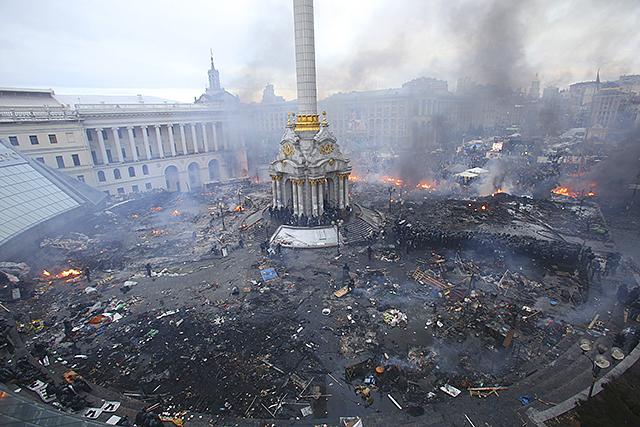
Pray for Ukraine

Our family walking in downtown Kyiv in November 2010:

DSC_1378

I was in town for a pastors conference with Calvary Chapel and we found Kyiv to be a beautiful, cosmopolitan European capital.

Here’s what Khreshchatyk street looks like today after months of anti-government protests, which recently turned violent:

 1959855_10203073030967423_1411475053_n

Here’s a photo I took of Independence Square, AKA Maidan, in 2010:

DSC_1376

Here’s the scene today:

IndependenceSquareKiev021914_640

You can follow the news of what is going on in Ukraine here: the BBC is running live updates as things unfold.

Please pray for the people of Ukraine. They have suffered greatly from corruption since the end of the Soviet Union. Ultimately, the greatest hope for these people, as for all people, is found in Jesus Christ, and in His Kingdom of righteousness.

“Blessed are those who hunger and thirst for righteousness, for they shall be satisfied.” (Matthew 5:6, ESV)

What Not to Say to Someone Who’s Suffering

It’s been said that if you minister to hurting people, you will never lack an audience.

But one of the things I believe we need to equip Christians with is how to love and care for hurting people. Christians are no different than most people, in that they feel uncomfortable around people who are suffering, and desperately want to make it all better. But as those who have been called to be salt and light in the world, I think we should be prepared and equipped to minister to those around us who are hurting – whether they be neighbors or people we are in community with at church.

In the video above, these pastors talk about what not to say to people who are suffering. A lot of people, because they feel that they should say something, and they want so bad to give a solution and fix the problem and alleviate the pain, say things which aren’t actually helpful. I have been on the receiving end of a few of these before: things like “I know what you’re going through” – “everything’s going to be fine” – and other things people say to try to quickly restore happiness.

But as the pastors mention towards the end of the video: the Gospel is big enough to handle our pain and to accept that tragedies happen and they are bad. The Gospel doesn’t shy away from the blood and guts of the reality of life in a fallen world. The Gospel is also big enough to give hope in the most dire circumstances by pointing to the ultimate happy ending that belongs to those who have been redeemed in Jesus.

Question: What is the most helpful thing someone has said to you or done for you during a difficult time in your life?

I want to hear your thoughts! Comment below!

“Always Go To The Funeral”


I ran across this article from NPR’s All Things Considered called “Always Go To The Funeral.” It’s worth listening to or reading.

As a pastor, I attend a fair number of funerals. Since our congregation is relatively young, these aren’t usually funerals for our church members, but funerals for their loved ones who pass away.

I think going to funerals is important. There are certain moments and events in life that are worth inconveniencing yourself for; honoring the life of a human being is one of them. 

A lot of people avoid funerals because death is something that we all feel is a foreign imposition on us – something that is inherently wrong. We are right to feel that way actually;  God’s Word makes it clear that we were made to live forever, and that sickness, pain and death are a curse – part of the very curse that Jesus Christ came to set us free from. However, it’s that very reason why it’s a healthy thing for us to attend funerals – to be faced with the ultimate realities that make the hope of the Gospel truly good news.

One thing I’ve realized over the years as a pastor, is that most people aren’t prepared for how to handle those who suffer or grieve. On a recent trip to Hungary I taught a seminar for the church there, whose pastor had recently lost a child, on how to understand grief and how to love and minister to grieving people. This instruction is so helpful, because most people (at least over there) default to either avoiding the situation or saying things which aren’t helpful. In reality, one of the best things you can do for someone who is grieving is not say anything, but just be around – present, available.
Yes, funerals are uncomfortable. Guess who else doesn’t enjoy being at that funeral: the person who lost a loved one. Bless them by being there beside them in their time of loss.