In this week’s episode of the Theology for the People Podcast, I sat down with Pastor Wayne Taylor from Calvary Fellowship in Seattle, Washington.
Wayne has a long history as a leader in the Calvary Chapel movement. He founded Calvary Fellowship in Seattle and served there as lead pastor for 42 years. Under Wayne’s leadership, 55 churches were planted, both in the Pacific Northwest and abroad.
Wayne recently spoke at White Fields Church. That message, in which he reads a limerick he wrote about me(!), can be found here: Ephesians 2:10 – God’s Poem’s at Work.
In this episode, Pastor Wayne and I discuss Charismatic Christianity: where the word “charismatic” comes from, what it means, arguments for and against charismatic practices, as well as John MacArthur, theological method, Calvary Chapel, and our own personal experiences and biases.
Pastor Wayne Taylor has a long history as a leader in the Calvary Chapel movement; he founded Calvary Fellowship in Seattle, Washington, where he served as lead pastor for 42 years. Under his leadership, 55 churches were planted out of Calvary Fellowship, both in the Pacific Northwest and abroad. Wayne now serves on the executive leadership team of Calvary Global Network.
In this week's episode, Wayne and I discuss what it means to be "charismatic." We discuss the origin of the word, arguments for and against charismatic practices, as well as John MacArthur, theological method, Calvary Chapel, and our own personal experiences and biases.
Follow Pastor Wayne on Facebook, and check out the Theology for the People blog.
The sermon series from White Fields Church on the Holy Spirit can be found here: The Spirit-Filled Life.
Did you know that children in the foster system form an at-risk people group within our own communities?
In almost every case, the reason these children end up in foster care care is because of an unsuitable home environment, which may involve violence, neglect, drugs, crime, etc. These environments not only result in trauma many times, but they also tend to result in or be associated with poverty. Many foster care situations are kinship care, which means the child is cared for by a relative, which can create a financial burden.
Poverty has a profound impact on a child’s mental and physical well-being. Children living in poverty have higher rates of absenteeism from school. Students who come from low income families are six times more likely to drop out of high school. Adults without a high school diploma are 4 times more likely to be unemployed and live in poverty, which means raising their children in poverty, perpetuating a cycle of poverty which may persist for generations: poverty affects education which affects poverty. (source 1, source 2)
One of the ways that we can help kids break out of this cycle of poverty is by encouraging them to stay in school – and one of the ways we can do that is by helping them have the things they need to be confident and excited about going to school, so they can succeed!
Our church, White Fields Community Church, has a history of ministering to children in the foster system, and five years ago we began a new ministry: Project Back to School.
We are working with Weld County Department of Human Services, and this year they have identified over 100 at-risk kids who need help with school supplies, clothes, and shoes. They have provided us with a list of needed items, which we will share with those who sign up to help.
We are trusting that God will raise up people to bless these families in the name of Jesus. It’s a way for us to love not only in words and in speech, but in action as well (1 John 3:18).
We will be taking sign-ups beginning Sunday, July 4 and asking items to be returned by Sunday, July 25.
How to Get Involved and Make a Difference
1. Sign up in-person
If you live in or near Longmont, visit White Fields Church on a Sunday morning this July and sign up to sponsor one or more children.
2. Sign up online
If you can’t make it on a Sunday morning, but are still local and could drop off items to us for delivery, leave a comment below, or contact the church here.
3. Contribute Financially
All monies that come in designated for Project Back to School will go directly towards buying school supplies for at risk children. You can make a tax-deductible donation on our church’s website here: whitefieldschurch.com/give/ (choose Project Back to School on the drop-down menu).
Join us in praying for these kids, and that God uses this initiative to bless them.
When I was a missionary in Hungary, we used to visit a refugee camp populated with thousands of people from muslim-majority countries, with whom we didn’t have a common language. Everyone in the camp got by with a mix of English, Russian, and sometimes German words that formed a special form of refugee pidgin. But this was insufficient for deeper conversations, such as those about God, Jesus, and salvation.
So, with the help of the International Bible Society, we were able to get New Testaments in Urdu, Dari, Farsi, and other languages, and we handed these out along with humanitarian aid, telling those we met to read them, and then we would follow up. For many of them, this was their first time ever having access to the New Testament in their own language, and by God’s grace, we did see many of them become followers of Jesus.
But this approach to ministry was based on an underlying assumption: that anyone with average reading comprehension skills can sufficiently understand the meaning of the Bible when it comes to what it says about who Jesus is and how salvation is possible through Him.
This assumption is known as belief in the “perspicuity,” or clarity of Scripture.
Not everyone embraces the idea that Scripture is perspicuous, notably the Roman Catholic Church and Eastern Orthodox churches – as well as fringe groups including the Mormons (AKA Latter Day Saints) and the Jehovah’s Witnesses.
It was after a friend of mine converted to Roman Catholicism based on claims he had heard about Scripture not being perspicuous that I was intrigued by this topic and wanted to research it further. I ended up writing my Masters dissertation on the topic – specifically looking at the question of whether the concept of the perspicuity of Scripture was novel to the Reformation, or if it is also found in the writings of the early Church Fathers – which would mean that the insistence on the perspicuity of Scripture in the Reformation period was actually a return to the way the early Christians understood and viewed Scripture.
In this week’s episode of the Theology for People Podcast, Mike asks me questions about the perspicuity of Scripture; what it is and why it matters, and what is at stake when it comes to this issue.
The Perspicuity of Scripture: Is the Bible Clear? Can Everyone Understand It? –
Theology for the People
Can anyone pick up the Bible, read it and understand it? Is Scripture "clear," and if it is: about what and for whom is it clear?
I wrote my Masters dissertation on the topic of the perspicuity, or clarity, of Scripture. This is an important topic, because whether or not we view Scripture as clear affects how we handle and use the Bible and how we relate to church traditions, and how we view the world in the midst of a culture in which many long-held beliefs and assumptions are being challenged.
In this episode, Nick and Mike discuss the concept of the perspicuity of Scripture, looking at the history of this concept and what is at stake in this debate.
For more articles and content, make sure to check out the Theology for the People website.
Last week I had the honor of being a guest on Gino Geraci’s radio show: Crosswalk with Gino Geraci, on 94.7 FM KRKS which airs in the Denver metro area and online.
We discussed the topic of the “perspicuity” or “clarity” of Scripture, which was the subject of my MA dissertation.
The discussion certainly wasn’t exhaustive, and there is more I would like to share about meaning and implications of the perspicuity of Scripture via this blog and my podcast – such as the difference between the external and internal aspects of perspicuity, but this was a great introduction to the topic.
Gino is well-read and understands the subject well, and it was fun to talk with someone who enjoys discussing these things and helping other people understand them.
What is perhaps most interesting about our discussion is that we spent time talking about how the perspicuity of Scripture speaks to the current trend of postmodern thinking and epistemology, in which even many professing Christians are taking up views which are contrary to the clear reading of Scripture because of pressure from the culture.
You can listen to the two hours we spent discussing this topic on the radio here:
In Part 2 of this two-part series, Mike and I discuss the process through which the New Testament was recognized as Holy Scripture.
At what point were the books of the New Testament recognized as Scripture? Who was involved in that process, or who made that determination? What about the disputed books, and why was the Gospel of Thomas kept out of the Bible?
We answer these questions and more in this episode. (Click here to listen to Part 1.)
The Formation of the New Testament Canon: Part 2 – Recognition, Disputes & the Gospel of Thomas –
Theology for the People
In Part 2 of this two-part series, Nick and Mike discuss the process through which the New Testament was recognized as Holy Scripture.
At what point were the books of the New Testament recognized as Scripture? Who was involved in that process, or who made that determination? What about the disputed books, and why was the Gospel of Thomas kept out of the Bible?
We answer these questions and more in this episode.
Make sure to check out the Theology for the People blog as well.
Our NextGen team at White Fields is excited to put on our first ever vacation Bible school (VBS) this summer.
If you are within driving distance of Longmont, we would love to have your kids (3 years old – 6th grade) join us from July 12-16, 2021 for a week of fun and learning about Jesus.
The Formation of the New Testament Canon: Part 1 – Nicaea, Constantine, & Conspiracy Theories –
Theology for the People
In Part 1 of this two-part episode, Nick and Mike discuss some common misnomers and conspiracy theories regarding the formation of the New Testament canon.
What happened in Nicaea? Did Constantine play a role in the formation of the New Testament canon? If so, is there anything we should be concerned about?
Check out the Theology for the People blog as well.
There are some excellent speakers lined up this year. Personally, I’m really excited that missiologist Alan Hirsch will be there, as well as Gavin Ortlund and Ed Stetzer, who is such an important voice in the church today – and happens to love Calvary Chapel!
Gavin Ortlund
Ed Stetzer
Alan Hirsch
I will be teaching an in-person Training Track at the conference on the topic of: “Preaching and Teaching Gospel-Centered Expository Messages.”
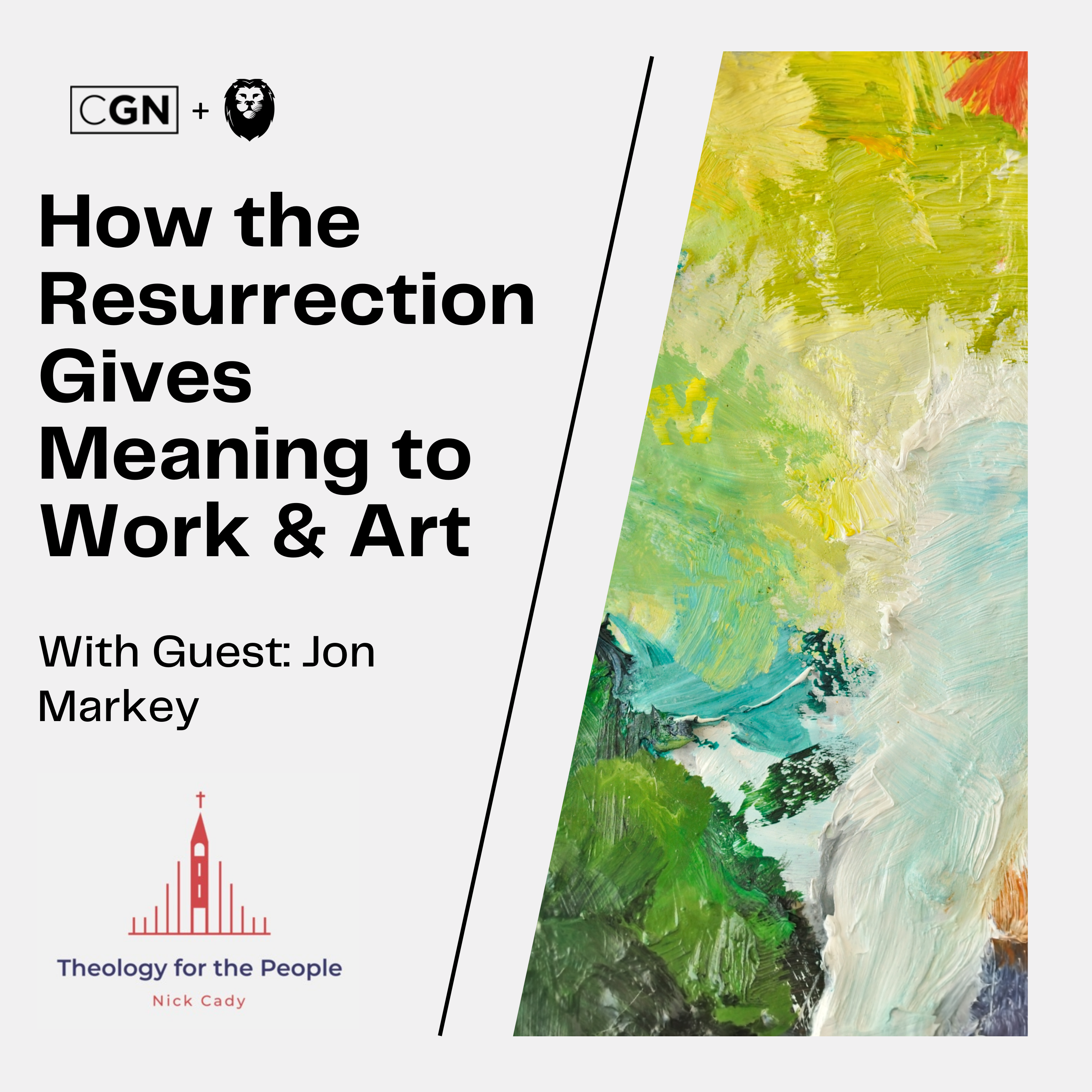
In this episode I’m joined by Pastor Jon Markey from Ternopil, Ukraine. Along with being a pastor and missionary, Jon is a musician and producer. We discuss how the resurrection infuses our lives, including our work and art, with meaning and purpose.
Sometimes people have the idea that if the world is going to burn anyway, then there is no point in trying to invest time and energy into work or art in this world; it would simply be akin to hanging curtains in a house that is on fire. However, as Jon and I discuss, Jesus’ resurrection changes that story in a big way.
Check out Jon and Steffie’s work at Room for More on Instagram and YouTube.
If "It's All Gonna Burn" Then What's the Point? – How the Resurrection Gives Meaning to Work & Art –
Theology for the People
In this episode I'm joined by Pastor Jon Markey from Ternopil, Ukraine. Along with being a pastor and missionary, Jon is a musician and producer. We discuss how the resurrection infuses our lives, including our work and art, with meaning and purpose.
Sometimes people have the idea that if the world is going to burn anyway, then there is no point in trying to invest time and energy into work or art in this world; it would simply be akin to hanging curtains in a house that is on fire. However, as Jon and I discuss, Jesus' resurrection changes that story in a big way.
Check out Jon and Steffie's work at Room for More:
Instagram
YouTube
This past Sunday we concluded our Eastertide (the 50 days following Easter) series called The Risen Life, in which we studied the post-resurrection appearances of Jesus from the perspective of what His risen life shows us about what it means for us to live as people who have died with Christ and been risen to new life.






 Theology for the People