Expecting Nothing in Return? Not Usually.

For a long time, I have found this sentence from Jesus to be both extremely beautiful and terribly convicting:

But love your enemies, and do good, and give, expecting nothing in return, and your reward will be great, and you will be sons of the Most High, for he is kind to the ungrateful and the evil. (Luke 6:35)

This is the definition of generosity: giving, expecting nothing in return. Nothing.

That means that a generous person doesn’t keep an accounting in their relationships, i.e. a running tally of who has done more for whom. They don’t keep score. They are free from that – free to give, expecting nothing in return.

That’s a lot easier said than done though…

Recently in my conversations with two people, this topic came up. One in particular likes to help people. He’s always helping people and doing favors. Nice, right? Except there’s one problem: he’s become resentful towards some of the people he’s helped out.

The other person explained to me that he likes to buy things for other people, little token gifts. But he too struggles with feelings of resentment, when he feels that his gestures of kindness are not reciprocated.

Both of these people would say that when they do these things, they don’t expect any form of compensation for them, but yet, both of them feel resentful. Why?

At least in the case of the first person, it is because, albeit subconsciously, oftentimes he isn’t just helping for the sake of helping – he’s doing it because there is a form of compensation that he hopes to receive for doing it. In his case it is not money, it is friendship. If and when friendship does not result, he feels that he was involved in a transaction in which the other party did not pay. The only thing is: the other party wasn’t aware of the assumed agreement and didn’t realize it was a transaction.

“Free” is rarely free.

What that means is that some people give a lot, but they’re not generous – because they give for selfish reasons. For example, the Pharisee in Luke 18:9-14 gave a lot to the Temple, but the reason he gave was so that other people would see it and praise him as a good person. His giving was a means of self-justification and self-glorification. The money still went to good use, and it is certainly better to give to a good cause for bad reasons than to spend money wastefully or only on yourself, but God is also concerned about why we give what we give.

Tim Keller, speaking about generosity, says that some people are always doing things to help other people, but they are actually using those people to feel good about themselves – i.e. they need those people to need them. They need for people to think they are good people. It’s their source of identity and their means of trying to justify their life. They’re not doing nice things for other people for the sake of those people themselves as much as they are actually doing it for themselves.

True generosity is when you act from selfless motivation, giving something and expecting nothing in return.

This is what Jesus encourages, saying, “your father who sees in secret will reward you” (Matthew 6:4)

Again, that is easier said than done. The way we can be motivated to truly act that way is through the message of the Gospel. First of all, the Gospel is that God has been generous to you, not as a transaction, but simply just because He loves you and enjoys blessing you. That’s grace. Secondly, the Gospel gives you an identity: it affirms you, saying that God not only knows you fully, but loves you completely.

Many people believe that they can either be known completely or loved completely, but not both – because if someone really gets to know them, they couldn’t possibly love them. Therefore, in order for people to love them and accept them completely, they cannot possibly allow anyone to know them completely.

But the message of the Gospel is that God BOTH knows you completely and loves you completely – at the same time. That’s incredible love and affirmation.

The message of the Gospel is that you have been justified in Christ, therefore you don’t need to work hard to justify yourself.

And when you really understand that – you’ll be free to give, expecting nothing in return: like God who gives even to the evil and the ungrateful. You’ll be free to give for the sake of giving, for the sake of another person or a cause, with no strings attached, because you are so firm in your identity, that you are already loved and justified and have value. The Gospel sets us free from our ulterior motives in doing even good things and from feelings of resentment towards those we have done acts of kindness for.

 

Spurgeon Quotes

Charles Spurgeon’s hundreds of sermons are a deep well of eloquent and powerful quotes. Here are a few favorites I recently came across:

Calvinists are often criticized for not considering evangelism an urgent priority, since God is sovereign. Spurgeon was a Calvinist, but these were his thoughts on the importance of diligence in evangelism:

If sinners be damned, at least let them leap to Hell over our dead bodies. And if they perish, let them perish with our arms wrapped about their knees, imploring them to stay. If Hell must be filled, let it be filled in the teeth of our exertions, and let not one go unwarned and unprayed for.

Spurgeon on the gospel which is worth living for, dying for and sacrificing for:

there used to be a gospel in the world which consisted of facts which Christians never questioned. There was once in the church a gospel which believers hugged to their hearts as if it were their soul’s life. There used to be a gospel in the world, which provoked enthusiasm and commanded sacrifice. Tens of thousands have met together to hear this gospel at peril of their lives. Men, to the teeth of tyrants, have proclaimed it, and have suffered the loss of all things, and gone to prison and to death for it, singing psalms all the while. Is there not such a gospel remaining?

Do you have any favorite Spurgeon quotes?  Leave me a comment below.

#SB50 and #Antichoice Doritos Ad

88bd59592be50f106ac59f449cfee09d

This past weekend I watched as my Denver Broncos won Super Bowl 50. The last time the Broncos won the Super Bowl I was in high school. They won with their incredible defense, which throughout the year was exciting to watch, especially in the playoffs.

On Tuesday I took my son out of school and went down to Civic Center Park in Denver for the Broncos victory parade. I remember going with my dad to the parade back in 1998, the first time the Broncos won the Super Bowl, now I was taking my kids – it was a cool moment.

Apparently my son was one of an estimated 25,000 students who skipped school to attend the parade. My dad works for the Denver Mint, which is directly behind the City and County Building, where the parade ended and the speeches were given, and he was given liberal leave, not only so that employees could attend the parade, but also because it would have been nearly impossible to even get to the Mint for work.

Authorities verified that over 1 million people attended the parade – and it certainly felt like it. I remember the parade back in ’98, and standing in Civic Center Park, not too far from the stage in the crowd of 650,000. This time the crowd was so much bigger, it was uncomfortable. People packed into the park to the point where there wasn’t even an inch to move.

My wife’s favorite thing about the Super Bowl is that it means that NFL season is finally over and no more will Sundays revolve around Broncos games. For the Super Bowl she decided to give in and wear team colors, so she put on a blue shirt – only to realize she put on Carolina sky blue. Needless to say, we asked her to be the one to take the group photo…

Like many people, Rosemary’s favorite part of the Super Bowl was Coldplay and the commercials. One of our favorite commercials was this Doritos one about an ultrasound:

Kinda creepy, but no creepier than PuppyMonkeyBaby.

I was surprised to see that NARAL, an abortion advocacy group, took issue with the ad, claiming that it was “antichoice” (I didn’t even know that was a word…)

The problem? The ad “humanized” unborn children (whom they refuse to call children…)

What’s next? Will they begin advocating against ultrasounds? Because as ultrasound technology has advanced, we have only found more and more reason to consider yet unborn children fully human: as one spokesperson said:

“If NARAL is scandalized by the notion that a human fetus is human, then they are scandalized by science. We know children in the womb have distinct and human DNA. We also know that they exhibit all sorts of human behaviors in the womb such as yawning, thumb-sucking, and even dancing thanks to tremendous advances in ultrasound technology.

But groups like NARAL and Planned Parenthood rely on a denial of these scientific realities better suited to the Dark Ages to maintain their rabid insistence that those unborn babies are undeserving of basic human rights.”  – Ashley McGuire of The Catholic Foundation

For the most part, I think NARAL is shouting into the wind. Trying to take away a person’s humanity is a long-used method for justifying or coping with doing something wrong to another person.

That being said, I highly doubt Doritos was trying to make a political statement. For NARAL, fetal behavior which reflects their humanness is an inconvenient fact – but a fact nonetheless.

The History of Lent & the Lost Celebration

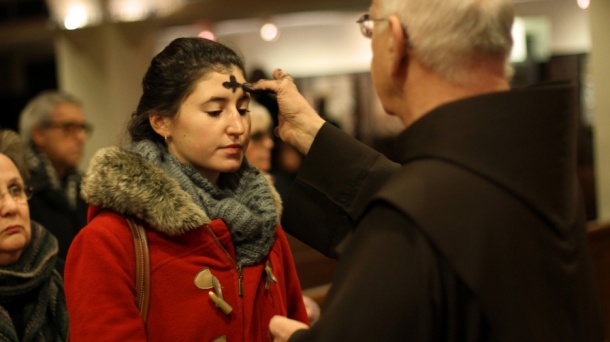
ash-wednesday-cropped

I grew up going to a Lutheran school until 8th grade, and one of the highlights of the year was Ash Wednesday, the first day of the season of Lent:  the 40 days leading up to Easter, which is a time of fasting and self-denial in preparation for Easter. On Ash Wednesday we would have chapel service and would get to walk to the front of the church and have ash put on our foreheads in the shape of a cross. Today as I was out around town, I noticed people with these ash crosses on their heads.

Lent is a tradition which predates all Christian denominations, but today is practiced mainly by Roman Catholic, Anglican/Episcopalian, and Orthodox Christians. However, Lent is more and more popular among evangelical Protestants, some of whom long for connection to the rich history of Christian tradition. I ran across a plethora of articles today from sources like Relevant and Christianity Today recommending that evangelicals would benefit from the practice of Lent. I tend to be inclined this way myself: to appreciate and want to be connected to Christianity’s rich traditions and to embrace the meaningful symbolism.

However, I have changed my thinking in recent years about Lent in particular. In seminary I took a course about the history and development of Christian worship. Here’s what I discovered about the development of Lent:

In the earliest days of Christianity, the time recorded in the Book of Acts, it is clear that new converts to Christianity first came to faith and then were baptized. As time went on, Christians began to feel that it was important that not only faith precede baptism, but instruction also. So they began to require believers to go through a period of instruction in Christian doctrines (catechism) before they could be baptized.

Several early Christian writings indicate that new believers would be baptized on Easter, which from the earliest days of Christianity was the chief Christian celebration. One of these writings that mentions baptisms of new believers being practiced only on Easter is from Tertullian, who argues that baptism need not only be practiced on Easter.

The number 40 held special significance for the early Christians because of the significance of the number 40 in the Hebrew scriptures, and so the 40 days leading up to Easter were the days of preparation, instruction and consecration for those who were getting ready to be baptized on Easter.

Easter itself, for the first 400 years of the church, was a feast that did not last only one day, but which began on Easter Sunday and lasted for 40 days. During that 40 days, people were forbidden from fasting, as well as from kneeling when they prayed, as kneeling is a posture of contrition, and these 40 days were set aside for the express purpose of celebrating the new life, the forgiveness and the redemption that we have because Jesus rose from the grave. It was a 40 day season of joy.

But here’s what changed: in the 4th Century, paedobaptism (child or infant baptism) became the norm. Paedobaptism was already a practice of some churches before that; Tertullian, in his On Baptism (circa 200), mentions that some churches practiced it and others did not, but that it was becoming increasingly popular in his time.

The reasons for the rise of paedobaptism were:

  1. Questions about how those who were born into and raised in Christianity should be initiated into the faith, and how this relates to the Old Testament model of a people in covenant with God.
  2. The emergence of Christendom as Christianity had become the official and dominant religion of the Roman Empire, so to be a citizen of the Empire was equated with being “Christian” and it was presumed that everyone who was a citizen of the empire was a Christian.  This view prevailed throughout the medieval period in Europe and was perpetuated by the magisterial Reformers.
    (I have written more on the subject of Christendom here)
  3. The formulation of the doctrine of ‘original sin’ by Augustine of Hippo, which gave many people a rationale for baptizing infants. The reasoning was that since the Nicene Creed declares that there is ‘one baptism for the forgiveness of sins’, that infant baptism remitted original sin (something Augustine did not teach, but which led to parents wanting to have their babies baptized as soon after birth as possible). Thomas Aquinas also taught that baptism removed the guilt of original sin; however, this teaching was rejected by Luther and other Reformers and is not held by all modern adherents of paedobaptism.

But here’s the issue that paedobaptism brought up in the church: If you baptize babies, then you can’t instruct them before you baptize them, because they’re infants… So what do you do with the 40 day period of consecration and preparation leading up to Easter? Hmm…
Here’s what they did: they decided to make this a time of all believers consecrating themselves to God in preparation for Easter, and catechism was moved to adolescence and paired with a confirmation of one’s faith/baptism.

So, here’s what you had at that point:  40 days of consecration to God before Easter – EASTER – 40 days of celebration of salvation and new life after Easter.

But then, guess what happened with time: We kept one 40 day observance and dropped the other. And which one did we choose? Not the celebration, but the consecration… and over time that consecration became more and more dour and focused on self-denial, penance and contrition.

James White writes:

It is perplexing why Christians have forsaken the season of rejoicing in exchange for the season of penance.

Particularly during the medieval period (and vestiges of this remain in our day in some places and to some degree) some Christians became more obsessed with the process of Jesus’ death – his “passion” – than with the purpose of his death.

Taking this into consideration, I am less inclined to celebrate Lent. I believe that I should consecrate myself to God every day. Romans 12:1 says – I appeal to you therefore, brothers, by the mercies of God, to present your bodies as a living sacrifice, holy and acceptable to God, which is your spiritual worship. 

However, I do believe that the discipline of self-denial is healthy and very much needed for some people, and that setting apart a dedicated time of consecration is both biblical and good.

In the end it gets down to WHY you are practicing Lent. If it is a spiritual discipline through which you draw nearer to God by purposefully setting aside something in order to consecrate yourself in an amplified way for a particular time – then I think that is wonderful and would recommend that you do it.

No matter what – whether you practice it or not – please remember the history, and along with your 40 days of consecration, I encourage you to practice 40 days of dedicated rejoicing in the salvation and new life that Jesus made available to you.

Celebrating what He did for you should take precedence over focusing on what you do for Him.


Something Worth Listening To

A friend from White Fields Church recently recommended I check out the Eric Metaxas Show podcast. I’ve enjoyed reading Eric’s books and I would highly recommend his biographies of Dietrich Bonhoeffer as well as his shorter 7 Men and 7 Women.

I recently subscribed to the podcast and have been listening to it while I drive. If you’re looking for something good to listen to, I recommend it. Below I’ve embeded an episode to get you started, in which Eric interviews someone from Voice of the Martyrs and talks about the life and legacy of Richard Wurmbrand, a Lutheran pastor who was tortured for his Christian faith in communist Romania and became an advocate for persecuted Christians worldwide.

Another great podcast I’d recommend is the Ask Pastor John podcast with John Piper.

And of course, don’t forget to subscribe to the White Fields Community Church podcast, available in the iTunes podcast store.

If you are looking for a good podcast app for Android, I like Podcast Addict.

Here’s that episode:

About Those Muslims…

I ran across this factoid in my reading today:

In my experience working with muslim refugees from places like Iran, Afghanistan and Kosovo, I found that many people born and raised in muslim families in majority muslim countries are open to hearing and considering the Gospel – sometimes more open than people in “Christian” Europe and North America.

Many people born and raised in Islam know very little about what the Koran teaches, and for them being muslim is more about cultural identity than theological conviction.

Consider this: the majority of muslims in the world do not speak Arabic, yet the Koran is to be read only in its “pure” form: in Arabic. What this means is that the majority of muslims have not read the Koran for themselves. The largest muslim majority country in the world by population is not even in the Middle East: it is Indonesia, and in Indonesia Christianity is legal, there is a sizable Christian population and there is opportunity for muslim people to hear the Gospel.

Did you know that Christianity is the most culturally and racially diverse religion in the world – by far?!  Every other major faith has 80% or more of its adherents on 1 or 2 continents, but roughly 20% of Christians are in Africa, 20% are in South America, a little less than 20% are in Asia, a little more than 20% are in Europe and North America each.  No other religion even comes close to the ethnic and cultural diversity of Christianity.

One of the differences between Christianity and Islam is that whereas Christianity affirms other cultures and languages, Islam does not. Wherever Islam has spread it imposes a foreign (Arabic) language and culture, including dress, art, music and other forms of expression upon its adherents. Christianity does not; rather Christianity liberates the African to be fully African and the European to be fully European in regard to language, dress, art, music and other forms of cultural expression. Considering the fact that the majority of muslims live outside of the Arabian Peninsula, this is a particularly compelling aspect of Christianity compared to Islam, which has imposed Arabic culture upon people at the cost of suppressing their African, Persian, Indian, etc. forms of cultural expression. For the Arab, while Islam does represent a distinctly Arab cultural expression, the fact remains that for 600 years a strong and healthy, culturally-Arab Christian community thrived in the Middle East, the remnants of which still remain – although they are currently endangered – in Syria, Lebanon and Iraq.

Christians, we have been given a mission which is greater than protecting and preserving our comforts. We have been given a mission to “preach the Gospel to all creatures” and to “make disciples of all nations”.  This includes the 1.6 billion people on around the world who self-identity as muslim. We live in unprecedented times, in which more people raised muslim have come to faith in Jesus Christ in the last 20 years than in the previous 1400 combined. May God do an even greater work in the years to come, and may we share His heart for all people.

God is Not Mad at You…unless He is.

I took my son to the store on Sunday night to buy some trading cards for a game he plays. As we were walking around the store, a book caught my eye.

20160117_204314

The title: “God is Not Mad at You.” To be fair, I haven’t read this book, however, I did take the time to go and read some reviews of it online to see if my initial assumptions about the message of this book would turn out to be mistaken. It would seem from these reviews that they were not.

Here’s the thing: the author is correct, God is not mad at you…that is unless, of course, He is.

What do I mean?  What I mean is that God is mad at some people – and rightly so! The Bible makes it very clear that God “opposes” some people, and that God considers some people “enemies.”  In fact, “the wrath of God is revealed from heaven against all ungodliness and unrighteousness of men” (Romans 1:18) and the objects of His wrath are in fact people (Ephesians 2:1-3)!

After all, isn’t it only right that God should be mad about some things AND at some people?  The Bible, in both Old and New Testaments, makes it explicitly clear that there are things which God abhors, and which we should also abhor, for example: injustice, deceit, abuse. God is mad about these things, and more than that: God is mad at the people who do these things. God is mad at the person who exploits another or takes advantage of them from a position of power. God is mad when children are abused, when women are raped, when racial injustice occurs, and God is mad at the people who do these things.

Here’s the thing: it’s easy for us to say, “Well, yeah, okay, I get what you’re saying: God is mad at the bad guys who do bad things. That makes sense… But aside from those guys, who need to know that what they are doing is wrong and that divine justice is promised, the rest of us need to be comforted and encouraged that God isn’t mad at us – after all, most of us aren’t that bad.” 

The question is: who defines “bad”? And how bad do you have to be to be “bad.”  The Bible says this: “For whoever keeps the whole law and yet stumbles at just one point is guilty of breaking all of it.” (James 2:10) Furthermore, Jesus taught in the Sermon on the Mount and the Bible says elsewhere that “all have sinned and fallen short of the glory of God” and that “there is none who is good, no not one.”

What this all means that you and I are more sinful than we even realize, and therefore more deserving of God’s wrath than we even know.

But here’s the message of the Gospel: it’s not that you are a good person and therefore God isn’t mad at you – it’s that God LOVES you in spite of your sins and failures and shortcomings so much that He sent Jesus, the Divine Son, to die in your place, and absorb the wrath which you deserved.

What that means is that if you are in Christ, then indeed God is not mad at you – because Jesus became the “propitiation for our sins” (1 John 2:2), which means that he absorbed not only the legal judgment for our sins, but the righteous anger of God toward our sin.

If you are in Christ, then indeed: the message of the Gospel is that God is not mad at you

However, if you are not in Christ, then the Bible says that you are still in your sins. Jesus himself said this: “Unless you believe that I am He (the Messiah, the Savior), you will die in your sins.” (John 8:24). And if you are still in your sins, then the wrath of God remains on you!  Again, Jesus himself said this very thing: “Whoever believes in the Son has eternal life, but whoever rejects the Son will not see life, for God’s wrath remains on them.” (John 3:36)

Whoever believes in the Son has eternal life, but whoever rejects the Son will not see life, for God’s wrath remains on them. – JESUS (John 3:36)

Here’s the point: God is not mad at you IF you are in Christ, because God’s wrath was poured out on Him in place of you – the undeserving in place of the deserving.  Apart from Jesus, however, there is no such promise and no such hope.

The reason I take issue with this book is because it declares something to all people as a blanket statement, a broad generalization, which does indeed apply to some, but only some! To others, therefore, it gives a false sense of comfort and security, which actually does them a disservice.

The false prophets in the day of Jeremiah did the same thing. God had called Jeremiah to call the people of Judah to radical repentance, to turn away from sin and wickedness and turn with their whole hearts to God, and if they did that they would experience blessing. Jeremiah preached this message, which turned out to be radically unpopular, despite the fact that it was from God.  At the same time, another group of prophets came with a message which was wildly popular, despite the fact that it wasn’t from God! Their message? “Don’t worry; be happy. God’s not mad at you. God just wants you to be happy, so just do your thing and don’t bother yourself with feelings of guilt or needing to repent.” About these false prophets, God said:  “They dress the wound of my people as though it were not serious. ‘Peace, peace,’ they say, when there is no peace.” (Jeremiah 6:14)

“They dress the wound of my people as though it were not serious. ‘Peace, peace,’ they say, when there is no peace.” (Jeremiah 6:14)

The message of the Gospel is that Jesus died on the cross, so that God could end sin without ending us.

No matter who you are or what you’ve done, that is how much God loves you. If you are in Christ, if you have put your faith in Jesus as your Savior, as your righteousness, as the propitiation for your sins and as your Redeemer – then indeed, take comfort: God is not mad at you!

Thoughts at New Year

The new year is an interesting time – because it is somewhat of an arbitrary holiday; we are not celebrating a person or a great historical event. All we’re really celebrating, other than the fact that the Earth went all the way around the sun and now we have to go replace our calendars…

The value of the new year is that it gives us a gauge to measure by, it gives us perspective, and perspective helps us to see things more clearly.

The new year also comes with a sense of a new beginning – something which, as Christians, we can have a sense of each and every day because of God’s grace.

I’m not in the habit of making New Year’s resolutions, but there is one thing I do every year, which I find helpful: I sit down and write a list of things which I would like to see in one year from now. These are things which are not yet reality, but things which I would like to see become reality. Having written these things down, I keep that list on my desk, and pray and plan over these things until they become reality. Having this list helps direct my prayers and my focus, my time and my energy.

Zig Ziglar famously said: “If you aim at nothing, you’ll hit it every time.”

We have a big God, with whom all things are possible (Mark 10:27) – a God who is able to do exceedingly, abundantly more than we can ask or imagine. (Ephesians 3:20). I encourage you to dream and pray in faith for those things which are yet unseen. Write them down, so that you won’t quickly forget them because of the tyranny of the urgent that creeps into our lives. At the end of the year, you will find yourself with a list of things which God has done.

O Little Town of Bethlehem: What are the Odds?

A reader of this blog contacted me this week asking if I could write a few words about Micah 5:2

But you, O Bethlehem Ephrathah,
who are too little to be among the clans of Judah,
from you shall come forth for me
one who is to be ruler in Israel,
whose coming forth is from of old,
from ancient days.

Bethlehem = “House of Bread” – it is a small town only a few kilometers outside of Jerusalem. It was also the ancestral home of King David.

The older, pre-Jewish name of Bethlehem was Ephrathah, which is used on several occasions to speak of it in the Bible.

Micah’s prophecy is about the impending destruction of Samaria and Judea, including Jerusalem for their sins and refusal to repent of them and turn their hearts back to God. As a result, destruction would come upon them from other nations and they would be carried off in exile.

However, the final word of this prophetic message is one of hope and restoration, the message that God has not abandoned his people, but is wholly committed to them, and at a time when they have repented, he will fulfill his promises to them.

What promises were these? In particular it was the promise of a ruler, a King in the line of David, who would establish a Kingdom which would have no end; a kingdom of peace and justice and righteousness which would last forever.

That’s a pretty steep promise! Is it just meant as hyperbole, or was it meant to be taken as a literal promise? How could any king rule forever?

When you begin to take the different promises about this king together, the picture comes together of a King who is more than just a man, but who is actually divine in nature. Notice how Micah says that “his coming forth is from old, from ancient days” – this is saying that one is going to be born, who has existed from eternity past. This is speaking of divinity being born into the world to establish an everlasting kingdom. This is speaking of the incarnation: God coming to us, born in human flesh.

And where would this happen? In Bethlehem. A village of no consequence, only famous as the ancestral home of Israel’s greatest king – and significantly, a king who was promised by God that one of his descendants would establish an everlasting kingdom.

Micah 5:2 is one of 300+ prophecies found in the Hebrew Bible (what Christians call the Old Testament) about the Messiah, which speak of who he would be, what he would do, and how his coming would take place. 300+ – fulfilled by one person! What are the odds?

Peter Stoner, in Science Speaks (Moody Press) attempts to show how coincidence is ruled out by the science of probability. Stoner says that by using the modern calculation of probability in reference to eight prophecies, “we find that the chance that any man might have lived down to the present time and fulfilled all eight prophecies is 1 in 1017.” That would be 1 in 100,000,000,000,000,000.  In order to help us comprehend this staggering probability, Stoner illustrates it by supposing that “we take 1017silver dollars and lay them on the face of Texas. They will cover all of the state two feet deep.

“Now mark one of these silver dollars and stir the whole mass thoroughly, all over the state. Blindfold a man and tell him that he can travel as far as he wishes, but he must pick up one silver dollar and say that this is the right one. What chance would he have of getting the right one? Just the same chance that the prophets would have had of writing these eight prophecies and having them all come true in any one man.”

Stoner considers 48 prophecies and says, “we find the chance that any one man fulfilled all 48 prophecies to be 1 in 10157. The estimated number of electrons in the universe is around 1079. It should be quite evident that Jesus did not fulfill the prophecies by accident.”

Advent Meditations: 13 – The Reason the Son of God Appeared

The reason the Son of God appeared was to destroy the works of the devil. – 1 John 3:8

I have been away for a few days from this because my wife gave birth to our baby girl this past weekend! We feel very blessed.

With every new life comes the promise of hope and joy and the light that this new life will bring into the world, but over every life there looms the shadow of a cloud on the horizon… a debt which will one day come due: the inevitability of death.

Every child is born into a world that is cracked and broken, with remnants of what it was originally intended and designed to be and we live with a lingering memory – an ancestral notion of how things were meant to be.

The message of Christmas is that the Son of God appeared to destroy the works of the devil – to restore things to the way they were meant to be. This is the hope of the Gospel and the hope that we celebrate at Advent: that the day is coming, and is ever nearer, when this hope of ours will be realized. The meaning of Christmas is that there is a new inevitability: that that day is coming, and will be here before we realize it.

The Son of God appeared to destroy the works of the devil: in the world, and also in each of us. He came to make the world what it was meant to be, and to make each of us what we were meant to be.

Joy to the world – the Lord has come!  The Savior reigns!