
What is Baptism with Fire?

This past Sunday I was out of town, officiating the wedding of some friends in Minnesota. It was my first time in Minnesota, and it was really nice! I can see the appeal of the lakes.

So this past Sunday I was out of town, but the week before that I preached a message titled “Baptism by Fire” in which I taught about the events of Pentecost, when the Holy Spirit came upon the church in fulfillment of the promises of not only Jesus, but also of God from even the Old Testament. I made reference to the words of John the Baptist, who said that he baptized with water unto repentance, but that one (Jesus) was coming after him who would baptize with the Holy Spirit and fire, and I talked about how the fulfillment of that is found in Pentecost, when the believers were baptized with the Holy Spirit, and as a sign of them each individually receiving this baptism, tongues of fire rested on each of their heads.

Afterwards, someone asked me a great question: Whether the baptism with fire that John the Baptist was talking about was a description of the baptism with the Holy Spirit (like I had taught), or if John was speaking of the fire of judgment – because in the very next verse, John the Baptist says: “His winnowing fork is in his hand, and he will clear his threshing floor and gather his wheat into the barn, but the chaff he will burn with unquenchable fire.” (Matthew 3:12)

Here was my response:

I am familiar with that interpretation you mention, and I think it’s entirely possible given the context of what John was talking about — which is promise of the Messiah and a warning of judgement. In this interpretation, the assumption is that Jesus is saying: he will baptize some people with the Holy Spirit and other people he will baptize with fire — i.e. the same fire of judgment that he refers to in the following verse (vs 12).

Is that what John meant by those words? I agree with you (and many Bible interpreters) that it is quite possible that this is what he meant.

The other main interpretation about this, is that the “fire” is a reference to the Holy Spirit and the purpose of the tongues of fire on Pentecost was that they were a sign that these words of John were now being fulfilled. This is the line of thinking that I took in my sermon. Here’s more on that from the Holman Bible Dictionary:

Fire is one of the physical manifestations of God’s presence. This is illustrated several times in the Bible: the making of the covenant with Abraham (Genesis 15:17 ), the appearance in the burning bush (Exodus 3:2), God leading the Israelites by a pillar of fire by night (Exodus 13:21-22; Exodus 14:24; Numbers 9:15-16; Numbers 14:14; etc.), His appearance on Mount Sinai (Exodus 19:18; Exodus 24:17; Deuteronomy 4:11-36; Deuteronomy 5:4-26; etc.), and others (1Kings 18:24,1 Kings 18:38; 1 Chronicles 21:26; 2Chronicles 7:1,2 Chronicles 7:3 ).

Fire was used symbolically in Israel’s worship to represent God’s constant presence with Israel (Leviticus 6:12-13 ). God’s presence as fire represented both judgment and purification (the words purify and purge come from the Greek word for fire). To be in God’s presence is to be in the presence of absolute holiness where no sin or unrighteousness can stand. To be in the presence of God is to have the overwhelming sense of one’s uncleanness and the overwhelming desire to be clean (see Isaiah 6:1-6 ). God is able to judge and destroy the sin and purify the repentant sinner.

To be baptized with the Holy Spirit has a wider application than this; but when the Holy Spirit is coupled with fire, the particular aspect of the Holy Spirit’s work as described here is in view.

One thing I would add to this excerpt is that fire is a cleansing agent, and one of the roles of the Holy Spirit as he indwells us is sanctification, e.g. Rom 8:13.

This is one of the difficulties of Bible interpretation — to figure out what exactly was meant by a particular word or phrase in its context. In this case, both options are theologically sound and contextually possible, so it’s kind of a win-win. I’m glad to have the chance to explain a little more about the fire aspect and what the significance of it might be.

Did Judas Go To Hell?

In teaching through the Book of Acts on Sunday mornings at White Fields I recently taught the section in Acts 1 where it talks about how Judas committed suicide after betraying Jesus.

Afterwards someone wrote a question:

Did Judas go to hell?  Is suicide a deal breaker? Judas knew that what he did was wrong, so is it possible that he will go to heaven?

It is hard for us to say with certainty about anyone’s eternal destiny; that is something which ultimately is only known by God. However, we do have good reason to assume that Judas did go to hell based on two things that Jesus said:

Matthew 26:20-25. At the Last Supper Jesus told his disciples that one of them would betray him, and then he says: “Woe to that man by whom the Son of Man is betrayed! It would have been better for that man if he had not been born”. The implication is that it would be better for a person not to have been born than to go to hell.In John 17, Jesus prays to the Father about and for the disciples and he says in Vs 12: “While I was with them, I kept them in your name, which you have given me. I have guarded them, and not one of them has been lost except the son of destruction”

Based on these 2 verses I think we can assume that Judas did go to hell.

However, did he go to hell because he committed suicide? No, that wasn’t why. The reason Judas went to hell is because, rather than repenting of his sin and seeking and receiving forgiveness and restoration from Jesus, he chose to end his life. This reminds us that feeling bad about your sin is not the same as repenting of your sin and receiving forgiveness.

Interestingly, Judas is not the only one of Jesus’ disciples who betrayed him. Peter also betrayed him, and several other disciples “scattered” when Jesus was arrested. Peter and Judas are an interesting contrast: Peter returns and is restored, whereas Judas goes off and kills himself. Peter betrayed Jesus but then was forgiven and restored; Judas did not return to Jesus, and therefore missed the opportunity for grace and forgiveness and restoration.

Jesus’ words about the lostness of Judas should be seen in regard to his foreknowledge that Judas would not return to repent and receive forgiveness and restoration.

To the point about suicide: It has been taught in certain Christian groups that suicide is an unforgivable sin. This has been based 1 Corinthians 3:16-17 which says: “Do you not know that you are God’s temple and that God’s Spirit dwells in you? If anyone destroys God’s temple, God will destroy him.”   This is one of those instances where it helps to know other languages, if not even the original language. Because when you read this in the original (or in other languages which differentiate between you (singular) and you (plural), it becomes immediately clear from the context as well, that this is not talking about suicide at all, but what Paul is talking about is the church!  In other words:  You all are the temple of the Holy Spirit.  — the context of 1 Corinthians chapter 3 is that Paul is talking about people who cause division in the church!   He says that the Church — the Christ-ordained gathering of the people of God — is the Temple of the Holy Spirit, and whoever destroys the church, through division, will be judged by God!

In other words – 1 Corinthians 3:16-17 is not talking about suicide but it is speaking to those who cause division in the church. Is suicide an unforgivable sin? I don’t see why we should believe it is. That being said, I would not encourage anyone to test God on this.  The message of the Gospel is new life and restoration in Jesus Christ from any and all forms of despair, and the hope of eternal live and joy for those who persevere.

Narrative Theology in an Animated Video

One of my favorite approaches to the Bible is that of Narrative Theology: a way of looking at the Bible focused on the grand story that the Bible tells.

These guys doing The Bible Project put together this great video, which uses this approach. Check this video out; I think it’s awesome!

They have a bunch of other videos on their YouTube page which are worth watching too.

Should Christians Try to Improve Society?

Tomorrow morning I’ll be teaching on Jesus’ salt and light metaphors from the Sermon on the Mount, as part of our CounterCulture series at White Fields.

I found this quote in a book by John Stott, about the social responsibility of Christians as part of our identity as the salt of the Earth. Since salt has a healing and preserving effect, the idea is that Christians should have a healing and preserving effect on society.

There are some who would say, What’s the point in trying to make society better?  If Jesus could come back any minute, and this life is short anyway, then shouldn’t all our efforts be towards saving people out of this world, rather than “polishing a turd”, to put it crassly?

However, it seems to me that it is an inherent part of the calling of a Christian to make the world a better place, if for no other reason than to “let your light shine before others so that they may see your good works and glorify your Father who is in Heaven.” (Matthew 5:16)

Here is that John Stott quote:

Too often evangelical Christians have interpreted their social responsibility in terms only of helping the casualties of a sick society, and have done nothing to change the structures which cause the casualties. Just as doctors are concerned not only with the treatment of patients but also with preventive medicine and public health, so we should concern ourselves with what might be called preventive social medicine and higher standards of moral hygiene. However small our part may be, we cannot opt out of seeking to create better social structures, which guarantee justice in legislation and law enforcement, the freedom and dignity of the individual, civil rights for minorities and the abolition of social and racial discrimination. We should neither despise these things nor avoid our responsibility for them. They are part of God’s purpose for his people. Whenever Christians are conscientious citizens, they are acting like salt in the community.

As Sir Frederick Catherwood put it:‘To try to improve society is not worldliness but love. To wash your hands of society is not love but worldliness.’

Stott goes on to say that SALT is not all that the world needs. The world also needs LIGHT – the truth of God, ultimately found in the Gospel.

The Eschatological Significance of the Christian Sunday

Following up on a previous post on why Christians worship on Sunday and the correlation between the Jewish Sabbath and the Christian Sunday, I recently read something I found interesting.

While many people assume that Christianity just took the Jewish idea of Sabbath and moved it to Sunday, it turns out the reason for the Christian Sunday is deeply eschatological.

Check it out:

Jewish Sabbath

  • End (Saturday)
  • Rest from Creation
  • Happens after creation, within time: retrospective
  • Keeping of obligations
  • Preservation

Christian Sunday

  • Beginning (Sunday)
  • Commencement of the New Creation
  • Speaks to the aim of new creation: eternity = future-oriented
  • Celebrates that the obligations have been met by God through Christ
  • Resurrection

Christianity was not just a rebranding of Jewish practices, but an eschatological fulfillment of them.

The Christian Sunday is more than a day of rest for Christians, it is a day of new creation. In it, we remember not only to rest from our labor, but we are reminded that with the resurrection of Jesus, we stand at the dawn of eternity – and that one day soon, the Son will break over the horizon and usher in the New Day. In the death and resurrection of Jesus Christ we have witnessed the death of death and the birth of “the life that is truly life”.

Crossing Jordan

A reader of this blog requested that I write a post about the symbolic significance of the Jordan River crossing in Joshua chapter 3.

This week I began teaching Bible class at Longmont Christian High School. This class is doing an overview of the Old Testament, and I picked up where the previous teacher had left off: in the Book of Joshua.

One of the concepts I shared with the students as we’ve been studying Johsua is Biblical Typeology, or how certain characters, events or places in the Old Testament function as types of New Tesament truths.

In 1 Corinthians 10, Paul writes this: For I do not want you to be unaware, brothers, that our fathers were all under the cloud, and all passed through the sea, and all were baptized into Moses in the cloud and in the sea, and all ate the same spiritual food, and all drank the same spiritual drink. For they drank from the spiritual Rock that followed them, and the Rock was Christ. Nevertheless, with most of them God was not pleased, for they were overthrown in the wilderness. Now these things took place as examples for us, that we might not desire evil as they did. (‭1 Corinthians‬ ‭10‬:‭1-6‬ ESV)

What Paul is talking about here are how the Old Testament stories are both historically true, and yet were also so masterfully crafted by God that He, in His divine providence, embedded them with symbolic meaning, that is only realized by us now as being a pattern or type or foreshadowing of New Testament truths, i.e. Christ and the Christian life.

For example, in Luke 24, we read how after Jesus resurrected from the dead, he gave the best Bible study ever given: he took his disciples through the Olt Testament, showing them how everything actually pointed to him.

And beginning with Moses and all the Prophets, he interpreted to them in all the Scriptures the things concerning himself.

Then he said to them, “These are my words that I spoke to you while I was still with you, that everything written about me in the Law of Moses and the Prophets and the Psalms must be fulfilled.” Then he opened their minds to understand the Scriptures, (‭Luke‬ ‭24‬:‭27, 44-45‬ ESV)

In other words, reading the Bible is a lot like watching the movie “The Sixth Sense”. If you’ve seen the movie, it’s about a boy who sees dead people. The boy starts meeting with a psychologist, played by Bruce Willis, who talks him through what’s going on, but at the end of the movie you realize something that changes everything: the psychologist is dead too – he’s been dead all along. And then, when you realize that, you can never watch the movie the same way again. In fact, you feel compelled to watch the whole movie all over again, because this time you see the whole thing in a completely different way: you realize that no one ever looks at the psychologist – people look right past him, because they don’t see him.

That’s how it is with reading the Bible too! Once you know the end of the story – that it was all building up to Jesus Christ, and you come to understand the Gospel, you can never read it in the same way again! This is what happened to the Apostle Paul! As soon as he came to see that Jesus was the Messiah, he could never read the scriptures the same way ever again (see Acts 13:13-41).

The whole Old Testament is full of such types of Christ and of the New Life in Christ. For example: Melchizedek (Genesis 14). Hebrews 7 says that Jesus is a high priest in the order of Melchizedek. What does that mean? It means that Melchizedek was an Olt Testament type of Christ. The name Melchizedek means: King of Righteousness. He was king of Salem, which means peace, and he gave Abraham bread and wine and Abraham gave him a tithe.

The Exodus narrative is another example of Biblical Typeology. Think about it:

  • The people of Israel are in bondage in Egypt, just as we in our natural condition are in bondage to sin, vanity and futility.
  • The people of Israel cry out to God to set the free, and so God saves them by the blood of the Passover lamb; if anyone is covered by the blood of the lamb, their house is passed over by tha angel of death. In the same way, if we are covered by the blood of the true and ultimate Passover lamb, Jesus Christ, we will be saved from the judgment of God.
  • After saving them by the blood of the lamb, God led the people of Israel out of bondage in Egypt. They were separated from Egypt (which is commonly considered a type of “the world”) through the Red Sea, which Paul tells us in 1 Corinthians 10 is a type or picture of baptism.
  • After they cross through the Red Sea, the next thing that happens is that God leads them to the Mountain of God, where they came out and God gives them His Word. In the same way, once we are saved and set free, God gives us His Word and instructs us in His ways.
  • After that, they are to enter the Promised Land, which they fail to do because of their lack of faith, out of fear of the obstacles. There has been debate as to what the Promised Land would be a type of. Many old songs refer to it as a type of Heaven. However, I disagree. The Promised Land is a place where there are battles to be wages, there are enemy forces. There are victories to be won, but defeats are also suffered. There are obstacles and difficulties in the Promised Land, but there is the primise of victory if the people will obey God by faith and take hold of everything He will give them if they assertively take hold of it. For this reason, many, including myself, would say that the Promised Lamd is rather a picture or type of the Victorious Christian life that God promises to those who are in Christ (see Ephesians 1). Some would also refer to this as the Spirit-Filled Life.
  • Because the Israelites were unwilling to enter the Promised Land, they ended up wandering in the wilderness, going in circles and getting nowhere for 40 years, until they died, having lived lives of aimless wandering, not taking hold of what God would have given them and wanted to give them, because they allowed fear to hold them back from engaging in mission God gave them. Yet, they were saved by the blood of the lamb, baptized in the Red Sea and had received the word of God. This is clearly a type of the Christian life as it is lived by some.
  • That brings us to the issue of the Jordan River crossing in Joshua 3. What is this a type of? Well, it is the entrance into the Promised Land, a step which must be taken by faith. Just as the Red Sea crossing is a type of baptism, the Jordan crossing would seem to also picture baptism: a second baptism: the baptism of the Holy Spirit.

Once you’ve read the book and seen Jesus, you can never read the book the same way again!


Why do Christians Worship on Sunday?

Have you ever wondered why Christians worship on Sunday?

Recently I have been taking a seminary class on the history of Christian worship, and I came across some interesting information the other day about the history of Christian worship on Sundays.

The most common assumption is that Christians worship on Sunday because that is the day that Jesus rose from the dead. And that is correct. But there is more to it than that.

For the early Christians, Sunday become known as “the Lord’s Day” – references to which are made in the New Testament. However, it is worth noting that in the places Christians lived in those early centuries, including the Roman Empire, Sunday was a work day. So it became common for Christians to gather early on Sunday mornings, before work, to share in communion, teaching and worship – communion being seen as an essential element of the gathering, one which they would never consider neglecting (an important factor when considering what we do on Sunday mornings in churches today).

It was only in the time of Emperor Constantine, that Sunday became a day of rest, when Constantine (before his “conversion” to Christianity) declared that the “venerable day of the Sun” should be a day of rest for all people in the empire. Interestingly, in Germanic languages, including English, we have retained some of the pagan names for the days of the week, from Roman times: Sunday (Sun), Monday (Moon), Saturday (Saturn). However, in romance languages, the name of Sunday reflects the Christian understanding of “the Lord’s Day”, e.g. “Domenica” in Italian.

Another common assumption is that the Christians chose Sunday as the day of worship because it was the day on which Jesus rose from the dead, and it was their alternative Sabbath – their new “day of rest”.

The true story is actually even more interesting. Early Christians considered it of great significance that Jesus rose on a Sunday, and they carried this understanding and significance into their practice of worshiping on Sundays.  The Jewish understanding of the week is that each day corresponds to a day of Creation, and the reason they rest on Saturday is because it is the Seventh Day, the day on which God rested from His labor, and instructed us to do the same. Sunday, in the Jewish mind, is the first day of the week and corresponds to the first day of creation, the day on which God brought light out of the darkness. For the Jews, there was an understanding of the week as a closed circuit, if you will.

In Jewish apocalyptic writing, there is a book called the Book of Enoch, in which a concept is introduced called “The Eighth Day”. The Eighth Day is the day of the Messiah – when the Messiah comes and He inaugurates a NEW DAY – the Eighth Day – the first day of a NEW CREATION.

Early Christian fathers wrote about this concept of the Eighth Day several times in the early centuries, and they considered Sunday worship as representing this idea of the Eighth Day – that Jesus Christ rose from the dead on a Sunday – the day after the Seventh Day – and by his resurrection he inaugurated the Eighth Day, and now we worship on the Eighth Day – the day of new creation, as Jesus in His resurrection was the first-born of the new creation (1 Cor 15). This is the day on which Jesus broke us out of the closed circuit that we have been living in of the first creation, and inaugurated a new day – the Eighth Day – the day of the new creation.


Time Talks

I found this quote in a book I am reading for a theology course on the history of Christian worship. The point of this chapter is how, unlike other religions which eschew time as insignificant or illusory, Christianity takes time seriously. Christianity does not just talk about salvation in general, but of salvation accomplished by specific actions of God at definite times and places. It speaks of climactic events and a finale to time.

Time talks. When we give time to others, we are really giving ourselves to them. Not only does our use of time show what is important to us but it also indicates who or what is most significant to our lives. Time, then, is a definite representation of our priorities. We reveal what we value most by how we allocate this limited resource.

I personally found that very challenging. It seems that time allocation is somewhat of a mirror. If what our time allocation reveals about our values does not match up with what we believe they should be in theory, then we should be challenged to change some things!

Don’t Forget the Actual Holiday Happening Today

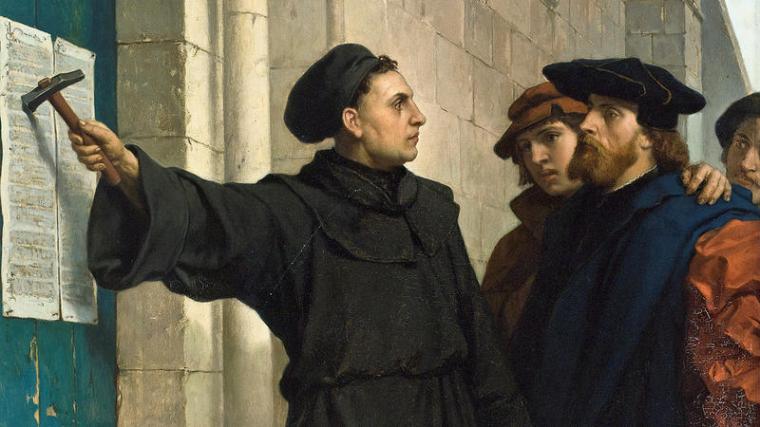
luther95theses

Today is Reformation Day. On October 31, 1517 Martin Luther nailed his 95 Theses to the door of the Wittenberg Schlosskirche, sparking the Protestant Reformation.

Today is a great day to remember the work of the reformers which you unquestionably benefit from. Men who struggled for us to have the freedom to read the Bible for ourselves, in our own languages – and consider for ourselves what God says to us in the Scriptures. Today is a day to be thankful for the return to Biblical theology and the doctrine of grace that these men fought for.