Redemption: Jesus’ Family Tree

advent2014HERO


In the Gospel of Matthew, the Christmas Story doesn’t begin with a baby born in Bethlehem and placed in a manger. When Matthew wants to tell us the story of Jesus, he takes us back hundreds, even thousands of years, to look at the family line from which God chose to bring the Redeemer into the world. Matthew starts by giving us a genealogy — which gets skipped over by many people, because it reads like a Hebrew phone book!
But, if you look closely, you’ll find that Jesus’ family tree contains a lot of knots: people we have read about in the Old Testament, whose stories were full of scandal and intrigue…and sin. Yet, these people each represent a story of redemption, in which God blessed a mess and brought beauty from ashes and salvation from brokenness. Ultimately, it was from this group of people that God brought The Savior, The Redeemer, Jesus Christ into the world.
In Matthew 1:21, we read this glorious proclamation: “Mary will bear a son and you shall call his name Jesus, for he will save his people from their sins.”  
Jesus came to save you from your sins. That is what Christmas is all about.
I invite you to join us at White Fields Church in Longmont every Sunday in December and on Christmas Eve for “Redemption: An Advent Series” – in which we will be looking at the knots in Jesus’ family tree, and how God redeems.


Why do Christians Worship on Sunday?

Have you ever wondered why Christians worship on Sunday?

Recently I have been taking a seminary class on the history of Christian worship, and I came across some interesting information the other day about the history of Christian worship on Sundays.

The most common assumption is that Christians worship on Sunday because that is the day that Jesus rose from the dead. And that is correct. But there is more to it than that.

For the early Christians, Sunday become known as “the Lord’s Day” – references to which are made in the New Testament. However, it is worth noting that in the places Christians lived in those early centuries, including the Roman Empire, Sunday was a work day. So it became common for Christians to gather early on Sunday mornings, before work, to share in communion, teaching and worship – communion being seen as an essential element of the gathering, one which they would never consider neglecting (an important factor when considering what we do on Sunday mornings in churches today).

It was only in the time of Emperor Constantine, that Sunday became a day of rest, when Constantine (before his “conversion” to Christianity) declared that the “venerable day of the Sun” should be a day of rest for all people in the empire. Interestingly, in Germanic languages, including English, we have retained some of the pagan names for the days of the week, from Roman times: Sunday (Sun), Monday (Moon), Saturday (Saturn). However, in romance languages, the name of Sunday reflects the Christian understanding of “the Lord’s Day”, e.g. “Domenica” in Italian.

Another common assumption is that the Christians chose Sunday as the day of worship because it was the day on which Jesus rose from the dead, and it was their alternative Sabbath – their new “day of rest”.

The true story is actually even more interesting. Early Christians considered it of great significance that Jesus rose on a Sunday, and they carried this understanding and significance into their practice of worshiping on Sundays.  The Jewish understanding of the week is that each day corresponds to a day of Creation, and the reason they rest on Saturday is because it is the Seventh Day, the day on which God rested from His labor, and instructed us to do the same. Sunday, in the Jewish mind, is the first day of the week and corresponds to the first day of creation, the day on which God brought light out of the darkness. For the Jews, there was an understanding of the week as a closed circuit, if you will.

In Jewish apocalyptic writing, there is a book called the Book of Enoch, in which a concept is introduced called “The Eighth Day”. The Eighth Day is the day of the Messiah – when the Messiah comes and He inaugurates a NEW DAY – the Eighth Day – the first day of a NEW CREATION.

Early Christian fathers wrote about this concept of the Eighth Day several times in the early centuries, and they considered Sunday worship as representing this idea of the Eighth Day – that Jesus Christ rose from the dead on a Sunday – the day after the Seventh Day – and by his resurrection he inaugurated the Eighth Day, and now we worship on the Eighth Day – the day of new creation, as Jesus in His resurrection was the first-born of the new creation (1 Cor 15). This is the day on which Jesus broke us out of the closed circuit that we have been living in of the first creation, and inaugurated a new day – the Eighth Day – the day of the new creation.


Where Two or More are Gathered… But Why?

You have probably heard the verse before: “For where two or three are gathered in my name, there am I among them.” 

These words, spoken by Jesus, and recorded for us in Matthew 18:20, are often used with good intention in many settings to refer to the way that God’s presence is specially manifested in the gathering of believers.

But here’s the thing: Most people who quote that verse, although not incorrect in what they are stating, are taking those words of Jesus out of context.

Do you know what the context was in which Jesus said that famous statement?

Wait for it…

CHURCH DISCIPLINE!

Here’s the entire context:

“If your brother sins against you, go and tell him his fault, between you and him alone. If he listens to you, you have gained your brother. But if he does not listen, take one or two others along with you, that every charge may be established by the evidence of two or three witnesses. If he refuses to listen to them, tell it to the church. And if he refuses to listen even to the church, let him be to you as a Gentile and a tax collector. Truly, I say to you, whatever you bind on earth shall be bound in heaven, and whatever you loose on earth shall be loosed in heaven. Again I say to you, if two of you agree on earth about anything they ask, it will be done for them by my Father in heaven. For where two or three are gathered in my name, there am I among them.” (Matthew 18:15-20)

The full context of what Jesus was saying is about addressing Christians in the church who are in sin. He urges Christians to lovingly confront each other if they are in sin, for the purposes of repentance, reconciliation and restoration. This loving confrontation is to be done in the smallest circle possible, because it is not meant to shame a person or embarrass them, but to lovingly confront them because sin by nature is destructive and detrimental, not only to the person who sins, but it has an overflow affect to those around them. Sin never happens in vacuum.

If that person won’t listen to the one who lovingly confronts them, then other objective Christian brothers or sisters are to be brought along, to talk to that person and pray for them to have a change of heart and turn back to the Lord.

It is in this regard, that God says: know that I will with you when you gather together to do this, as a word of reassurance and encouragement to those seeking to do the difficult job of confronting someone in love and urging them towards repentance.

Eric Bargerhuff sums it up well:

Essentially, Jesus is teaching that interpersonal sin and conflict should not be ignored or dismissed, because Christians in general should be committed to maintaining healthy, wholesome, and fully reconciled relationships. After all, this is ultimately why Christ died, so that we first could be reconciled with God and second, reconciled to one another. So we must guard and protect our relationships from sin, especially those relationships between believers.

Jesus is saying that whenever the church is pursuing and is involved in a reconciliation process with someone who has refused to repent, they can rest assured that God’s blessing is with them in their efforts. In other words, as the church renders judicial decisions on matters of right and wrong that are based on the truth of God’s Word, they should be confident that they are doing the right thing and that Christ himself is right there with them, spiritually present in their midst.

From: The Most Misused Verses in the Bible 

The Problem with Free

Several years ago, my wife and I moved to Eger, Hungary to plant a church. Eger is a college town, and the first members of our church were college students, so we did a lot of outreach at the college campus.

One of the main ways we did outreach in the early years at the college, was by organizing lectures on various topics, such as intelligent design, business ethics – we even did a cultural night with Indian dancing and food as well as a lecture on the veracity of the Da Vinci Code, back when that was a hot topic. Each of these events was done for the purpose of evangelism and introducing people to the Gospel of Jesus Christ, and they were very effective.

The first such event we organized at the college was a lecture on intelligent design from an American speaker who is a friend of ours. We rented out a lecture hall at the college, organized all the logistics – and asked a friend of ours to be in charge of designing a flyer.

The flyer he designed had all the pertinent information on it – including the fact that this event was FREE.  At the very bottom of the flyer was a line of text which read: “And the best part is: It’s Free!”

After the flyers were printed, we began handing them out on the campus, inviting students to join us in the evening for this lecture. As I handed the flyer to one student, he stood and read it, and then handed it back to me and said: “If the best part of this event is that it’s free, then I think I’ll find something else to do.”

This gets to the idea of “Perceived Value”. Perceived value means: “the worth that a product or service has in the mind of the consumer. The consumer’s perceived value of a good or service affects the price that he or she is willing to pay for it.” (source)

In this situation, the ‘perceived value’ was ZERO, because we told everybody that the BEST thing about this event was that it was free!  #epicfail

In spite of this, we did pack the lecture hall out that night, and the event was a success, but we learned a valuable lesson. Interestingly, our most effective outreach in Hungary was (and still is) a camp, which the campers pay full price to attend!

What we have found is that when something COSTS someone something, the perceived value is higher. This has led to discussions about whether we should charge for outreaches, such as concerts, not because we have to, but because ironically more people come when something costs something – because we are wary of things that are free, wondering what the agenda or the catch is behind it being free.

I say all that to say this: I think one area where the Christian church has missed the mark, is when we say basically the same thing about God’s grace as we said on that flyer:  The BEST part is: It’s FREE!

Yes, Grace is freely given by God to the repentant – but in a very important way, Grace is not free: there is a cost to that Grace > it cost God EVERYTHING, it cost Jesus His whole life, AND it will cost YOU everything!  It will cost you your whole life, in order to take hold of it!

This is made very clear by Jesus, who tells parables about a man who found a treasure in a field, and, in his JOY, went and sold ALL THAT HE HAD, that he might purchase that field. Jesus says that you must take up your cross, you must DIE! – you must give up your whole life in order to take hold of the new life that He is making available to you!

Here’s the thing: when we portray that the BEST thing about the Gospel is that it is free, we are diminishing the perceived value. No wonder some people react with a less than enthusiastic response! No wonder some people say: Well, maybe later – you know, once I’m done doing my own thing – if that ever happens.

The point of what Jesus says when he says that the Kingdom of God is like a treasure hidden in a field, which a man finds and in his joy goes and sells all that he has and returns and buys that field – is that the knowledge of God, the ways of God, eternal life – these things are such incredible treasures, that if you could only understand how great they are, you would be willing to do ANYTHING and EVERYTHING necessary to take hold of them. In other words: No cost would be too high!

And it is only then, once we have helped people to understand this, that we bring them the good news: that it is God’s free gift to them. But the only way to take hold of it is to give all of yourself over to him who gave all of himself for you.

That kind of understanding is one that brings a person to their knees, to tears of thankfulness and gratefulness, where they are overwhelmed with the kindness and goodness and love of God.

The best part about grace is not that it is free. That’s just the icing on the cake. 

May we portray the Gospel of Jesus Christ in its true infinite value: something worth living for, something worth dying for, something worth giving EVERYTHING for.

Give…expecting nothing in return

One of the sayings of Jesus that I find most inspiring and challenging is in the Gospel of Luke, chapter 6, where Jesus says:

“If you love those who love you, what benefit is that to you? For even sinners love those who love them. And if you do good to those who do good to you, what benefit is that to you? For even sinners do the same. And if you lend to those from whom you expect to receive, what credit is that to you? Even sinners lend to sinners, to get back the same amount. But love your enemies, and do good, and lend, expecting nothing in return, and your reward will be great, and you will be sons of the Most High, for he is kind to the ungrateful and the evil.

(Luke 6:32-35 ESV)

Most of us do things for others with at least some expectation that we will receive something in return. If we are nice to others, we expect that they will be nice to us in return. If they are not, we tend to get upset about it.

Many of us give with the expectation, that at least the recipient will be appreciative of our generosity.

Many of us love, with the expectation that our love will be reciprocated – and if it is not, then we tend to “clam up”, because to love is to make oneself vulnerable, and unreciprocated love leaves us more vulnerable than reciprocated love.

But here is Jesus challenging us toward something that does not come naturally: to GIVE, expecting nothing in return.

Nothing.

Why? Because that is how God loves.  And if you do that, then you will understand the heart of the Father in a profound way, and you will be like Him. Because He gives to the ungrateful and the evil – He blesses people who don’t deserve it and don’t even appreciate it.  

If He gets nothing out of it, then why does He do it?   Because that is what divine love does: it gives, not as a means of coercion, but simply gives out of pure love.

I want to be that kind of person, to my wife, to my kids, to those around me – even to my “enemies”. This is the vision; only by the grace of God can I carry it out.

The Interactive Sermon

The past 2 Sundays at White Fields we’ve been trying something new, where our background slide invites people to text or tweet their questions in during the sermon. Once we get these questions, I will answer some during the service if we have time, or I will answer them on The City – our church’s in-house social network.

The response we’ve gotten to this has been really good! I’ve really enjoyed engaging with people and answering their questions. You can read some of those discussions here. Look for the posts titled “Sermon Follow-Up”.

I think that in this day and age, with the proliferation of the internet especially, sermons need to be more interactive. Finding the right way to do this though, is what is hard.

Timothy Keller, at his Sunday night services in NYC, has had a question and answer time for years. It’s a main part of the service – and it invites skeptics to come and do what New Yorkers do best: be skeptical and inquisitive. Tim Keller has said that the average young adult in New York is a thinker and thinkers have questions, and if you want them to really consider Christianity, you have to give them a chance to have their questions answered.

Nowadays, any news article you read online gives readers the option to engage in a comments section, where they can have a discussion about the content of the article. Any attitude in churches of “don’t question anything” is completely disconnected from where our culture is at today, especially with young people. Furthermore, I feel that if pastors are not answering the real questions that people are asking and struggling with, if we are not addressing the issues that people are really wondering about and discussing, then we have become irrelevant talking heads. If everywhere in the world there is transparency and discussion is encouraged, but at church we have smokescreens and we don’t like questions, what does that communicate to people? Perhaps that we lack the confidence that is required to allow people to ask questions? That shouldn’t be the case.

However, the danger in opening up to engagement like this, is that it inevitably gives a platform to haters – people who don’t have sincere questions, but who ask questions in order to be critical or in an attempt to trip others up. This is something that Jesus dealt with a lot from the Pharisees and Sadducees, who put a lot of effort into tripping him up. I’m sure that Timothy Keller gets tons of people like this as well, but it doesn’t deter him from encouraging people to ask questions and give him the chance to offer a biblical answer.

What are your thoughts on encouraging engagement with sermons? How have you seen it done effectively – or ineffectively?

The Importance of Old Testament Ideas of Sacrifice in a Christian Understanding of Atonement

This is an article I wrote for a seminary class on Christology and Atonement, which I have found to be particularly relevant in many discussions – especially the part towards the end about “expiation” vs. “propitiation”.
Feel free to leave feedback in the comments section below.

The Christian doctrine of atonement is an attempt to achieve an understanding of the event of the crucifixion of Christ and the benefits of Christ gained for believers by his death. Atonement theories deal with the question of how an historical event in a specific place and time – the crucifixion of Jesus Christ – can somehow constitute universal saving power in perpetuity, as the New Testament claims that it does (1 Jn 2:2, Heb. 10:10-14). Unarguably, it is from the sacrificial system of ancient Israel that we have inherited the framework and terminology of the Christian idea of atonement. A consideration, therefore, of the Old Testament ideas of sacrifice gives insight into and shapes our view of what was accomplished through the crucifixion.

The Christian claim from scripture and tradition is that Christ’s action constituted God’s gift of salvation, and was not merely illustrative of it. Gunton points out that sacrifice is the primary New Testament metaphor regarding the crucifixion. The early church interpreted Jesus’ death in sacrificial terms, which developed out of a context of the temple cult. It is important to remember that the setting in which Jesus and the early Christians lived was one in which the Old Testament sacrifices were still being offered; in fact, these sacrifices were being offered during practically the whole period of the composition of the New Testament. The antecedents of New Testament ideas of atonement are found in the Old Testament sacrificial system. The book of Leviticus, therefore, gives some of the clearest insights into biblical religion and is fundamental to the New Testament’s understanding of atonement.

In the Old Testament, sacrifice is the divinely appointed way of securing atonement, and the need for atonement exists because humankind is estranged from God by sin, hence the need for reconciliation or ‘at-one-ment’ between humans and God. An important understanding in the Old Testament is the distinction between the holy and the common, the clean and the unclean. One of the duties of the priest was to distinguish between these (Lev. 10:10). Cleanness in the Old Testament understanding has little to do with hygiene; it has to do with imperfection, a distortion of existence. Examples of what would make someone unclean were things like contact with a dead body, a bodily excretion, and committing acts of sin or lawbreaking – either intentionally or unintentionally. God is the super-holy and should anyone unclean come near God, they are liable to be destroyed. Sacrifice was God’s way of removing human uncleanness, so that people could be restored to fellowship with God.

Leviticus lists five main sacrifices: the burnt offering, the grain offering, the peace offering, the sin offering and the guilt offering. Each of these, besides the grain offering, included the shedding of the blood of animals. Each was a sacrifice in the metaphorical sense, in that they were of significant cost to the person who presented the sacrifice, which drives home the idea that atonement has a high price and sin is never to be taken lightly. The sin offering and the guilt offering were for the purpose of atonement for committed sins. The sin offering was particularly focused on purification, whereas the guilt offering carried more of the metaphor of compensation for wrongdoing.

In each of the animal sacrifices, the blood of the animal is shed, and the animal dies. Thus, it is clear that in the Old Testament it was recognised that death was the penalty for sin (Ezek. 18:20), but that God graciously permitted the death of a sacrificial victim to substitute or ransom for the death of the unclean person. Herein we have the basis for the substitutional and representative death of Jesus as a sacrifice on behalf of humankind. This same understanding of substitutional sacrificial death which results in atonement can be found elsewhere in the Old Testament, e.g. in Ex. 32, where Moses seeks to make atonement for the sin of the people by asking God to blot him out of the book which he has written. However, in the Old Testament sacrifices, it is not the death of the animal which is the climax of the rite, but rather what is done with its blood. The blood of the sin offering acts as a spiritual cleanser. Jesus’ blood is also spoken of as that which cleanses from sin, e.g. 1 Jn 1:7. In the Old Testament sacrificial system, the sacrificed creature was required to be unblemished, representing perfection, hence the importance in the New Testament that Jesus was without sin (2 Cor. 5:21, Heb. 4:15, 7:26, 9:14, 1 Pet. 2:22, 1 Jn 3:5); otherwise he would not have been qualified to be an atoning sacrifice.

God says in Leviticus 17:11 of the atoning blood ‘I have given it for you on the altar to make atonement for your souls, for it is the blood that makes atonement by the life.’ From this we learn that although human estrangement from God is because of human shortcomings, God took the initiative to provided the means for atonement. This idea carried into the New Testament view of atonement, in which, once again, God is the one who provides the means for our atonement by sending Jesus to be our atoning sacrifice.

Furthermore, the greatest day in the Old Testament calendar was the Day of Atonement, which was so significant that it became simply referred to as ‘the Day’. On this day, special sin offerings were made by the high priest for himself and for the whole nation. One of the elements of the Day of Atonement was the scapegoat ceremony in which the high priest laid his hands on the goat and confessed all the sins of the people, thereby symbolising the transferring of the nation’s sins onto the goat. Herein we have the basis for the understanding of making atonement for a large group of people at one time, rather than only for individuals, as well as the idea of transference of sin and guilt onto an innocent party – both of which are central to the Christian concept of atonement, in which our sins are transferred onto Jesus, and he who knew no sin becomes sin for us (2 Cor. 5:21, Is. 53:6, Jn 1:29, 1 Pet. 2:24).

The importance of Old Testament ideas of sacrifice in the Christian account of atonement are perhaps nowhere more greatly pronounced than in the letter to the Hebrews, which David Ford calls ‘the most fully developed theology of the death of Jesus in the New Testament’. The great concern of the letter to the Hebrews is to show that the Old Testament sacrifices were inadequate except as types, which foreshadowed and pointed to Christ. This is proven by the fact that they cannot provide entrance into the holy of holies, nor free the conscience from guilt. Rather than remedies for sin, they are reminders of sin, imposed until a time of reformation. (Heb. 9:6-10, 10:3), which has now come in Christ, who was the true and final sacrifice, after which no more sacrifices for atonement are needed (Heb. 10:11-14).

Furthermore, according to Hebrews, Jesus is not only the atoning sacrifice, but he is also the fulfilment of the high priest, who enters heaven (the reality of which the holy of holies was merely a representation), not with the blood of bulls and goats, but with his own blood. (Heb. 9:23-26). Thus, Jesus’ death is not simply seen as having been the result of wicked men rising up against him and overcoming him because he was not able to resist them, but as an intentional sacrifice, which Jesus came to present, in order to make atonement for humankind (Mk 10:45).

However, it is not only the letter to the Hebrews which reflects this understanding of Jesus’ crucifixion as being an atoning sacrifice. References to atoning sacrifice, which use the language and imagery of the Old Testament sacrificial system are found throughout the New Testament. He is spoken of as the true passover lamb (1 Cor. 5:6-8) and as a sin offering (Rom. 8:3). Jesus spoke of his blood as the blood of the covenant which was poured out for the forgiveness of many (Matt. 26:28).

Historically, Christian accounts of atonement have been culturally mediated, deriving from their socio-political contexts, and reflective of prevailing philosophical ideas. In this sense, it is understandable why Christianity, born in a Jewish context, would have drawn so heavily on Old Testament ideas and imagery of sacrifice. In modern times, the idea of a sacrificial cult in which blood has to be shed in order for forgiveness of sins to take place is generally considered crude, primitive and unsophisticated, and it has been suggested that Christians should take on different views of the significance of Jesus’ life, death and resurrection, for example an exemplarist view, in which we learn from Christ the virtue of self-sacrifice, and are moved by his act of self-sacrifice to repentance and faith and are motivated to live a life of holiness. Wellhausen’s moral evolution account has contributed to this line of thinking, in which he claimed to see a critique of cultic practices present in the prophets. However, since most of the prophets were also priests, they were involved with sacrifice and were rather criticising the practice of making offerings in the wrong spirit rather than critiquing the cultic practice of sacrifice itself. Another modern emphasis on sacrifice is that it be understood metaphorically in terms of a ‘gift’. Fiddes points out that this is a slippage form the ancient use of the term which formed the context for early Christian reflection on the death of Christ. Even in Old Testament times, there was precedent, e.g. in the Psalms, to speak of sacrifice in metaphorical terms (‘spiritual sacrifice’), but this was not a substitution of the literal animal sacrifices. In fact, early Christians drew on both the spiritual sacrifices and the literal sacrifices to provide a backdrop and meaning for the death of Jesus.

During the Reformation, one of the theories of atonement which became popular was that of penal substitution; that the law of God demanded punishment from those who breached it and that God, as a strategy of love, effectively propitiated himself in Christ, satisfying the demands of his own justice. The attraction of this theory has been that it does appear to explain how the death of Christ is a final and decisive event, and after his death the anger or truth of God needs not be propitiated again. However, the shortcoming of this theory of atonement is that when we consider the Old Testament sacrificial system, what we find is that atonement is centred around cleansing the unclean person from that which makes them unclean, rather than about dealing with the reaction of God against sin. If we are to claim that the Old Testament sacrificial system is the basis for the Christian understanding of atonement, then we must recognise that the Old Testament sacrificial system was not focused on dealing with God’s reaction to sin, but with removing sin and making the unclean clean. Fiddes contends that when Romans 3:25 says that Jesus was ‘propitiation by his blood’, that the word translated propitiation (‘hilasterion’) should rather be understood as ‘expiation’ (‘to wipe away’), because God is always the subject of the process of atonement, never the object. Although the word ‘hilasterion’ means ‘propitiation’ when it is used in other texts of the period, Fiddes claims that when the New Testament writers use it they are intentionally changing its meaning to mean expiation, which is what the Old Testament atoning sacrifices describe. Certainly the Bible does depict God being angry against sin (e.g. Rom. 1:18). But even though God does feel anger and wrath towards sin, when he acts to make atonement he is not acting to satisfy his anger, but to remove sin. Those who refuse to appropriate this atonement will remain unclean and estranged from God.

It is clear that the writers of the New Testament drew heavily on the imagery of the Old Testament sacrificial system in regard to the significance of the life and death of Jesus. This imagery was not only used by the writer to the Hebrews, but is also found in the writings of Paul, Peter, John and the writers of the Gospels, who give us examples of Jesus speaking in such terms about himself. If then the Old Testament sacrifices are the basis of our Christian account of atonement, we can gain insight into what the crucifixion of Christ did and did not mean when we consider the purposes and effects of the Old Testament sacrifices.

Bibliography:
Beckwith, R.T., ‘Sacrifice and Offering’ , in New Bible Dictionary, 3rd edn, ed. by I.H. Marshall, A.R. Millard, J.I. Packer, and D.J. Wiseman, eds, New Bible Dictionary, 3rd edn (Leicester: Inter-Varsity Press, 1996), pp. 1035-1044
Carter, D., THY303 Christology and Atonement in Historical Perspective (Cheltenham: University of Gloucestershire, 2012)
Currid, J., K. Nobuyoshi and J.A. Sklar, ‘Leviticus’, in ESV Study Bible, ed. by L.T. Dennis, W. Grudem, J.I. Packer, C.J. Collins, T.R. Schreiner and J. Taylor (Wheaton, Illinois: Crossway, 2008), pp. 211-256
Fiddes, P.S., Past Event and Present Salvation: The Christian Idea of Atonement (Louisville: Westminster/John Knox Press, 1989)
Gunton, C.E., The Actuality of Atonement: A Study of Metaphor, Rationality and the Christian Tradition (Grand Rapids: Eerdmans, 1989)
Goldingay, J., ‘Old Testament Sacrifice and the Death of Christ’ in John Goldingay, (ed.) Atonement Today, a Symposium at St. John’s College, Nottingham (London: SPCK, 1995), pp. 3-20
Marshall, I.H., A.R. Millard, J.I. Packer, and D.J. Wiseman, eds, New Bible Dictionary, 3rd edn (Leicester: Inter-Varsity Press, 1996)
McGrath, A.E., Christian Theology: An Introduction, 4th edn (Malden, MA: Blackwell Publishing, 2007)
Morris, L.L., ‘Atonement’, in New Bible Dictionary, 3rd edn, ed. by I.H. Marshall, A.R. Millard, J.I. Packer, and D.J. Wiseman, eds, New Bible Dictionary, 3rd edn (Leicester: Inter-Varsity Press, 1996), pp. 102-104
Morris, L.L., “Theories of the Atonement”, Monergism <http://www.monergism.com/thethreshold/articles/onsite/atonementmorris2.html&gt; [28/06/13]
Wenham, G.J., The Pentateuch, Exploring the Old Testament: Volume 1 (London: SPCK, 2003)

The King’s Crown

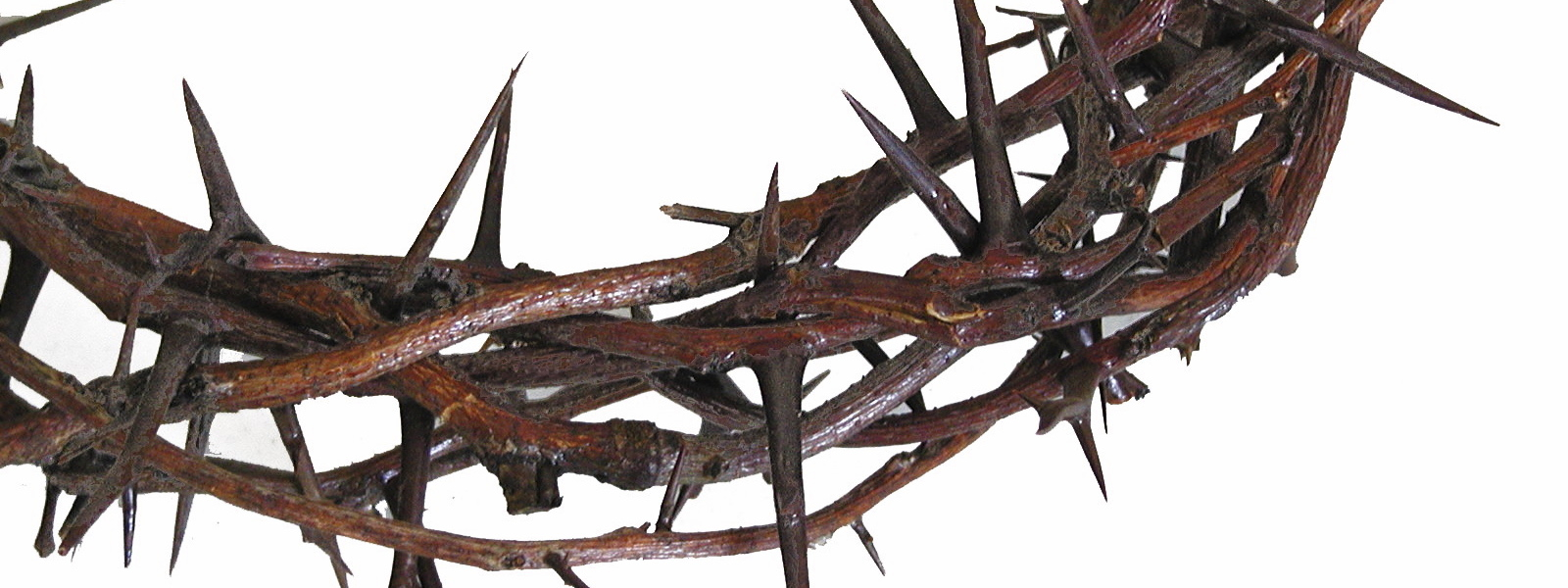
…and twisting together a crown of thorns, they put it on his head and put a reed in his right hand. And kneeling before him, they mocked him, saying, “Hail, King of the Jews!”
– Matthew 27:29

Today is Good Friday, the day on which some 2000 years ago Jesus of Nazareth was nailed to a Roman cross just outside the walls of Jerusalem.

Have you ever wondered why Jesus wore a crown of thorns?

Clearly, the Roman soldiers put it on his head to mock him.  Jesus had been hailed “King of the Jews”,  so the Romans considered him an insurrectionist.

But there is a deeper meaning.

Back in Genesis chapter 3, we read about what happened when sin entered the world. When by their rebellion and disobedience to his commands, people first told God, “we don’t trust you and we don’t want you – we know better than you what is best for us” – as sin entered into the world, it brought with it a curse: the curse of death.

This curse affected all of creation, and amongst the various effects of this curse, we read:

cursed is the ground because of you;
in pain you shall eat of it all the days of your life;
thorns and thistles it shall bring forth for you
– Genesis 3:18

Do you see the symbolism of the crown of thorns?  Thorns, the symbol of the curse of sin and death, were placed upon Jesus’ head because on the cross Jesus was taking our curse upon himself, so that we might be set free from it.

He hung on a wooden cross. Why? Because in his death, he was taking our curse – the curse of sin and death – upon himself.

Christ redeemed us from the curse of the law by becoming a curse for us—for it is written, “Cursed is everyone who hangs on a tree”
– Galatians 3:13

In the same way, the crown of thorns symbolized our curse, which Jesus took upon himself on the cross, so we could be redeemed.

Have a wonderful Good Friday, reflecting on the fact that “It is Finished!”
And don’t forget: Sunday is coming…

Maundy Thursday – The Greatest Servant

Today is Maundy Thursday, the day of Holy Week when Jesus and his disciples celebrated their last supper.

On this day, we read that they rented a room in which to eat the traditional Passover meal, full of symbolism, of which Jesus was the ultimate fulfillment.

Being that people wore open sandals and that the roads were dirt, it meant that if they had been walking around outside, people’s feet were dirty.  Not only were they dirty from dusty roads, but without modern sewage systems, a lot of waste would end up in the streets, adding to the level of grime and filth on a person’s feet after simply going about a day’s business outside. Especially, considering that dinner was eaten sitting on pads on the floor, this foot washing was important because of the close proximity people would be in to each other’s feet – smelly feet ruin appetites.

For this reason, the custom was for people who entered a house to remove their sandals and wash their feet. If you were a guest at someone’s house, usually that foot washing would be taken care of by the host, or if the host could afford it, by a servant.

However, Jesus and his disciples were using a borrowed room, so there was no host to welcome them, and no servant assigned to wash people’s feet.

Luke’s Gospel tells us that as they sat at this dinner table, eating the passover – the disciples began to argue over which of them was the greatest. Presumably, part of this discussion was also to determine which one of them was the least – which one of them should become the servant of all and wash everyone’s feet.

And then something happened which no one expected: Jesus stood up and wrapped a towel around his waist and one by one, he washed the feet of his disciples.

Peter, seeing this, protested! How could he let Jesus serve him?! He should be serving Jesus!   But Jesus told Peter: If you don’t let me serve you, you can have no part in me.

And Jesus explained to them – that if anyone would be the greatest in His Kingdomhe must become the servant of all. In His Kingdom, those who humble themselves are the greatest, and those who exalt themselves will be humbled. Jesus explained: “The kings of the Gentiles exercise lordship over them, and those in authority over them are called benefactors. But it will not be so amongst you. Rather, let the greatest among you become as the least, and the leader as one who serves.”

At another point Jesus had said: “The Son of Man came not to be served but to serve, and to give his life as a ransom for many.”

How are you doing as a servant? Pursue true greatness and be like Jesus: a servant.

What is the Scope of Salvation?

One of the things I’m intrigued by in the Bible is the meaning of salvation. I have noticed in myself and others a tendency to settle for a narrower understanding of the scope of the salvation that is promised to us in Jesus than the fullness of what is found in the scriptures.

Of course this is not to distract from or undermine the central concern for our relationship with God and our need to be put right with him (justification). But when you see the scope of salvation in the Bible, beyond saving us from damnation, it is exciting!

For example, in chapter 19 of the Gospel of Luke, Zacchaeus, having spent years ripping people off, turns to Jesus and repents of his greed and sin, and also shows signs of true repentance when he gives back the money he ripped off to the people he took it from, even though it may have happened years prior – and Jesus declares: “salvation has come to this house today” (Luke 19:9). Salvation for Zacchaeus was salvation for his soul, AND deliverance from bondage to vain things AND salvation unto a new course in life as a disciple of Jesus – which inherently means taking an active role in God’s mission to bring salvation to the world.

The very name Jesus means “Savior”!  Here are some quotes on the meaning and scope of the salvation that’s found in Jesus:

Salvation itself, the salvation Christ gives to his people, is freedom from sin in all its ugly manifestations, and liberation into a new life of service, until finally we attain ‘the glorious liberty of the children of God. (J. Stott, Christian Mission in the Modern World)


In the Old Testament the word ‘salvation’ speaks of ‘shalom’, or complete wholeness of being, in every dimension of life. (A. Motyer, The Prophecy of Isaiah)


The three tenses of salvation – past, present and future – are united into an organic whole; they may be distinguished but must not be separated. The salvation that the gospel proclaims is not limited to man’s reconciliation to God. It involves the remaking of man in all the dimensions of his existence. It has to do with the recovery of the whole man according to God’s original purpose for his creation. (R. Padilla, Mission Between the Times)


The full gospel brought by Jesus Christ is both salvation from sin and salvation into the capacity to be fully human and truly free. (D. Webster)

Exciting? I think so.